2000 AUDI ALLROAD weight
[x] Cancel search: weightPage 197 of 306

VE
HICLE OPERATION------------------------
The external conditions
in which you drive also affect your fuel con
sumption.
The following conditions increase fuel con
sumption:
• Heavy traffic, especially in large cities
with many traffic lights.
• Stop-and-go driving, especially short dis
tances so that the engine never warms up
as it should.
• Driving in heavy, slow moving traffic in
low gear so that the engine speed is rela
tively high when compared to the distance
driven.
� Plan your trips ahaad of time. Or
� ganizs your trips to include sev
sral errands and to avoid heavy traf
fi c.
Of course, there are some conditions that
will affect fuel consumption that you can't
control.
For example, fuel consumption increases in
the winter or under difficult conditions (bad
roads, towing a trailer, etc.).
19 6 The
technical requirements
for optimum fuel consumption and eco
nomy were ''built" intoyourvehicle. Special
attention was paid to the environment. To
reta in and make use of these characteris
tics, please note the following points:
riJ Use only unleaded gasoline.
Leaded gasoline causes damage to the cat
alytic converter and other components of
the emission system.
t:Gh Have your vehicle serviced by an
� Audi Dealar at the specified in
tervals -see page 228 and your
Main tenance booklet.
Having your vehicle regularly serviced by an
Audi Dealer helps ensure that it runs prop
erly and economical ly, that it does not dis
turb the environment, and that it has a long
service life. t:Gh
Check
your tire pressure once a
W month.
Low tire pressure increases fuel consump
tion and tire wear, and impair s vehicle han
dling.
�W ARNING
Underinflation and overloading of
tires can lead to tire failure. Sud
den failur e on the road could cause
a serious or fata l accident. See
page 253 for inflation informa
tion.
� Do not carry unnecessary items
in the luggage compartment.
Particularly in city traffic where you must
often accelerate, weight influences fuel
consumption.
Page 209 of 306
VEHICLE OPERA
TION-----------------------
Trailer towing
Yo ur Audi was designed primarily for pas
senger transportat ion. The additional load
will affect durability, economy and perfor
mance.
Tra iler towing not only places more stress
on the vehicle, it also calls for more con
centration from the driver.
For this reasons, always follow the opera
ting and driving instructions given and use
common sense.
208 Te
chnical requirements
Tr ailer hitch
Use a weight-carrying hitch conforming to
the gross trailer weight. The hitch must be
suitable for your vehicle and trailer and
securely bolted to appropriate place on the
vehicle's chassis. Use only a trailer hitch
with removable ball mount. Always check
with the trailer hitch manufacturer to make
sure that you are using the correct hitch.
Do not use a bumper hitch.
The hitch must be installed in such a way
that it does not interfere with the impact-ab
sorbing bumper system. No modifications
should be made to the vehicle exhaust and
brake systems. From time to time, check
that all hitch mounting bolts remain secure
ly fastened. When
you are not towing a trailer, remove
the trailer hitch ball mount. This prevents
the hitch from causing damage should your
vehicle be struck from behind.
�W ARNING
When you are no longer towing a
trailer, remove the entire trailer
hitch. When doing so, seal all bolt
holes to prevent water and deadly
exhaust fumes from entering the
vehicle.
Engine cooling system
To wing a tr ailer make the engine work hard
er. It is important that the engine cooling
system be up to the job. Make sure that the
cooling system has enough fluid.
Page 210 of 306

Tr
ailer brakes
If your trailer is equipped with a bra king sys
tem, check to be sure that it conforms to all
regulations.
The trailer brake system must not be direct
ly connected to the vehicle' s brake system.
Safety chains
Always use safety chains between your ve
hicle and trailer.
Tr ailer lights
Tra iler lights must meet all regulations. Do
not connect the trailer light system directly
to the light system of your vehicle. Be sure
to check with your Audi Dealer for correct
wiring, switches and relays. Mirrors
If you are unable to see the traffic behind
you using the regular outside mirrors, then
you must install extended mirrors. It's im
porta nt that you always have clear vision to
the rear.
Operating instructions
Maximum trailer weight
A trailer for your vehicle is limi ted to a typical
class 1 or class 2 trailer.
Never allow a passenger to ride in a
trailer.
�W ARNING
Anyone not properly restrained in
a moving vehicle is at much great
er risk in an accident.
Never let anyone ride without the
restra ints provided by Audi. VEHICL
E OPER ATION
Lights
The headlight settings should be checked
with the trailer attached before driving off.
Adjust as necessary so that you can see the
road ahead but not blind on-coming traffic.
Check proper working of vehicle and trailer
lights.
Safety chains
Be sure trailer safety chains are properly
conn ected from the trailer to the hitch on
the vehicle. Leave enough slack in the
chains to permit turning corners. When you
install safety chains, make sure they will not
drag on the road when you are driving.
The chains should cross under the trailer
tongue to prevent it from dropping in case
of separation from the hitch.
209
Page 212 of 306
-----------------------VEHICL E OPER ATION
Tr ailer towing tips
Yo ur vehicle handles differently when tow
ing a trailer because of the additional weight
and weight distribution. Safety, perfor
mance and economy will greatly depend on
how carefully you load your trailer and oper
ate your rig.
Before you actually tow your trailer, practice
turning, stopping and backing up in an area
away from traffic until you learn the feel of
your vehicle and trailer unit.
Backing up is difficult and requir es practice.
Steering while backing up is generally oppo
site of that when backing your vehicle with
out a trailer.
Maintain a greater distance between your
vehicle and the one in front of you. You will
need more room to stop.
To compensate for the trailer, you will need
a larger than normal turning radius. When
passing, remember that you cannot
accelerate as fast as you normally would be
cause of the added load. Make sure you
have enough room to pass. After passing,
allow plenty of room for your trailer before
changing lanes again.
Avoid jerky starts, sharp turns or rapid lane
changes.
After parking, always block the wheels of
both vehicle and trailer. Do not park with a
trailer on a slope. If it cannot be avoided, do
so only after doing the following:
• Apply foot brake.
• Have someone place chocks under both
vehicle and trailer wheels.
• With chocks in place, slowly release
brakes until wheel blocks absorb the load.
• Turn wheels to curb.
o Apply parking brake.
• Place automatic transmission in "P". If
you move the selector lever of the auto
matic transmission to "P" before applying
the parking brake and before blocking the
wheels, you may require more force later to
move the lever out of the "P" position.
When restarting after parking on a slope, re
verse the procedure:
• Start the engine.
• Shift transmission into gear.
o Release the parking brake and slowly
move away from the wheel blocks.
• Stop and have someone retrieve the
wheel blocks.
Notes
• Do not tow a trailer during the
break-in period of your vehicle.
• If you tow a trailer, your Audi may require
more frequent maintenance due to the ex
tra load -see also page 228.
211
Page 284 of 306
Lifting
vehicle
Lifting with workshop hoist
and with floor jack
Notes
• The vehicle should never be lifted
or jacked up from underneath the
engine oil pan, the transmission
housing, the front or rear axle or the
body side members. This could lead
to serious damage.
The same lifting points as illus trated on the
next page for the hoist also apply when a
floor jack is used.
e To avoid damage to the under
body or chassis frame, it is neces
sary to insert a rubber pad between
the floor jack and the lift points.
• To prevent damaging the shock
absorbers when lifting the vehicle
with a jack or on a hoist, the level
selection must be in the jack mode.
See next page. �W
ARNING
• To reduce the risk of serious in
jury and vehicle damage, lift the
vehicle only at the special work
shop hoist and floor jack lift points
illus trated. Failure to lift the ve
hicle at these points could cause
the vehicle to tilt or fall from a lift
if there is a change in vehicle
weight distribution and balance.
This might happen, for example,
when heavy components such as
the engine block or transmission
are removed.
• When removing such heavy
components, anchor vehicle to
hoist or add correspo nding
weights to maintain the center of
gravity. Otherwise, the vehicle
might tilt or slip oH the hoist,
causing serious damage or person
al injur y. DO-IT-YOU
RSELF SERVICE
�� WARNING continued
• If you must lift your vehicle with
a floor jack to work underneath,
be sure the vehicle is safely sup
ported on stands intended for this
purpose.
• Before driving over a workshop
hoist, check that the vehicle weight
does not exceed the permissible lift
ing capacity of the hoist.
• Before driving over a workshop
hoist, ensure that there is suHicient
clearance between the hoist and
low parts of the vehicle.
283
Page 290 of 306

Weights
The Gross Vehicle Weight Rating (GVWR),
and the Gross Axle Weight Rating (GAWR)
for front and rear are listed on a sticker on
the left door jamb.
The Gross Vehicle Weight Rating in
cludes the weight of the basic vehicle plus
full fuel tank, oil and coolant, plus maximum
load, which combines passenger weight
(150 lbs/68 kg per designated seating posi
tion) and luggage weight.
Luggage weight is not increased by the use
of a roof rack, unless the passenger capac
ity is reduced accordingly.
The Gross Axle Weight Rating is the
maximum load that can be applied at each
axle of the vehicle. �W
ARNIN G
• The actual Gross Axle Weight
Rating at the front and rear axles
should not exceed the permissible
weights, and their combination
must nbt exceed the Gross Vehicle
Weight Rating.
• Exceeding permissible weight
ratings can result in vehicle dam
age, accidents and personal injury.
The vehicle capacity weight (max.
load) is listed inside the fuel filler flap. TECHNICAL
DATA
Notes
• The vehicle capacity weight fig
ures apply when the load is distrib
uted evenly in the vehicle (passengers
and luggage). When transporting a
heavy load in the luggage compart·
ment, carry the load as near to the
rear axle as possible so that the ve
hicle's handling is not impaired.
• Do not exceed the maximum per
missible axle loads or the maximum
Gross Vehicle Weight.
Always remember that the vehicle's
handling will be affected by the ex
tra load. Therefore, adjust your
speed accordingly.
• Always observe local regulations.
289
Page 291 of 306
TECHNICA L
DAT A-------------------------
Roof weight
The maximum permissible roof weight is
200 lbs (1 00 kg).
Only use the roof rack system specifically
designed, tested and approved by Audi.
Distribute the load evenly and do not ex
ceed the Permissible Roof Weight (in
cluding the weight of the roof rack system)
or the Gross Vehicle Weight.
For more details see page 191.
290 Ve
hicle identification
The Vehicle Identification
Number (YIN)
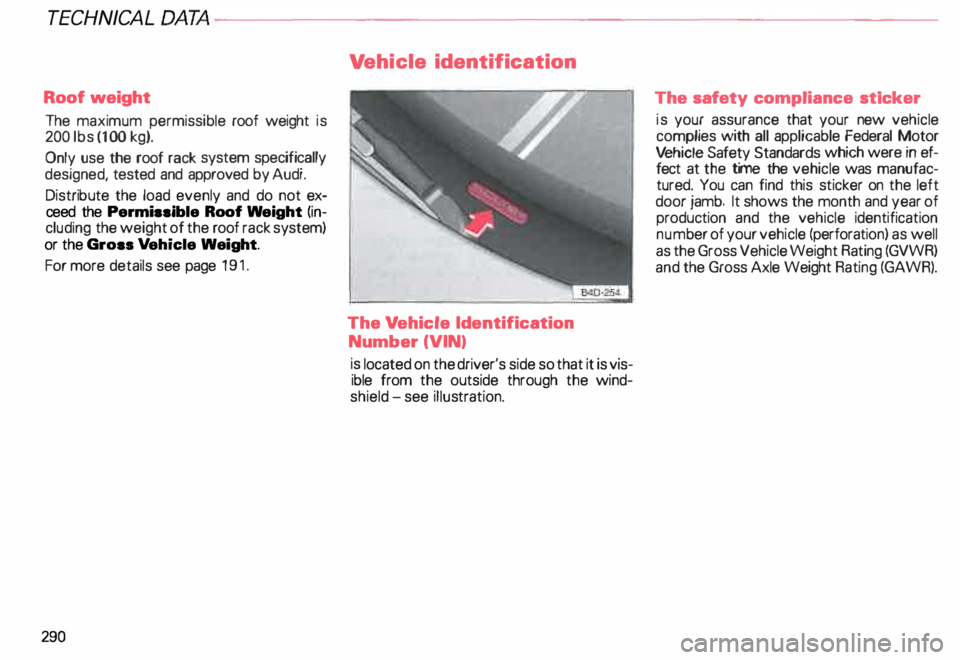
is located on the driver's side so that it is vis
ible from the outside through the wind
shield -see illustration. The
safety compliance sticker
is your assurance that your new vehicle
complies with all applicable Federal Motor
Ve hicle Safety Standards which were in ef
fect at the time the vehicle was manufac
tured. You can find this sticker on the left
door jamb. It shows the month and year of
production and the vehicle identification
numb er of your vehicle (perforat ion) as well
as the Gross Vehicle Weight Rating (GVWR)
and the Gross Axle Weight Rating (GAWR).
Page 298 of 306

c
Capacities ...• ••.•. .......• o o 287
Care of
-e xterior . 212
-i nterior . . 217
Cargo net . .
89
earphone . . •
• . . • • 190
Catalytic converter •
. . . • • o 197
CB radios . . . . . . . . . . . . . . . . • . . . 189
CD changer . . . . . . . . . . . . . . . . . . . 184
Central locking system .. ... . 0 • • 59
- Rear lid . . . . . . . . . . . . • . . . • . • . 63
Changing a wheel . . . . . . . .. o • • 267
Changing engine oil . . . . . . . . • 236
Checking engine oil level . . . . . . . 235
Child restra int anc horages . . . . . . . 53
Child safety ... ........... .. ... 44
Child safety lock for rear doors . . . 62
Child seat bench . . . . 92
Child seats
- Booster seats . . . . . . • • • • • . . 48
-C onvertible seats .. • .. o •• 47
- Infant seats . . . . .
. .. ... .. . 45
-O lder children . . . • . . . . . . . . 49 Chime
...
Ciga rette lighter
Cleaning 57,
113, 14 9
18 1
- Engine compartment ..... . 219
217
-
Glass ............. ... .. . .
- Inside of vehicle . . . . 217
- Leather upholstery . . . . . . . 217
-O utside of vehicle .... . • .. 212
- Safety belts . . . . . . . . . . . . . . . 218
-W indows· . . . . . . . . . . . • . . . . 215
Cleaning and protection . . . . . . . . 212
Clima te controls . . . . . . . . .... o • 16 2
Clock .. .. . .. .. . .. .. .. .. .. .
117
Coat hooks . . . . . . . . . . . . . . • . •
179
Com partment for Service
Literature Wallet ......... .... 18 3 .,)
Convenient entry function . . . . . . 1 01
Convertible locking retractor .... . 51
Convertible seats......... . ... 47
Coolant temperature gauge . . . . . 118
Cooling system . . . . . . . .
238
- Expansion tank 0 • • • • • • • • • 239
Cruise control . . . . 15
8
Cup holder . . . . . . . . . • . • . . • . . 182
Curb weight . . . . . . . . _. . . . ... 289 ALP
HABETICAL INDEX
D
Dashboard ...... •••• .••.• .... 8
Data . . . . . . . o • • • • • • • • • • • • • 286
Date display . . . . . .
• .. 0 • 117
Daytime running lights .
148
Deflated full size spare tire ..... 266
Defrosting windows . . . . . . . • . . . 151
Difficult operating conditions . . . . 262
Digital clock . . . . . . . . . . . . . . . . . 117
Dimensions . . . . . . . . . . . . . . . . . . 288
Doors ....................... 0. 59
Driver information system . . . . . . 130
-C alling up the menu ....... . 131
- Display types . . . . . . . . . • . • 133
- Entering settings . . . . • . • . . . 134
- Menu display . . . . . . . • • • . . . 131
- Navigation display ..... _ . . . . 130
Driving economically . . . . 19
5
Dri ving in foreign countries . . . . . 292
Driving on slopes . . . . . . . . . . . . . 200
Driving under difficult conditions
262
Driving with Four-Wheel Drive . . 207
Dupl icate key ....... .... ....... 57
297