2000 AUDI ALLROAD weight
[x] Cancel search: weightPage 49 of 306
SA
FETY FIRST--
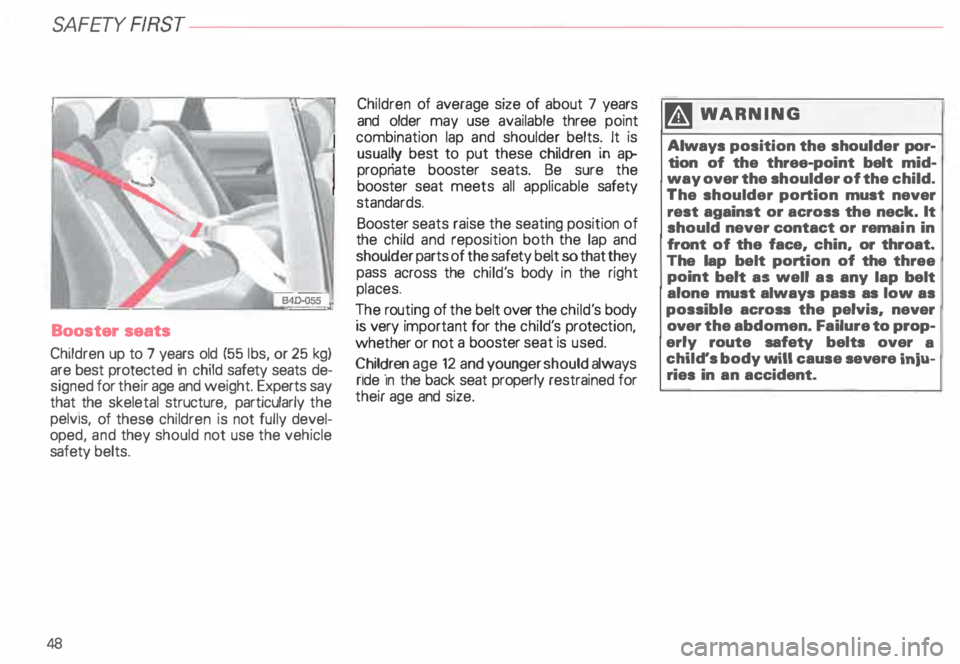
Booster seats
Children up to 7 years old (55 1bs, or 25 kg)
are best protect ed in child safety seats de
signed for their age and weight. Experts say
that the skeletal structure, particularly the
pelvis, of these children is not fully devel
oped, and they should not use the vehicle
safety belts.
48 Children
of average size of about 7 years
and older may use available three point
combination lap and shoulder belts. It is
usual �y best to put these children in ap
propnate booster seats. Be sure the
booster seat meets all applicable safety
standards.
Booster seats raise the seating position of
the child and reposition both the lap and
shoulder parts of the safety belt so that they
pass across the child' s body in the right
places.
} he rou.ting of the belt over the child' s body
IS very Important for the child' s protec tion,
whether or not a booster seat is used.
Chil �ren age 12 and younger should always
nde 1n the back seat properly restrained for
their age and size. �W
ARNING
� lways position the shoulder por
tion of the three-point belt mid
way over the shoulder of the child.
The shoulder portion must never
rest against or across the neck. It
should never contact or rema in in
front of the face, chin, or throat.
The lap belt portion of the three
point belt as well as any lap belt
alone must always pass as low as
possible across the pelvis, never
over the abdomen. Failure to prop
erly route safety belts over a
chil d's body will cause severe iniu
ries in an accident.
Page 51 of 306
SAFETYRRST-----------------------------------------------------
�W ARNING
Failure to properly route safety
balta over a childs body will cause
severe injuries in an accident.
The lap belt portion of the three
point belt as wall as any lap belt
alone must always pass as low as
possible across the pelvis, never
over the stomach or abdomen.
Yo unger children should use a lap belt only
in very exceptio nal situations and only if no
child restraint system for the child' s size and
weight or safer alternative means of trans
portation of the child is available. In these
excep tional situations, the use of a lap belt
is better than permitting the child to remain
totally unrestrained. But remember: a lap
belt cannot provide the same level of
protect ion as a proper child restra int.
50 �W
ARNING
• An improperly worn safety belt
will not provide the best protec
tion in an accident and may causa
serious personal injury. Always
make sure that children and other
vehicle occupants properly wear
available restraint systems. Care
fully follow the Instructions pro
vided by the manufacturers of
child restra ints.
• Commercially available child
seats are required to comply with
U. S. Federal Motor Vehicle Safety
Standard (FMVSS) 213 (in Canada
CMVSS 213).
• These standards include instal
lation requirements for using the
lap portion of a combination lap
shoulder belt such as those
installed in your vehicle. fA,
WARNING continued
• When buying a child restraint,
select one that fits your child and
vehicle.
• Only use child restraint systems
that fully contact the flat portion
of the seat cushion. The child seat
must not tip or lean to either side.
Audi does not recommend using
child seats that rest on legs or
tube-like frames. They do not pro
vida adequate contact with the
seat.
• Improperly or inadequately
installed child restraint systems
can increase the risk of injury to
children in accidents. Therefore,
always carefully read and follow
all instructions on installation and
use that come with the system.
Page 56 of 306
�W
ARNING
• To prevent serious injuries, chil
dren must always be secured in a
vehicle by a child restraint system
appropriate for their age and size.
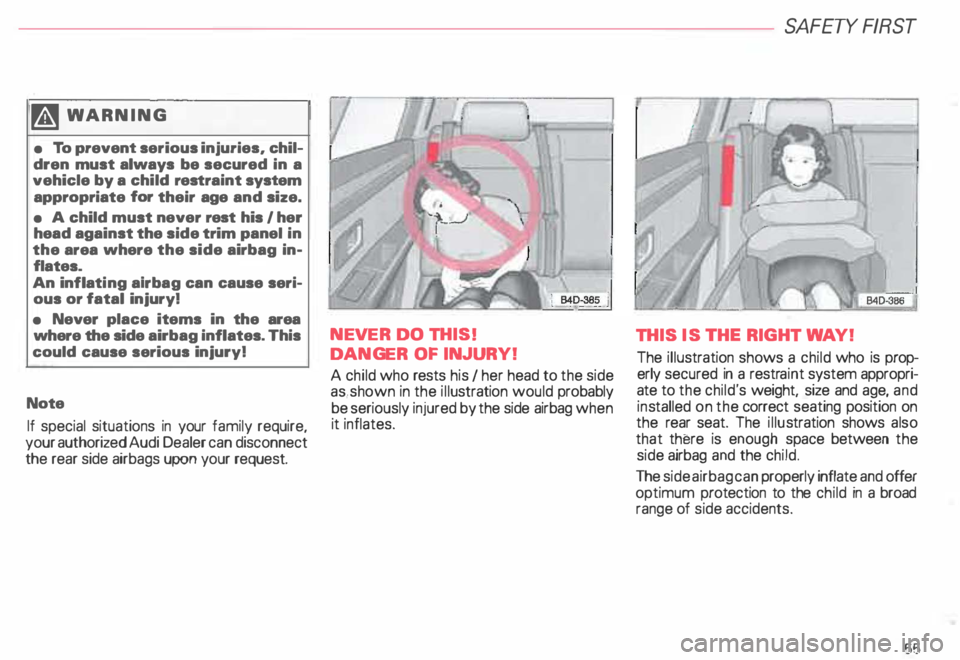
• A child must never rest his I her
head against the side trim panel in
the area where the side airbag in
flates.
An inflati ng alrbag can cause seri
ous or fatal injury!
• Never place items in the area
where the side airbag inflates. This
could cause serious injury!
Note If special situations in your family require,
your authorized Audi Dealer can disconnect
the rear side airbags upon your request. NEVER
DO THIS I
DANGER OF INJ URY !
A child who rests his I her head to the side
as, shown in the illustration would probably
be seriously injured by the side airbag when
it inflates. SA
FETY FIRST
THIS IS THE RIGHT WAY !
The illustration shows a child who is prop
erly secured in a restr aint system appropri
ate to the child' s weight, size and age, and
ins talled on the correct seating position on
the rear seat. The illustration shows also
that there is enough space between the
side airbag and the child.
The side airbag can properly inflate and offer
optimum protection to the child in a broad
range of side accidents.
55
Page 89 of 306
CONTROLS
AND EQUIPMENT---------------------
Luggage
compartment
Increasing size of the luggage
compartment
Yo u can fold the backrest forward to in
crease the size of the luggage compart
ment.
Tr ansporting heavy objects
Tra nsporting heavy objects can change the
way your vehicle behaves. For best han
dling under these conditions, distribute
loads evenly.
Always place heavy cargo as far forward as
possible in the luggage compartment.
When transporting heavy objects, drive
slowly and avoid sudden maneuvers.
�W ARNING
• Never exceed the Gross Axle
Weight Rating or the Gross Vehicle
Weight Rat�ng specified on the
safety compliance sticker on the
left door jamb. Exceed ing permis
sible weight ratings can change
the way the vehicle handles and
could result in accidents, personal
injur y, and vehicle damage.
88 M
WARNING continued
• Do not allow passengers to
occupy the rear load surface while
the vehicle Is in motion. Vehicle
occupants must always be prop
erly restrained.
• Loose items inside the passen
ger compartment, can fly forward
in an accident or sudden maneuver
and injure occupants. Always
store articles in the luggage
compartment and use the fasten
ing eyes, especially when the rear
seat backs have been folded down.
In particular, when traveling on
rough roads or rugged terrain, ma
ke cert ain that all luggage and
other items are stowed in the lug
gage compartment and that they
are secured in such a way that they
cannot shift. M
WARNING continued
• To help prevent poisonous ex
haust gas from being drawn into
the vehicle, always keep the rear
lid closed while driving. Never
transport objects larger than
those fitting completely into the
luggage area, because the rear lid
cannot be fully closed.
• If you must drive with the rear
lid open under exceptional circum
stances always take the following
precautions to help reduce the risk
of deadly carbon monoxide (CO)
from the exhaust system from be
ing drawn into the passengers
compartment:
open all of the windows
turn off the air recirculation
switch
- select maximum fan speed.
Page 108 of 306
In selector
lever positions "P" (Park) a no
"N" (Neutral), the instruction "WHEN
STA TIONARY APPLY FOOTBRAKE WHILE
SELECTING GEAR" appears in the instru
ment cluster as a reminder for the driver.
Also, the symbol in the shift console will
light up.
A time delay element prevents the selector
lever from locking when it is moved through
the "N"' (Neutral) position (for example,
going from "R" to "D"). The locking ele
ment only locks the selector lever if it is left
in the "N" (Neutral) position for more than
about one second without the brake pedal
being depressed.
In the N (Neutral) position, the selector le
ver will not lock when the vehicle is driving
faster than 3 mph (5 km/h). Display
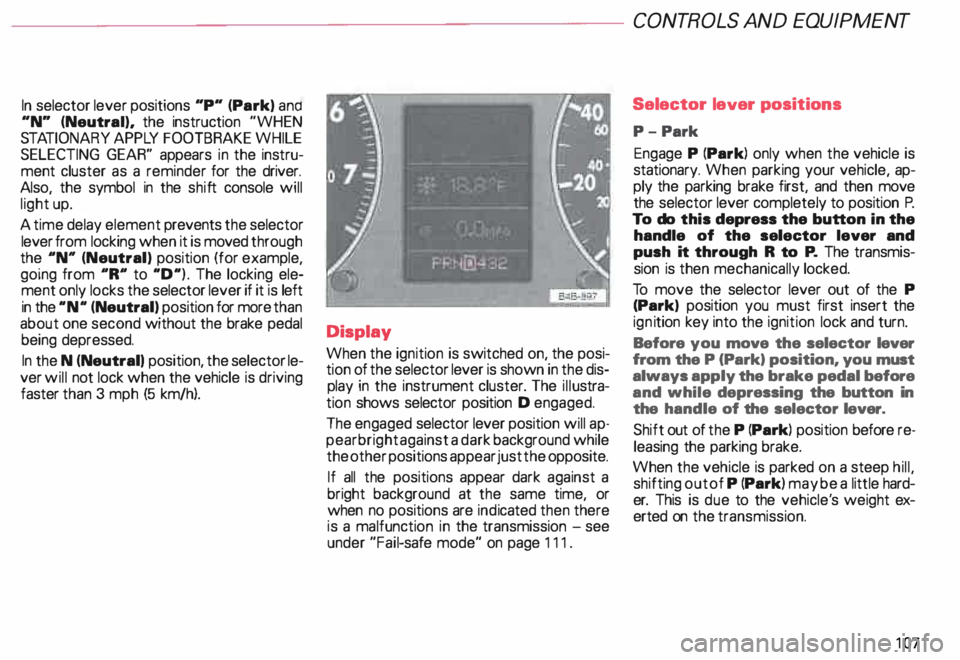
When the ignition is switched on, the posi
tion of the selector lever is shown in the dis
play in the instrument cluster. The illustra
tion shows selector position D engaged.
The engaged selector lever position will ap
pear bright against a dark background while
the other positions appear just the opposite.
If all the positions appear dark against a
bright background at the same time, or
when no positions are indicated then there
is a malfunction in the transmission -see
under "Fail-safe mode" on page 111. CONT
ROLS AND EQUIPMENT
Selector lever positions
P- Park
Engage P (Park) only when the vehicle is
stationary. When parking your vehicle, ap
ply the parking brake first, and then move
the selector lever completely to position P.
To do this depress the button in the
handle of the selector lever and
push it through R to P. The transmis
sion is then mechanically locked.
To move the selector lever out of the P
(Park) position you must first insert the
ign ition key into the ignition lock and turn.
Before you move the selector lever
from the P (Park) position, you must
always apply the brake pedal before
and while depressing the button in
the handle of the selector lever.
Shift out of the P (Park) position before re
leasing the parking brake.
When the vehicle is parked on a steep hill,
shifting out of P (Park) may be a little hard
er. This is due to the vehicle' s weight ex
erted on the transmission.
107
Page 151 of 306

CONTROLS AND
EQUIPMENT--------------------
1 and 4-Electrically heated ... 8
seats• utJ
The heating elements in both seats can be
turned on and regulated separately with the
two thumb wheel switches.
With the ignition on, the seat cushion and
backrest of the front seats can be heated
electrically.
15 0 1
- Use this thumb wheel switch to activate
and regulate the heating elements in the
driver's seat.
4- Use this thumbwheel switch to activate
and regulate the heating elements in the
front passenger's seat.
From position 0, roll thumbwheel upward to
activate the heating elements.
Select the desired temperature setting be
tween positions 1-6. When the heating ele
ments are activated, the numbers on the
thumb wheel will light up.
The steering wheel heating* is
swit ched on automatically when the seat
heating is switched on. The temperature.
however, remains at a constant preset level
and cannot be regulated with the thumb
wheel (1).
Note
To prevent possible damage to the heating
elements, do not kneel on the seats or in
any other way apply a heavy load to relative
ly small areas of the seat. The
heating elements* for the left and right
seating positions of the rear seat bench are
switched on and off and regulated by the
thumbwheel in the center console:
a - left
b- right
The rear seat heating* only operates when
a sensor registers the weight of the occu
pant on the seat.
Select the desired temperature setting be
tween positions 1-6. When the heating ele
ments are activated, the numb ers on the
thumbwheel will light up.
Page 180 of 306
Coat hooks
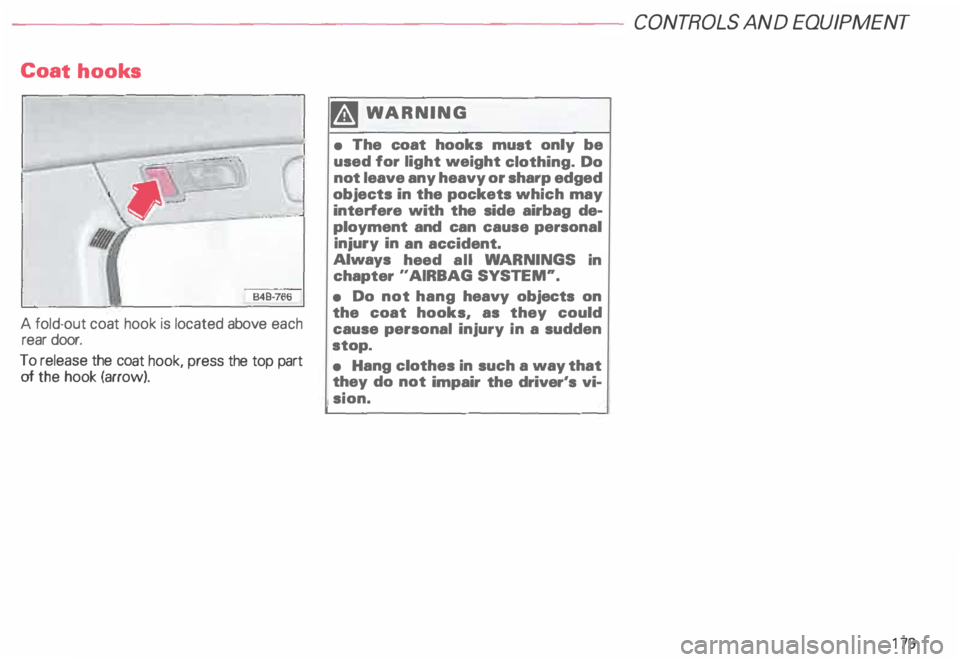
A fold-out coat hook is located above each
rear door.
To release the coat hook, press the top part
of the hook (arrow). �W
ARNING
• The coat hooks muet only be
used for light weight clothing. Do
not leave any heavy or sharp edged
objects in the pockets which may
interfere with the side airbag de
ployment and can cause personal
injury in an accident.
Always heed all WARNINGS in
chapter ., AIRBAG SYSTEM".
• Do not hang heavy objects on
the coat hooks, as they could cause personal injury in a sudden
stop.
• Hang clothes in such a way that
they do not impair the driver's vi
sion. CONTROLS
AND EQUIPMENT
179
Page 193 of 306
CONT
ROLS AND
EQUIPMENT---------------------
Loading a roof rack
Always distribute the loads evenly.
The total maximum permissible load
carrying capacity of 200 lbs ( 1 00 kg)
for the roof rack installation (includ
ing weight the roof rack system)
must not be exceeded -see
page 290 for details.
19 2 �
WARNING
• Improper use of a roof rack can
cause accidents and personal inju
ries.
• The use of a roof rack can nega
tively affect the way a vehicle han
dles.
• Cargo that is large. heavy,
bulk y, long or flat will have a
greater negative influence on the
vehicle's aerodynamics. center of
gravity and over all handling.
• Never exceed the maximum per
missible load carrying capacity of
the roof of your vehicle.
• Always drive slowly, avoid sud
den braking and maneuvers when
transp orting cargo on the roof of
your vehicle. When to
remove the roof rack
If you have installed a roof rack on your ve
hicle, it is best to ask the car wash operator
if it should be removed before going
through an automatic car wash.
When not in use, remove the roof rack to re
duce wind noise, improve handling, fuel
consump tion and guard against theft.