2000 AUDI ALLROAD oil
[x] Cancel search: oilPage 218 of 306
Care
of interior
Glass Use the same cleaning agents as for exteri
or glass surfaces and polish dry.
Fabric Use a vacuum cleaner or a soft bristle brush
to remove dust and loose dirt from carpet
ing, upholste ry, headliner and other trim.
Dirt stains can usually be removed with a
lukewarm soapy water or all-purpose clean
er solution, or a dry foam cleaner.
For greasy, oily and other stubborn stains,
use a spot remover. Do not pour the liquid
on the fabric. Dampen a clean cloth and rub
carefully, starting at the edge and working
inward. Plastic
and vinyl
Use a clean, damp cloth or sponge to re
move dust. For other soil, use a lukewarm
all-purpose cleaning solution or a mild
saddle soap for vinyl trim. Remove water
spots and soap traces with a clean, damp
cloth or sponge. Use a clean, soft cloth to
rub dry.
Grease, tar or oil stains can be removed
with a clean cloth or sponge soaked with all
purpose cleaner or with a solvent type vinyl
cleaning agent.
Occasionally apply a colorless vinyl or leath
er preservative to reta in the material's luster
and pliabi lity.
Aluminum trim
Use only neutral-pH products to remove
spots and deposits from aluminum sur
faces. Chrome care products and alkaline
cleaners will atta ck aluminum surfaces and
can damage them over time. VEH
ICLE CA RE
Cleaning and care of leather
uphols tery
Audi does everything possible to preserve
the special qualities of natural leather uphol
stery. When treating the hides, care is taken
to avoid all processes which could impair
the natural advantages of the material
which make for extra comfort.
Because of the exclusive nature of the
hides selected and the natural properties of
the leather, this kind of upholstery requires
a cert ain amount of care in everyday use
since the leather is sensitive to mater ials
such as oil, grease and dirt or wet clothing.
If it is given regular attention, the leather up
holstery will retain its high quality for many
years.
217
Page 221 of 306

VEHICL E
CA RE-------------------------
If the engine compartment is cleaned at any
time with grease removing solutions 1 ), or if
you have the engine washed, the antK:orr
as well. It is therefore essential to ask: for a
long-lasting corrosion protection of all sur
faces, seams, joints and components in the
engine compartment.
c£> If you must rinse off gasoline, oil
residue or grease while you are
washing your engine, then tha dirty
water should be run through an oil
separator filter. We recommend that
you have your engine washed at a
qualified workshop or service sta
ti on.
11 Use only
the correct cleaning solutions.
Never use gasoline or Diesel.
220 Chassis
The lower body shell of your Audi is also
thoroughly protected against corrosion.
Any damage to the undercoat ing caused by
road hazards should be repaired promptly.
g WARNING
Do not apply additional undercoat
ing or rustproofing on or near the
exhaust manifold, exhaust pipes.
catalytic converter or heat shields.
During driving, the substance
used for undercoating could over
heat and cause a fire. Body
cavity sealing
All body cavities which could be affected by
corro sion have been given thorough protec
tion at the factory.
This sealing does not require any inspection
or additional treatments. If any wax should
seep out of the cavity when the ambient
temperature is high, it can be removed with
a plastic scraper and a suitable solvent.
c£> If you use benzine for removing
the wax, keep sparks, flame and
ligh ted cigara ttas away. Nsver
dump benzine on the ground, into
open streams or down sewage
dr ains.
Be sure to observe all safety and en
vi ronmental regulations.
Page 222 of 306
General
notes
• We recommend that you have the engine
compartment and the underside of your ve
hicle inspected twice a year for any damage
to the protective coating, preferably before
and after the winter season. Have neces
sary repairs done as soon as possible.
• Also, whenever the lower body sh�ll.
axle, transmission or engine assemblies
have been repaired, any anti-corrosion coat
ing lost on the affected surfaces should be
reapplied.
• Oil-based protective sprays must not be
applied. Only tar-or wax -based anti-corro
sion protectors are compatible with the fac
tory applied corrosion pro tection. Bef_ore ap
plication, road dirt, salt spray deposits and
oily substances must be removed. Yo
ur authorized Audi Dealer stocks the
cleaning and preservation solutions recom
mended by the factory for this purpose and
has the equipment necessary to apply
them. Therefore, any additional corrosion
protection work should be perform .ed by an
Audi Dealer. Using incorrect cleamng solu
tions could damage rubber parts or painted
surfaces.
� WARNING
Use only the correct cleaning solu
tions. Never use gasoline, Diesel
fuel or solvents which could cause
a fire. VE
HICLE CARE
221
Page 229 of 306

VEHICLE
CARE---------------------------------------------------
Maintenance
Yo ur vehicle has been designed to help
keep maintenance requirements to a mini
mum.
However. a certa in amount of regular main
tenance is still necessary to assure your ve
hic le's safety, economy and reliabili ty.
c£> By regularly maintaining your
vehicle, you help make sure that
emission standards are maintai ned,
thus minimizing adverse effects on
the envir onment.
For detailed vehicle maintenance consult
your Maintenance booklet.
Under difficult operating condi
tions, for example at extremely low out
side temperatures, in very dusty regions,
when towing a trailer very frequently, etc.,
some service work should be performed
between the intervals specified.
This applies particularly to:
• oil changes, and
• cleaning or replacing the air filter.
228 Important
considerations for
you and your vehicle:
The increasing use of electr onics, sophisti
cated fuel injection and emission control
systems, and the generally increasing tech
nical complexity of today's automobiles,
have steadily reduced the scope of mainte
nance and repairs which can be carried out
by vehicle owners. Also, safety and en
vironmental concerns place very strict
limi ts on the nature of repairs and adjust
ments to engine and transmission parts
which an owner can perform . Main
tenance, adjustments and repairs usu
ally require special tools, testing devices
and other equipment available to specially
trained workshop personnel in order to as
sure proper performance, reliability and
safety of the vehicle and its many systems.
Impr oper maintenan ce, adjustments and
repairs can impair the operation and reliabil
ity of your vehicle and even void your ve
hicle warranty. Therefore, proof of servicing
in accordance with the maintenance
schedule may be a condition for upholding
a possible warranty claim made within the
warranty period.
Above all, operational safety can be ad
versely affected, creating unnecessary
risks for you and your passengers.
Page 231 of 306
VEHI
CLE CARE
J'4 WARN ING continued
• If you must work underneath
the vehicle with the wheels on the
ground, always make sure the ve
hicle is on level ground. that the
wheels are always securely
blocked and that the engine can
not be started. Always remove the
ignition key before anyone gets
under the vehicle.
Always make sure the transmis
sion selector lever (automatic
transmission) is in "P" (Park posi
tion) and the hand brake is firmly
applied.
• Always be extremely careful
when working on the vehicle. Always follow commonly accepted safety practices and general com
mon sense. Never risk personal in
jury.
230 �
Changing the engine settings
will adversely aHect emission
levels. This Is detrimental to the en
vi ronment and increases fuel con
sumption.
Always observe environmental reg
ulations when disposing of old en
gine oil. used brake fluid, dirty en
gine coolant, spent batteries or
worn out tires.
Page 234 of 306
When
adding fluids, always make
sure that they are poured into the
proper container or filler opening,
otherwise serious damage to ve
hicle systems will occur. r:Gb To detect leaks in time, inspect
� the vehicle floor pen from under
neath regular ly. If you see spots
from oil or other vehicle fluids, have
your vehicle inspected by an autho
ri zed Audi Dealer .
D Always heed all WA RNINGS
� on page 232.
Always exercise extreme caution
when working under the engine
hood. -
VE HICLE CARE
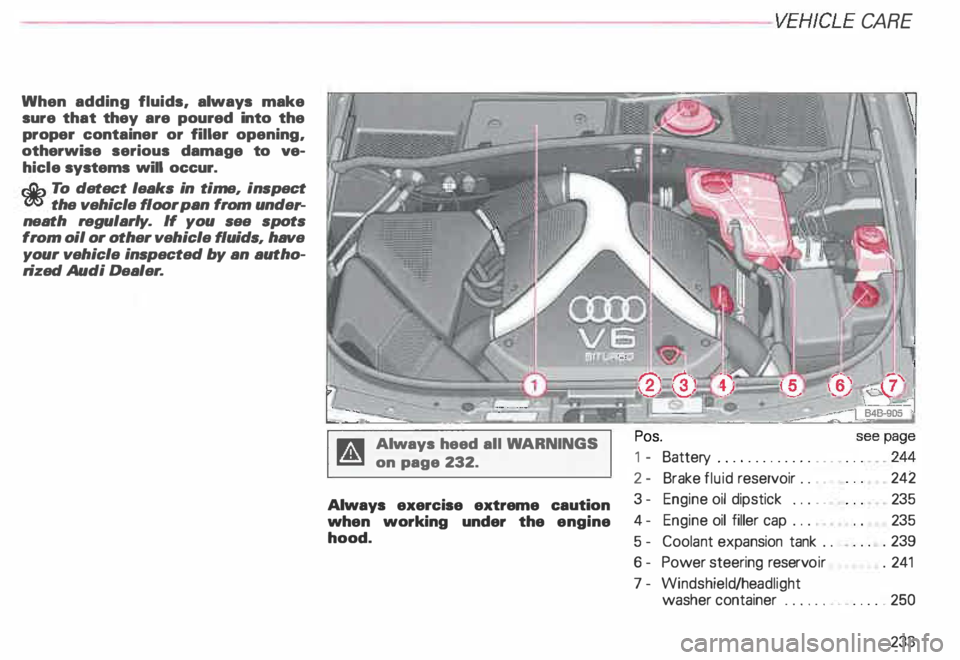
Pos.
1 - Battery ............. . _ .. .. .
2- Brake fluid reservoir . . . 242
3 - Engine oil dipstick ... . _ 235
4- Engine oil filler cap . . . 235
5- Coolant expansion tank . . . 239
6 - Power steering reservoir .
241
7 - Windshield /headlight
washer container ......•• _ .... . 250
233
Page 235 of 306
VE
HICLE CARE---------------------------------------------------
Engine oil
Specification and viscosity
Yo ur engine was factory filled with an all
season high quality engine oil. If you need to
add oil between oil changes, use any high
quality petroleum- or synthetic-based oil
with correct specifications.
The following terms must appear on the oil
conta iner singly or in combination with oth
er designations:
- API Service SJ
- ACEA A2 or ACEA A3
Engine oils are graded according to their vis
cosity. The proper grade to be used in your
engine depends on existing climatic or sea
sonal conditions.
The engine oil which was first put into your
engine has a viscosity grade of SAE OW--30.
You can use this oil over all temperature
ranges for normal driving. If engine oil vis
costy grade SAE OW--30 is not available, you
can also use SAE 5W-30 or SAE 5W-40.
See your authorized Audi Dealer tor more in
formation regarding oil for your vehicle.
234 I
B31-113C I
Engine oil identification symbol
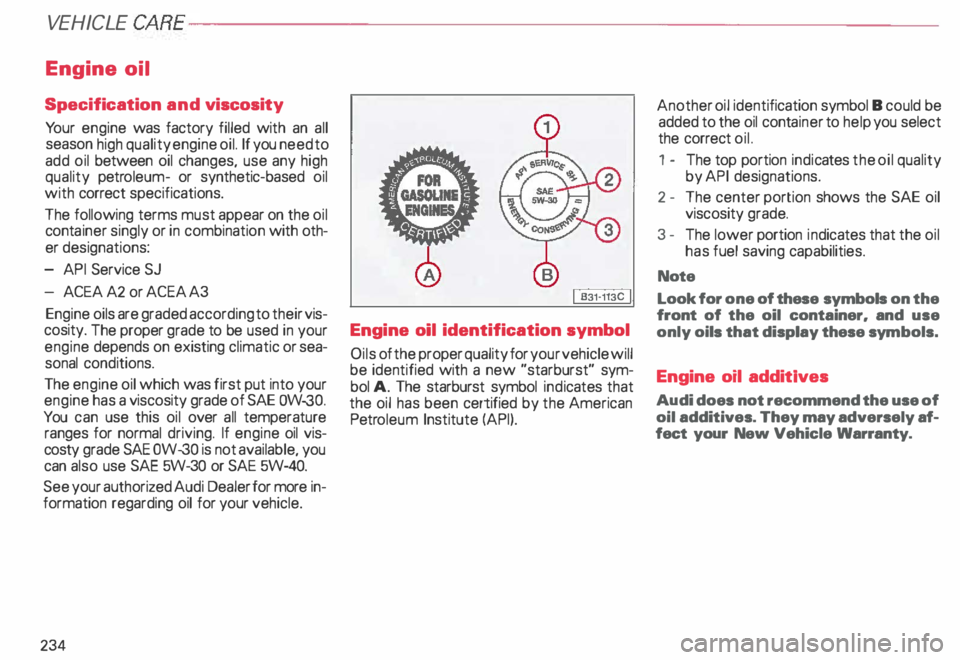
Oils of the proper qualityforyour vehicle will
be identified with a new "starburst" sym
bol A. The starburst symbol indicates that
the oil has been certified by the American
Petr oleum Institute (API). Another
oil identi fication symbol B could be
added to the oil container to help you select
the correct oil.
1 - The top portion indicates the oil quality
by API designations.
2 - The center portion shows the SAE oil
viscosity grade.
3- The lower portion indicates that the oil
has fuel saving capabilities.
Note
Look for one of these symbols on the
front of the oil container. and use
only oils that display these symbols.
Engine oil additives
Audi does not recommend the use of
oil additives. They may adversely af
fect your New Vehicle Warranty.
Page 236 of 306
Engine
oil consumption
The rate of the oil consumption depends on
the quality and viscosity of oil, the speed at
which the engine is operated, the climate,
and road conditions as well as amount of
dilution and oxidation of the lubricant.
Because of these variables, no standard
rate of oil consumption can be established,
but drivers should expect higher oil con
sumption at high speeds and when the en
gine is new.
Therefore, we recommend that you check
the oil level at regular intervals (for example,
each time you are refuelling, or before going
on a long trip).
If the oil level should go below the minimal
level, the check engine oil level warn
ing light* in the instrument cluster will
come on. See page 144. You should check
the oil level using the oil dip stick as soon as
possible, and then top off the oil as neces
sary. Notes
• The engine in your vehicle de
pends on oil to lubricate and cool all
of its moving parts. Therefore the
engine oil should be checked regu
larly and kept at the required level.
• Lack of sufficient engine oil may
lead to severe engine damage.
• The oil pressure warning light is
not an oil level indicator.
A Always
heed all WAR NINGS
� on page 232.
Checking the engine oil level
The best time to check the engine oil level
is when the oil is warm.
To get a true reading, the vehicle must be on
level ground.
A Always heed all WAR NINGS
� on page 232.
• After turning off the engine, wait a few
minu tes for the oil to return to the oil pan. VE
HICLE CARE
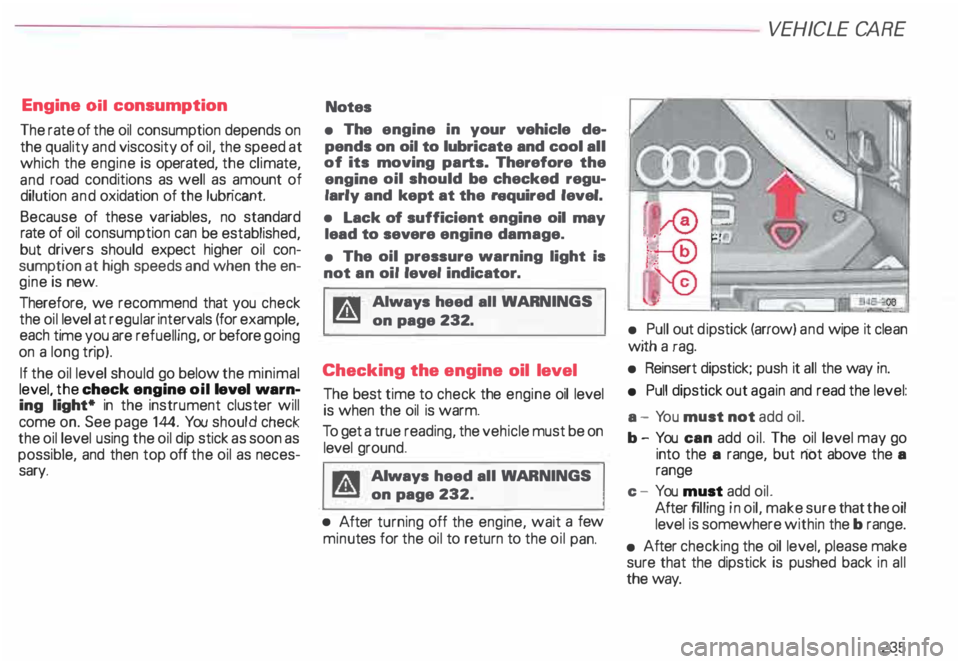
• Pull out dipstick (arrow) and wipe it clean
with a rag.
• Reinsert dipstick; push it all the way in.
• Pull dipstick out again and read the level:
a - Yo u must not add oil.
b- You can add oil. The oil level may go
into the a range, but riot above the a
range
c - You must add oil.
After filling in oil, make sure that the oil
level is somewhere within the b range.
• After checking the oil level, please make
sure that the dipstick is pushed back in all
the way.
235