1999 SUBARU LEGACY automatic
[x] Cancel search: automaticPage 646 of 1456
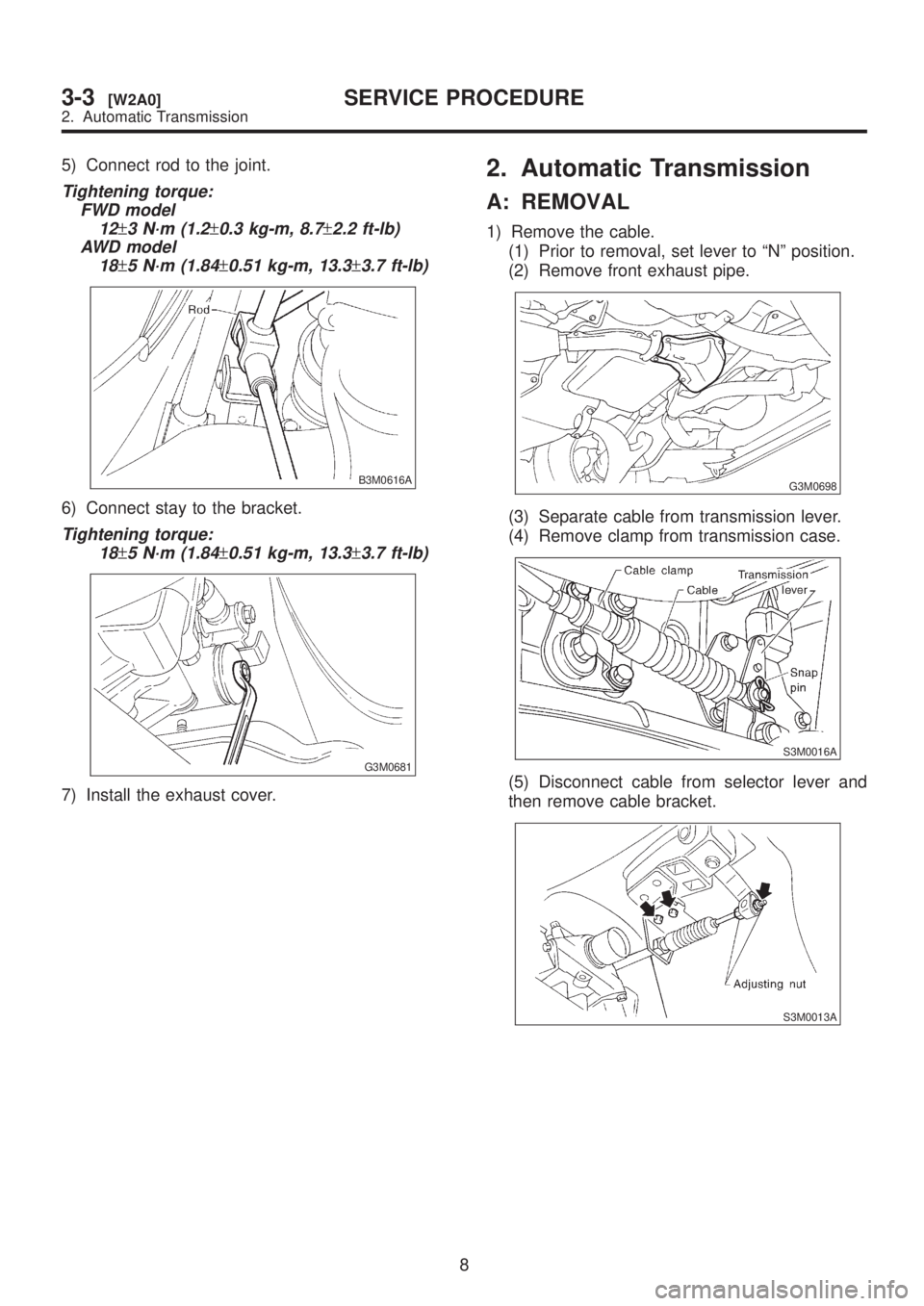
5) Connect rod to the joint.
Tightening torque:
FWD model
12
±3 N´m (1.2±0.3 kg-m, 8.7±2.2 ft-lb)
AWD model
18
±5 N´m (1.84±0.51 kg-m, 13.3±3.7 ft-lb)
B3M0616A
6) Connect stay to the bracket.
Tightening torque:
18
±5 N´m (1.84±0.51 kg-m, 13.3±3.7 ft-lb)
G3M0681
7) Install the exhaust cover.
2. Automatic Transmission
A: REMOVAL
1) Remove the cable.
(1) Prior to removal, set lever to ªNº position.
(2) Remove front exhaust pipe.
G3M0698
(3) Separate cable from transmission lever.
(4) Remove clamp from transmission case.
S3M0016A
(5) Disconnect cable from selector lever and
then remove cable bracket.
S3M0013A
8
3-3[W2A0]SERVICE PROCEDURE
2. Automatic Transmission
Page 647 of 1456
![SUBARU LEGACY 1999 Service Repair Manual 2) Remove console box. <Ref. to 5-4 [W1A0].>
3) Disconnect the connectors, then remove the six
screws to take out the selector lever assembly
from the body.
S3M0017A
B: DISASSEMBLY
1) Remove connector](/manual-img/17/57435/w960_57435-646.png "SUBARU LEGACY 1999 Service Repair Manual 2) Remove console box. <Ref. to 5-4 [W1A0].>
3) Disconnect the connectors, then remove the six
screws to take out the selector lever assembly
from the body.
S3M0017A
B: DISASSEMBLY
1) Remove connector")
2) Remove console box.
3) Disconnect the connectors, then remove the six
screws to take out the selector lever assembly
from the body.
S3M0017A
B: DISASSEMBLY
1) Remove connector from plate.
B3M0645
2) Remove indicator light and two screws.
3) Remove retainer spring, then pull up selector
lever grip with indicator cover for holding selector
lever button.
CAUTION:
Pull the selector lever grip carefully so that the
selector lever button may not jump out.
B3M0646A
4) Remove shift-lock solenoid and ªPº position
switch.
S3M0018A
5) Remove cap and clip, then extract pin.
6) Remove selector lever lower then take away
selector lever upper from plate.
B3M0647A
C: INSPECTION
1) Inspect removed parts by comparing with new
ones for deformation, damage and wear. Correct
or replace if defective.
2) Confirm the following parts for operating condi-
tion before assembly.
(1) Sliding condition of the button in the grip ...
it should move smoothly.
(2) Insertion of the grip on the selector lever ...
when pushing the grip on the selector lever by
hand, screw holes should be aligned.
(3) Operation of selector lever and rod ... they
should move smoothly.
D: ASSEMBLY
1) Clean all parts before assembly.
2) Apply grease [NIGTIGHT LYW No. 2 or equiva-
lent] to each parts.
3) Assembly is in the reverse order of disassem-
bly.
4) After completion of fitting, transfer selector
lever to range ªPº Ð ª1º, pressing the button of the
grip; then check whether the indicator and selector
lever agree, whether the pointer and position mark
agree and what the operating force is.
9
[W2D0]3-3SERVICE PROCEDURE
2. Automatic Transmission
Page 648 of 1456
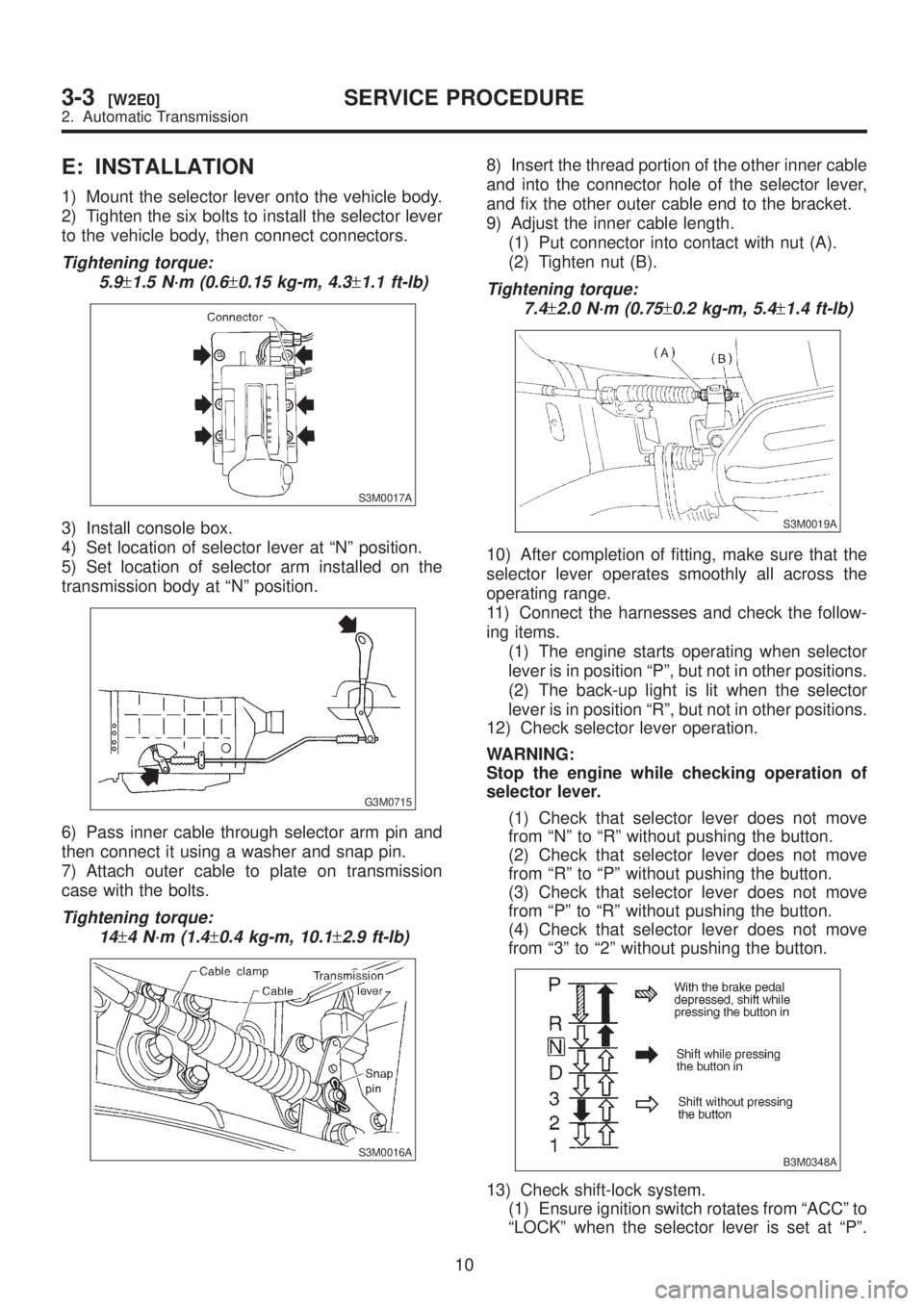
E: INSTALLATION
1) Mount the selector lever onto the vehicle body.
2) Tighten the six bolts to install the selector lever
to the vehicle body, then connect connectors.
Tightening torque:
5.9
±1.5 N´m (0.6±0.15 kg-m, 4.3±1.1 ft-lb)
S3M0017A
3) Install console box.
4) Set location of selector lever at ªNº position.
5) Set location of selector arm installed on the
transmission body at ªNº position.
G3M0715
6) Pass inner cable through selector arm pin and
then connect it using a washer and snap pin.
7) Attach outer cable to plate on transmission
case with the bolts.
Tightening torque:
14
±4 N´m (1.4±0.4 kg-m, 10.1±2.9 ft-lb)
S3M0016A
8) Insert the thread portion of the other inner cable
and into the connector hole of the selector lever,
and fix the other outer cable end to the bracket.
9) Adjust the inner cable length.
(1) Put connector into contact with nut (A).
(2) Tighten nut (B).
Tightening torque:
7.4
±2.0 N´m (0.75±0.2 kg-m, 5.4±1.4 ft-lb)
S3M0019A
10) After completion of fitting, make sure that the
selector lever operates smoothly all across the
operating range.
11) Connect the harnesses and check the follow-
ing items.
(1) The engine starts operating when selector
lever is in position ªPº, but not in other positions.
(2) The back-up light is lit when the selector
lever is in position ªRº, but not in other positions.
12) Check selector lever operation.
WARNING:
Stop the engine while checking operation of
selector lever.
(1) Check that selector lever does not move
from ªNº to ªRº without pushing the button.
(2) Check that selector lever does not move
from ªRº to ªPº without pushing the button.
(3) Check that selector lever does not move
from ªPº to ªRº without pushing the button.
(4) Check that selector lever does not move
from ª3º to ª2º without pushing the button.
B3M0348A
13) Check shift-lock system.
(1) Ensure ignition switch rotates from ªACCº to
ªLOCKº when the selector lever is set at ªPº.
10
3-3[W2E0]SERVICE PROCEDURE
2. Automatic Transmission
Page 649 of 1456
Also check that ignition key can be removed
only from the ªLOCKº position.
(2) Ensure selector lever moves from ªPº to any
other position when the brake pedal isdepressed with ignition key set at ªONº or
ªSTARTº.
11
[W2E0]3-3SERVICE PROCEDURE
2. Automatic Transmission
Page 788 of 1456

8. Aluminum Wheel
A: INSPECTION
Inspection for aluminum wheels is basically the
same as the one for steel wheels. However, check
the rim flange for cracks or damage, and replace
(not repair) aluminum wheel if air leakage is found.
B: PRECAUTIONS
Aluminum wheels are easily scratched. To main-
tain their appearance and safety, do the following:
1) Do not damage aluminum wheels during
removal, disassembly, installation, wheel
balancing, etc. After removing aluminum wheels,
place them on a rubber mat, etc.
2) While vehicle is being driven, be careful not to
ride over sharp obstacles or allow aluminum
wheels to contact the shoulder of the road.
3) When installing tire chain, be sure to install it
properly not to have a slack; otherwise it may hit
wheel while driving.
4) When washing aluminum wheel, use neutral
synthetic detergent and water. Avoid using the
cleanser including abrasive, hard brushes or an
automatic car washer.
9. Wheel Balancing
1) Proper wheel balance may be lost if the tire is
repaired or if it wears. Check the tire for dynamic
balance, and repair as necessary.
2) To check for dynamic balance, use a dynamic
balancer. Drive in the balance weight on both the
top and rear sides of the rim.
3) Some types of balancer can cause damage to
the wheel. Use an appropriate balancer when
adjusting the wheel balance.
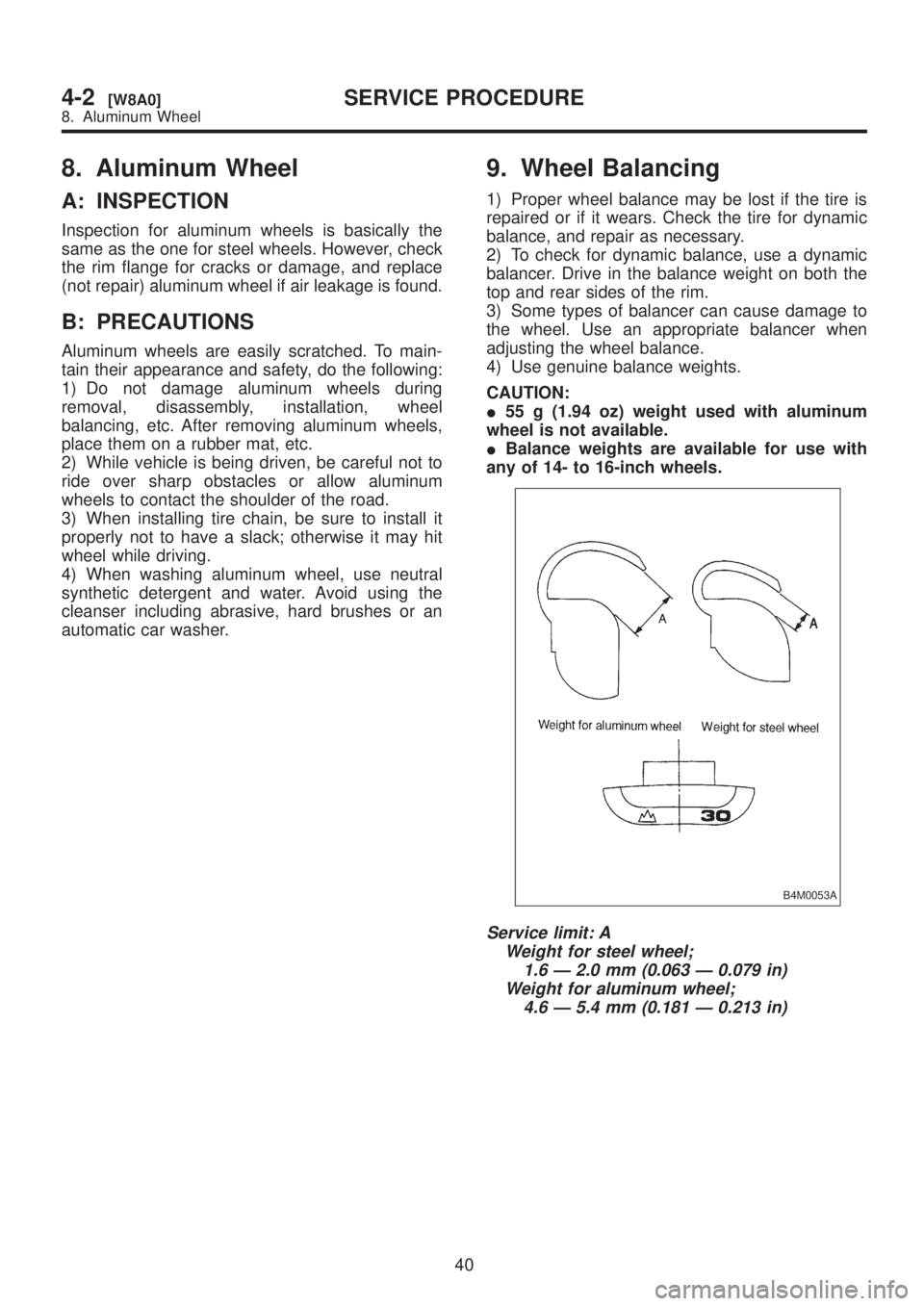
4) Use genuine balance weights.
CAUTION:
I55 g (1.94 oz) weight used with aluminum
wheel is not available.
IBalance weights are available for use with
any of 14- to 16-inch wheels.
B4M0053A
Service limit: A
Weight for steel wheel;
1.6 Ð 2.0 mm (0.063 Ð 0.079 in)
Weight for aluminum wheel;
4.6 Ð 5.4 mm (0.181 Ð 0.213 in)
40
4-2[W8A0]SERVICE PROCEDURE
8. Aluminum Wheel
Page 789 of 1456
8. Aluminum Wheel
A: INSPECTION
Inspection for aluminum wheels is basically the
same as the one for steel wheels. However, check
the rim flange for cracks or damage, and replace
(not repair) aluminum wheel if air leakage is found.
B: PRECAUTIONS
Aluminum wheels are easily scratched. To main-
tain their appearance and safety, do the following:
1) Do not damage aluminum wheels during
removal, disassembly, installation, wheel
balancing, etc. After removing aluminum wheels,
place them on a rubber mat, etc.
2) While vehicle is being driven, be careful not to
ride over sharp obstacles or allow aluminum
wheels to contact the shoulder of the road.
3) When installing tire chain, be sure to install it
properly not to have a slack; otherwise it may hit
wheel while driving.
4) When washing aluminum wheel, use neutral
synthetic detergent and water. Avoid using the
cleanser including abrasive, hard brushes or an
automatic car washer.
9. Wheel Balancing
1) Proper wheel balance may be lost if the tire is
repaired or if it wears. Check the tire for dynamic
balance, and repair as necessary.
2) To check for dynamic balance, use a dynamic
balancer. Drive in the balance weight on both the
top and rear sides of the rim.
3) Some types of balancer can cause damage to
the wheel. Use an appropriate balancer when
adjusting the wheel balance.
4) Use genuine balance weights.
CAUTION:
I55 g (1.94 oz) weight used with aluminum
wheel is not available.
IBalance weights are available for use with
any of 14- to 16-inch wheels.
B4M0053A
Service limit: A
Weight for steel wheel;
1.6 Ð 2.0 mm (0.063 Ð 0.079 in)
Weight for aluminum wheel;
4.6 Ð 5.4 mm (0.181 Ð 0.213 in)
40
4-2[W8A0]SERVICE PROCEDURE
8. Aluminum Wheel
Page 793 of 1456
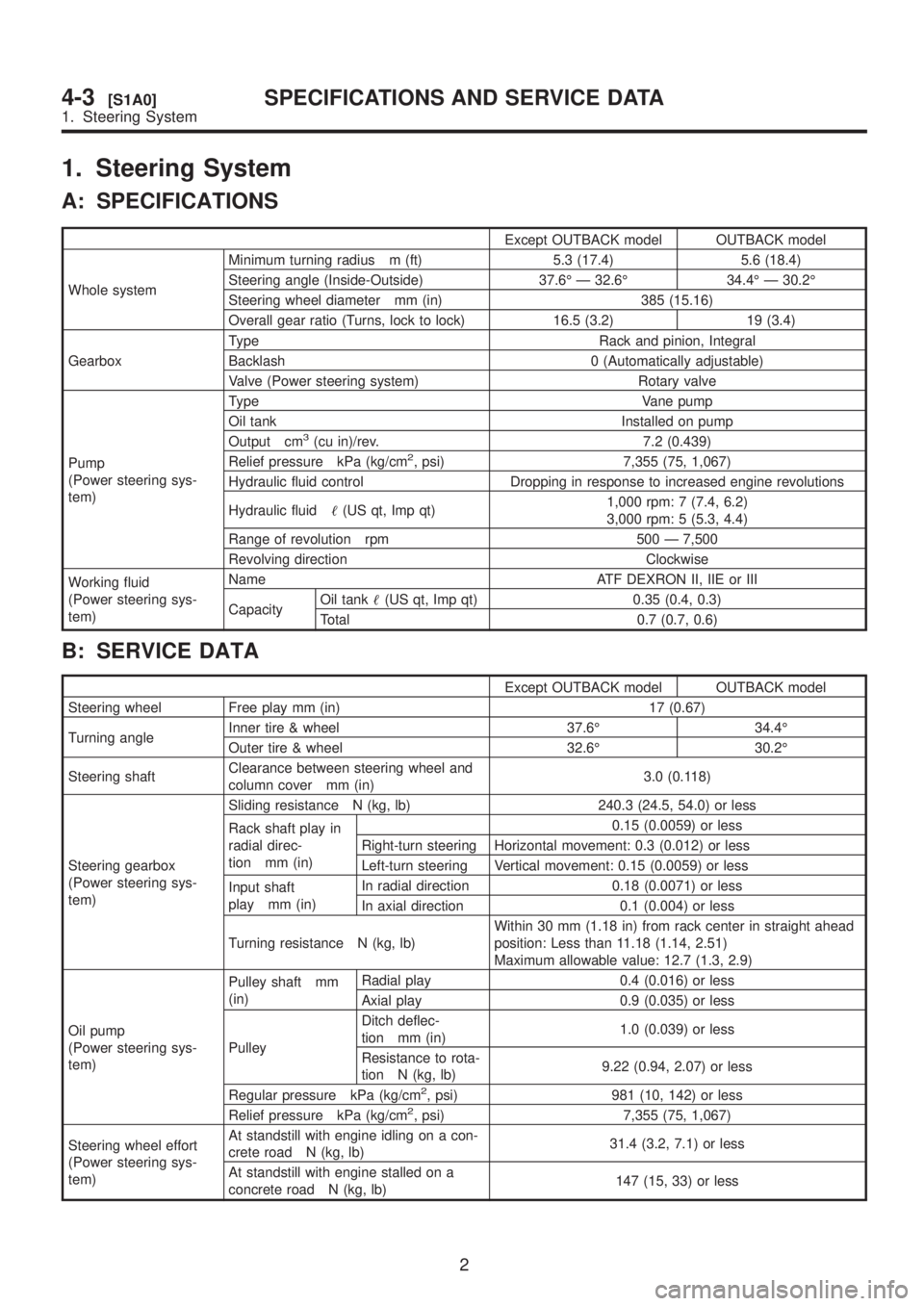
1. Steering System
A: SPECIFICATIONS
Except OUTBACK model OUTBACK model
Whole systemMinimum turning radius m (ft) 5.3 (17.4) 5.6 (18.4)
Steering angle (Inside-Outside) 37.6É Ð 32.6É 34.4É Ð 30.2É
Steering wheel diameter mm (in) 385 (15.16)
Overall gear ratio (Turns, lock to lock) 16.5 (3.2) 19 (3.4)
GearboxType Rack and pinion, Integral
Backlash 0 (Automatically adjustable)
Valve (Power steering system) Rotary valve
Pump
(Power steering sys-
tem)Type Vane pump
Oil tank Installed on pump
Output cm
3(cu in)/rev. 7.2 (0.439)
Relief pressure kPa (kg/cm2, psi) 7,355 (75, 1,067)
Hydraulic fluid control Dropping in response to increased engine revolutions
Hydraulic fluid(US qt, Imp qt)1,000 rpm: 7 (7.4, 6.2)
3,000 rpm: 5 (5.3, 4.4)
Range of revolution rpm 500 Ð 7,500
Revolving direction Clockwise
Working fluid
(Power steering sys-
tem)Name ATF DEXRON II, IIE or III
CapacityOil tank(US qt, Imp qt) 0.35 (0.4, 0.3)
Total 0.7 (0.7, 0.6)
B: SERVICE DATA
Except OUTBACK model OUTBACK model
Steering wheel Free play mm (in) 17 (0.67)
Turning angleInner tire & wheel 37.6É 34.4É
Outer tire & wheel 32.6É 30.2É
Steering shaftClearance between steering wheel and
column cover mm (in)3.0 (0.118)
Steering gearbox
(Power steering sys-
tem)Sliding resistance N (kg, lb) 240.3 (24.5, 54.0) or less
Rack shaft play in
radial direc-
tion mm (in)0.15 (0.0059) or less
Right-turn steering Horizontal movement: 0.3 (0.012) or less
Left-turn steering Vertical movement: 0.15 (0.0059) or less
Input shaft
play mm (in)In radial direction 0.18 (0.0071) or less
In axial direction 0.1 (0.004) or less
Turning resistance N (kg, lb)Within 30 mm (1.18 in) from rack center in straight ahead
position: Less than 11.18 (1.14, 2.51)
Maximum allowable value: 12.7 (1.3, 2.9)
Oil pump
(Power steering sys-
tem)Pulley shaft mm
(in)Radial play 0.4 (0.016) or less
Axial play 0.9 (0.035) or less
PulleyDitch deflec-
tion mm (in)1.0 (0.039) or less
Resistance to rota-
tion N (kg, lb)9.22 (0.94, 2.07) or less
Regular pressure kPa (kg/cm
2, psi) 981 (10, 142) or less
Relief pressure kPa (kg/cm2, psi) 7,355 (75, 1,067)
Steering wheel effort
(Power steering sys-
tem)At standstill with engine idling on a con-
crete road N (kg, lb)31.4 (3.2, 7.1) or less
At standstill with engine stalled on a
concrete road N (kg, lb)147 (15, 33) or less
2
4-3[S1A0]SPECIFICATIONS AND SERVICE DATA
1. Steering System
Page 868 of 1456

Fluid leaking area Possible cause Corrective action
Leakage from connecting portions of
pipes and hoses, numbered with (1) thru
(9) in figureInsufficient tightening of flare nut, catch-
ing dirt or the like, damage to flare or
flare nutLoosen and retighten, if ineffective,
replace.
Poor insertion of hose, poor clamping Retighten or replace clamp.
Damaged O-ring Replace O-ring pipe or hose with new
one, if ineffective, replace gearbox also.
Leakage from hose (10) and (11) in fig-
ureCrack or damage in hose Replace with a new one.
Crack or damage in hose hardware Replace with a new one.
Leakage from surrounding of cast iron
portion of oil pump (12) and (13) in fig-
ureDamaged O-ring Replace O-ring.
Damaged gasket Replace gasket.
Leakage from oil tank, (14) and (15) in
figureCrack in oil tank, (14) Replace oil tank.
Damaged O-ring, (15) Replace O-ring.
Leakage from filler neck (16) Damaged cap packing Replace cap.
Crack in root of filler neck Replace oil tank.
High fluid level *1 Adjust fluid level.
Leakage from surrounding of power cyl-
inder of gearbox, (17) in figureDamaged oil seal Replace oil seal.
Leakage from control valve of gearbox,
(18) and (19) in figureDamaged packing or oil seal Replace problem parts.
Damage in control valve Replace control valve.
*1 Fluid level is specified at optimum position (range) for ordinary use. Accordingly, if the vehicle is used often under hard
conditions such as on very rough roads or in mountainous areas, fluid may bleed out from cap air vent hole. This is not
a problem. If a customer complains strongly and is not likely to be satisfied with the leakage, lower the fluid level to the
extent that fluid will not bleed out under the conditions described, and have the customer check the fluid level and its
quality more frequency than usual.
E: NOISE AND VIBRATION
CAUTION:
Don't keep the relief valve operated over 5 sec-
onds at any time or inner parts of the oil pump
may be damaged due to rapid increase of fluid
temperature.
NOTE:
IGrinding noise may be heard immediately after
the engine start in extremely cold condition. In this
case, if the noise goes off during warm-up there is
no abnormal function in the system. This is due to
the fluid characteristic in extremely cold condition.
IOil pump makes whine or growl noise slightly
due to its mechanism. Even if the noise can be
heard when steering wheel is turned at stand still
there is no abnormal function in the system pro-
vided that the noise eliminates when the vehicle is
running.
IWhen stopping with service brake and/or park-
ing brake applied, power steering can be operated
easily due to its light steering effort. If doing so, thedisk rotates slightly and makes creaking noise. The
noise is generated by creaking between the disk
and pads. If the noise goes off when the brake is
released, there is no abnormal function in the sys-
tem.
IThere may be a little vibration around the steer-
ing devices when turning steering wheel at
standstill, even though the component parts are
properly adjusted and have no defects.
Hydraulic systems are likely to generate this kind
of vibration as well as working noise and fluid noise
because of combined conditions, i.e., road surface
and tire surface, engine speed and turning speed
of steering wheel, fluid temperature and braking
condition.
This phenomena does not indicate there is some
abnormal function in the system.
The vibration can be known when steering wheel
is turned repeatedly at various speeds from slow to
rapid step by step with parking brake applied on
concrete road and in ªDº range for automatic trans-
mission vehicle.
Trouble Possible cause Corrective action
Hiss noise (continuous)
While engine is running.Relief valve emits operating sound when steering wheel is
completely turned in either direction. (Don't keep this condition
over 5 seconds.)Normal
Relief valve emits operating sound when steering wheel is not
turned. This means that the relief valve is faulty.Defective
Replace oil pump.
74
4-3[K1E0]DIAGNOSTICS
1. Power Steering