1999 NISSAN PRIMERA air suspension
[x] Cancel search: air suspensionPage 2027 of 2267
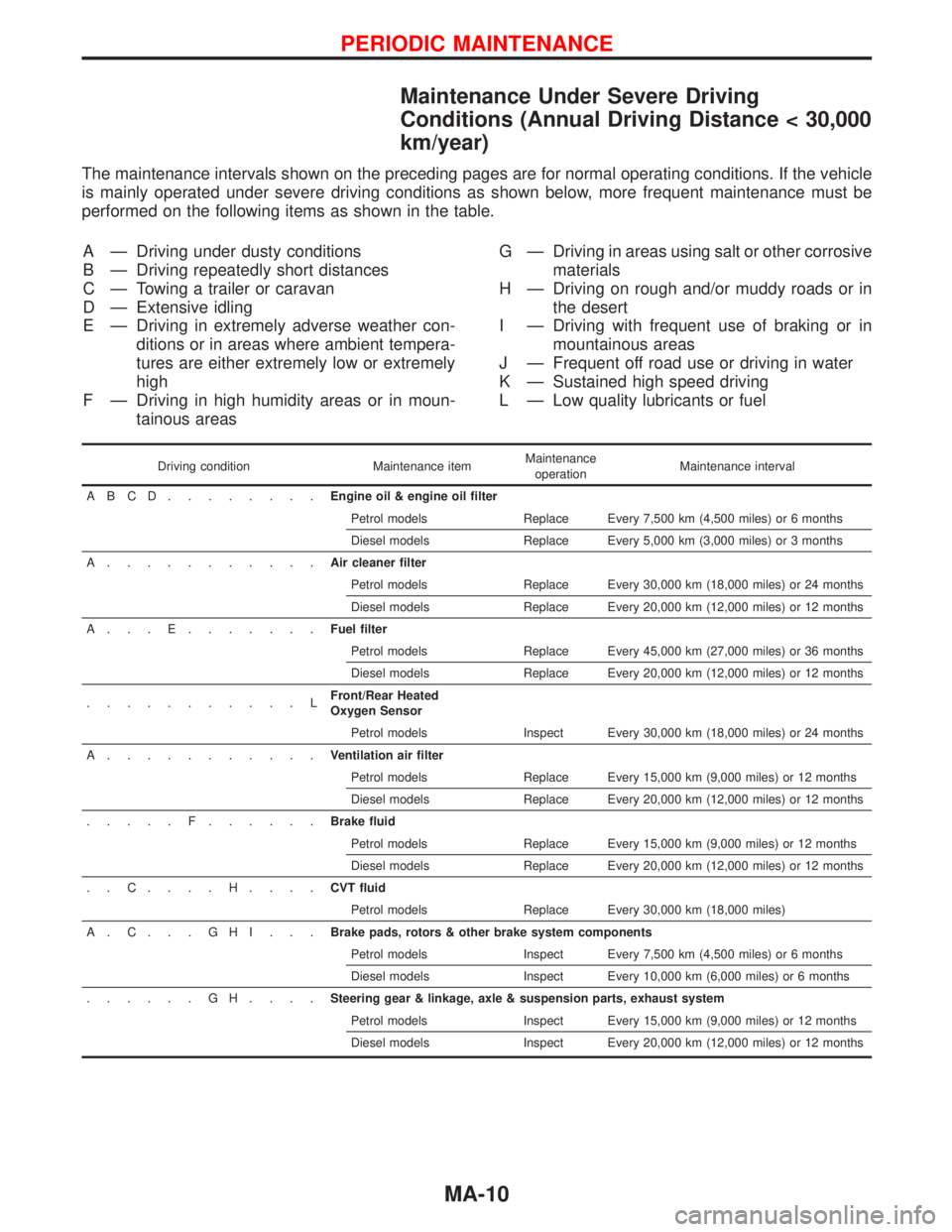
Maintenance Under Severe Driving
Conditions (Annual Driving Distance < 30,000
km/year)
The maintenance intervals shown on the preceding pages are for normal operating conditions. If the vehicle
is mainly operated under severe driving conditions as shown below, more frequent maintenance must be
performed on the following items as shown in the table.
A—Driving under dusty conditions
B—Driving repeatedly short distances
C—Towing a trailer or caravan
D—Extensive idling
E—Driving in extremely adverse weather con-
ditions or in areas where ambient tempera-
tures are either extremely low or extremely
high
F—Driving in high humidity areas or in moun-
tainous areasG—Driving in areas using salt or other corrosive
materials
H—Driving on rough and/or muddy roads or in
the desert
I—Driving with frequent use of braking or in
mountainous areas
J—Frequent off road use or driving in water
K—Sustained high speed driving
L—Low quality lubricants or fuel
Driving condition Maintenance itemMaintenance
operationMaintenance interval
ABCD........Engine oil & engine oil filter
Petrol models Replace Every 7,500 km (4,500 miles) or 6 months
Diesel models Replace Every 5,000 km (3,000 miles) or 3 months
A...........Air cleaner filter
Petrol models Replace Every 30,000 km (18,000 miles) or 24 months
Diesel models Replace Every 20,000 km (12,000 miles) or 12 months
A...E.......Fuel filter
Petrol models Replace Every 45,000 km (27,000 miles) or 36 months
Diesel models Replace Every 20,000 km (12,000 miles) or 12 months
...........LFront/Rear Heated
Oxygen Sensor
Petrol models Inspect Every 30,000 km (18,000 miles) or 24 months
A...........Ventilation air filter
Petrol models Replace Every 15,000 km (9,000 miles) or 12 months
Diesel models Replace Every 20,000 km (12,000 miles) or 12 months
.....F......Brake fluid
Petrol models Replace Every 15,000 km (9,000 miles) or 12 months
Diesel models Replace Every 20,000 km (12,000 miles) or 12 months
..C....H....CVT fluid
Petrol models Replace Every 30,000 km (18,000 miles)
A.C...GHI...Brake pads, rotors & other brake system components
Petrol models Inspect Every 7,500 km (4,500 miles) or 6 months
Diesel models Inspect Every 10,000 km (6,000 miles) or 6 months
......GH....Steering gear & linkage, axle & suspension parts, exhaust system
Petrol models Inspect Every 15,000 km (9,000 miles) or 12 months
Diesel models Inspect Every 20,000 km (12,000 miles) or 12 months
PERIODIC MAINTENANCE
MA-10
Page 2029 of 2267
![NISSAN PRIMERA 1999 Electronic Repair Manual Chassis and Body Maintenance
Abbreviations: R = Replace I = Inspect: Correct or replace if necessary L = Lubricate T = Tighten [ ] = At the specified mile-
age only
MAINTENANCE OPERATION MAINTENANCE I](/manual-img/5/57377/w960_57377-2028.png "NISSAN PRIMERA 1999 Electronic Repair Manual Chassis and Body Maintenance
Abbreviations: R = Replace I = Inspect: Correct or replace if necessary L = Lubricate T = Tighten [ ] = At the specified mile-
age only
MAINTENANCE OPERATION MAINTENANCE I")
Chassis and Body Maintenance
Abbreviations: R = Replace I = Inspect: Correct or replace if necessary L = Lubricate T = Tighten [ ] = At the specified mile-
age only
MAINTENANCE OPERATION MAINTENANCE INTERVAL
Perform on a kilometer basis only.km×1,000 15 30 45 60 75 90 105 120
(miles x 1,000) (9) (18) (27) (36) (45) (54) (63) (72)
Underhood and under vehicleReference
pages
Headlamp aimingIIIIEL-87
Wheel alignment (if necessary, balance & rotate wheels)IIIIFA-6/RA-6/
(MA-53)
Brake pads, rotors & other components*IIIIMA-51
Foot brake, parking brake & clutch (for free play, stroke & operation)IIIIBR-48/BR-13/
CL-5
Brake booster vacuum hoses, connections, check valve I I MA-51
Brake & clutch, systems and fluid (for level and leaks)IIIIMA-51/MA-48
Brake fluid*R R BR-7
Power steering fluid and lines (for level and leaks)IIIIMA-53
Air bag system See NOTE (1) RS-11
Ventilation air filter*RRRRHA-117
Manual transmission oil (check for leakage. Use genuine
NISSAN XZ gear oil or exact equivalent.)IIIIMA-49
CVT fluid (for level and leaks or replace.
Use genuine NISSAN CVT fluid (NS-1) or exact equivalent)*I [R] I [R] MA-50
Steering gear and linkage, axle & suspension, exhaust system* I IMA-53/FA-5/
RA-5/MA-48
Body corrosion See NOTE (2) MA-55
NOTE: (1) Inspect after 10 years, then every 2 years.
(2) Inspect once per year.
* Maintenance items with“*”should be performed more frequently according to“Maintenance under severe driving
conditions”.
PERIODIC MAINTENANCE
MA-12
Page 2031 of 2267
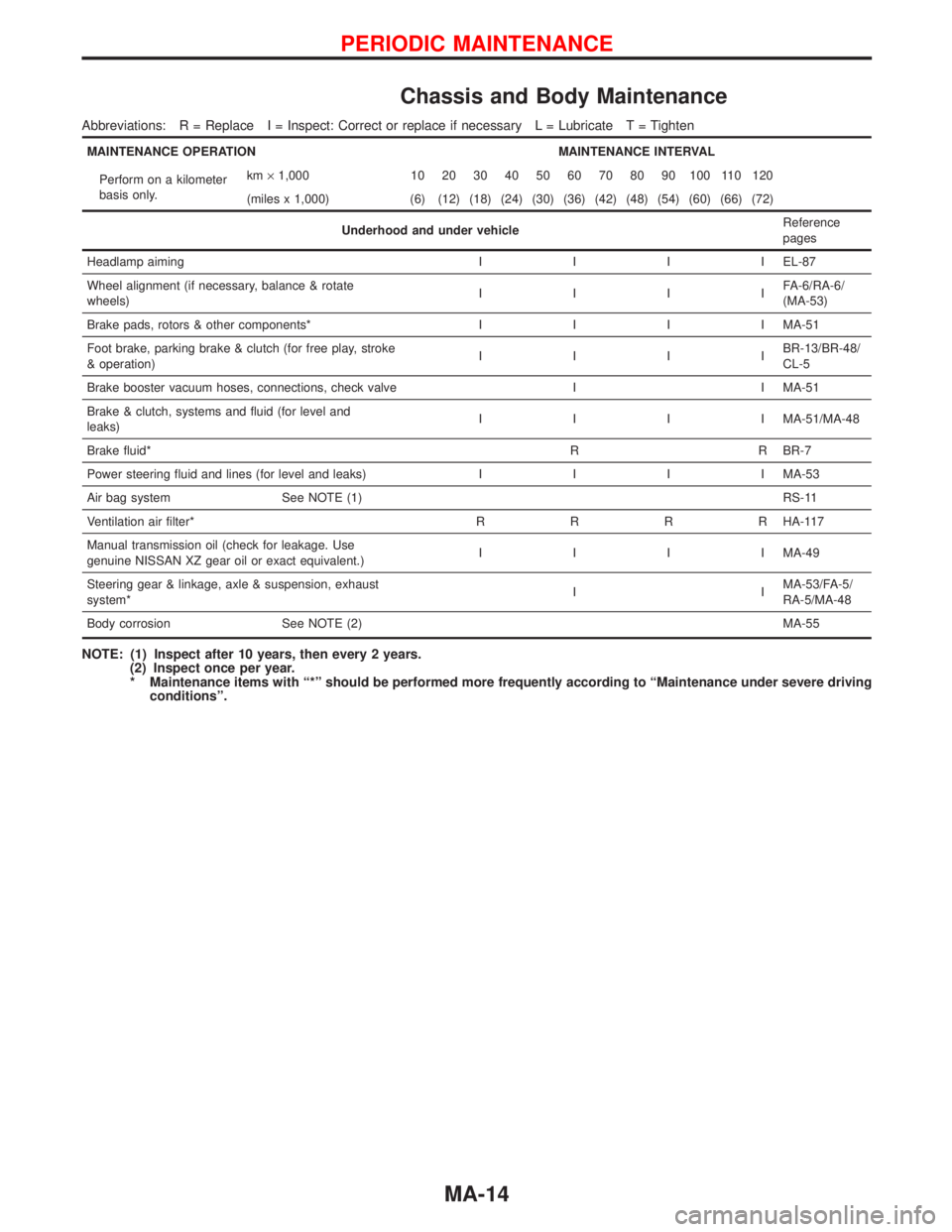
Chassis and Body Maintenance
Abbreviations: R = Replace I = Inspect: Correct or replace if necessary L = Lubricate T = Tighten
MAINTENANCE OPERATION MAINTENANCE INTERVAL
Perform on a kilometer
basis only.km×1,000 10 20 30 40 50 60 70 80 90 100 110 120
(miles x 1,000) (6) (12) (18) (24) (30) (36) (42) (48) (54) (60) (66) (72)
Underhood and under vehicleReference
pages
Headlamp aimingIIIIEL-87
Wheel alignment (if necessary, balance & rotate
wheels)IIIIFA-6/RA-6/
(MA-53)
Brake pads, rotors & other components*IIIIMA-51
Foot brake, parking brake & clutch (for free play, stroke
& operation)IIIIBR-13/BR-48/
CL-5
Brake booster vacuum hoses, connections, check valve I I MA-51
Brake & clutch, systems and fluid (for level and
leaks)IIIIMA-51/MA-48
Brake fluid*R R BR-7
Power steering fluid and lines (for level and leaks)IIIIMA-53
Air bag system See NOTE (1)RS-11
Ventilation air filter*RRRRHA-117
Manual transmission oil (check for leakage. Use
genuine NISSAN XZ gear oil or exact equivalent.)IIIIMA-49
Steering gear & linkage, axle & suspension, exhaust
system*IIMA-53/FA-5/
RA-5/MA-48
Body corrosion See NOTE (2)MA-55
NOTE: (1) Inspect after 10 years, then every 2 years.
(2) Inspect once per year.
* Maintenance items with“*”should be performed more frequently according to“Maintenance under severe driving
conditions”.
PERIODIC MAINTENANCE
MA-14
Page 2032 of 2267
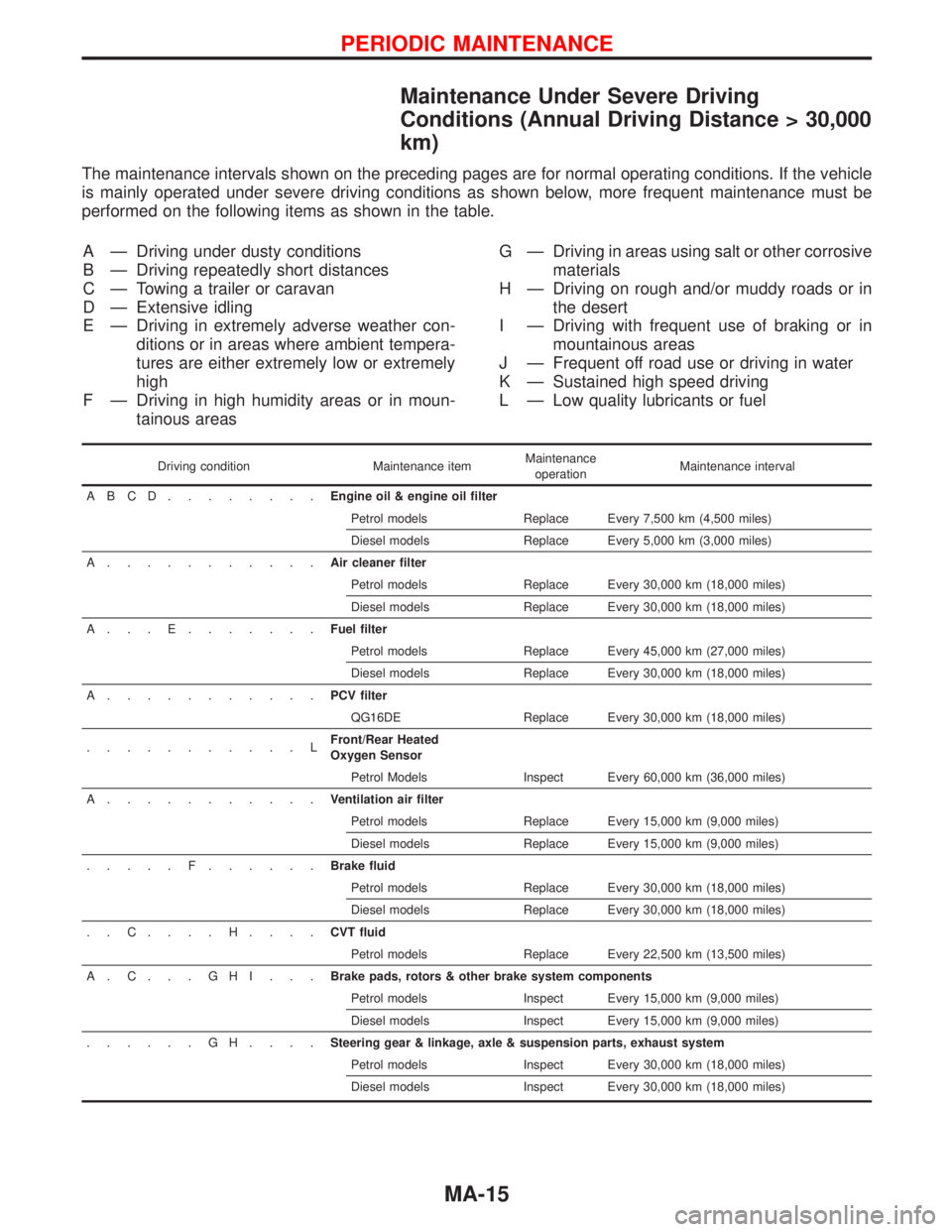
Maintenance Under Severe Driving
Conditions (Annual Driving Distance > 30,000
km)
The maintenance intervals shown on the preceding pages are for normal operating conditions. If the vehicle
is mainly operated under severe driving conditions as shown below, more frequent maintenance must be
performed on the following items as shown in the table.
A—Driving under dusty conditions
B—Driving repeatedly short distances
C—Towing a trailer or caravan
D—Extensive idling
E—Driving in extremely adverse weather con-
ditions or in areas where ambient tempera-
tures are either extremely low or extremely
high
F—Driving in high humidity areas or in moun-
tainous areasG—Driving in areas using salt or other corrosive
materials
H—Driving on rough and/or muddy roads or in
the desert
I—Driving with frequent use of braking or in
mountainous areas
J—Frequent off road use or driving in water
K—Sustained high speed driving
L—Low quality lubricants or fuel
Driving condition Maintenance itemMaintenance
operationMaintenance interval
ABCD........Engine oil & engine oil filter
Petrol models Replace Every 7,500 km (4,500 miles)
Diesel models Replace Every 5,000 km (3,000 miles)
A...........Air cleaner filter
Petrol models Replace Every 30,000 km (18,000 miles)
Diesel models Replace Every 30,000 km (18,000 miles)
A...E.......Fuel filter
Petrol models Replace Every 45,000 km (27,000 miles)
Diesel models Replace Every 30,000 km (18,000 miles)
A...........PCV filter
QG16DE Replace Every 30,000 km (18,000 miles)
...........LFront/Rear Heated
Oxygen Sensor
Petrol Models Inspect Every 60,000 km (36,000 miles)
A...........Ventilation air filter
Petrol models Replace Every 15,000 km (9,000 miles)
Diesel models Replace Every 15,000 km (9,000 miles)
.....F......Brake fluid
Petrol models Replace Every 30,000 km (18,000 miles)
Diesel models Replace Every 30,000 km (18,000 miles)
..C....H....CVT fluid
Petrol models Replace Every 22,500 km (13,500 miles)
A.C...GHI...Brake pads, rotors & other brake system components
Petrol models Inspect Every 15,000 km (9,000 miles)
Diesel models Inspect Every 15,000 km (9,000 miles)
......GH....Steering gear & linkage, axle & suspension parts, exhaust system
Petrol models Inspect Every 30,000 km (18,000 miles)
Diesel models Inspect Every 30,000 km (18,000 miles)
PERIODIC MAINTENANCE
MA-15
Page 2172 of 2267
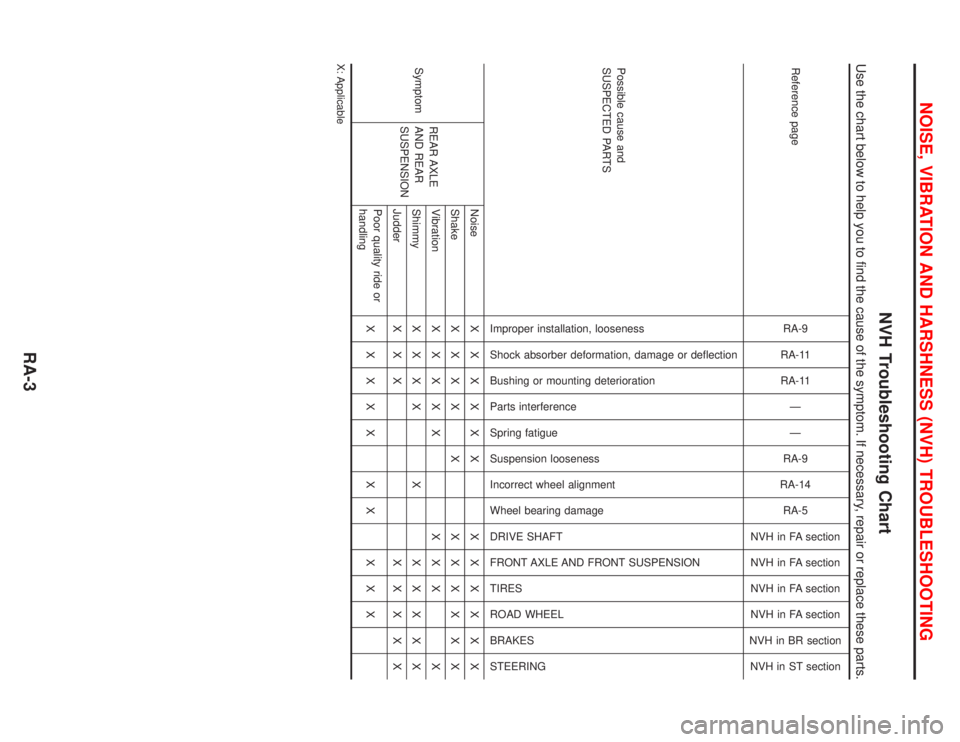
NVH Troubleshooting Chart
Use the chart below to help you to find the cause of the symptom. If necessary, repair or replace these parts.
Reference pageRA-9
RA-11
RA-11
Ð
Ð
RA-9
RA-14
RA-5
NVH in FA section
NVH in FA section
NVH in FA section
NVH in FA section
NVH in BR section
NVH in ST section
Possible cause and
SUSPECTED PARTS
Improper installation, looseness
Shock absorber deformation, damage or deflection
Bushing or mounting deterioration
Parts interference
Spring fatigue
Suspension looseness
Incorrect wheel alignment
Wheel bearing damage
DRIVE SHAFT
FRONT AXLE AND FRONT SUSPENSION
TIRES
ROAD WHEEL
BRAKES
STEERING
SymptomREAR AXLE
AND REAR
SUSPENSIONNoiseXXXXXX XXXXXX
ShakeXXXX X XXXXXX
VibrationXXXXX XXX X
ShimmyXXXX X XXXXX
Judder X X XXXXXX
Poor quality ride or
handlingXXXXX XX XXX
X: Applicable
NOISE, VIBRATION AND HARSHNESS (NVH) TROUBLESHOOTING
RA-3
Page 2175 of 2267
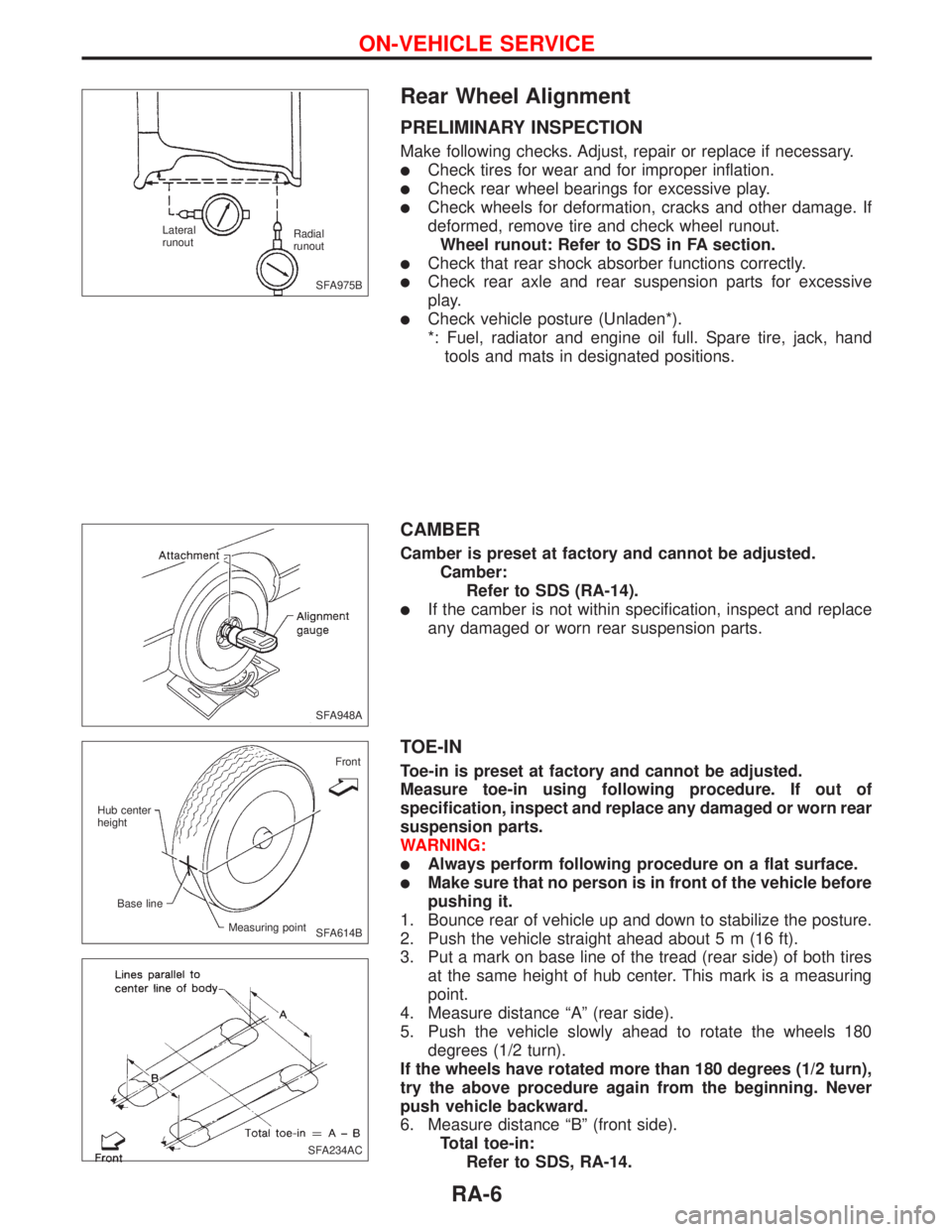
Rear Wheel Alignment
PRELIMINARY INSPECTION
Make following checks. Adjust, repair or replace if necessary.
lCheck tires for wear and for improper inflation.
lCheck rear wheel bearings for excessive play.
lCheck wheels for deformation, cracks and other damage. If
deformed, remove tire and check wheel runout.
Wheel runout: Refer to SDS in FA section.
lCheck that rear shock absorber functions correctly.
lCheck rear axle and rear suspension parts for excessive
play.
lCheck vehicle posture (Unladen*).
*: Fuel, radiator and engine oil full. Spare tire, jack, hand
tools and mats in designated positions.
CAMBER
Camber is preset at factory and cannot be adjusted.
Camber:
Refer to SDS (RA-14).
lIf the camber is not within specification, inspect and replace
any damaged or worn rear suspension parts.
TOE-IN
Toe-in is preset at factory and cannot be adjusted.
Measure toe-in using following procedure. If out of
specification, inspect and replace any damaged or worn rear
suspension parts.
WARNING:
lAlways perform following procedure on a flat surface.
lMake sure that no person is in front of the vehicle before
pushing it.
1. Bounce rear of vehicle up and down to stabilize the posture.
2. Push the vehicle straight ahead about 5 m (16 ft).
3. Put a mark on base line of the tread (rear side) of both tires
at the same height of hub center. This mark is a measuring
point.
4. Measure distance ªAº (rear side).
5. Push the vehicle slowly ahead to rotate the wheels 180
degrees (1/2 turn).
If the wheels have rotated more than 180 degrees (1/2 turn),
try the above procedure again from the beginning. Never
push vehicle backward.
6. Measure distance ªBº (front side).
Total toe-in:
Refer to SDS, RA-14.
SFA975B Radial
runout Lateral
runout
SFA948A
SFA614BFront
Hub center
height
Base line
Measuring point
SFA234AC
ON-VEHICLE SERVICE
RA-6
Page 2247 of 2267
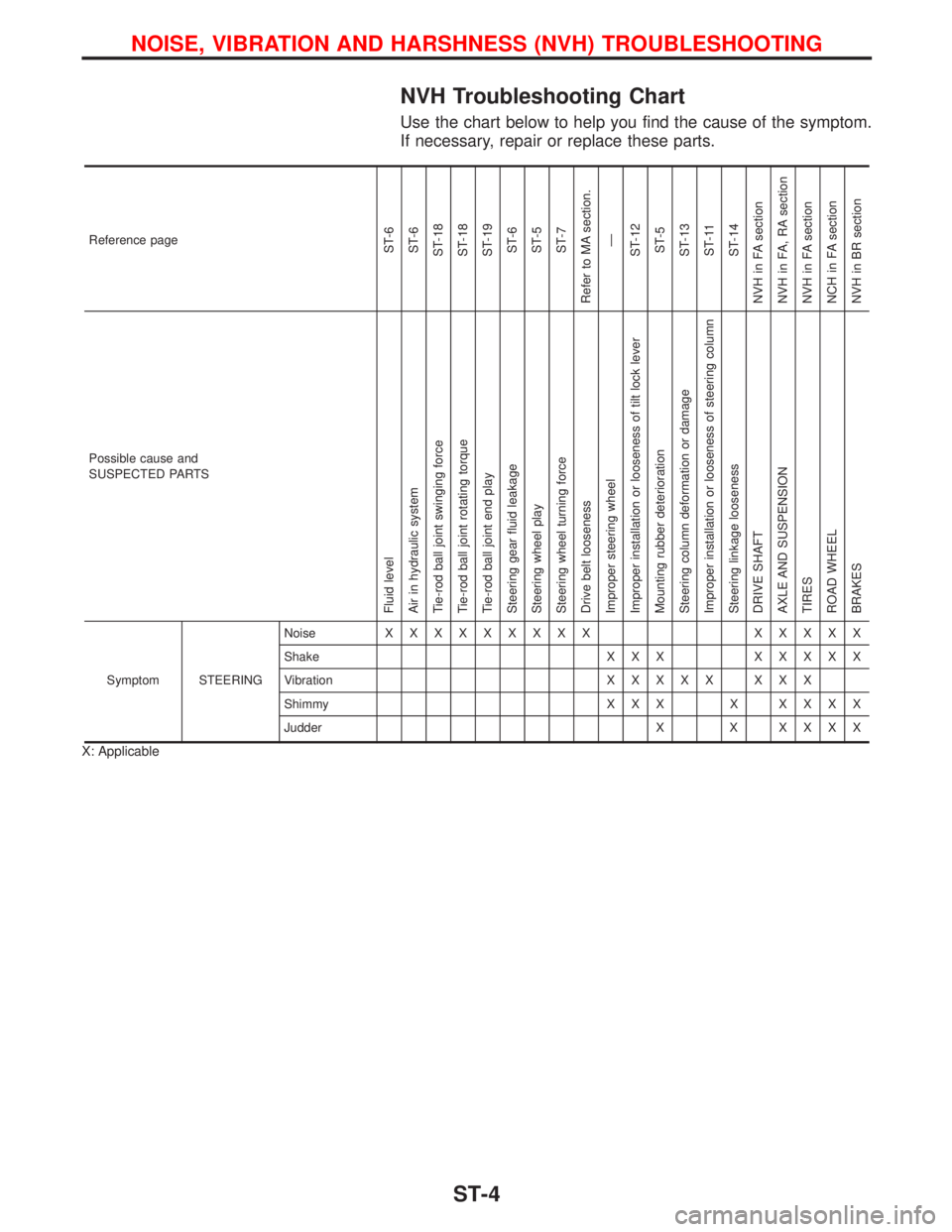
NVH Troubleshooting Chart
Use the chart below to help you find the cause of the symptom.
If necessary, repair or replace these parts.
Reference pageST-6
ST-6
ST-18
ST-18
ST-19
ST-6
ST-5
ST-7
Refer to MA section.
Ð
ST-12
ST-5
ST-13
ST-11
ST-14
NVH in FA section
NVH in FA, RA section
NVH in FA section
NCH in FA section
NVH in BR section
Possible cause and
SUSPECTED PARTS
Fluid level
Air in hydraulic system
Tie-rod ball joint swinging force
Tie-rod ball joint rotating torque
Tie-rod ball joint end play
Steering gear fluid leakage
Steering wheel play
Steering wheel turning force
Drive belt looseness
Improper steering wheel
Improper installation or looseness of tilt lock lever
Mounting rubber deterioration
Steering column deformation or damage
Improper installation or looseness of steering column
Steering linkage looseness
DRIVE SHAFT
AXLE AND SUSPENSION
TIRES
ROAD WHEEL
BRAKES
Symptom STEERINGNoiseXXXXXXXXX XXXXX
Shake X X XXXXXX
VibrationXXXXX XXX
Shimmy X X X XXXXX
Judder X XXXXX
X: Applicable
NOISE, VIBRATION AND HARSHNESS (NVH) TROUBLESHOOTING
ST-4