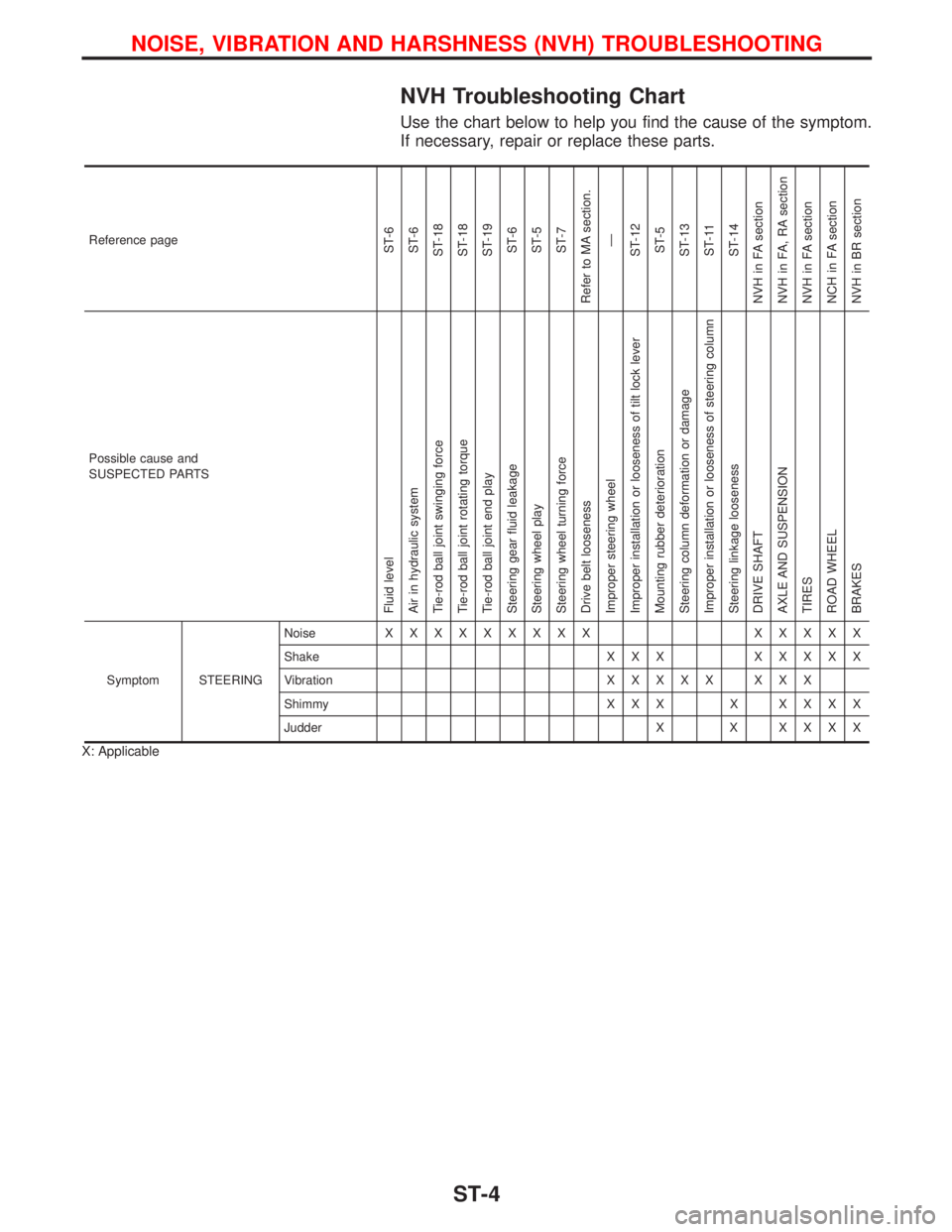
NVH Troubleshooting Chart
Use the chart below to help you find the cause of the symptom.
If necessary, repair or replace these parts.
Reference pageST-6
ST-6
ST-18
ST-18
ST-19
ST-6
ST-5
ST-7
Refer to MA section.
Ð
ST-12
ST-5
ST-13
ST-11
ST-14
NVH in FA section
NVH in FA, RA section
NVH in FA section
NCH in FA section
NVH in BR section
Possible cause and
SUSPECTED PARTS
Fluid level
Air in hydraulic system
Tie-rod ball joint swinging force
Tie-rod ball joint rotating torque
Tie-rod ball joint end play
Steering gear fluid leakage
Steering wheel play
Steering wheel turning force
Drive belt looseness
Improper steering wheel
Improper installation or looseness of tilt lock lever
Mounting rubber deterioration
Steering column deformation or damage
Improper installation or looseness of steering column
Steering linkage looseness
DRIVE SHAFT
AXLE AND SUSPENSION
TIRES
ROAD WHEEL
BRAKES
Symptom STEERINGNoiseXXXXXXXXX XXXXX
Shake X X XXXXXX
VibrationXXXXX XXX
Shimmy X X X XXXXX
Judder X XXXXX
X: Applicable
NOISE, VIBRATION AND HARSHNESS (NVH) TROUBLESHOOTING
ST-4
lIncomplete air bleeding will cause the following to occur.
When this happens, bleed air again.
a. Generation of air bubbles in reservoir tank
b. Generation of clicking noise in oil pump
c. Excessive buzzing in oil pump
While the vehicle is stationary or while moving the steering wheel
slowly, fluid noise may occur in the valve or oil pump. This noise
is inherent in this steering system, and it will not affect perfor-
mance or durability of the system.
Checking Steering Wheel Turning Force
1. Park vehicle on a level, dry surface and set parking brake.
2. Start engine.
3. Bring power steering fluid up to adequate operating tempera-
ture. [Make sure temperature of fluid is approximately 60 to
80ÉC (140 to 176ÉF).]
Tires need to be inflated to normal pressure.
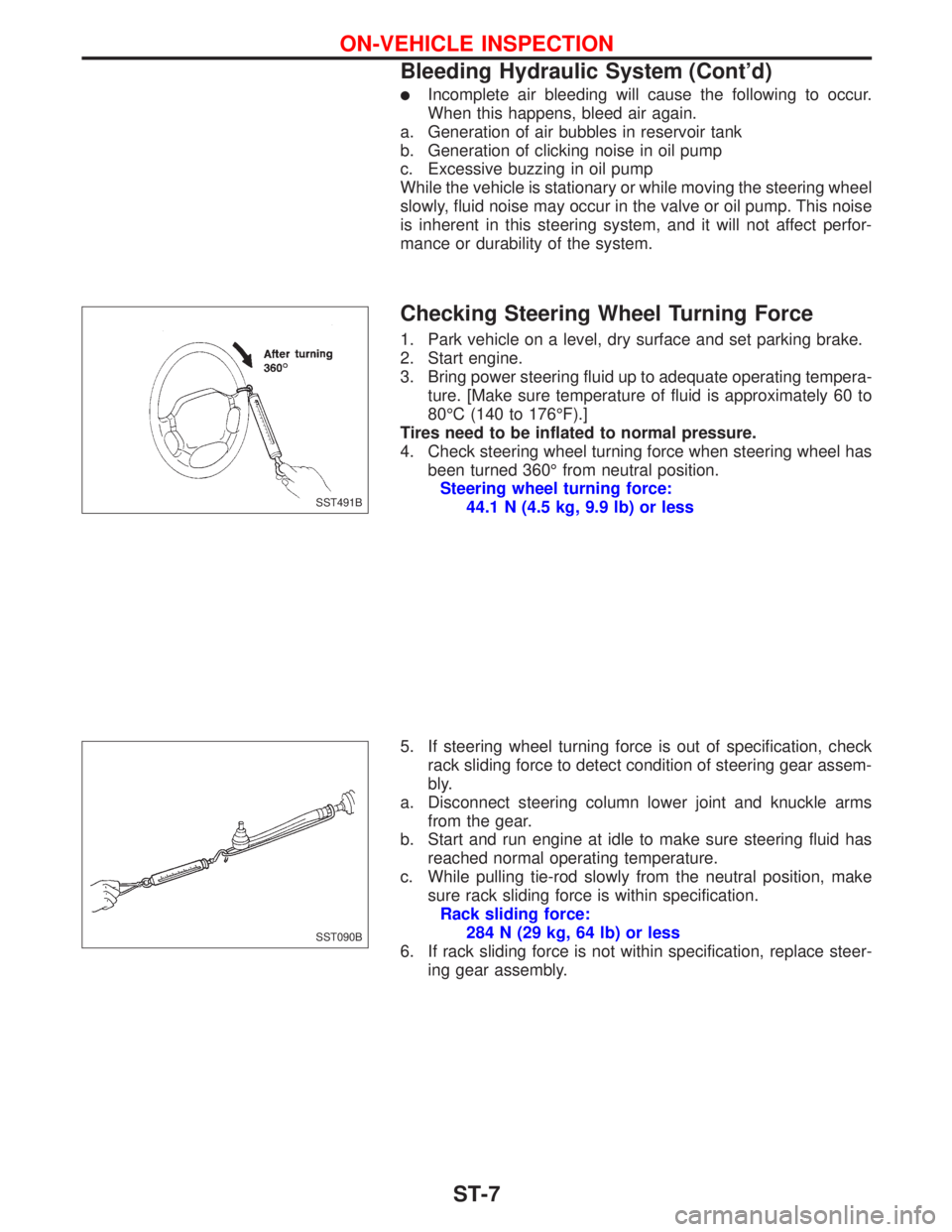
4. Check steering wheel turning force when steering wheel has
been turned 360É from neutral position.
Steering wheel turning force:
44.1 N (4.5 kg, 9.9 lb) or less
5. If steering wheel turning force is out of specification, check
rack sliding force to detect condition of steering gear assem-
bly.
a. Disconnect steering column lower joint and knuckle arms
from the gear.
b. Start and run engine at idle to make sure steering fluid has
reached normal operating temperature.
c. While pulling tie-rod slowly from the neutral position, make
sure rack sliding force is within specification.
Rack sliding force:
284 N (29 kg, 64 lb) or less
6. If rack sliding force is not within specification, replace steer-
ing gear assembly.
SST491B
SST090B
ON-VEHICLE INSPECTION
Bleeding Hydraulic System (Cont'd)
ST-7