1999 DODGE NEON steering
[x] Cancel search: steeringPage 36 of 1200
WHEEL BEARING
REMOVE
(1) Remove steering knuckle, hub and wheel bear-
ing as an assembly from the vehicle. Refer to Steer-
ing Knuckle in the Removal And Installation section
in this group of the service manual for the required
steering knuckle removal procedure.
The removal and installation of the wheel
bearing from the steering knuckle is ONLY to
be done with the steering knuckle removed
from the vehicle. Removal of the wheel bearing
from the steering knuckle MUST be done using
an arbor press and the following procedure.
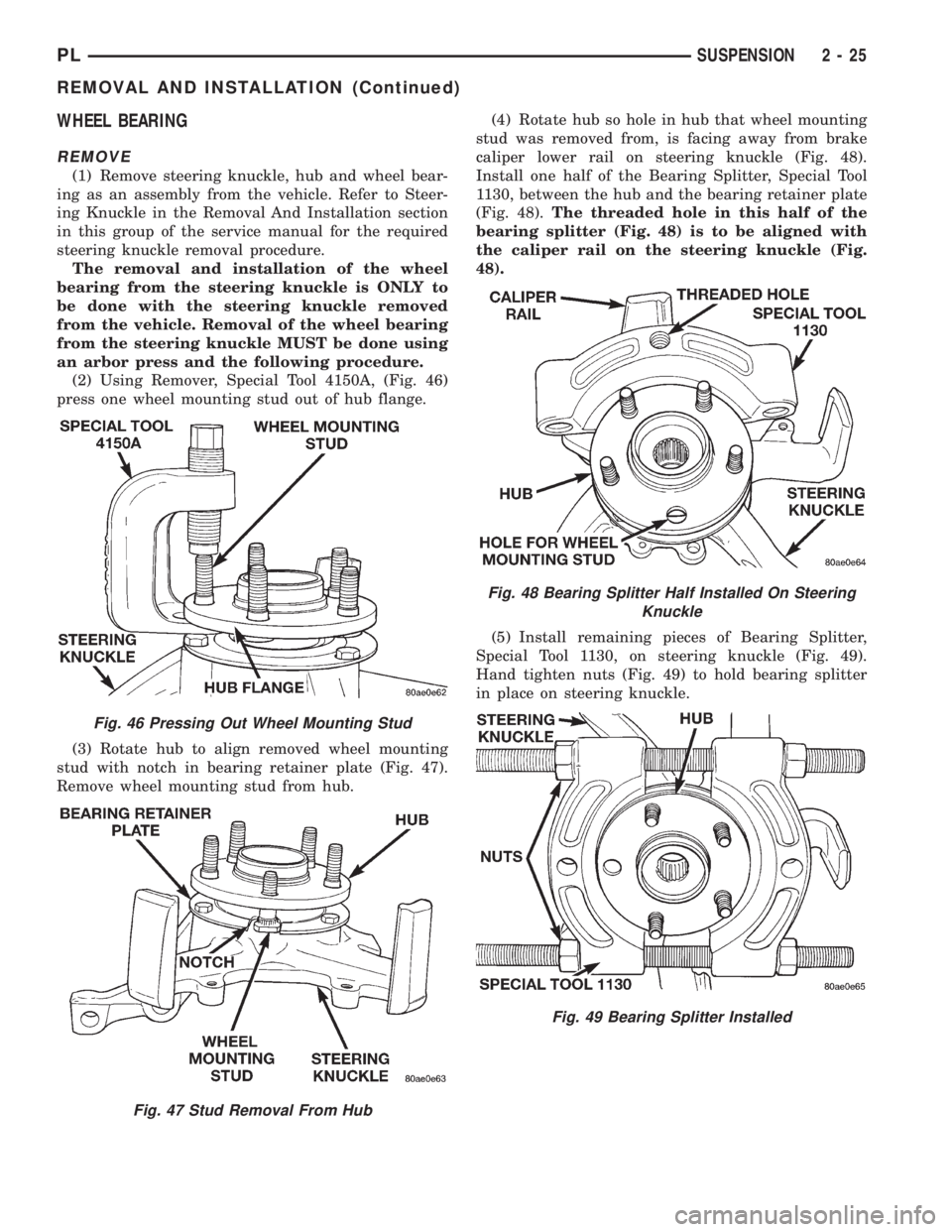
(2) Using Remover, Special Tool 4150A, (Fig. 46)
press one wheel mounting stud out of hub flange.
(3) Rotate hub to align removed wheel mounting
stud with notch in bearing retainer plate (Fig. 47).
Remove wheel mounting stud from hub.(4) Rotate hub so hole in hub that wheel mounting
stud was removed from, is facing away from brake
caliper lower rail on steering knuckle (Fig. 48).
Install one half of the Bearing Splitter, Special Tool
1130, between the hub and the bearing retainer plate
(Fig. 48).The threaded hole in this half of the
bearing splitter (Fig. 48) is to be aligned with
the caliper rail on the steering knuckle (Fig.
48).
(5) Install remaining pieces of Bearing Splitter,
Special Tool 1130, on steering knuckle (Fig. 49).
Hand tighten nuts (Fig. 49) to hold bearing splitter
in place on steering knuckle.
Fig. 46 Pressing Out Wheel Mounting Stud
Fig. 47 Stud Removal From Hub
Fig. 48 Bearing Splitter Half Installed On Steering
Knuckle
Fig. 49 Bearing Splitter Installed
PLSUSPENSION 2 - 25
REMOVAL AND INSTALLATION (Continued)
Page 37 of 1200
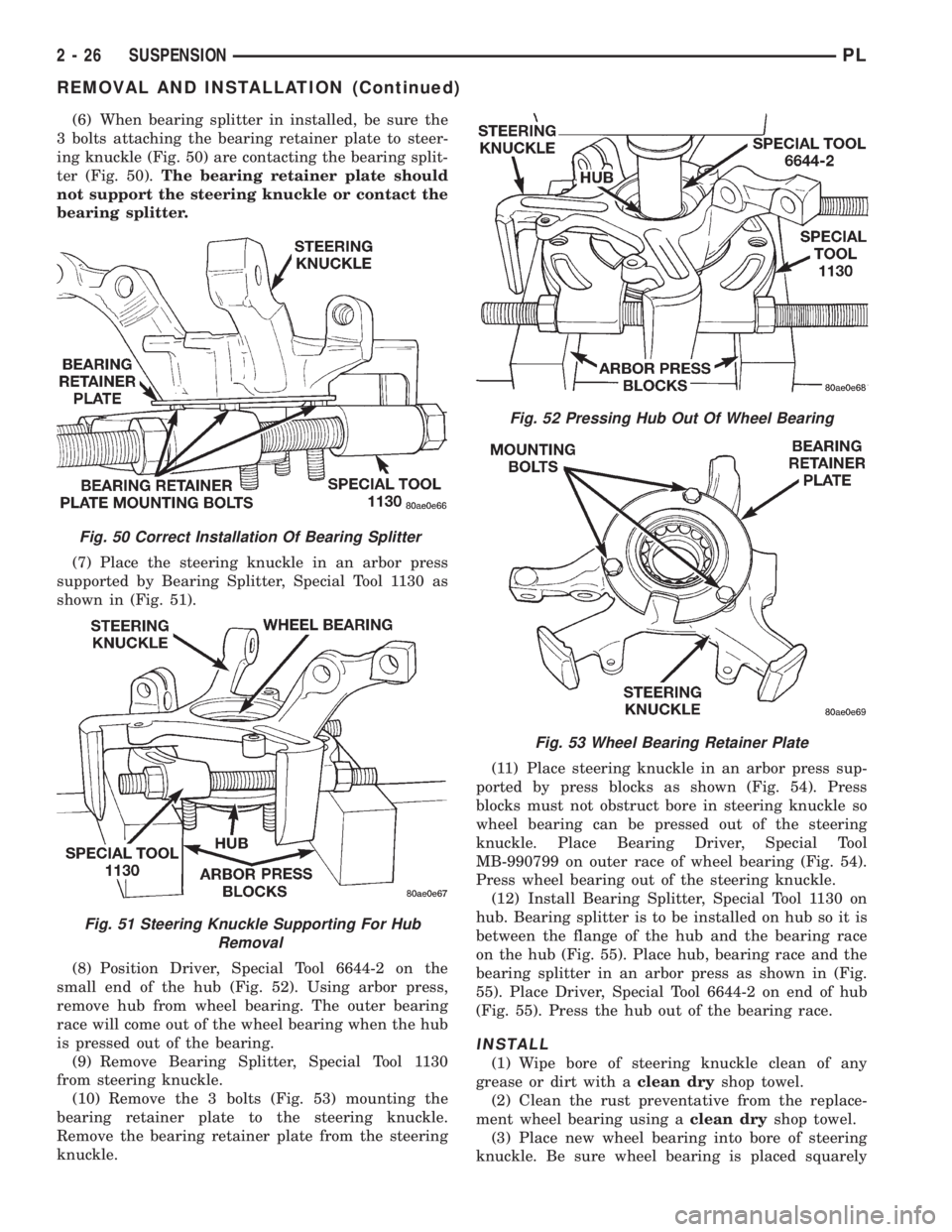
(6) When bearing splitter in installed, be sure the
3 bolts attaching the bearing retainer plate to steer-
ing knuckle (Fig. 50) are contacting the bearing split-
ter (Fig. 50).The bearing retainer plate should
not support the steering knuckle or contact the
bearing splitter.
(7) Place the steering knuckle in an arbor press
supported by Bearing Splitter, Special Tool 1130 as
shown in (Fig. 51).
(8) Position Driver, Special Tool 6644-2 on the
small end of the hub (Fig. 52). Using arbor press,
remove hub from wheel bearing. The outer bearing
race will come out of the wheel bearing when the hub
is pressed out of the bearing.
(9) Remove Bearing Splitter, Special Tool 1130
from steering knuckle.
(10) Remove the 3 bolts (Fig. 53) mounting the
bearing retainer plate to the steering knuckle.
Remove the bearing retainer plate from the steering
knuckle.(11) Place steering knuckle in an arbor press sup-
ported by press blocks as shown (Fig. 54). Press
blocks must not obstruct bore in steering knuckle so
wheel bearing can be pressed out of the steering
knuckle. Place Bearing Driver, Special Tool
MB-990799 on outer race of wheel bearing (Fig. 54).
Press wheel bearing out of the steering knuckle.
(12) Install Bearing Splitter, Special Tool 1130 on
hub. Bearing splitter is to be installed on hub so it is
between the flange of the hub and the bearing race
on the hub (Fig. 55). Place hub, bearing race and the
bearing splitter in an arbor press as shown in (Fig.
55). Place Driver, Special Tool 6644-2 on end of hub
(Fig. 55). Press the hub out of the bearing race.
INSTALL
(1) Wipe bore of steering knuckle clean of any
grease or dirt with aclean dryshop towel.
(2) Clean the rust preventative from the replace-
ment wheel bearing using aclean dryshop towel.
(3) Place new wheel bearing into bore of steering
knuckle. Be sure wheel bearing is placed squarely
Fig. 50 Correct Installation Of Bearing Splitter
Fig. 51 Steering Knuckle Supporting For Hub
Removal
Fig. 52 Pressing Hub Out Of Wheel Bearing
Fig. 53 Wheel Bearing Retainer Plate
2 - 26 SUSPENSIONPL
REMOVAL AND INSTALLATION (Continued)
Page 38 of 1200
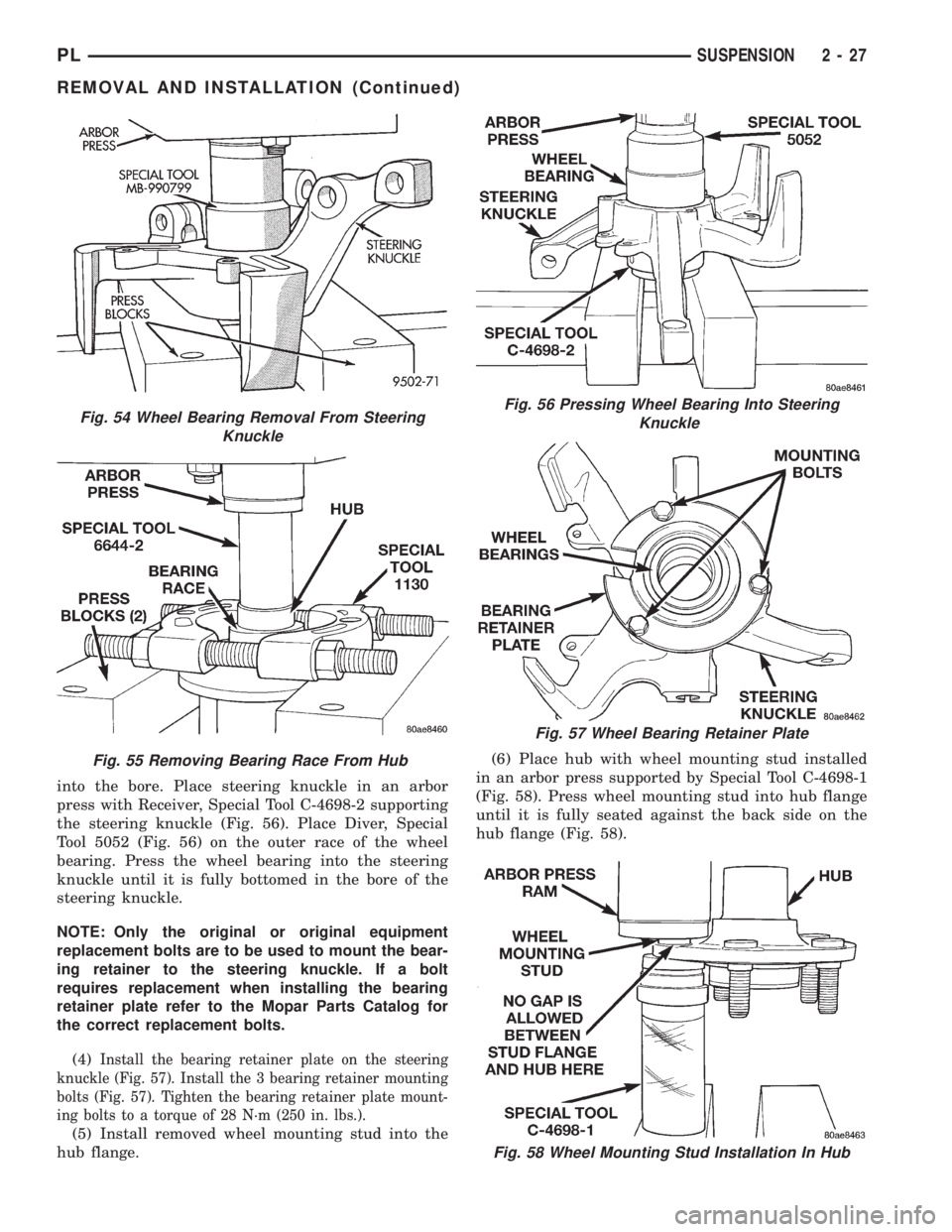
into the bore. Place steering knuckle in an arbor
press with Receiver, Special Tool C-4698-2 supporting
the steering knuckle (Fig. 56). Place Diver, Special
Tool 5052 (Fig. 56) on the outer race of the wheel
bearing. Press the wheel bearing into the steering
knuckle until it is fully bottomed in the bore of the
steering knuckle.
NOTE: Only the original or original equipment
replacement bolts are to be used to mount the bear-
ing retainer to the steering knuckle. If a bolt
requires replacement when installing the bearing
retainer plate refer to the Mopar Parts Catalog for
the correct replacement bolts.
(4)
Install the bearing retainer plate on the steering
knuckle (Fig. 57). Install the 3 bearing retainer mounting
bolts (Fig. 57). Tighten the bearing retainer plate mount-
ing bolts to a torque of 28 N´m (250 in. lbs.).
(5) Install removed wheel mounting stud into the
hub flange.(6) Place hub with wheel mounting stud installed
in an arbor press supported by Special Tool C-4698-1
(Fig. 58). Press wheel mounting stud into hub flange
until it is fully seated against the back side on the
hub flange (Fig. 58).
Fig. 58 Wheel Mounting Stud Installation In Hub
Fig. 54 Wheel Bearing Removal From Steering
Knuckle
Fig. 55 Removing Bearing Race From Hub
Fig. 56 Pressing Wheel Bearing Into Steering
Knuckle
Fig. 57 Wheel Bearing Retainer Plate
PLSUSPENSION 2 - 27
REMOVAL AND INSTALLATION (Continued)
Page 39 of 1200
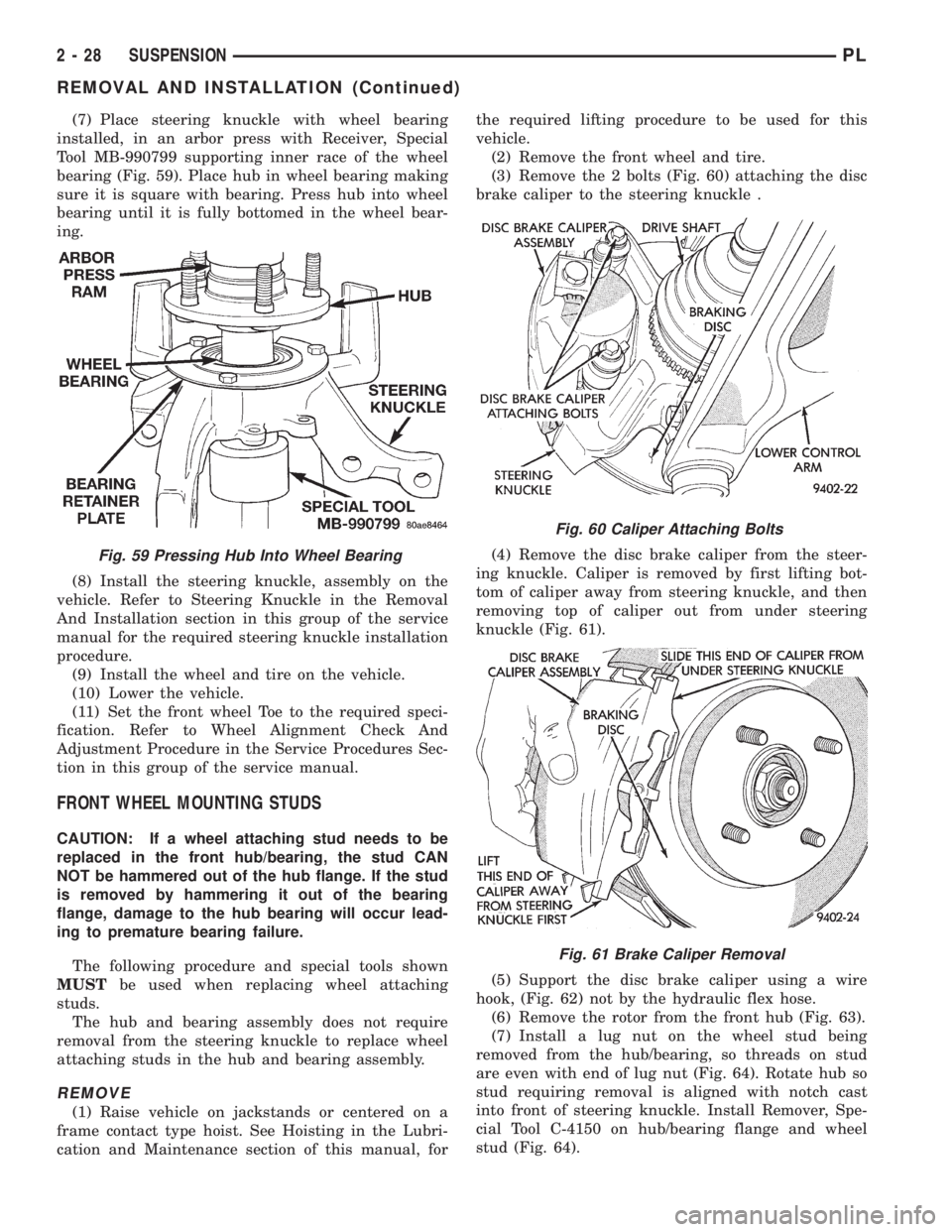
(7) Place steering knuckle with wheel bearing
installed, in an arbor press with Receiver, Special
Tool MB-990799 supporting inner race of the wheel
bearing (Fig. 59). Place hub in wheel bearing making
sure it is square with bearing. Press hub into wheel
bearing until it is fully bottomed in the wheel bear-
ing.
(8) Install the steering knuckle, assembly on the
vehicle. Refer to Steering Knuckle in the Removal
And Installation section in this group of the service
manual for the required steering knuckle installation
procedure.
(9) Install the wheel and tire on the vehicle.
(10) Lower the vehicle.
(11) Set the front wheel Toe to the required speci-
fication. Refer to Wheel Alignment Check And
Adjustment Procedure in the Service Procedures Sec-
tion in this group of the service manual.
FRONT WHEEL MOUNTING STUDS
CAUTION: If a wheel attaching stud needs to be
replaced in the front hub/bearing, the stud CAN
NOT be hammered out of the hub flange. If the stud
is removed by hammering it out of the bearing
flange, damage to the hub bearing will occur lead-
ing to premature bearing failure.
The following procedure and special tools shown
MUSTbe used when replacing wheel attaching
studs.
The hub and bearing assembly does not require
removal from the steering knuckle to replace wheel
attaching studs in the hub and bearing assembly.
REMOVE
(1) Raise vehicle on jackstands or centered on a
frame contact type hoist. See Hoisting in the Lubri-
cation and Maintenance section of this manual, forthe required lifting procedure to be used for this
vehicle.
(2) Remove the front wheel and tire.
(3) Remove the 2 bolts (Fig. 60) attaching the disc
brake caliper to the steering knuckle .
(4) Remove the disc brake caliper from the steer-
ing knuckle. Caliper is removed by first lifting bot-
tom of caliper away from steering knuckle, and then
removing top of caliper out from under steering
knuckle (Fig. 61).
(5) Support the disc brake caliper using a wire
hook, (Fig. 62) not by the hydraulic flex hose.
(6) Remove the rotor from the front hub (Fig. 63).
(7) Install a lug nut on the wheel stud being
removed from the hub/bearing, so threads on stud
are even with end of lug nut (Fig. 64). Rotate hub so
stud requiring removal is aligned with notch cast
into front of steering knuckle. Install Remover, Spe-
cial Tool C-4150 on hub/bearing flange and wheel
stud (Fig. 64).
Fig. 59 Pressing Hub Into Wheel Bearing
Fig. 60 Caliper Attaching Bolts
Fig. 61 Brake Caliper Removal
2 - 28 SUSPENSIONPL
REMOVAL AND INSTALLATION (Continued)
Page 40 of 1200
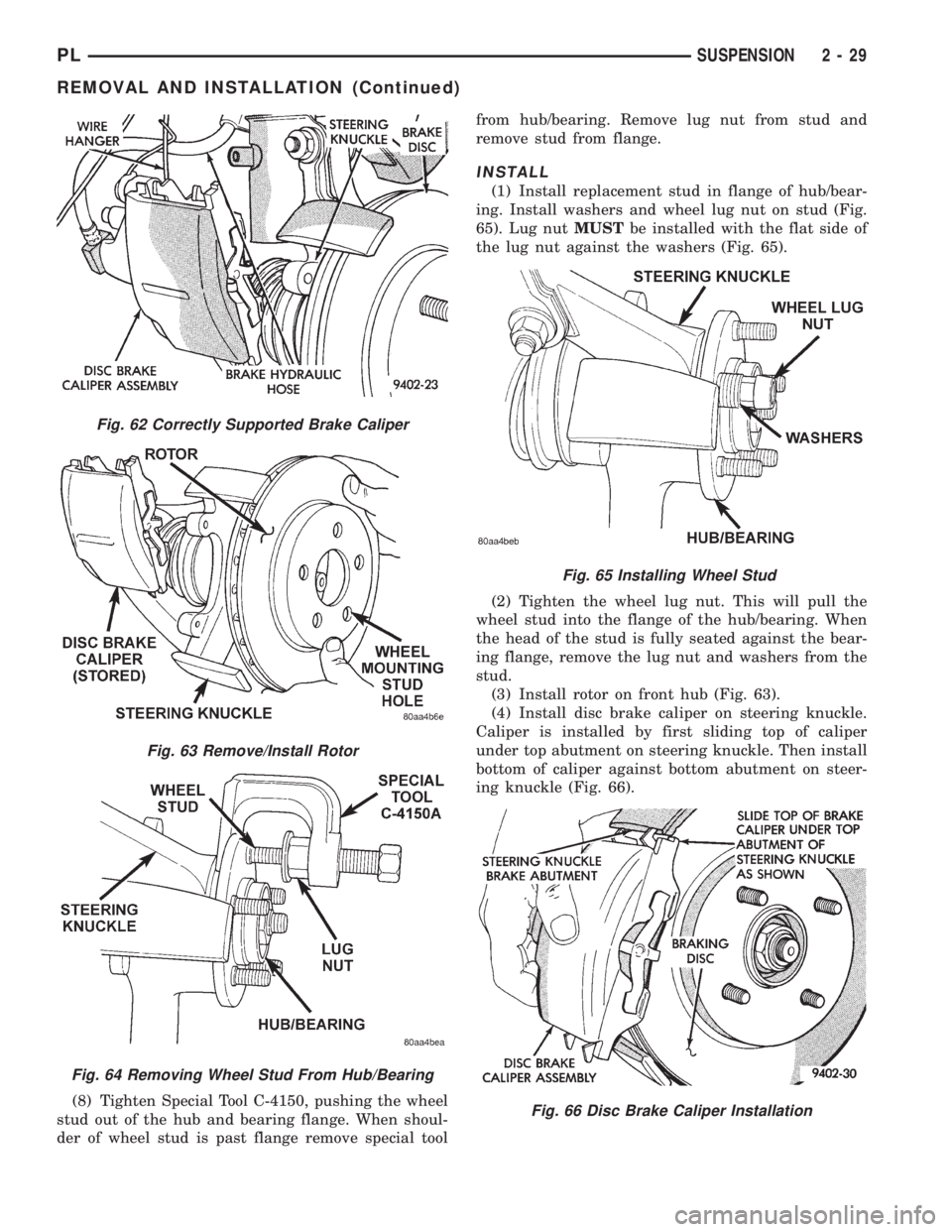
(8) Tighten Special Tool C-4150, pushing the wheel
stud out of the hub and bearing flange. When shoul-
der of wheel stud is past flange remove special toolfrom hub/bearing. Remove lug nut from stud and
remove stud from flange.
INSTALL
(1) Install replacement stud in flange of hub/bear-
ing. Install washers and wheel lug nut on stud (Fig.
65). Lug nutMUSTbe installed with the flat side of
the lug nut against the washers (Fig. 65).
(2) Tighten the wheel lug nut. This will pull the
wheel stud into the flange of the hub/bearing. When
the head of the stud is fully seated against the bear-
ing flange, remove the lug nut and washers from the
stud.
(3) Install rotor on front hub (Fig. 63).
(4) Install disc brake caliper on steering knuckle.
Caliper is installed by first sliding top of caliper
under top abutment on steering knuckle. Then install
bottom of caliper against bottom abutment on steer-
ing knuckle (Fig. 66).
Fig. 62 Correctly Supported Brake Caliper
Fig. 63 Remove/Install Rotor
Fig. 64 Removing Wheel Stud From Hub/Bearing
Fig. 65 Installing Wheel Stud
Fig. 66 Disc Brake Caliper Installation
PLSUSPENSION 2 - 29
REMOVAL AND INSTALLATION (Continued)
Page 41 of 1200
(5) Install the disc brake caliper to steering
knuckle attaching bolts (Fig. 61). Tighten the attach-
ing bolts to a torque of 31 N´m (23 ft. lbs.).
(6) Install front wheel and tire. Install front wheel
lug nuts and torque to 135 N´m
(7) (100 ft. lbs.).
(8) Lower vehicle.
DISASSEMBLY AND ASSEMBLY
McPHERSON STRUT
DISASSEMBLY
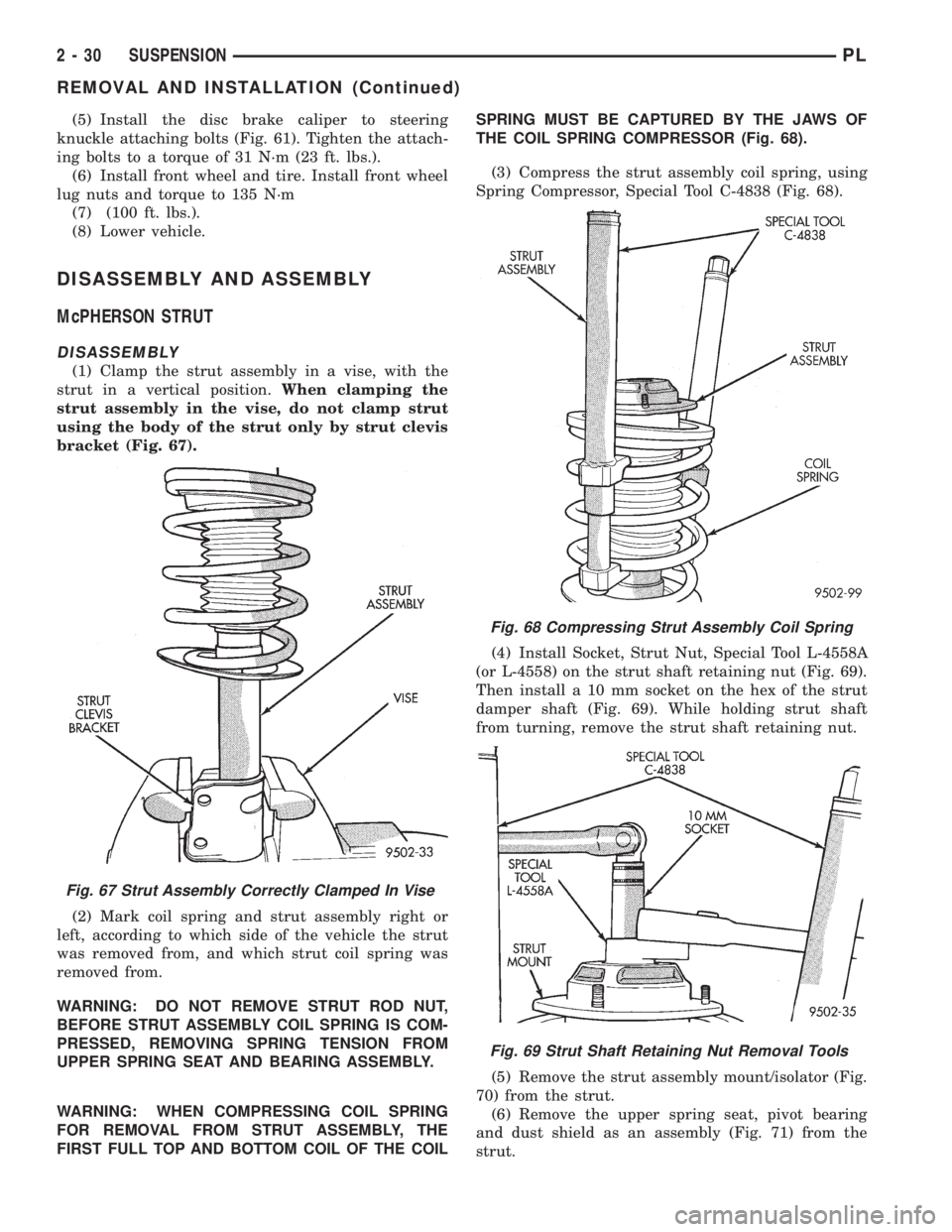
(1) Clamp the strut assembly in a vise, with the
strut in a vertical position.When clamping the
strut assembly in the vise, do not clamp strut
using the body of the strut only by strut clevis
bracket (Fig. 67).
(2) Mark coil spring and strut assembly right or
left, according to which side of the vehicle the strut
was removed from, and which strut coil spring was
removed from.
WARNING: DO NOT REMOVE STRUT ROD NUT,
BEFORE STRUT ASSEMBLY COIL SPRING IS COM-
PRESSED, REMOVING SPRING TENSION FROM
UPPER SPRING SEAT AND BEARING ASSEMBLY.
WARNING: WHEN COMPRESSING COIL SPRING
FOR REMOVAL FROM STRUT ASSEMBLY, THE
FIRST FULL TOP AND BOTTOM COIL OF THE COILSPRING MUST BE CAPTURED BY THE JAWS OF
THE COIL SPRING COMPRESSOR (Fig. 68).
(3) Compress the strut assembly coil spring, using
Spring Compressor, Special Tool C-4838 (Fig. 68).
(4) Install Socket, Strut Nut, Special Tool L-4558A
(or L-4558) on the strut shaft retaining nut (Fig. 69).
Then install a 10 mm socket on the hex of the strut
damper shaft (Fig. 69). While holding strut shaft
from turning, remove the strut shaft retaining nut.
(5) Remove the strut assembly mount/isolator (Fig.
70) from the strut.
(6) Remove the upper spring seat, pivot bearing
and dust shield as an assembly (Fig. 71) from the
strut.
Fig. 67 Strut Assembly Correctly Clamped In Vise
Fig. 68 Compressing Strut Assembly Coil Spring
Fig. 69 Strut Shaft Retaining Nut Removal Tools
2 - 30 SUSPENSIONPL
REMOVAL AND INSTALLATION (Continued)
Page 43 of 1200

²Binding strut assembly pivot bearing. If pivot
bearing is replaced it is to be installed with the white
side of bearing facing up (Fig. 74).
²Inspect dust shield for rips and/or deterioration.
²Inspect jounce bumper for cracks and signs of
deterioration.
(11) Replace any components of the strut assembly
found to be worn or defective during the inspection,
before assembling the strut.
ASSEMBLE
(1) Clamp the strut assembly in a vise, with the
strut in a vertical position.When clamping the
strut assembly in the vise, do not clamp strut
using the body of the strut only by strut clevis
bracket (Fig. 67).
(2) Install the compressed coil spring onto the
strut. Coil spring is to be installed with smaller coil
down, so spring correctly seats on strut assembly
(Fig. 73).
(3) Install jounce bumper on the strut shaft (Fig.
72).
(4) Install dust shield, pivot bearing and upper
spring seat as an assembly on the strut (Fig. 71).
(5) Position upper spring seat alignment notch
with clevis bracket on strut assembly.
(6) Install strut mount on strut assembly (Fig. 70)
and the strut mount retaining nut on the shaft of the
strut assembly.
WARNING: THE FOLLOWING 2 STEPS MUST BE
COMPLETELY DONE BEFORE SPRING COMPRES-
SOR, SPECIAL TOOL C-4838 IS RELEASED FROM
THE COIL SPRING.
(7) Install Socket, Strut Nut, Special Tool L-4558A
(or L-4558) on the strut shaft retaining nut (Fig. 69).
Then install a 10 mm socket through the center of
the socket and on the hex of the strut shaft (Fig. 69).
While holding strut shaft from turning, torque strut
shaft retaining nut to 75 N´m (55 ft. lbs.).
(8) Equally loosen both Spring Compressors, Spe-
cial Tool C-4838 until top coil of spring is fully seated
against upper spring seat and strut mount. Then
relieve all tension from spring compressors and
remove spring compressors from strut assembly
spring.
BALL JOINT
DISASSEMBLE
(1) Using a screw driver or other suitable tool, pry
seal boot off of ball joint assembly (Fig. 75).
(2) Position Receiving Cup, Special Tool 6758 to
support lower control arm while receiving ball joint
assembly (Fig. 76). Install Remover/Installer, Special
Tool 6804 in top of ball joint assembly (Fig. 76).(3) Using arbor press, press ball joint assembly
completely out of lower control arm.
ASSEMBLE
CAUTION: When installing ball joint in its mount-
ing hole in lower control arm, position ball joint so
notch in ball joint stud is facing the front lower con-
trol arm bushing. This will ease assembly of ball
joint to steering knuckle when attempting to install
pinch bolt.
(1) By hand, position ball joint assembly into ball
joint bore of lower control arm. Be sure ball joint
assembly is not cocked in the bore of the control arm,
this will cause binding of the ball joint assembly,
when being pressed into lower control arm.
(2) Position assembly in an arbor press with
Receiving Cup, Special Tool 6758 supporting lower
control arm (Fig. 77). Then install Remover/Installer,
Special Tool 6804 on the bottom of the ball joint
assembly (Fig. 77).
Fig. 75 Ball Joint Seal Boot Removal
Fig. 76 Removing Ball Joint From Lower Control
Arm
2 - 32 SUSPENSIONPL
DISASSEMBLY AND ASSEMBLY (Continued)
Page 47 of 1200
ADJUSTMENTS
STRUT ADJUSTMENT COMPETITION PACKAGE
SUSPENSION
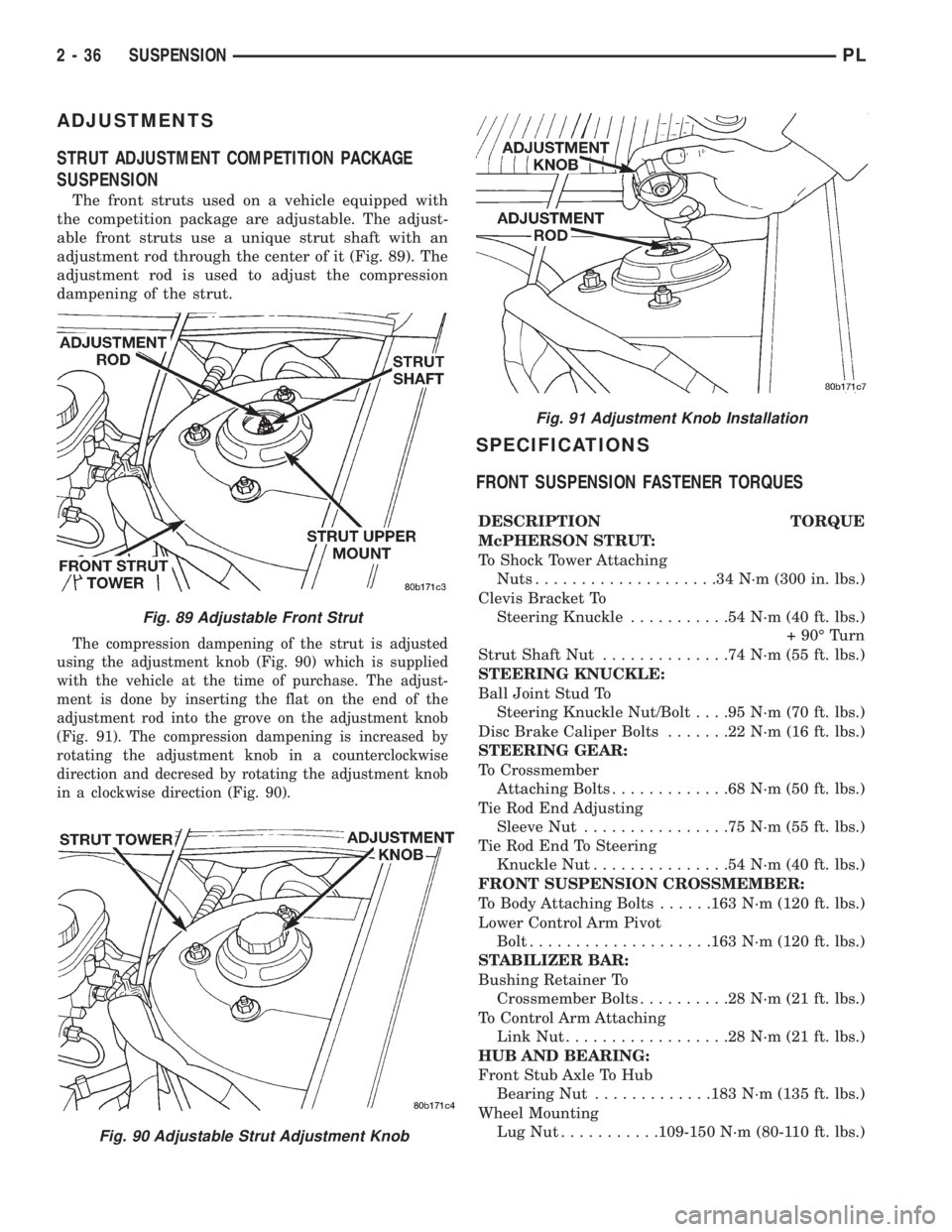
The front struts used on a vehicle equipped with
the competition package are adjustable. The adjust-
able front struts use a unique strut shaft with an
adjustment rod through the center of it (Fig. 89). The
adjustment rod is used to adjust the compression
dampening of the strut.
The compression dampening of the strut is adjusted
using the adjustment knob (Fig. 90) which is supplied
with the vehicle at the time of purchase. The adjust-
ment is done by inserting the flat on the end of the
adjustment rod into the grove on the adjustment knob
(Fig. 91). The compression dampening is increased by
rotating the adjustment knob in a counterclockwise
direction and decresed by rotating the adjustment knob
in a clockwise direction (Fig. 90).
SPECIFICATIONS
FRONT SUSPENSION FASTENER TORQUES
DESCRIPTION TORQUE
McPHERSON STRUT:
To Shock Tower Attaching
Nuts....................34N´m(300 in. lbs.)
Clevis Bracket To
Steering Knuckle...........54N´m(40ft.lbs.)
+ 90É Turn
Strut Shaft Nut..............74N´m(55ft.lbs.)
STEERING KNUCKLE:
Ball Joint Stud To
Steering Knuckle Nut/Bolt. . . .95 N´m (70 ft. lbs.)
Disc Brake Caliper Bolts.......22N´m(16ft.lbs.)
STEERING GEAR:
To Crossmember
Attaching Bolts.............68N´m(50ft.lbs.)
Tie Rod End Adjusting
Sleeve Nut................75N´m(55ft.lbs.)
Tie Rod End To Steering
Knuckle Nut...............54N´m(40ft.lbs.)
FRONT SUSPENSION CROSSMEMBER:
To Body Attaching Bolts......163 N´m (120 ft. lbs.)
Lower Control Arm Pivot
Bolt....................163 N´m (120 ft. lbs.)
STABILIZER BAR:
Bushing Retainer To
Crossmember Bolts..........28N´m(21ft.lbs.)
To Control Arm Attaching
Link Nut..................28N´m(21ft.lbs.)
HUB AND BEARING:
Front Stub Axle To Hub
Bearing Nut.............183 N´m (135 ft. lbs.)
Wheel Mounting
LugNut...........109-150 N´m (80-110 ft. lbs.)
Fig. 89 Adjustable Front Strut
Fig. 90 Adjustable Strut Adjustment Knob
Fig. 91 Adjustment Knob Installation
2 - 36 SUSPENSIONPL