Page 286 of 1659
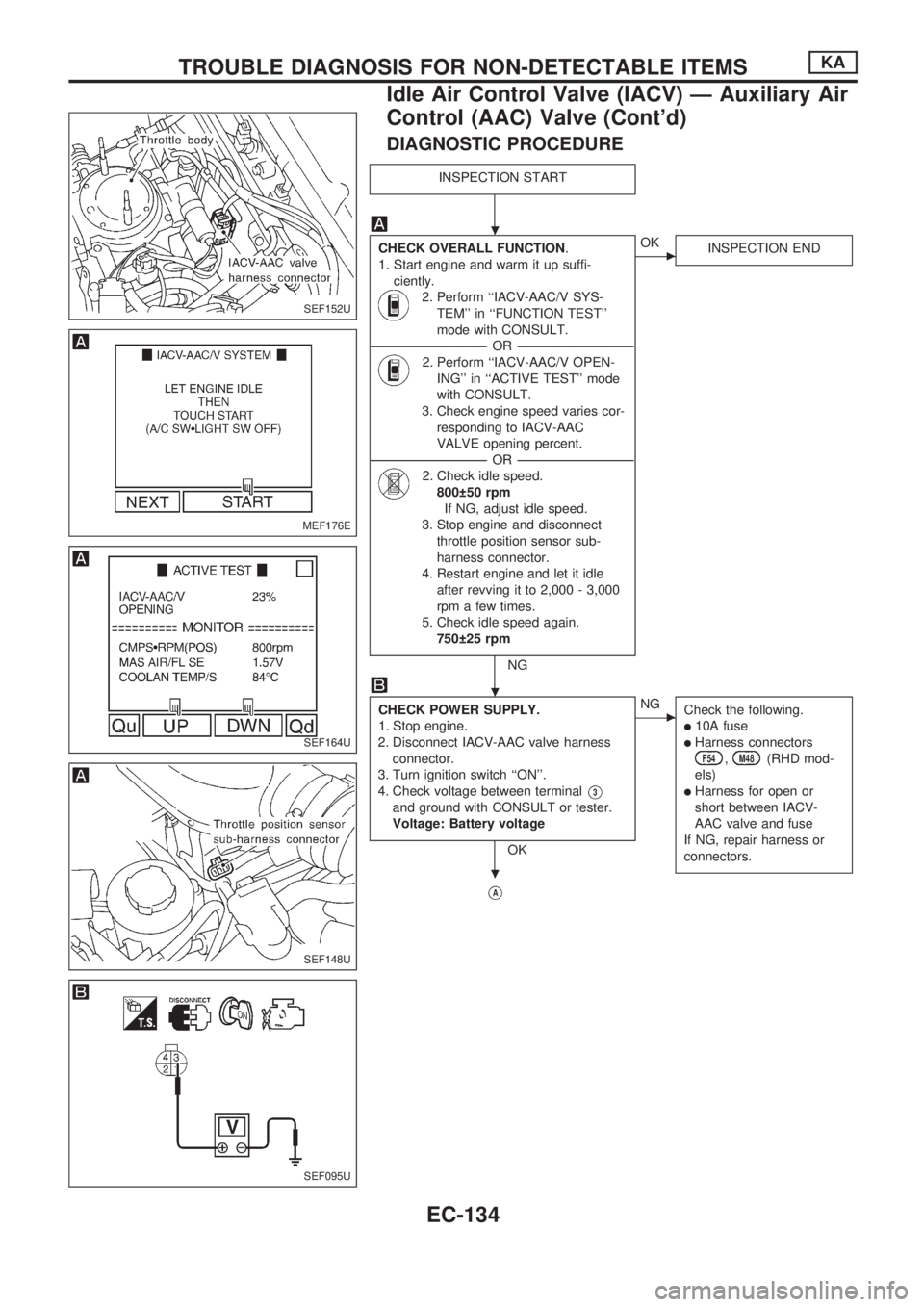
DIAGNOSTIC PROCEDURE
INSPECTION START
CHECK OVERALL FUNCTION.
1. Start engine and warm it up suffi-
ciently.
2. Perform ``IACV-AAC/V SYS-
TEM'' in ``FUNCTION TEST''
mode with CONSULT.
----------------------------------------------------------------------------------------------------------------------------------OR----------------------------------------------------------------------------------------------------------------------------------
2. Perform ``IACV-AAC/V OPEN-
ING'' in ``ACTIVE TEST'' mode
with CONSULT.
3. Check engine speed varies cor-
responding to IACV-AAC
VALVE opening percent.
----------------------------------------------------------------------------------------------------------------------------------OR----------------------------------------------------------------------------------------------------------------------------------
2. Check idle speed.
800 50 rpm
If NG, adjust idle speed.
3. Stop engine and disconnect
throttle position sensor sub-
harness connector.
4. Restart engine and let it idle
after revving it to 2,000 - 3,000
rpm a few times.
5. Check idle speed again.
750 25 rpm
NG
cOK
INSPECTION END
CHECK POWER SUPPLY.
1. Stop engine.
2. Disconnect IACV-AAC valve harness
connector.
3. Turn ignition switch ``ON''.
4. Check voltage between terminal
V3
and ground with CONSULT or tester.
Voltage: Battery voltage
OK
cNG
Check the following.
l10A fuse
lHarness connectorsF54,M48(RHD mod-
els)
lHarness for open or
short between IACV-
AAC valve and fuse
If NG, repair harness or
connectors.
VA
SEF152U
MEF176E
SEF164U
SEF148U
SEF095U
.
.
.
TROUBLE DIAGNOSIS FOR NON-DETECTABLE ITEMSKA
Idle Air Control Valve (IACV) Ð Auxiliary Air
Control (AAC) Valve (Cont'd)
EC-134
Page 303 of 1659
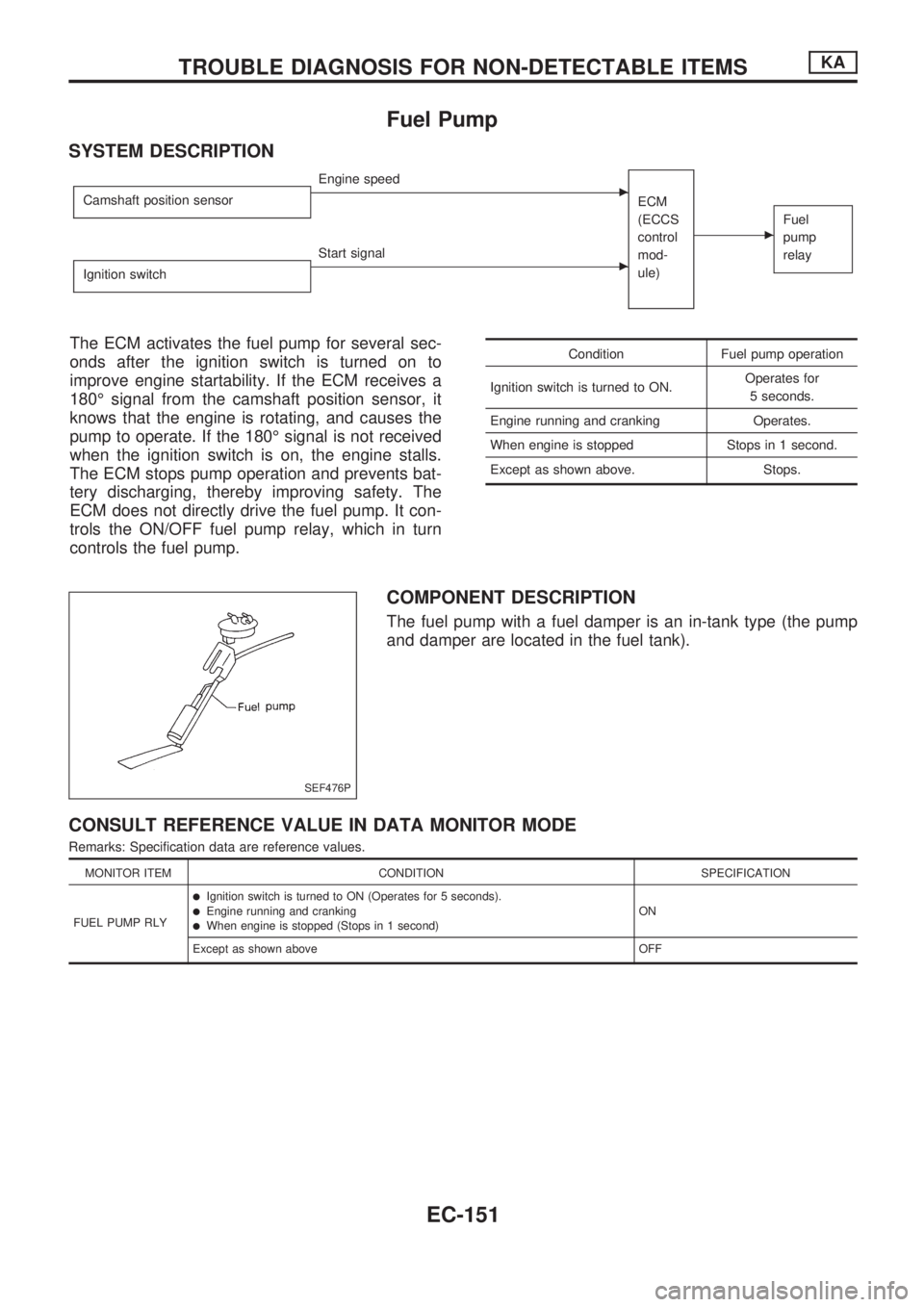
Fuel Pump
SYSTEM DESCRIPTION
Camshaft position sensorcEngine speed
ECM
(ECCS
control
mod-
ule)
cFuel
pump
relay
Ignition switchcStart signal
The ECM activates the fuel pump for several sec-
onds after the ignition switch is turned on to
improve engine startability. If the ECM receives a
180É signal from the camshaft position sensor, it
knows that the engine is rotating, and causes the
pump to operate. If the 180É signal is not received
when the ignition switch is on, the engine stalls.
The ECM stops pump operation and prevents bat-
tery discharging, thereby improving safety. The
ECM does not directly drive the fuel pump. It con-
trols the ON/OFF fuel pump relay, which in turn
controls the fuel pump.Condition Fuel pump operation
Ignition switch is turned to ON.Operates for
5 seconds.
Engine running and cranking Operates.
When engine is stopped Stops in 1 second.
Except as shown above. Stops.
COMPONENT DESCRIPTION
The fuel pump with a fuel damper is an in-tank type (the pump
and damper are located in the fuel tank).
CONSULT REFERENCE VALUE IN DATA MONITOR MODE
Remarks: Specification data are reference values.
MONITOR ITEM CONDITION SPECIFICATION
FUEL PUMP RLY
lIgnition switch is turned to ON (Operates for 5 seconds).lEngine running and crankinglWhen engine is stopped (Stops in 1 second)ON
Except as shown above OFF
SEF476P
TROUBLE DIAGNOSIS FOR NON-DETECTABLE ITEMSKA
EC-151
Page 313 of 1659
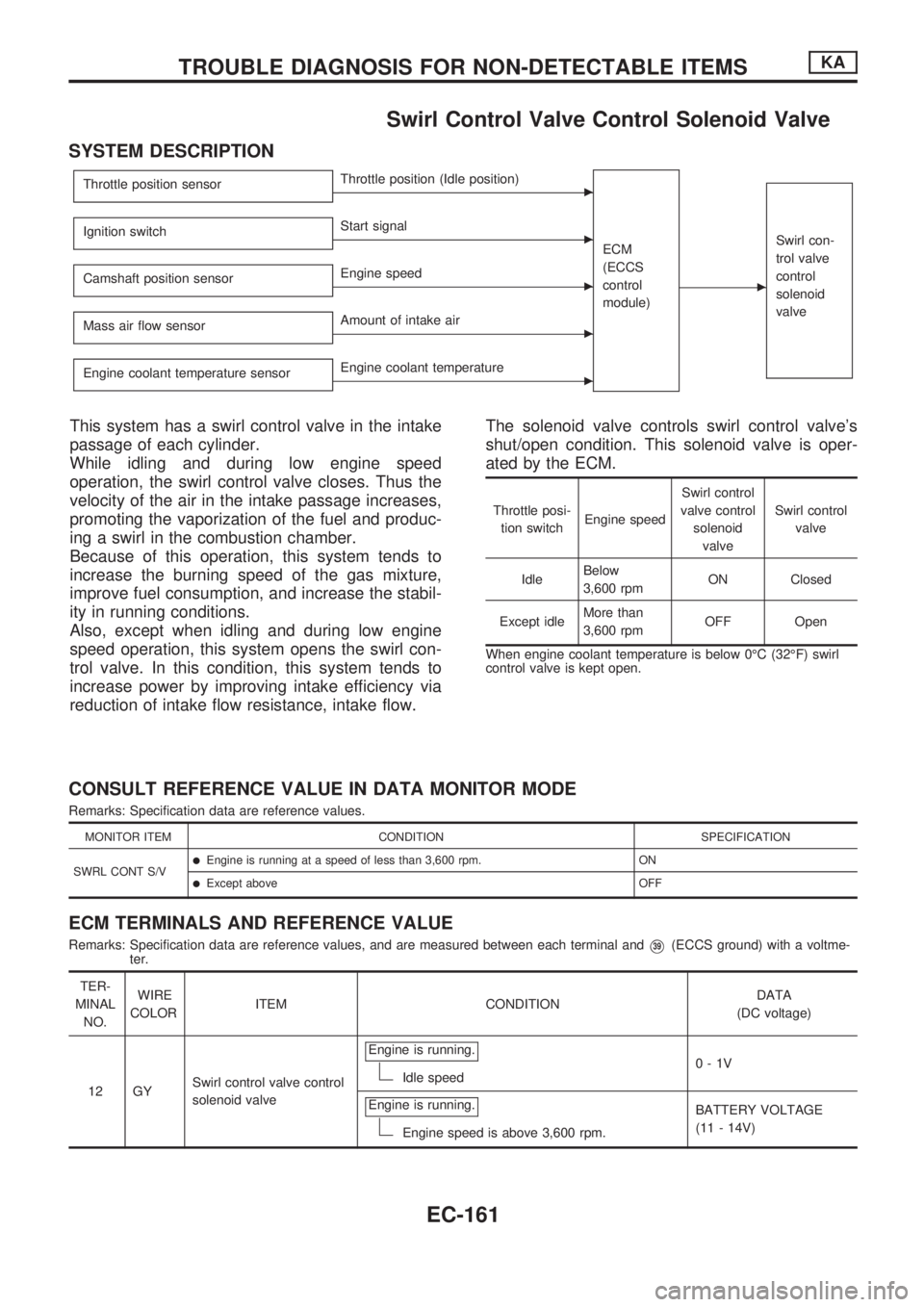
Swirl Control Valve Control Solenoid Valve
SYSTEM DESCRIPTION
Throttle position sensorcThrottle position (Idle position)
ECM
(ECCS
control
module)
c
Swirl con-
trol valve
control
solenoid
valveIgnition switchcStart signal
Camshaft position sensor
cEngine speed
Mass air flow sensor
cAmount of intake air
Engine coolant temperature sensor
cEngine coolant temperature
This system has a swirl control valve in the intake
passage of each cylinder.
While idling and during low engine speed
operation, the swirl control valve closes. Thus the
velocity of the air in the intake passage increases,
promoting the vaporization of the fuel and produc-
ing a swirl in the combustion chamber.
Because of this operation, this system tends to
increase the burning speed of the gas mixture,
improve fuel consumption, and increase the stabil-
ity in running conditions.
Also, except when idling and during low engine
speed operation, this system opens the swirl con-
trol valve. In this condition, this system tends to
increase power by improving intake efficiency via
reduction of intake flow resistance, intake flow.The solenoid valve controls swirl control valve's
shut/open condition. This solenoid valve is oper-
ated by the ECM.
Throttle posi-
tion switchEngine speedSwirl control
valve control
solenoid
valveSwirl control
valve
IdleBelow
3,600 rpmON Closed
Except idleMore than
3,600 rpmOFF Open
When engine coolant temperature is below 0ÉC (32ÉF) swirl
control valve is kept open.
CONSULT REFERENCE VALUE IN DATA MONITOR MODE
Remarks: Specification data are reference values.
MONITOR ITEM CONDITION SPECIFICATION
SWRL CONT S/V
lEngine is running at a speed of less than 3,600 rpm. ON
lExcept above OFF
ECM TERMINALS AND REFERENCE VALUE
Remarks: Specification data are reference values, and are measured between each terminal andV39(ECCS ground) with a voltme-
ter.
TER-
MINAL
NO.WIRE
COLORITEM CONDITIONDATA
(DC voltage)
12 GYSwirl control valve control
solenoid valveEngine is running.
Idle speed0-1V
Engine is running.
Engine speed is above 3,600 rpm.BATTERY VOLTAGE
(11 - 14V)
TROUBLE DIAGNOSIS FOR NON-DETECTABLE ITEMSKA
EC-161
Page 355 of 1659
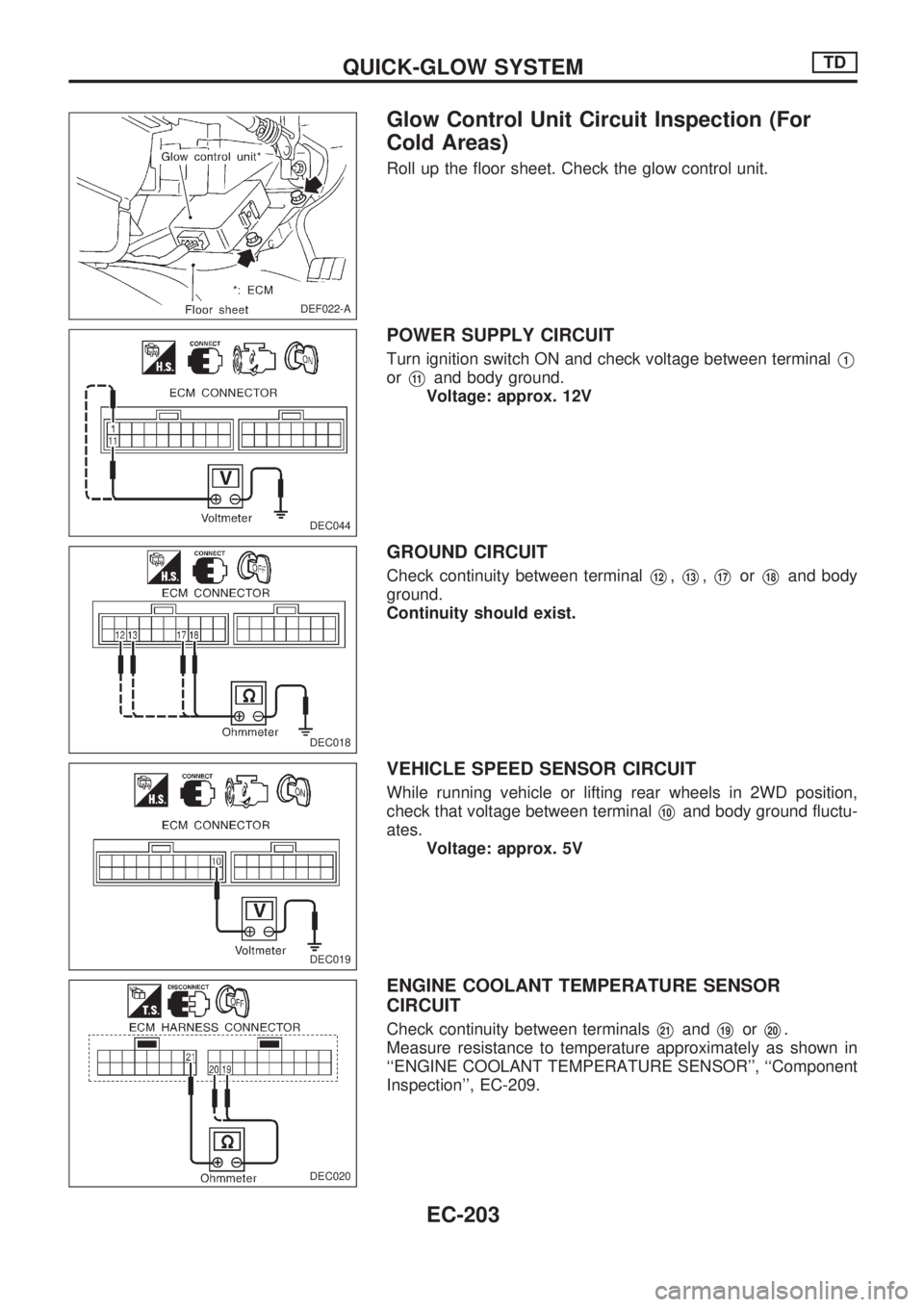
Glow Control Unit Circuit Inspection (For
Cold Areas)
Roll up the floor sheet. Check the glow control unit.
POWER SUPPLY CIRCUIT
Turn ignition switch ON and check voltage between terminalV1
orV11and body ground.
Voltage: approx. 12V
GROUND CIRCUIT
Check continuity between terminalV12,V13,V17orV18and body
ground.
Continuity should exist.
VEHICLE SPEED SENSOR CIRCUIT
While running vehicle or lifting rear wheels in 2WD position,
check that voltage between terminal
V10and body ground fluctu-
ates.
Voltage: approx. 5V
ENGINE COOLANT TEMPERATURE SENSOR
CIRCUIT
Check continuity between terminalsV21andV19orV20.
Measure resistance to temperature approximately as shown in
``ENGINE COOLANT TEMPERATURE SENSOR'', ``Component
Inspection'', EC-209.
DEF022-A
.
DEC044
DEC018
DEC019
DEC020
QUICK-GLOW SYSTEMTD
EC-203
Page 358 of 1659
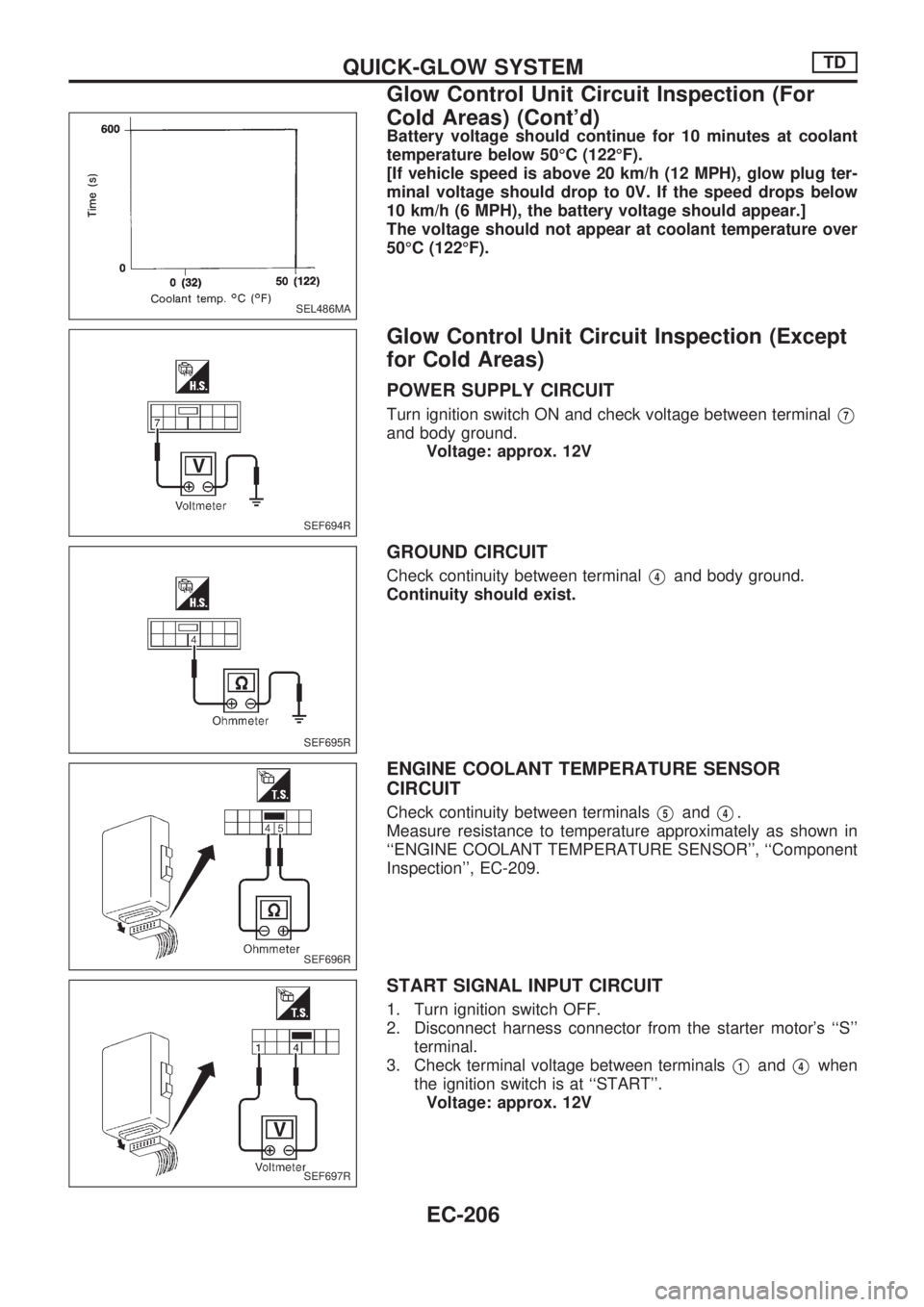
Battery voltage should continue for 10 minutes at coolant
temperature below 50ÉC (122ÉF).
[If vehicle speed is above 20 km/h (12 MPH), glow plug ter-
minal voltage should drop to 0V. If the speed drops below
10 km/h (6 MPH), the battery voltage should appear.]
The voltage should not appear at coolant temperature over
50ÉC (122ÉF).
Glow Control Unit Circuit Inspection (Except
for Cold Areas)
POWER SUPPLY CIRCUIT
Turn ignition switch ON and check voltage between terminalV7
and body ground.
Voltage: approx. 12V
GROUND CIRCUIT
Check continuity between terminalV4and body ground.
Continuity should exist.
ENGINE COOLANT TEMPERATURE SENSOR
CIRCUIT
Check continuity between terminalsV5andV4.
Measure resistance to temperature approximately as shown in
``ENGINE COOLANT TEMPERATURE SENSOR'', ``Component
Inspection'', EC-209.
START SIGNAL INPUT CIRCUIT
1. Turn ignition switch OFF.
2. Disconnect harness connector from the starter motor's ``S''
terminal.
3. Check terminal voltage between terminals
V1andV4when
the ignition switch is at ``START''.
Voltage: approx. 12V
SEL486MA
SEF694R
SEF695R
SEF696R
SEF697R
QUICK-GLOW SYSTEMTD
Glow Control Unit Circuit Inspection (For
Cold Areas) (Cont'd)
EC-206
Page 361 of 1659
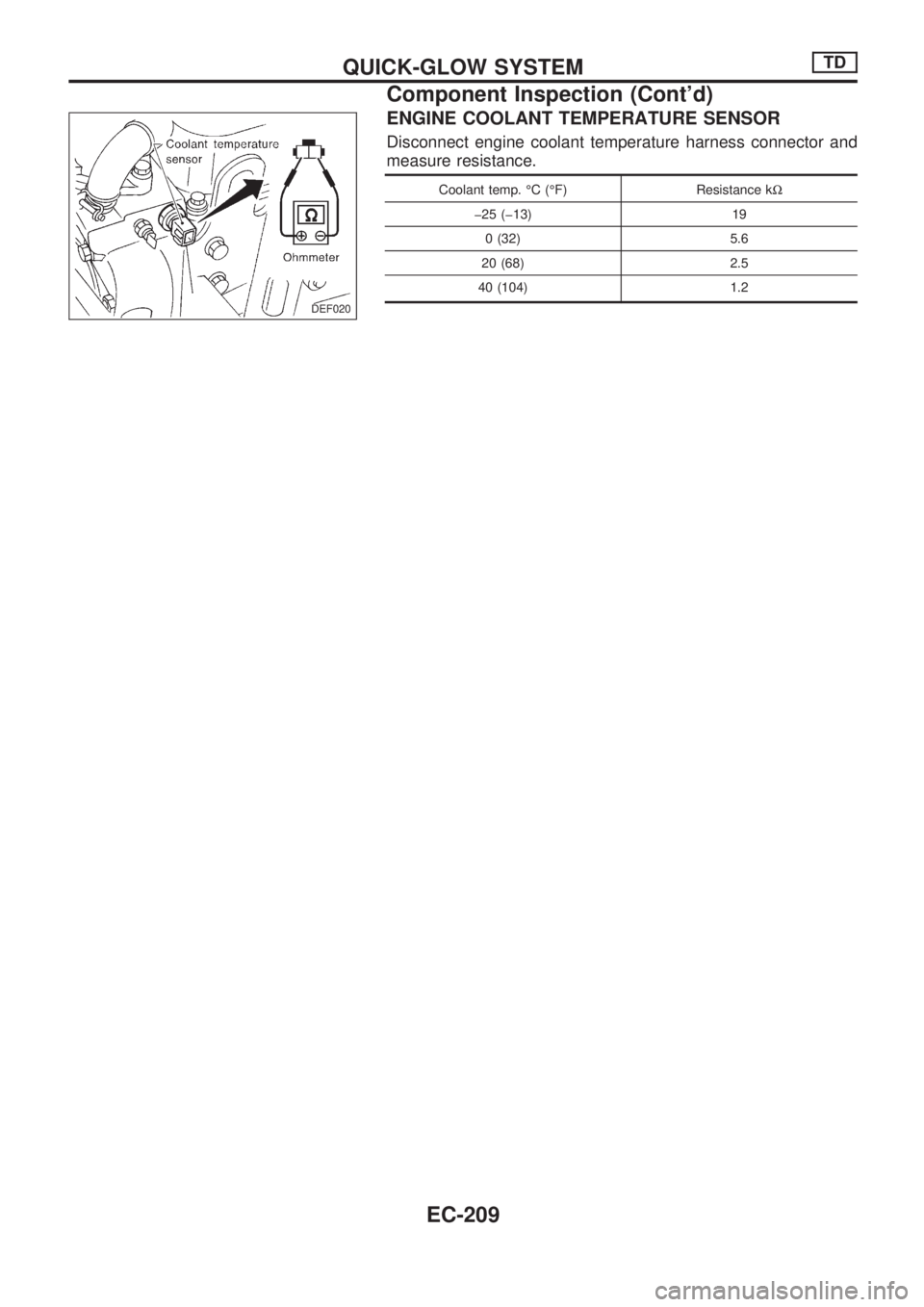
ENGINE COOLANT TEMPERATURE SENSOR
Disconnect engine coolant temperature harness connector and
measure resistance.
Coolant temp. ÉC (ÉF) Resistance kW
þ25 (þ13) 19
0 (32) 5.6
20 (68) 2.5
40 (104) 1.2
DEF020
QUICK-GLOW SYSTEMTD
Component Inspection (Cont'd)
EC-209
Page 370 of 1659
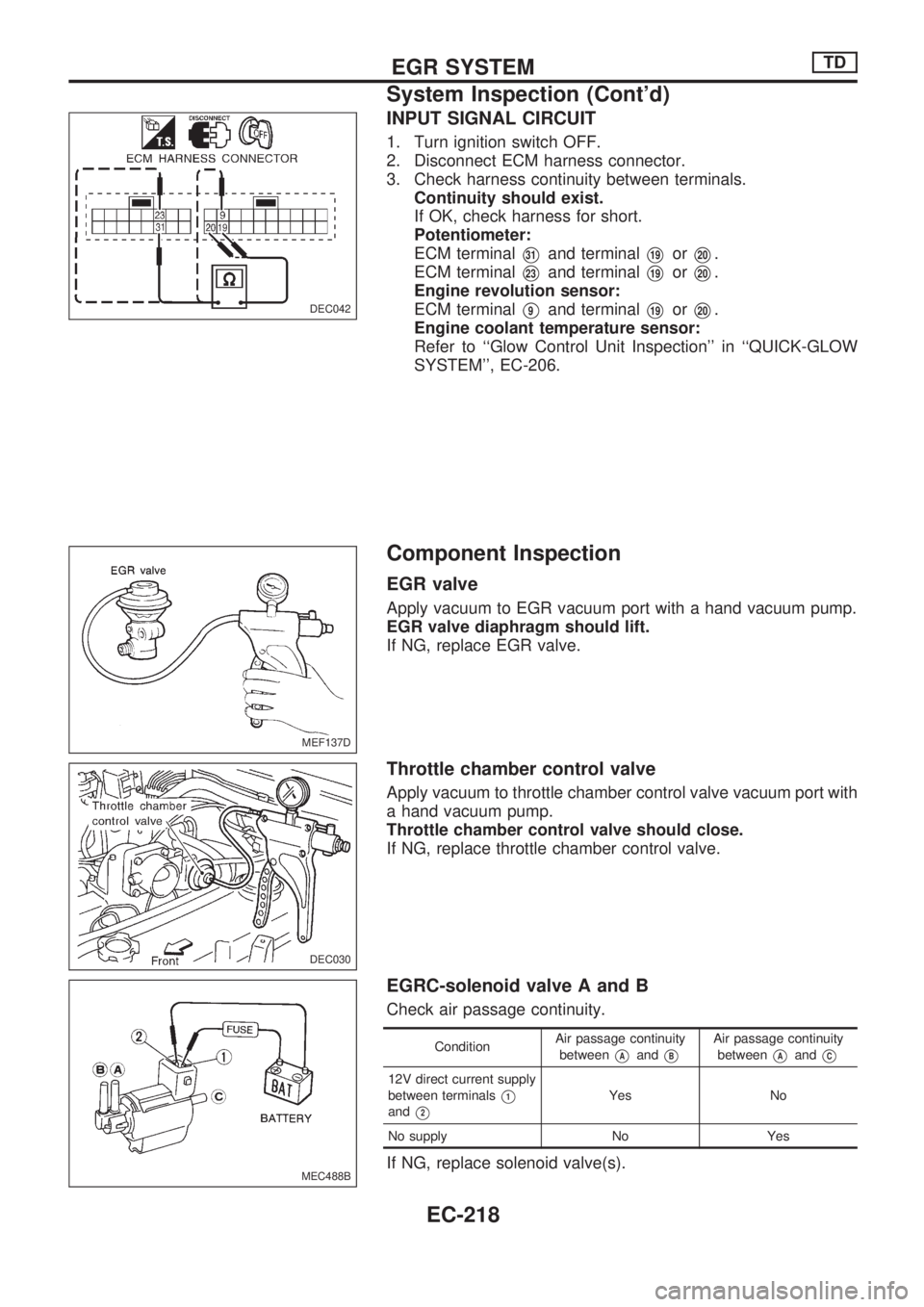
INPUT SIGNAL CIRCUIT
1. Turn ignition switch OFF.
2. Disconnect ECM harness connector.
3. Check harness continuity between terminals.
Continuity should exist.
If OK, check harness for short.
Potentiometer:
ECM terminal
V31and terminalV19orV20.
ECM terminal
V23and terminalV19orV20.
Engine revolution sensor:
ECM terminal
V9and terminalV19orV20.
Engine coolant temperature sensor:
Refer to ``Glow Control Unit Inspection'' in ``QUICK-GLOW
SYSTEM'', EC-206.
Component Inspection
EGR valve
Apply vacuum to EGR vacuum port with a hand vacuum pump.
EGR valve diaphragm should lift.
If NG, replace EGR valve.
Throttle chamber control valve
Apply vacuum to throttle chamber control valve vacuum port with
a hand vacuum pump.
Throttle chamber control valve should close.
If NG, replace throttle chamber control valve.
EGRC-solenoid valve A and B
Check air passage continuity.
ConditionAir passage continuity
betweenVAandVB
Air passage continuity
between
VAandVC
12V direct current supply
between terminals
V1
andV2
Yes No
No supply No Yes
If NG, replace solenoid valve(s).
DEC042
MEF137D
DEC030
MEC488B
EGR SYSTEMTD
System Inspection (Cont'd)
EC-218
Page 371 of 1659
Engine revolution sensor
1. Disconnect engine revolution sensor harness connector.
2. Check resistance between terminals
V1andV2.
Resistance: Approximately 1.6 kW[at 25ÉC (77ÉF)]
If NG, replace sensor.
Potentiometer
1. Disconnect potentiometer harness connector.
2. Make sure that resistance between terminals
V2andV3
changes when accelerator operated.
Accelerator pedal condition Resistance kW[at 20ÉC (68ÉF)]
Completely released Approximately 0.7
Partially depressed 0.7 - 5
Completely depressed Approximately 5
If NG, replace potentiometer.
Atmospheric pressure sensor
This sensor is inside ECM and not replaceable.
EGR system should not operate under atmospheric pressure
below 90.0 kPa (900 mbar, 675 mmHg, 26.57 inHg).
Engine coolant temperature sensor
Refer to ``Component Inspection'' in ``QUICK-GLOW SYSTEM'',
EC-209.
DEC031
DEC032
EGR SYSTEMTD
Component Inspection (Cont'd)
EC-219
![NISSAN PICK-UP 1998 Repair Manual Engine revolution sensor
1. Disconnect engine revolution sensor harness connector.
2. Check resistance between terminals
V1andV2.
Resistance: Approximately 1.6 kW[at 25ÉC (77ÉF)]
If NG, replace sens](/manual-img/5/57374/w960_57374-370.png "NISSAN PICK-UP 1998 Repair Manual Engine revolution sensor
1. Disconnect engine revolution sensor harness connector.
2. Check resistance between terminals
V1andV2.
Resistance: Approximately 1.6 kW[at 25ÉC (77ÉF)]
If NG, replace sens")