Page 757 of 1659
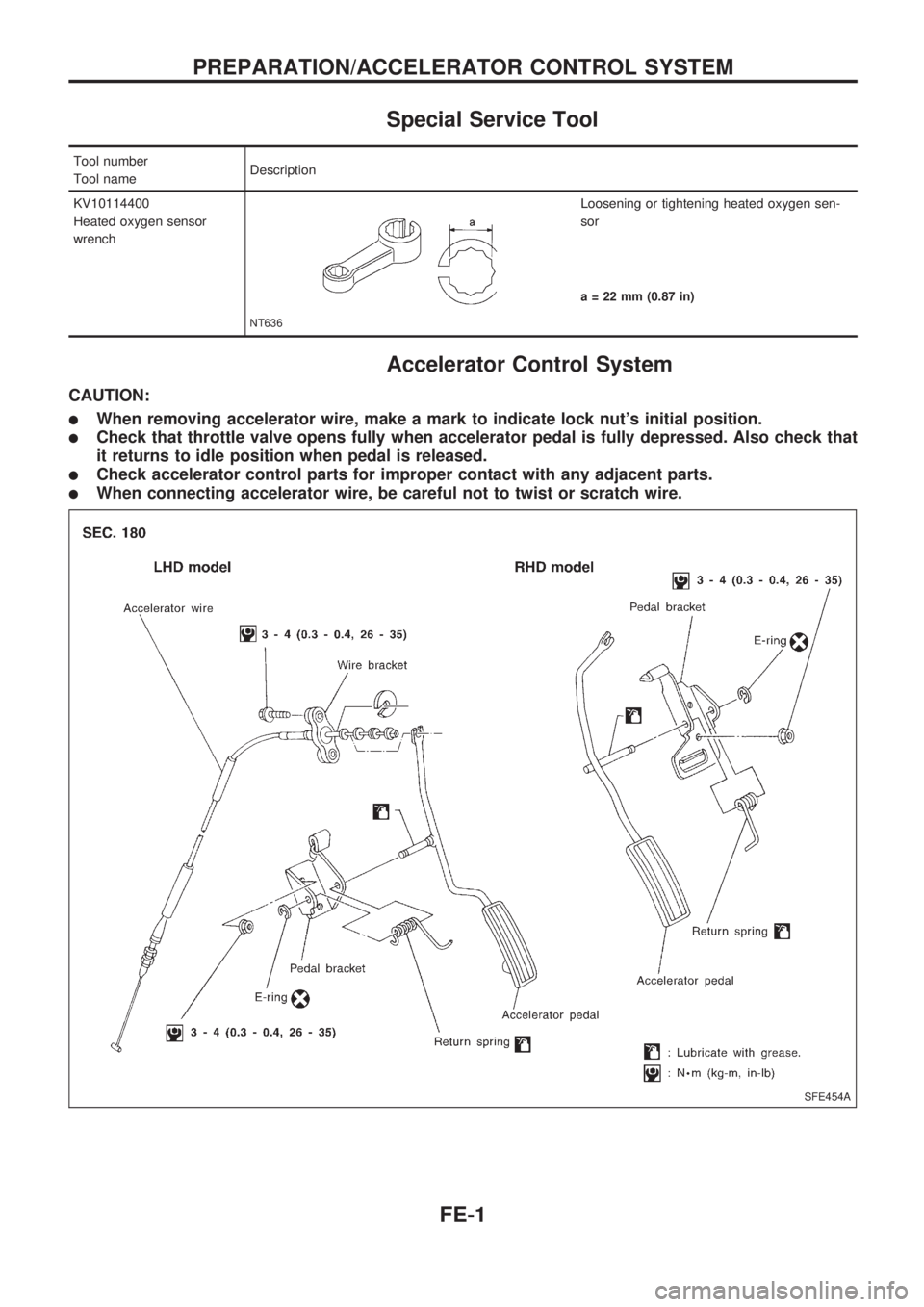
Special Service Tool
Tool number
Tool nameDescription
KV10114400
Heated oxygen sensor
wrench
NT636
Loosening or tightening heated oxygen sen-
sor
a = 22 mm (0.87 in)
Accelerator Control System
CAUTION:
lWhen removing accelerator wire, make a mark to indicate lock nut's initial position.
lCheck that throttle valve opens fully when accelerator pedal is fully depressed. Also check that
it returns to idle position when pedal is released.
lCheck accelerator control parts for improper contact with any adjacent parts.
lWhen connecting accelerator wire, be careful not to twist or scratch wire.
SFE454A
PREPARATION/ACCELERATOR CONTROL SYSTEM
FE-1
Page 761 of 1659
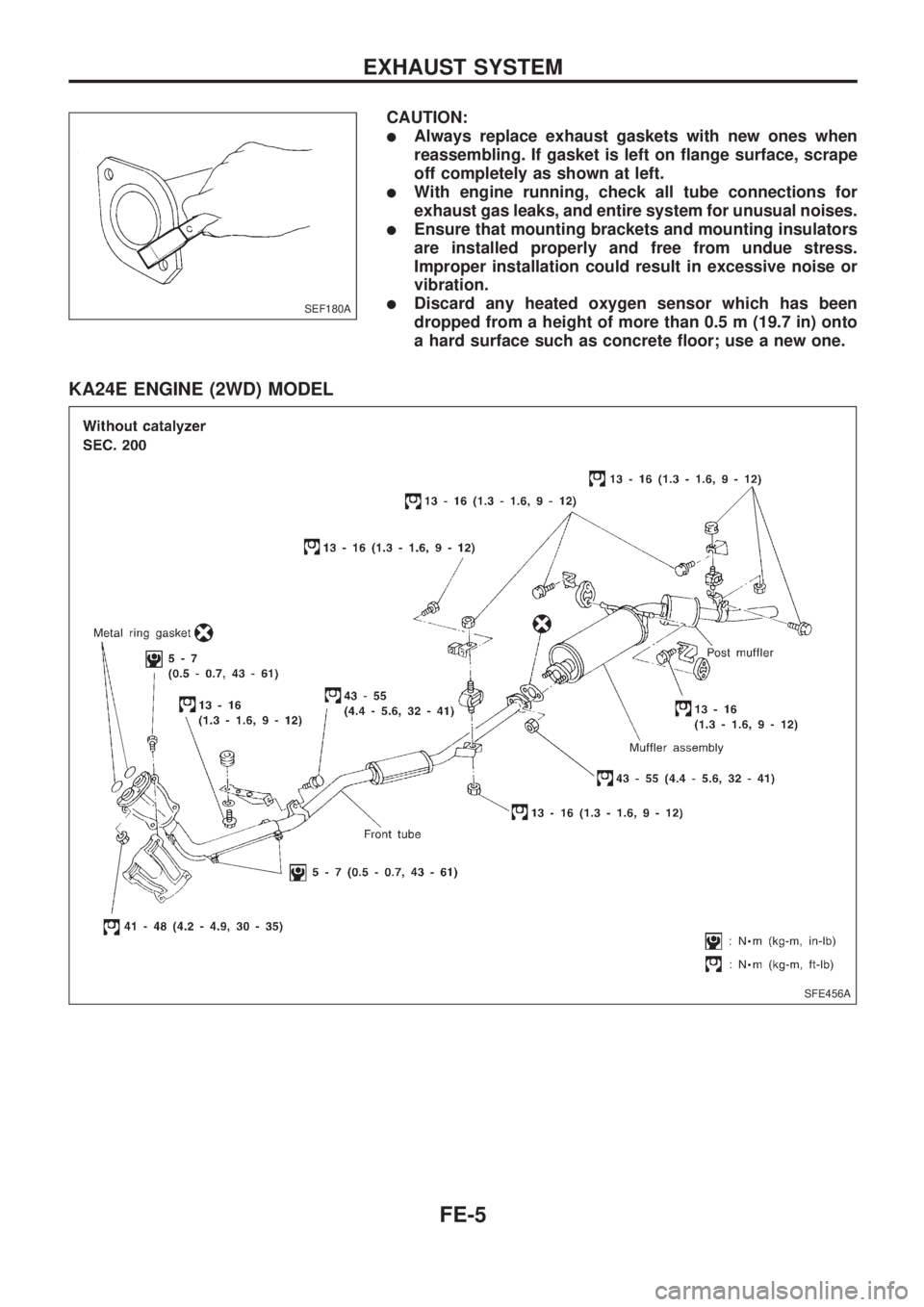
CAUTION:
lAlways replace exhaust gaskets with new ones when
reassembling. If gasket is left on flange surface, scrape
off completely as shown at left.
lWith engine running, check all tube connections for
exhaust gas leaks, and entire system for unusual noises.
lEnsure that mounting brackets and mounting insulators
are installed properly and free from undue stress.
Improper installation could result in excessive noise or
vibration.
lDiscard any heated oxygen sensor which has been
dropped from a height of more than 0.5 m (19.7 in) onto
a hard surface such as concrete floor; use a new one.
KA24E ENGINE (2WD) MODEL
SEF180A
SFE456A
EXHAUST SYSTEM
FE-5
Page 762 of 1659
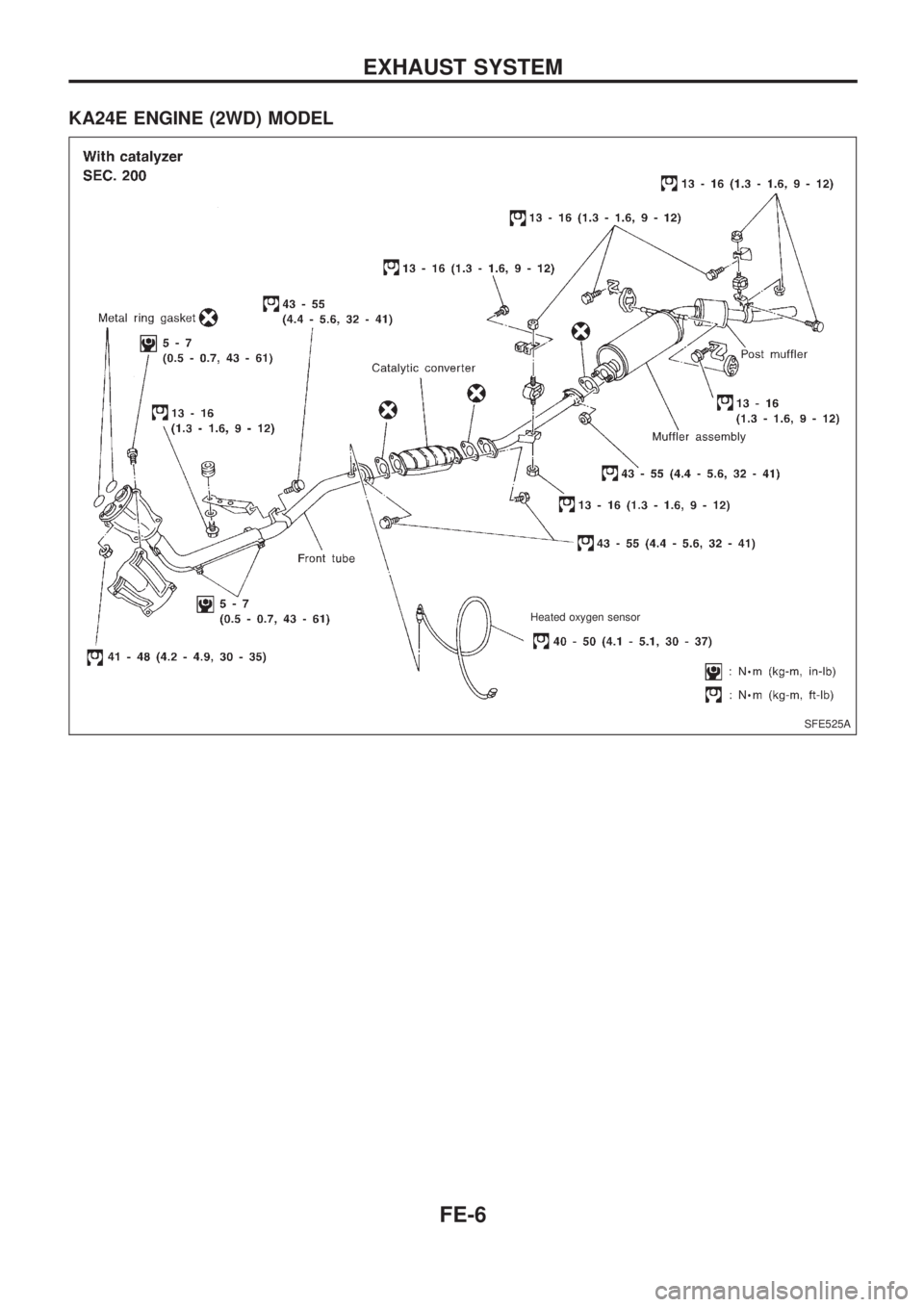
KA24E ENGINE (2WD) MODEL
SFE525A
.Heated oxygen sensor
EXHAUST SYSTEM
FE-6
Page 782 of 1659
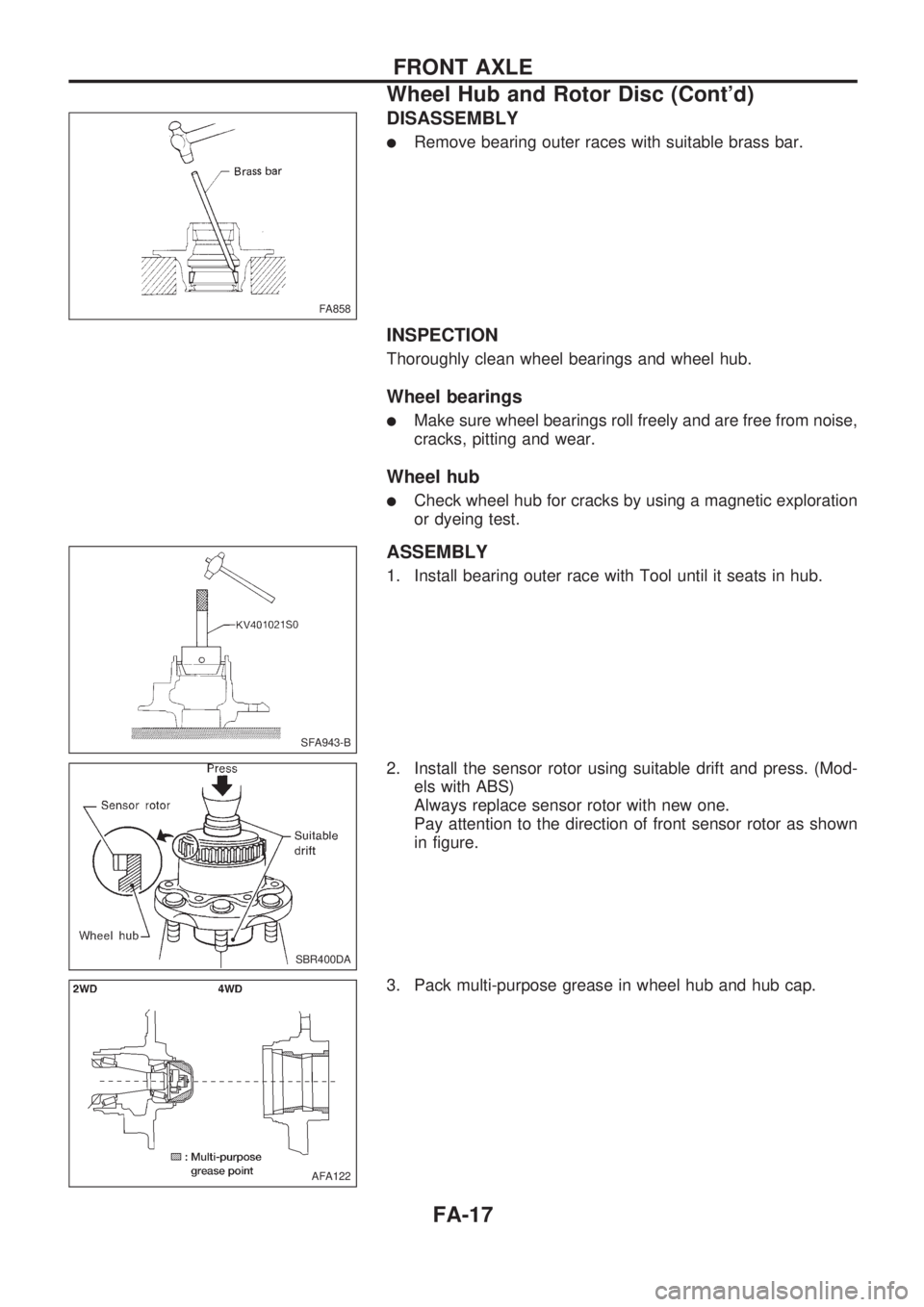
DISASSEMBLY
lRemove bearing outer races with suitable brass bar.
INSPECTION
Thoroughly clean wheel bearings and wheel hub.
Wheel bearings
lMake sure wheel bearings roll freely and are free from noise,
cracks, pitting and wear.
Wheel hub
lCheck wheel hub for cracks by using a magnetic exploration
or dyeing test.
ASSEMBLY
1. Install bearing outer race with Tool until it seats in hub.
2. Install the sensor rotor using suitable drift and press. (Mod-
els with ABS)
Always replace sensor rotor with new one.
Pay attention to the direction of front sensor rotor as shown
in figure.
3. Pack multi-purpose grease in wheel hub and hub cap.
FA858
SFA943-B
SBR400DA
AFA122
FRONT AXLE
Wheel Hub and Rotor Disc (Cont'd)
FA-17
Page 805 of 1659
Observe the following precautions to ensure safe and
proper servicing. These precautions are not described in
each individual section.
Precautions for Supplemental Restraint
System (SRS) ``AIR BAG'' (4WD models)
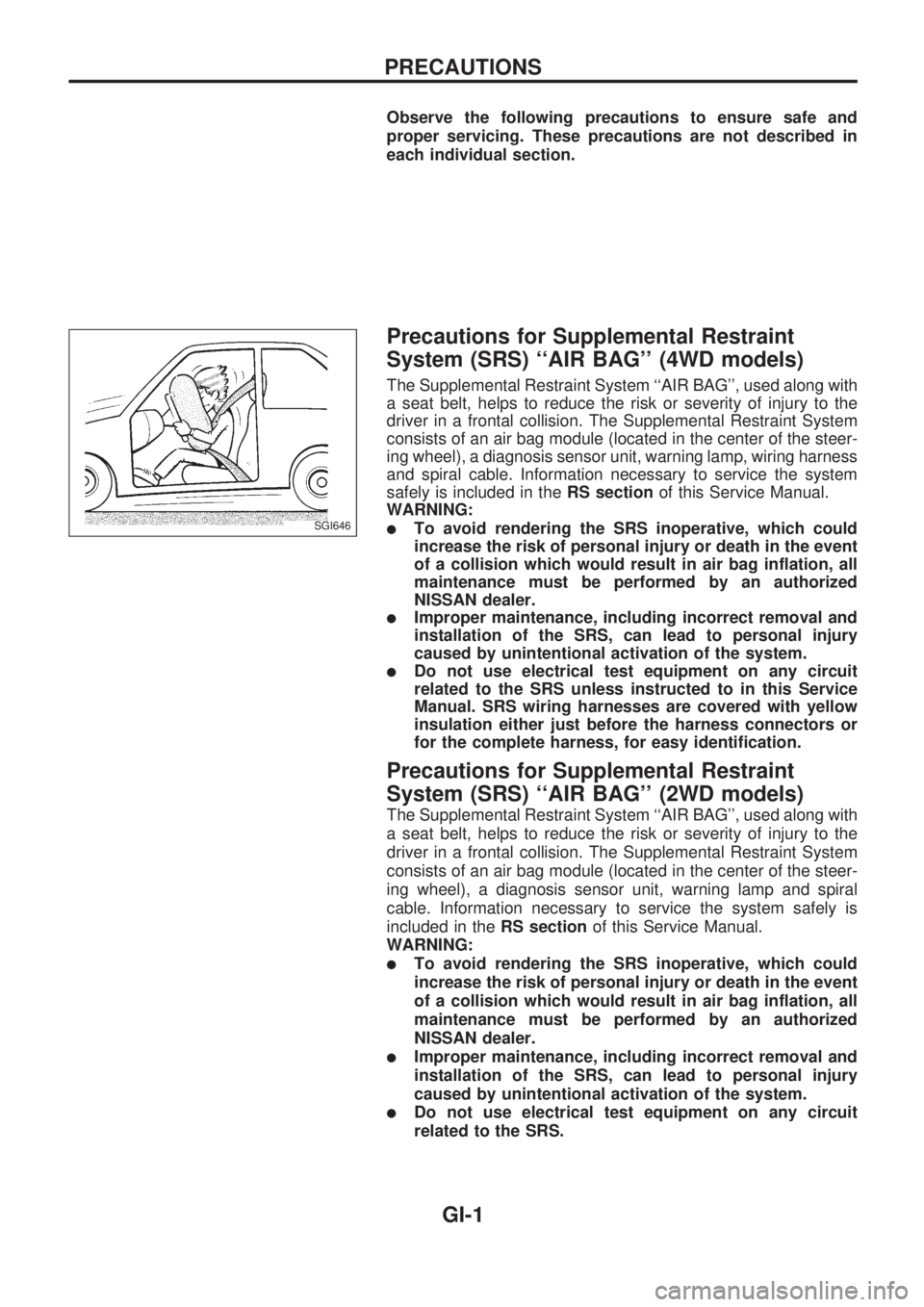
The Supplemental Restraint System ``AIR BAG'', used along with
a seat belt, helps to reduce the risk or severity of injury to the
driver in a frontal collision. The Supplemental Restraint System
consists of an air bag module (located in the center of the steer-
ing wheel), a diagnosis sensor unit, warning lamp, wiring harness
and spiral cable. Information necessary to service the system
safely is included in theRS sectionof this Service Manual.
WARNING:
lTo avoid rendering the SRS inoperative, which could
increase the risk of personal injury or death in the event
of a collision which would result in air bag inflation, all
maintenance must be performed by an authorized
NISSAN dealer.
lImproper maintenance, including incorrect removal and
installation of the SRS, can lead to personal injury
caused by unintentional activation of the system.
lDo not use electrical test equipment on any circuit
related to the SRS unless instructed to in this Service
Manual. SRS wiring harnesses are covered with yellow
insulation either just before the harness connectors or
for the complete harness, for easy identification.
Precautions for Supplemental Restraint
System (SRS) ``AIR BAG'' (2WD models)
The Supplemental Restraint System ``AIR BAG'', used along with
a seat belt, helps to reduce the risk or severity of injury to the
driver in a frontal collision. The Supplemental Restraint System
consists of an air bag module (located in the center of the steer-
ing wheel), a diagnosis sensor unit, warning lamp and spiral
cable. Information necessary to service the system safely is
included in theRS sectionof this Service Manual.
WARNING:
lTo avoid rendering the SRS inoperative, which could
increase the risk of personal injury or death in the event
of a collision which would result in air bag inflation, all
maintenance must be performed by an authorized
NISSAN dealer.
lImproper maintenance, including incorrect removal and
installation of the SRS, can lead to personal injury
caused by unintentional activation of the system.
lDo not use electrical test equipment on any circuit
related to the SRS.
SGI646
PRECAUTIONS
GI-1
Page 808 of 1659
lAfter disconnecting vacuum or air hoses, attach a tag to
indicate the proper connection.
lUse only the fluids and lubricants specified in this manual.
lUse approved bonding agent, sealants or their equivalents
when required.
lUse tools and recommended special tools where specified
for safe and efficient service repairs.
lWhen repairing the fuel, oil, water, vacuum or exhaust
systems, check all affected lines for leaks.
lDispose of drained oil or the solvent used for cleaning parts
in an appropriate manner.
WARNING:
To prevent ECM from storing the diagnostic trouble codes,
do not carelessly disconnect the harness connectors which
are related to the ECCS system and TCM (Transmission
Control Module) system. The connectors should be discon-
nected only when working according to the WORK FLOW of
TROUBLE DIAGNOSES in EC section.
Precautions for Multiport Fuel Injection
System or ECCS Engine
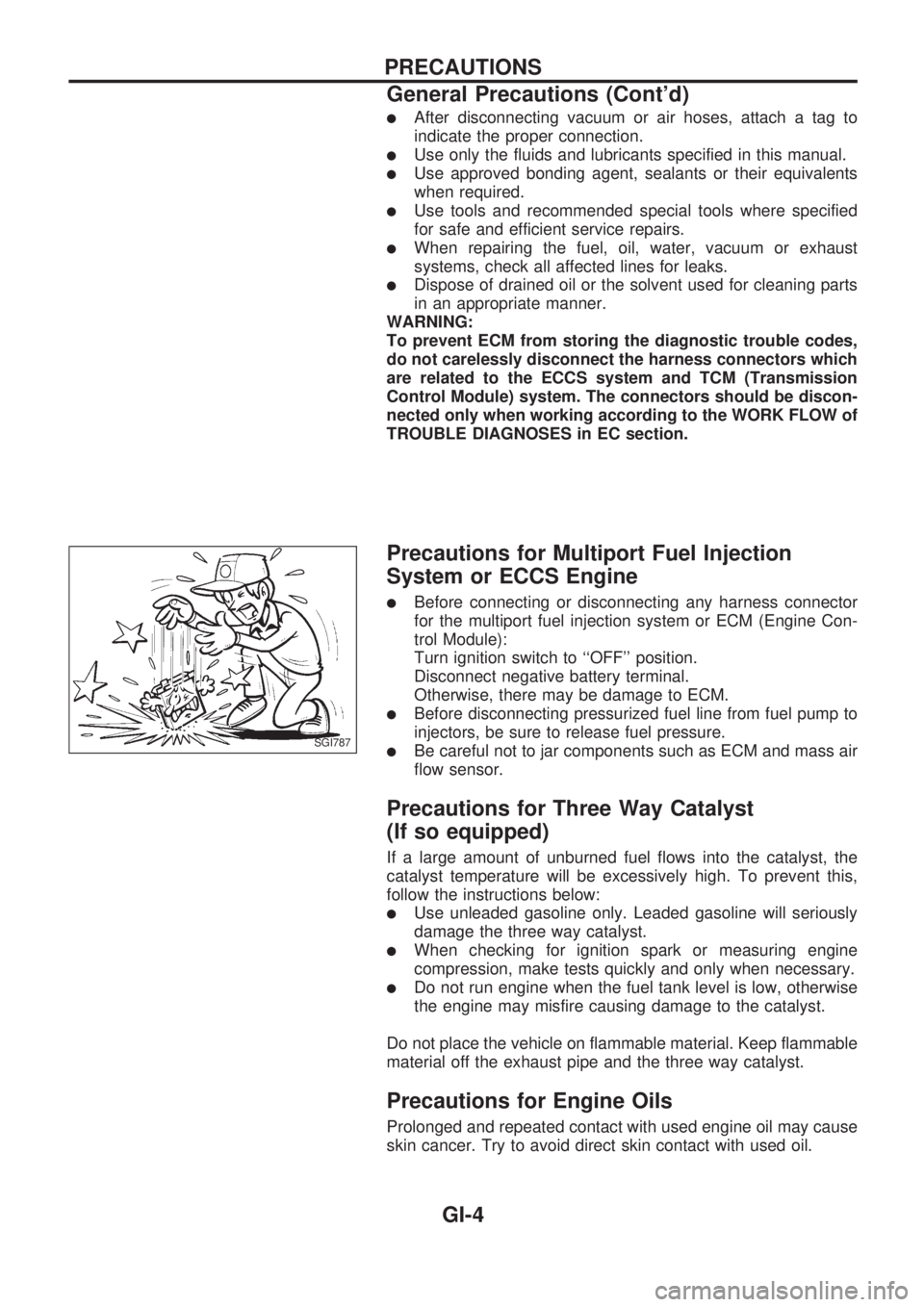
lBefore connecting or disconnecting any harness connector
for the multiport fuel injection system or ECM (Engine Con-
trol Module):
Turn ignition switch to ``OFF'' position.
Disconnect negative battery terminal.
Otherwise, there may be damage to ECM.
lBefore disconnecting pressurized fuel line from fuel pump to
injectors, be sure to release fuel pressure.
lBe careful not to jar components such as ECM and mass air
flow sensor.
Precautions for Three Way Catalyst
(If so equipped)
If a large amount of unburned fuel flows into the catalyst, the
catalyst temperature will be excessively high. To prevent this,
follow the instructions below:
lUse unleaded gasoline only. Leaded gasoline will seriously
damage the three way catalyst.
lWhen checking for ignition spark or measuring engine
compression, make tests quickly and only when necessary.
lDo not run engine when the fuel tank level is low, otherwise
the engine may misfire causing damage to the catalyst.
Do not place the vehicle on flammable material. Keep flammable
material off the exhaust pipe and the three way catalyst.
Precautions for Engine Oils
Prolonged and repeated contact with used engine oil may cause
skin cancer. Try to avoid direct skin contact with used oil.
SGI787
PRECAUTIONS
General Precautions (Cont'd)
GI-4
Page 826 of 1659
Incident Simulation Tests
INTRODUCTION
Sometimes the symptom is not present when the vehicle is brought in for service. If possible, re-create the
conditions present at the time of the incident. Doing so may help avoid a No Trouble Found Diagnosis. The
following section illustrates ways to simulate the conditions/environment under which the owner experiences
an electrical incident.
The section is broken into the six following topics:
lVehicle vibration
lHeat sensitive
lFreezing
lWater intrusion
lElectrical load
lCold or hot start up
Get a thorough description of the incident from the customer. It is important for simulating the conditions of
the problem.
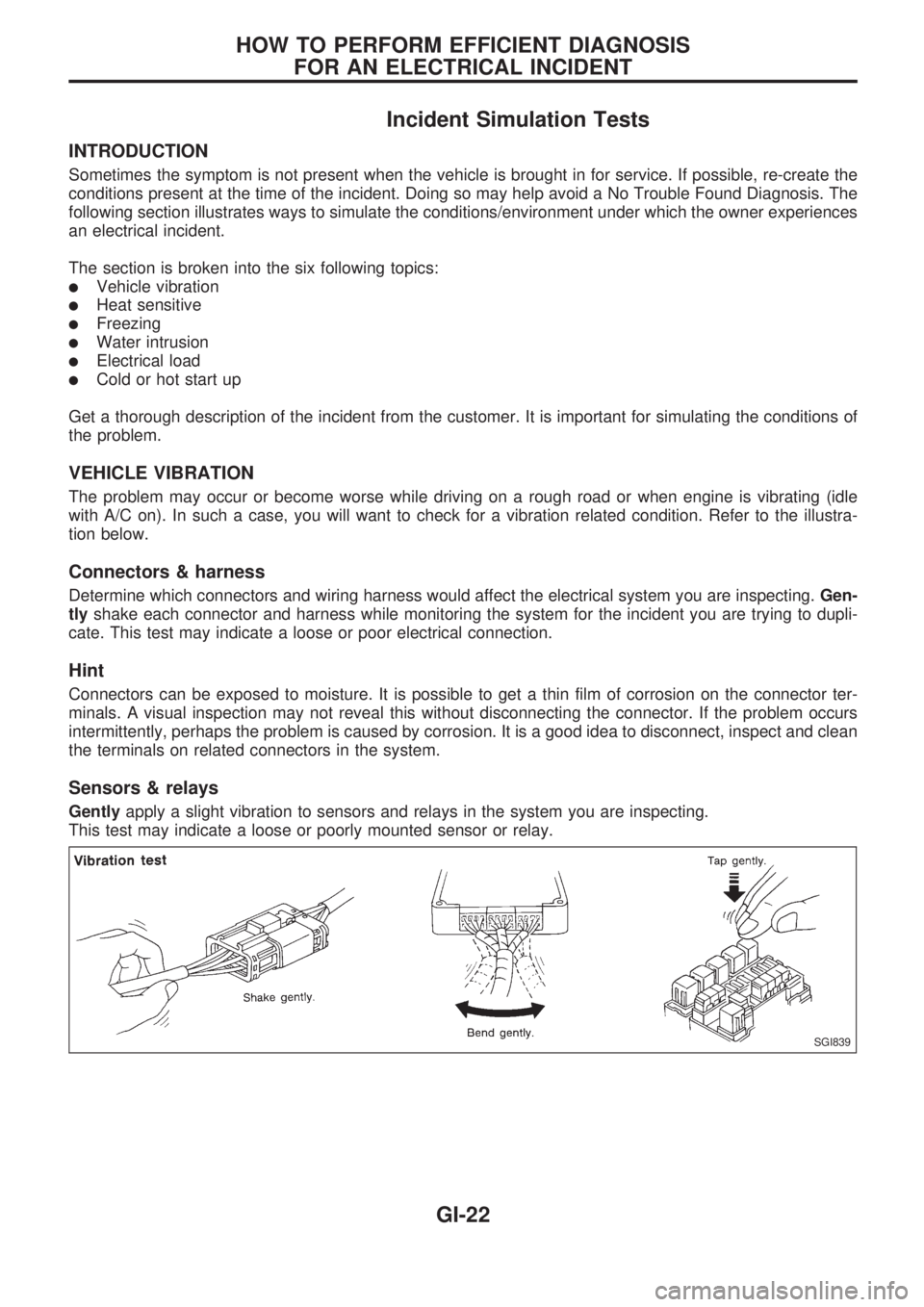
VEHICLE VIBRATION
The problem may occur or become worse while driving on a rough road or when engine is vibrating (idle
with A/C on). In such a case, you will want to check for a vibration related condition. Refer to the illustra-
tion below.
Connectors & harness
Determine which connectors and wiring harness would affect the electrical system you are inspecting.Gen-
tlyshake each connector and harness while monitoring the system for the incident you are trying to dupli-
cate. This test may indicate a loose or poor electrical connection.
Hint
Connectors can be exposed to moisture. It is possible to get a thin film of corrosion on the connector ter-
minals. A visual inspection may not reveal this without disconnecting the connector. If the problem occurs
intermittently, perhaps the problem is caused by corrosion. It is a good idea to disconnect, inspect and clean
the terminals on related connectors in the system.
Sensors & relays
Gentlyapply a slight vibration to sensors and relays in the system you are inspecting.
This test may indicate a loose or poorly mounted sensor or relay.
SGI839
HOW TO PERFORM EFFICIENT DIAGNOSIS
FOR AN ELECTRICAL INCIDENT
GI-22
Page 859 of 1659
SAE J1930 Terminology List
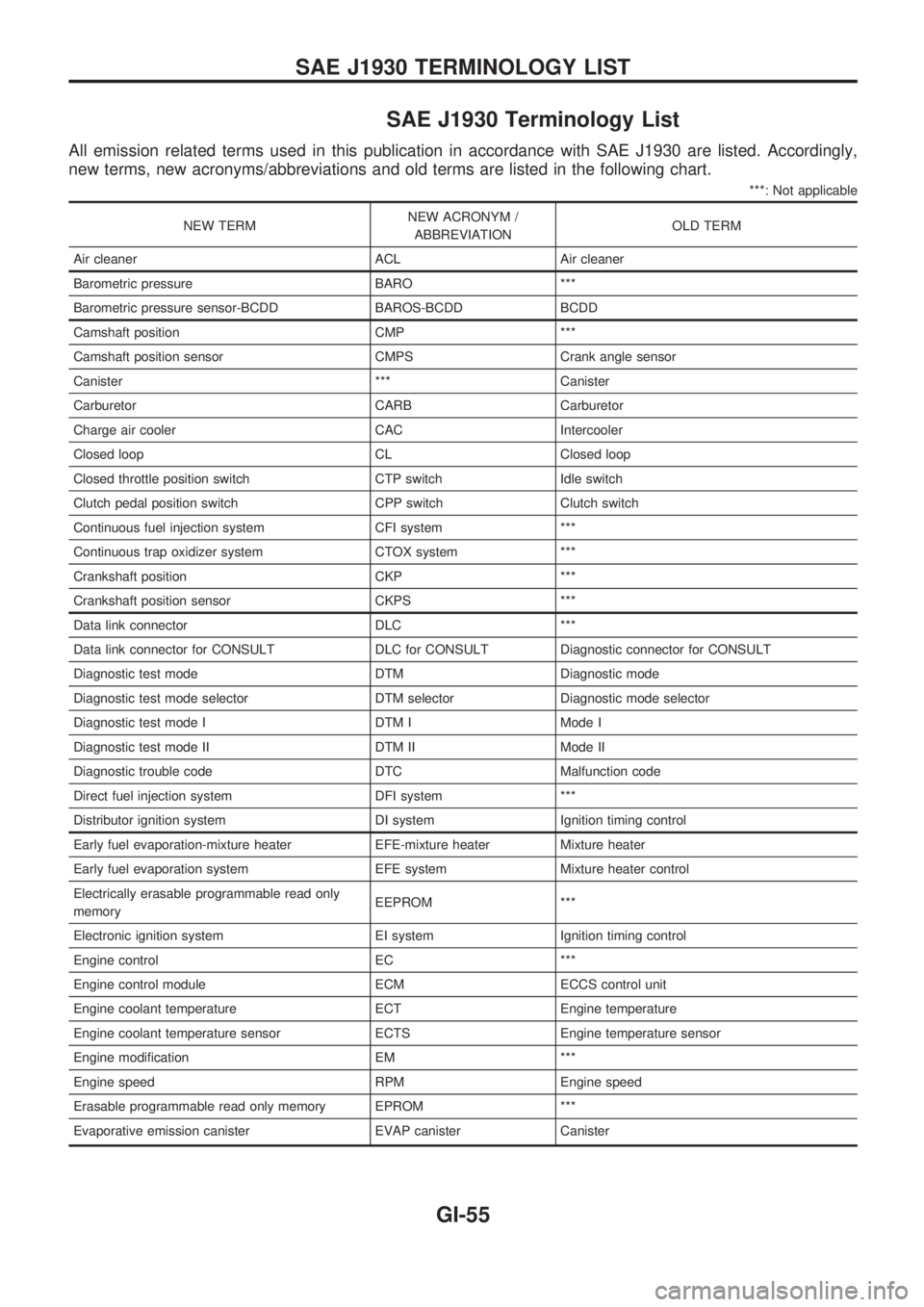
All emission related terms used in this publication in accordance with SAE J1930 are listed. Accordingly,
new terms, new acronyms/abbreviations and old terms are listed in the following chart.
***: Not applicable
NEW TERMNEW ACRONYM /
ABBREVIATIONOLD TERM
Air cleaner ACL Air cleaner
Barometric pressure BARO ***
Barometric pressure sensor-BCDD BAROS-BCDD BCDD
Camshaft position CMP ***
Camshaft position sensor CMPS Crank angle sensor
Canister *** Canister
Carburetor CARB Carburetor
Charge air cooler CAC Intercooler
Closed loop CL Closed loop
Closed throttle position switch CTP switch Idle switch
Clutch pedal position switch CPP switch Clutch switch
Continuous fuel injection system CFI system ***
Continuous trap oxidizer system CTOX system ***
Crankshaft position CKP ***
Crankshaft position sensor CKPS ***
Data link connector DLC ***
Data link connector for CONSULT DLC for CONSULT Diagnostic connector for CONSULT
Diagnostic test mode DTM Diagnostic mode
Diagnostic test mode selector DTM selector Diagnostic mode selector
Diagnostic test mode I DTM I Mode I
Diagnostic test mode II DTM II Mode II
Diagnostic trouble code DTC Malfunction code
Direct fuel injection system DFI system ***
Distributor ignition system DI system Ignition timing control
Early fuel evaporation-mixture heater EFE-mixture heater Mixture heater
Early fuel evaporation system EFE system Mixture heater control
Electrically erasable programmable read only
memoryEEPROM ***
Electronic ignition system EI system Ignition timing control
Engine control EC ***
Engine control module ECM ECCS control unit
Engine coolant temperature ECT Engine temperature
Engine coolant temperature sensor ECTS Engine temperature sensor
Engine modification EM ***
Engine speed RPM Engine speed
Erasable programmable read only memory EPROM ***
Evaporative emission canister EVAP canister Canister
SAE J1930 TERMINOLOGY LIST
GI-55