Page 276 of 1659
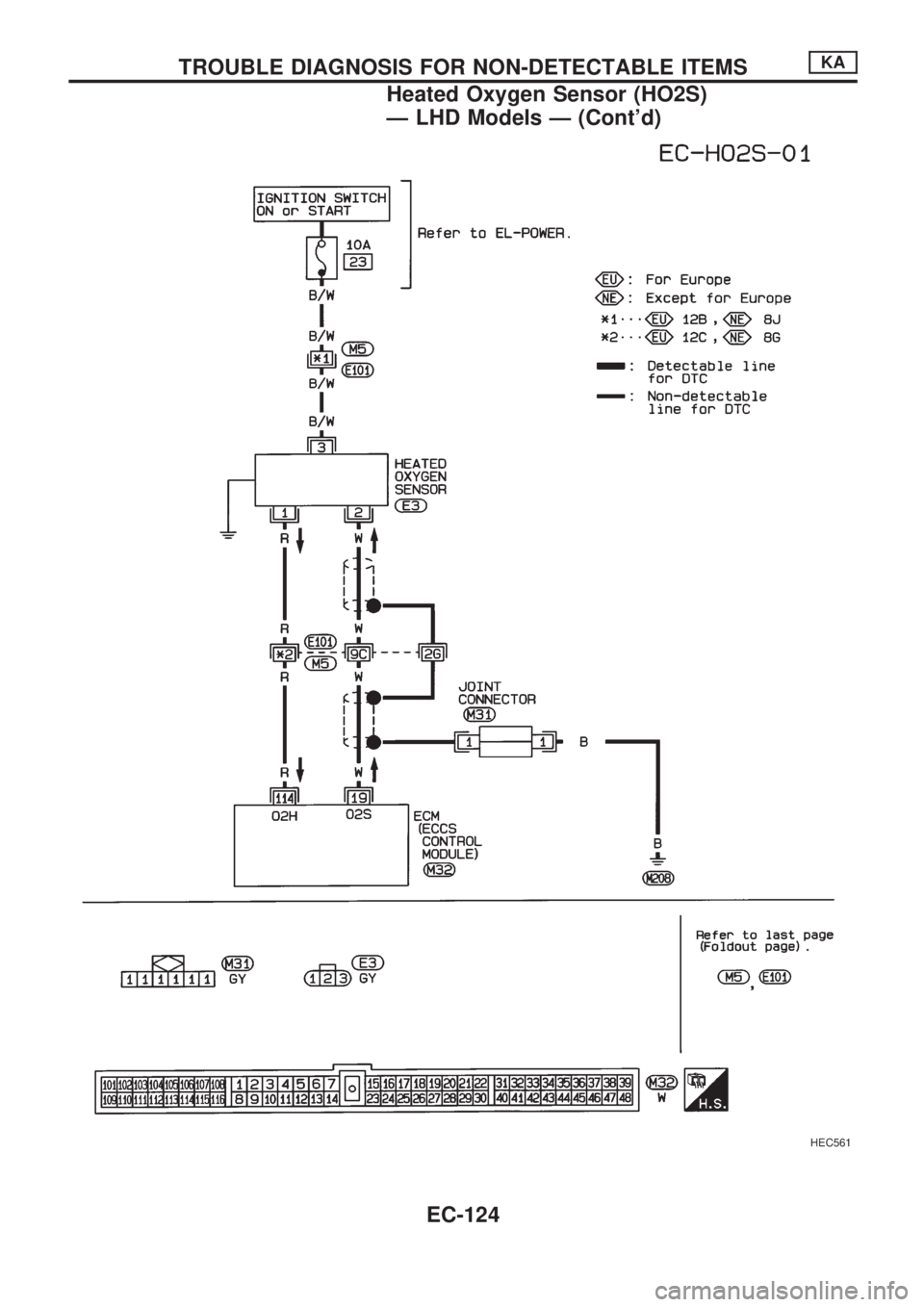
HEC561
TROUBLE DIAGNOSIS FOR NON-DETECTABLE ITEMSKA
Heated Oxygen Sensor (HO2S)
Ð LHD Models Ð (Cont'd)
EC-124
Page 277 of 1659
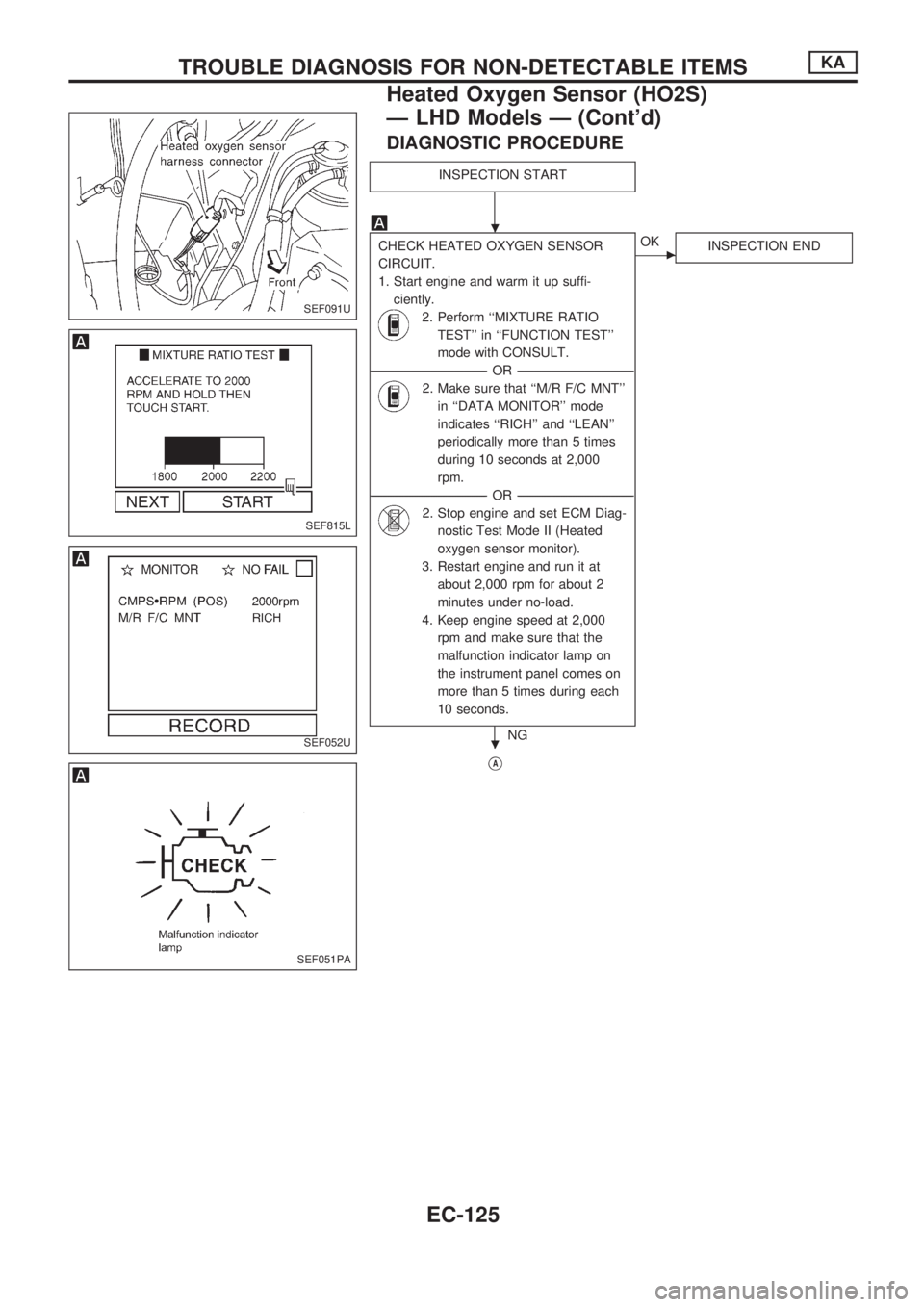
DIAGNOSTIC PROCEDURE
INSPECTION START
CHECK HEATED OXYGEN SENSOR
CIRCUIT.
1. Start engine and warm it up suffi-
ciently.
2. Perform ``MIXTURE RATIO
TEST'' in ``FUNCTION TEST''
mode with CONSULT.
----------------------------------------------------------------------------------------------------------------------------------OR----------------------------------------------------------------------------------------------------------------------------------
2. Make sure that ``M/R F/C MNT''
in ``DATA MONITOR'' mode
indicates ``RICH'' and ``LEAN''
periodically more than 5 times
during 10 seconds at 2,000
rpm.
----------------------------------------------------------------------------------------------------------------------------------OR----------------------------------------------------------------------------------------------------------------------------------
2. Stop engine and set ECM Diag-
nostic Test Mode II (Heated
oxygen sensor monitor).
3. Restart engine and run it at
about 2,000 rpm for about 2
minutes under no-load.
4. Keep engine speed at 2,000
rpm and make sure that the
malfunction indicator lamp on
the instrument panel comes on
more than 5 times during each
10 seconds.
NG
cOK
INSPECTION END
VA
SEF091U
SEF815L
SEF052U
SEF051PA
.
.
TROUBLE DIAGNOSIS FOR NON-DETECTABLE ITEMSKA
Heated Oxygen Sensor (HO2S)
Ð LHD Models Ð (Cont'd)
EC-125
Page 278 of 1659
VA
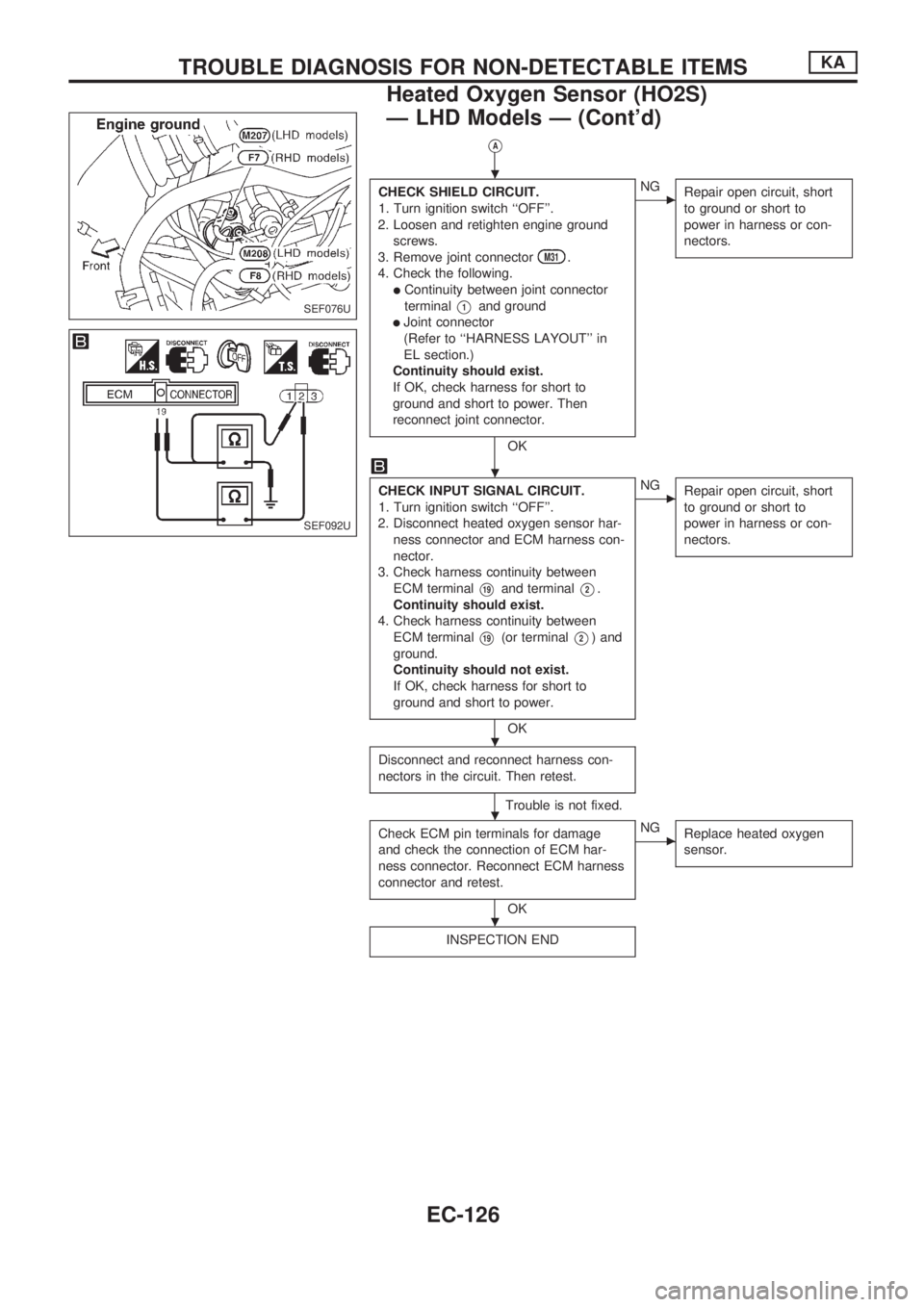
CHECK SHIELD CIRCUIT.
1. Turn ignition switch ``OFF''.
2. Loosen and retighten engine ground
screws.
3. Remove joint connector
M31.
4. Check the following.
lContinuity between joint connector
terminal
V1and ground
lJoint connector
(Refer to ``HARNESS LAYOUT'' in
EL section.)
Continuity should exist.
If OK, check harness for short to
ground and short to power. Then
reconnect joint connector.
OK
cNG
Repair open circuit, short
to ground or short to
power in harness or con-
nectors.
CHECK INPUT SIGNAL CIRCUIT.
1. Turn ignition switch ``OFF''.
2. Disconnect heated oxygen sensor har-
ness connector and ECM harness con-
nector.
3. Check harness continuity between
ECM terminal
V19and terminalV2.
Continuity should exist.
4. Check harness continuity between
ECM terminal
V19(or terminalV2) and
ground.
Continuity should not exist.
If OK, check harness for short to
ground and short to power.
OK
cNG
Repair open circuit, short
to ground or short to
power in harness or con-
nectors.
Disconnect and reconnect harness con-
nectors in the circuit. Then retest.
Trouble is not fixed.
Check ECM pin terminals for damage
and check the connection of ECM har-
ness connector. Reconnect ECM harness
connector and retest.
OK
cNG
Replace heated oxygen
sensor.
INSPECTION END
SEF076U
SEF092U
.
.
.
.
.
TROUBLE DIAGNOSIS FOR NON-DETECTABLE ITEMSKA
Heated Oxygen Sensor (HO2S)
Ð LHD Models Ð (Cont'd)
EC-126
Page 279 of 1659
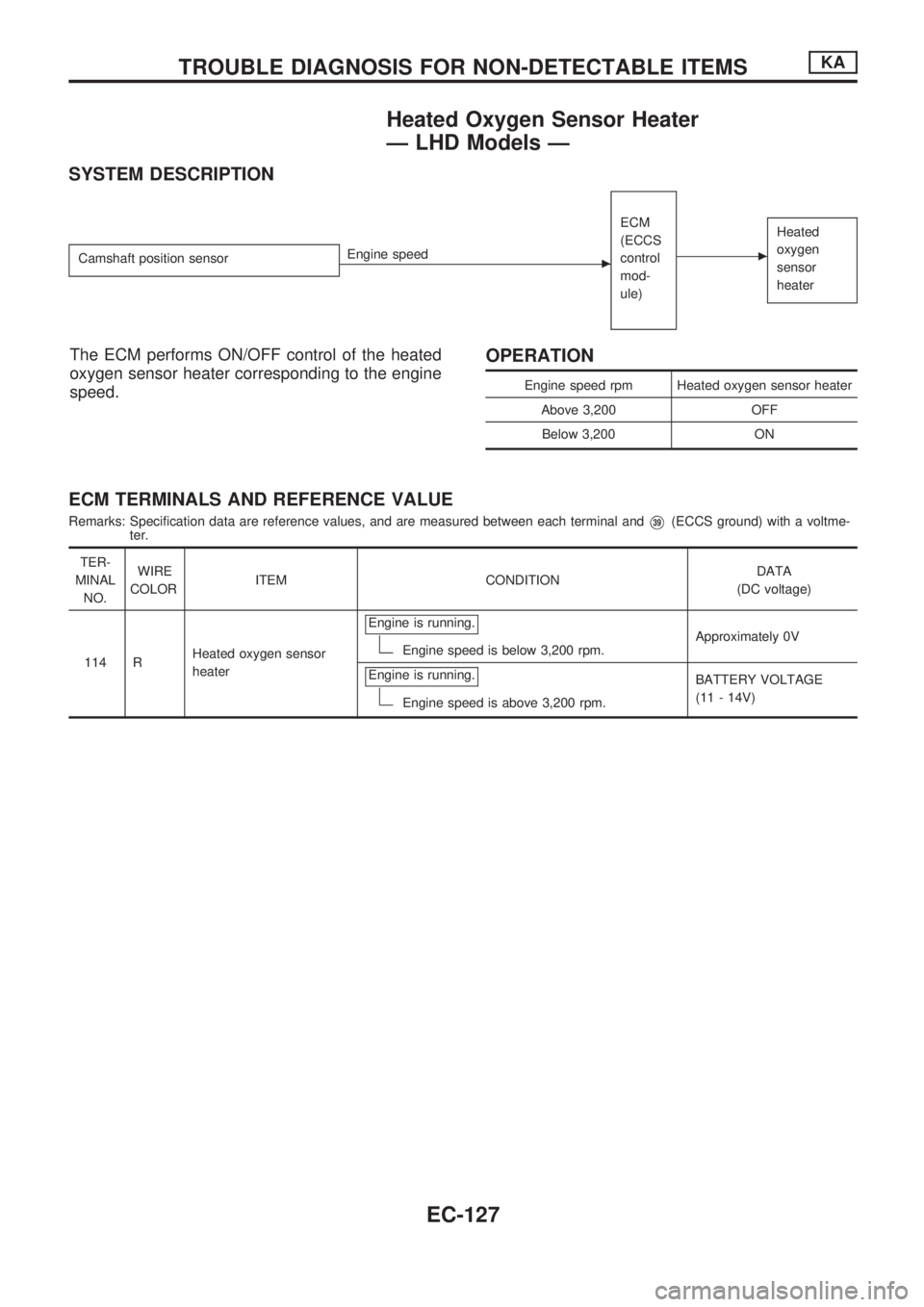
Heated Oxygen Sensor Heater
Ð LHD Models Ð
SYSTEM DESCRIPTION
Camshaft position sensorcEngine speedECM
(ECCS
control
mod-
ule)c
Heated
oxygen
sensor
heater
The ECM performs ON/OFF control of the heated
oxygen sensor heater corresponding to the engine
speed.OPERATION
Engine speed rpm Heated oxygen sensor heater
Above 3,200 OFF
Below 3,200 ON
ECM TERMINALS AND REFERENCE VALUE
Remarks: Specification data are reference values, and are measured between each terminal andV39(ECCS ground) with a voltme-
ter.
TER-
MINAL
NO.WIRE
COLORITEM CONDITIONDATA
(DC voltage)
114 RHeated oxygen sensor
heaterEngine is running.
Engine speed is below 3,200 rpm.Approximately 0V
Engine is running.
Engine speed is above 3,200 rpm.BATTERY VOLTAGE
(11 - 14V)
TROUBLE DIAGNOSIS FOR NON-DETECTABLE ITEMSKA
EC-127
Page 280 of 1659
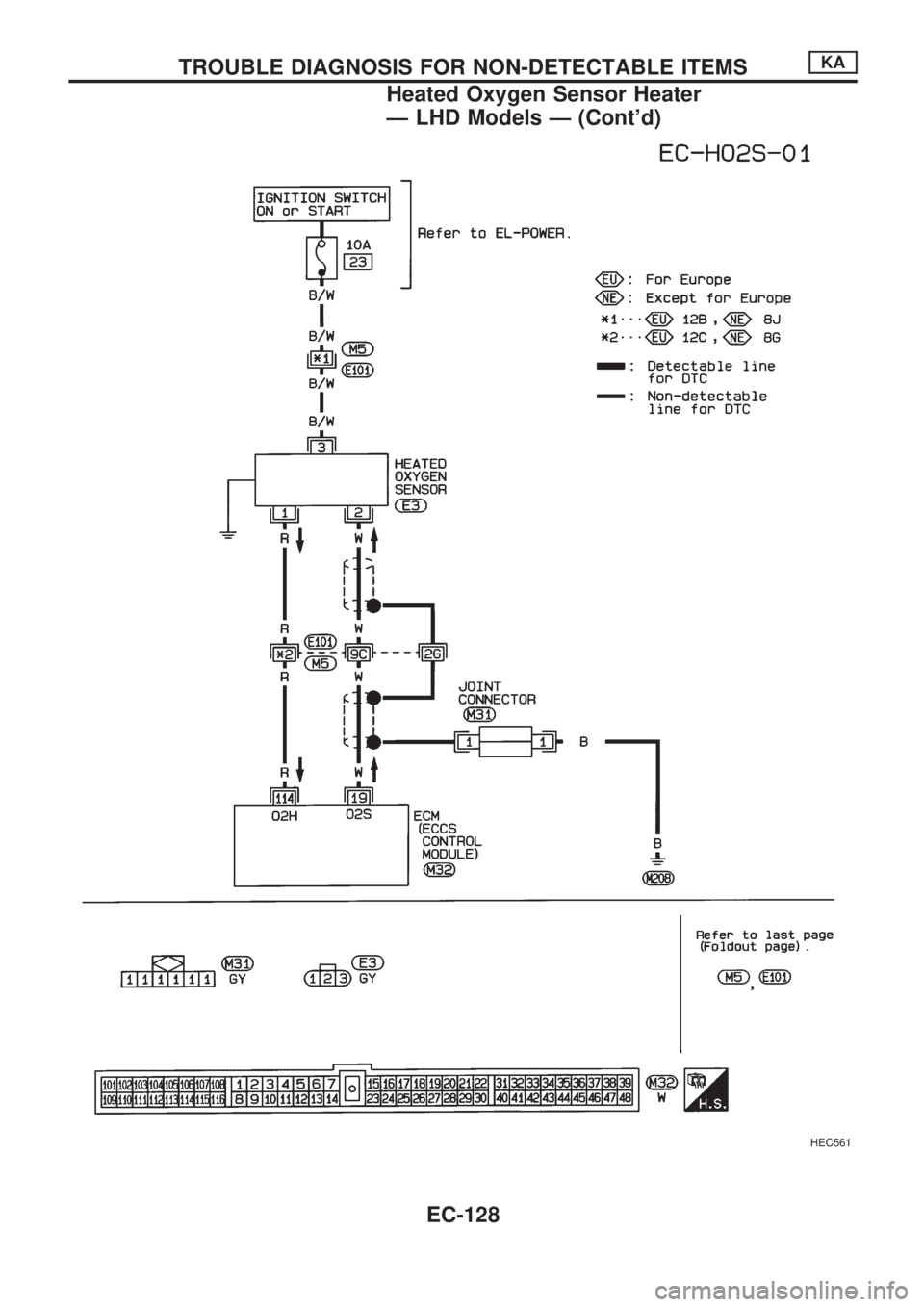
HEC561
TROUBLE DIAGNOSIS FOR NON-DETECTABLE ITEMSKA
Heated Oxygen Sensor Heater
Ð LHD Models Ð (Cont'd)
EC-128
Page 281 of 1659
DIAGNOSTIC PROCEDURE
INSPECTION START
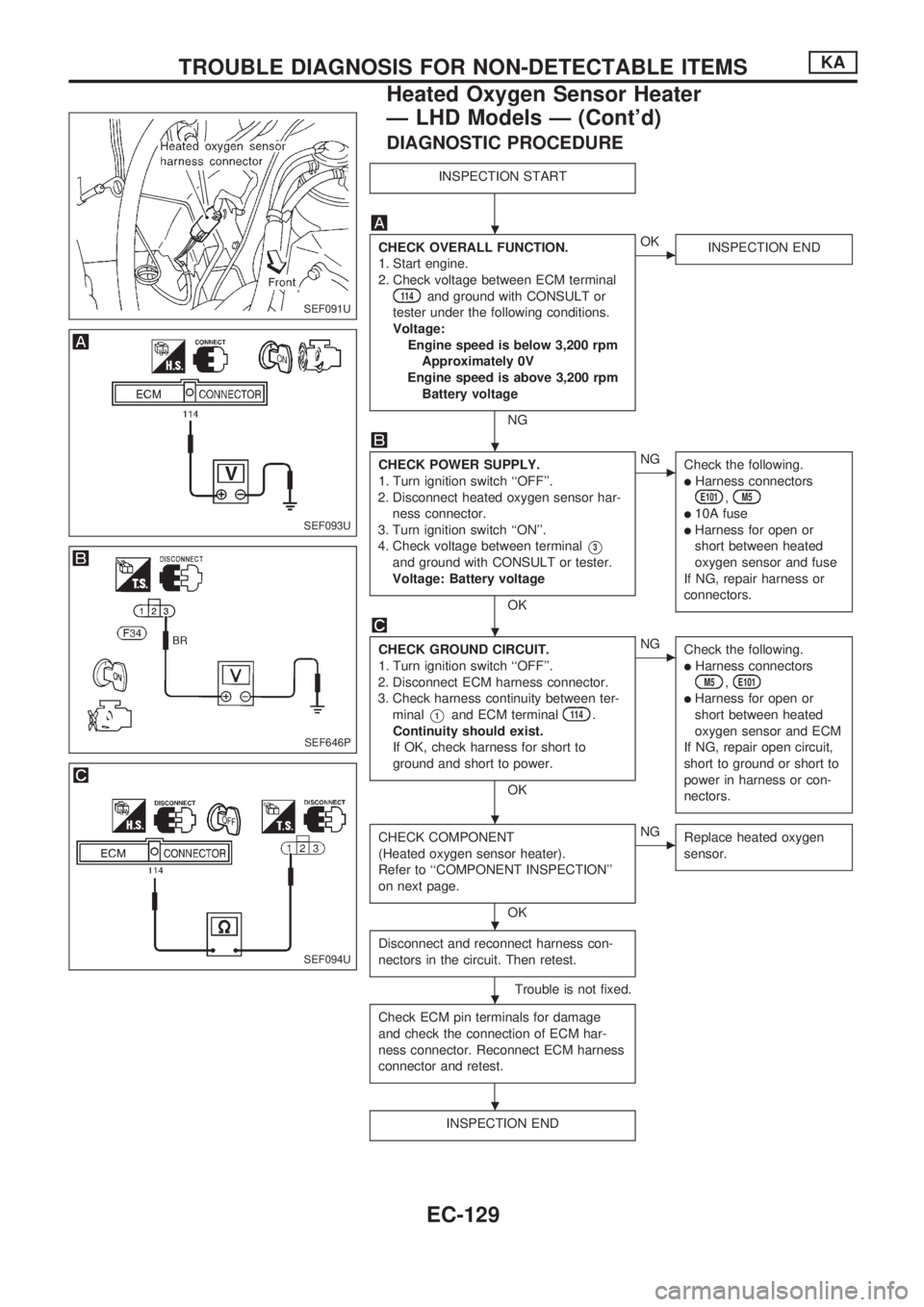
CHECK OVERALL FUNCTION.
1. Start engine.
2. Check voltage between ECM terminal
114and ground with CONSULT or
tester under the following conditions.
Voltage:
Engine speed is below 3,200 rpm
Approximately 0V
Engine speed is above 3,200 rpm
Battery voltage
NG
cOK
INSPECTION END
CHECK POWER SUPPLY.
1. Turn ignition switch ``OFF''.
2. Disconnect heated oxygen sensor har-
ness connector.
3. Turn ignition switch ``ON''.
4. Check voltage between terminal
V3
and ground with CONSULT or tester.
Voltage: Battery voltage
OK
cNG
Check the following.
lHarness connectorsE101,M5
l10A fuse
lHarness for open or
short between heated
oxygen sensor and fuse
If NG, repair harness or
connectors.
CHECK GROUND CIRCUIT.
1. Turn ignition switch ``OFF''.
2. Disconnect ECM harness connector.
3. Check harness continuity between ter-
minal
V1and ECM terminal114.
Continuity should exist.
If OK, check harness for short to
ground and short to power.
OK
cNG
Check the following.
lHarness connectorsM5,E101
lHarness for open or
short between heated
oxygen sensor and ECM
If NG, repair open circuit,
short to ground or short to
power in harness or con-
nectors.
CHECK COMPONENT
(Heated oxygen sensor heater).
Refer to ``COMPONENT INSPECTION''
on next page.
OK
cNG
Replace heated oxygen
sensor.
Disconnect and reconnect harness con-
nectors in the circuit. Then retest.
Trouble is not fixed.
Check ECM pin terminals for damage
and check the connection of ECM har-
ness connector. Reconnect ECM harness
connector and retest.
INSPECTION END
SEF091U
SEF093U
SEF646P
SEF094U
.
.
.
.
.
.
.
TROUBLE DIAGNOSIS FOR NON-DETECTABLE ITEMSKA
Heated Oxygen Sensor Heater
Ð LHD Models Ð (Cont'd)
EC-129
Page 282 of 1659
COMPONENT INSPECTION
Heated oxygen sensor heater
Check resistance between terminalsV3andV1.
Resistance: 2.3 - 4.3Wat 25ÉC (77ÉF)
Check continuity between terminals
V2andV1,V3andV2.
Continuity should not exist.
If NG, replace the heated oxygen sensor.
CAUTION:
Discard any heated oxygen sensor which has been dropped
from a height of more than 0.5 m (19.7 in) onto a hard sur-
face such as a concrete floor; use a new one.
SEF586Q
TROUBLE DIAGNOSIS FOR NON-DETECTABLE ITEMSKA
Heated Oxygen Sensor Heater
Ð LHD Models Ð (Cont'd)
EC-130
Page 283 of 1659
Idle Air Control Valve (IACV) Ð Auxiliary Air
Control (AAC) Valve
SYSTEM DESCRIPTION
Camshaft position sensorcEngine speed
ECM
(ECCS
control
module)
cIACV-AAC valve
Mass air flow sensorcAmount of intake air
Engine coolant temperature sensor
cEngine coolant temperature
Ignition switch
cStart signal
Throttle position sensor
cThrottle position
Neutral position switch
cNeutral position
Air conditioner switch
cAir conditioner operation
Power steering oil pressure switch
cPower steering load signal
Battery
cBattery voltage
Vehicle speed sensor
cVehicle speed
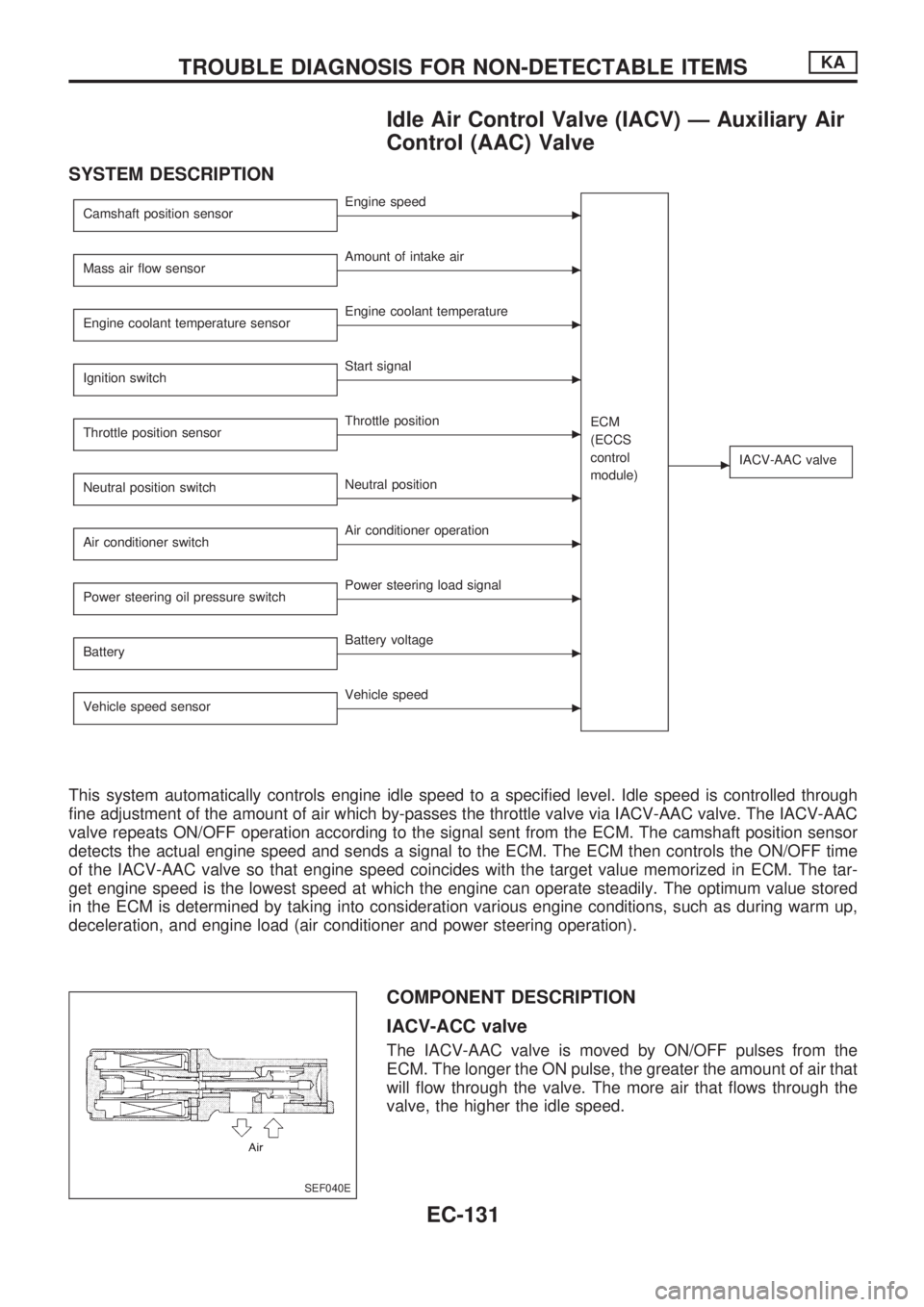
This system automatically controls engine idle speed to a specified level. Idle speed is controlled through
fine adjustment of the amount of air which by-passes the throttle valve via IACV-AAC valve. The IACV-AAC
valve repeats ON/OFF operation according to the signal sent from the ECM. The camshaft position sensor
detects the actual engine speed and sends a signal to the ECM. The ECM then controls the ON/OFF time
of the IACV-AAC valve so that engine speed coincides with the target value memorized in ECM. The tar-
get engine speed is the lowest speed at which the engine can operate steadily. The optimum value stored
in the ECM is determined by taking into consideration various engine conditions, such as during warm up,
deceleration, and engine load (air conditioner and power steering operation).
COMPONENT DESCRIPTION
IACV-ACC valve
The IACV-AAC valve is moved by ON/OFF pulses from the
ECM. The longer the ON pulse, the greater the amount of air that
will flow through the valve. The more air that flows through the
valve, the higher the idle speed.
SEF040E
TROUBLE DIAGNOSIS FOR NON-DETECTABLE ITEMSKA
EC-131