Page 217 of 378
Downloaded from www.Manualslib.com manuals search engine Your anti-lock brakes improve your vehicle’s stability when you make a hard stop on a slippery road. Even
though you have the anti-lock braking system, you’ll
want to begin stopping sooner than you would on
dry
pavement. See “Anti-Lock” in the Index.
Allow greater following distance on any
slippery road.
Watch for slippery spots. The road might be fine
until you hit
a spot that’s covered with ice. On an
otherwise clear road, ice patches may appear in
shaded areas where the sun can’t reach: around
clumps
of trees, behind buildings or under bridges.
Sometimes the surface
of a curve or an overpass may
remain icy when the surrounding roads are clear.
If
you see a patch of ice ahead of you, brake before you
are on it. Try not to brake while you’re actually on
the ice, and avoid sudden steering maneuvers.
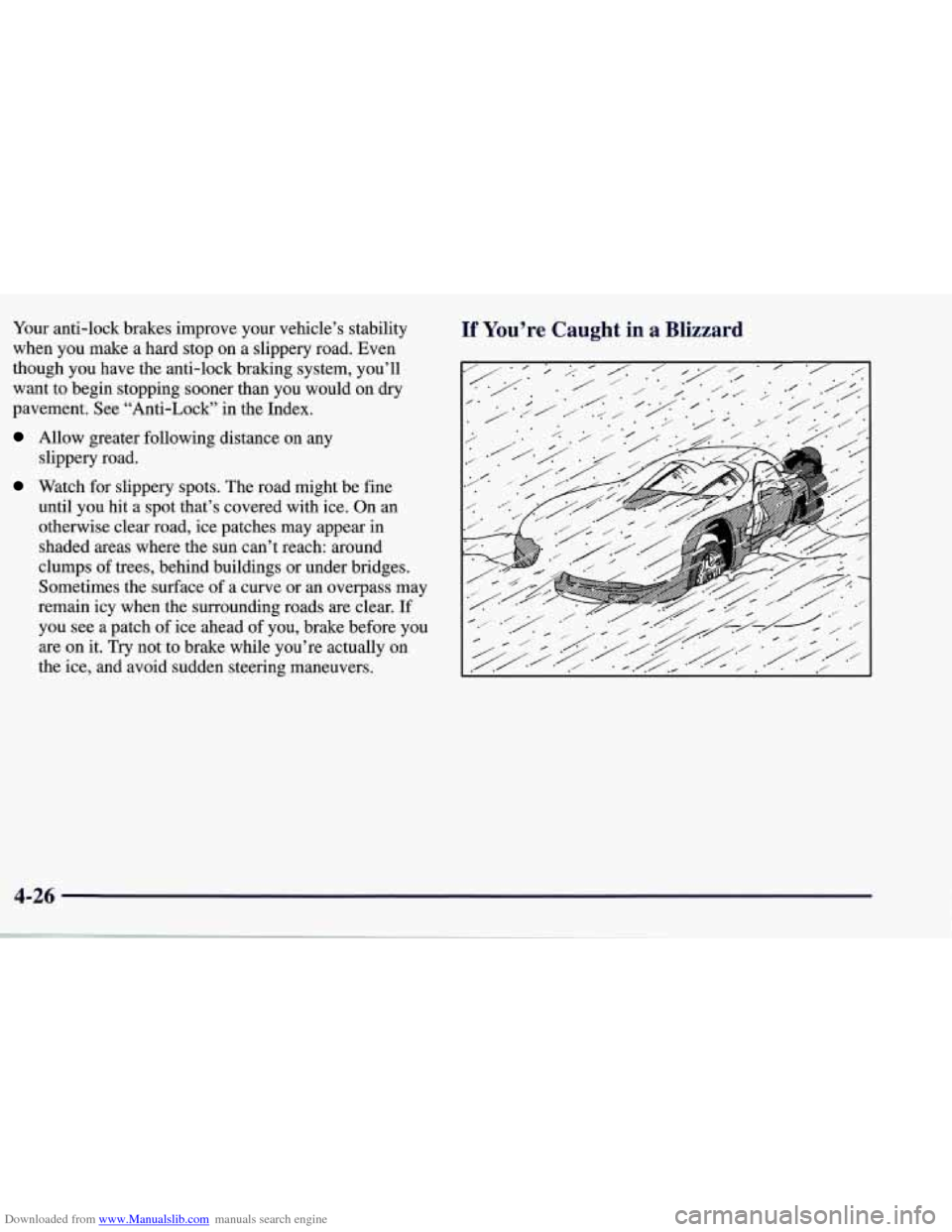
If You’re Caught in a Blizzard
Page 219 of 378
Downloaded from www.Manualslib.com manuals search engine I A CAUTION:
Snow can trap exhaust gases under your vehicle.
This can cause deadly CO (carbon monoxide) gas
to get inside. CO could overcome you and
kill
you. You can’t see it or smell it, so you might not
know it is in your vehicle. Clear away snow from
around the base of your vehicle, especially any
that is blocking your exhaust pipe. And check
around again from time to time to be sure snow
doesn’t collect there.
Open
a window just a little on the side of the
vehicle that’s away from the wind. This will help
keep CO out.
Run your engine only as long as you must. This saves
fuel. When you run the engine, make it
go a little faster
than just idle. That is, push the accelerator slightly.
This
uses less fuel for the heat that you get and it keeps the
battery charged.
You will need a well-charged battery to
restart the vehicle, and possibly for signaling later on
with your headlamps. Let the heater
run for a while.
Then, shut the engine
off and close the window almost
all the way to preserve the heat. Start the engine again
and repeat this only when you feel really uncomfortable
from the cold. But do it as little as possible. Preserve the
fuel as long as you can. To help keep warm, you can get
out of the vehicle and do some fairly vigorous exercises
every half hour or
so until help comes.
Page 230 of 378
Downloaded from www.Manualslib.com manuals search engine To help avoid injury to you or others:
Never let passengers ride in a vehicle that is
Never tow faster than safe or posted speeds.
Never tow with damaged parts not
0 Never get under your vehicle after it has
Always secure the vehicle on each side with
0 Use only R-hooks. being towed.
fully secured.
been lifted by the tow truck.
separate safety chains when towing it.
A vehicle can fall from a car carrier if it isn’t
adequately secured. This can cause a collision,
serious personal injury and vehicle damage. The
vehicle should be tightly secured with chains or
steel cables before
it is transported.
Don’t use substitutes (ropes, leather straps,
canvas webbing, etc.) that can be cut by sharp
edges underneath the towed vehicle. Always use
R-hooks inserted in the front and rear R-hook
slots. Never use J-hooks. They will damage
drivetrain and suspension components.
When your vehicle is being towed, have the ignition
key in the
OFF position. The steering wheel should
be clamped in a straight-ahead position, with a
clamping device designed for towing service.
Do not
use the vehicle’s steering column lock for this. The
transmission should be in
NEUTRAL (N) and the
parking brake released.
5-9
Page 251 of 378
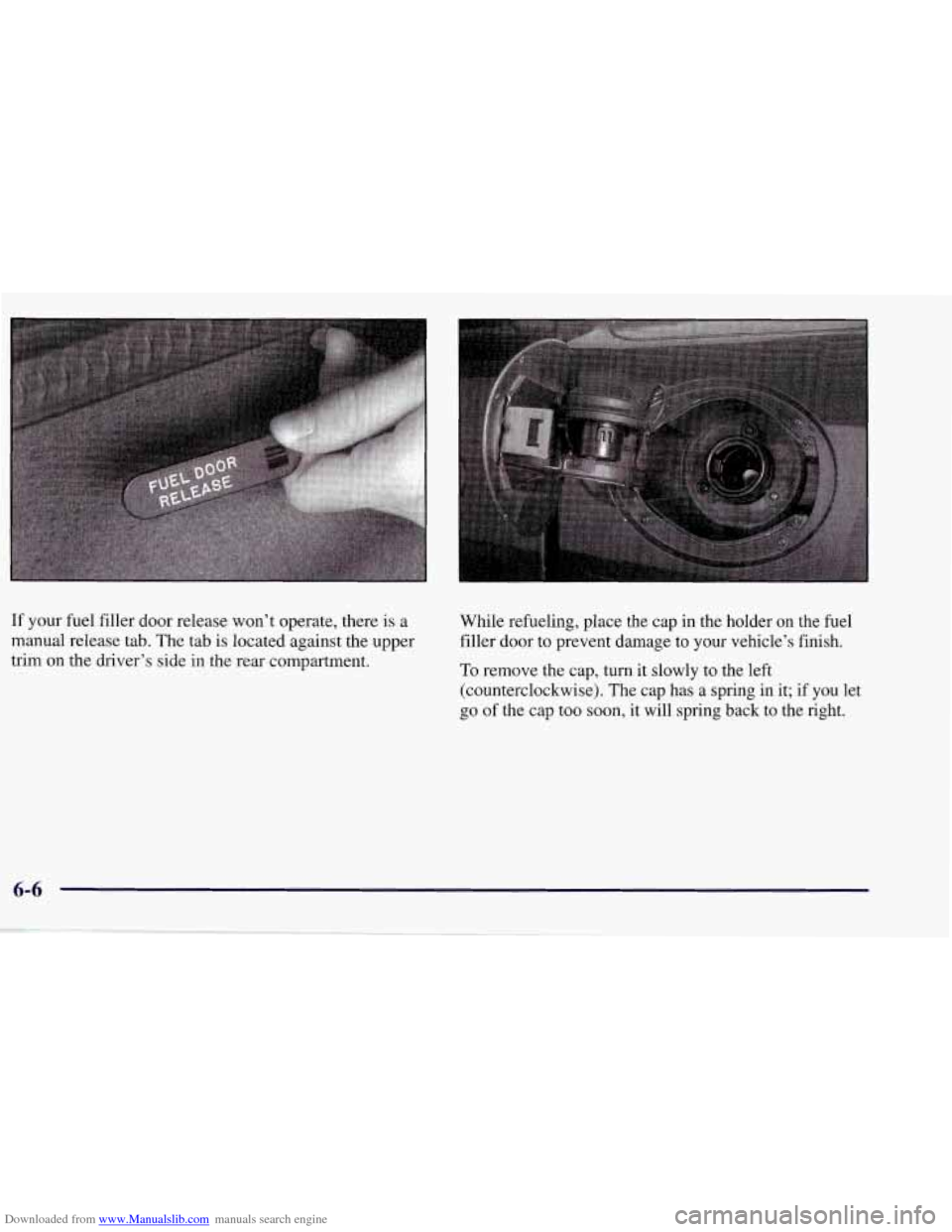
Downloaded from www.Manualslib.com manuals search engine If your fuel filler door release won’t operate, there is a
manual release tab. The tab is located against the upper
trim on the driver’s side in the rear compartment. While
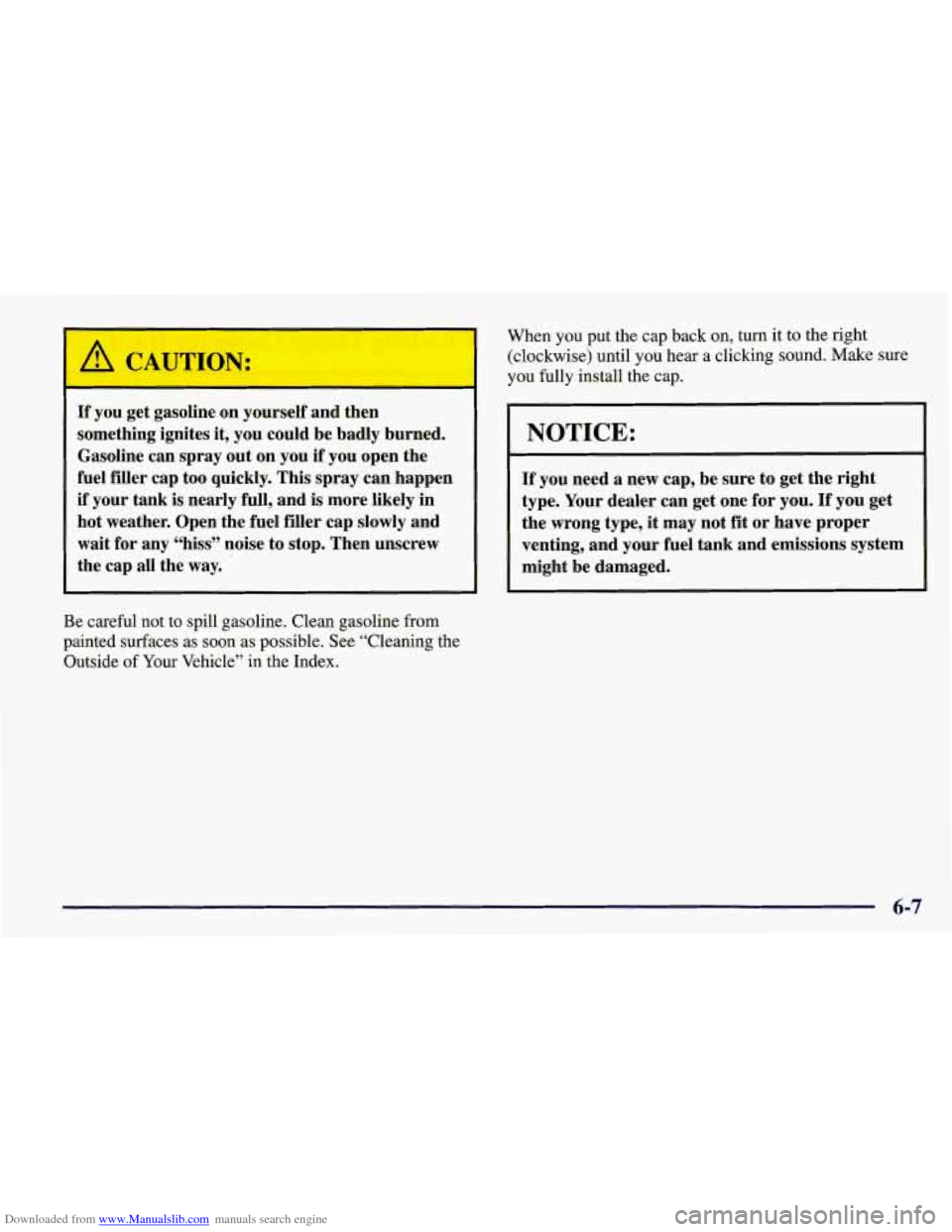
refueling, place the cap in the holder on the fuel
filler door to prevent damage to your vehicle’s finish.
To remove the cap, turn it slowly to the left
(counterclockwise). The cap has a spring in it; if you let
go of the cap too soon, it will spring back to the right.
6-6
Page 252 of 378
Downloaded from www.Manualslib.com manuals search engine When you put the cap back on, turn it to the right
(clockwise) until you hear a clicking sound. Make sure
you fully install the cap.
/9 CAUTION:
If J ,.I get gasoline on yourself and then
something ignites it, you could be badly burned.
Gasoline can spray out on you
if you open the
fuel filler cap too quickly. This spray can happen
if your tank is nearly full, and is more likely in
hot weather. Open the fuel filler cap slowly and
wait for any “hiss” noise to stop. Then unscrew
the cap all the way.
Be careful not to spill gasoline. Clean gasoline from
painted surfaces as soon as possible. See “Cleaning the
Outside of Your Vehicle” in the Index.
I NOTICE:
If you need a new cap, be sure to get the right
type. Your dealer can get one for you.
If you get
the wrong type, it may not fit or have proper
venting, and your fuel tank and emissions system
might be damaged.
6-7
Page 279 of 378
Downloaded from www.Manualslib.com manuals search engine 6
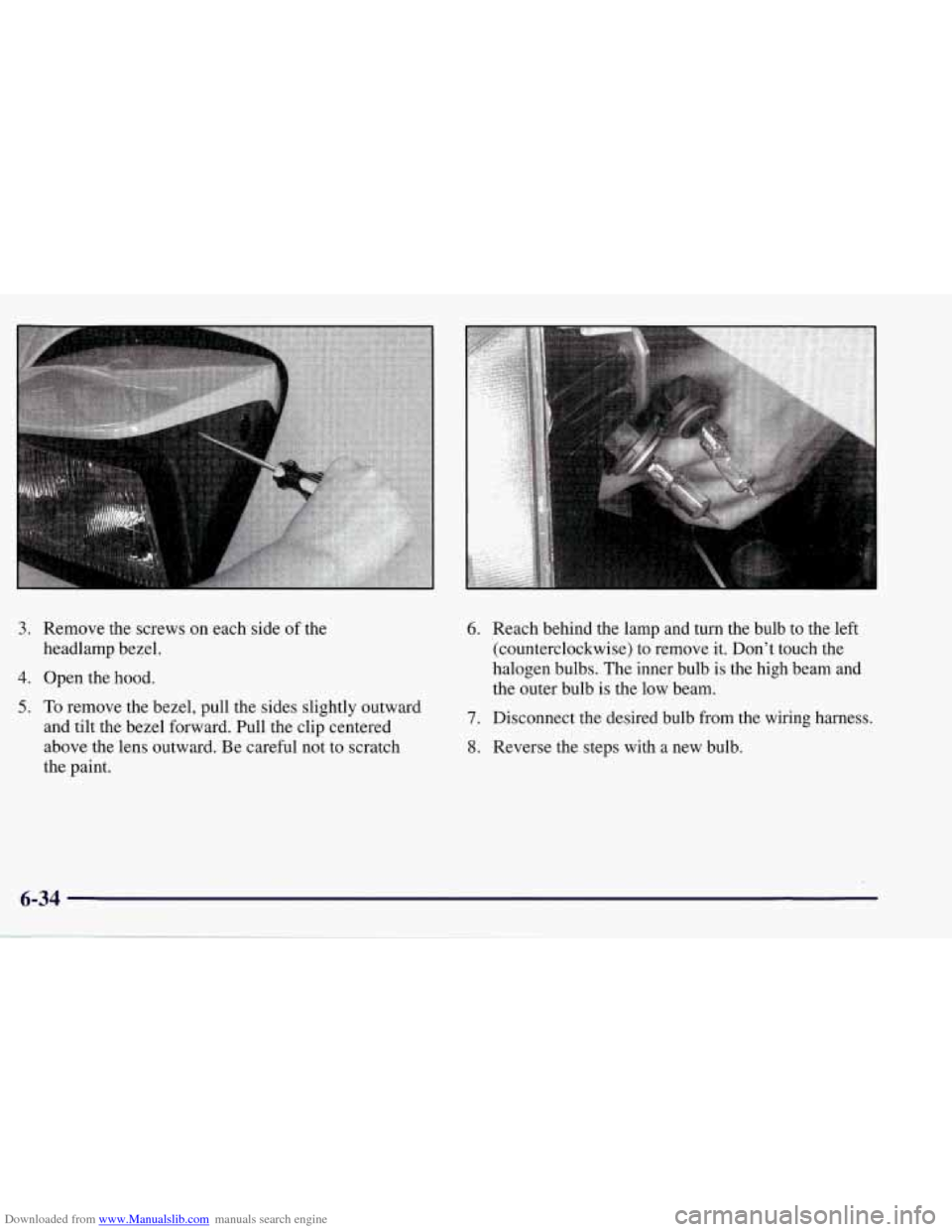
3. Remove the screws on each side of the
headlamp bezel.
4. Open the hood.
5. To remove the bezel, pull the sides slightly outward
and tilt the bezel forward. Pull the clip centered
above the lens outward. Be careful not to scratch
the paint.
6. Reach behind the lamp and turn the bulb to the left
(counterclockwise) to remove it. Don’t touch the
halogen bulbs. The inner bulb is the high beam and
the outer bulb is the low beam.
7. Disconnect the desired bulb from the wiring harness.
8. Reverse the steps with a new bulb.
Page 280 of 378
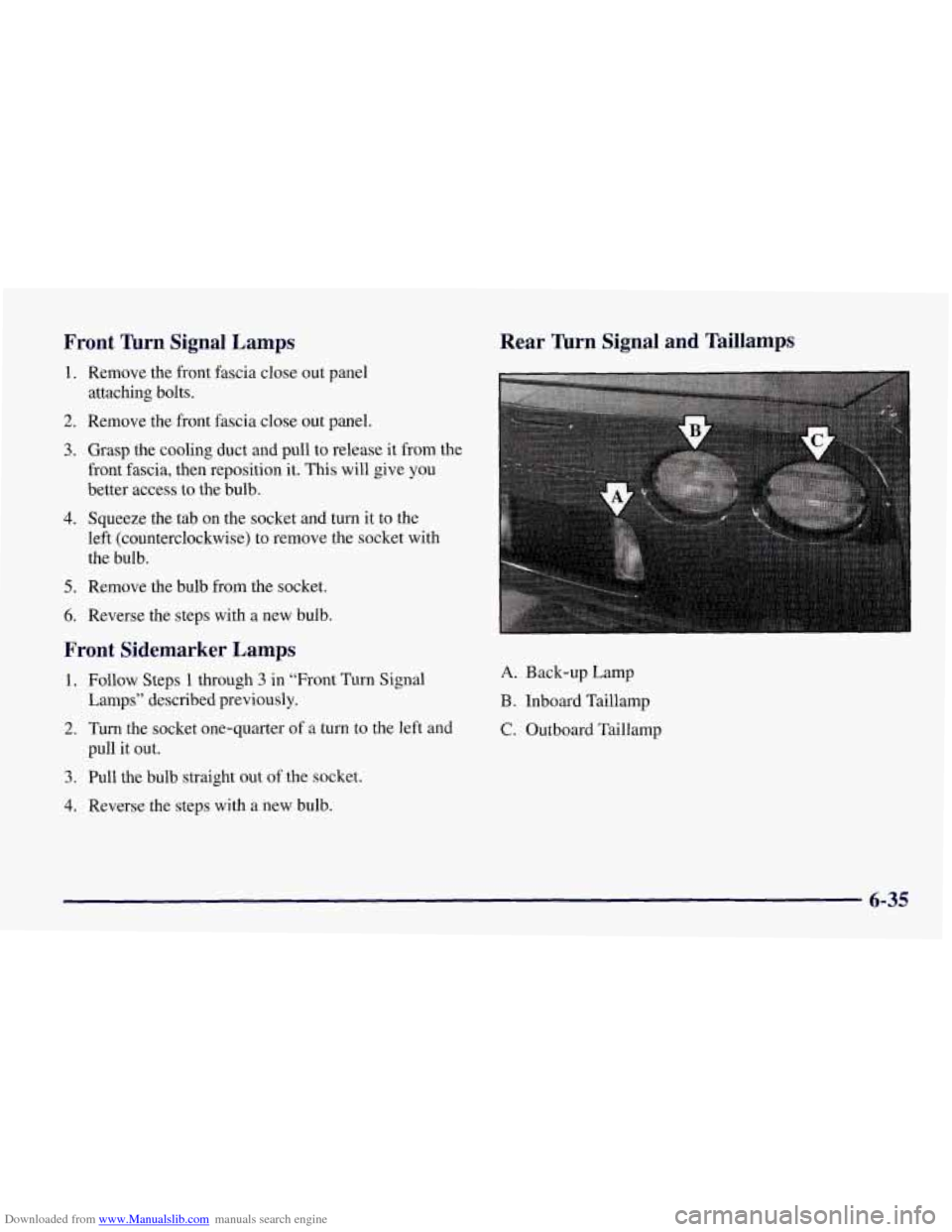
Downloaded from www.Manualslib.com manuals search engine Front nrn Signal Lamps Rear nrn Signal and Taillamps
1. Remove the front fascia close out panel
attaching bolts.
2. Remove the front fascia close out panel.
3. Grasp the cooling duct and pull to release it from the
front fascia, then reposition
it. This will give you
better access to the bulb.
4. Squeeze the tab on the socket and turn it to the
left (counterclockwise) to remove the socket with
the bulb.
5. Remove the bulb from the socket.
6. Reverse the steps with a new bulb.
Front Sidemarker Lamps
1. Follow Steps 1 through 3 in “Front Turn Signal
Lamps” described previously.
2. Turn the socket one-quarter of a turn to the left and
pull it out.
3. Pull the bulb straight out of the socket.
4. Reverse the steps with a new bulb.
A. Back-up Lamp
B. Inboard Taillamp
C. Outboard Taillamp
6-35
Page 281 of 378
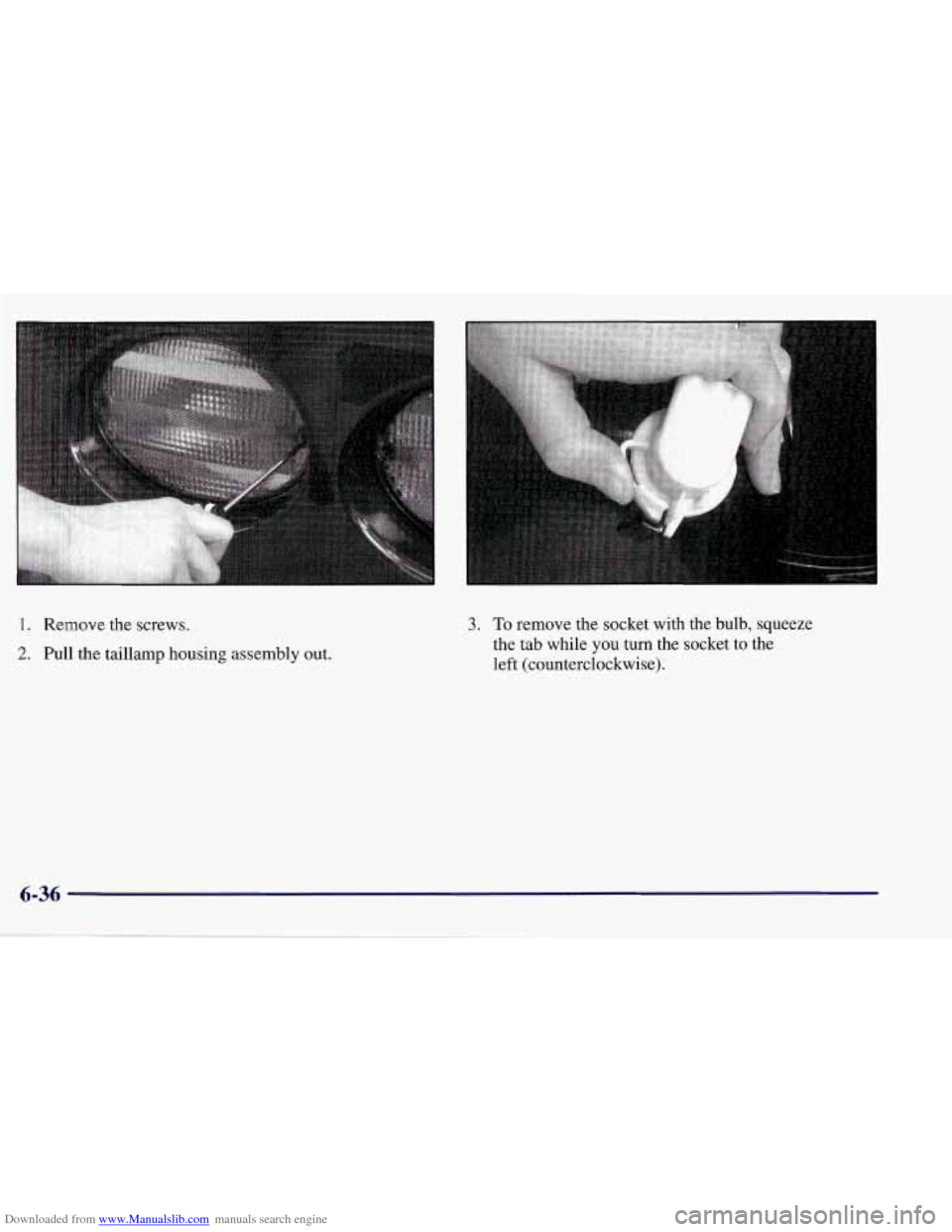
Downloaded from www.Manualslib.com manuals search engine 1. Remove the screws.
2. Pull the taillamp housing assembly out.
3. To remove the socket with the bulb, squeeze
the tab while you turn the socket to the
left (counterclockwise).