1997 CHEVROLET CORVETTE engine oil
[x] Cancel search: engine oilPage 248 of 356
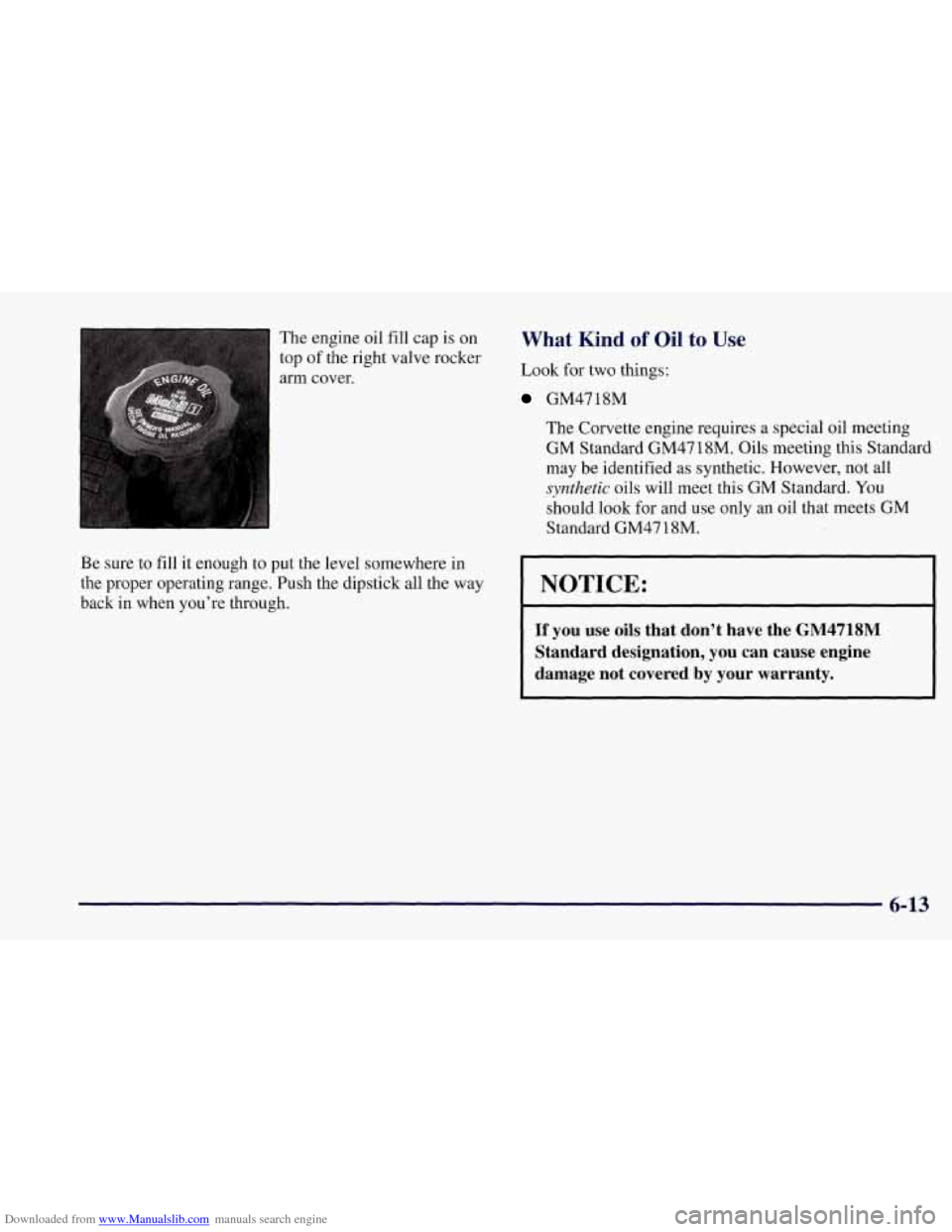
Downloaded from www.Manualslib.com manuals search engine The engine oil fill cap is on
top
of the right valve rocker
arm cover.
What Kind of Oil to Use
Look for two things:
GM4718M
The Corvette engine requires a special oil meeting
GM Standard GM47 18M. Oils meeting this Standard
may be identified as synthetic. However, not all
synthetic oils will meet this GM Standard. You
should look for and
use only an oil that meets GM
Standard GM47 18M.
Be sure to fill it enough to put the level somewhere in
the proper operating range. Push the dipstick all the way
back in when you’re through. I I
1 NOTICE: I
If you use oils that don’t have the GM4718M
Standard designation, you can cause engine
damage not covered
by your warranty.
6-13
Page 249 of 356
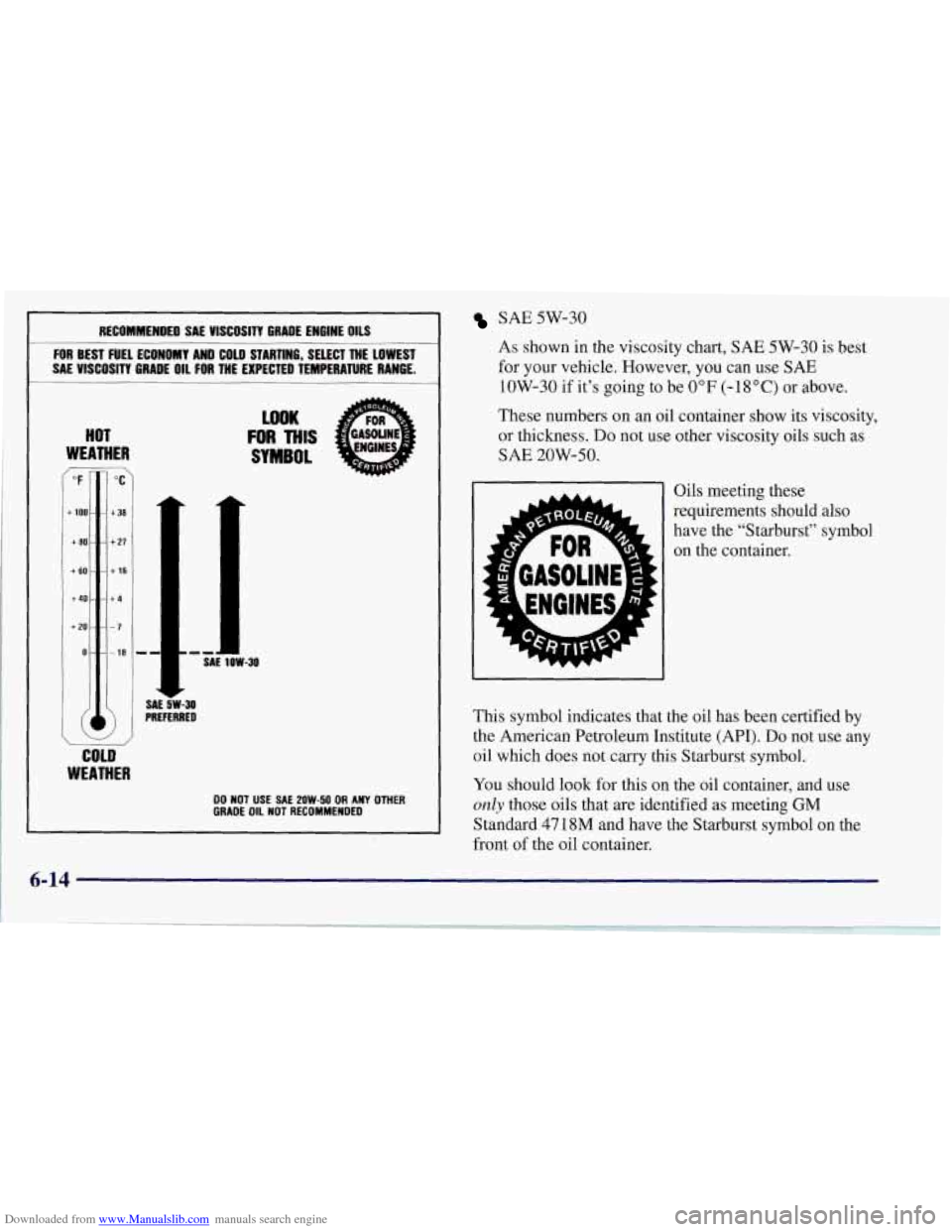
Downloaded from www.Manualslib.com manuals search engine RECOMMENDED SAE VISCOSITY GRADE ENGINE OILS
FOR BEST FUEL ECONOMY AND COLD STARTING, SELECT THE LOWEST
SAE VISCOSITY GRADE OIL
FOR THE EXPECTED TEMPERATURE RANGE.
I
HOT
WEATHER
COLD
WEATHER
LOOK
FOR MIS
SYMBOL
DO NOT USE SAE 2OW-50 OR ANY OTHER
GRADE OIL NOT RECOMMENDED
SAE 5W-30
As shown in the viscosity chart, SAE 5W-30 is best
for your vehicle. However, you can use
SAE
1OW-30 if it’s going to be 0°F (-18°C) or above.
These numbers on an oil container show its viscosity,
or thickness.
Do not use other viscosity oils such as
SAE 20W-50.
Oils meeting these
requirements should also
have the “Starburst” symbol
on the container.
This symbol indicates that the oil has been certified by
the American Petroleum Institute
(API). Do not use any
oil which does not carry this Starburst symbol.
You should look for this on the oil container, and use
only those oils that are identified as meeting GM
Standard
47 18M and have the Starburst symbol on the
front
of the oil container.
Page 250 of 356
Downloaded from www.Manualslib.com manuals search engine Your Corvette engine is filled at the factory with a
Mobil
l@ synthetic oil, which meets all requirements for
your vehicle.
Substitute Oil: When adding oil to maintain engine oil
level, oil meeting GM Standard GM4718M may not be
available. You can add substitute oil designated SAE
5W-30 with the “Starburst” symbol at all temperatures.
If temperatures are above 0°F
(- 18 O C), you may
substitute SAE 1OW-30 with the “Starburst” symbol.
Substitute oil not meeting GM Standard GM4718M
should not be used for an oil change.
Engine Oil Additives
Don’t add anything to your oil. Your Chevrolet dealer is
ready to advise
if you think something should be added.
When to Change Engine Oil
Your Corvette has an Engine Oil Life Monitor. This
feature will let you know when to change your oil and
filter
-- usually between 3,000 miles (5 000 km) and
10,000 miles (1 6 000 km) since your last oil change.
Under severe conditions, the indicator may come on
before
3,000 miles (5 000 km). Never drive your vehicle
more than 10,000 miles
(1 6 000 km) or 12 months
(whichever occurs first) without an oil change. Use
engine oil meeting the GM Standard GM4718M. The
system won’t detect dust in the
oil. So, if you
drive in a dusty area, be sure to change your oil every
3,000 miles (5 000 km) or sooner if the CHANGE OIL
light comes on. Remember to reset the Engine Oil Life
Monitor when the oil has been changed. For more
information, see “Engine Oil Life Monitor” in the Index.
When Changing the Engine Oil
There is a special procedure for changing engine oil.
Contact your Chevrolet dealer for additional information
or the procedure can be found in a Corvette Service
Manual. To purchase a service manual, see “Service and
Owner Publications”
in the Index.
How to Reset the Engine Oil Life Monitor
Press RESET to acknowledge the CHANGE OIL SOON
warning. The oil page on the DIC will then show a
message such as OIL LIFE 0%. To reset the monitor,
press and hold RESET for two seconds.
You will then
receive a message such as OIL LIFE
99%.
Page 251 of 356
Downloaded from www.Manualslib.com manuals search engine What to Do with Used Oil
Did you know that used engine oil contains certain
elements that may be unhealthy for your skin and could
even cause cancer? Don’t
let used oil stay on your skin
for very long. Clean your slun and nails with soap and
water, or a good hand cleaner. Wash or throw away
clothing or rags containing used engine oil. (See the
manufacturer’s warnings about the use and disposal
of
oil products.)
Used
oil can be a real threat to the environment. If you
change your own oil, be sure to drain all free-flowing oil
from the filter before disposal. Don’t ever dispose of oil
by putting it in the trash, pouring it on the ground, into
sewers, or into streams or bodies of water. Instead,
recycle it
by taking it to a place that collects used oil. If
you have a problem properly disposing of your used oil,
ask your dealer, a service station or a local recycling
center for help.
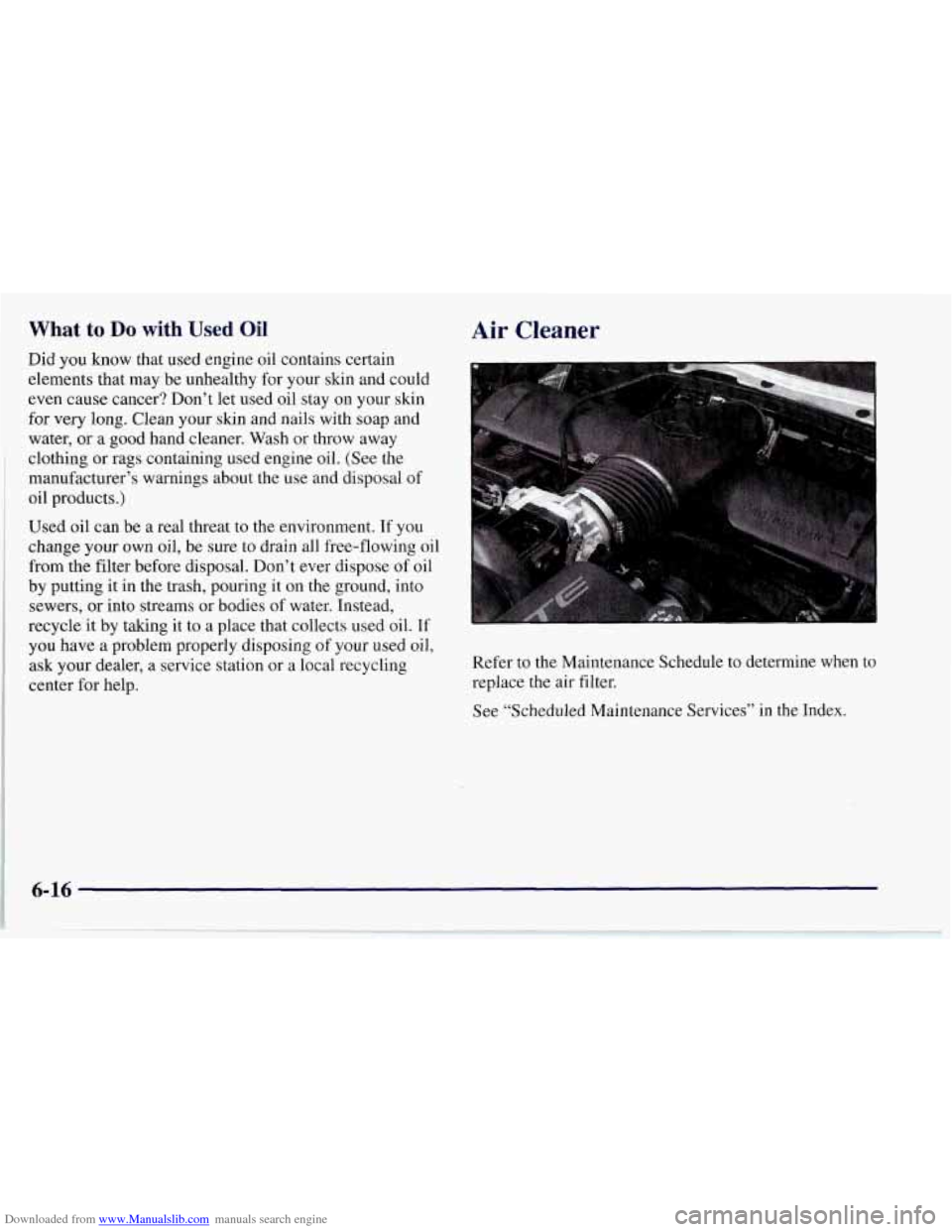
Air Cleaner
Refer to the Maintenance Schedule to determine when to
replace the air filter.
See “Scheduled Maintenance Services” in the Index.
6-16
Page 254 of 356

Downloaded from www.Manualslib.com manuals search engine Change both the fluid and filter every 50,000 miles
(80 000 km) if the vehicle is mainly driven under one of
these conditions:
In heavy city traffic where the outside temperature
regularly reaches
90” F (32” C) or higher.
In hilly or mountainous terrain.
0 High performance operation.
If you do not use your vehicle under one of these
conditions, the fluid and filter do not require changing.
See “Scheduled Maintenance Services” in the Index for
the proper service intervals for the transmission fluid
and filter.
Manual Transmission Fluid
When to Check
A good time to have it checked is when the engine oil is
changed. However, the fluid in your manual
transmission doesn’t require changing.
How to Check
Because this operation can be difficult, you may
choose to have this done at your Chevrolet dealership
Service Department.
If you do it yourself, be sure to follow all the
instructions here, or you could get a false reading.
I NOTICE:
Too much or too little fluid can damage your
transmission.
Too much can mean that some
of the fluid could come out and fall on hot
exhaust system parts, starting a fire. Be sure to
1 get an accurate reading if you check your
transmission fluid.
Check the fluid level only when your engine is off, the
vehicle is parked on a level place and the transmission is
cool enough for you to rest your fingers
on the
transmission case.
6-19
Page 258 of 356
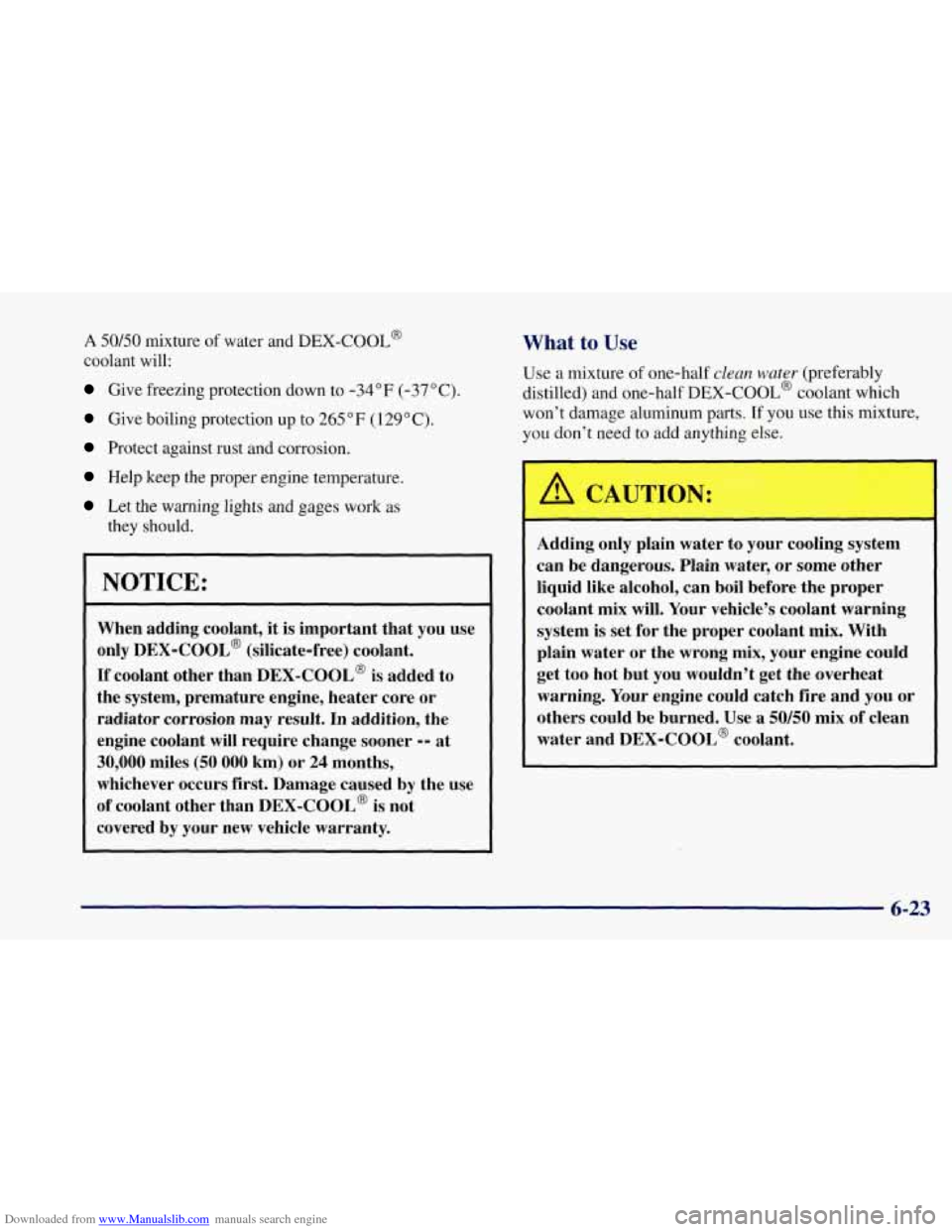
Downloaded from www.Manualslib.com manuals search engine A 50/50 mixture of water and DEX-COOL@
coolant will:
Give freezing protection down to -34°F (-37°C).
Give boiling protection up to 265 "F (129" C).
Protect against rust and corrosion.
Help keep the proper engine temperature,
Let the warning lights and gages work as
they should.
NOTICE:
When adding coolant, it is important that you use
only
DEX-COOL@ (silicate-free) coolant.
If coolant other than DEX-COOL@ is added to
the system, premature engine, heater core or
radiator corrosion
may result. In addition, the
engine coolant will require change sooner
-- at
30,000 miles (50 000 km) or 24 months,
whichever occurs first. Damage caused
by the use
of coolant other than DEX-COOL@ is not
covered by your new vehicle warranty.
What to Use
Use a mixture of one-half clean water (preferably
distilled) and one-half
DEX-COOL' coolant which
won't damage aluminum parts.
If you use this mixture,
you don't need to add anything else.
Adding only plain water to your cooling system
can be dangerous. Plain water, or some other
liquid like alcohol, can boil before the proper
coolant mix will. Your vehicle's coolant warning
system
is set for the proper coolant mix. With
plain water or the wrong mix, your engine could
get too hot but you wouldn't get the overheat
warning. Your engine could catch fire and
you or
others could be burned. Use
a 50/50 mix of clean
water and DEX-COOL@ coolant.
I
6-23
Page 265 of 356
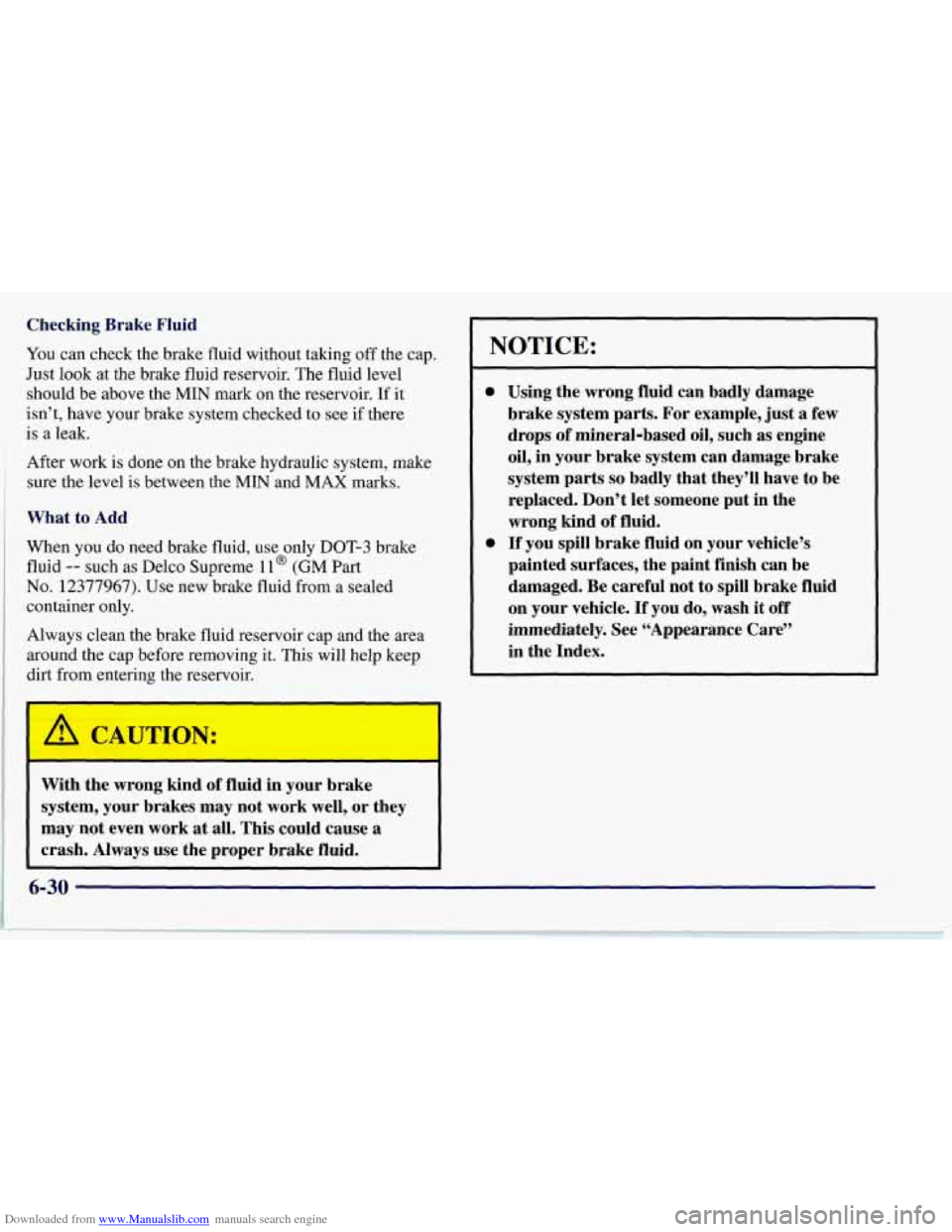
Downloaded from www.Manualslib.com manuals search engine Checking Brake Fluid
You can check the brake fluid without taking off the cap. NOTICE:
Just look at the brake fluid reservoir. The fluid level
should be above the MIN mark on the reservoir.
If it
isn’t, have your brake system checked to see if there
is a leak.
After work is done on the brake hydraulic system, make
sure the level is between the MIN and MAX marks.
What to Add
When you do need brake fluid, use only DOT-3 brake
fluid
-- such as Delco Supreme ll@ (GM Part
No. 12377967). Use new brake fluid from a sealed
container only.
Always clean the brake fluid reservoir cap and the area
around the cap before removing it. This will help keep
dirt from entering the reservoir.
With the wrong kind of fluid in your b,,ke
system, your brakes may not work well, or they
may not even work at all. This could cause
a
crash. Always use the proper brake fluid.
0 Using the wrong fluid can badly damage
brake system parts. For example, just
a few
drops
of mineral-based oil, such as engine
oil, in your brake system can damage brake
system parts
so badly that they’ll have to be
replaced. Don’t let someone put in the
wrong kind of fluid.
0 If you spill brake fluid on your vehicle’s
painted surfaces, the paint finish can be
damaged. Be careful not to spill brake fluid
on your vehicle.
If you do, wash it off
immediately. See “Appearance Care”
in the Index.
6-30
Page 284 of 356
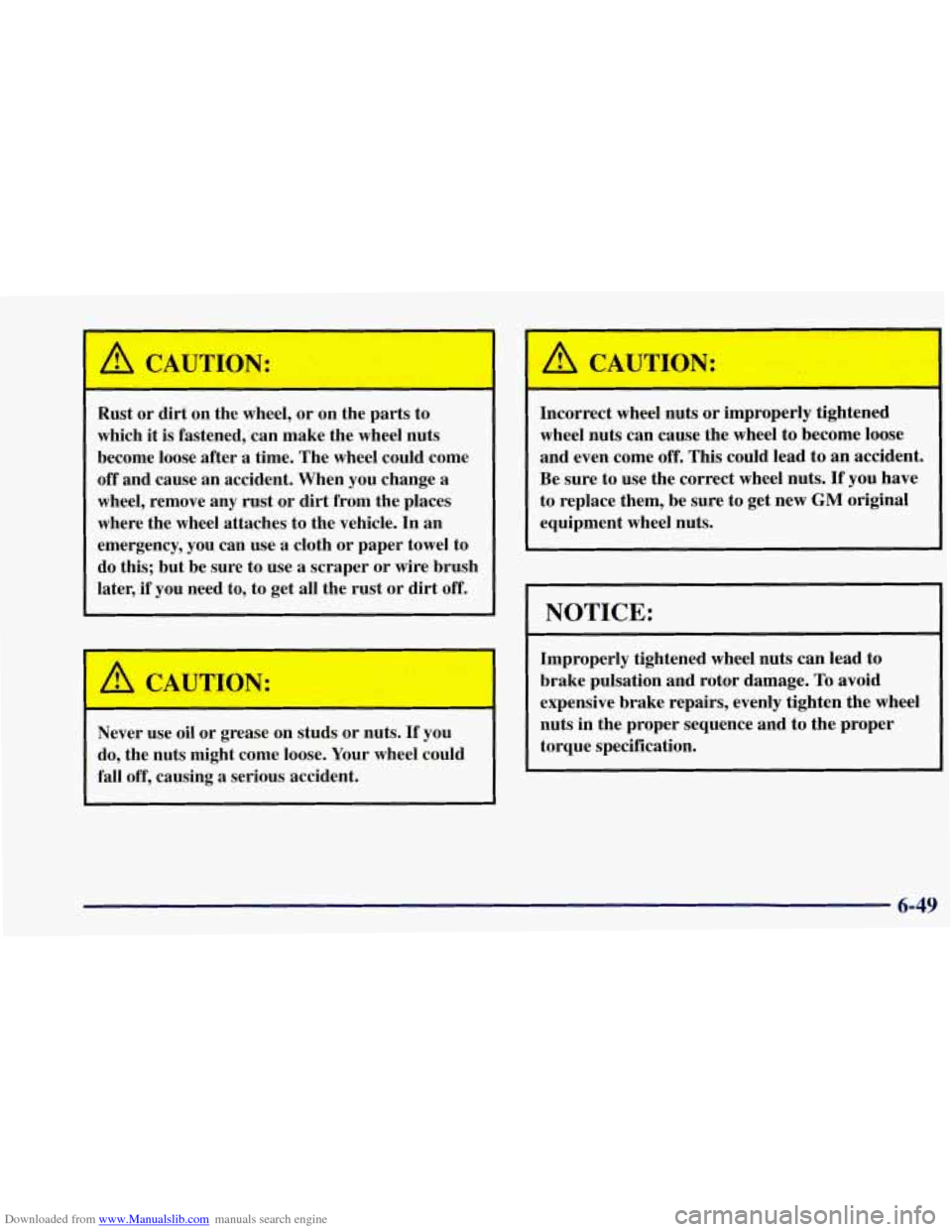
Downloaded from www.Manualslib.com manuals search engine A CAUTION:
I
Rust or dirt on the wheel, or on the parts to
which it is fastened, can make the wheel nuts
become loose after
a time. The wheel could come
off and cause an accident. When you change
a
wheel, remove any rust or dirt from the places
where the wheel attaches to the vehicle. In an
emergency, you can use
a cloth or paper towel to
do this; but be sure to use
a scraper or wire brush
later, if you need to, to get all the rust or dirt off.
Never use oil or grease on studs or nuts.
If you
do, the nuts might come loose. Your wheel could
fall off, causing a serious accident.
~
A CAUTION:
Incorrect wheel nuts or improperly tightened
wheel nuts can cause the wheel to become loose
and even come off. This could lead to an accident.
Be sure to use the correct wheel nuts. If you have
to replace them, be sure to get new
GM original
equipment wheel nuts.
NOTICE:
Improperly tightened wheel nuts can lead to
brake pulsation and rotor damage. To avoid
expensive brake repairs, evenly tighten the wheel
nuts in the proper sequence and to the proper torque specification.
6-49