Page 1 of 2248
G2M0544
1. Front Catalytic Converter
A: REMOVAL
1) Disconnect front oxygen sensor connector.
B2M0312
2) Lift-up the vehicle.
3) Disconnect rear oxygen sensor connector.
B2M0055
4) Separate center exhaust pipe from rear exhaust pipe.
B2M0054
5) Remove bolts which hold front exhaust pipe onto cylin-
der heads.
B2M0313
6) Remove front exhaust pipe and center exhaust pipe
from hanger bracket.
CAUTION:
Be careful not to pull down front exhaust pipe and
center exhaust pipe.
2
2-1SERVICE PROCEDURE
1. Front Catalytic Converter
Page 3 of 2248
B2M0313
5) Tighten bolt which holds center exhaust pipe to hanger
bracket.
Tightening torque:
35±5 N⋅m (3.6±0.5 kg-m, 26.0±3.6 ft-lb)
B2M0312
6) Connect rear oxygen sensor connector.
G2M0544
7) Lower the vehicle.
8) Connect front oxygen sensor connector.
B2M0312
2. Rear Catalytic Converter
A: REMOVAL
1) Lift-up the vehicle.
2) Disconnect rear oxygen sensor connector.
B2M0055
3) Separate center exhaust pipe and rear catalytic con-
verter assembly from rear exhaust pipe.
4
2-1SERVICE PROCEDURE
1. Front Catalytic Converter - 2. Rear Catalytic Converter
Page 4 of 2248
B2M0313
5) Tighten bolt which holds center exhaust pipe to hanger
bracket.
Tightening torque:
35±5 N⋅m (3.6±0.5 kg-m, 26.0±3.6 ft-lb)
B2M0312
6) Connect rear oxygen sensor connector.
G2M0544
7) Lower the vehicle.
8) Connect front oxygen sensor connector.
B2M0312
2. Rear Catalytic Converter
A: REMOVAL
1) Lift-up the vehicle.
2) Disconnect rear oxygen sensor connector.
B2M0055
3) Separate center exhaust pipe and rear catalytic con-
verter assembly from rear exhaust pipe.
4
2-1SERVICE PROCEDURE
1. Front Catalytic Converter - 2. Rear Catalytic Converter
Page 99 of 2248
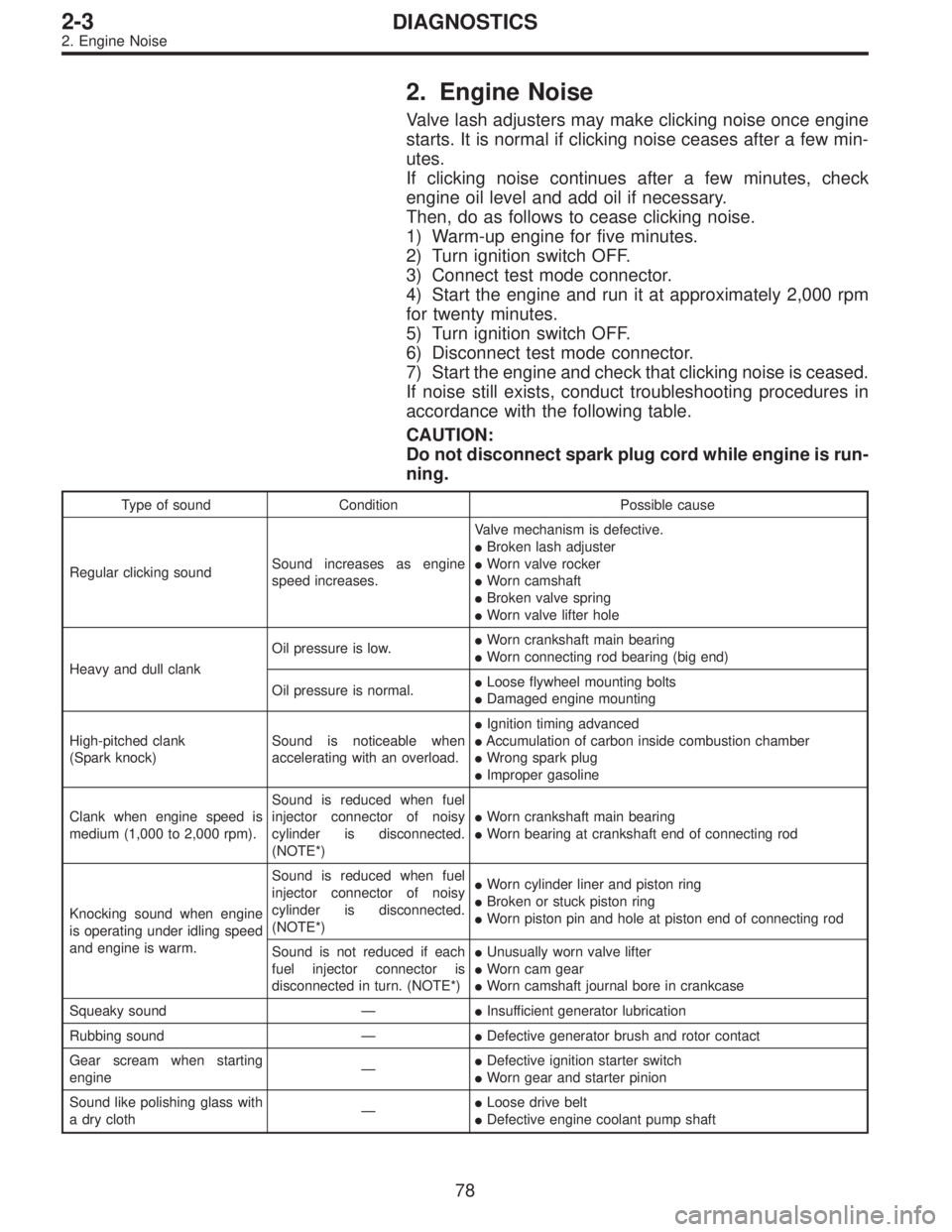
2. Engine Noise
Valve lash adjusters may make clicking noise once engine
starts. It is normal if clicking noise ceases after a few min-
utes.
If clicking noise continues after a few minutes, check
engine oil level and add oil if necessary.
Then, do as follows to cease clicking noise.
1) Warm-up engine for five minutes.
2) Turn ignition switch OFF.
3) Connect test mode connector.
4) Start the engine and run it at approximately 2,000 rpm
for twenty minutes.
5) Turn ignition switch OFF.
6) Disconnect test mode connector.
7) Start the engine and check that clicking noise is ceased.
If noise still exists, conduct troubleshooting procedures in
accordance with the following table.
CAUTION:
Do not disconnect spark plug cord while engine is run-
ning.
Type of sound Condition Possible cause
Regular clicking soundSound increases as engine
speed increases.Valve mechanism is defective.
�Broken lash adjuster
�Worn valve rocker
�Worn camshaft
�Broken valve spring
�Worn valve lifter hole
Heavy and dull clankOil pressure is low.�Worn crankshaft main bearing
�Worn connecting rod bearing (big end)
Oil pressure is normal.�Loose flywheel mounting bolts
�Damaged engine mounting
High-pitched clank
(Spark knock)Sound is noticeable when
accelerating with an overload.�Ignition timing advanced
�Accumulation of carbon inside combustion chamber
�Wrong spark plug
�Improper gasoline
Clank when engine speed is
medium (1,000 to 2,000 rpm).Sound is reduced when fuel
injector connector of noisy
cylinder is disconnected.
(NOTE*)�Worn crankshaft main bearing
�Worn bearing at crankshaft end of connecting rod
Knocking sound when engine
is operating under idling speed
and engine is warm.Sound is reduced when fuel
injector connector of noisy
cylinder is disconnected.
(NOTE*)�Worn cylinder liner and piston ring
�Broken or stuck piston ring
�Worn piston pin and hole at piston end of connecting rod
Sound is not reduced if each
fuel injector connector is
disconnected in turn. (NOTE*)�Unusually worn valve lifter
�Worn cam gear
�Worn camshaft journal bore in crankcase
Squeaky sound—�Insufficient generator lubrication
Rubbing sound—�Defective generator brush and rotor contact
Gear scream when starting
engine—�Defective ignition starter switch
�Worn gear and starter pinion
Sound like polishing glass with
a dry cloth—�Loose drive belt
�Defective engine coolant pump shaft
78
2-3DIAGNOSTICS
2. Engine Noise
Page 107 of 2248
G2M0544
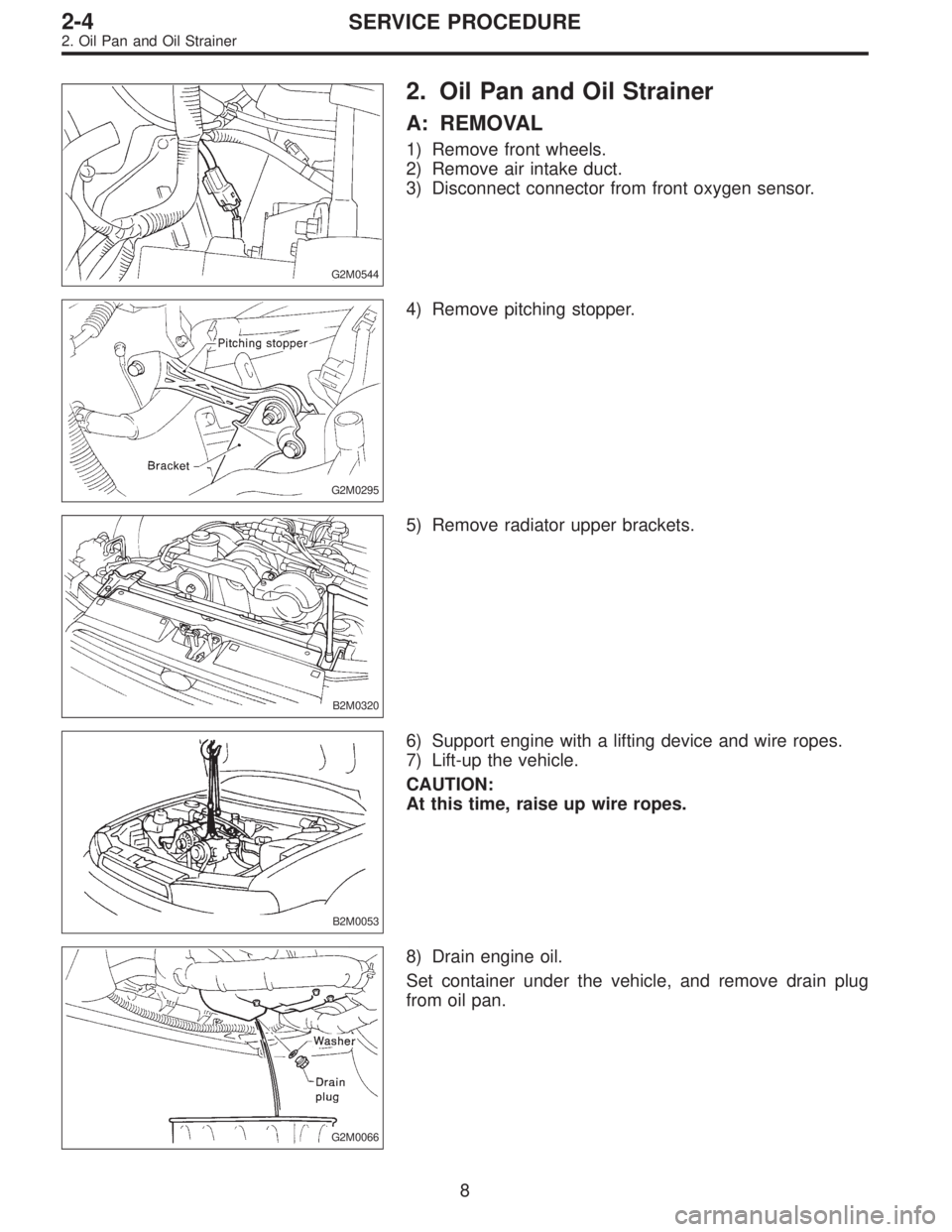
2. Oil Pan and Oil Strainer
A: REMOVAL
1) Remove front wheels.
2) Remove air intake duct.
3) Disconnect connector from front oxygen sensor.
G2M0295
4) Remove pitching stopper.
B2M0320
5) Remove radiator upper brackets.
B2M0053
6) Support engine with a lifting device and wire ropes.
7) Lift-up the vehicle.
CAUTION:
At this time, raise up wire ropes.
G2M0066
8) Drain engine oil.
Set container under the vehicle, and remove drain plug
from oil pan.
8
2-4SERVICE PROCEDURE
2. Oil Pan and Oil Strainer
Page 111 of 2248
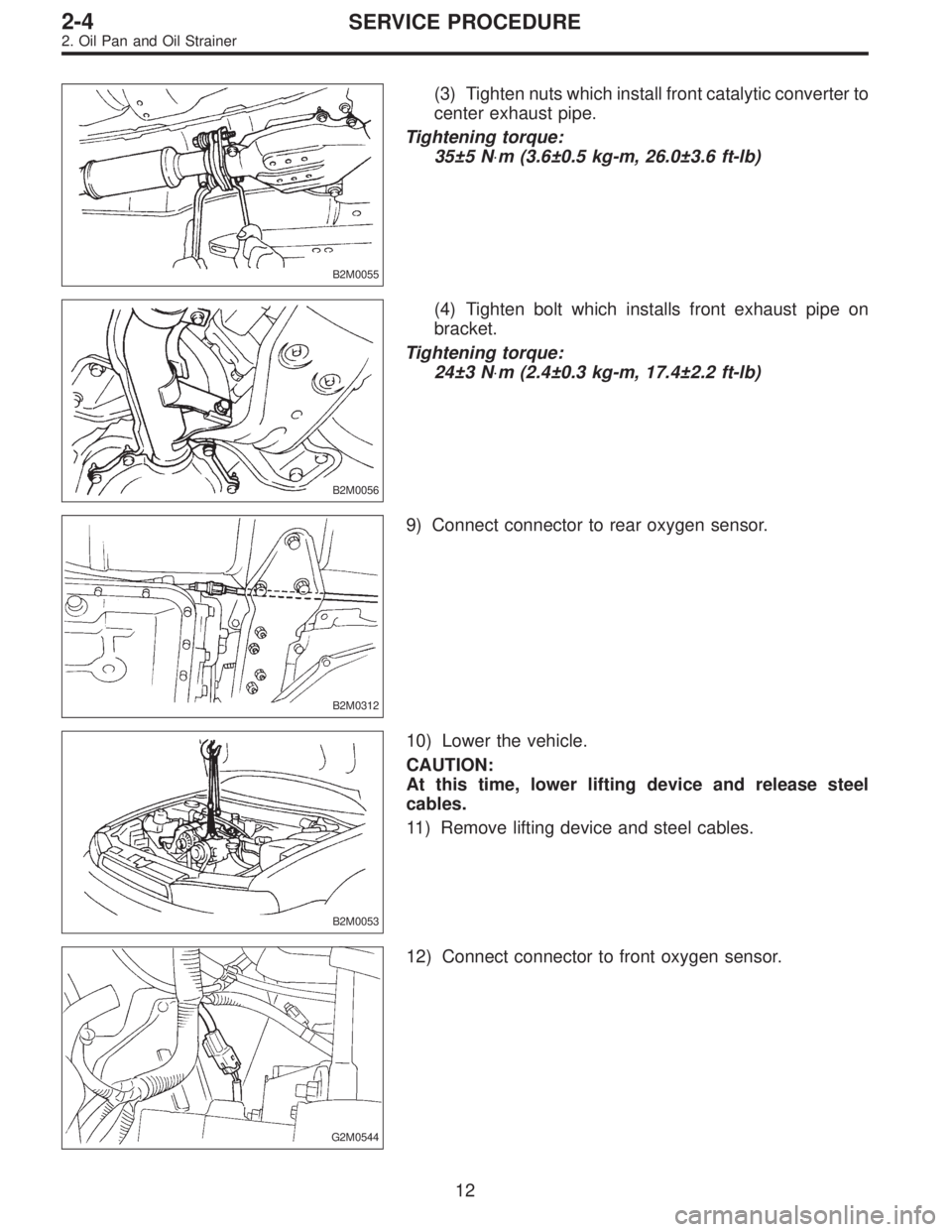
B2M0055
(3) Tighten nuts which install front catalytic converter to
center exhaust pipe.
Tightening torque:
35±5 N⋅m (3.6±0.5 kg-m, 26.0±3.6 ft-lb)
B2M0056
(4) Tighten bolt which installs front exhaust pipe on
bracket.
Tightening torque:
24±3 N⋅m (2.4±0.3 kg-m, 17.4±2.2 ft-lb)
B2M0312
9) Connect connector to rear oxygen sensor.
B2M0053
10) Lower the vehicle.
CAUTION:
At this time, lower lifting device and release steel
cables.
11) Remove lifting device and steel cables.
G2M0544
12) Connect connector to front oxygen sensor.
12
2-4SERVICE PROCEDURE
2. Oil Pan and Oil Strainer
Page 117 of 2248
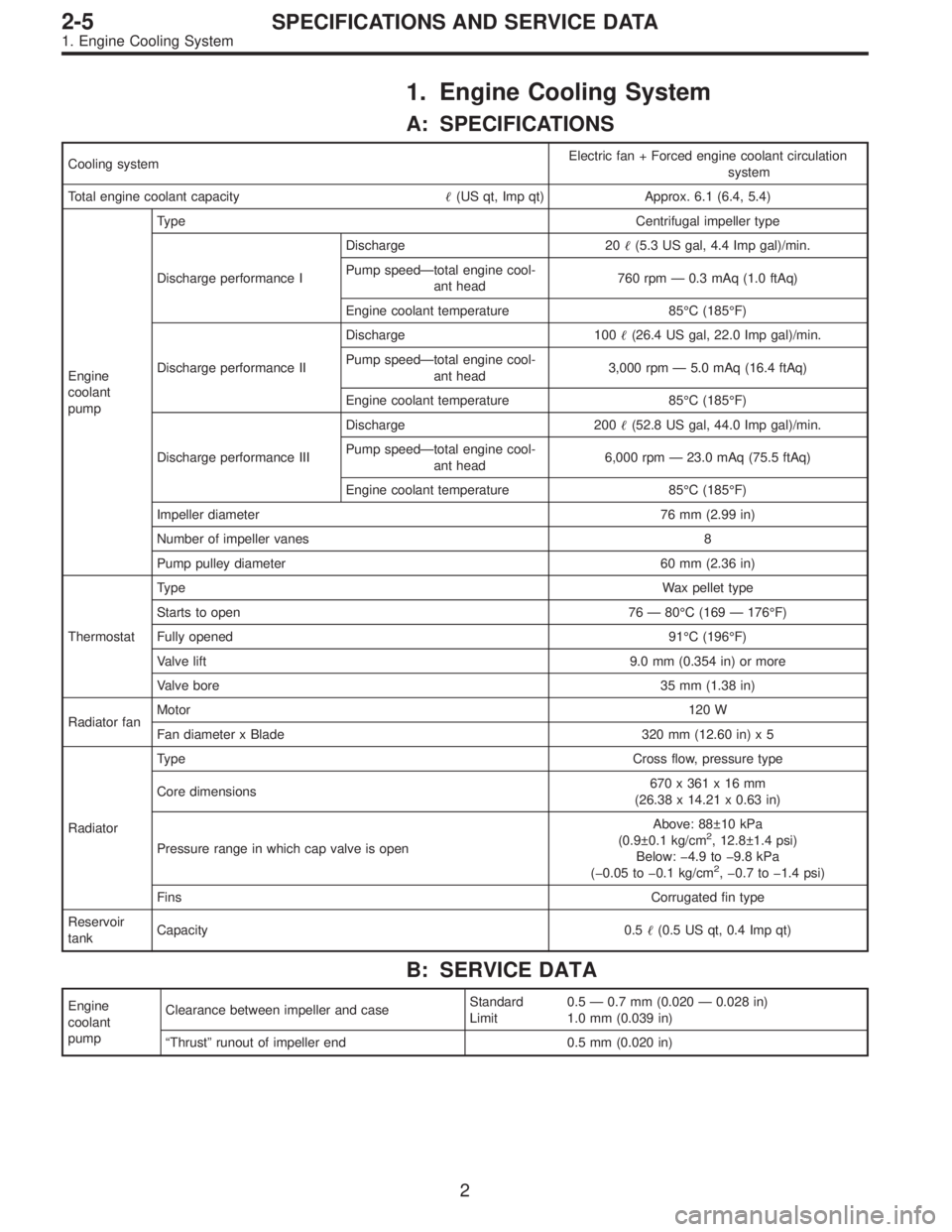
1. Engine Cooling System
A: SPECIFICATIONS
Cooling systemElectric fan + Forced engine coolant circulation
system
Total engine coolant capacity�(US qt, Imp qt) Approx. 6.1 (6.4, 5.4)
Engine
coolant
pumpTypeCentrifugal impeller type
Discharge performance IDischarge 20�(5.3 US gal, 4.4 Imp gal)/min.
Pump speed—total engine cool-
ant head760 rpm — 0.3 mAq (1.0 ftAq)
Engine coolant temperature 85°C (185°F)
Discharge performance IIDischarge 100�(26.4 US gal, 22.0 Imp gal)/min.
Pump speed—total engine cool-
ant head3,000 rpm — 5.0 mAq (16.4 ftAq)
Engine coolant temperature 85°C (185°F)
Discharge performance IIIDischarge 200�(52.8 US gal, 44.0 Imp gal)/min.
Pump speed—total engine cool-
ant head6,000 rpm — 23.0 mAq (75.5 ftAq)
Engine coolant temperature 85°C (185°F)
Impeller diameter 76 mm (2.99 in)
Number of impeller vanes 8
Pump pulley diameter 60 mm (2.36 in)
ThermostatTypeWax pellet type
Starts to open 76 — 80°C (169 — 176°F)
Fully opened91°C (196°F)
Valve lift9.0 mm (0.354 in) or more
Valve bore35 mm (1.38 in)
Radiator fanMotor120 W
Fan diameter x Blade 320 mm (12.60 in) x 5
RadiatorTypeCross flow, pressure type
Core dimensions670x361x16mm
(26.38 x 14.21 x 0.63 in)
Pressure range in which cap valve is openAbove: 88±10 kPa
(0.9±0.1 kg/cm
2, 12.8±1.4 psi)
Below: 4.9 to 9.8 kPa
(0.05 to 0.1 kg/cm
2, 0.7 to 1.4 psi)
FinsCorrugated fin type
Reservoir
tankCapacity 0.5�(0.5 US qt, 0.4 Imp qt)
B: SERVICE DATA
Engine
coolant
pumpClearance between impeller and caseStandard
Limit0.5 — 0.7 mm (0.020 — 0.028 in)
1.0 mm (0.039 in)
“Thrust” runout of impeller end 0.5 mm (0.020 in)
2
2-5SPECIFICATIONS AND SERVICE DATA
1. Engine Cooling System
Page 121 of 2248
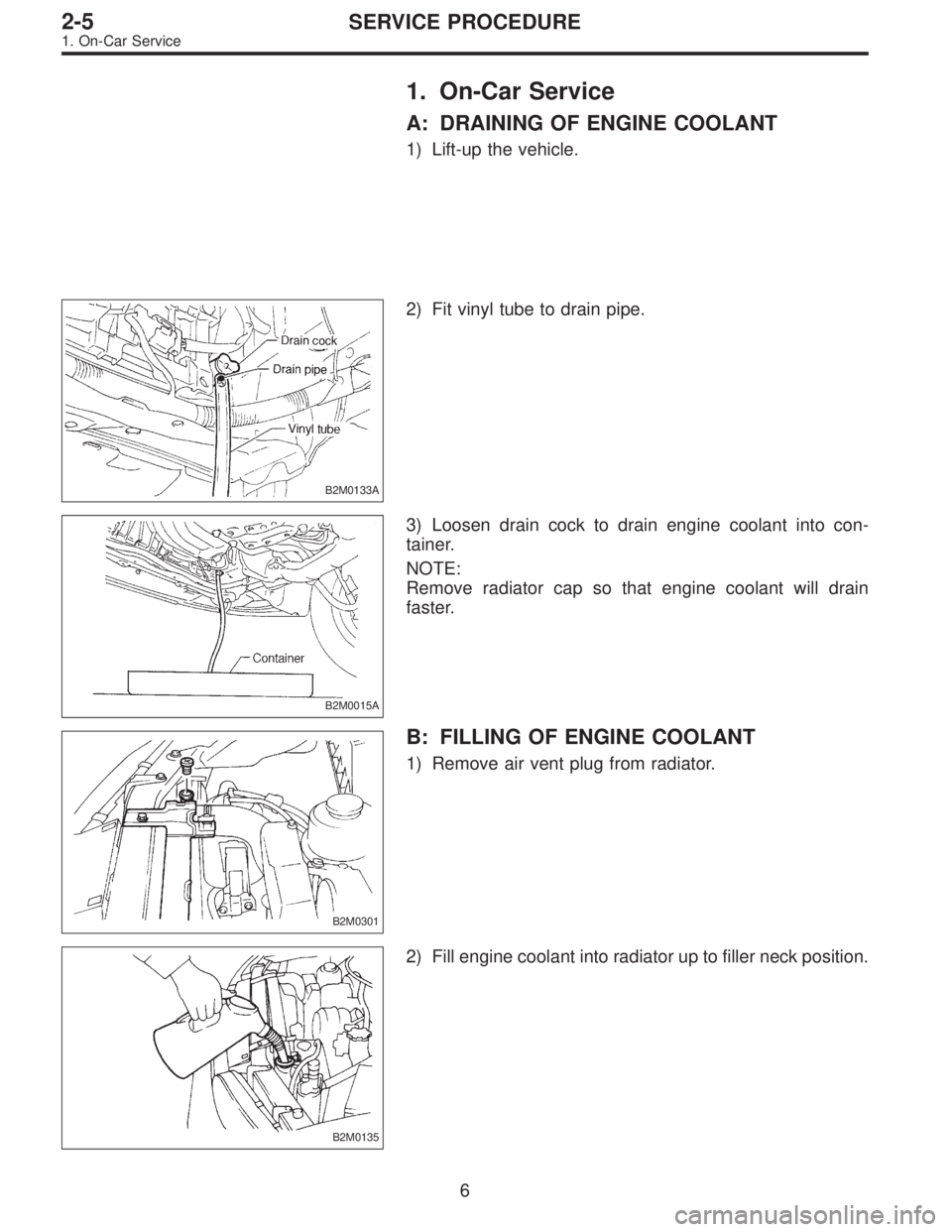
1. On-Car Service
A: DRAINING OF ENGINE COOLANT
1) Lift-up the vehicle.
B2M0133A
2) Fit vinyl tube to drain pipe.
B2M0015A
3) Loosen drain cock to drain engine coolant into con-
tainer.
NOTE:
Remove radiator cap so that engine coolant will drain
faster.
B2M0301
B: FILLING OF ENGINE COOLANT
1) Remove air vent plug from radiator.
B2M0135
2) Fill engine coolant into radiator up to filler neck position.
6
2-5SERVICE PROCEDURE
1. On-Car Service