Page 204 of 340
Downloaded from www.Manualslib.com manuals search engine If You’re Stuck: In Sand, Mud, Ice or
Snow
What you don’t want to do when your vehicle is stuck is
to spin your wheels too fast. The method known as
“rocking” can help you get out when you’re stuck, but
you must use caution.
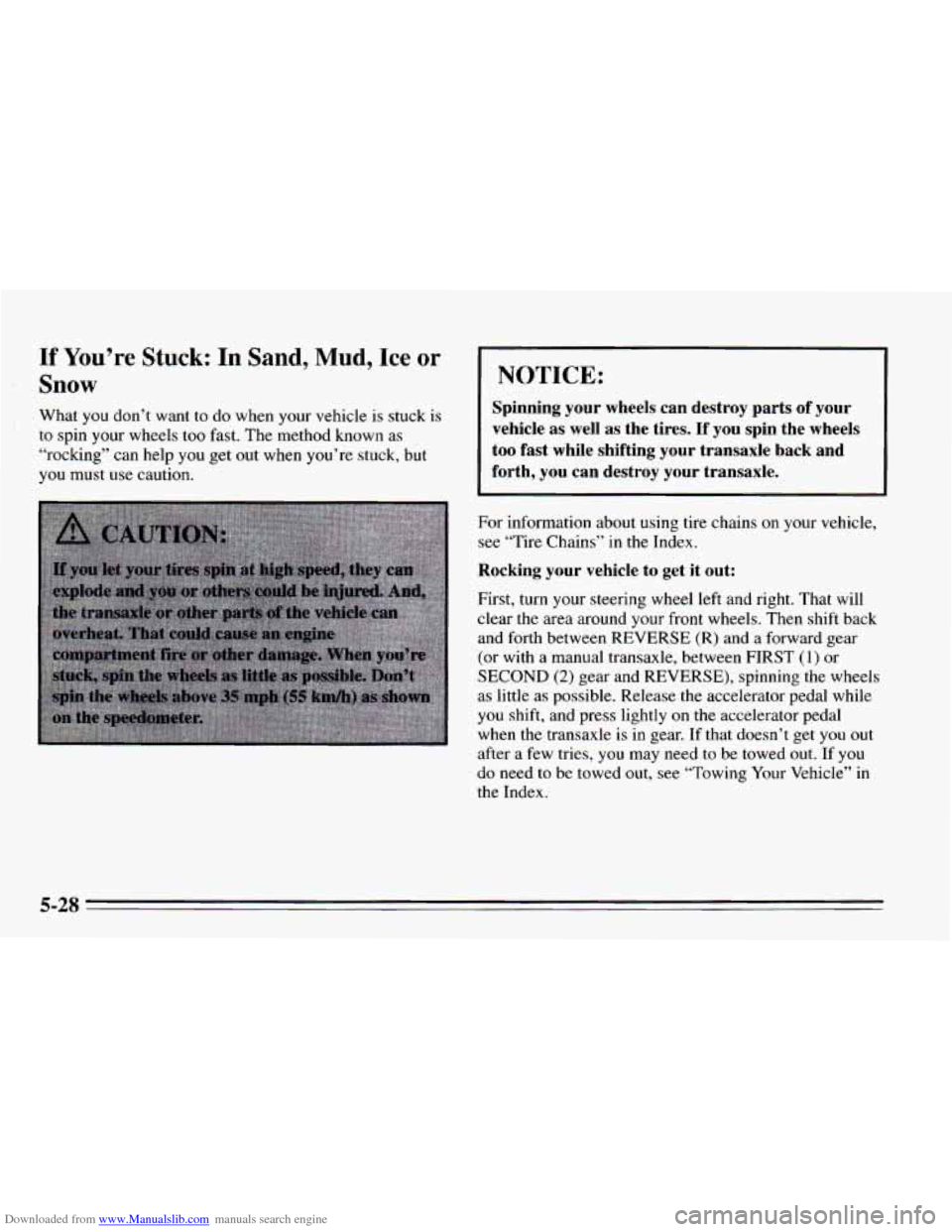
I NOTICE:
Spinning your wheels can destroy parts of your
vehicle as well as the tires.
If you spin the wheels
too fast while shifting your transaxle back and
forth, you can destroy your transaxle.
For information about using tire chains on your vehicle,
see “Tire Chains”
in the Index.
Rocking your vehicle to get it out:
First, turn your steering wheel left and right. That will
clear the area around your front wheels. Then shift back
and forth between REVERSE (R) and a forward gear
(or with a manual transaxle, between FIRST
(1) or
SECOND (2) gear and REVERSE), spinning the wheels
as little as possible. Release the accelerator pedal while
you shift, and press lightly on the accelerator pedal
when the transaxle is in gear. If that doesn’t get
you out
after a few tries, you may need to be towed out. If you
do need to be towed out, see “Towing Your Vehicle” in
the Index.
5-28
Page 215 of 340
Downloaded from www.Manualslib.com manuals search engine To Check Engine Oil
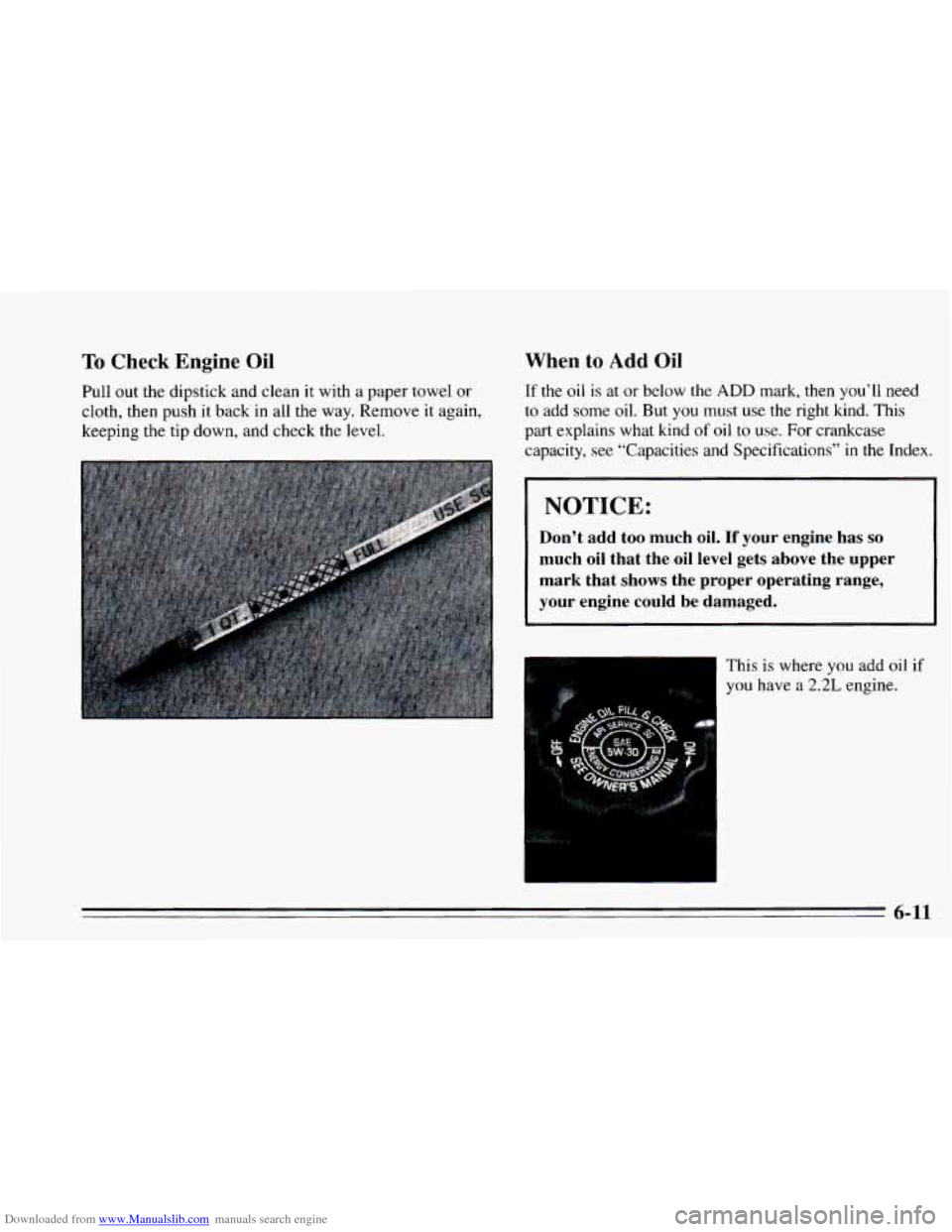
Pull out the dipstick and clean it with a paper towel or
cloth, then push
it back in all the way. Remove it again,
keeping the tip down, and check the level.
When to Add Oil
If the oil is at or below the ADD mark, then you’ll need
to add some oil, But you must use the right kind. This
part explains what kind
of oil to use. For crankcase
capacity, see “Capacities and Specifications”
in the Index.
NOTICE:
Don’t add too much oil. If your engine has so
much oil that the oil level gets above the upper
mark that
shows the proper operating range,
your engine could be damaged.
.. This is where you add oil if
you have a 2.2L engine.
6-11
Page 218 of 340
Downloaded from www.Manualslib.com manuals search engine Engine Oil Additives Engine Coolant Heater
Don’t add anything to your
oil. Your Chevrolet dealer is
ready
to advise if you think something should be added.
When to Change Engine Oil
See if any one of these is true for you:
0 Most trips are less than 5 to 10 miles (8 to 16 km).
This is particularly important when outside
temperatures are below freezing.
driving in stop and go traffic).
0 Most trips are through dusty areas.
0 Most trips include extensive idling (such as frequent
0 You frequently tow a trailer or use a carrier on top of
your vehicle.
If any
one of these is true for your vehicle, then you
need to change your oil and filter every
3,000 miles
(5 000 km) or 3 months -- whichever comes first.
If none of them is true, change the oil and filter every
7,500 miles (12 500 km) or 12 months -- whichever
comes first. An
engine coolant heater can be a big help
if you have
to park outside
in very cold weather, 0°F (- 18 “C) or
colder.
If your vehicle has this option, see “Engine
Coolant Heater” in the Index.
What to Do with Used Oil
Did you know that used engine oil contains certain
elements that may be unhealthy for your skin and could
even cause cancer? Don’t let used oil stay
on your skin
for very long. Clean your skin and nails with soap and
water, or a good hand cleaner. Wash or properly throw
away clothing or rags containing used engine oil. (See
the manufacturer’s warnings about the use and disposal
of oil products.)
Used oil can be a real threat to the environment.
If you
change your own oil, be sure
to drain all free-flowing oil
from the filter before disposal. Don’t ever dispose of oil
by putting it in the trash, pouring it
on the ground, into
sewers, or into streams or bodies of water. Instead,
recycle
it by taking it to a place that collects used oil. If
you have a problem properly disposing
of your used oil,
ask your dealer, a service station or a local recycling
center for help.
6-14
Page 224 of 340
Downloaded from www.Manualslib.com manuals search engine Then, follow these steps: How to Add Fluid
Here’s how to add fluid. Refer to the Maintenance
Schedule
to determine what kind of fluid to use. See
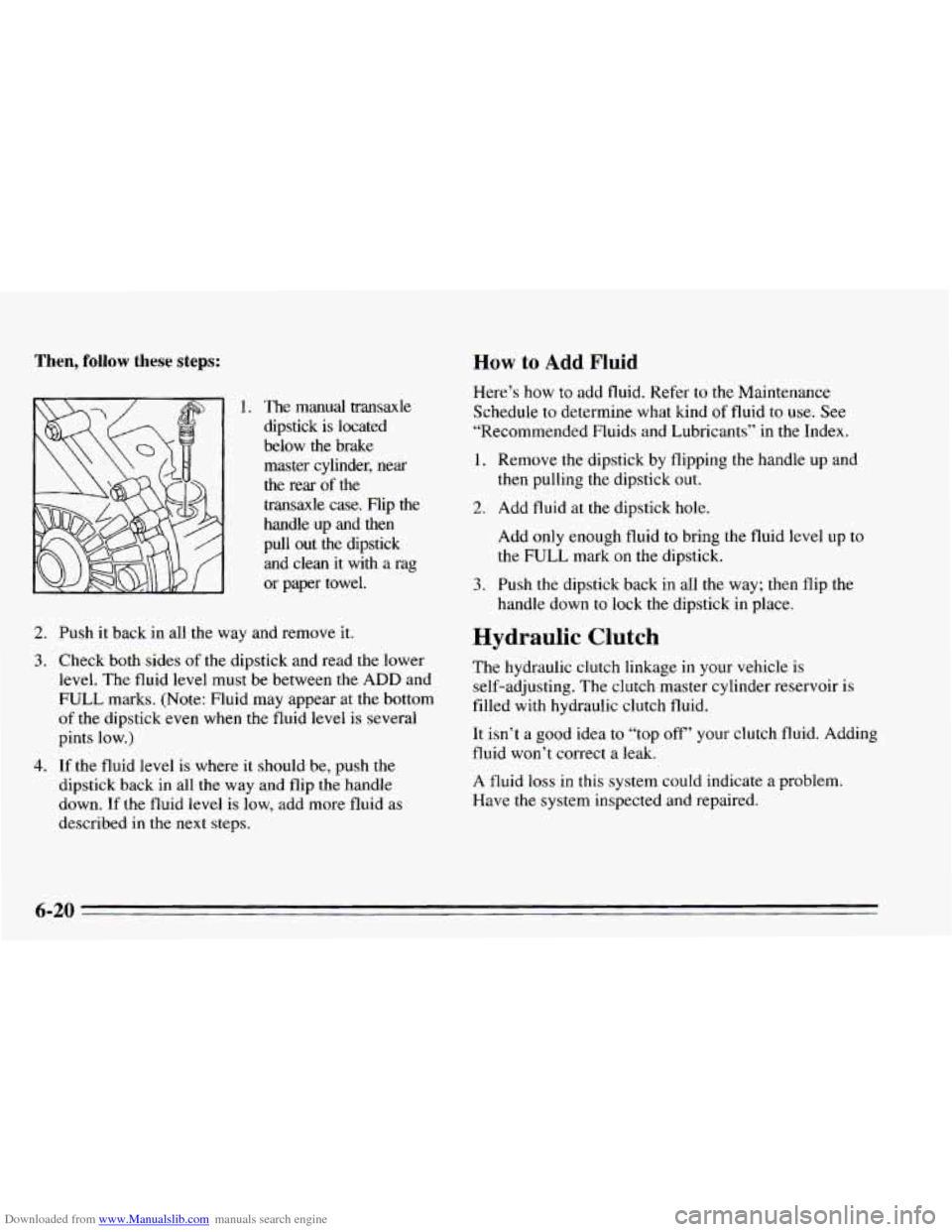
“Recommended Fluids and Lubricants” in the Index. ~ , 1. The manual transaxle
dipstick is located
below the brake
master cylinder, near the rear
of the
transaxle case. Flip the
handle up and then pull out the dipstick
and clean it with a rag
or paper towel.
2. Push it back in all the way and remove it.
3. Check both sides of the dipstick and read the lower
level. The fluid level must be between the
ADD and
FULL
marks. (Note: Fluid may appear at the bottom
of the dipstick even when the fluid level is several
pints
low.)
4. If the fluid level is where it should be, push the
dipstick back in all the way and flip the handle
down.
If the fluid level is low, add more fluid as
described
in the next steps.
1. Remove the dipstick by flipping the handle up and
then pulling the dipstick out.
2. Add fluid at the dipstick hole.
Add only enough fluid to bring the fluid level up to
the FULL mark on the dipstick.
3. Push the dipstick back in all the way; then flip the
handle down to lock the dipstick in place.
Hydraulic Clutch
The hydraulic clutch linkage in your vehicle is
self-adjusting. The clutch master cylinder reservoir
is
filled with hydraulic clutch fluid.
It isn’t
a good idea to “top off’ your clutch fluid. Adding
fluid won’t correct a leak.
A fluid loss in this system could indicate a problem.
Have the system inspected and repaired.
6-20
Page 234 of 340
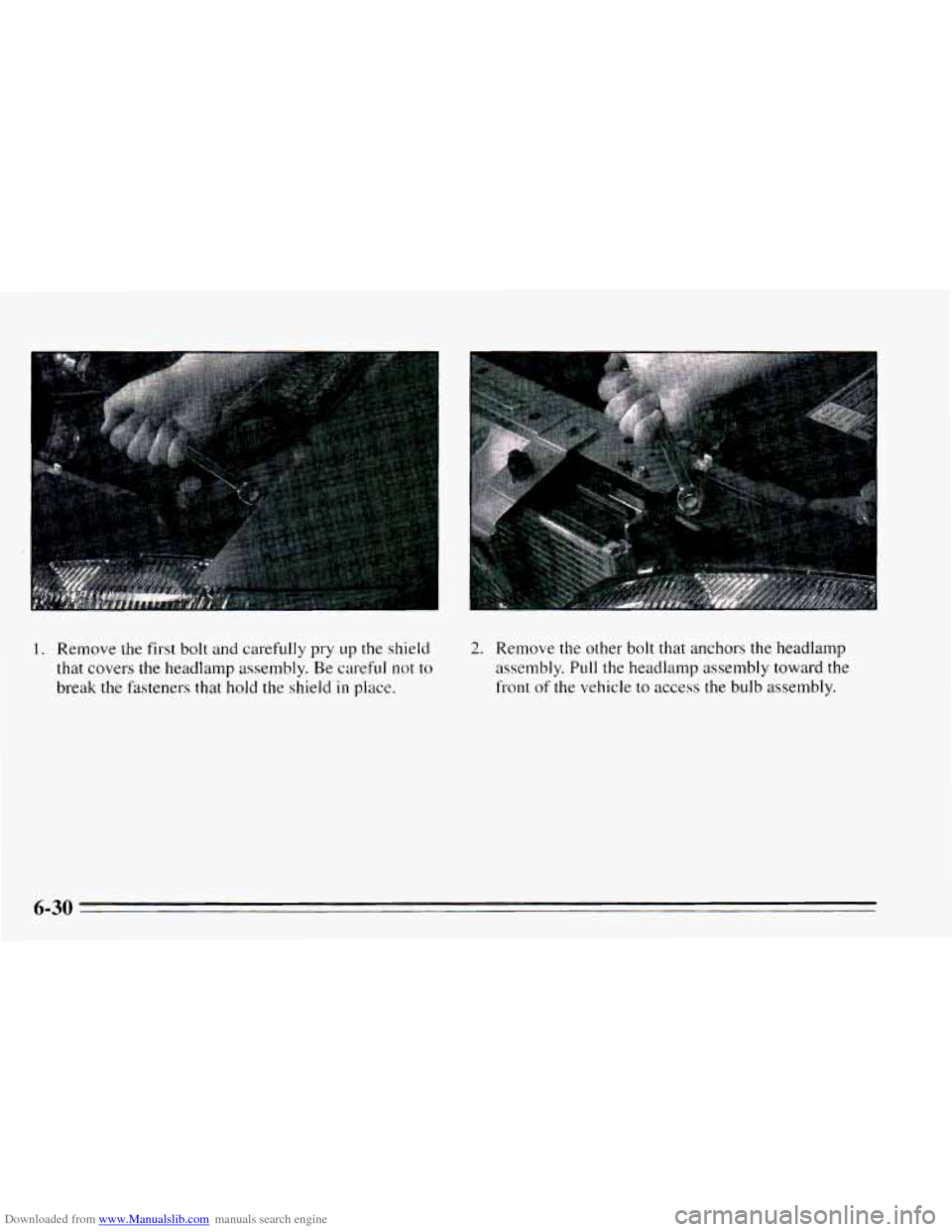
Downloaded from www.Manualslib.com manuals search engine 1. Remove the first bolt and carefully pry up the shield
that covers
the headlamp assembly. Be careful not to
break the fasteners that hold the shield in place.
2. Remove the other bolt that anchors the headlamp
assembly. Pull the headlamp assembly toward the
front of the vehicle to access the bulb assembly.
6-30
Page 236 of 340
Downloaded from www.Manualslib.com manuals search engine Windshield Wiper Blade Replacement
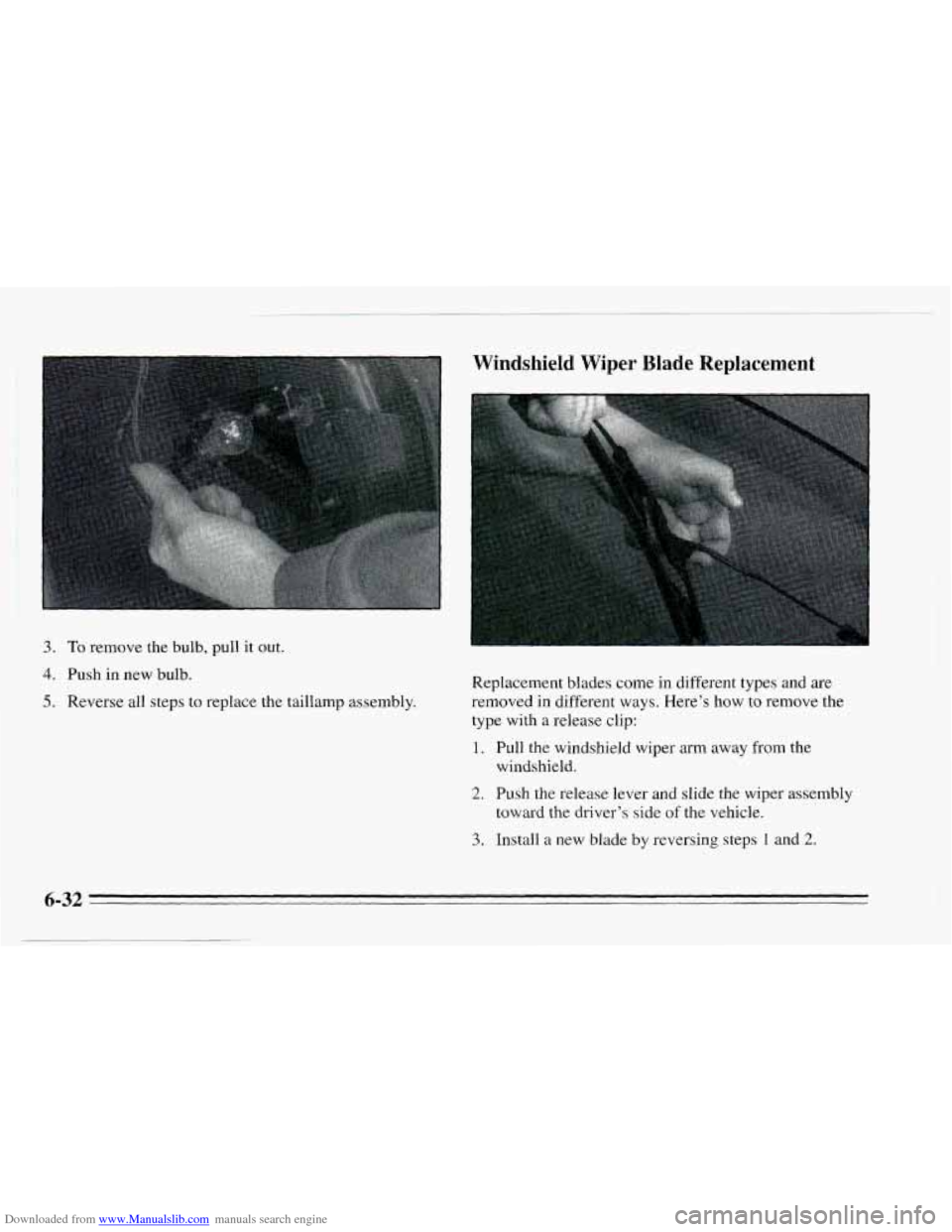
3. To remove the bulb, pull it out.
4. Push in new bulb.
5. Reverse all steps to replace the taillamp assembly.
b
Replacement blades come in different types and are
removed
in different ways. Here’s how to remove the
type with a release clip:
1. Pull the windshield wiper arm away from the
windshield.
2. Push the release lever and slide the wiper assembly
toward the driver’s side of the vehicle.
3. Install a new blade by reversing steps 1 and 2.
6-32
Page 247 of 340
Downloaded from www.Manualslib.com manuals search engine Using Foam-Type Cleaner on Fabric
0
0
0
0
0
0
0
0
0
0
Vacuum and brush the area to remove any loose dirt.
Always clean a whole trim panel or section. Mask
surrounding trim along stitch or welt lines.
Mix Multi-Purpose Powdered Cleaner following the
directions
on the container label.
Use suds
only and apply with a clean sponge.
Don’t saturate the material.
Don’t rub
it roughly.
As soon as you’ve cleaned the section, use a sponge
to remove the suds.
Rinse
the section with a clean, wet sponge.
Wipe
off what’s left with a slightly damp paper towel
or cloth.
Then dry it immediately with a blow dryer or a heat
lamp.
NOTICE:
Be careful. A blow dryer may scorch the fabric.
~~~~ ~~ ~~
0 Wipe with a clean cloth.
Using Solvent-Type Cleaner on Fabric
First, see if you have to use solvent-type cleaner at all.
Some spots and stains will clean
off better with just
water and mild soap.
If you need to use a solvent:
0 Gently scrape excess soil from the trim material with
a clean, dull knife or scraper. Use very little cleaner,
light pressure and clean cloths (preferably
cheesecloth). Cleaning should start at
the outside of
the stain, “feathering” toward
the center. Keep
changing to
a clean section of the cloth.
0 When you clean a stain from fabric, immediately dry
the area with
a blow dryer to help prevent a cleaning
ring. (See the previous
NOTICE.)
Fabric Protection
Your Chevrolet has upholstery that has been treated with
Scotchgard
TM Fabric Protector, a 3M product.
Scotchgard” protects fabrics by repelling oil and water,
which are the carriers
of most stains. Even with this
protection,
you still need to clean your upholstery often
to keep
it looking new.
Further information on cleaning is available by calling
1-800-433-3296
(in Minnesota, 1-800-642-6 167).
6-43
Page 250 of 340
Downloaded from www.Manualslib.com manuals search engine Weatherstrips
Silicone grease on weatherstrips will rnake them last
longer, seal better, and not stick or squeak.
Apply
silicone grease with a clean cloth at least every six
months. During very cold, damp weather more frequent
application may be required. (See “Recomnlended
Fluids and Lubricants“
in the Index.)
Cleaning the Outside of Your
Chevrolet
The paint finish on your vehicle provides beauty, depth
of color, gloss retention and durability.
Washing Your Vehicle
The best way to preserve your vehicle’s finish is to keep
it clean by washing it often with lukewarm or cold
water.
Don‘t wash your vehicle
in the direct rays of the sun.
Don’t use strong soaps or chemical detergents. Use
liquid hand,
dish or car washing (mild detergent) soaps.
Don’t use cleaning agents that are petroleum based, or
that contain acid
or abrasives. All cleaning agents
should be flushed promptly and
not allowed to dry on
the surface, or they could stain. Dry the finish with a
soft, clean chamois or a 100% cottorl towel to avoid
surface scratches and water spotting.
High pressure vehicle washes may cause water
to enter
your vehicle.
Finish Care
Occasional waxing or mild polishing of your Chevrolet
by hand may be necessary to remove residue from the
paint finish. You can get GM approved cleaning
products from your dealer. (See “Appearance Care and
Materials?’
in the Index.)
Your Chevrolet has a “basecoatklearcoat” paint finish.
The clearcoat gives more depth and gloss to the colored
basecoat. Always use waxes and
polishes that are
non-abrasive
and made for a basecoat/clearcoat paint
finish.
NOTICE:
Machine compounding or aggressive polishing on
a basecoatklearcoat paint finish may dull the
finish
or leave swirl marks.
6-46