Page 109 of 340
Downloaded from www.Manualslib.com manuals search engine 10. Turn the ignition to the RUN position. Don’t start
the engine.
11. Lower both door windows to avoid wear to the
weather strips.
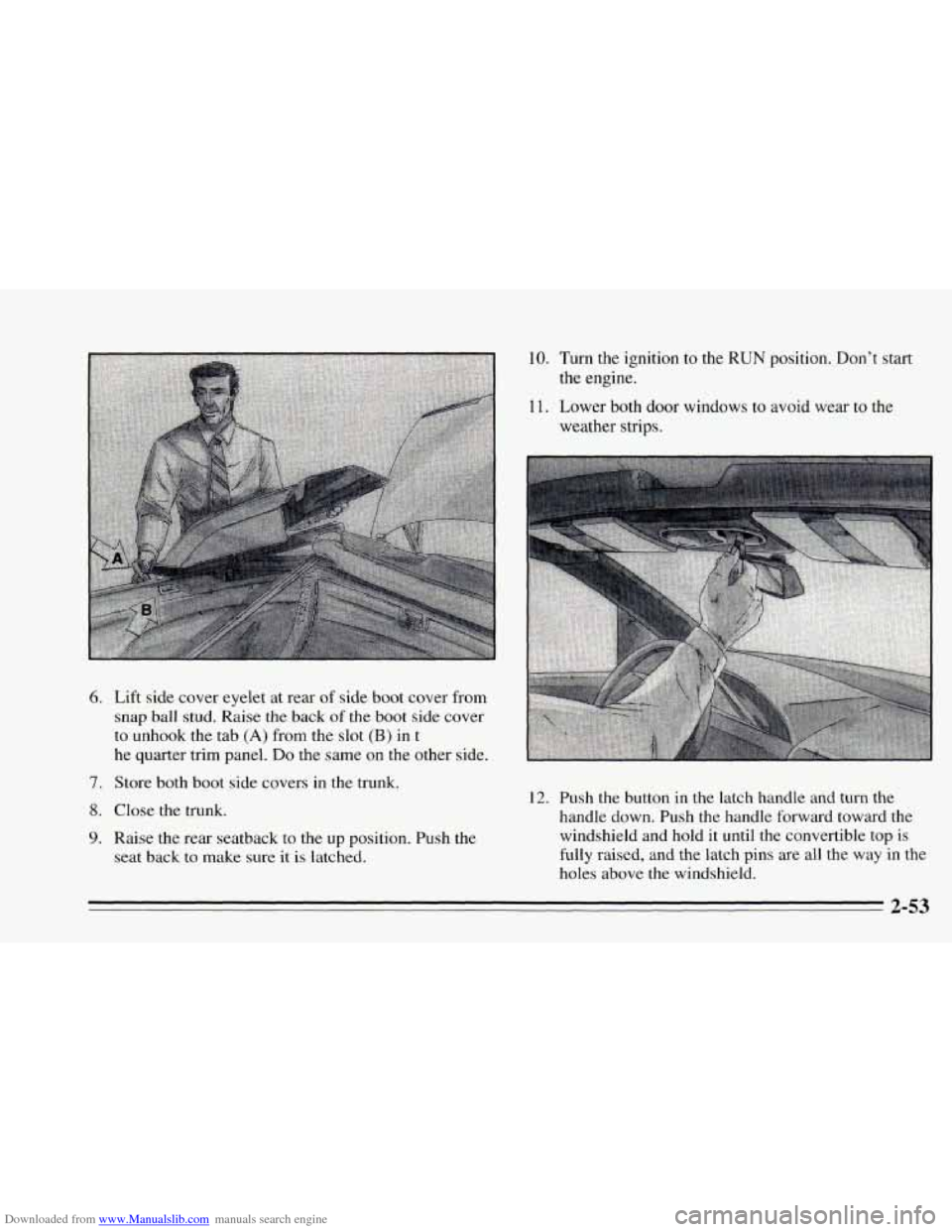
6. Lift side cover eyelet at rear of side boot cover from
snap ball stud. Raise the back
of the boot side cover
to unhook the tab
(A) from the slot (B) in t
he quarter trim panel.
Do the same on the other side.
7. Store both boot side covers in the trunk.
8. Close the trunk.
9. Raise the rear seatback to the up position. Push the
seat back
to make sure it is latched.
12. Push the button in the latch handle and turn the
handle down. Push the handle forward toward the
windshield and hold it until the convertible top is
fully raised, and the latch pins
are all the way in the
holes above the windshield.
2-53
Page 118 of 340
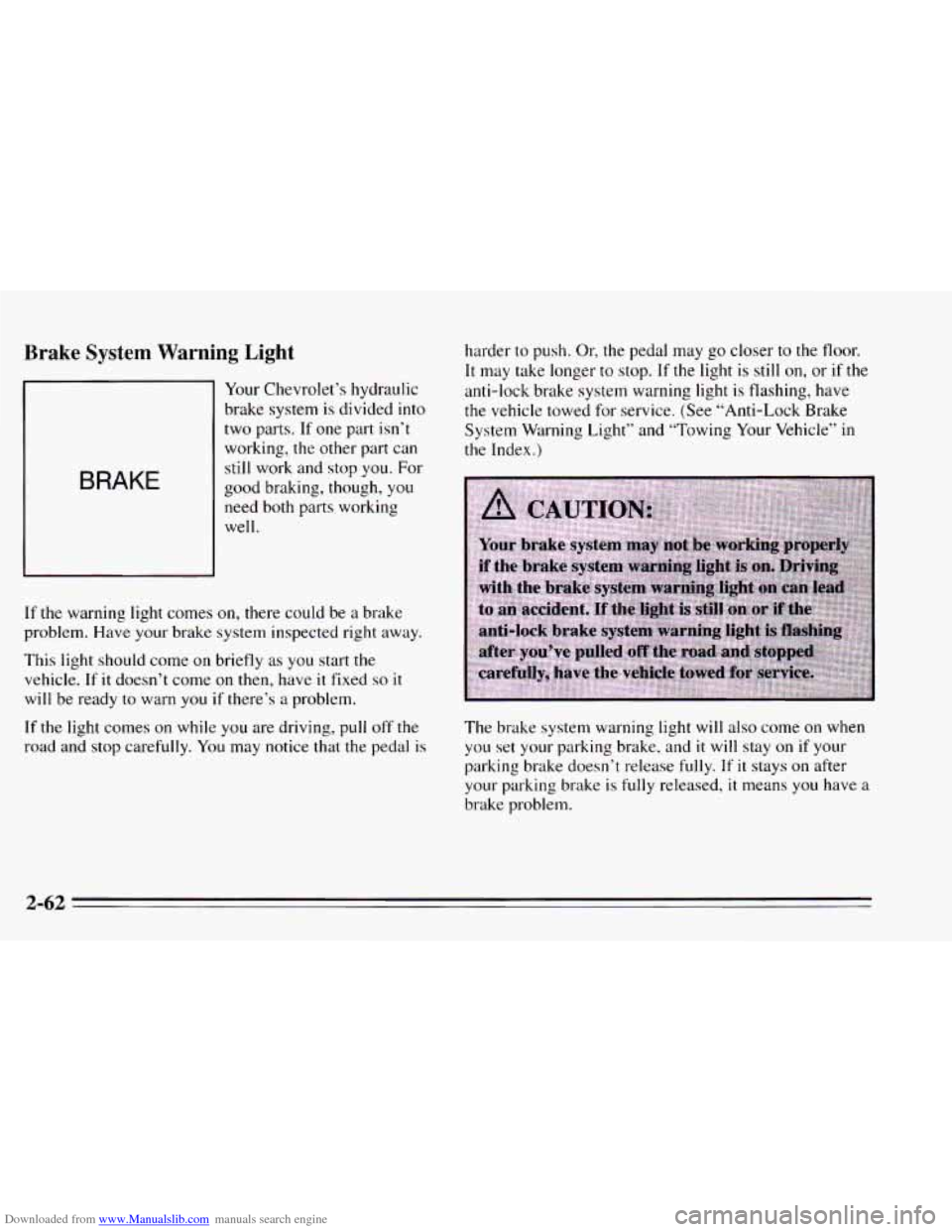
Downloaded from www.Manualslib.com manuals search engine Brake System Warning Light
BRAKE
Your Chevrolet’s hydraulic
brake system is divided
into
two parts. If one part isn’t
working, the other part can
still work and stop you. For
good braking, though, you
need both parts working
well.
If the warning light comes on, there could be a brake
problem. Have your brake system inspected right away.
This light should come on briefly as you start the
vehicle. If it doesn’t come on then, have it fixed so it
will be ready to warn you if there’s a problem.
If the light comes on while you are driving, pull off the
road and stop carefully.
You may notice that the pedal is
harder to push. Or, the pedal may go closer to the floor.
It may take longer to stop. If the light is still on, or if the
anti-lock brake system warning light is flashing, have
the vehicle towed for service. (See “Anti-Lock Brake
System Warning Light” and “Towing Your Vehicle”
in
the Index.)
The brake system warning light will
also come on when
you set your parking brake, and
it will stay on if your
parking brake doesn’t release
fully. If it stays on after
your parking brake
is fully released, it means you have a
brake problem.
2-62
Page 119 of 340
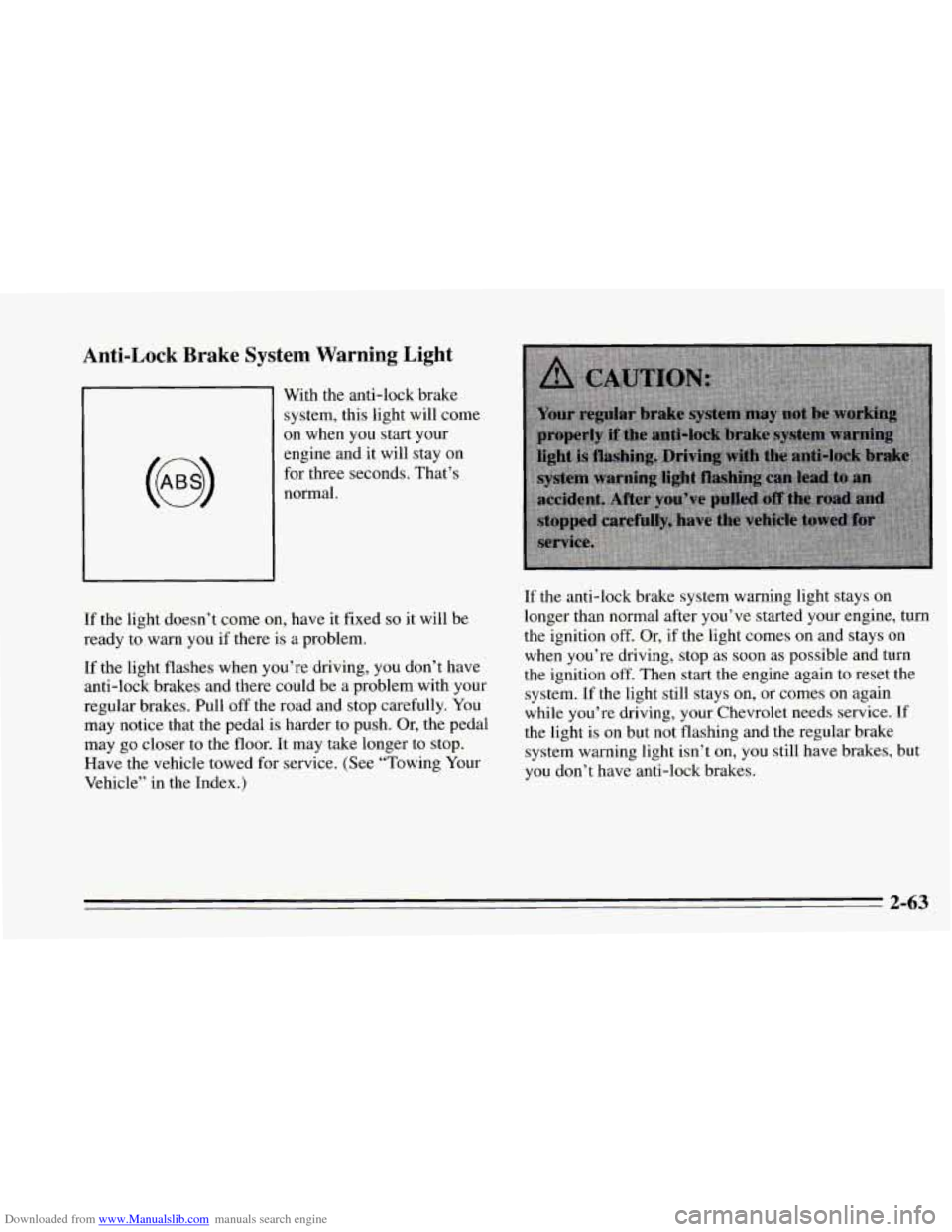
Downloaded from www.Manualslib.com manuals search engine Anti-Lock Brake System Warning Light
1 With the anti-lock brake
’ system, this light will come
on when you start your
engine and it will stay on
for three seconds. That’s
normal.
If the light doesn’t come on, have it fixed
so it will be
ready to warn you if there is a problem.
If the light flashes when you’re driving,
you don’t have
anti-lock brakes and there could be a problem with your
regular brakes. Pull off the road and stop carefully. You
may notice that the pedal is harder to push. Or, the pedal
may
go closer to the floor. It may take longer to stop.
Have the vehicle towed for service. (See “Towing Your
Vehicle” in the Index.) If
the anti-lock brake system warning light stays on
longer than normal after you’ve started your engine, turn
the ignition off. Or, if the light comes on and stays on
when you’re driving, stop as soon as possible and turn
the ignition
off. Then start the engine again to reset the
system. If the light still stays on, or comes
on again
while you’re driving, your Chevrolet needs service.
If
the light is on but not flashing and the regular brake
system warning light isn’t on,
you still have brakes, but
you don’t have anti-lock brakes.
2-63
Page 126 of 340
Downloaded from www.Manualslib.com manuals search engine These following conditions also may cause the CHECK
ENGINE light to come
on:
0
0
Low Fuel/Out of Fuel: As the vehicle starts to run
out of fuel, the CHECK ENGINE light may come on
as a result of an engine misfire. Filling your fuel tank
should correct this condition. Make sure to install
the
gas cap fully. It will require a few driving trips to
turn the light off.
Poor Quality Fuel: Be sure to fuel your vehicle with
quality fuel. Your engine may
not run efficiently on
poor fuel. Poor fuel may cause stalling, hesitation or
misfire. These conditions may
go away when the
engine
is warmed-up. However, poor quality fuel
may cause the
CHECK ENGINE light to come on.
Have a dealer check the vehicle. If no problems are
found, you may want
to change to another brand of
fuel.
Driving Through Standing Water: Driving your
vehicle through puddles
of deep standing water may
result in
a temporary misfire condition. This
condition will usually correct itself shortly after
the
electrical system dries out. it will require a few
driving trips
to turn the light off.
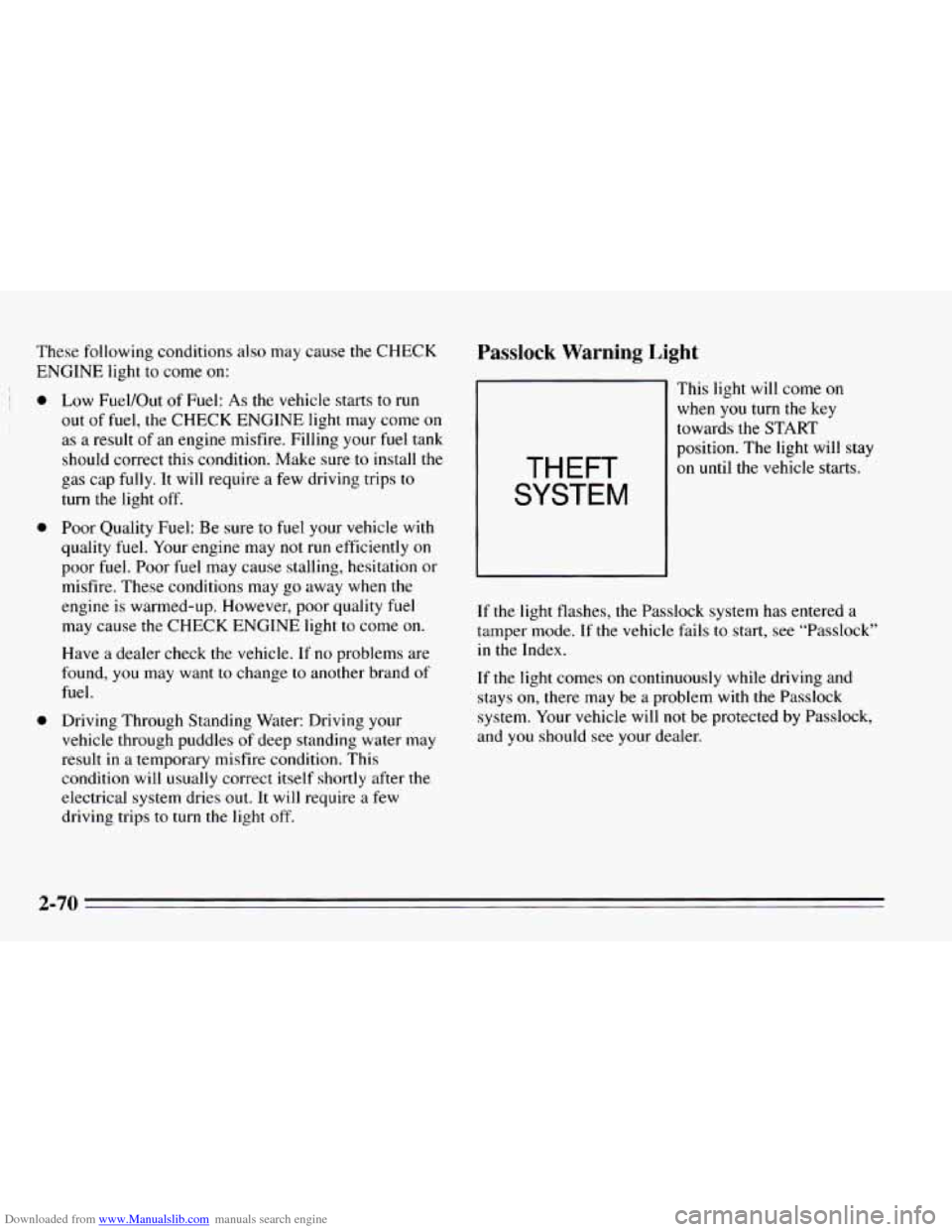
Passlock Warning Light
THEFT
SYSTEM
This light will come on
when you turn the key
towards the
START
position. The light will stay
on until the vehicle starts.
If the light flashes, the Passlock system has entered a
tamper mode.
If the vehicle fails to start, see “Passlock”
in the Index.
If
the light comes on continuously while driving and
stays
on, there may be a problem with the Passlock
system. Your vehicle will not be protected
by Passlock,
and
you should see your dealer.
2-70
Page 127 of 340
Downloaded from www.Manualslib.com manuals search engine 0 Section 3 Comfort Controls and Audio Svstems J
In this section you’ll find out how to operate the comfort
control systems and audio systems offered with your
Chevrolet. Be sure
to read about the particular system
supplied with your vehicle.
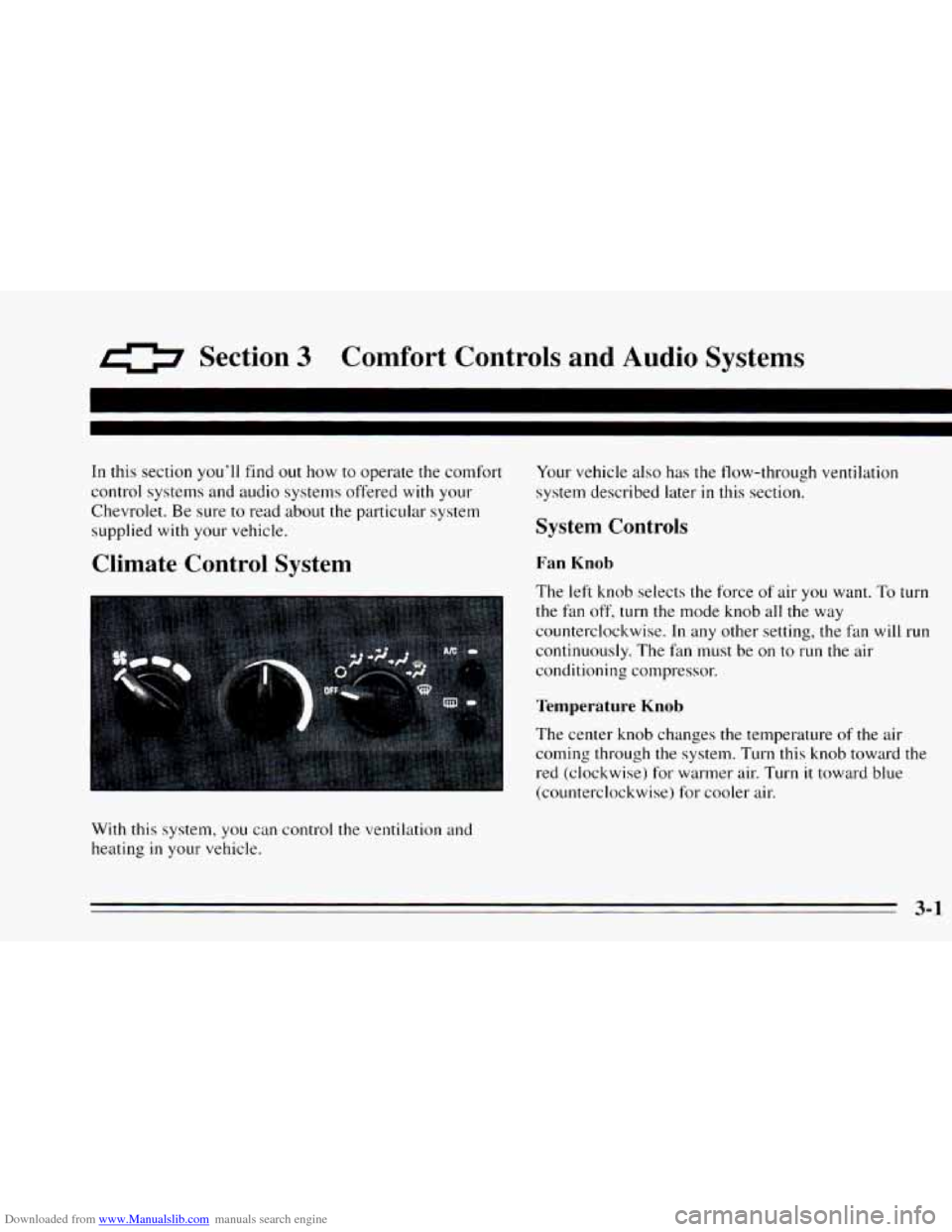
Climate Control System
With this system, you can control the ventilation and
heating
in your vehicle. Your
vehicle also has the flow-through ventilation
system described later
in this section.
System Controls
Fan Knob
The left knob selects the force of air you want. To turn
the fan off, turn the mode knob all the way
counterclockwise.
In any other setting, the fan will run
continuously. The fan must
be on to run the air
conditioning compressor.
Temperature Knob
The center knob changes the temperature of the air
coming through
the system. Turn this knob toward the
red (clockwise) for warmer air. Turn it toward blue
(counterclockwise) for cooler air.
3-1
Page 129 of 340
Downloaded from www.Manualslib.com manuals search engine setting is used for long periods of time, the air in your
vehicle may become too dry.
For normal cooling
on hot days, use VENT with the
temperature knob in the blue area and the
NC button
pushed in. The system will bring in outside air and cool it.
On cool but sunny days, the sun may warm your upper
body, but your lower body may not be warm enough.
You can use BI-LEVEL with the temperature knob in
the middle and the A/C button pushed
in. The system
will bring in outside air and direct slightly warmer air to
your lower body. You may notice this temperature
difference more at some times
than others.
Heating
On cold days use FLOOR with the temperature all the
way in the red area. The system will bring in outside air,
heat it and send
it to the floor ducts.
Your vehicle has heat ducts that are directed toward the
rear seat. Keep the area under the front seats clear
of
obstructions so the heated air can reach the rear seat
passengers.
If your vehicle has an engine coolant heater, you can use
it to help your system provide warm air faster when it’s
cold outside (0°F (-18°C) or lower). An engine coolant
heater warms
the coolant your engine and heating
system use
to provide heat. See “Engine Coolant
Heater” in the Index.
Ventilation
For mild outside temperatures when little heating or
cooling is needed, use VENT to direct outside air
through your vehicle. Your vehicle also has the
flow-through ventilation system described later
in this
section.
Defogging and Defrosting Windows
Your system has two settings for clearing the front and
side windows. To defrost
the windows quickly, use
DEFROST with the temperature knob all
the way in the
red area. To warm passengers while keeping the
windows clean, use
DEFOG.
To defog the side windows while using the air
conditioner, set the right control to BI-LEVEL, the fan
control
to the highest setting, and press the A/C button.
Aim
the side vents toward the side windows. For
increased air flow
to the side vents, close the center
vents.
3-3
Page 166 of 340
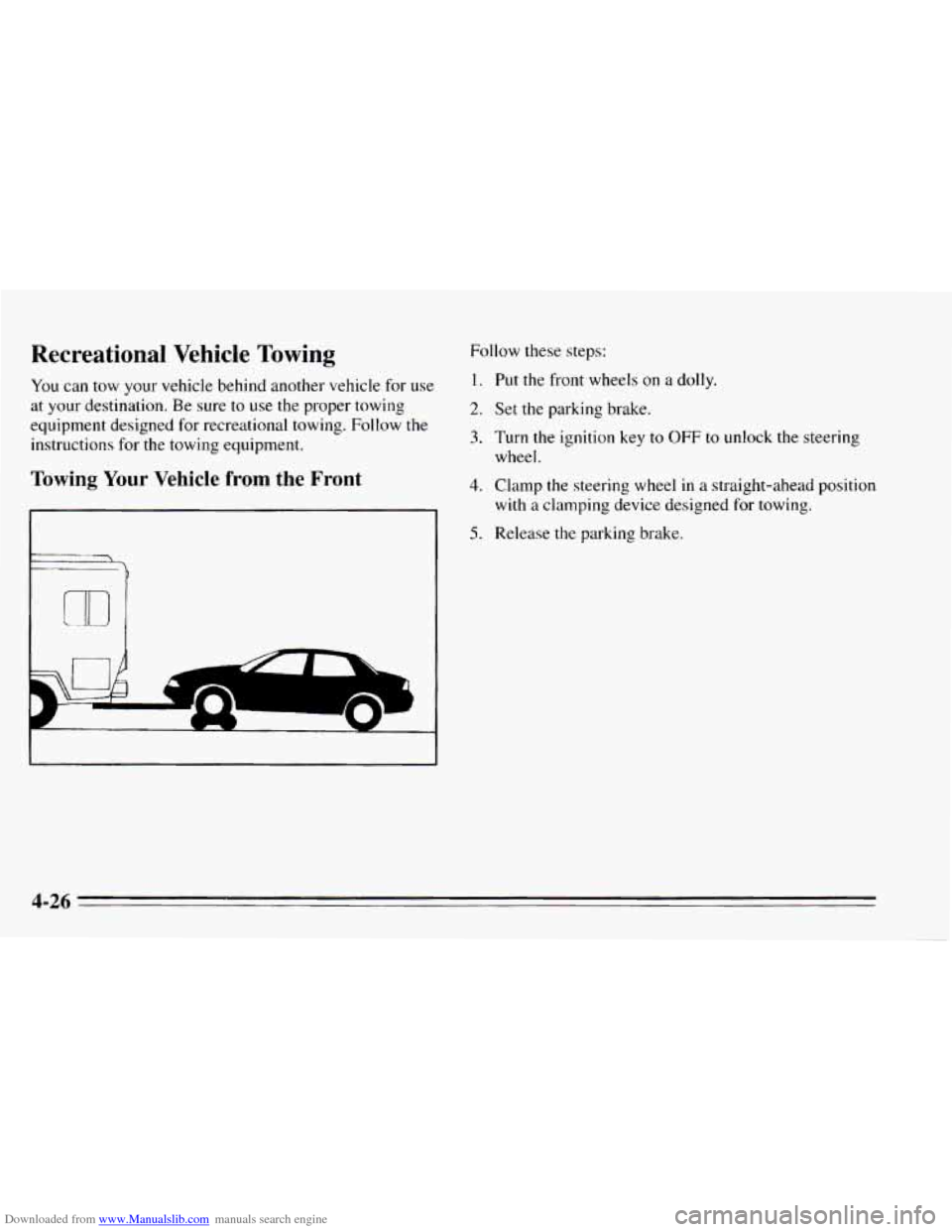
Downloaded from www.Manualslib.com manuals search engine Recreational Vehicle Towing
You can tow your vehicle behind another vehicle for use
at your destination.
Be sure to use the proper towing
equipment designed for recreational towing. Follow
the
instructions for the towing equipment.
Towing Your Vehicle from the Front
P
Follow these steps:
1. Put the front wheels on a dolly.
2. Set the parking brake.
3. Turn the ignition key to OFF to unlock the steering
4. Clamp the steering wheel in a straight-ahead position
5. Release the parking brake.
wheel.
with
a clamping device
designed for towing.
4-26
-
Page 167 of 340
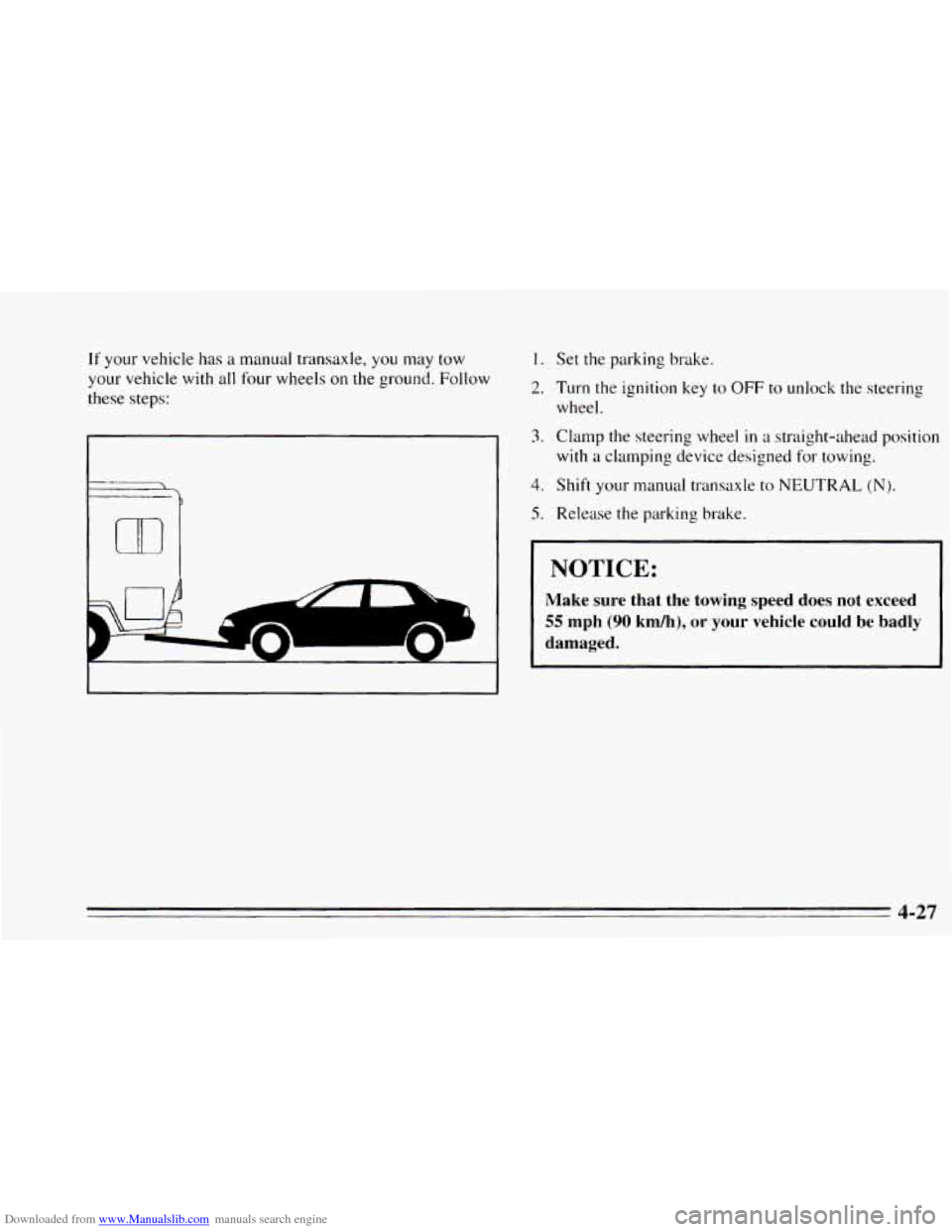
Downloaded from www.Manualslib.com manuals search engine If your vehicle has a manual transaxle, you may tow
your vehicle with
all four wheels on the ground. Follow
these steps:
1.
2.
3.
4.
5.
Set the parking brake.
Turn the ignition key
to OFF to unlock the steering
wheel.
Clamp the steering wheel
in a straight-ahead position
with a clamping device designed for towing.
Shift
your manual transaxle to NEUTRAL (N).
Release the parking brake.
I NOTICE:
Make sure that the towing speed does not exceed
55 mph (90 kh), or your vehicle could be badly
damaged.
4-27