Page 184 of 340
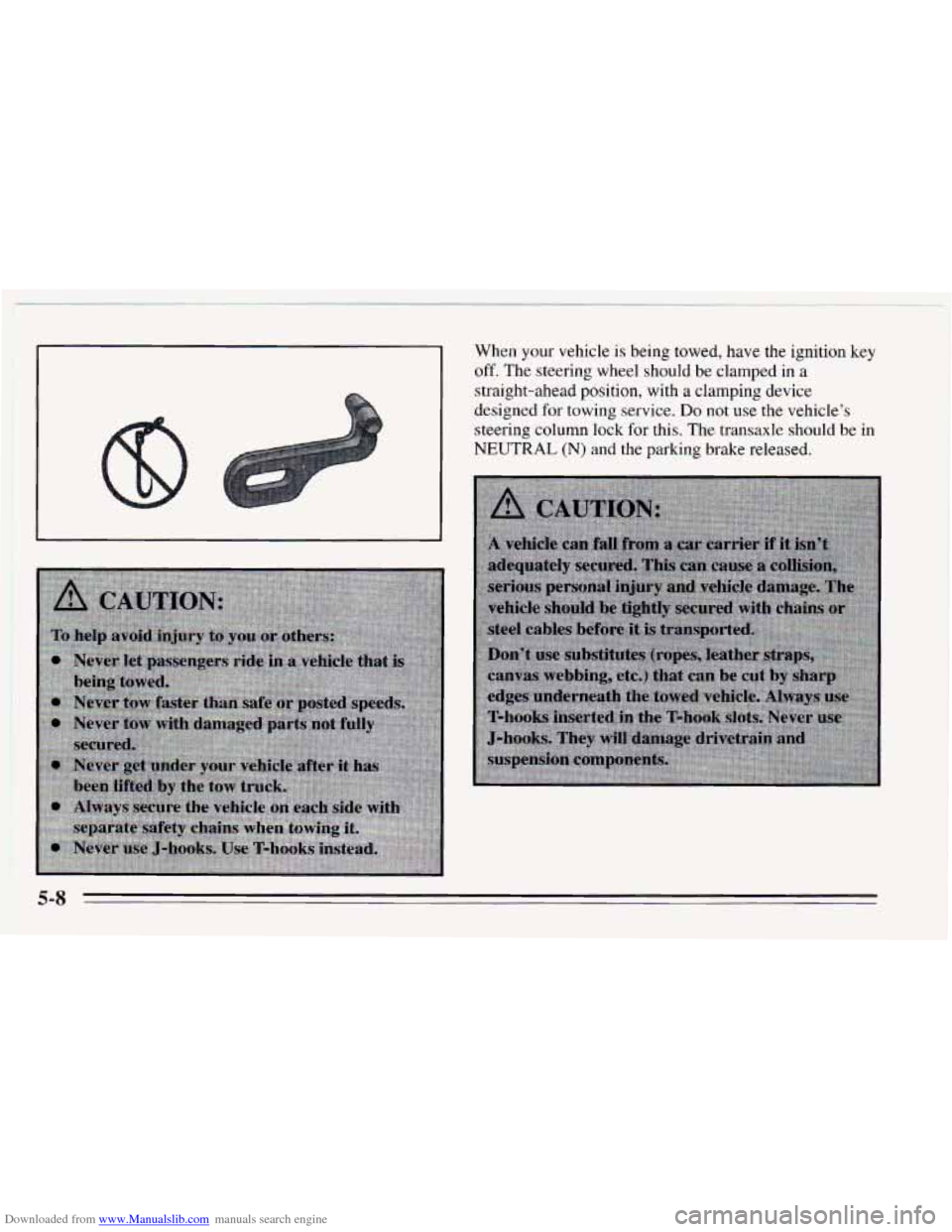
Downloaded from www.Manualslib.com manuals search engine When your vehicle is being towed, have the ignition key
off, The steering wheel should be clamped in a
straight-ahead position, with a clamping device
designed for towing service.
Do not use the vehicle’s
steering column lock
for this. The transaxle should be in
NEUTRAL (N) and the
parking brake released.
5-8
Page 185 of 340
Downloaded from www.Manualslib.com manuals search engine Towing from the Front -- Vehicle Hookup
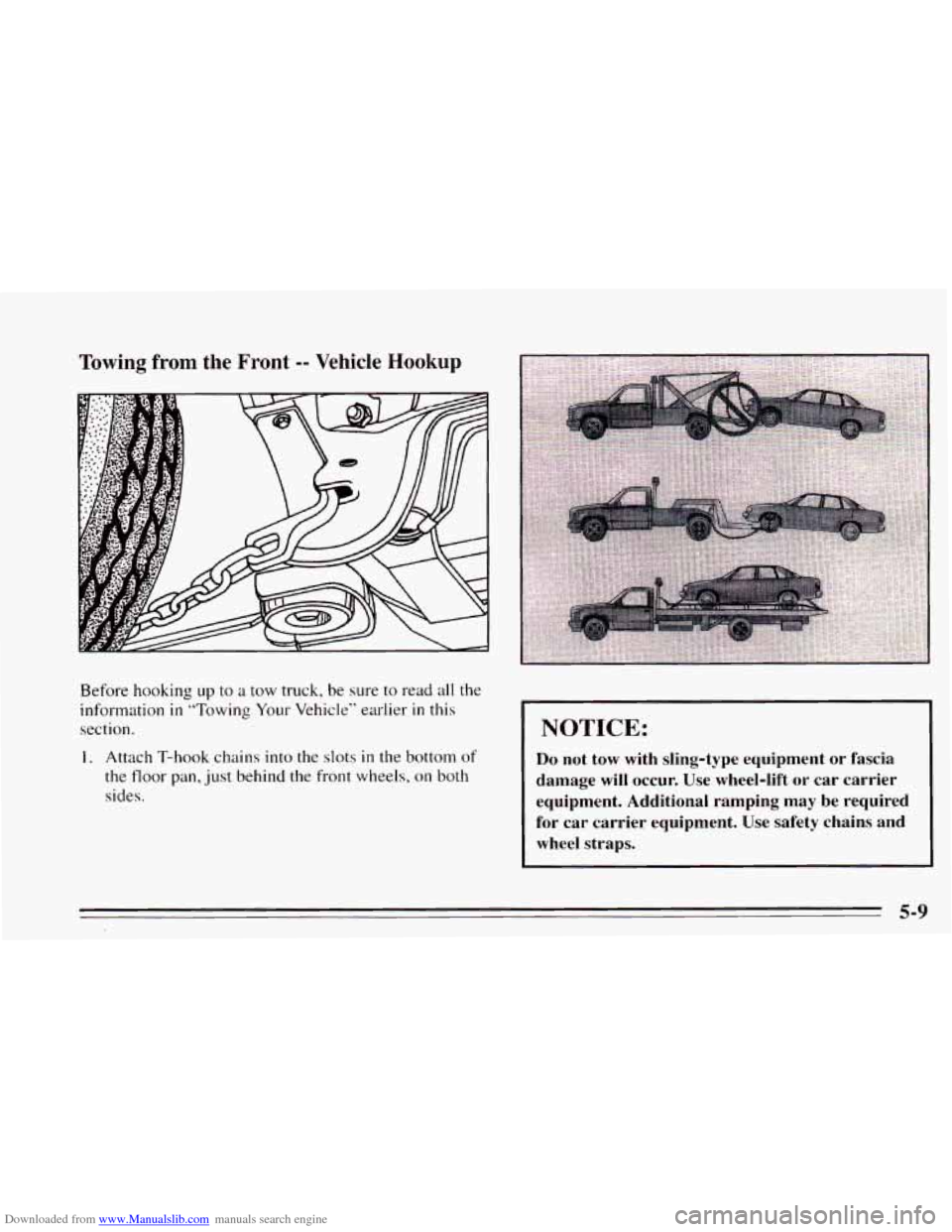
Before hooking up to a tow truck, be sure to read all the
information
in “Towing Your Vehicle” earlier in this
section.
1. Attach T-hook chains into the slots in the bottom of
the floor pan, just behind the front wheels, on both
sides.
NOTICE:
Do not tow with sling-type equipment or fascia
damage will occur. Use wheel-lift or car carrier
equipment. Additional ramping
may be required
for car carrier equipment. Use safety chains and
wheel straps.
5-9
Page 186 of 340
Downloaded from www.Manualslib.com manuals search engine NOTICE:
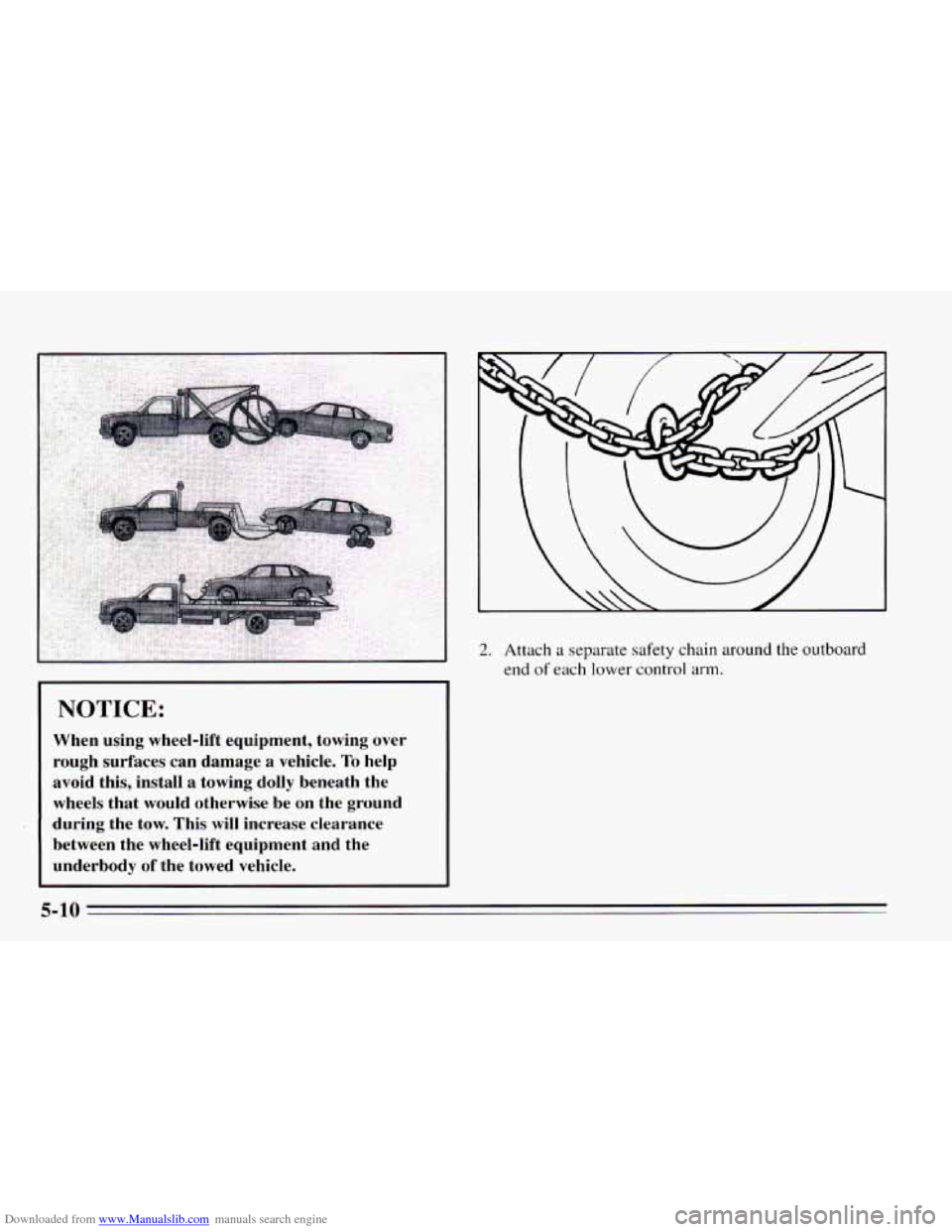
When using wheel-lift equipment, towing over
rough surfaces can damage a vehicle. To help
avoid this, install a towing dolly beneath the
wheels that would otherwise be on the ground
during the tow. This
will increase clearance
between the wheel-lift equipment and the
underbody
of the towed vehicle.
L
2. Attach a separate safety chain around the outboard
end
of each lower control arm.
J
5-10
Page 187 of 340
Downloaded from www.Manualslib.com manuals search engine Towing from the Rear -- Vehicle Hookup
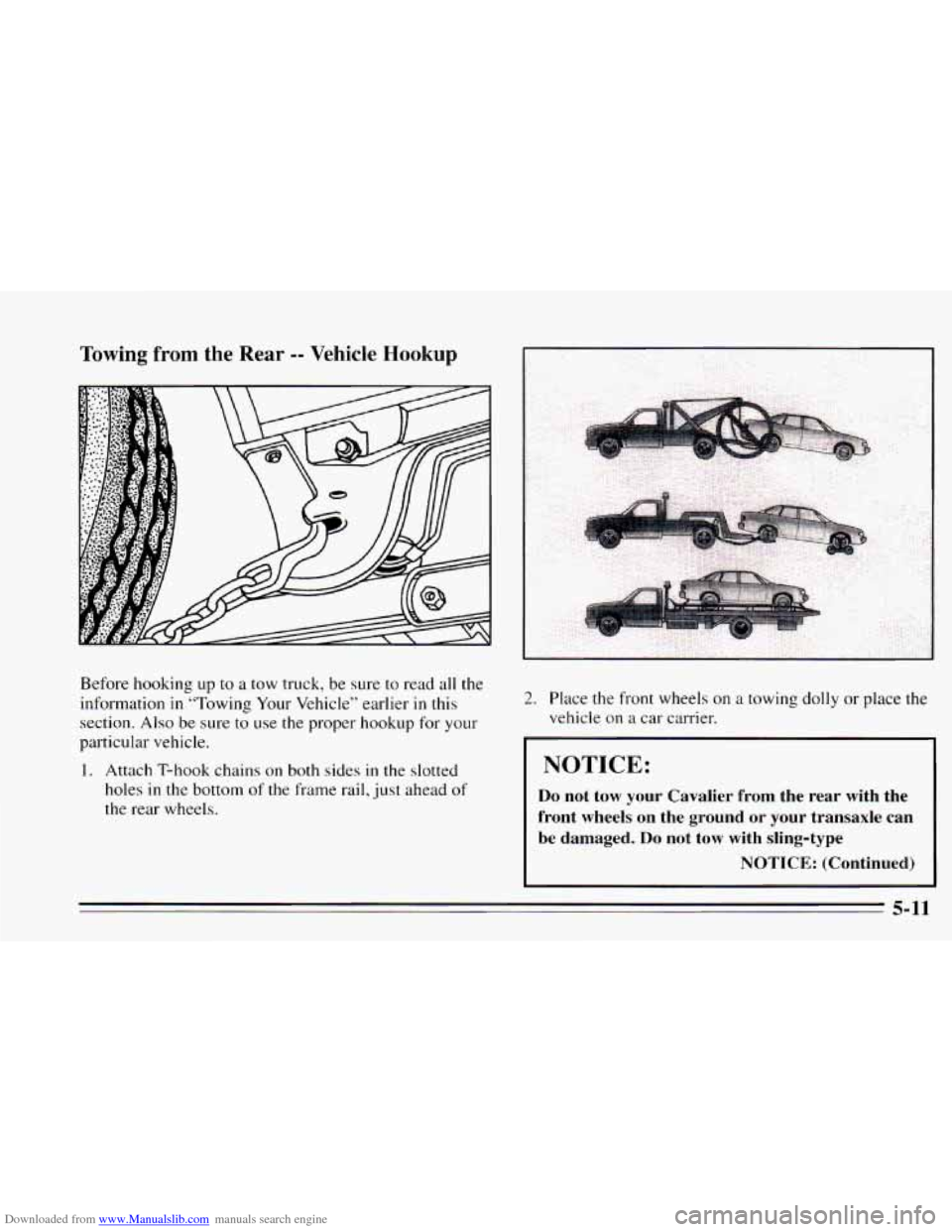
Before hooking up to a tow truck, be sure to read all the
information
in “Towing Your Vehicle” earlier in this
section.
Also be sure to use the proper hookup for your
particular vehicle.
1. Attach T-hook chains on both sides in the slotted
holes
in the bottom of the frame rail, just ahead of
the rear wheels.
I
2. Place the front wheels on a towing dolly or place the
vehicle on a car carrier.
I NOTICE:
Do not tow your Cavalier from the rear with the
front wheels on the ground or your transaxle can
be damaged. Do not tow with sling-type
NOTICE: (Continued)
5-11
Page 188 of 340
Downloaded from www.Manualslib.com manuals search engine NOTICE: (Continued)
equipment
or rear bumper valance will be
damaged. Use wheel-lift equipment with a towing
dolly or car carrier equipment. Additional
ramping may be required
for car carrier
equipment. Use safety chains and wheel straps.
Engine Overheating
You will find a coolant temperature gage on your
Chevrolet’s instrument
panel.
If Steam Is Coming From Your Engine
I I
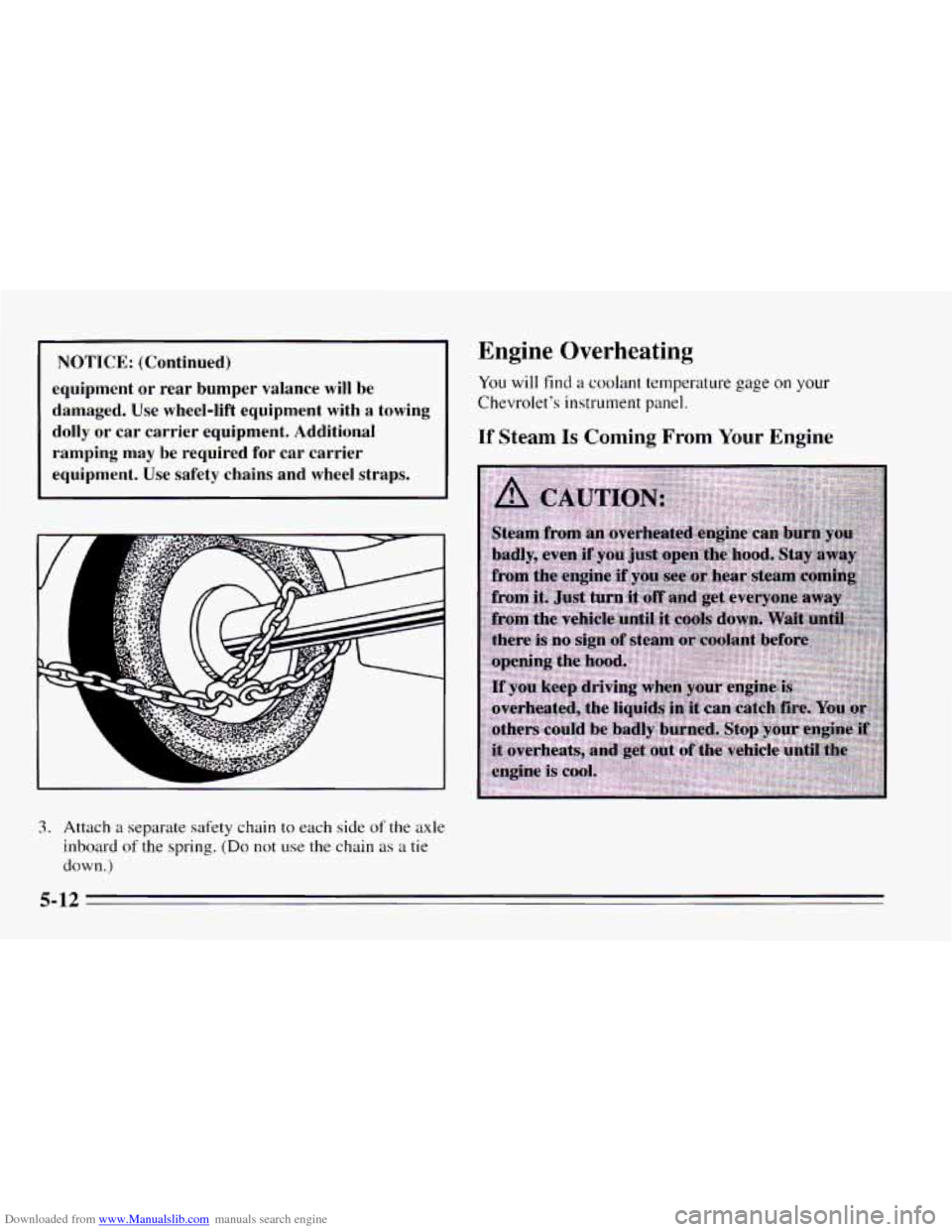
3. Attach a separate safety chain to each side of the axle
inboard
of the spring. (Do not use the chain as a tie
down.)
5-12
Page 189 of 340
Downloaded from www.Manualslib.com manuals search engine NOTICE:
If your engine catches fire because you keep
driving with no coolant, your vehicle can be
badly damaged.
The costly repairs would not be
covered by your warranty.
If No Steam Is Coming From Your Engine
If you get the overheat warning but see or hear no
steam, the problem may not be
too serious. Sometimes
the engine can get
a little too hot when you:
Climb a long hill on a hot day.
0 Stop after high speed driving.
Idle for long periods in traffic.
Tow a trailer.
If you get the overheat warning with no sign
of steam,
try this for a minute or
so:
1. If you have an air conditioner, turn it off.
2. Turn on your heater to full hot at the highest fan
speed and
open the window as necessary.
3. If you’re in a traffic jam, shift to NEUTRAL (N);
otherwise, shift to the highest gear while
driving
-- AUTOMATIC OVERDRIVE (@)
or DRIVE (D) for automatic transaxles.
If you no longer have the overheat warning, you can
drive. Just
to be safe, drive slower for about ten minutes.
If the warning doesn’t come back on, you can drive
normally.
If the warning continues, pull over, stop, and park your
vehicle right away.
If there’s still
no sign of steam, you can idle the engine
for two or three minutes while you’re parked, to see if
the warning stops. But then,
if you still have the
warning.
turn oflthe engine and get everyone out qfthe
vehicle until it cools down.
You may decide not to lift the hood but to get service
help right away.
5-13
Page 196 of 340
Downloaded from www.Manualslib.com manuals search engine If a Tire Goes Flat
It’s unusual for a tire to “blow out” while you’re driving,
especially if
you maintain your tires properly. If air goes
out of a tire, it’s much more likely
to leak out slowly.
But if you should ever have a “blowout,” here are a few
tips about what to expect and what to do:
If a front tire fails, the flat tire will create a drag that
pulls the vehicle toward that side. Take your foot off the
accelerator pedal and grip the steering wheel firmly.
Steer to maintain lane position, then gently brake to a
stop well out
of the traffic lane.
A rear blowout, particularly on a curve, acts much like a
skid and
may require the same correction you’d use in a
skid. In any rear blowout, remove your foot from the
accelerator pedal. Get the vehicle under control by
steering the way you want the vehicle to
go. It may be
very bumpy and noisy, but you can still steer. Gently
brake to
a stop, well off the road if possible.
If a tire goes flat, the next part shows how to use your
jacking equipment
to change a flat tire safely.
Changing a Flat Tire
If a tire goes flat, avoid further tire and wheel damage
by driving slowly
to a level place. Turn on your hazard
warning flashers.
5-20
Page 200 of 340
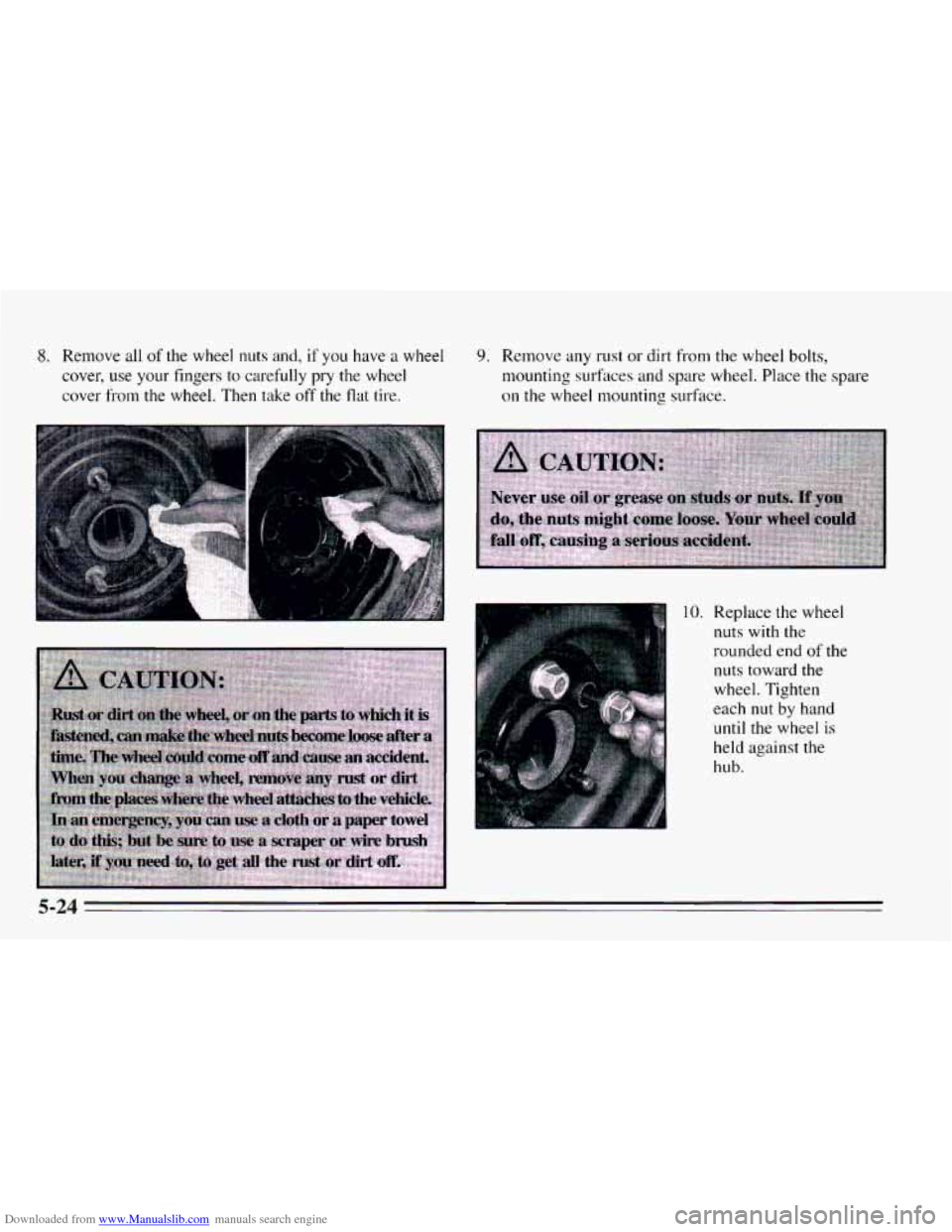
Downloaded from www.Manualslib.com manuals search engine 8. Remove all of the wheel nuts and, if you have a wheel
cover, use your fingers to carefully pry the wheel
cover from
the wheel. Then take off the flat tire.
9. Remove any rust or dirt from the wheel bolts,
mounting surfaces and spare wheel. Place the spare
on the wheel mounting surface.
10. Replace the wheel
nuts with the
rounded end
of the
nuts toward the wheel. Tighten
each
nut by hand
until the wheel is
held against the
hub.
5-24