Page 71 of 340
Downloaded from www.Manualslib.com manuals search engine Ensure the shift lever is fully in PARK (P) range before
starting the engine. Your Chevrolet has
a
brake-transaxle shift interlock. You have to fully apply
your regular brakes before you can shift from PARK (P)
when the ignition key is in the RUN position. If you
cannot shift out of PARK (P), ease pressure on the shift
lever
-- push the shift lever all the way into PARK (P)
and also release the shift lever button on floor shift
console models as
you maintain brake application. Then
move the shift lever into the gear you
wish. (Press the
shift lever button before moving the shift lever.) See
“Shifting
Out of PARK (P)” in the Index.
REVERSE (R): Use this gear to back up.
NOTICE:
Shifting to REVERSE (R) while your vehicle is
moving forward could damage your transaxle. Shift to REVERSE
(R) only after your vehicle is
stopped.
To rock your vehicle back and forth to get out of snow,
ice or sand without damaging your transaxle, see “If
You’re Stuck: In Sand,
Mud, Ice or Snow” in the Index.
NEUTRAL (N): In this position, your engine doesn’t
connect with the wheels.
To restart when you’re
already moving, use NEUTRAL (N) only. Also, use
NEUTRAL (N) when your vehicle
is being towed.
2-15
Page 73 of 340
Downloaded from www.Manualslib.com manuals search engine NOTICE:
If your front wheels can’t rotate, don’t try to
drive. This might happen if you were stuck in
very deep sand or mud or were up against a solid
object.
You could damage your transaxle. Also, if
you stop when going uphill, don’t hold your
vehicle there with only the accelerator pedal. This
could overheat and damage the transaxle. Use
your brakes or shift into
PARK (P) to hold your
vehicle in position on
a hill.
Forward Gears (Four Speed)
AUTOMATIC OVERDRIVE (D): This position is for
normal driving with
the four speed automatic transaxle.
If
you need more power for passing, and you’re:
0 Going less than about 35 mph (56 km/h), push your
accelerator pedal about halfway down.
0 Going about 35 mph (56 kmh), push your
accelerator all
the way down.
THIRD (3): This position is also used for normal
driving, however,
it offers more power and lower fuel
economy than AUTOMATIC OVERDRIVE (D). Here
are some times you might choose THIRD
(3) instead of
AUTOMATIC OVERDRIVE (D):
0 When driving on hilly, winding roads.
0 When towing a trailer, so there is less shifting
between gears.
0 When going down a steep hill.
SECOND (2): This position gives you more power out
lower fuel economy. You can use SECOND
(2) on hills.
It can help control your speed as you
go down steep
mountain roads, but then
you would also want to use
your brakes off and on.
NOTICE:
Don’t drive in SECOND (2) for more than
5 miles (8 km), or at speeds over 55 mph
(88 km/h), or you can damage your transaxle.
Use AUTOMATIC OVERDRIVE
(D), THIRD (3)
or DRIVE (D) as much as possible. Don’t shift into
SECOND
(2) unless you are going slower than 65
mph (105 km/h), or you can damage your engine.
2-17
Page 78 of 340
Downloaded from www.Manualslib.com manuals search engine To set the parking brake, hold the brake pedal down and
pull up on the parking brake lever. If the ignition
is on,
the brake system warning light will come on.
To release the parking brake, hold the brake pedal down.
Pull the parking brake lever up until you can press the
release button.
Hold the release button in as you move
the brake lever all the way down.
I NOTICE:
Driving with the parking brake on can cause
your rear brakes to overheat. You may have to
replace them, and you could also damage other
parts
of your vehicle.
If you are towing a trailer and are parking on any hill,
see “Towing a Trailer’’ in the Index. That section shows
what to
do first to keep the trailer from moving.
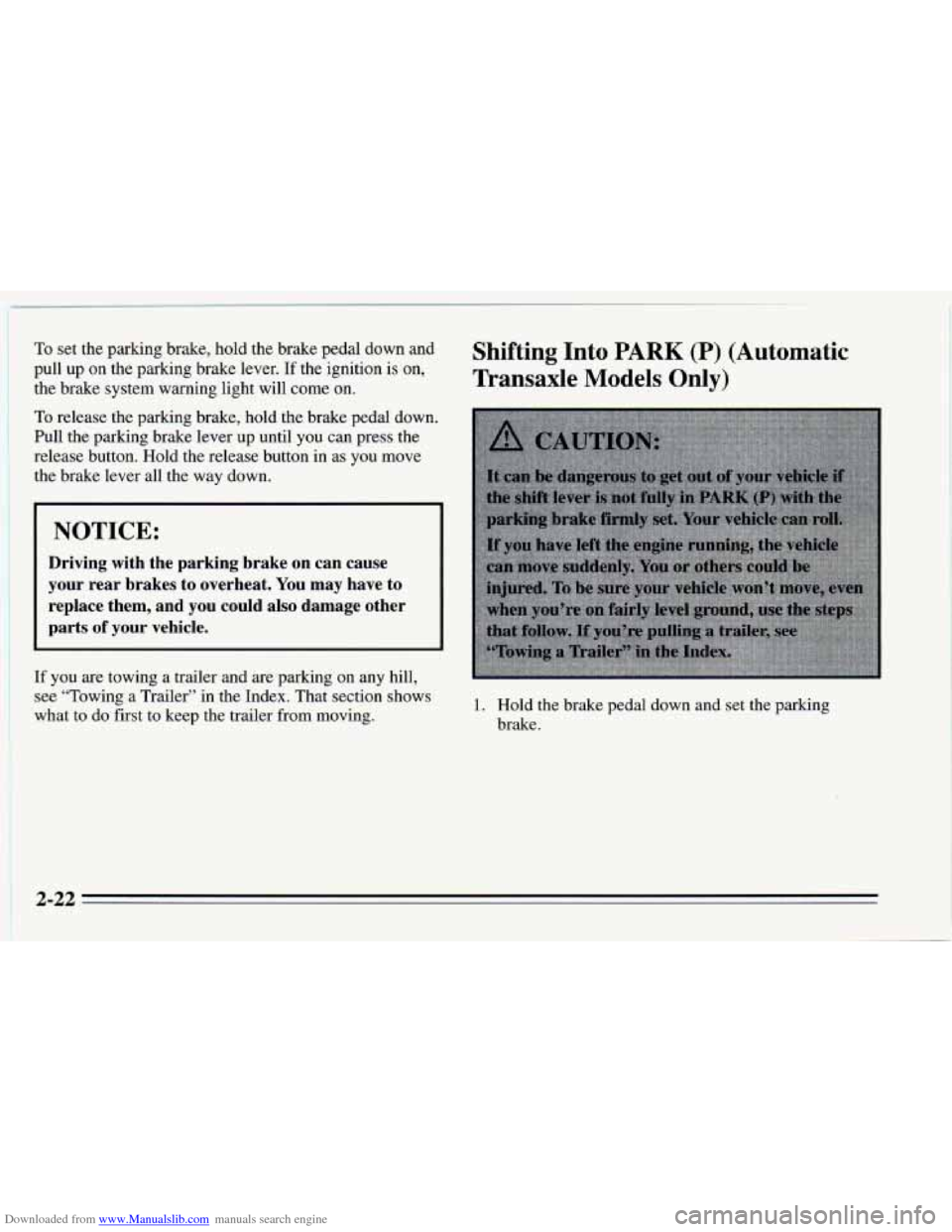
Shifting Pnto PARK (P) (Automatic
Transaxle Models Only)
1. Hold the brake pedal down and set the parking
brake.
2-22
Page 79 of 340
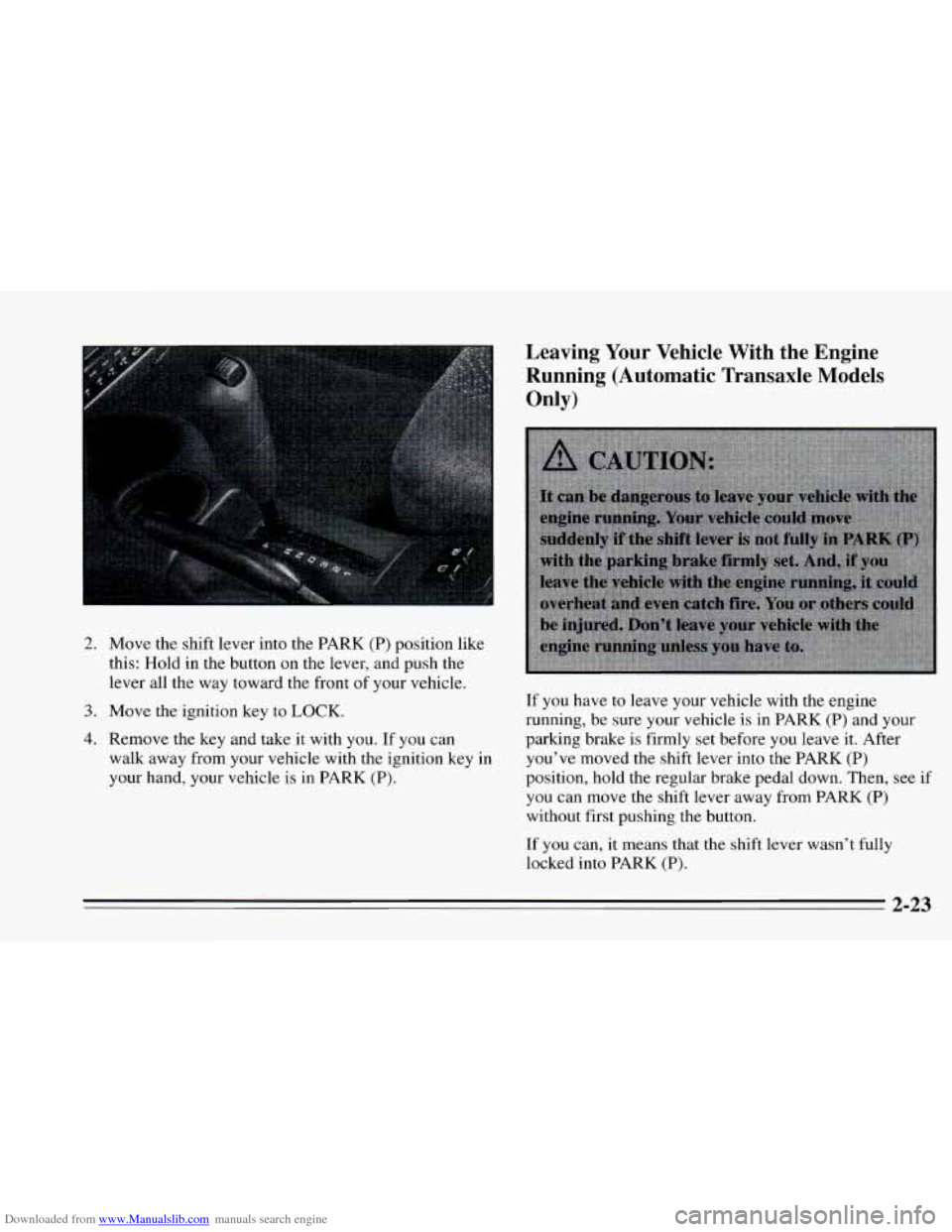
Downloaded from www.Manualslib.com manuals search engine 2. Move the shift lever into the PARK (P) position like
this: Hold in the button on the lever, and push the
lever all the way toward the front
of your vehicle.
3. Move the ignition key to LOCK.
4. Remove the key and take it with you. If you can
walk away from your vehicle with the ignition key in
your hand, your vehicle is in PARK (P).
Leaving Your Vehicle With the Engine
Running (Automatic Transaxle Models
Only)
If you have to leave your vehicle with the engine
running, be sure your vehicle
is in PARK (P) and your
parking brake is firmly set before you leave it. After
you’ve moved the shift lever into the PARK (P)
position,
hold the regular brake pedal down. Then, see if
you can move the shift lever away from PARK (P)
without first pushing the button.
If you can, it means that the shift lever wasn’t fully
locked into PARK
(P).
2-23
Page 82 of 340
Downloaded from www.Manualslib.com manuals search engine Running Your Engine While You’re
Parked (Automatic Transaxle)
It’s better not to park with the engine running. But if you
ever have to, here are some things to know.
Follow the proper steps to be sure your vehicle won’t
move. See “Shifting Into
PARK (P)” in the Index.
If you are parking on a hill and if you’re pulling a
trailer, also see “Towing a Trailer”
in the Index.
Windows
On a vehicle with manual windows, use the window
crank
to open and close each window.
2-26
Page 86 of 340
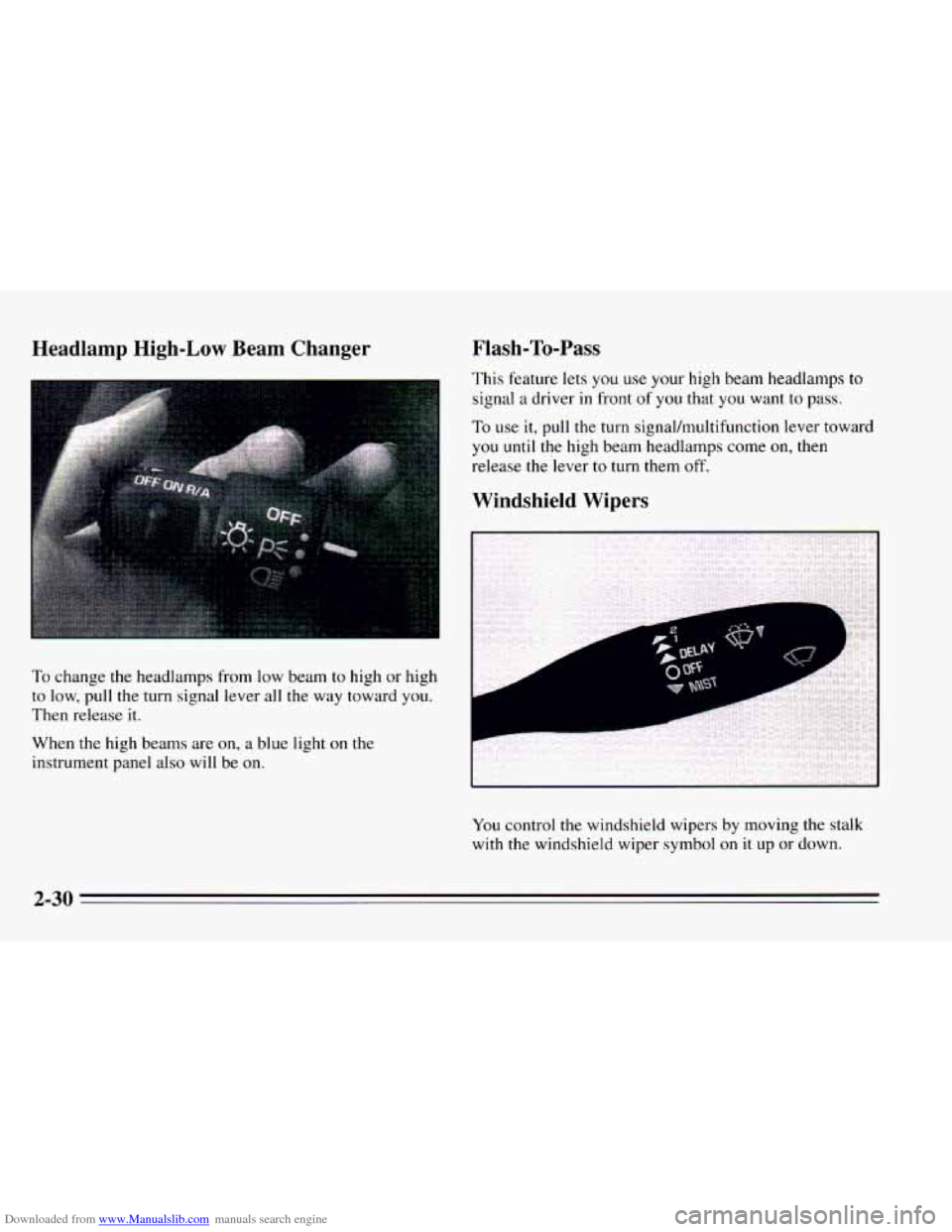
Downloaded from www.Manualslib.com manuals search engine Headlamp High-Low Beam Changer
. ..
To change the headlamps from low beam to high or high
to low, pull the turn signal lever all the way toward you.
Then release it.
When
the high beams are on, a blue light on the
instrument panel also
will be on.
Flash-To-Pass
This feature lets you use your high beam headlamps to
signal a driver in front of you that you want to pass.
To use it, pull the turn signal/multifunction lever toward
you until the high beam headlamps come on, then
release the 'lever to turn them off.
Windshield Wipers
You control the windshield wipers by moving the stalk
with the windshield wiper symbol
on it up or down.
2-30
Page 88 of 340
Downloaded from www.Manualslib.com manuals search engine Windshield Washer
NOTICE:
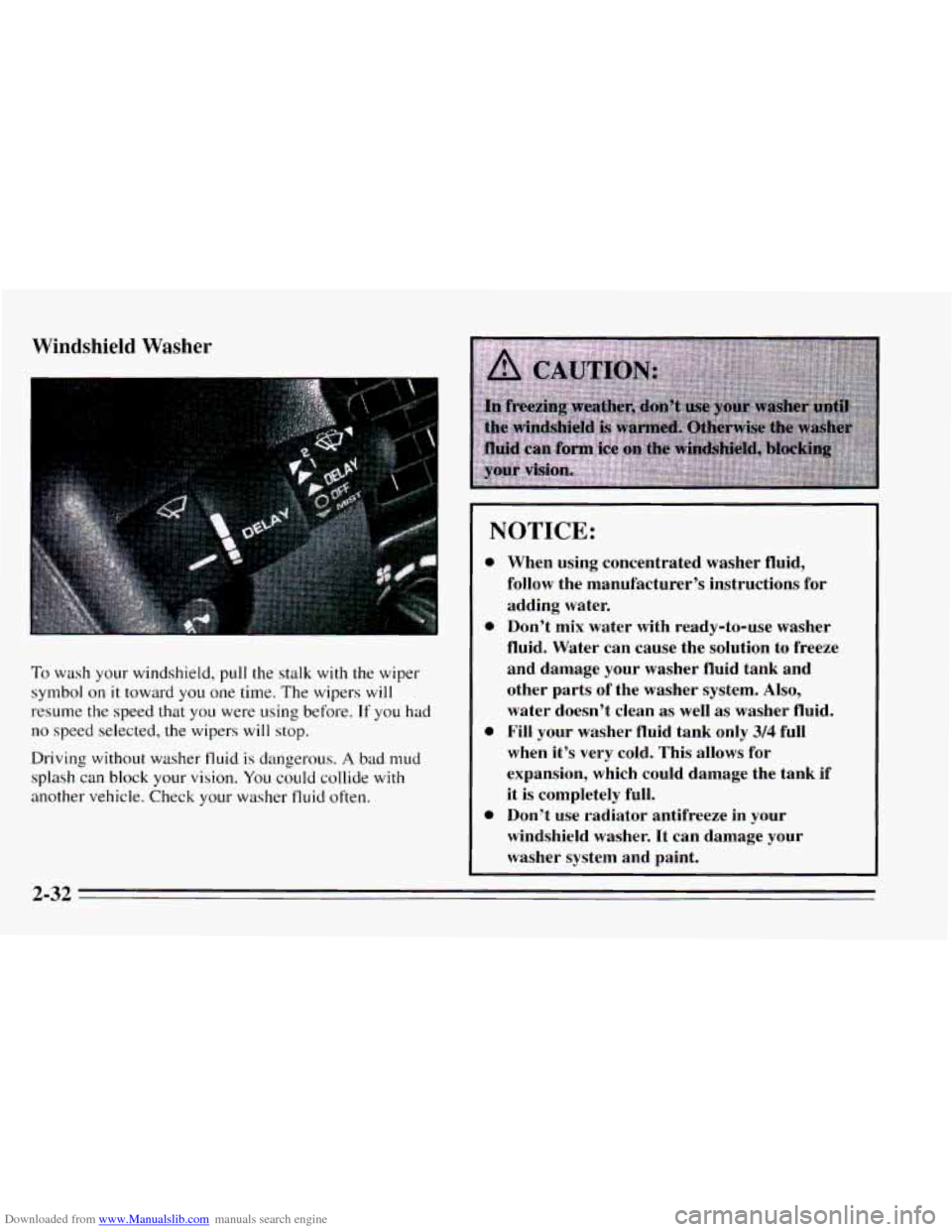
To wash your windshield, pull the stalk with the wiper
symbol
on it toward you one time. The wipers will
resume the speed that you were using before. If you had
no speed selected, the wipers will stop.
Driving without washer fluid
is dangerous. A bad mud
splash can block your vision. You could collide with
another vehicle. Check your washer fluid often.
1
0
0
0
0
When using concentrated washer fluid,
follow the manufacturer’s instructions for
adding water.
Don’t mix water with ready-to-use washer
fluid. Water can cause the solution to freeze
and damage your washer fluid tank and
other parts of the washer system.
Also,
water doesn’t clean as well as washer fluid.
Fill your washer fluid tank only
314 full
when it’s very cold. This allows for
expansion, which could damage the tank if
it is completely full. Don’t use radiator antifreeze in your
windshield washer. It can damage your
washer system and paint.
2-32
Page 98 of 340
Downloaded from www.Manualslib.com manuals search engine Inside Manual Daymight Rearview Mirror
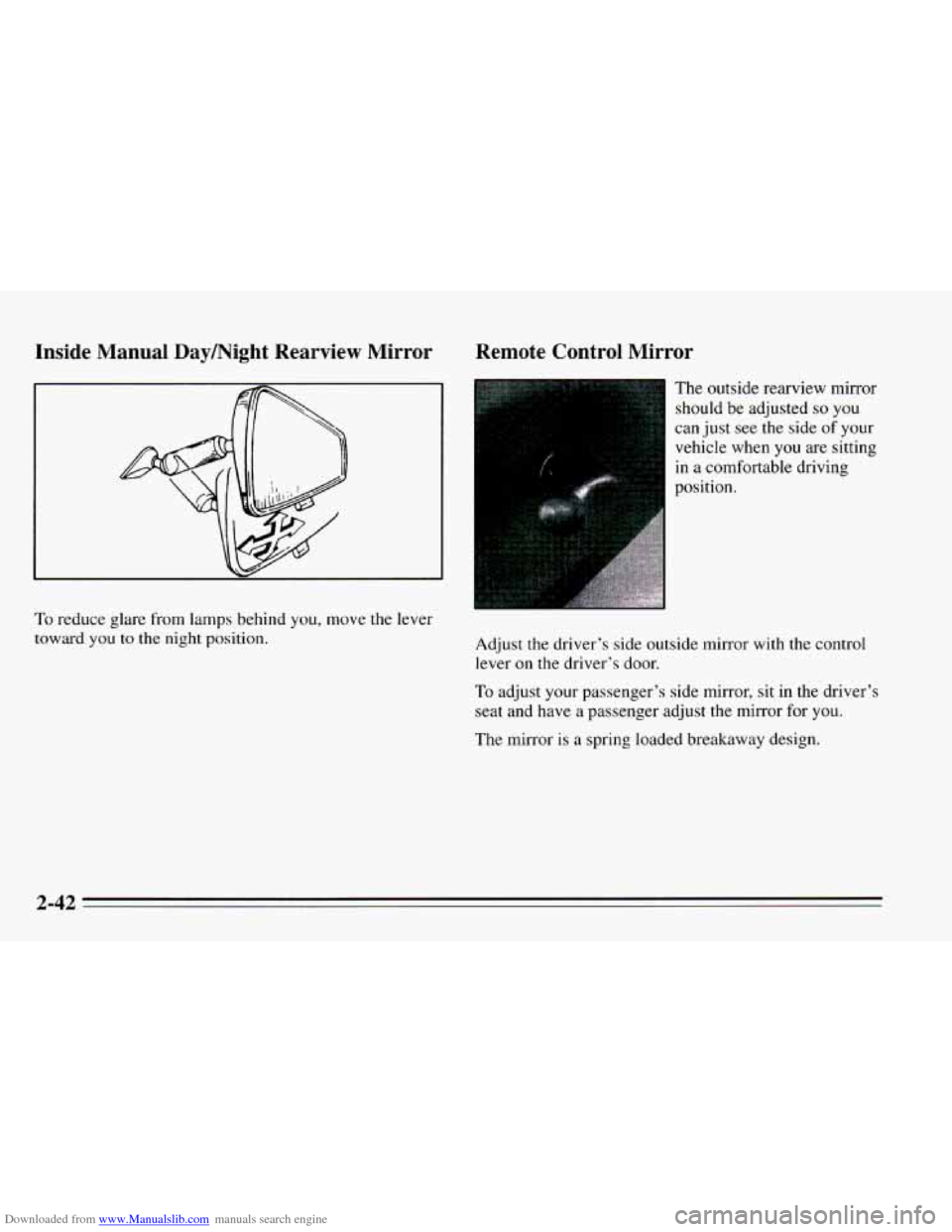
To reduce glare from lamps behind you, move the lever
toward you
to the night position.
Remote Control Mirror
The outside rearview mirror
should be adjusted
so you
can just see the side
of your
vehicle when
you are sitting
in a comfortable driving
position.
Adjust
the driver’s side outside mirror with the control
lever on
the driver’s door.
To adjust your passenger’s side mirror, sit in the driver’s
seat and have a passenger adjust the mirror for
you.
The mirror is a spring loaded breakaway design.
2-42