1994 CHEVROLET CAVALIER lock
[x] Cancel search: lockPage 117 of 243
Downloaded from www.Manualslib.com manuals search engine Your Driving and the Road
If you’re being passed, make it easy
for the following driver to get ahead of
you. Perhaps you can ease a little to
the right.
Loss of Control
Let’s review what driving experts say
about what happens when the three
control systems (brakes, steering and
acceleration) don’t have enough friction
where the tires meet the road to do
what the driver has asked.
In any emergency, don’t give up. Keep
trying to steer and constantly seek an
escape route or area
of less danger.
Skidding
In a skid, a driver can lose control of
the vehicle. Defensive drivers avoid
most skids by taking reasonable care
suited
to existing conditions, and by not
“overdriving” those conditions. But
skids are always possible.
The three types of skids correspond to
your Chevrolet’s three control systems.
In the braking skid your wheels aren’t
rolling.
In the steering or cornering
skid, too much speed or steering in a
curve causes tires to slip and lose
cornering force. And in the acceleration
skid too much throttle causes the
driving wheels to spin.
A cornering skid and an acceleration
skid are best handled by easing your
foot
off the accelerator pedal.
If your vehicle starts to slide, ease your
foot
off the accelerator pedal and
quickly steer the way
you want the
vehicle to go.
If you start steering
quickly enough, your vehicle may
straighten out. Always be ready for a
second skid
if it occurs. Of
course, traction is reduced when
water, snow, ice, gravel, or other
material is
on the road. For safety,
you’ll want to slow down and adjust
your driving to these conditions. It is
important to slow down on slippery
surfaces because stopping distance will
be longer and vehicle control more limited.
While driving
on a surface with reduced
traction,
try your best to avoid sudden
steering, acceleration, or braking (including engine braking by shifting to
a lower gear). Any sudden changes
could cause the tires to slide. You may
not realize the surface is slippery until
your vehicle is skidding. Learn
to
recognize warning clues - such as
enough water, ice or packed snow on
the road to make a “mirrored surface”
- and slow down when you have any
doubt.
Remember: Any anti-lock braking
system (ABS) helps avoid only the
braking slid.
Page 125 of 243
Downloaded from www.Manualslib.com manuals search engine Your Driving and the Road
I..
Whatever the condition - smooth ice,
packed, blowing or loose snow
- drive
with caution. Accelerate gently. Try not
to break the fragile traction. If you
accelerate too fast, the drive wheels will
spin and polish the surface under the
tires even more.
Your anti-lock brakes improve your ability to make a hard stop on a slippery
road. Even though you have the anti-
lock braking system, you’ll want to begin
stopping sooner than you would on dry
pavement. See
Anti-lock in the Index.
Allow greater following distance on
any slippery road.
Watch for slippery spots. The road
might be fine until you hit a spot
that’s covered with ice. On an
otherwise clear road, ice patches may
appear in shaded areas where the sun
can’t reach: around clumps of trees,
behind buildings, or under bridges. Sometimes the surface of a curve or
an overpass may remain icy when the
surrounding roads are clear.
If you see
a patch of ice ahead of you, brake
before you are on it. Try not to brake
while you’re actually
on the ice, and
avoid sudden steering maneuvers.
I24
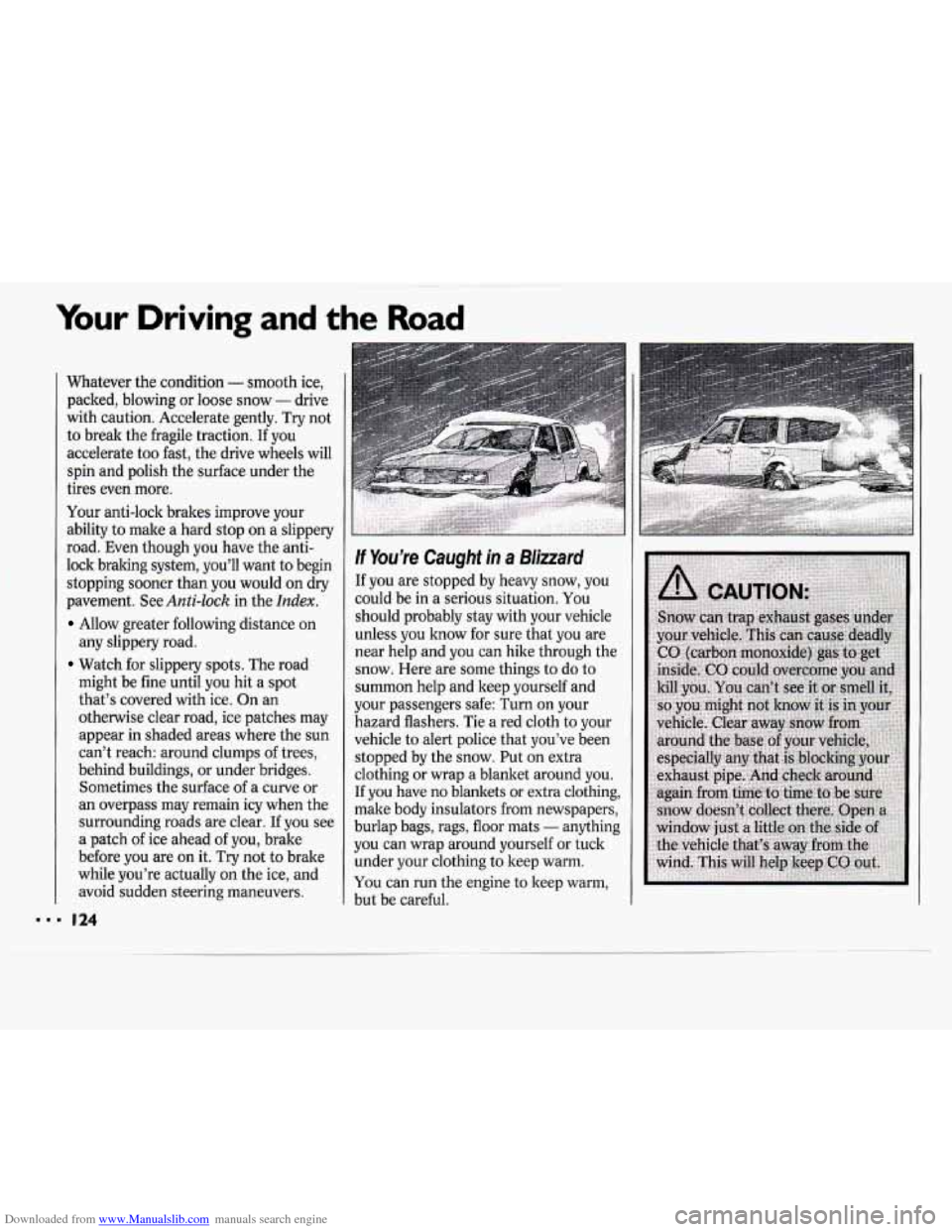
If You’re Caught in a Blizzard
If you are stopped by heavy snow, you
could be in a serious situation. You
should probably stay with your vehicle
unless you know for sure that you are
near help and you can hike through the
snow. Here are some things to do to
summon help and keep yourself and
your passengers safe: Turn on your
hazard flashers. Tie
a red cloth to your
vehicle to alert police that you’ve been
stopped by the snow. Put on extra
clothing or wrap a blanket around
you.
If you have no blankets or extra clothing,
make body insulators from newspapers,
burlap bags, rags, floor mats
- anything
you can wrap around yourself or tuck
under your clothing to keep warm.
You can run the engine to keep warm,
but be careful.
Page 126 of 243
Downloaded from www.Manualslib.com manuals search engine Run your engine only as long as you
must. This saves fuel. When you run the
engine, malte it go a little faster than
just idle. That is, push the accelerator
slightly. This uses less fuel for the heat
that you get and it keeps the battery
charged.
You will need a well-charged
battery to restart the vehicle, and
possibly
for signaling later on with your
headlights. Let the heater run for
awhile.
Then, shut the engine
off and close the
window almost all the way to preserve
the heat. Start the engine again and
repeat this only when you feel really
uncomfortable
from the cold. But do it
as little as possible. Preserve the fuel as
long as
you can. To help keep warm,
you can get out
of the vehicle and do
some fairly vigorous exercises every half
hour or so until help comes.
~~
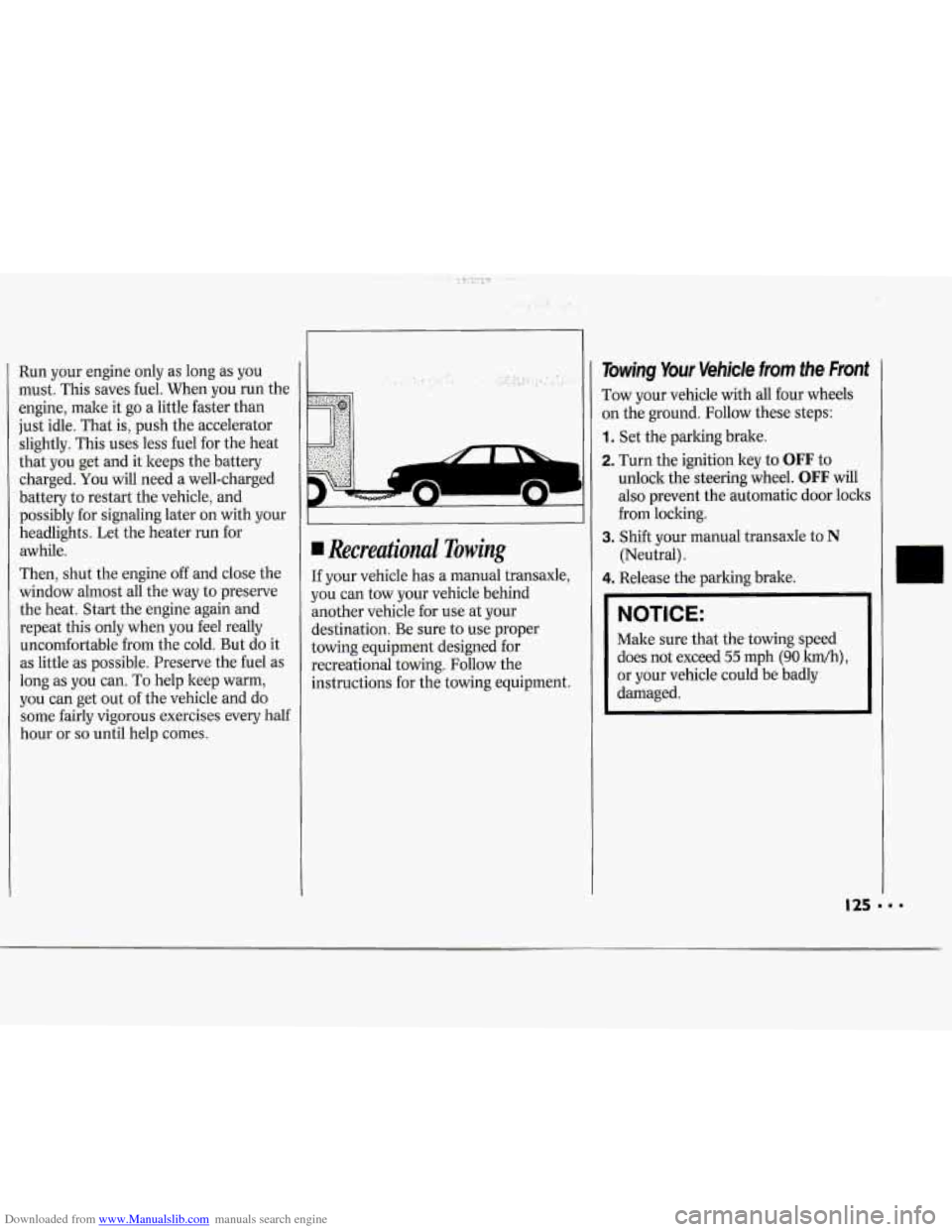
Recreational Towing
If your vehicle has a manual transaxle,
you can tow your vehicle behind
another vehicle for use at your
destination. Be sure
to use proper
towing equipment designed for
recreational towing. Follow the
instructions for the towing equipment.
Towing Your Vehicle from the Front
Tow your vehicle with all four wheels
on the ground. Follow these steps:
1. Set the parking brake.
2. Turn the ignition key to OFF to
unlock the steering wheel.
OFF will
also prevent the automatic door locks
from locking.
(Neutral).
3.
Shift your manual transaxle to
N
4. Release the parking brake.
NOTICE:
Make sure that the towing speed
does not exceed
55 mph (90 lm),
or your vehicle could be badly
damaged.
Page 134 of 243
Downloaded from www.Manualslib.com manuals search engine When your vehicle is being towed, have
the ignition key
off. The steering wheel
should be clamped in a straight-ahead
position, with a clamping device
designed for towing service.
Do not use
the vehicle’s steering column lock for
this. The transaxle should be in
N
(Neutral) and the parking brake
released.
Don’t have your vehicle towed
on the
front wheels, unless you must. If the
vehicle must be towed
on the front wheels,
don’t
go more than 35 mph (56 kdh)
or farther than
50 miles (80 lun) or your
transaxle will be damaged.
If these
limits must be exceeded, then the front
wheels have to be supported on a dolly.
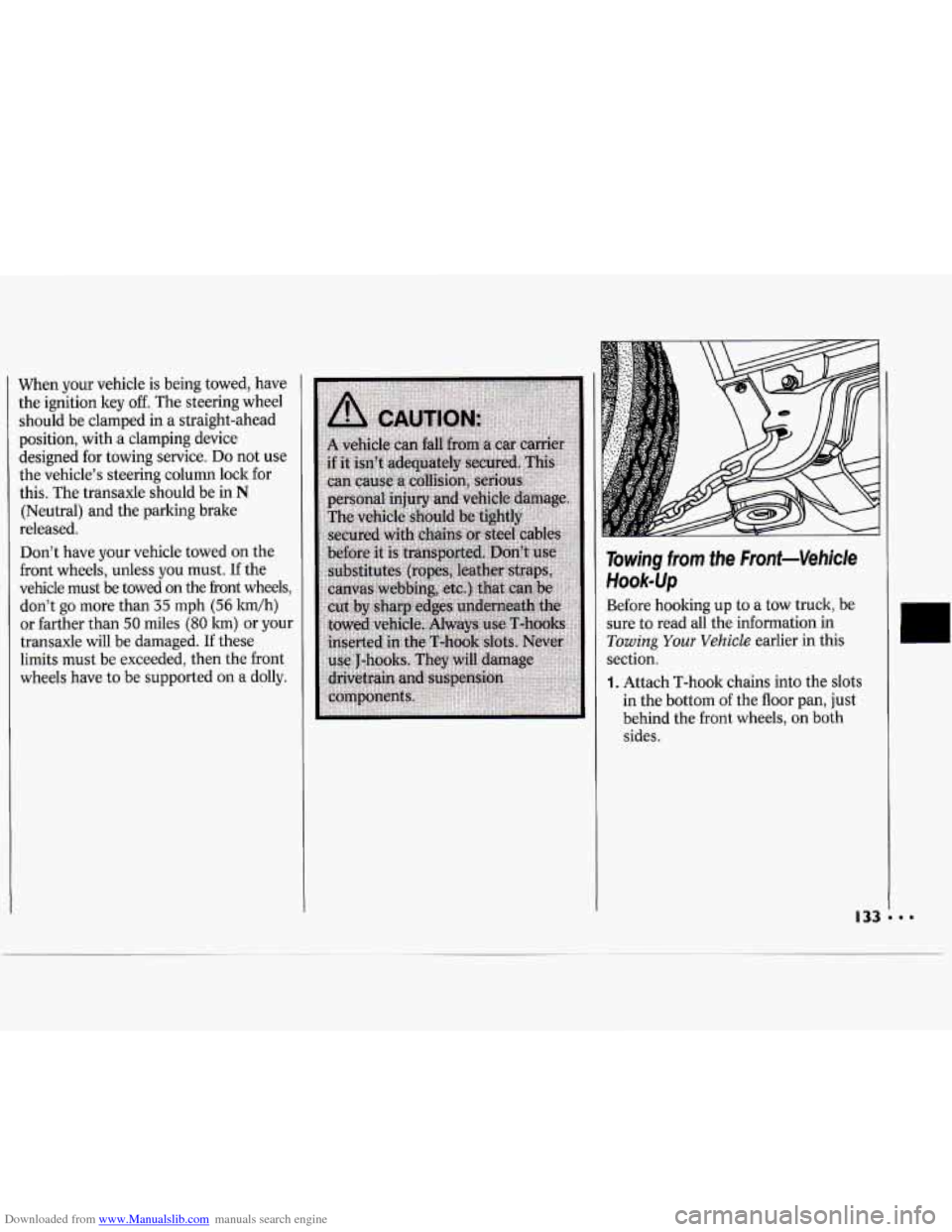
Towing from the Front-Vehicle
Hookup
Before hooking up to a tow truck, be
sure to read all the information in
Towing Your Vehicle earlier in this
section.
1. Attach T-hook chains into the slots
in the bottom
of the floor pan, just
behind the front wheels, on both
sides.
Page 136 of 243
Downloaded from www.Manualslib.com manuals search engine Towing from the Rear- Vehicle
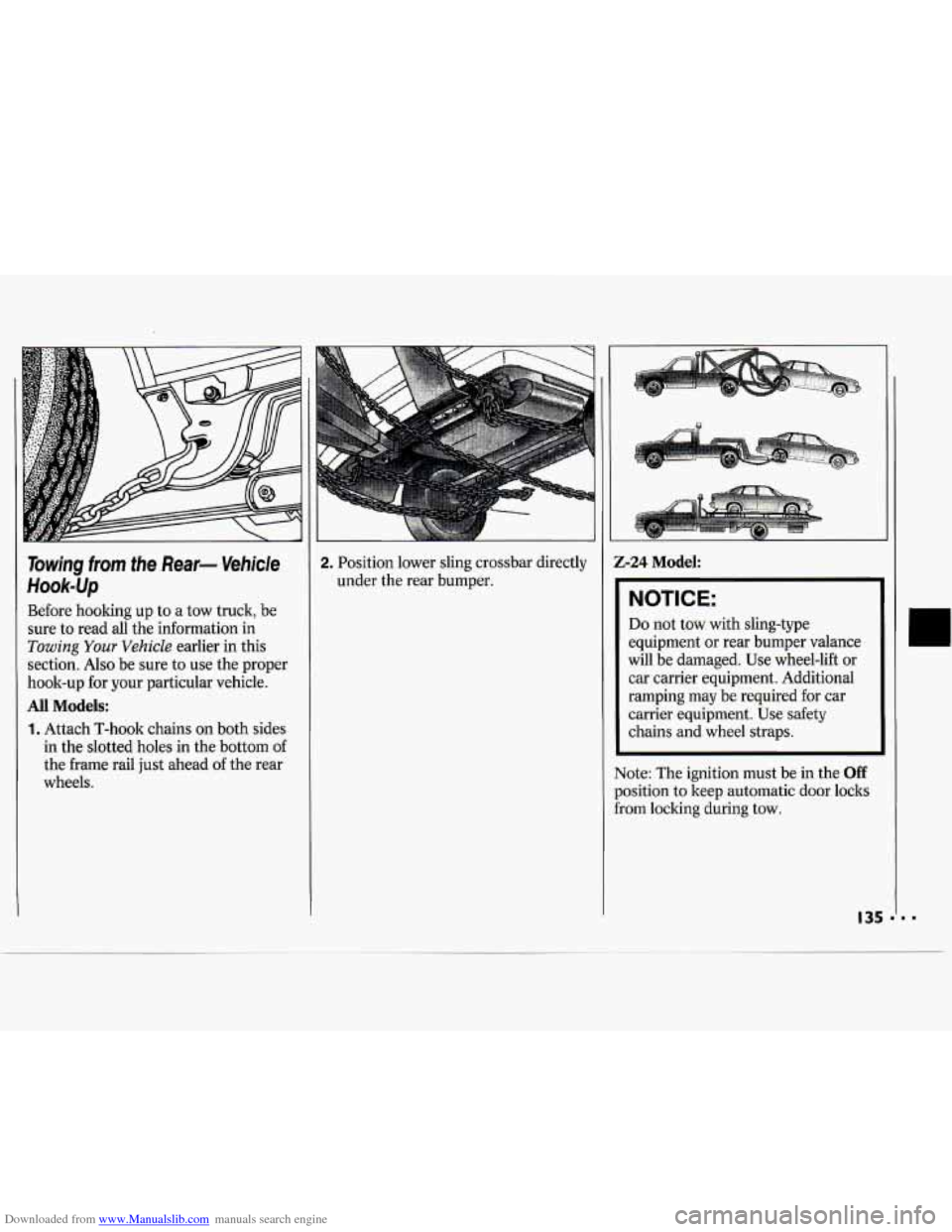
Hook-up
Before hooking up to a tow truck, be
sure to read all the information in
Towing Your Vehicle earlier in this
section.
Also be sure to use the proper
hook-up for your particular vehicle.
All Models:
1. Attach T-hook chains on both sides
in the slotted holes in the bottom
of
the frame rail just ahead of the rear
wheels.
2. Position lower sling crossbar directly
under the rear bumper.
I-
-24 Model:
NOTICE:
Do not tow with sling-type
equipment or rear bumper valance
will be damaged. Use wheel-lift
or
car carrier equipment. Additional
ramping may be required for car
carrier equipment. Use safety
chains and wheel straps.
~~
ote: The ignition must be in the Off
Isition to keep automatic door locks
3m locking during tow.
I
I
135 11 -
Page 148 of 243
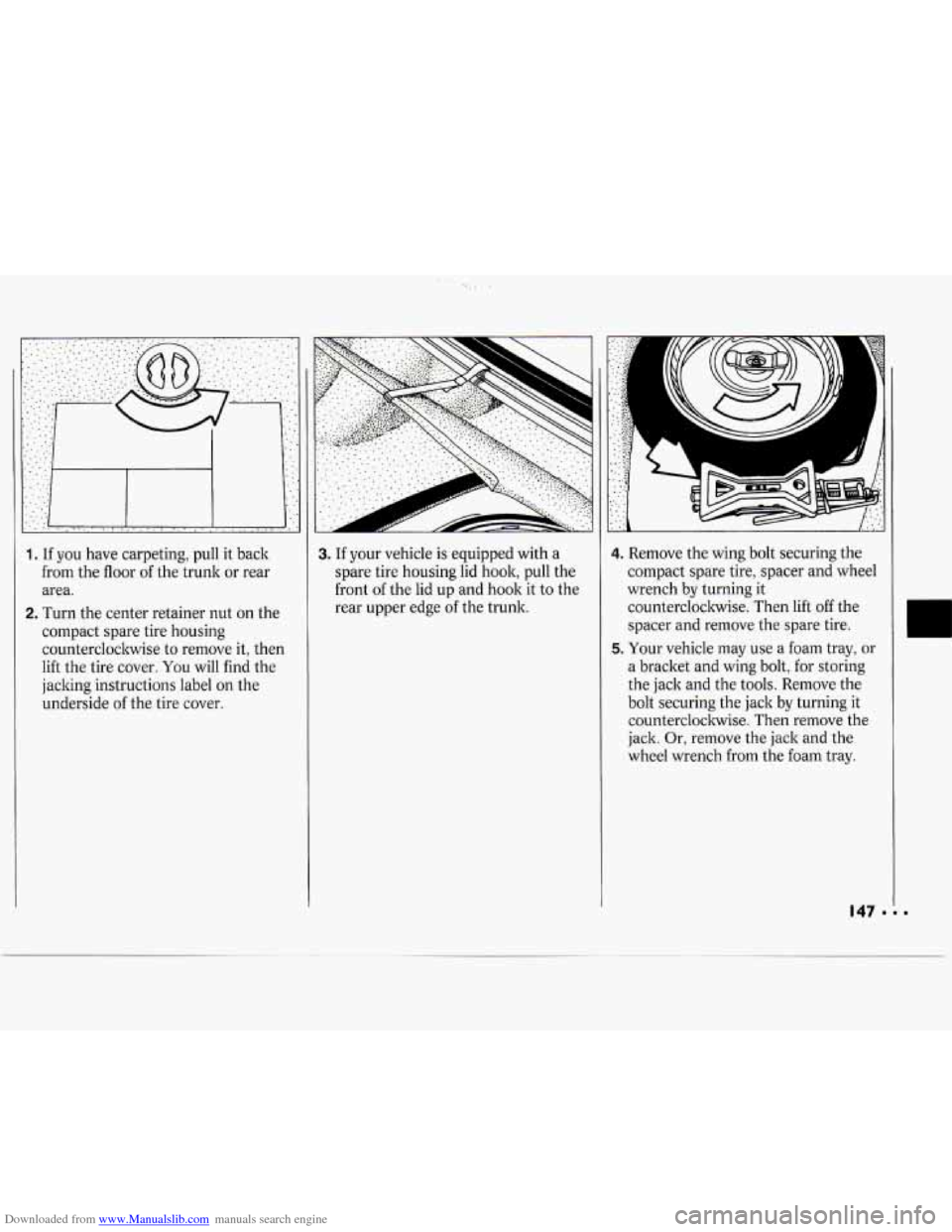
Downloaded from www.Manualslib.com manuals search engine 1. If you have carpeting, pull it back
from the floor of the trunk or rear
area.
2. Turn the center retainer nut on the
compact spare tire housing counterclockwise to remove it, then
lift the tire cover.
You will find the
jacking instructions label
on the
underside
of the tire cover.
..
3. If your vehicle is equipped with a
spare tire housing lid hook, pull the
front
of the lid up and hook it to the
rear upper edge
of the trunk.
4. Remove the wing bolt securing the
compact spare tire, spacer and wheel
wrench by turning it
counterclockwise. Then lift off the
spacer and remove the spare tire.
5. Your vehicle may use a foam tray, or
a bracket and wing bolt, for storing
the jack and the tools. Remove the
bolt securing the jack by turning it
counterclockwise. Then remove the
jack. Or, remove the jack and the
wheel wrench from the foam tray.
I
Page 151 of 243
Downloaded from www.Manualslib.com manuals search engine Problems on the Road
J
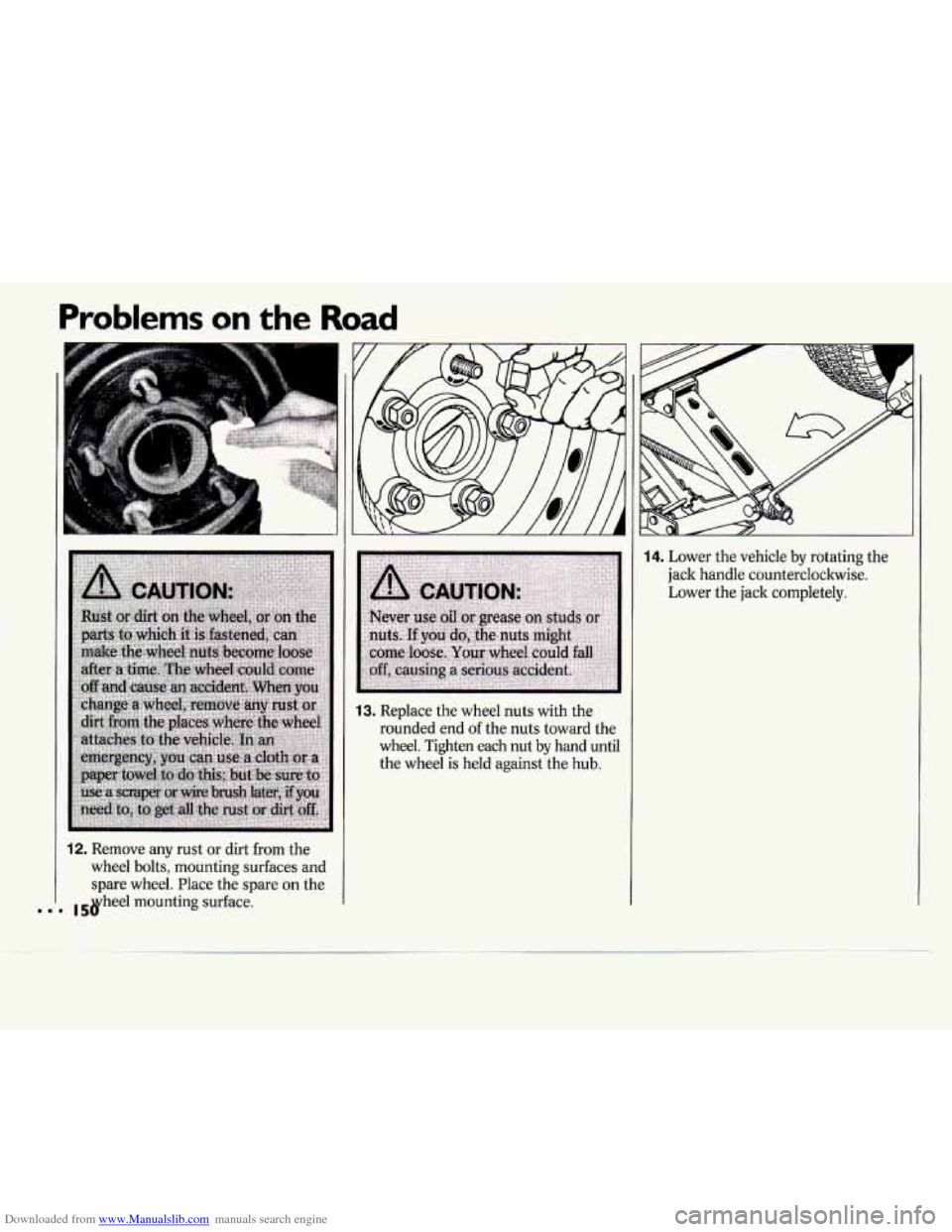
12. Remove any rust or dirt from the
wheel bolts, mounting surfaces and
spare wheel. Place the spare
on the
mounting surface.
F
13. Replace the wheel nuts with the
rounded end of the nuts toward the
wheel. Tighten each nut by hand until
the wheel
is held against the hub.
14. Lower the vehicle by rotating the
jack handle counterclockwise.
Lower the jack completely.
Page 157 of 243
Downloaded from www.Manualslib.com manuals search engine ..
Service & Appearance Care
Fuels in Foreign Countries
If you plan on driving in another
country outside the
U.S. or Canada,
unleaded fuel may be hard to find. Do
not use leaded gasoline.
If you use even
one tankful, your emission controls
won’t work well or at all. With
continuous use, spark plugs can get
fouled, the exhaust system can corrode,
and your engine oil can deteriorate
quickly. Your vehicle’s oxygen sensor
will be damaged. All
of that means
costly repairs that wouldn’t be covered
by your warranty.
To check on fuel availability, ask an
auto club, or contact a major oil
company that does business in the
country where you’ll be driving.
You can also write us at the following
address for advice. Just tell us where
you’re going and give your Vehicle Identification Number
(VIN).
General Motors Overseas Distribution
North American Export Sales (NAES)
1908 Colonel Sam Drive
Oshawa, Ontario
L1H 8P7
Corporation Filling Your Tank
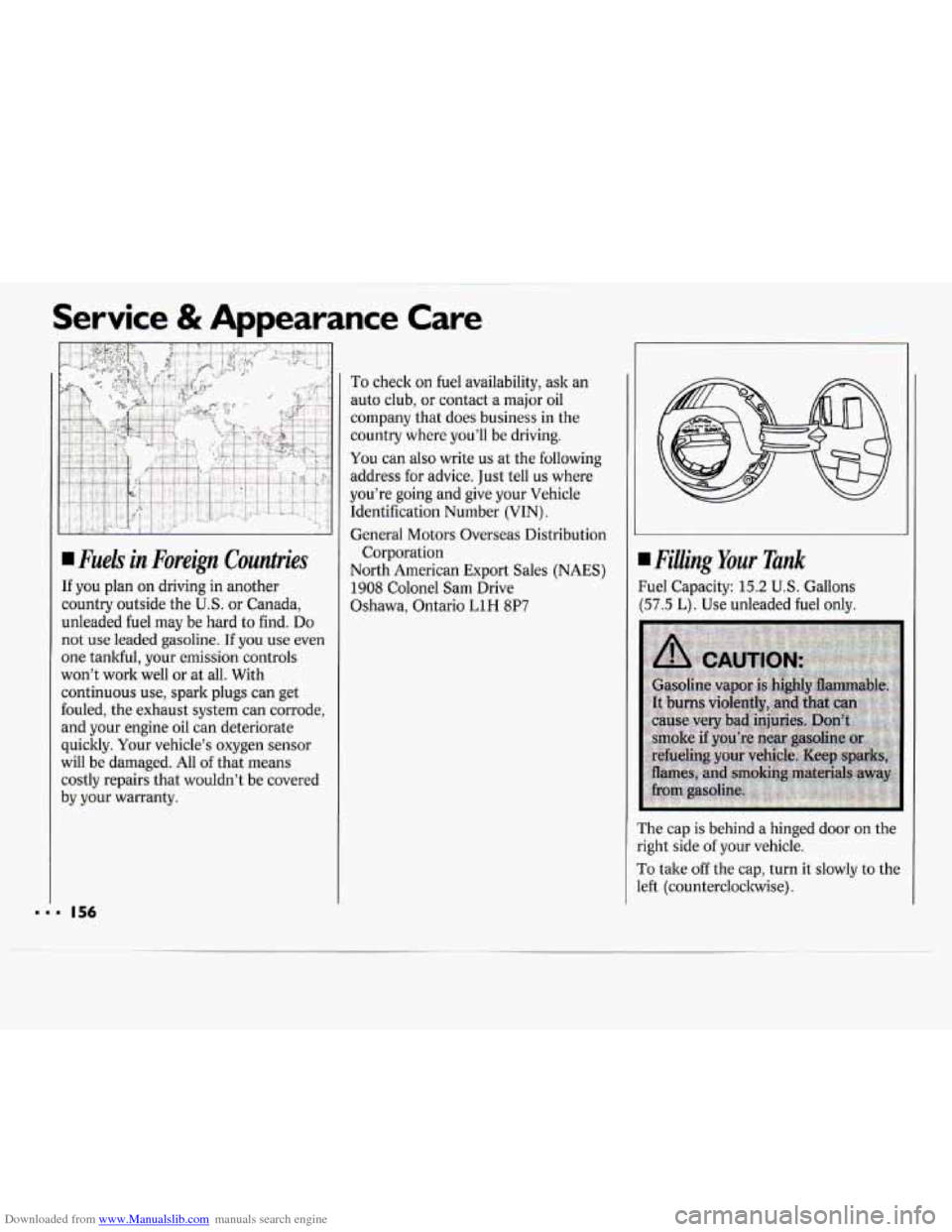
“el Capacity: 15.2 U.S. Gallons
77.5 L). Use unleaded fuel only.
The cap
is behind a hinged door on the
sight side
of your vehicle.
To take off the cap, turn it slowly to the
eft (counterclockwise).