1994 CHEVROLET CAVALIER lock
[x] Cancel search: lockPage 166 of 243
Downloaded from www.Manualslib.com manuals search engine Engine Coolant Heater (Engine Block Heater)
An engine coolant heater can be a big
help if you have to park outside in very
cold weather,
0°F (-18°C) or colder. If
your vehicle has this option, see
Engine
Coolant Heater
in the Index.
What to Do with Used Oil
Did you know that used engine oil
contains certain elements that may be
unhealthy for your
skin and could even
cause cancer? Don’t let used oil stay on
your skin for very long. Clean your
skin
and nails with soap and water, or a
good hand cleaner. Wash or properly
throw away clothing or rags containing
used engine oil. (See the manufacturer’s
warnings about the use and disposal of
oil products.) Used oil
can be a real threat.,t.o the
environment. If you change your
own
oil, be sure to drain all free-flowing oil
from the filter before disposal. Don’t
ever dispose of oil by putting it in the
trash, pouring it
on the ground, into
sewers, or into streams or bodies of
water. Instead, recycle it by taking it to
a place that collects used oil.
If you
have a problem properly disposing of
your used oil, ask your dealer, a service
station or a local recycling center for
help.
Air Cleaner
Refer to the Maintenance Schedule to
determine when to replace the air filter.
See
Scheduled Maintenance Services in
the
Index.
-
NOTICE:
If the air cleaner is off, a backfire
can cause a damaging engine fire.
And,
dirt can easily get into your
engine, which will damage
it.
Always have the air cleaner in place
when you’re driving.
I
Page 170 of 243
Downloaded from www.Manualslib.com manuals search engine Manual Transaxle Fluid
When to Check
A good time to have it checked is when
the engine oil is changed. However, the
fluid in your manual transaxle doesn't
require changing.
How to Check
Because this operation can be a little
difficult, you may choose to have this
done at a Chevrolet dealership Service
Department.
If you do it yourself, be sure to follow
all the instructions here, or you could
get a false reading on the dipstick.
NOTICE:
Too much or too little fluid can
damage your transaxle.
Too much
can mean that some of the fluid
could come out and fall on hot'
engine parts or exhaust system,
starting a fire. Be sure to get an
accurate reading if you check your
transaxle fluid. Check
the fluid level only when your
engine is off, the vehicle is parked on a
level place and the transaxle is cool
enough for you to rest your fingers on
the transaxle case.
Then, follow these steps:
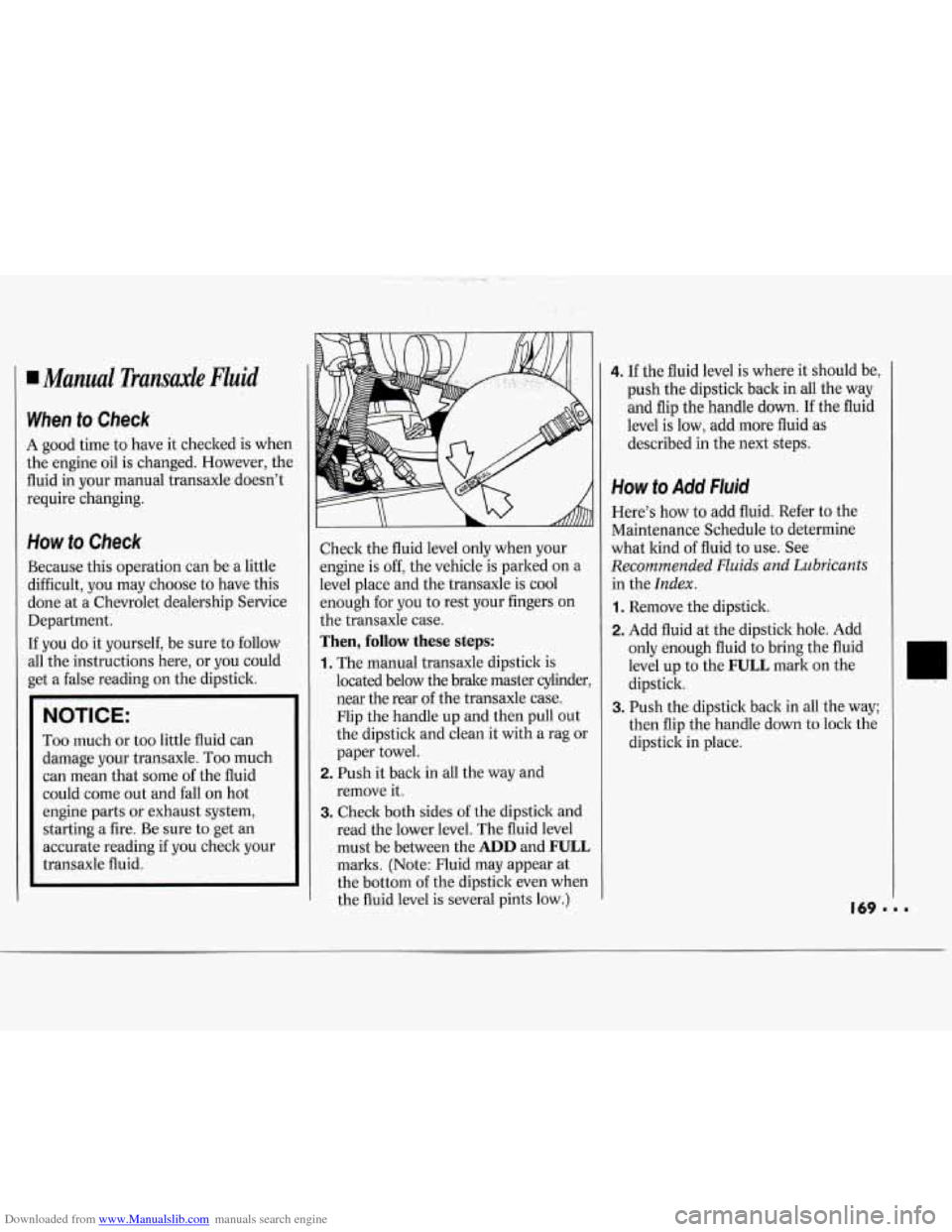
1. The manual transaxle dipstick is
located below the brake master cylinder
near the rear of the transaxle case.
Flip the handle up and then pull out
the dipstick and clean it with a rag or
paper towel.
2. Push it back in all the way and
remove it.
3. Check both sides of the dipstick and
read the lower level. The fluid level
must be between the
ADD and FULL
marks. (Note: Fluid may appear at
the bottom of the dipstick even when
the fluid level is several pints low.)
4. If the fluid level is where it should be,
push the dipstick back in all the way
and flip the handle down.
If the fluid
level is low, add more fluid as
described in the next steps.
How to Add Fluid
Here's how to add fluid. Refer to the
Maintenance Schedule to determine
what kind of fluid to use. See
Recommended Fluids and Lubricants
in the Index.
1. Remove the dipstick.
2. Add fluid at the dipstick hole. Add
only enough fluid to bring the fluid
level up to the
FULL mark on the
dipstick.
3. Push the dipstick back in all the way;
then flip the handle down
to lock the
dipstick in place.
Page 178 of 243
Downloaded from www.Manualslib.com manuals search engine Headlight Bulb Replacement
For the type of bulb, see the Index
under Replacement Bulbs.
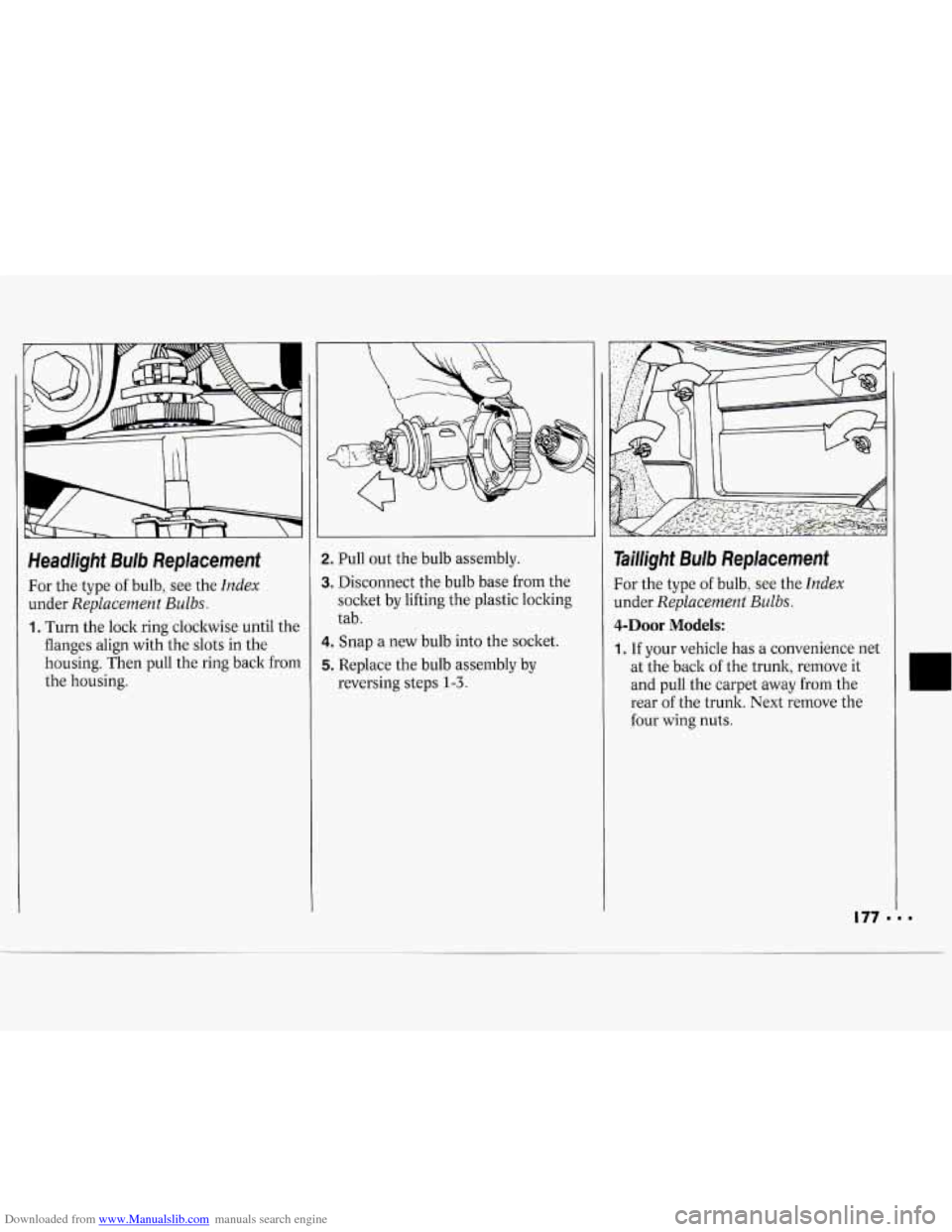
1. Turn the lock ring clockwise until the
flanges align with the slots in the
housing. Then pull the ring back from
the housing.
2. Pull out the bulb assembly.
3. Disconnect the bulb base from the
socket by lifting the plastic locking
tab.
4. Snap a new bulb into the socltet.
5. Replace the bulb assembly by
reversing steps
1-3.
Taillight Bulb Replacement
For the type of bulb, see the Index
under Replacement Bulbs.
4-Door Models:
1, If your vehicle has a convenience net
at the back of the trunk, remove it
and pull the carpet away from the
rear of the trunk. Next remove the
four wing nuts.
177 1
Page 180 of 243
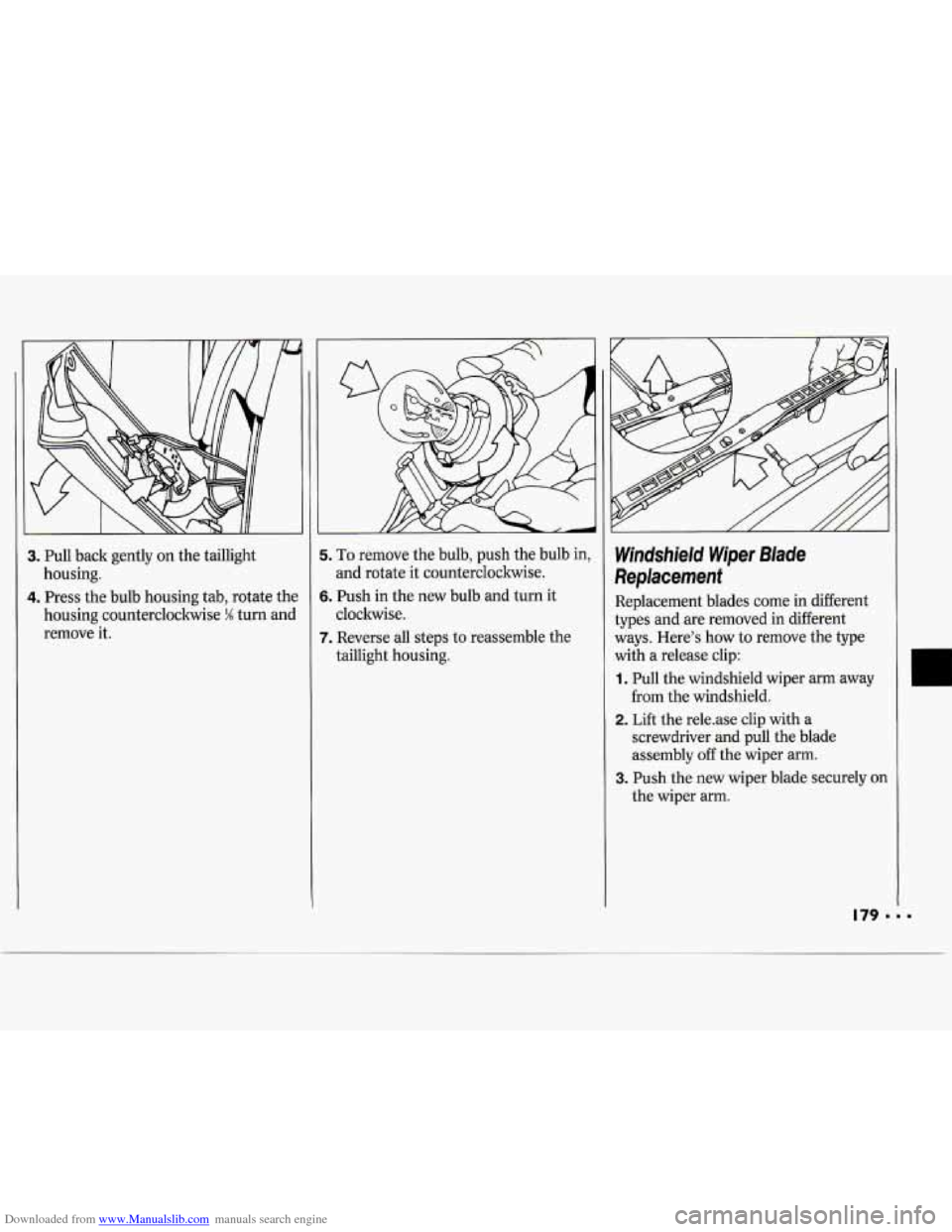
Downloaded from www.Manualslib.com manuals search engine 3. Pull back gently on the taillight
housing.
4. Press the bulb housing tab, rotate the
housing counterclockwise
% turn and
remove it.
i. To remove the bulb, push the bulb in,
and rotate it counterclockwise.
5. Push in the new bulb and turn it
cloclnvise.
7. Reverse all steps to reassemble the
taillight housing.
Windshield Wiper Blade
Replacement
Replacement blades come in different
types and are removed in different
ways. Here’s how to remove the type
with
a release clip:
1. Pull the windshield wiper arm away
from the windshield.
2. Lift the rele-ase clip with a
screwdriver and pull the blade
assembly off the wiper arm.
the wiper arm.
3. Push the new wiper blade securely on
Page 197 of 243

Downloaded from www.Manualslib.com manuals search engine Service & Appearance Care
Vse Usage 1
196
Fuse
INST LPS
ECM
DR UNLK
CIG LTR
RDO 2
GAUGES
PIUTURN
HTR-A/C
WIPER
F/P
RDO
1
CTSY
WDO CRUISE
TURN-B/U S/LP
FTP
ACC HDLP
Rating
(AMP.)
5
10
10
15
10
10
15
25
25
10
10
15
30
10
15
20
20
30
20
Circuitry
Instrument Panel Lamps
Electronic Control Module, Fuel Injectors
Automatic Door Unlock (Remove to Disable)
Cigarette Lighter, Glove Box Light
Radio Power
Gages, Audio Warning System, Cluster Telltales, TCC,
Rear Defogger Relay, Brake Transaxle Shift Interlock,
Multiport Fuel Injection
Park and Turn Lamps
Heater and A/C Power, Daytime Running Lights
(Canada), Anti-Lock Brakes
Windshield Wipers
Fuel Pump Radio Memory, Digital Clock
Interior Lights, Horn, Power Locks, Audible Warning
System, Remote Liftgate Release, Check Oil Light
Power Window (Circuit Breaker)
Cruise Control
Turn Signal, Back-Up Lamps
Stop Lamps, Hazard Flashers
Flash-To-Pass
Power Locks, Rear Window Defogger (Circuit Breaker)
Headlamp (Circuit Breaker)
Page 198 of 243
Downloaded from www.Manualslib.com manuals search engine Headlight Wiring
The headlight wiring is protected by a
circuit breaker in the fuseblock. An
electrical overload will cause the lights
to go on and off, or in some cases
to
remain off. If this happens, have your
headlight system checked right away.
To access the headlight circuit breaker,
squeeze the plastic clip together and
remove.
Windshield Wipers
The windshield wiper motor is
protected by
a circuit breaker and a
fuse. If the motor overheats due to
heavy snow, etc., the wiper will stop
until the motor cools.
If the overload is
caused by some electrical problem, have
it fixed.
Power Windows and Other Power
Options
Circuit breakers in the fuse panel
protect the power windows and other
power accessories. When the current
load is too heavy, the circuit breaker
opens and closes, protecting the circuit
until the problem is fixed.
Page 215 of 243
Downloaded from www.Manualslib.com manuals search engine Maintenance Schedule
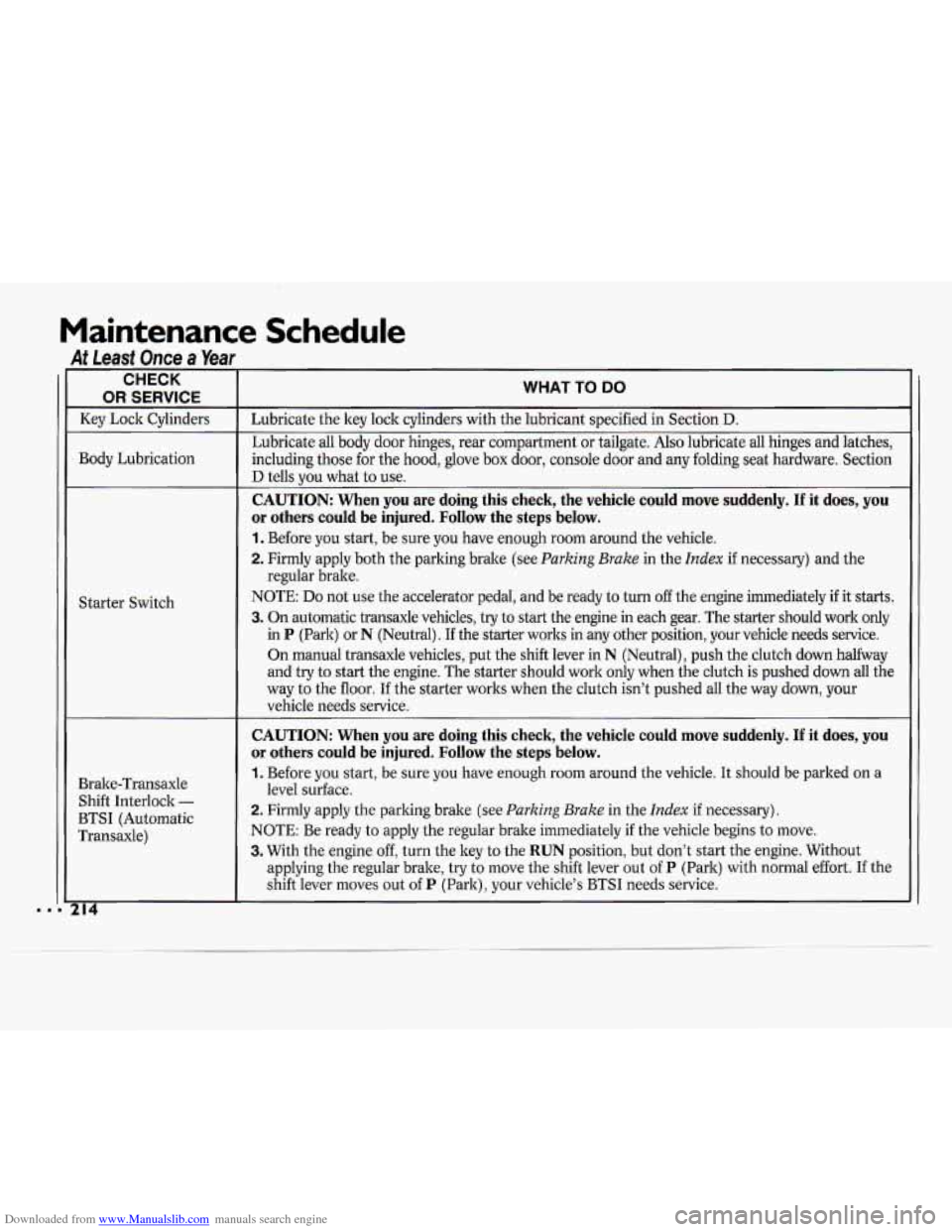
At Leasf Once a Year
CHECK
-
-
-
OR SERVICE
Key Lock Cylinders
Body Lubrication
Starter Switch
Bralte-Transaxle Shift Interlock
-
BTSI (Automatic
Transaxle)
- z A
WHAT TO DO
Lubricate the key lock cylinders with the lubricant specified in Section D.
Lubricate all body door hinges, rear compartment or tailgate. Also lubricate all hinges and latches,
including those for the hood, glove box door, console
door and any folding seat hardware. Section
D tells vou what to use.
CAUTION: When you are doing this check, the vehicle could move suddenly. If it does, you
or others could be injured. Follow the steps below.
1. Before you start, be sure you have enough room around the vehicle.
2. Firmly apply both the parking brake (see Parking Brake in the Index if necessary) and the
NOTE:
Do not use the accelerator pedal, and be ready to turn off the engine immediately if it starts.
3. On automatic transaxle vehicles, try to start the engine in each gear. The starter should work only
in
P (Park) or N (Neutral). If the starter worlts in any other position, your vehicle needs servic\
e.
On manual transaxle vehicles, put the shift lever in
N (Neutral), push the clutch down halfway
and try to start the engine. The starter should work only when the clutch is pushed down all the
way to the floor.
If the starter worlts when the clutch isn’t pushed all the way down, your
vehicle needs service. regular
brake.
CAUTION: When you are doing this check, the vehicle could move\
suddenly. If it does, you
or others could be injured. Follow the steps below.
1. Before you start, be sure you have enough room around the vehicle. It should be parked on a
2. Firmly apply the parking brake (see Parking Brake in the Index if necessary),
NOTE: Be ready to apply the regular brake immediately if the vehicle begins to move.
3. With the engine off, turn the key to the RUN position, but don’t start the engine. Without
level surface.
applying the regular brake, try to move the shift lever out of
P (Park) with normal effort. If the
shift lever moves out of
P (Park), your vehicle’s BTSI needs service.
Page 216 of 243
Downloaded from www.Manualslib.com manuals search engine CHECK
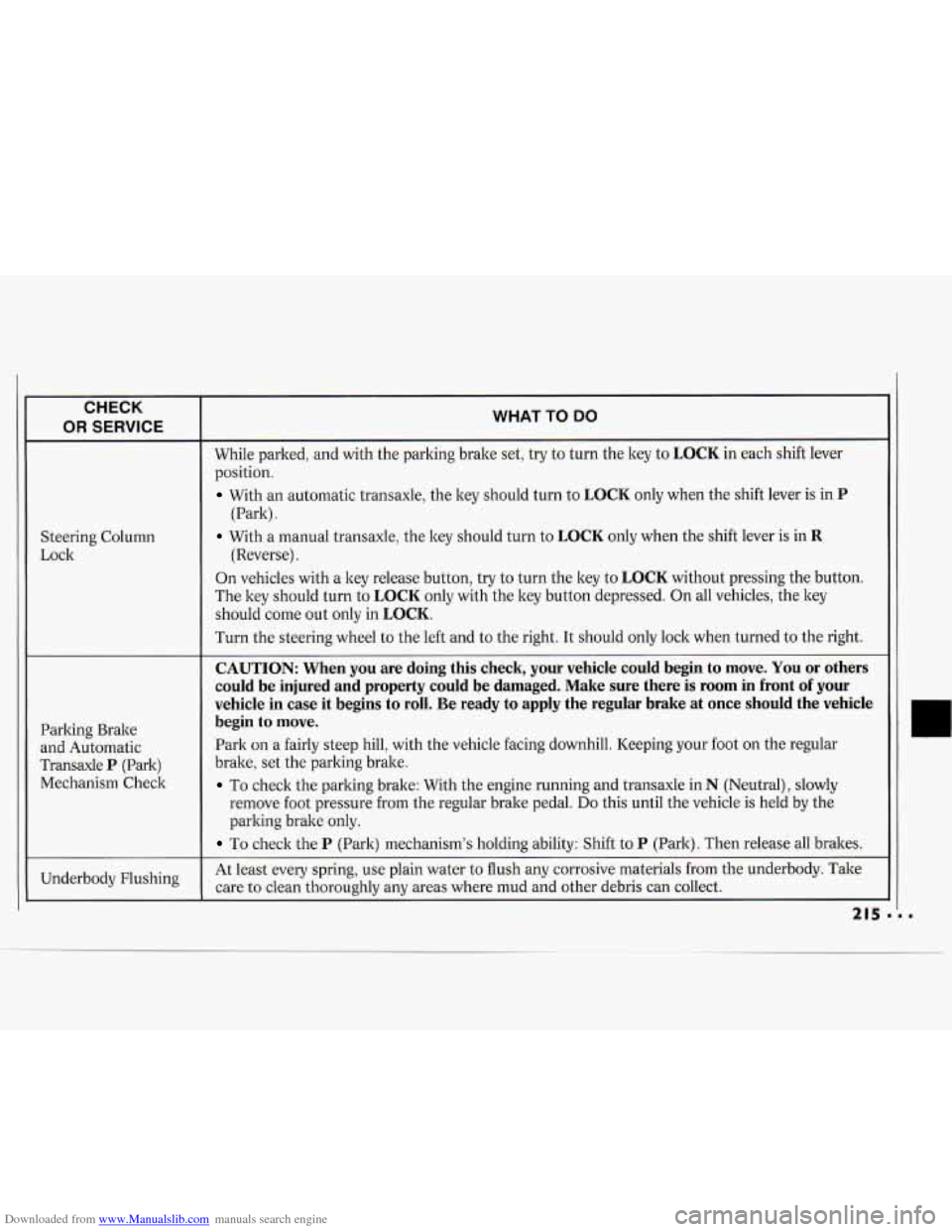
I OR SERVICE
Steering Column
Lock
Parking Brake
and Automatic
Transaxle
P (Park)
Mechanism Check
WHAT TO DO
While parked, and with the parking brake set, try to turn the key to LOCK in each shift lever
position.
With an automatic transaxle, the key should turn to LOCK only when the shift lever is in P
(Park) .
With a manual transaxle, the key should turn to LOCK only when the shift lever is in R
(Reverse).
On vehicles with a key release button, try to turn the key to
LOCK without pressing the button.
The key should turn to
LOCK only with the key button depressed. On all vehicles, the key
should come out only in
LOCK.
Turn the steering wheel to the left and to the right. It should only lock when turned to the right.
~~ ~~ ~
CAUTION: When you are doing this check, your vehicle could begin to move. You or others
could be injured and property could be damaged. Make sure ther\
e is room in front
of your
vehicle in case
it begins to roll. Be ready to apply the regular brake at once should the vehicle
begin to move.
Park on a fairly steep hill, with the vehicle facing downhill. Keeping your foot on the regular
brake, set the parking brake.
To check the parking brake: With the engine running and transaxle in N (Neutral), slowly
remove foot pressure from the regular brake pedal.
Do this until the vehicle is held by the
parking brake only.
To check the P (Park) mechanism’s holding ability: Shift to P (Park). Then release all brakes.
At least every spring, use plain water to flush any corrosive materials from the underbody. Take
care
to clean thoroughly any areas where mud and other debris can collect.