1994 CADILLAC ELDORADO wheel
[x] Cancel search: wheelPage 193 of 398
Downloaded from www.Manualslib.com manuals search engine ‘I
r td
r
r
!
-
I- t>
Try to adjust your speed so you can ‘‘d&xCY through.thecurve. Maintain a
reasonable,. steady speed, Wait to .accelerate until you are out of the
curve,
and then accelerate-gently into the straightaway.
.. .:r 5.
Steering in Emergencies
There are times when steering canbe more effective.than braking. For
example, you. come over a hill and, find a truck stopped
in your lane, .or a
car suddenly pulls. out from nowhere, ox a child darts out €rm betwe
you. You can avoid these pxoblems
by braking.
-- if you can stop in time. But sometimes you can’t; there isn’t
room. That’s the time for evasive action
-- steering around the problem.
Your Cadillac can perform verywell
in. emergencies like these. First apply
your brakes. It
is better to remove as much speed as you can from a,
possible collision. Then steer around the problem, to the left orright
depending on the space available.
An emergency like this requires close attention and a quick decision. If
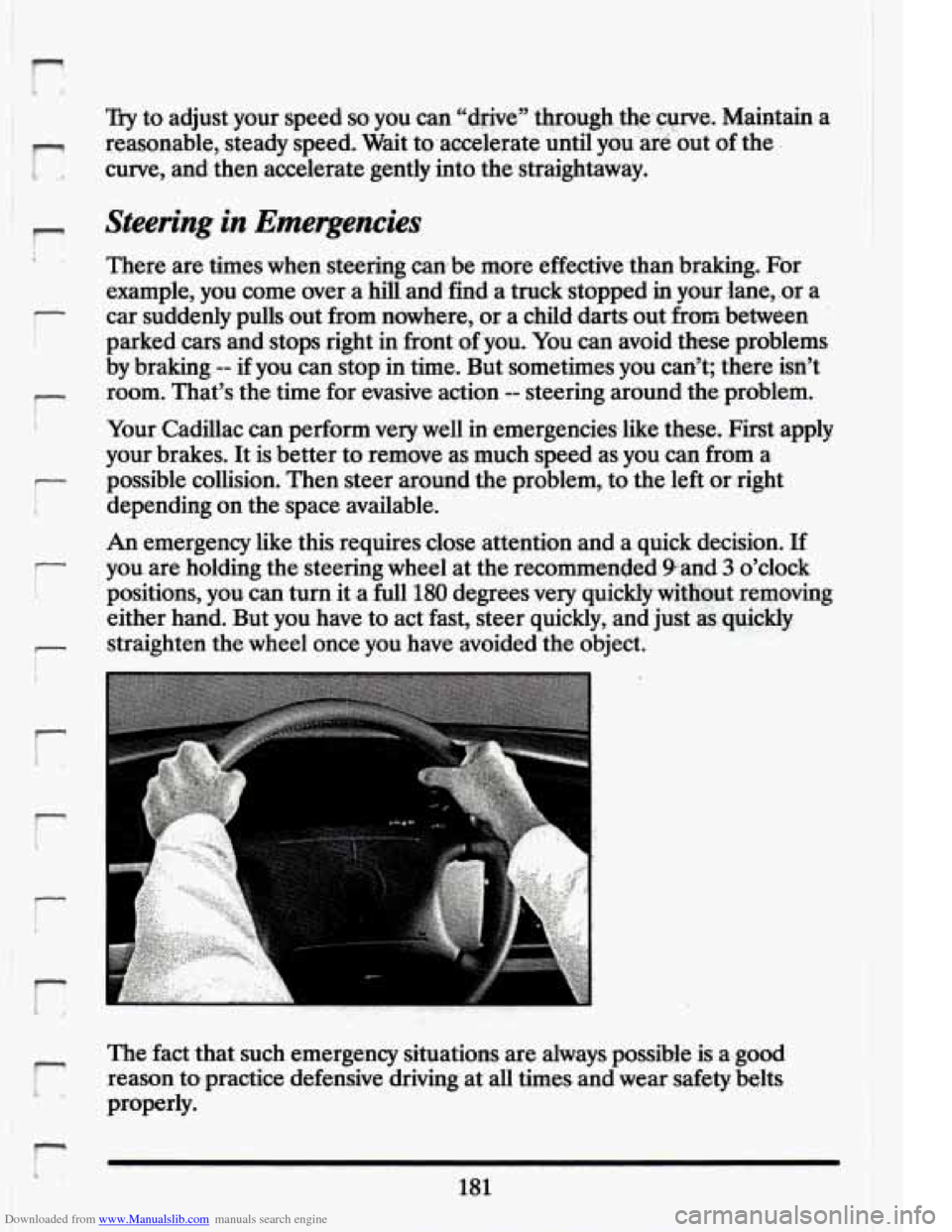
you. are holding the steering wheel’ at the recommended Pand-3’o’clock
positions, you can turn
it a full 180 degrees very quickly without removing
either hand. But you have to act fast, steer quickly, and just aslquickly
straighten the wheel once
you have avoided-:the object.
The fact that such emergency situations are always possible
is a.good
reason to practice defensive driving at all times. and wear safety belts
properly.
r c
181.
Page 194 of 398
Downloaded from www.Manualslib.com manuals search engine OFF-ROAD RECOVERY
You may find sometime that your right wheels have dropped off the edge
of a road onto the shoulder while you’re driving.
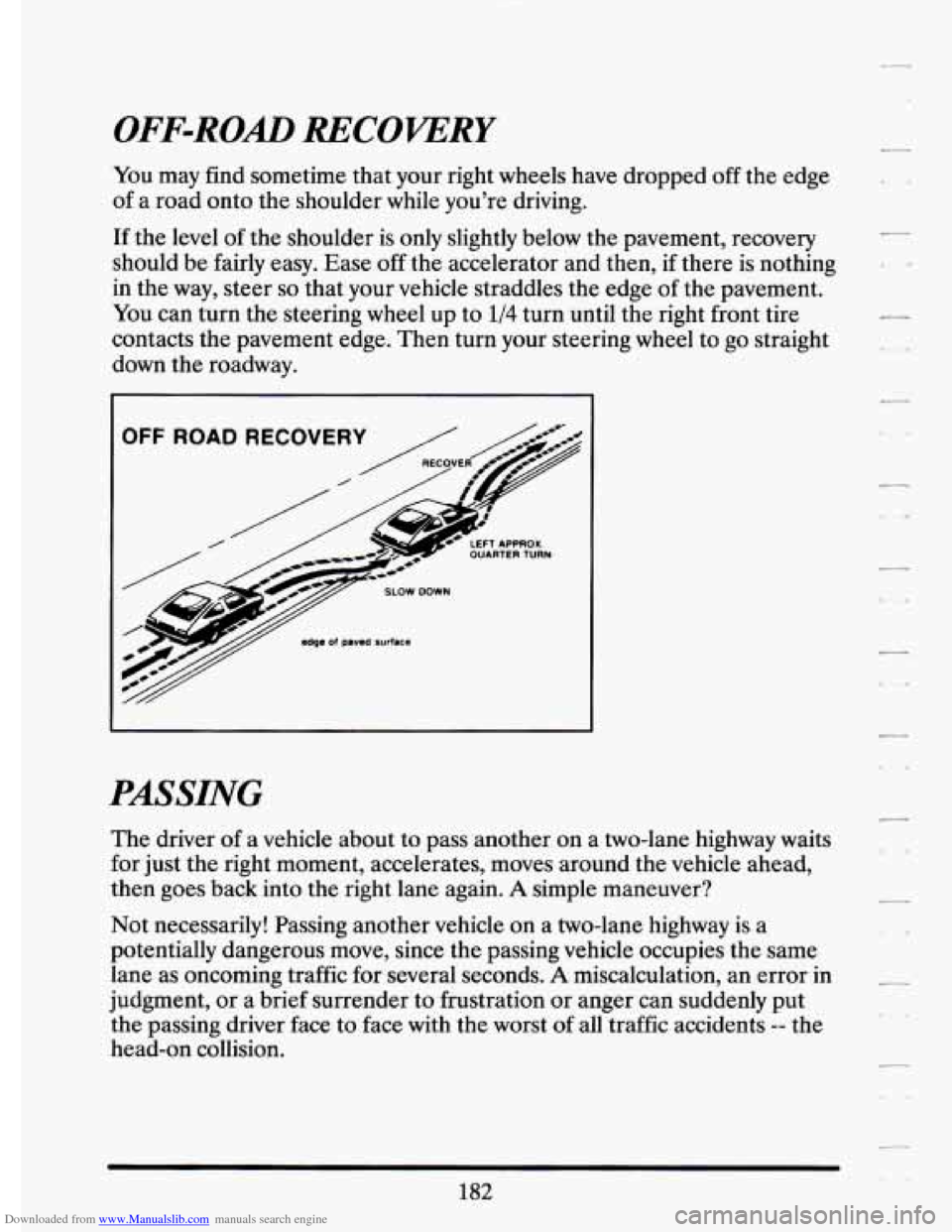
If the level of the shoulder is only slightly below the pavement, recovery
should be fairly easy. Ease
off the accelerator and then, if there is nothing - -
in the way, steer so that your vehicle straddles the edge of the pavement.
You
can turn the steering wheel up to 1/4 turn until the right front tire
contacts the pavement edge.
Then turn your steering wheel to go straight
-
down the roadway.
-
PASSING
The driver of a vehicle about to pass another on a two-lane highway waits
for just the right moment, accelerates, moves around the vehicle ahead,
then goes back into the right lane again.
A simple maneuver?
Not necessarily! Passing another vehicle on a two-lane highway is a
potentially dangerous move, since the passing vehicle occupies the same
lane
as oncoming traffic for several seconds. A miscalculation, an error in
judgment,
or a brief surrender to.frustration or anger can suddenly put
the passing driver face to face with the worst
of all traffic accidents -- the
head-on collision.
182
Page 196 of 398
Downloaded from www.Manualslib.com manuals search engine Try not to pass more than one vehicle at a time on two-lane roads.
Reconsider before passing the next vehicle.
Don’t overtake a slowly moving vehicle too rapidly. Even though the
brake lights are not flashing, it may be slowing down or starting to
turn.
If you’re being passed, make it easy for the following driver to get
ahead
of you. Perhaps you can ease a little to the right.
LOSS OF CONTROL
Let’s review what driving experts say about what happens whe\
n the three
control systems (brakes, steering and acceleration) don’t ha\
ve enough
friction where the tires meet the road to do what the driver has asked.
In any emergency, don’t give up. Keep trying to steer and constantly seek
an escape route or area of less danger.
Skidding
In a skid, a driver can lose control of the vehicle. Defensive drivers avoid
most skids by taking reasonable care suited to existing conditions, and by
not “overdriving” those conditions. But skids are always possible.
The three types of skids correspond
to your Cadillac’s three control
systems. In the braking skid your wheels aren’t rolling.
In the steering or
cornering skid, too much speed or steering
in a curve causes tires to slip
and lose cornering force. And in the acceleration skid too much throttle
causes the driving wheels to spin.
A cornering skid is best handled by easing your foot off the accelerator
pedal.
If your vehicle starts to slide, ease your foot off the accelerator pedal and
quickly steer the way you want the vehicle
to go. If you start steering
quickly enough, your vehicle may straighten out. Always be ready for a
second skid if it occurs.
Of course, traction is reduced
when water, snow, ice, gravel, or other
material is on the road. For safety, you’ll want
to slow down .md adjust
your driving
to these conditions. It is important to slow dowr on slippery
surfaces because stopping distance will be longer and vehicle control
more limited.
184
Page 205 of 398
Downloaded from www.Manualslib.com manuals search engine n
r !
1- ,
r I
ii
P
I
- i
r
E‘
0 LiEhts: Are they all working? Are the lenses clean?
0 Tires: They are vitally important to a safe, trouble-free trip. Is the
tread good enough for long-distance driving? Are the tires all inflated
I
to the recommended pressure? 1 I
0 Weather Forecasts: What’s the weather outlook along your route?
Shodd you delay your trip a
short time to avoid a major storm
system?
0 Maps; Do you have up-to-date maps?
HIGHFKAYHWNOSIS
Is there actually such a condition as “highway hypnosis”? Or is it just
plain falling asleep at the wheel? Call it.highway hypnosis; lack
of
awareness, or whatever.
There
is something about an easy stretch of road with the same scenery,
along with the
hum of the tires on the road, the drone of the engine, and
the rush
of the wind against the vehicle. that can make you sleepy. Don’t
let it happen to you!
If it does, your vehicle can leave the road in less than
a second, and you could crash and be injured.
What can you do about highway hypnosis? First,
be aware that it can
happen.
Then here are some tips:
0 Make sure your vehicle is well ventilated, with a comfortably cool
interior.
0 Keep your eyes moving. Scan the road ahead and to the sides. Check
If you get sleepy, pull off the road into a rest, service., or parking area
your rearview
mirrors and
your instruments frequently.
and take a nap, get some exercise, or both. For safety, treat drowsiness
on the highway as an emergency.
i
193
Page 213 of 398
Downloaded from www.Manualslib.com manuals search engine r
r
r
P
r
!
r I
r
r-
NOTICE:
Pulling a trailer improperly can damage your vehicle and result
in costly repairs not covered by your warranty. To pull a trailer
correctly, follow the advice
in this section.
Your Cadillac is a passenger vehicle. It was not designed for many of the
demands that trailer towing can add.. Trailer towing can change the way
your vehicle performs on the road. It brings new forces into play and can
add plenty
of strain and stress to your vehicle.
Load pulling components such as the engine, transaxle, wheel assemblies,
and tires are forced to work harder against the drag
of the added weight.
The engine is required to operate at relatively higher speeds and under
greater loads, generating extra heat. Trailer towing adds considerably to
wind resistance increasing the pulling requirements.
All
of that means changes in:
Handling
Durability
Fuel Economy
You may decide not to pull a trailer but meet your load carrying needs in
some other way.
201 I
I
Page 217 of 398
Downloaded from www.Manualslib.com manuals search engine n
F- I
r
r i
I r’ j’ IL i
Folbwing Distance ~ ..
Stay at Least ,twice as far behind the vehicle ahead as you would when
driving your vehicie without a trailer.
This can help you.avoid situations
that require heavy braking and sudden turns.
,Passing
You’ll need more passing distance up ahead-.when you’re towing a. trailer.
And, because y0u’re.a good deal longer, you’ll need to go much farther
beyond the passed vehicle before you .can return to
your lane.
Backing Up
Hold the bottom of the steering wheel with one hand. Then, to move the
trailer ‘to .the- left, just move that hand
to the left. To move the trailer to
the right, .move -your hand
‘to the right. Always back up. slowly and, if
possible, have someone guide you.
Making nrns
When you’re turning with a trailer, make wider turns than normal. Do
.this so your trailer won? strike soft shoulders, curbs, road signs, trees, or
other .objects. Avoid jerky.or sudden maneuvers. Signal well
in advance.
Turn sigreals When Towing a Trailer
When you tow a trailer, your vehicle has to have a different turn signal
.= flasher and extra wiring. The green arrows on your instrument panel will f
J I flash, whenever you signal a turn or lane change. Properly hooked. up, the
trailer
l&hts will also flash, telling other drivers you’re about to turn,
change lanes or stop.
flash for turns even’if the.bulbs on the trailer are burned out. .Thus, you
may think drivers behind
you are seeing your- signal when they are not.
’ Et’s important to check occasionally to be sure the trailer. bulbs are still
r
i When towing a trailer; the green arrows on your instrument panel will
t! working.
205
Page 218 of 398
Downloaded from www.Manualslib.com manuals search engine Driving On Grades
Reduce speed and shift to a lower gear before you start down a long or
steep downgrade.
If you don’t shift down, you might have to use your
brakes
so much that they would get hot and no longer work well.
On a long uphill grade, shift down and reduce your speed to around
45 mph (70 km/h) or less to reduce the possibility of engine and transaxle
overheating.
If your trailer weighs more than 1,000 pounds (450 Kg) and you have an
automatic transaxle with Overdrive, you may want
to drive in “3” instead
of Overdrive
Parking on Hills
You really should not park your vehicle, with a trailer attached, \
on a hill.
If something goes wrong, your rig could start to move. People can be
injured, and both your vehicle and the trailer can be damaged.\
But
if you ever have to park your rig on a hill, here’s how to do it:
Apply your regular brakes, but do not shift into “P’, (Park).
Have someone place chocks-under the- trailer wheels.
When. the wheel chocks are in place, release the regular brakes until
the chocks absorb the load.
Reapply the regular brakes. THen shift into “P7, (Park) firmly and
apply your parking brake.
Release the regular brakes.
When You Are Ready to Leave Afler Parking on a Hill
1. Apply your regular brakes and hold the pedal down while you:
Start your engine;
Shift into a gear; and
0 Be sure the parking brake has released.
2. Let up on the brake pedal.
L
c
206
i
Page 229 of 398
Downloaded from www.Manualslib.com manuals search engine TOWING YOUR VEHICLE
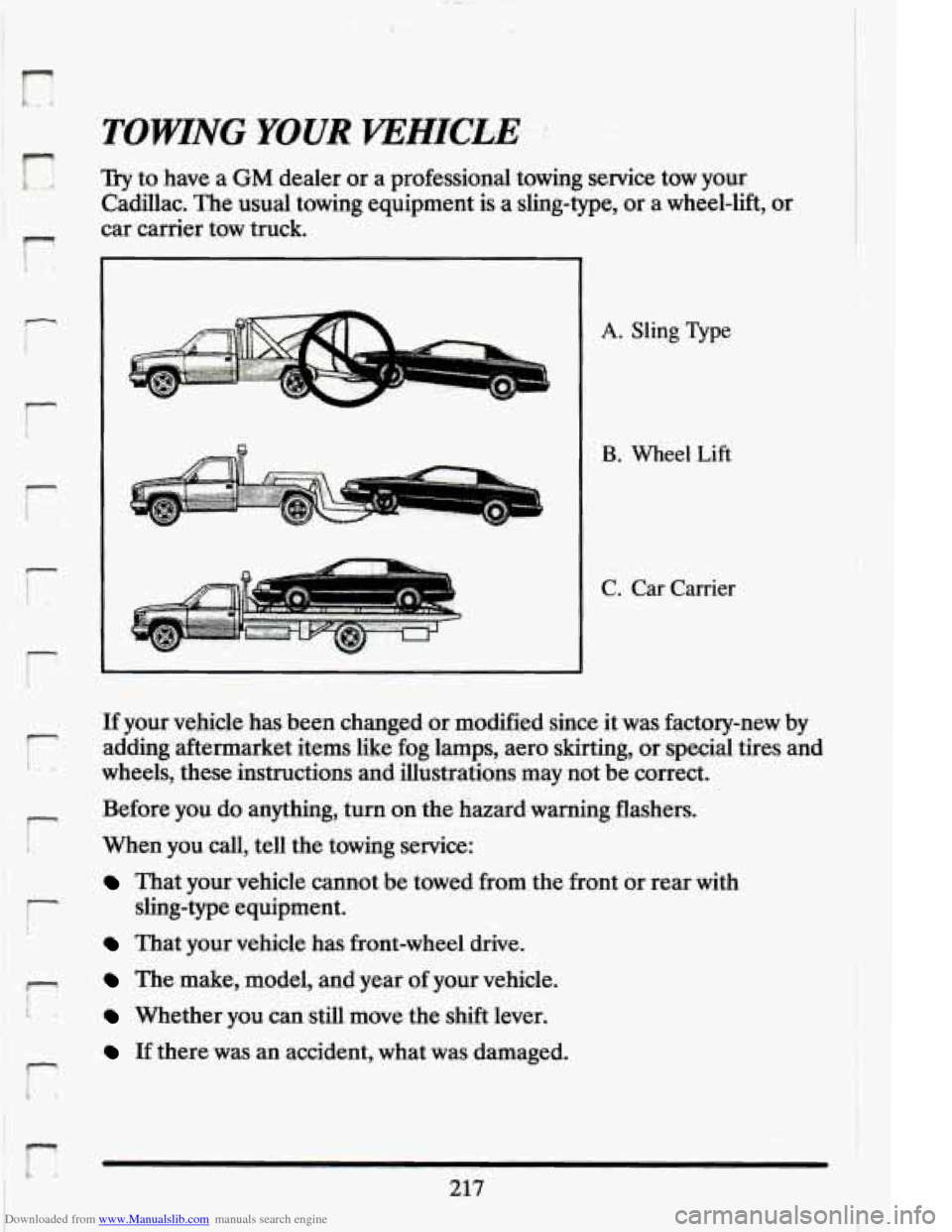
r, Try to have a GM dealer or a professional towing service tow your
Cadillac. The usual towing equipment is a sling-type, or a wheel-lift, or
car carrier tow truck.
r
r
V
I n
t
ir
I 'r:
F-
i
17
r
A. Sling Type
B. Wheel Lift
C. Car Carrier
If your vehicle has been changed or modified since it was factory-new by
adding aftermarket items like fog lamps, aero skirting, or special tires and
wheels, these instructions and illustrations may not be correct.
Before you do anything, turn on the hazard warning flashers.
When you call, tell the towing service:
That your vehicle cannot be towed from the front or rear with
That your vehicle has front-wheel drive.
The make, model, and year of your vehicle.
Whether you can still move the shift lever.
If there was an accident, what was damaged.
sling-type
equipment.
217