1994 CADILLAC ELDORADO power steering
[x] Cancel search: power steeringPage 113 of 398
Downloaded from www.Manualslib.com manuals search engine r 1.
i
i
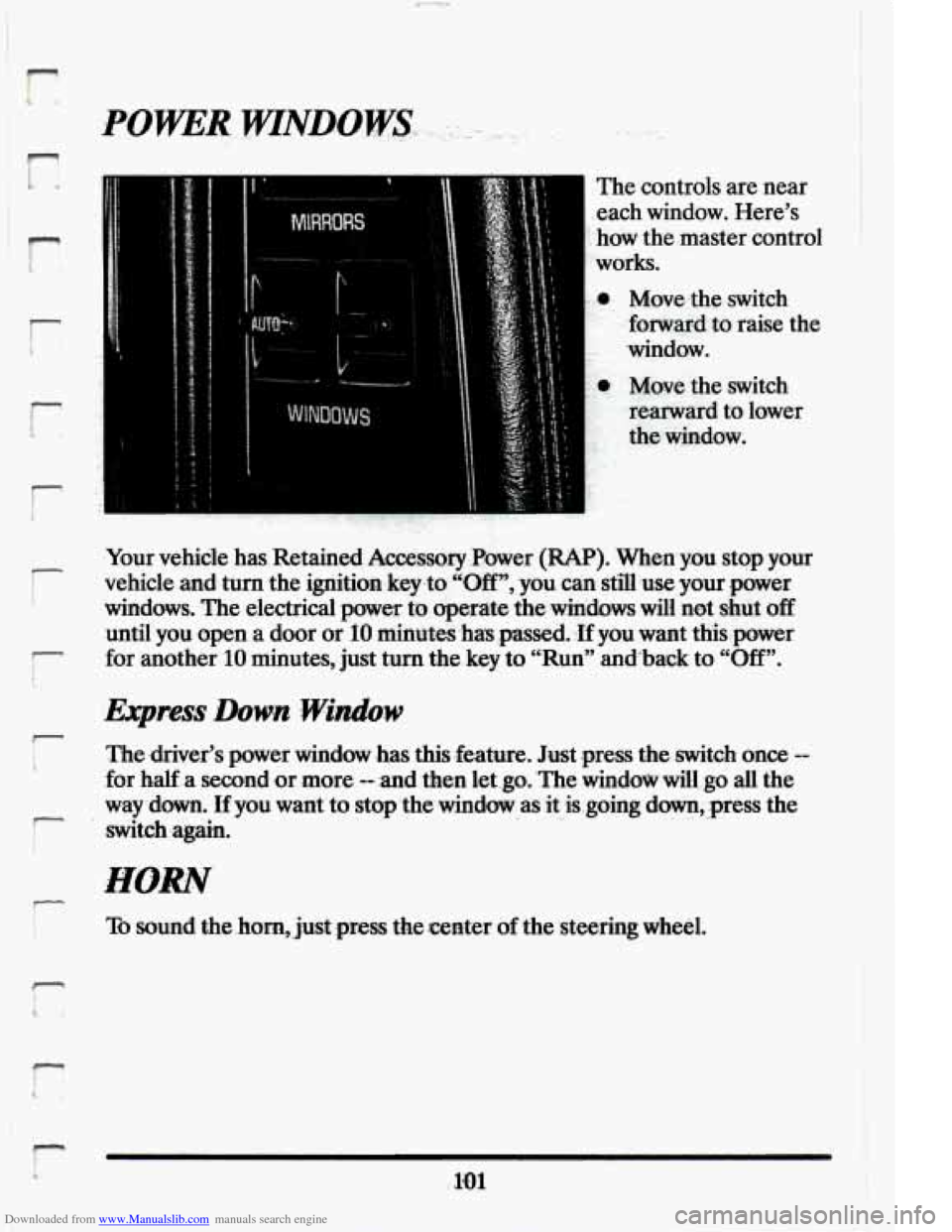
The controls ‘are near
,each window. Here’s
:-how the.master contro:
..works.
Mowthe switch
forwmd
to raise the
window.
- ‘C Move the witch
.. rearward to lower
.I the window.
.Your vehicle has.Retained
Accessory Power (RAP). When,ym stop your
vehicle and ,turn the ignitionkeyto “Off,;you can
still use your power
windows, The electrical powa
to, aperate the winaows will not shut off
until you open a door or IO minutes has .passed. :If yaw want thispower
for another
IO minutes, just turn the key to “Run” anaback to “Off”.
The ,driver’s power window has this--fea.ture. Just press the .switch once --
for half a second %or more -- :and then let .go. ‘The window dl, go -all the
way
down. tf you want to stopthe-window as it isgoing dm, press the
switdragain. .. r ..
To sound the .horn,:just press the center of the ,steering wheel.
Page 191 of 398
Downloaded from www.Manualslib.com manuals search engine I
r
i .’
r
r
L
r
i
r I
Your vehicle has traction control system that limits wheel spin. This is
especially useful in slippery road conditions. The system operates only
if
it senses that one or both of the front wheels are spinning or- beginning to
lose traction. When .this happens, the system works the front brakes and
reduces engine power (by shutting
off fuel injectors) to limit wheel spin.
The “TRACTION ACTIVE” message will display on the Driver
Information Center when the traction control system is limiting wheel
spin. See “Driver Information Center Messages” in the Index. You may
feel the system working, or you may notice some noise, but this
is nomal.
If your vehicle is in cruise control when the traction control system begins
to limit wheel spin, the cruise control will automatically disengage. When
road conditions allow you to safely use it again, you may
turn the cruise
control back on. (See “Cruise Control” in the Index.)
The “TRACTION DISABLED” message
will display on the Driver
Information Center
if there’s a problem with your traction control system.
See “D,river Information Center Messages” in the Index. When. this
message is displayed, the system will not limit wheel spin. Adjust your
driving accordingly.
Braking in Emergencies
Use your anti-lock braking system when you need to. With anti-lock, you
can steer and brake at the same time. In many emergencies, steering can
help you more than even the very best braking.
179
Page 192 of 398
Downloaded from www.Manualslib.com manuals search engine STEEMNG
Power Steering
L_
c-
If you lose power steering assist because the engine stops or the system is
not functioning, you can steer but it
will take much more effort.
Steering Tips
Driving on Curves
It’s important to take curves at a reasonable speed.
A lot of the “driver lost control” accidents mentioned on the news
happen on curves. Here’s why:
Experienced driver or beginner, each
of us is subject to the same laws of
physics when driving on curves. The traction of the tires against the road
surface makes it possible for the vehicle to change its path
when you turn
the front wheels. If there’s no traction, inertia will keep the vehicle going
in the same direction. If you’ve ever tried to steer a vehicle on wet ice,
you’ll understand this.
The traction you can get in a curve depends
on the condition of your tires
and the road surface, the angle at which the curve is banked, and your
speed. While you’re in a curve, speed is the one factor you can control.
Suppose you’re steering through a sharp curve. Then
you suddenly
accelerate. Both control systems
-- steering and acceleration -- have to do
their work where the tires meet the road. Unless you have the traction
control system, adding the sudden acceleration can demand too much
of
those places. You can lose control.
What should you do
if this ever happens? Ease up on the accelerator
Pedal, steer the vehicle the way you want it to go, and slow down.
31 ~ :d limit signs near curves warn that you should adjust your speed. Of
course, the posted speeds are based on good weather and road
conditions. Under less favorable conditions you’ll want to go slower.
If you need to reduce your speed as you approach a curve, do it before
you enter the curve, while your front wheels are straight ahead.
-
e.4
180
Page 278 of 398
Downloaded from www.Manualslib.com manuals search engine THERMOSTAT
Engine coolant temperature is controlled by a thermostat in the engine
coolant system. The thermostat stops the flow
of coolant through the
radiator until the coolant reaches
a preset temperature.
When
you replace your thermostat, an AC@ thermostat is recommended.
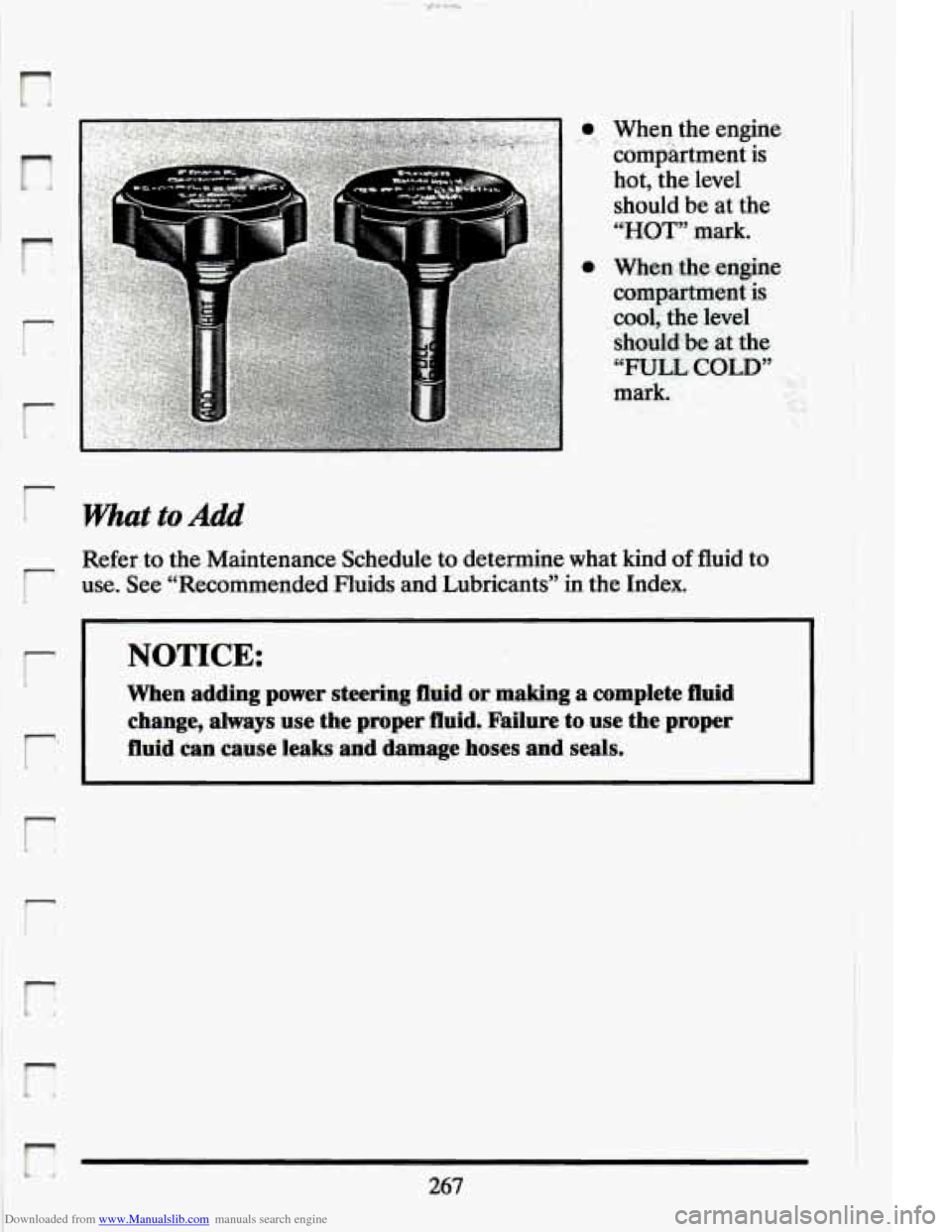
POWER STEERING FLUID
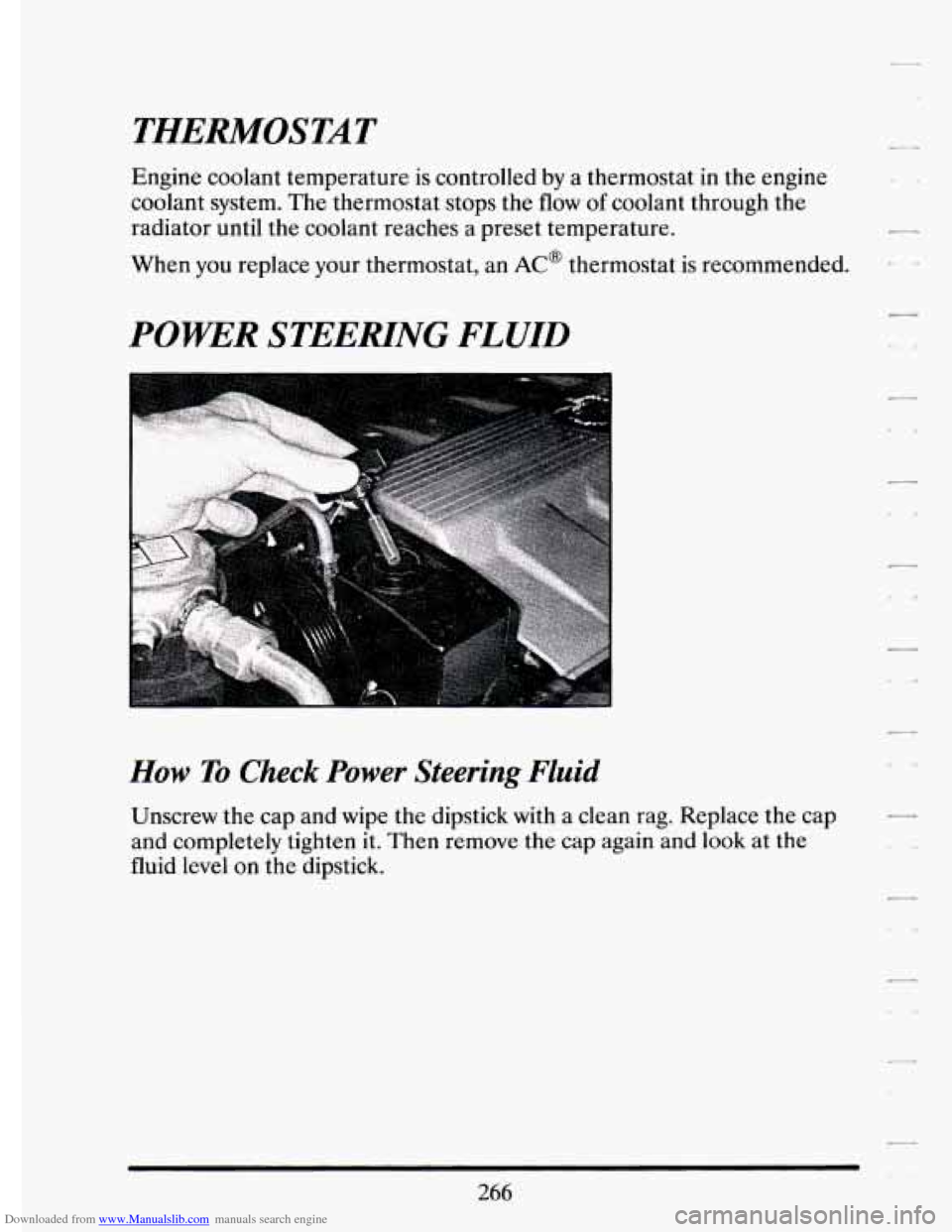
How To Check Power Steering Fluid
Unscrew the cap and wipe the dipstick with a clean rag. Replace the cap
and completely tighten
it. Then remove the cap again and look at the
fluid level
on the dipstick.
266
Page 279 of 398
Downloaded from www.Manualslib.com manuals search engine . I ,.-
r
r
r
r
.. .
What to Add
Refer to the Maintenance Schedule to determine what kind of fluid to
use. See “Recommended Fluids and Lubricants” in the Index.
NOTICE:
When adding power steering fluid or making a complete fluid
change, always use the proper fluid. Failure to use the proper
fluid
can cause leaks and damage hoses and seals.
r
I
Page 325 of 398

Downloaded from www.Manualslib.com manuals search engine Y
r
r I
i
r
!r:
i E
,r
i 'E
L HDLP LO R HDLP LO L HDLP HI R HDLP HI ION 3 COOL'FAN TRANS
I FUSE CENTER IDENTIFICATION I
ENGINE COMPARTMENT FUSE BLOCK
DlSTR 20A
SIR 20A - IGNITION CONTROL MODULE
- DIAGNOSTIC/ENERGY RESERVE
MODULE (DERM)
- DUAL POLE ARMING SENSOR PCM (ION 1OA
- PASS-Key@ DECODER MODULE INJ 10A
- POWERTRAIN CONTROL MODULE (PCM)
- 1,4,6, AND 7 FUEL INJECTORS
- 2.3.5. AND 8 FUEL INJECTORS INJ 1OA
ION
1 iOA - A/C REFRIGERANT PRESSURE SWITCH - TRANSAXLE RANGE SWITCH - STOP/BTSI/CRUISE BRAKE SWITCH - INSTRUMENT PANEL'CLUSTER - KEYLESS ENTRY MODULE - DIAGNOSTlCfENERGY RESERVE MODULE
- PERM2 ORN RING LIGHTS - TURN/HAZARD SWITCH ASSY. - CHIME MODULE - HEADLIGHT SWITCH - TWILIGHT SENTINEUDRL MODULE
- FUELPUMP - OIL PRESSURE SWITCH - POWERTRAIN CONTROL MODULE IPCMI
FUEL PUMP 20A
PCM (BAT) 1OA
RTD
, AT) 20A - RgAD SENSING SUSPENSION (RSS) MODUL A/C COMP 1OA
- POWERTRAIN CONTROL MODULE (PCM)
- A/C COMPRESSOR CLUTCH HDLPS 3OA
.~
- HEADLIGHT DIMMER SWITCH - HEADLIGHT RELAY "D (ENGINE COMF!
- DRL HEADLIGHT RELAY "E" (WITH DAYTIME
- POWERS C13 MICRO RELAY CENTER)
RUNNING LIGHTS)
E
STOP LP 2OA - STOP/BTSI/CRUISE SWITCH - STOPUGHT SWITCH CAPACITOR TURNIHAZ 20A - HAZARD FLASHER - TURN FLASHER RELAY - TURN FLASHER MODULE DRL 1 OA (CANADA) - DAV~ME RUNNI'NG LIGHTS (CANADA) ~ ~~
DRL 1 OA (CANADA)
HTD
W/S 1OA
L HDLP LO 1OA
- LEFT AND RIGHT LO BEAM HEADLAMP
- HEATED WINDSHIELD CONTROL MODULE
- LEFT LO BEAM HEADLAMP R HDLP LO 10A
L HDLP HI 1OA - RIGHT LO BEAM HEADLAMP
- LEFT HI BEAM HEADLAMP R HDLP HI 1OA
IGN
3 10A - RIGHT HI BEAM HEADLAMP
- REAR DEFOGGERRELAY - ELECTRONIC LEVEL CONTROL IELCI - HEATED WINDSHIELD - HEATER AND A/C PROGRAMMER - CRUISE CONTROL
..
COOLING FAN 1OA - MENDED TRAVEL BRAKE SWITCH - POWERTRAIN CONTROL MO'DULE (PCM) - COOLING FAN RELAYS 1,2, AND 3 - FRONT AND REAR HEATED OXYGEN SENSOR TRANSIECS 1 OA - OVERSPEED ALERT MODULE (=PORT) - POWER STEERING PRESSURE SWITCH - EXHAUST GAS REClRCULAilON (EGR) VALVE - TRANSAXLE SHIFT SOLENOIDS A & B - EVAPORATIVE EMISSION CONTROL
SOLENOID ~~
- POWERTRAIN CONTROL MODULE (PCM) - TORQUE CONVERTER CLUTCH SOLENOID - TCC BRAKESWlTCH
313
Page 337 of 398
Downloaded from www.Manualslib.com manuals search engine r
r
r
I
Ir
r
Iil
r
r
r!
The power rack and pinion..stee&g .gstem--h,w, a ,rotaq- spool valve which
directs hydraulic fluid coming from the power steering pump .to one side or
the other
side of the rack piston. The integral rack.piston is attached to the
rack. The rack piston converts hydraulic pressure to a linear force which
moves the rack4eft or right.
The force is then transmitted through the
inner and outer tie rods to the steering
.. knuckles, , which turn the wheels
If hydraulic assist is not available, manual conirol, is ‘maintained. However
under these, conditions. more steering effort is required.
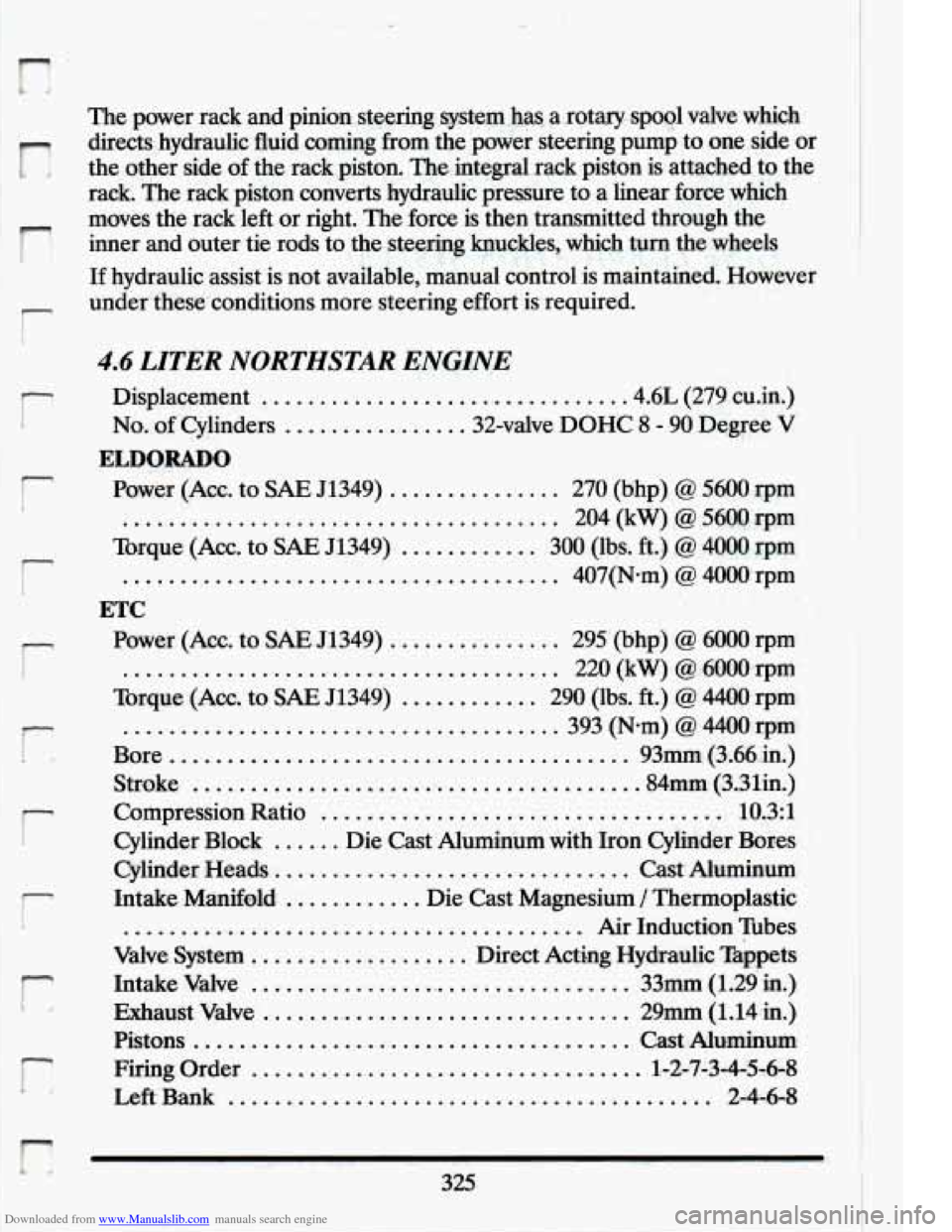
4.6 LITER NORTHSTAR ENGINE
Displacement ............................... .4.6L (279 cu.in.)
No. of Cylinders
................ 32-valve DOHC 8 - 90 Degree V
Power (ACC. to
SAE 51349) ................ 270 (b,hp) @ 5600 rpm
Torque (ACC. to
SAE 51349) ............ 300 (lbs. ft.) @? 4000 rpm
ELDORADO
...................................... 204 (kW) @ 5600 rprn
...................................... 407(N*m) @ 4OOOrpm
ETC
Power (ACC. to SAE 51349) ................ 295’(bhp) @ 6000 rpm
Torque (ACC. to
SAE 51349) ............ 290 (lbs. ft.) @? 440.0 rpm
Bore
........................................ 93mm.(3.66.in.)
Stroke
...................................... .84mm (331in.)
Compression Ratio
.................................... 10.3: 1
Cylinder Block ...... Die Cast Aluminum with Iron Cylinder Bores
Cylinder Heads
................................. Cast Aluminum
Intake Manifold-
............ Die Cast Magnesium / Thermoplastic
.......................................... Air Induction Tubes
........................................ 220 (kW) @ 6000 rpm
...................................... 393 (Nom) @ 4400 rpm
Valve. System ................... Direct Acting Hydraulic Tappets
Intake Valve
.................................. 33mm (1.29 in.).
Fkhaust Valve,. ................................ 29mm (1.14.h.)
Pktons
...................................... Cast Aluminum
Firing Order
.................................. 1-2-7-3-4-5-6-8
Left Bank ........................................... 2-4-6-8
325
Page 340 of 398
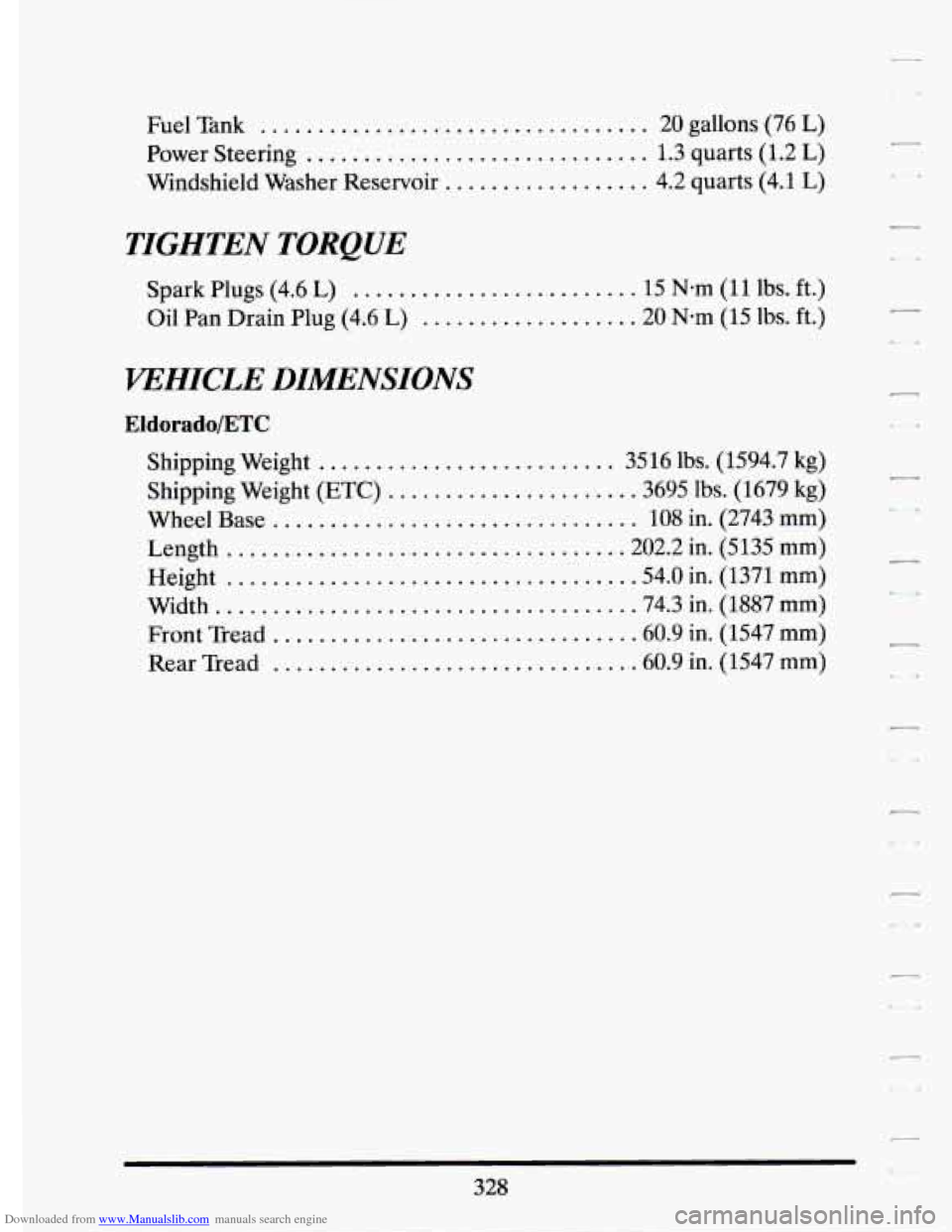
Downloaded from www.Manualslib.com manuals search engine Fuel Tank .................................. 20 gallons (76 L)
Power Steering
.............................. 1.3 quarts (1.2 L)
Windshield Washer Reservoir .................. 4.2 quarts (4.1 L)
TIGHTEN TORQUE
Spark Plugs (4.6 L) ......................... 15 N-m (11 lbs. ft.)
Oil Pan Drain Plug (4.6
L) ................... 20 N*m (15 lbs. ft.)
VEHICLE DIMENSIONS
Eldorado/ETC
Shipping Weight .......................... 3516 lbs. (1594.7 kg)
Shipping Weight
(ETC) ..................... .3695 lbs. (1679 kg)
Wheel Base
................................ 108 in. (2743 mm)
Length .................................. .202.2 in. (5135 mm)
Height ................................... .54.0 in. (1371 mm)
Width .................................... .74.3 in. (1887 mm)
Front Tread ............................... .60.9 in. (1547 mm)
Rear Tread ............................... .60.9 in. (1547 mm)
328