1990 VOLKSWAGEN TRANSPORTER ECU
[x] Cancel search: ECUPage 27 of 165
Downloaded from www.Manualslib.com manuals search engine
CONTROLS AND
EQUIPMENT
REAR SEAT BENCH/BED
COMBINATION*
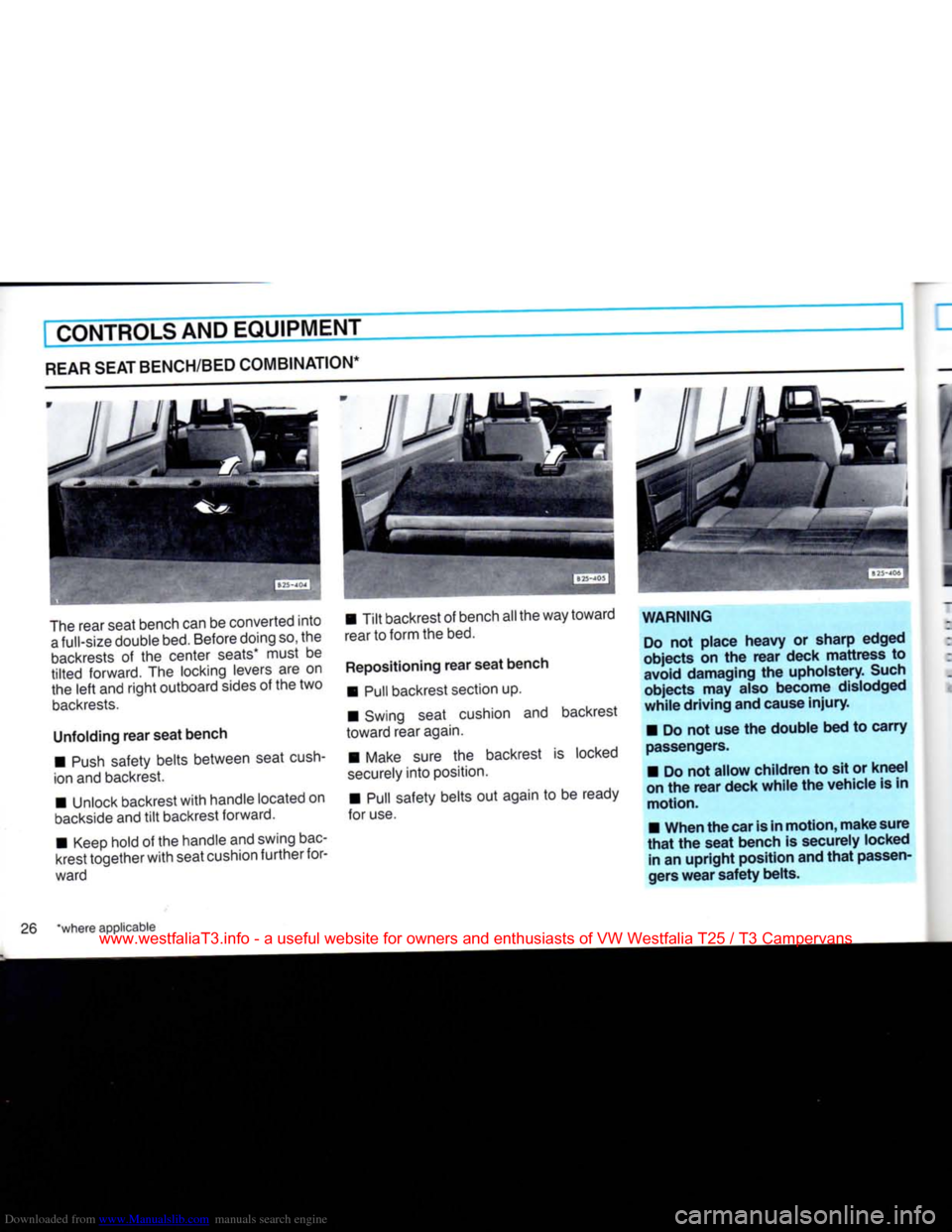
The rear seat bench can be converted
into
a
full-size double bed. Before doing so, the
backrests
of the center seats* must be
tilted
forward. The locking levers are on
the
left
and
right
outboard sides of the two
backrests.
Unfolding
rear
seat
bench •
Push
safety belts between seat
cush
ion and backrest.
• Unlock backrest
with
handle located on
backside
and
tilt
backrest forward.
• Keep hold of the handle and swing bac
krest together
with
seat cushion
further
for
ward •
Tilt
backrest of bench all the way toward
rear to form the bed.
Repositioning
rear
seat
bench • Pull backrest section up.
• Swing seat cushion and backrest
toward rear again.
• Make sure the backrest is locked
securely
into
position.
• Pull safety belts out again to be ready
for use.
WARNING
Do not
place
heavy
or
sharp
edged
objects
on the
rear
deck
mattress
to
avoid
damaging
the
upholstery.
Such
objects
may also
become
dislodged
while
driving
and cause
injury.
• Do not use the
double
bed to
carry
passengers.
• Do not
allow
children
to sit or
kneel
on the
rear
deck
while
the
vehicle
is in
motion.
•
When
the car is in
motion,
make
sure
that
the
seat
bench is securely locked in an
upright
position
and
that
passen
gers
wear
safety
belts.
26 *where applicable
www.westfaliaT3.info - a useful website for owners and enthusiasts of VW Westfalia T25 / T3 Campervans
Page 29 of 165
Downloaded from www.Manualslib.com manuals search engine
CONTROLS
AND
EQUIPMENT
^EAR SEAT/LUGGAGE COMPARTMENT
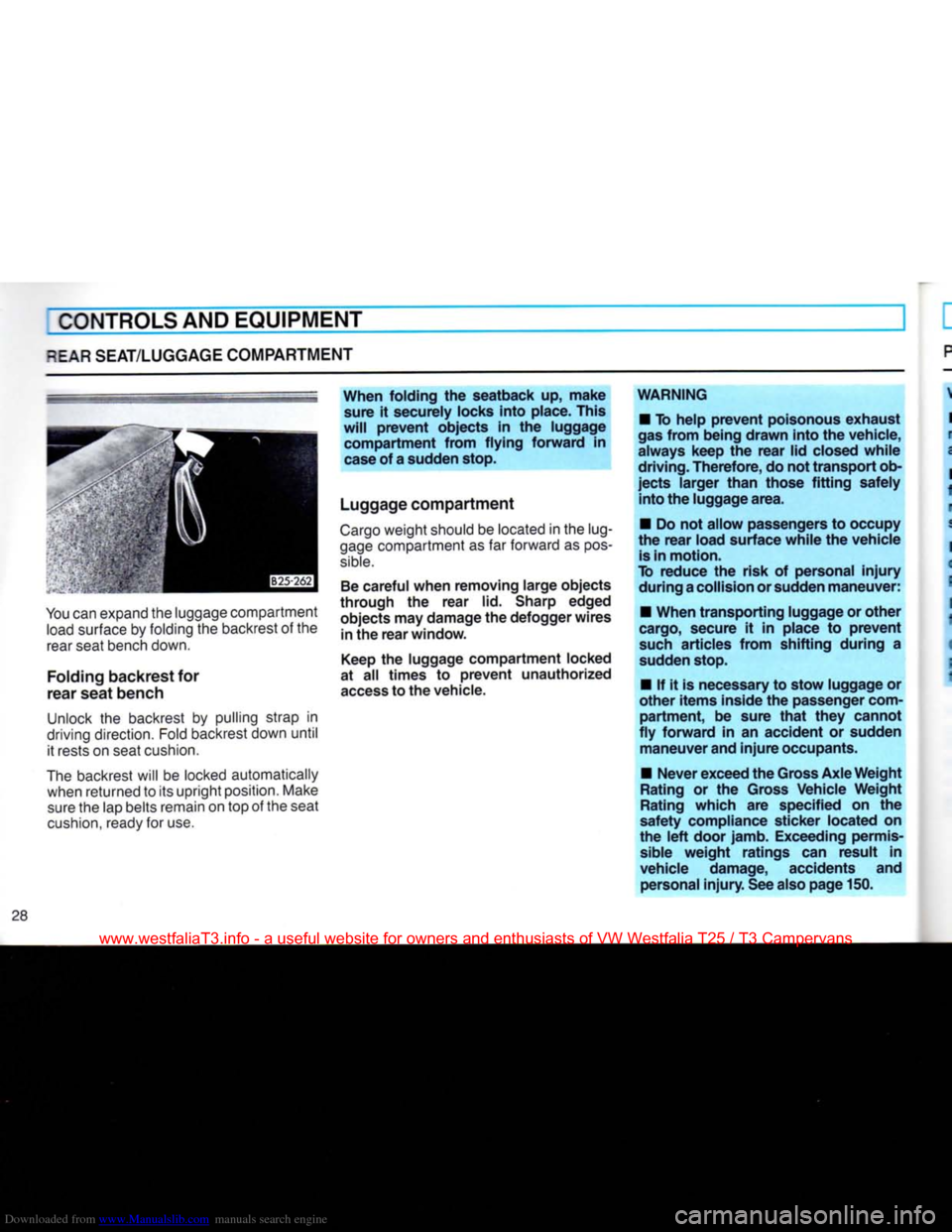
You can expand the luggage compartment
load
surface
by
folding
the
backrest
of the
rear seat bench down.
Folding
backrest for
rear seat bench
Unlock
the
backrest
by
pulling strap
in
driving direction. Fold backrest down until it rests
on
seat cushion.
The backrest will
be
locked automatically when returned
to
its upright position. Make sure the lap belts remain
on
top
of
the seat
cushion,
ready
for
use. When folding
the
seatback
up,
make
sure
it
securely locks into place.
This
will
prevent
objects
in the
luggage compartment from flying forward
in
case
of
a
sudden stop.
Luggage compartment
Cargo weight should
be
located
in the
lug
gage compartment
as far
forward
as
pos
sible.
Be
careful when removing large objects
through
the
rear
lid.
Sharp edged objects may damage the defogger wires in the rear window.
Keep
the
luggage compartment locked
at
all
times
to
prevent
unauthorized
access
to the vehicle. WARNING
•
To
help
prevent
poisonous exhaust
gas from being drawn into the vehicle,
always keep
the
rear lid closed while
driving. Therefore, do not transport ob
jects larger than those fitting safely into the luggage
area.
•
Do
not allow passengers to occupy
the rear load surface while the vehicle
is
in motion.
To reduce
the
risk
of
personal
injury
during
a
collision
or sudden maneuver:
•
When transporting luggage or other
cargo, secure
it in
place
to
prevent
such articles from shifting during
a
sudden stop.
•
If it is
necessary to stow luggage
or
other items inside the passenger
com
partment,
be
sure that
they
cannot
fly forward
in an
accident
or
sudden maneuver
and
injure occupants.
•
Never
exceed the Gross Axle Weight
Rating
or the
Gross Vehicle Weight
Rating
which
are
specified
on the
safety compliance sticker located
on
the left door jamb. Exceeding permis
sible
weight ratings
can
result
in
vehicle damage, accidents
and
personal
injury.
See also page
150.
www.westfaliaT3.info - a useful website for owners and enthusiasts of VW Westfalia T25 / T3 Campervans
Page 30 of 165
Downloaded from www.Manualslib.com manuals search engine
^EDALS
BRAKES CONTROLS AND EQUIPMENT
WARNING • The movement of the pedals must
never be obstructed by a floor mat or
any other object.
• In case one of the two brake circuits
fails,
increased brake pedal travel is required to bring your vehicle to a full
stop.
• It should always be possible to
depress the clutch and accelerator pedals fully.
• All pedals must be able to return
freely to their normal positions.
Only use floor mats which leave the pedal area free and can be secured with
floor mat fasteners. Functioning of brake system
Your vehicle is equipped with a power assisted hydraulic dual circuit brake
system with disc brakes at the front and
self-adjusting drum brakes at the rear. Both circuits function independently.
One brake circuit operates the front
wheels and the other the rear wheels. In the unlikely event of hydraulic failure of
one circuit, push the brake pedal down
firmly and hold it in that position. A mechanical linkage activates the second
circuit, and you will be able to bring the
vehicle to a stop.
WARNING Failure of one brake circuit will impair
the braking capability resulting in an increased stopping distance. If one brake circuit fails, the other will still
operate. However, you will notice an increased pedal travel when you step on
the brake. Should you encounter such experience, bring your vehicle safely to a
full stop.
Avoid driving the vehicle and have it
towed to the nearest Volkswagen dealer or qualified workshop.
Brake operation and brake
warning light
Make it a habit to check the operation of
your brakes before driving. The brake
warning light will light up while the engine is cranking and the parking brake is pulled
and/or the brake fluid level is too low. For more details see "Brake warning light" on
page 43.
Keep in mind that the braking distance
increases very rapidly as the speed increa
ses.
At 60 mph or at 100 km/h, for example, it is not twice but four times longer than at 30 mph or at 50 km/h. Tire
traction is also less effective when the roads are wet and slippery. Therefore,
always maintain a safe distance from the
vehicle in front of you.
29
www.westfaliaT3.info - a useful website for owners and enthusiasts of VW Westfalia T25 / T3 Campervans
Page 37 of 165
Downloaded from www.Manualslib.com manuals search engine
CONTROLS
AND EQUIPMENT
1 - Position for steep hills
This
position is to be
used
for mountain
driving
or
slow
driving.
It
also
provides
for
maximum
engine
braking effect. To
engage this gear depress the push but
ton in the handle of the selector lever
first. In "1" the
transmission
will
stay
in first
gear
and will not upshift.
The road speed must not exceed 33 mph
or
53 km/h. Only shift down into "1"
when the speed is below this speeds.
WARNING
Do
not shift to a lower driving position
until vehicle speed has dropped below
the specified limits otherwise engine
speed
will
suddenly increase and may
cause
engine damage and
loss
of
vehicle control. Driving the automatic transmission
Starting the engine
The
selector
lever
must be in Neutral or Park. If one of the driving
positions
is
engaged
a
safety
switch will prevent the
engine
from
being
started.
Emergency
starting
Your
Volkswagen
with
Automatic
Transmis
sion
cannot
be started by
pushing
or tow
ing.
If
engine
does
not start
because
of
dis
charged
battery, the
vehicle
can be started
with jumper
cables.
Refer
to
"Emergency
starting
with jumper
cables".
Should
the
engine
fail to start
consult
your
nearest
Volkswagen
dealer.
Selecting
a driving position
WARNING
•
Apply the foot brake before select
ing a driving position when the vehicle
is
stationary.
When the selector lever is in a driving
position,
the vehicle may creep even at
idle speed. Therefore, do not release
the parking brake or foot brake until
you
are ready to move, because power
is
transmitted to the wheels as soon as
a driving position is engaged.
•
Do not accelerate
while
selecting
a driving position. At this
time
the en
gine must run at idle speed so
that
no undue stress
will
be placed on the auto
matic clutches in the transmission.
•
Never have any position engaged
when checking in the engine compart ment. Make sure the selector lever is
securely
locked into the P position
with
the parking brake firmly set. Otherwise, any increase in engine speed may set
the vehicle in motion, even
with
the parking brake applied.
www.westfaliaT3.info - a useful website for owners and enthusiasts of VW Westfalia T25 / T3 Campervans
Page 38 of 165
Downloaded from www.Manualslib.com manuals search engine
CONTROLS
AND
EQUIPMENT
•
Never shift into Reverse (R) or Park
(P) when the vehicle is in motion.
•
Do not remove the key from the ig
nition steering lock until you have
parked the vehicle, because removal
of the key
will
lock the steering wheel.
•
If the selector lever is unintention
ally moved into Neutral (N)
while
driv
ing,
take
your foot off the accelerator pedal and
wait
until the engine speed
has
dropped to idling before selecting
a driving position.
Maneuvering
•'/hen
alternating between forward and
-averse
- for
instance,
while
maneuvering
ne
vehicle
into a tight parking
space
-
:nly
shift when the
vehicle
has
come
to a
full stop and the
engine
is running at idle
soeed.
Stuck
in snow, mud or sand
When
alternating between forward and
reverse
in an effort to free the
vehicle,
depress
the
accelerator
pedal
slightly
while
the
transmission
is in
gear,
and
release
the
accelerator
pedal
while
shifting.
Do not
race
the
engine
and
avoid
spinning
the
wheels.
Do not repeat
"rocking"
back and
forth
with
wheels
spinning
at high engine speed and heavy
throttle,
as serious damage may
be caused to the automatic transmis
sion
and other critical parts.
Kickdown
device
The
kickdown
device
gives
maximum
acceleration
when the
accelerator
pedal
is
pressed
down
past
the full throttle
posi
tion.
Depending
on
road
speed
and
engine
speed,
either the upshift is
delayed
(forced
throttle) or the box
changes
down
into
the next lower
gear.
WARNING
Be
careful when using the kickdown on
slippery
roads. Rapid acceleration may
cause
skidding.
Stopping
•
When
stopping briefly, at a traffic light
for
example,
it is not
necessary
to
move
the
selector
lever
to
Neutral.
Simply
apply
the
brakes.
To start
again
release
brake
and
accelerate.
•
The driving
positions
must
never
be
used
for holding the
vehicle
at rest
uphill.
Always
use your foot
brakes
when
stopped
on
inclines.
WARNING
•
Never get out of the driver's seat
when the engine is running and the
selector
lever is not securely locked in
the P position.
•
If you must leave the vehicle move
the selector lever securely into the P
position
and apply parking brake
firmly.
Towing
To
tow the
vehicle
see instructions
"Emergency
towing" on
page
138.
www.westfaliaT3.info - a useful website for owners and enthusiasts of VW Westfalia T25 / T3 Campervans
Page 54 of 165
Downloaded from www.Manualslib.com manuals search engine
CONTROLS
AND
EQUIPMENT
mLs 3
h
;
B25-419
Secondary heat exchanger for
passenger compartment*
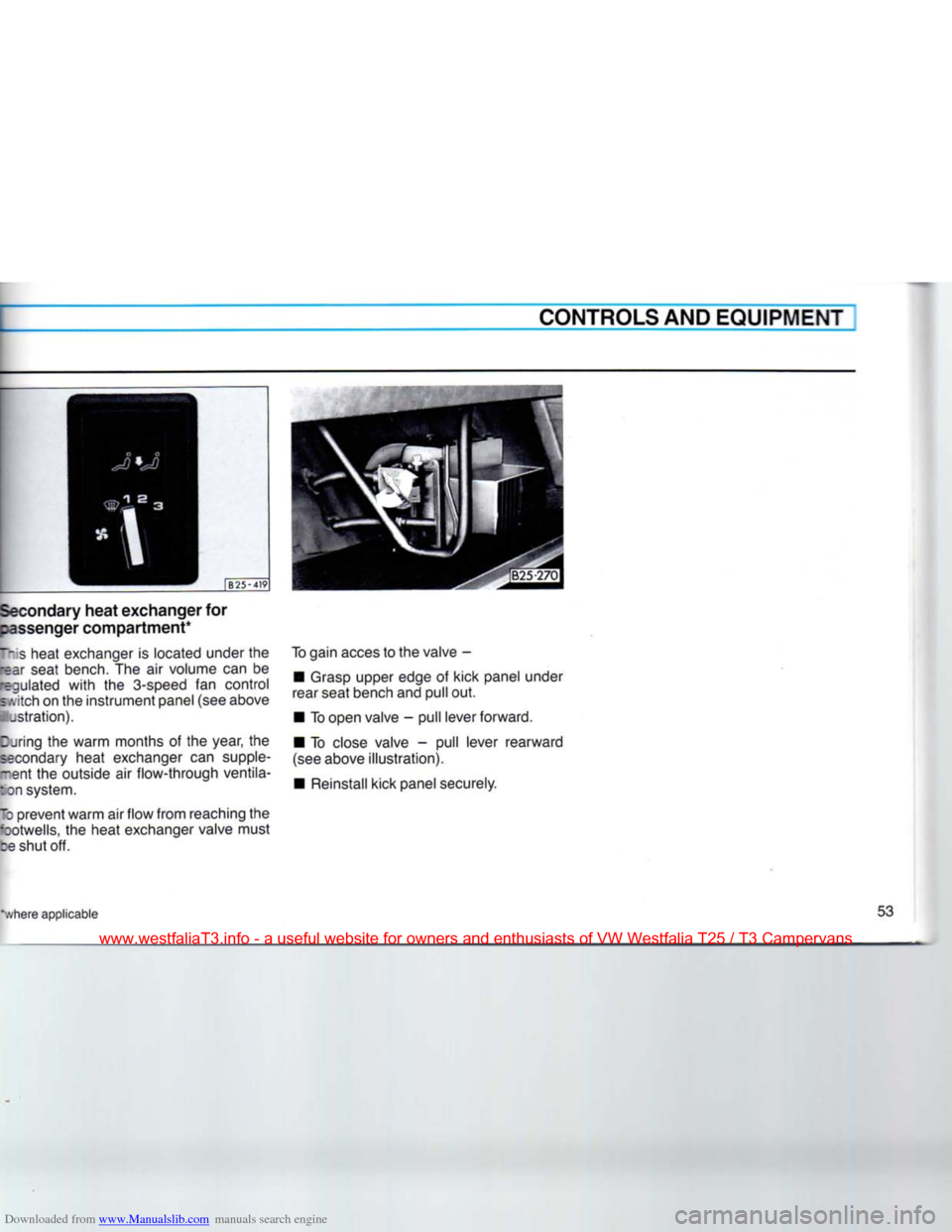
This
heat exchanger is located under the
rear seat bench. The air volume can be
regulated with the 3-speed fan control
s.vitch on the instrument panel (see above pstration).
Z jring the warm months of the year, the
secondary heat exchanger can supple
ment the outside air flow-through ventila
tion system.
•
prevent
warm air flow from reaching the
;ootwells, the heat exchanger valve must ze shut off. To gain acces to the valve -
•
Grasp upper edge of
kick
panel under
rear seat bench and pull out.
•
To open valve - pull lever forward.
•
To close valve - pull lever rearward
(see above illustration).
•
Reinstall
kick
panel securely.
"where applicable
www.westfaliaT3.info - a useful website for owners and enthusiasts of VW Westfalia T25 / T3 Campervans
Page 66 of 165
Downloaded from www.Manualslib.com manuals search engine
CONTROLS
AND EQUIPMENT
FOLDING
TABLE*
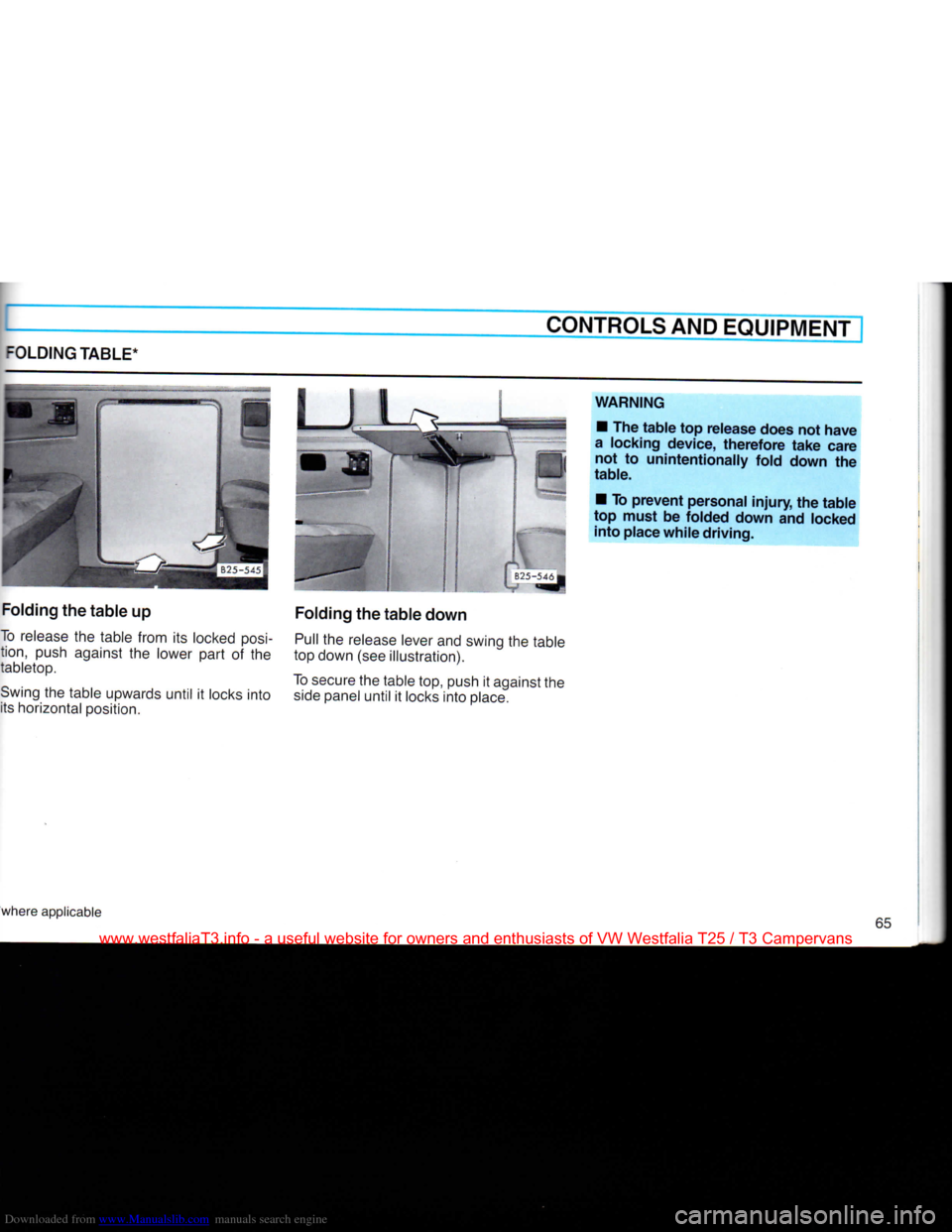
Folding
the table up
To
release
the table from its
locked
posi
tion,
push against the lower part of the
:abletop.
Swing
the table upwards until it
locks
into
its horizontal position.
Folding
the table down
Pull
the
release
lever and swing the table
top down (see illustration).
To
secure
the table top, push it against the
side
panel until it
locks
into
place.
WARNING
•
The
table
top release does not have
a locking device,
therefore
take
care not to unintentionally fold down the
table.
•
To prevent personal
injury,
the
table
top must be folded down and locked
into
place
while
driving.
where
applicable
www.westfaliaT3.info - a useful website for owners and enthusiasts of VW Westfalia T25 / T3 Campervans
Page 71 of 165
Downloaded from www.Manualslib.com manuals search engine
VEHICLE OPERATION
OPERATE
YOUR VEHICLE SAFELY
A
lot has gone
into
the manufacture of your Volkswagen, including advanced engineering techniques, rigid quality
control and demanding inspections.
These
engineering and safety features will be enhanced by you, the safe driver,
• who knows the vehicle and all controls
• who maintains the vehicle properly
• who uses driving skills wisely.
For
your own safety as well as
that
of
those around you - be a responsible
driver. If you
drink,
do not
drive.
The use
of alcohol, drugs and certain medications
will seriously impair perception, reactions and driving ability, substantially increasing
the risk of an accident and personal
injury.
Do not
drive
if you are
tired,
ill or
under
emotional
stress.
The
following
points
are also
important
for
your
safety,
please
observe
them
all.
First
things
first...
• Turn the engine off before performing
any checks or repairs on the vehicle.
• Be sure tires are inflated correctly.
Check
for damage and
tire
wear.
• See
that
wheel bolts or nuts are pro
perly tightened and not loose or missing.
• Check engine oil level, add if neces
sary.
Make it a habit to have engine oil
checked
with
every fuel filling.
• Check coolant level to assure sufficient
engine cooling.
• Be sure you have a well charged
battery.
• Check brake fluid level. If too low, have
brake system checked.
• Replenish windshield washer fluid.
• Replace worn or cracked wiper blades.
• See
that
all windows are clear and un
obstructed.
• Check whether all
light
lenses are
clean.
• Be sure all lights are working and head
lights are aimed correctly.
• Check under vehicle for leaks.
• Make sure the movement of either
brake,
clutch or accelerator pedal is not hampered in any way.
• Be sure all luggage is stored securely.
You'll
find helpful hints on how to perform most of these checks in this manual. If in
doubt, have these checks performed by
your dealer or any other qualified
mechanic.
Emergency
equipment
It is good practice to carry emergency
equipment in your vehicle. Some of the
things you should have are: emergency
light,
first-aid kit, small shovel, and for the
winter
season,
an ice scraper, snow brush,
a
container or bag of sand or salt, etc.
70
www.westfaliaT3.info - a useful website for owners and enthusiasts of VW Westfalia T25 / T3 Campervans