1990 VOLKSWAGEN TRANSPORTER oil type
[x] Cancel search: oil typePage 98 of 165
Downloaded from www.Manualslib.com manuals search engine
VEHICLE
CARE
MERIOR
3 ass
.5=
the
same cleaning agents
as for ex-
f
-
or
and polish
dry.
:abric
Lse
a
vacuum cleaner
or a
soft bristle
brjsh
to
remove dust
and
loose dirt from
ri'peting,
upholstery, headliner
and
other r
Ti.
Dirt stains
can
usually
be
removed :h
a
lukewarm soap water
or all
purpose
: eaner solution,
or a
dry foam cleaner.
For
reasy, oily and other stubborn stains,
use
= spot remover.
Do not
pour
the
liquid
on
~e fabric. Dampen
a
clean cloth
and rub
rarefully, starting
at the
edge
and
working
ward.
Plastic, vinyl and leather/leatherette
Use
a
clean, damp cloth
or
sponge
to
keep
this trim free from dust.
For
other soilage, use
a
lukewarm solvent free
all
purpose
cleaning solution
or a
mild saddle soap
for
vinyl and leather
trim.
Remove water spots and soap traces with
a
clean, damp cloth
or sponge.
Use a
clean, soft cloth
to rub
dry.
Grease,
tar or oil
stains
can be
removed
with
a
clean cloth
or
sponge soaked with all purpose cleaner
or
with
a
solvent type
vinyl
or
leather cleaning agent.
Occasionally apply
a
colorless vinyl
or
leather preservative
to
retain
the
material's
luster
and
pliability. Safety belts
Keep belts clean. Dirty belts may not re
tract properly. Do not remove belts from
the vehicle. Do not use chemical clean ing agents, bleach or dyes. They contain
corrosive properties which will weaken
the webbing. Do not allow inertia reel safety belts to retract before they are
completely dry.
For cleaning,
use a
mild soap water
solu
tion.
Let
belts
dry out
thoroughly and away
from direct
sun
light.
Use the opportunity to inspect the belts
for damage. If you discover damage, see your dealer.
www.westfaliaT3.info - a useful website for owners and enthusiasts of VW Westfalia T25 / T3 Campervans
Page 113 of 165
Downloaded from www.Manualslib.com manuals search engine
VEHICLE CARE
BRAKE FLUID 3 ATT
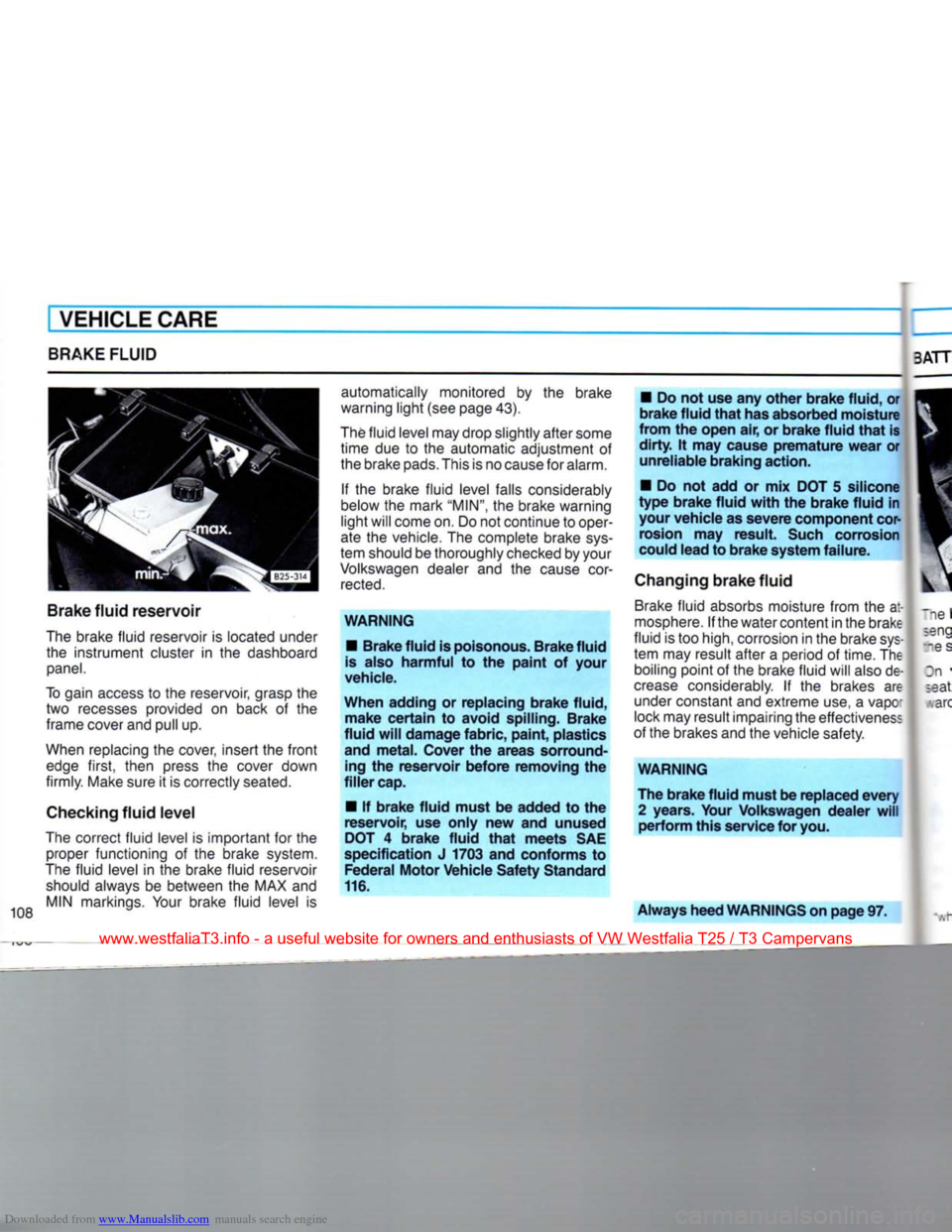
108 Brake fluid reservoir
The brake fluid reservoir is located under the instrument cluster in the dashboard
panel.
To gain access to the reservoir, grasp the two recesses provided on back of the frame cover and pull up.
When replacing the cover, insert the front edge first, then press the cover down
firmly. Make sure it is correctly seated.
Checking fluid level
The correct fluid level is important for the proper functioning of the brake system.
The fluid level in the brake fluid reservoir should always be between the MAX and MIN markings. Your brake fluid level is automatically monitored by the brake
warning light (see page 43).
The fluid level may drop slightly after some time due to the automatic adjustment of
the brake pads. This is no cause for alarm.
If the brake fluid level falls considerably
below the mark
"MIN",
the brake warning
light will come on. Do not continue to oper
ate the vehicle. The complete brake sys
tem should be thoroughly checked by your
Volkswagen dealer and the cause cor
rected.
WARNING • Brake fluid is poisonous. Brake fluid
is also harmful to the paint of your
vehicle.
When adding or replacing brake fluid, make certain to avoid spilling. Brake
fluid will damage fabric, paint, plastics and metal. Cover the areas sorround-ing the reservoir before removing the
filler cap.
• If brake fluid must be added to the
reservoir, use only new and unused
DOT 4 brake fluid that meets SAE
specification J 1703 and conforms to Federal Motor Vehicle Safety Standard
116.
• Do not use any other brake fluid, or
brake fluid that has absorbed moisture
from the open air, or brake fluid that is
dirty. It may cause premature wear or unreliable braking action.
• Do not add or mix DOT 5 silicone
type brake fluid with the brake fluid in your vehicle as severe component corrosion may result. Such corrosion
could lead to brake system failure.
Changing brake fluid Brake fluid absorbs moisture from the at
mosphere. If the watercontent in the brake
fluid is too high, corrosion in the brake sys
tem may result after a period of time. The boiling point of the brake fluid will also de
crease considerably. If the brakes are under constant and extreme use, a vapc
lock may result impairing the effectiveness
of the brakes and the vehicle safety. -e s
Dn seat arc
WARNING
The brake fluid must be replaced every 2 years. Your Volkswagen dealer will perform this service for you.
Always heed WARNINGS on page 97.
www.westfaliaT3.info - a useful website for owners and enthusiasts of VW Westfalia T25 / T3 Campervans
Page 121 of 165
Downloaded from www.Manualslib.com manuals search engine
VEHICLE CARE
Tire
care
Inspect your tires at least every 2,000
miles (3,000 km) for wear and damage.
WARNING
• Avoid
damaging
tires
and
wheel
rims.
If you
must
drive
over
a
curb
or
other
obstacle,
drive
slowly
and at an
angle.
Frequently
check
tires
for un
even
wear
and
damage.
•
Remove
imbedded
material.
•
Replace
worn
or
damaged
tires
immediately.
•
Replace
missing
valve
dust
caps.
• Keep oil,
fuel,
brake
fluid,
etc.
away
from
tires.
• Keep
tires
inflated
correctly.
• Mark tires before removing them.
Remount tires on the same vehicle side
because
the rotation direction should stay
the same.
• Store removed tires in a
cool,
dry and
preferably dark place. Tires which are not
on wheels should be stored standing up.
Tires
age even if they are not being
used.
Tires
which are older than 6 years should only be used cautiously in an emergency.
Wheels
and
tire
replacement
Wheels
and tires approved by the manu
facturer have been specially matched to
your vehicle and contribute largely to the road-holding and driving characteristics of
the vehicle.
• Fitting and repairing tires requires
expert knowledge and special tools. This
work should only be performed by a
spe
cialist.
• For safety reasons, tires should be
replaced
in pairs and not individually. The
tires
with
the deepest tread should always be mounted on the
front
wheels.
• In the interest of maximum safety and
best all-around vehicle handling, always
buy replacement radial tires
that
have the
same
specifications
with
regard to
tire
size,
design, load carrying capacity, tread pattern, tread depth etc. This also applies
to Volkswagen recommended alternate replacement tires.
• Never mount used tires if you are not
sure of their previous history.
• Whenever replacing a tubeless tire,
always install a new valve stem. Tire repair
should only be performed by a specialist.
WARNING
•
Never
mix
tires
of
different
design
such as
steel
belted
radials
with
radial
bias
belted
or
bias
ply
tires
etc.
Mixing
tire
types
will
adversely
affect
road
holding
and can
lead
to loss of
vehicle
control
and
personal
injury.
• New
tires
do not possess
maximum
traction.
They
tend
to be
slippery.
Break
new
tires
in by
driving
cautiously
at
moderate
speed for the
first
100
miles
(160
kilometers).
Applies
additionally
to the Syncro:
All
four wheels on the vehicle must always have tires of the same
size,
construction
and tread type so
that
the viscous coupling
does
not abnormally activate the
front
wheel drive. Different tires on the
front
or rear wheels exert additional stress on the
drive
train
components, causing increa
sed
tire
wear and impair vehicle control.
www.westfaliaT3.info - a useful website for owners and enthusiasts of VW Westfalia T25 / T3 Campervans
Page 122 of 165
Downloaded from www.Manualslib.com manuals search engine
VEHICLE
CARE
General notes
The original equipment tires
and
wheel
rims
on
your
vehicle comply with
all
applicable
Federal Motor Vehicle Safety
Standards.
If you
wish
to
equip
your
vehicle with tires
or wheels other than those installed
at the
factory, please note
the
following:
•
If
you plan
to
install other than the
ori
ginal
equipment tires
and
wheel rims,
ask
your
Volkswagen dealer.
•
For
technical reasons
it is not
possi
ble
in
every
case
to use
wheels from
other vehicles
-
under certain condi
tions
not
even wheels from
the
same
vehicle
model.
•
Wheel rims
and
wheel bolts
or lug
nuts are matched to fit
your
Volkswagen.
•
When installing different wheels
(for
example,
wheels with winter tires),
the
correct wheel bolts
or
lug nuts with
the
proper length
and
conical shape must
be used. The secure fit of the wheels and
the proper functioning
of the
brake system are dependent upon this.
•
Using tires and/or wheels which have
not been approved
by
the manufacturer
for
your
vehicle
type
can be detrimental
to vehicle safety.
•
If
wheel trim discs
or a
front
spoiler
are
installed,
make
sure the airflow for cooling
the brakes
is not
obstructed.
•
Before
you
plan
on
exchanging steel
wheels, light alloy wheels,
or
snow tires
already mounted on wheel rims, consult
your
Volkswagen dealer. He has the tech
nical
information necessary
to
advise
you which wheel rims and wheel bolts
or
lug
nuts are compatible with the original
factory installations.
WARNING
•
The
use of the wheel rims and wheel
bolts
or
lug nuts that do not meet
speci
fications
of the
original factory
install
ed equipment will affect the safe oper
ation
of
your
vehicle and may cause an
accident and personal
injury.
Tire specifications
Tire
specifications
are
imprinted
on the
sidewall
of
the tires.
If in
doubt, check with
your
Volkswagen dealer.
All
passenger car and some light trucks tires must conform
to
Federal Safety
Requirements
in
addition
to
these
grades.
Treadwear
The treadwear grade
is a
comparative
rating
based
on the
wear rate
of the
tire
when tested
on a
government test course. For example,
a
tire graded
150
would wear
one
and a
half
(IV2)
times
as
well
as a
tire
graded 100.
The
relative performance
of
tires depends
on
actual conditions
of use,
however,
and may
depart significantly
from
the
norm
due to
variations
in
driving
habits,
service practices
and
differences
in road characteristics and
climate.
Traction A, B, C
The traction grades, from highest
to
lowest,
are A, B and C and
represent
the
tire's ability
to
stop
on wet
pavement
as
measured
on
government test surfaces
of
asphalt
and concrete. Atire marked
C
may
have poor traction performance.
www.westfaliaT3.info - a useful website for owners and enthusiasts of VW Westfalia T25 / T3 Campervans
Page 147 of 165
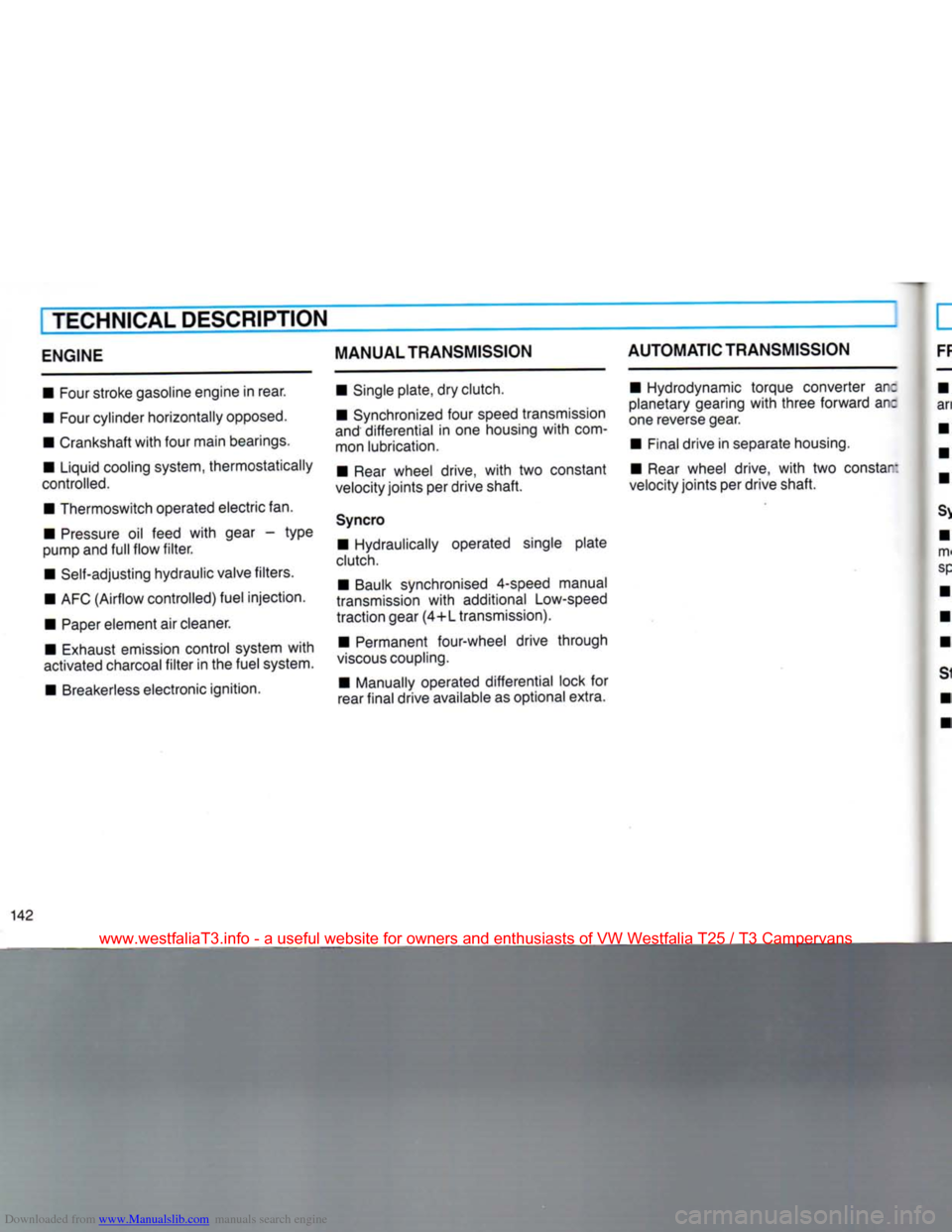
Downloaded from www.Manualslib.com manuals search engine
I TECHNICAL
DESCRIPTION
ENGINE
MANUAL
TRANSMISSION
AUTOMATIC
TRANSMISSION
• Four stroke gasoline engine in rear.
• Four cylinder horizontally opposed.
• Crankshaft
with
four main bearings.
• Liquid cooling system, thermostatically
controlled.
• Thermoswitch operated electric fan. • Pressure oil feed
with
gear - type
pump and
full
flow
filter.
• Self-adjusting hydraulic valve filters.
• AFC (Airflow controlled) fuel injection.
•
Paper
element air cleaner.
• Exhaust emission control system
with
activated charcoal
filter
in the fuel system.
• Breakerless electronic ignition. • Single plate, dry clutch.
• Synchronized four speed transmission
and'
differential in one housing
with
com
mon lubrication.
•
Rear
wheel drive,
with
two constant
velocity joints per drive shaft.
Syncro • Hydraulically operated single plate
clutch.
• Baulk synchronised 4-speed manual
transmission
with
additional Low-speed
traction gear (4+L transmission).
• Permanent four-wheel drive through
viscous
coupling.
• Manually operated differential lock for
rear final drive available as optional extra. • Hydrodynamic torque converter an:
planetary gearing
with
three forward an:
one reverse gear.
• Final drive in separate housing.
•
Rear
wheel drive,
with
two constar:
velocity joints per drive shaft.
www.westfaliaT3.info - a useful website for owners and enthusiasts of VW Westfalia T25 / T3 Campervans