1990 VOLKSWAGEN TRANSPORTER ECU
[x] Cancel search: ECUPage 74 of 165
Downloaded from www.Manualslib.com manuals search engine
iLER TOWING
VEHICLE OPERATION
phLT .'jlkswagen was primarily designed
pr : assenger transportation. If you plan to
m*
B.
trailer you should be mindful that
MLT
:ar will be performing a service it was
•cr "tended for. The additional load will
Wee durability and economy of per-
m~ ance. • :. :ow a trailer, your Volkswagen may
mc. -9 more frequent maintenance due to
ft* extra
load.
Gc not tow a trailer during the break-in kriod of your vehicle.
Keep an eye on your coolant tempera-
fere gauge. If coolant temperature warn- rc light comes on pull off the road to a sa's place to allow engine to cool down.
Maximum trailer weight
A vailer for your vehicle is limited to a
typi-
ca class I trailer. The maximum gross
Bier weight and the tongue load must not
eoeed the specifications listed in the
[fechnical Information/Data section of this
ranual.
Do not exceed the gross vehicle weight
•rhich is the weight of the driver, passen ger, luggage, trailer hitch and tongue
weight of the loaded trailer. Trailer hitch
Use a weight-carrying hitch conforming to
the gross trailer weight. The hitch must be suitable for your vehicle and trailer and
securely bolted to the body. Always check
with the trailer hitch manufacturer to make
sure that you are using the correct hitch. Do not use a bumper hitch.
The hitch must be installed in a way not to interfere with the impact-absorbing
bumper system. No modifications should
be made to the vehicle exhaust and brake
systems. From time to time check that all hitch mounting bolts remain securely fas
tened.
If not towing a trailer for a long period of
time,
remove the trailer hitch. This pre
vents the hitch from causing damage should your vehicle be struck from behind.
When removing the trailer hitch, seal all bolt holes to prevent water and exhaust
fumes from entering the vehicle.
Trailer brakes If your trailer is equipped with a braking
system,
check to be sure that it conforms
to all regulations.
The trailer brake system must not be di rectly connected to the vehicle's brake sys
tem.
Tire pressure
When towing a trailer, inflate the tires of
your vehicle to the cold tire pressure listed on the label on the left front door jamb. In
flate trailer tires to trailer and tire manufac
turer's specifications.
Safety chains
Always use safety chains between your car and trailer.
Trailer lights
Trailer lights must meet all regulations. Do not connect the trailer light system directly
to the light system of your vehicle. Be sure
to check with your Volkswagen dealer for
correct wiring, switches and relays.
Before you tow a trailer
Correct and even load distribution. All ob
jects inside the trailer should be held securely in place to guard against shifting, be it forward, backward or sideways.
Never allow a passenger in a moving
trailer.
www.westfaliaT3.info - a useful website for owners and enthusiasts of VW Westfalia T25 / T3 Campervans
Page 101 of 165
Downloaded from www.Manualslib.com manuals search engine
VEHICLE CARE
Important
Consideration
for you and your car:
A
thorough and detailed preventive maintenance schedule has been de
veloped
for your vehicle, which if followed
should
help assure you of years of reliable
and
dependable use. We strongly urge
you to give your dealer the opportunity to perform all scheduled maintenance and
necessary
repairs. He has the facilities,
original parts and trained specialists to
keep
your car running properly.
The
increasing use of electronics, sophisti
cated
fuel injection and emission control
systems
together
with
the generally in
creasing
technical complexity of today's automobiles has steadily reduced the
scope
of maintenance and repairs which
can
be carried out by vehicle owners.
Maintenance,
adjustments and repairs
usually
require special tools, testing de
vices
and other equipment by specially
trained workshop personnel in order to as
sure
proper performance, reliability and
safety of the vehicle and its many
sys
tems.
Improper maintenance, adjust ments and repairs can impair the opera
tion and reliability of your car and even
void your vehicle warranty. Above all oper ational safety can be adversely affected
creating unnecessary risks for vehicle oc
cupants and others.
This
section describes a limited number of
procedures
which can be performed upon
your vehicle
with
ordinary tools, should the
need
arise and trained personnel be un
available.
Before performing any of these
procedures,
always thoroughly read all of
the applicable
text
and carefully follow the instructions given. Always rigorously ob
serve
the
WARNINGS
provided.
WARNING
Serious personal
injury
may occur as a
result
of
improperly
performed
main
tenance,
adjustments
or
repairs.
• The
engine
compartment
of any
motor
vehicle
is a
potentially
hazard
ous
area.
• Do not
attempt
any of the
mainten
ance, checks or
repairs
described on
the
following
pages if you are not
fully
familiar
with
these
or
other
procedures
with
respect
to the vehicle, or are un
certain
as to how to proceed.
Have
the necessary
work
done
by your Volks
wagen
dealer
or any
other
properly
equipped
and
qualified
workshop.
•
Always support
your
vehicle
with
safety
stands if it is necessary to
work
underneath
the vehicle. The
jack
supplied
with
the
vehicle
is not
adequate
for
this
purpose. • If you
must
work
underneath
the . =-
hide
without
safety
stands but
with
t--t
wheels
on the ground,
always
ma-: sure the
vehicle
is on
level
ground, tr:
the
wheels
are
always
securely bloc ed and
that
the
engine
cannot
•
started.
Always
remove
the
ignitio-
key.
•
Always
be
extremely
careful
whe-
working
on the vehicle.
Always
folic commonly accepted
safety
practice*
and
general
common sense.
Never
ris• personal
injury.
Note
Incomplete or improper servicing ri
cause
problems in the operation of the r-
hicle
and may reduce or eliminate y;.
warranty coverage. If in doubt about a-
servicing,
have it done by your
Volks/
E-
gen
dealer or any other properly equips
and
qualified workshop.
www.westfaliaT3.info - a useful website for owners and enthusiasts of VW Westfalia T25 / T3 Campervans
Page 104 of 165
Downloaded from www.Manualslib.com manuals search engine
VEHICLE CARE
ENGINE OIL
Engine oil consumption t 3 normal for your engine to consume oil.
T-Q
rate of oil consumption depends on
re quality and viscosity of
oil,
the speed at
Mich
the engine is operated, the climate,
read
conditions as well as the amount of : ution and oxidation of the lubricant.
Because
of these variables, no standard
•e:e
of oil consumption can be esta-
:
shed,
but drivers should expect an in
creased
oil consumption at high speeds
s.nd when the engine is new.
• The
engine
in your
vehicle
depends
on oil to
lubricate
and cool all of its
mov
ing
parts.
Therefore
the
engine
oil
should be checked
regularly
and
kept
at
the
required
level.
•
Make
it a
habit
to
have
the
engine
oil
level
checked
with
every
fuel
filling.
• Lack of
sufficient
engine
oil may
lead
to
severe
engine
damage.
• The oil pressure
warning
light
is not
an oil
level
indicator.
Always
heed
WARNINGS
on
page
97.
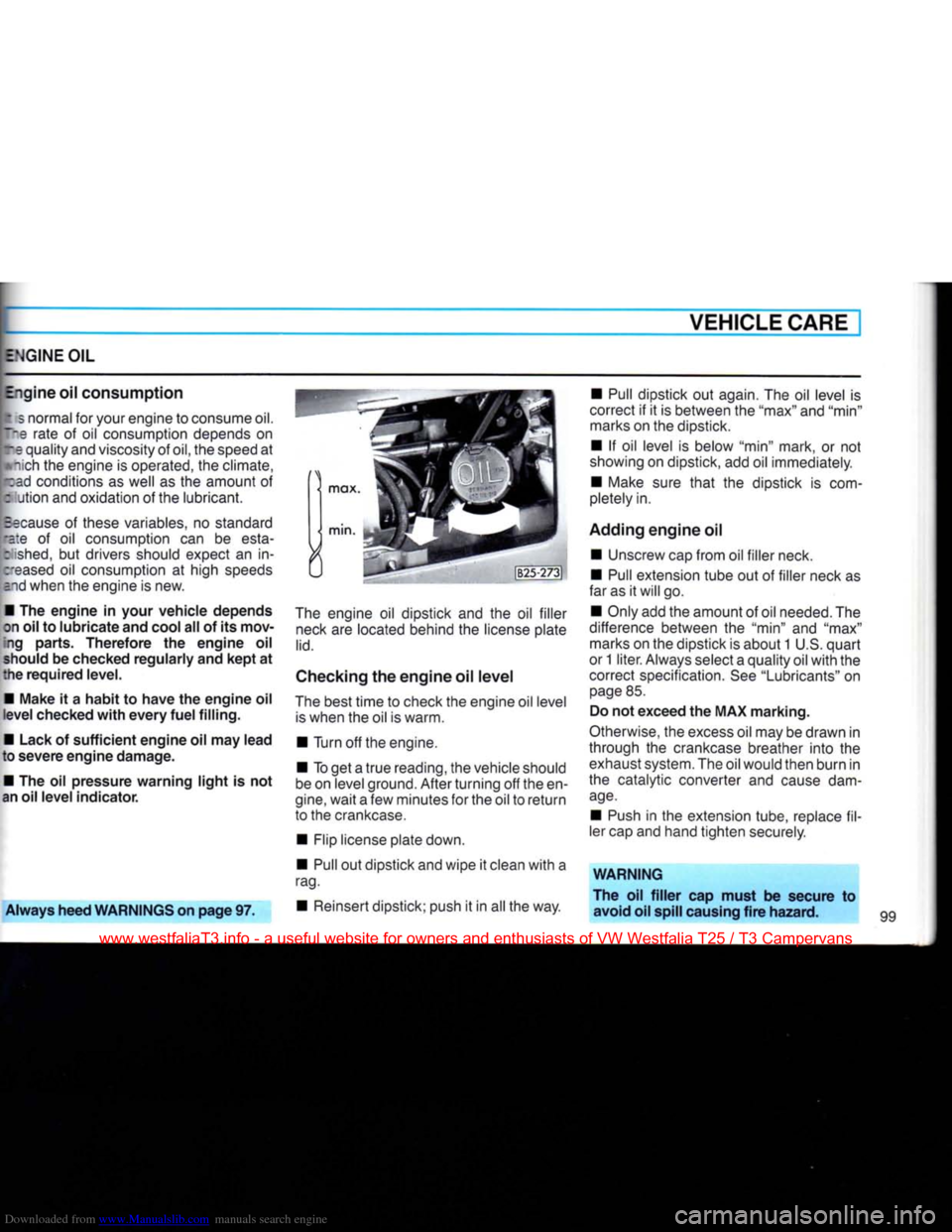
The
engine oil dipstick and the oil filler
neck
are located behind the license plate
lid.
Checking the
engine
oil
level
The
best time to check the engine oil level
is
when the oil is warm.
• Turn off the engine.
• To get a true reading, the vehicle should
be
on level ground. After turning off the en
gine,
wait a few minutes for the oil to return
to the crankcase.
• Flip license plate down.
• Pull out dipstick and wipe it clean
with
a
rag.
• Reinsert dipstick; push it in all the way. • Pull dipstick out again. The oil level is
correct if it is between the "max" and "min" marks on the dipstick.
• If oil level is below "min" mark, or not
showing on dipstick, add oil immediately.
• Make sure
that
the dipstick is com
pletely in.
Adding
engine
oil • Unscrew cap from oil filler neck.
• Pull extension tube out of filler neck as
far as it will go.
• Only add the amount of oil needed. The
difference between the "min" and "max" marks on the dipstick is about
1
U.S. quart
or
1
liter. Always select a quality oil
with
the
correct specification. See "Lubricants" on
page
85.
Do not exceed the MAX
marking.
Otherwise,
the excess oil may be drawn in
through the crankcase breather into the exhaust system. The oil would then burn in
the catalytic converter and cause dam
age.
•
Push
in the extension tube, replace fil
ler cap and hand tighten securely.
WARNING
The oil
filler
cap
must
be secure to avoid oil spill causing
fire
hazard.
www.westfaliaT3.info - a useful website for owners and enthusiasts of VW Westfalia T25 / T3 Campervans
Page 107 of 165
Downloaded from www.Manualslib.com manuals search engine
VEHICLE CARE
AUTOMATIC TRANSMISSION FLUID / MANUAL TRANSMISSION OIL
Automatic Transmission Fluid
The torque converter and the transmis
sion are lubricated with Automatic Trans mission Fluid (ATF).
The final drive requires hypoid oil SAE 90,
which does not have to be changed.
Checking the ATF level
The ATF has to be checked at frequent intervals, for instance, when the engine
oil is being checked or at least at the intervals specified in your Maintenance
booklet.
Always heed WARNINGS on page 97. A correct ATF level is very important for
transmission operation.
To obtain an accurate reading, the
vehicle must be on level ground, and the
fluid must have reached operating
tem
perature. Normally, after a cold-start the
fluid will reach operating temperature when the vehicle has been driven for ab
out 6 miles or 10 km. If the ATF is too cool
or too hot, the fluid level reading will be inaccurate.
WARNING Before checking the ATF, the selector
lever must be securely locked in the Park position and the parking brake ap
plied firmly.
Checking the ATF level is potentially hazardous because the hot engine has
to be running during the check. Do not
attempt to check the ATF before read ing all WARNINGS on page 97.
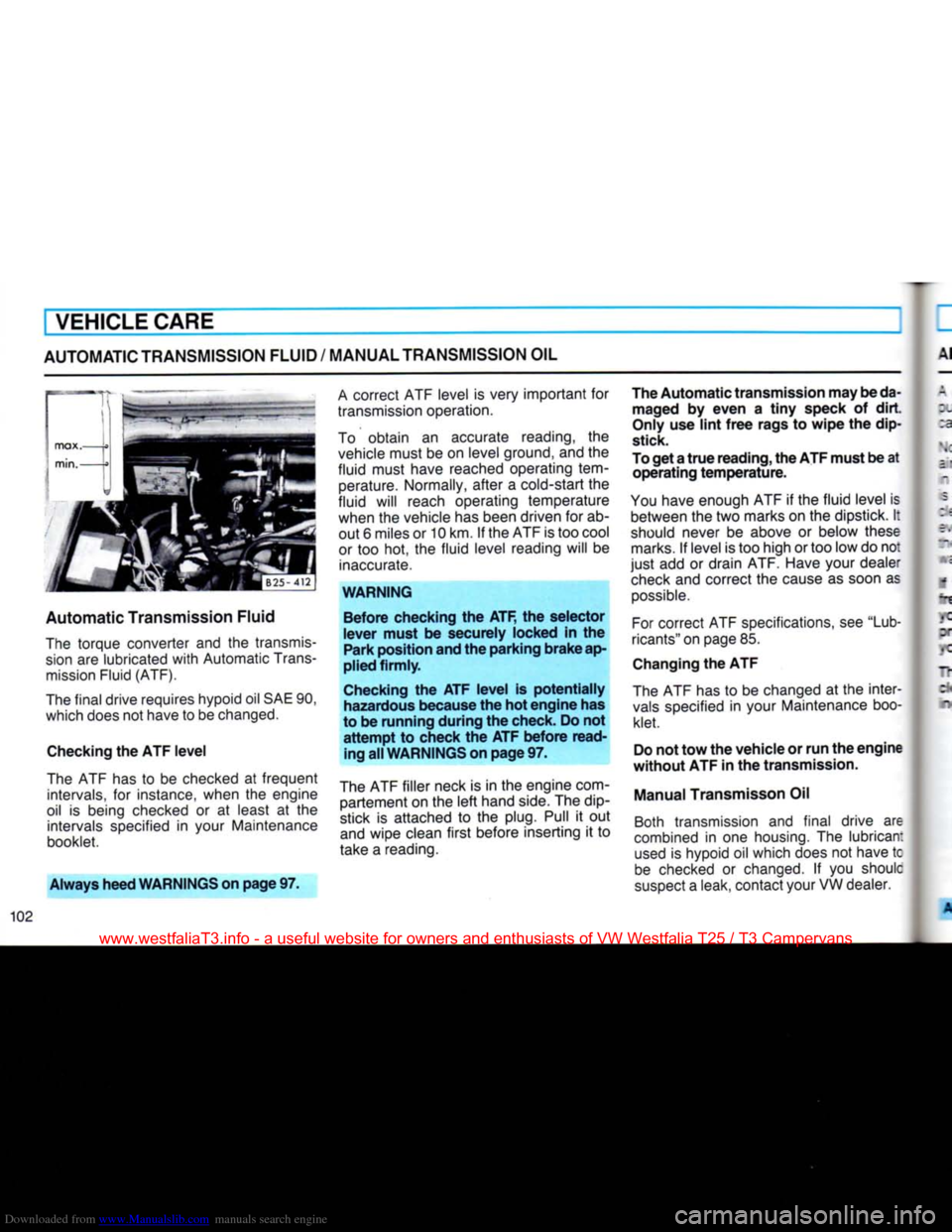
The ATF filler neck is in the engine com- partement on the left hand side. The dip
stick is attached to the
plug.
Pull it out
and wipe clean first before inserting it to
take a reading. The Automatic transmission may be da
maged by even a tiny speck of dirt.
Only use lint free rags to wipe the dip
stick.
To get a true reading, the ATF must be at operating temperature.
You have enough ATF if the fluid level is between the two marks on the dipstick. I:
should never be above or below these marks. If level is too high or too low do not
just add or drain ATF. Have your dealer check and correct the cause as soon as possible.
For correct ATF specifications, see "Lub
ricants" on page 85.
Changing the ATF
The ATF has to be changed at the inter vals specified in your Maintenance booklet.
Do not tow the vehicle or run the engine
without ATF in the transmission.
Manual Transmisson Oil Both transmission and final drive are
combined in one housing. The lubrican: used is hypoid oil which does not have tc
be checked or changed. If you shoulc
suspect a leak, contact your VW dealer.
www.westfaliaT3.info - a useful website for owners and enthusiasts of VW Westfalia T25 / T3 Campervans
Page 116 of 165
Downloaded from www.Manualslib.com manuals search engine VEHICLE CARE
• Switch on charger.
• Charging
rate
not over 6 Amp.
Vormally,
a battery should be charged at
rc more than 10 percent of its rated
capa
city.
For
example, a charging current of 4.5
Amp.
would be used on a battery having
• Ah. Rated capacity of the battery in .our vehicle is listed on the battery
"Dusing.
• After charging,
turn
off charger and dis-
ronnect charger
cables.
To
remove
battery
from
vehicle • Disconnect negative ground cable.
• Disconnect positive cable.
• Unscrew bolt of holding plate with open
end
wrench.
To
reinstall
battery
in vehicle •
Place
battery in vehicle and tighten bolt
of holding plate.
• Reconnect positive cable. • Reconnect negative ground cable.
WARNING
Do not
reverse
polarity.
Cleaning
terminals
and
connections
WARNING
• Before
work
is done on the
electrical
system, disconnect the
negative
ground cable.
•
When
working
on the
battery,
be
sure not to short circuit the
terminals
with
tools or
other
metal
objects. This
would
cause the
battery
to
heat
up
very
quickly,
which
could
lead
to
damage
or
explosion and personal
injury.
The
terminals and connections should be kept clean and greased with silicone spray
or
petroleum jelly. Make sure the ground
connection
to the body is
tight
and free of
corrosion.
With
a disconnected
battery
the
engine
must
not run because the
electrical
sys
tem
will
be damaged. Replacing
battery
A
replacement battery must have the
same
specifications and dimensions as
the original equipment battery.
Specifica
tions are listed on the battery housing.
Make
sure the replacement battery is in
stalled
correctly and securely. See "Re moving and reinstalling battery".
Always heed
WARNINGS
on
page
97.
www.westfaliaT3.info - a useful website for owners and enthusiasts of VW Westfalia T25 / T3 Campervans
Page 122 of 165
Downloaded from www.Manualslib.com manuals search engine
VEHICLE
CARE
General notes
The original equipment tires
and
wheel
rims
on
your
vehicle comply with
all
applicable
Federal Motor Vehicle Safety
Standards.
If you
wish
to
equip
your
vehicle with tires
or wheels other than those installed
at the
factory, please note
the
following:
•
If
you plan
to
install other than the
ori
ginal
equipment tires
and
wheel rims,
ask
your
Volkswagen dealer.
•
For
technical reasons
it is not
possi
ble
in
every
case
to use
wheels from
other vehicles
-
under certain condi
tions
not
even wheels from
the
same
vehicle
model.
•
Wheel rims
and
wheel bolts
or lug
nuts are matched to fit
your
Volkswagen.
•
When installing different wheels
(for
example,
wheels with winter tires),
the
correct wheel bolts
or
lug nuts with
the
proper length
and
conical shape must
be used. The secure fit of the wheels and
the proper functioning
of the
brake system are dependent upon this.
•
Using tires and/or wheels which have
not been approved
by
the manufacturer
for
your
vehicle
type
can be detrimental
to vehicle safety.
•
If
wheel trim discs
or a
front
spoiler
are
installed,
make
sure the airflow for cooling
the brakes
is not
obstructed.
•
Before
you
plan
on
exchanging steel
wheels, light alloy wheels,
or
snow tires
already mounted on wheel rims, consult
your
Volkswagen dealer. He has the tech
nical
information necessary
to
advise
you which wheel rims and wheel bolts
or
lug
nuts are compatible with the original
factory installations.
WARNING
•
The
use of the wheel rims and wheel
bolts
or
lug nuts that do not meet
speci
fications
of the
original factory
install
ed equipment will affect the safe oper
ation
of
your
vehicle and may cause an
accident and personal
injury.
Tire specifications
Tire
specifications
are
imprinted
on the
sidewall
of
the tires.
If in
doubt, check with
your
Volkswagen dealer.
All
passenger car and some light trucks tires must conform
to
Federal Safety
Requirements
in
addition
to
these
grades.
Treadwear
The treadwear grade
is a
comparative
rating
based
on the
wear rate
of the
tire
when tested
on a
government test course. For example,
a
tire graded
150
would wear
one
and a
half
(IV2)
times
as
well
as a
tire
graded 100.
The
relative performance
of
tires depends
on
actual conditions
of use,
however,
and may
depart significantly
from
the
norm
due to
variations
in
driving
habits,
service practices
and
differences
in road characteristics and
climate.
Traction A, B, C
The traction grades, from highest
to
lowest,
are A, B and C and
represent
the
tire's ability
to
stop
on wet
pavement
as
measured
on
government test surfaces
of
asphalt
and concrete. Atire marked
C
may
have poor traction performance.
www.westfaliaT3.info - a useful website for owners and enthusiasts of VW Westfalia T25 / T3 Campervans
Page 129 of 165
Downloaded from www.Manualslib.com manuals search engine
DO-IT-YOURSELF-SERVICE
SPARE
WHEEL
The
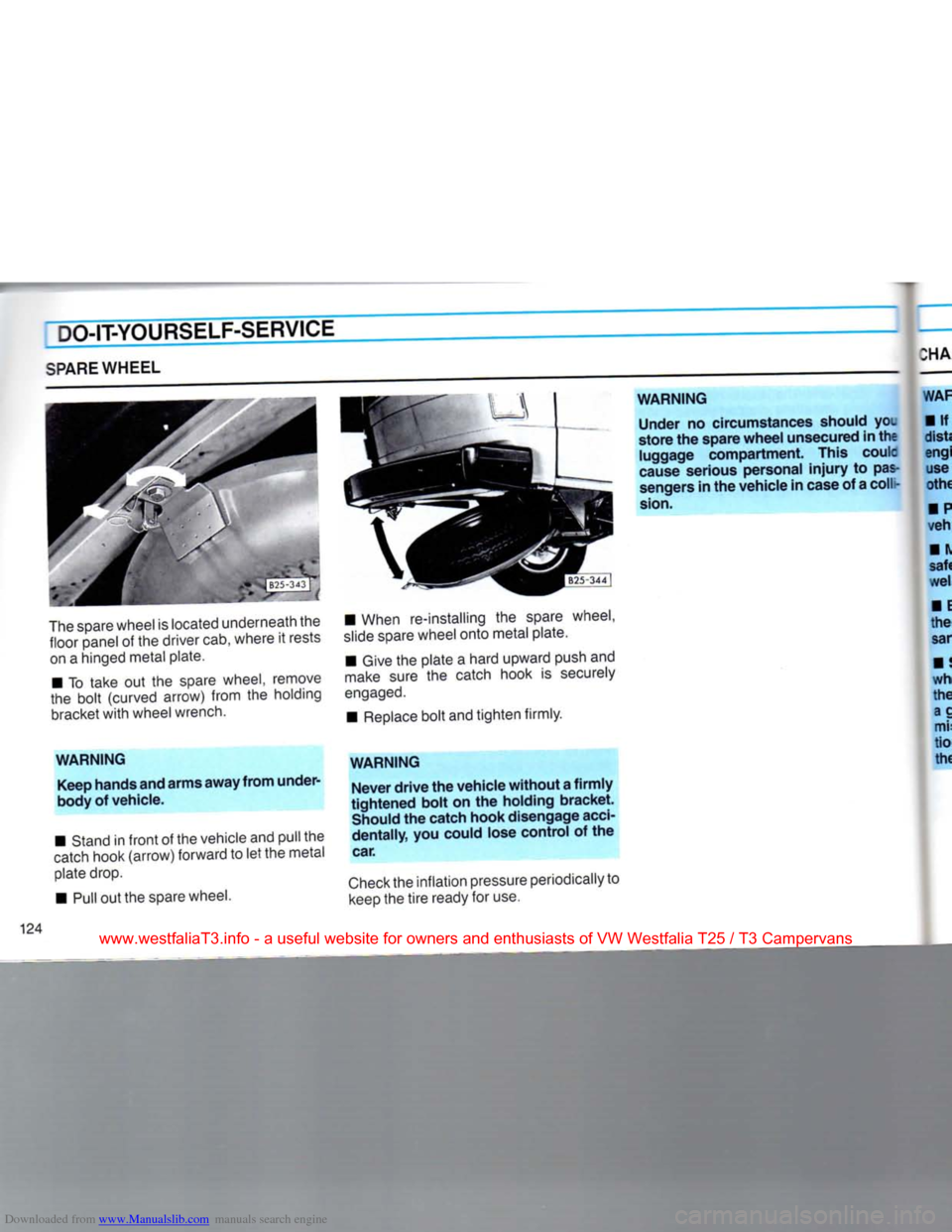
spare wheel is located underneath the floor panel of the driver cab, where it rests on a hinged metal plate.
• To take out the spare wheel, remove
the bolt (curved arrow) from the holding bracket
with
wheel wrench,
WARNING
Keep hands and
arms
away
from
under-
body of vehicle.
• Stand in
front
of the vehicle and pull the
catch
hook (arrow) forward to let the metal
plate drop.
•
Pull
out the spare wheel. • When re-installing the spare wheel,
slide
spare wheel onto metal plate.
•
Give
the plate a hard upward push and
make
sure the catch hook is securely
engaged.
•
Replace
bolt and tighten firmly.
WARNING
Never
drive
the
vehicle
without
a
firmly
tightened
bolt
on the holding
bracket.
Should the catch
hook
disengage acci
dentally,
you could lose
control
of the
car.
Check
the inflation pressure periodically to
keep
the
tire
ready for use.
WARNING
Under
no circumstances should you
store
the spare
wheel
unsecured in the
luggage
compartment.
This coulc
cause serious personal
injury
to pas
sengers in the
vehicle
in case of a coll -
sion.
www.westfaliaT3.info - a useful website for owners and enthusiasts of VW Westfalia T25 / T3 Campervans
Page 131 of 165
Downloaded from www.Manualslib.com manuals search engine
DO-IT-YOURSELF-SERVICE
Step
3
•
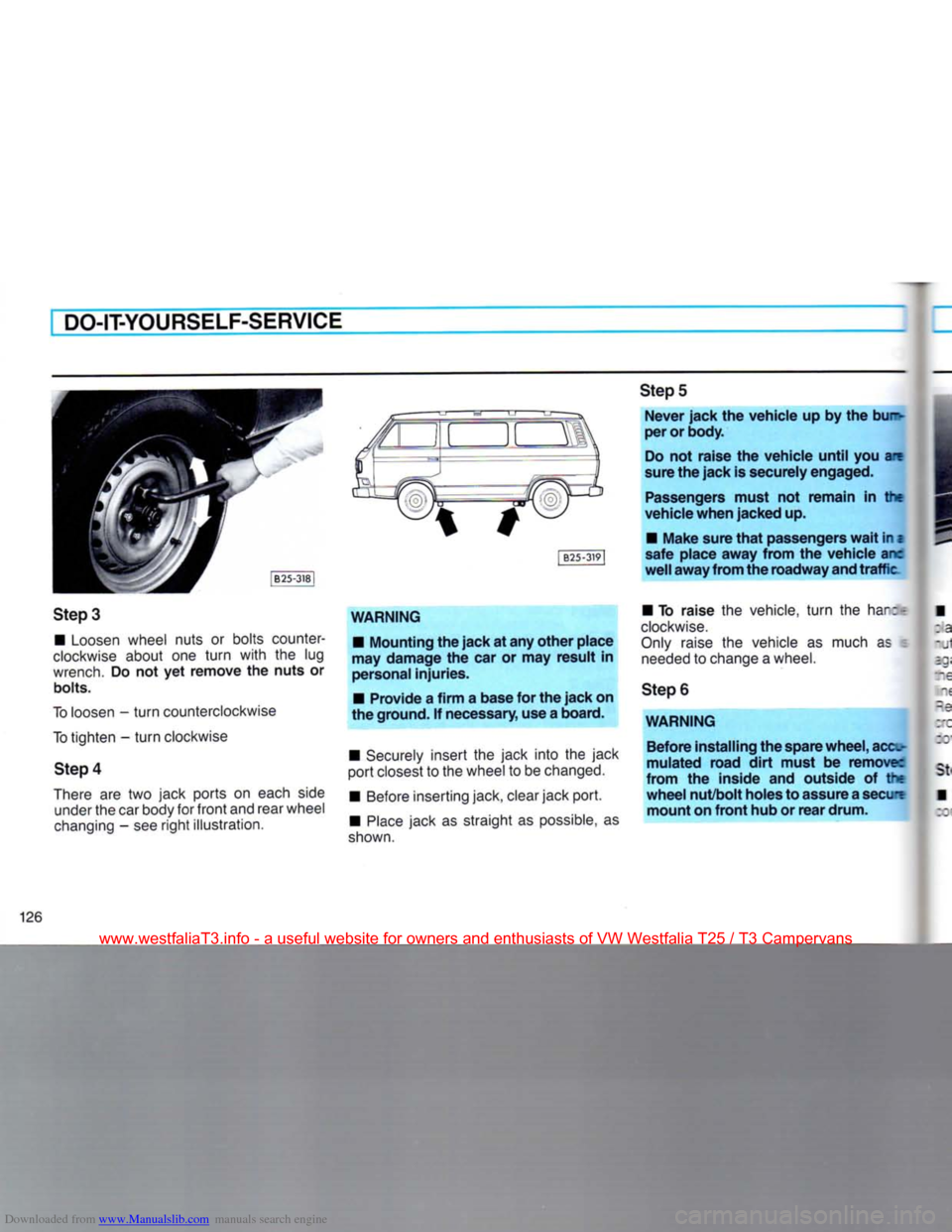
Loosen
wheel
nuts or bolts counter
clockwise
about one turn with the lug
wrench.
Do not yet remove the nuts or
bolts.
To
loosen
- turn
counterclockwise
To
tighten - turn
clockwise
Step
4
There
are two jack ports on
each
side
under
the car
body
for front and
rear
wheel
changing
- see right illustration. [
B25-3)9|
WARNING
•
Mounting the jack at any other place
may damage the car or may result in
personal
injuries.
•
Provide a firm a base for the jack on
the ground. If
necessary,
use a board.
•
Securely
insert the jack into the jack
port
closest
to the
wheel
to be
changed.
•
Before
inserting jack,
clear
jack port.
•
Place
jack as straight as
possible,
as
shown.
Step
5
Never jack the vehicle up by the bu~
per or body.
Do
not raise the vehicle until you are
sure
the jack is securely engaged.
Passengers
must not remain in the
vehicle when jacked up.
•
Make sure
that
passengers
wait
in z
safe place away from the vehicle arc
well
away from the roadway and traffic
•
To raise the
vehicle,
turn the
har:T
clockwise.
Only
raise
the
vehicle
as
much
as
needed
to
change
a
wheel.
Step
6
WARNING Before installing the spare wheel, acc-
mulated road
dirt
must be remove:
from the inside and outside of the
wheel nut/bolt holes to assure a secure mount on front hub or rear drum.
126
www.westfaliaT3.info - a useful website for owners and enthusiasts of VW Westfalia T25 / T3 Campervans