1990 VOLKSWAGEN CORRADO check engine
[x] Cancel search: check enginePage 323 of 906

A/C COMPRESSOR OIL CHECKING
Article Text (p. 5)
1990 Volkswagen Corrado
For Volkswagen Technical Site: http://vw.belcom.ru
Copyright © 1998 Mitchell Repair Information Company, LLC
Thursday, March 23, 2000 09:41PM
stabilize system before performing repairs. Turn off engine. Discharge
system and remove compressor. See SERVICING PRECAUTIONS at the
beginning of this article. Remove drain plug. Drain and measure oil.
2) If more than one ounce is drained, add same amount. If
less than one ounce is drained, add 2 ounces of new refrigerant oil to
compressor.
3) If A/C components are replaced, add refrigerant oil to
system. Add one ounce if condenser is replaced. Add 3.5 ounces if
accumulator is replaced.
4) When replacing a component which has caused a large
refrigerant leak, add 3 ounces of new oil plus the required amount for
the part being replaced. Add oil directly to part being replaced if
possible. If oil can not be easily added to part, add oil to
accumulator.
NOTE: If oil drained contains metal chips or other debris, replace
receiver-drier. Flush out system before evacuating and
recharging.
HITACHI 5-CYL DRAIN & REFILL
1) Before checking and adjusting oil level, operate
compressor at 1000-1500 engine RPM, and set controls at maximum
cooling and high blowing speed for about 10 minutes to return oil to
compressor.
2) Stop engine. Discharge refrigerant and remove compressor
from vehicle. See SERVICING PRECAUTIONS at the beginning of this
article. Drain oil from compressor through suction port. Measure
amount of oil drained.
3) If amount drained is more than 2.4 ounces, fill with same
amount using new oil. If amount drained is less than 2.4 ounces, fill
with 2.4 ounces. Install compressor and recharge.
4) If A/C components are replaced. add refrigerant oil to
system. Add 1.7 ounces if condenser is replaced. Add 2.4 ounces if
evaporator is replaced. oil does not need to be added if receiver-
drier is replaced.
HITACHI 6-CYL DRAIN & REFILL
1) Before checking and adjusting oil level, operate
compressor at engine idling speed, with controls set for maximum
cooling and high blower speed, for 10 minutes to return oil to
compressor.
2) Stop engine, discharge refrigerant and remove compressor
from vehicle. See SERVICING PRECAUTIONS at the beginning of this
article. Drain oil from compressor suction port. Measure amount of oil
drained. If amount drained was more than 2.4 ounces, refill with same
amount of new oil. If amount drained was less than 2.4 ounces, refill
with 2.4 ounces. Install compressor and recharge.
MATSUSHITA ROTARY VANE DRAIN & REFILL
Page 324 of 906

A/C COMPRESSOR OIL CHECKING
Article Text (p. 6)
1990 Volkswagen Corrado
For Volkswagen Technical Site: http://vw.belcom.ru
Copyright © 1998 Mitchell Repair Information Company, LLC
Thursday, March 23, 2000 09:41PM
Discharge system. Remove compressor from vehicle. Drain oil
from compressor through inlet and outlet holes. Refill compressor with
3.4-4.7 ounces of oil through suction port. When replacing evaporator,
add 2 ounces. When replacing other A/C components, add 1.4 ounces per
component replaced.
NIPPONDENSO ROTARY VANE DRAIN & REFILL
1) Before checking and adjusting oil level, operate
compressor at engine idle speed, and set controls at maximum cooling
and high blowing speed for 20-30 minutes to return oil to compressor.
2) Stop engine. Discharge refrigerant and remove compressor
from vehicle. See SERVICING PRECAUTIONS at the beginning of this
article. Drain compressor oil through compressor intake and discharge
ports. Measure amount drained. Oil may be hard to drain if compressor
cool. Drain compressor while compressor is warm.
3) If amount drained is less than 2.4 ounces, conduct leak
tests at system connections. If necessary, repair or replace faulty
parts. Check purity of oil level and adjust oil level as follows.
4) If amount drained is more than 2.4 ounces, oil level is
okay; fill with same amount drained using new oil. If amount drained
is less than 2.4 ounces, pour 2.4 ounces of new refrigerant oil.
5) When replacing condenser, add one ounce. when replacing
other A/C components, add .33 ounce per container replaced.
NIPPONDENSO 6 & 10-CYL DRAIN & REFILL
When inspecting system for oil loss, look for signs of
leaking (shiny, wet spots on components or underside of hood). If oil
leak is noted or component replacement is required, use the following
procedure as indicated:
NO OIL LEAK
Discharge system and change components as necessary. See
SERVICING PRECAUTIONS at the beginning of this article. Add
refrigerant oil to components as necessary.
OIL LEAK
1) Slowly discharge system. Repair or replace faulty
components. If equipped with a drain plug, remove plug, drain and
discard oil. If not equipped with a drain plug, remove compressor from
vehicle and pour oil out suction and discharge ports.
2) Replace drain plug (if equipped). Add 1.5 ounces of new
refrigerant oil through suction port. Use new gaskets or "O" rings
when replacing suction and discharge lines.
COMPRESSOR FAILURE OR SYSTEM CONTAMINATED
If either situation exists, discharge system and remove
Page 325 of 906

A/C COMPRESSOR OIL CHECKING
Article Text (p. 7)
1990 Volkswagen Corrado
For Volkswagen Technical Site: http://vw.belcom.ru
Copyright © 1998 Mitchell Repair Information Company, LLC
Thursday, March 23, 2000 09:41PM
compressor, receiver-drier and expansion valve. Clean expansion valve
screen. Flush entire system. Install new compressor and receiver-
drier. New compressors contain correct amount of oil. If installing
overhauled compressor, add 1.5 ounces of new refrigerant oil through
suction port.
PANASONIC ROTARY VANE DRAIN & REFILL
1) Before checking and adjusting oil level, operate
compressor at 1000-1500 engine RPM, and set controls at maximum
cooling and high blowing speed for about 10 minutes to return oil to
compressor.
2) Stop engine. Discharge refrigerant and remove compressor
from vehicle. See SERVICING PRECAUTIONS at the beginning of this
article. Drain oil from compressor through suction and discharge
ports. Measure amount of oil drained. If amount drained is more than
2.4 ounces, fill with same amount using new oil. If amount drained is
less than 2.4 ounces, fill with 2.4 ounces. Install compressor and
recharge.
3) If A/C components are replaced, add refrigerant oil to
system. Add 1.4 ounces if condenser is replaced. Add 2 ounces if the
evaporator is replaced. Oil does not need to be added if receiver-
drier is replaced.
SANDEN SCROLL DRAIN & REFILL
Discharge system. Remove compressor from vehicle. Drain oil
from compressor through inlet and outlet holes. Refill compressor with
2.8 ounces of oil through suction port. When replacing condenser, add
.5 ounce. When replacing evaporator, add 1.7 ounces. When replacing
other A/C components, add .5 ounce per component replaced.
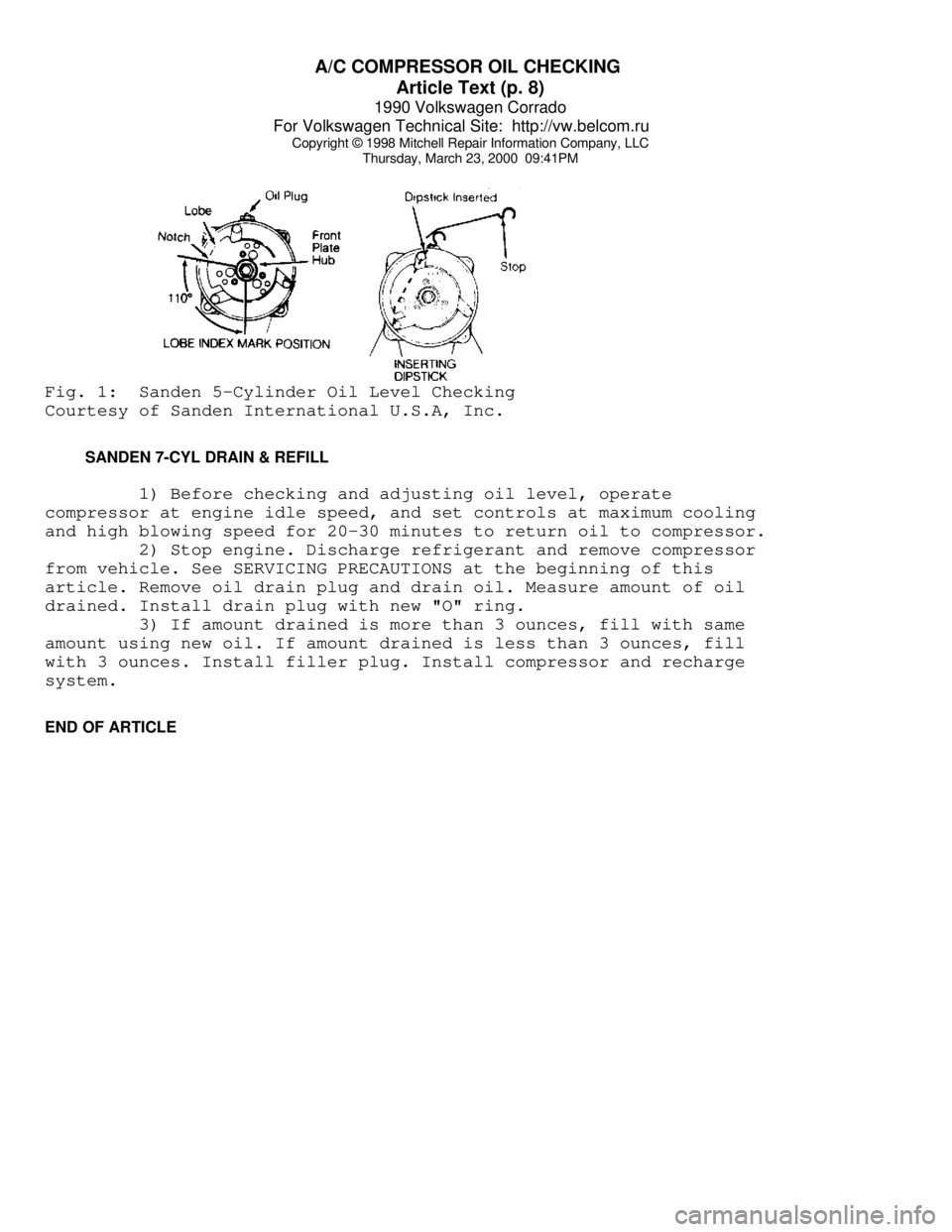
SANDEN 5-CYL DRAIN & REFILL
1) Discharge system. Remove compressor belt and loosen
mounting bolts. Rotate compressor in brackets until filler plug is at
top. Clean area around filler plug and remove plug slowly. Rotate
front hub plate so notch in lobe is 110 degrees from the bottom. This
rotates ball end of top piston to align with oil fill port and allows
clearance for dipstick. See Fig. 1.
2) Insert compressor dipstick diagonally from right to left
until stop on dipstick contacts filler plug surface. Remove dipstick
and note oil fill level. Each increment on dipstick represents one
ounce of oil. Add oil if necessary to reach 3-4 ounce level.
Page 326 of 906
A/C COMPRESSOR OIL CHECKING
Article Text (p. 8)
1990 Volkswagen Corrado
For Volkswagen Technical Site: http://vw.belcom.ru
Copyright © 1998 Mitchell Repair Information Company, LLC
Thursday, March 23, 2000 09:41PMFig. 1: Sanden 5-Cylinder Oil Level Checking
Courtesy of Sanden International U.S.A, Inc.
SANDEN 7-CYL DRAIN & REFILL
1) Before checking and adjusting oil level, operate
compressor at engine idle speed, and set controls at maximum cooling
and high blowing speed for 20-30 minutes to return oil to compressor.
2) Stop engine. Discharge refrigerant and remove compressor
from vehicle. See SERVICING PRECAUTIONS at the beginning of this
article. Remove oil drain plug and drain oil. Measure amount of oil
drained. Install drain plug with new "O" ring.
3) If amount drained is more than 3 ounces, fill with same
amount using new oil. If amount drained is less than 3 ounces, fill
with 3 ounces. Install filler plug. Install compressor and recharge
system.
END OF ARTICLE
Page 327 of 906

A/C COMPRESSOR SERVICING
Article Text
1990 Volkswagen Corrado
For Volkswagen Technical Site: http://vw.belcom.ru
Copyright © 1998 Mitchell Repair Information Company, LLC
Thursday, March 23, 2000 09:41PM
ARTICLE BEGINNING
1990 AIR CONDITIONING & HEAT
Compressor Service
* PLEASE READ THIS FIRST *
CAUTION: When discharging air conditioning system, use only approved
refrigerant recovery/recycling equipment. Make every attempt
to avoid discharging refrigerant into the atmosphere.
ISOLATING COMPRESSOR
NOTE: Only compressors with stem-type service valves can be
isolated.
1) Connect service gauge set to the compressor service valves
and open compressor valves slightly (turn in clockwise). Start engine
and operate air conditioning. Slowly turn compressor suction valve
clockwise toward closed (front-seated) position.
2) When suction pressure is reduced to zero or less, turn off
engine and compressor and quickly turn suction valve stem in to full
front-seated position. Suction pressure should be slightly above zero.
Turn discharge valve into front-seated position.
3) To check oil level, slowly open compressor crankcase plug
to relieve any remaining pressure. After oil level is corrected, cap
service gauge ports on both valves. Back-seat suction service valve to
allow refrigerant to enter compressor. Open discharge valve halfway.
4) Loosen discharge service valve cap, allowing refrigerant
pressure to force air out of compressor. Back-seat service valve and
tighten cap. Compressor is now ready for operation.
REFRIGERANT OIL
Only new, pure, moisture-free refrigerant oil should be used
in the air conditioning system. This oil is highly refined and
dehydrated to a point where moisture content is less than 10 parts per
million. The oil container must be tightly closed at all times when
not in use, or moisture will be absorbed into the refrigerant oil from
the air.
DISCHARGING SYSTEM PRECAUTIONS
CAUTION: When discharging air conditioning system, use only approved
refrigerant recovery/recycling equipment. Make every attempt
to avoid discharging refrigerant into the atmosphere.
If compressor has stem-type service valves, it can be
isolated and removed without discharging entire system. Otherwise,
discharge system completely using approved refrigerant
Page 350 of 906

A/C SYSTEM GENERAL DIAGNOSTIC PROCEDURES
Article Text (p. 2)
1990 Volkswagen Corrado
For Volkswagen Technical Site: http://vw.belcom.ru
Copyright © 1998 Mitchell Repair Information Company, LLC
Thursday, March 23, 2000 09:41PM
5000 ........................ 24.92 ......................... +5.0
6000 ........................ 23.92 ......................... +6.0
7000 ........................ 23.02 ......................... +6.9
8000 ........................ 22.22 ......................... +7.7
9000 ........................ 21.32 ......................... +8.6
10,000 ...................... 20.52 ......................... +9.4
(1) - Add correction shown to gauge readings.ÄÄÄÄÄÄÄÄÄÄÄÄÄÄÄÄÄÄÄÄÄÄÄÄÄÄÄÄÄÄÄÄÄÄÄÄÄÄÄÄÄÄÄÄÄÄÄÄÄÄÄÄÄÄÄÄÄÄÄÄÄÄÄÄÄÄÄÄÄÄ PREPARATION FOR TESTING
1) Attach Low and High pressure gauges.
2) Start engine and allow to warm up.
3) Set system to "COOL" and blower to "HIGH".
4) Open car doors and hood.
5) Run engine at fast idle for 2-3 minutes.
AIR CONDITIONING SYSTEM PERFORMANCE CHECK TABLE
ÄÄÄÄÄÄÄÄÄÄÄÄÄÄÄÄÄÄÄÄÄÄÄÄÄÄÄÄÄÄÄÄÄÄÄÄÄÄÄÄÄÄÄÄÄÄÄÄÄÄÄÄÄÄÄÄÄÄÄÄÄÄÄÄÄÄÄÄÄPERFORM TESTS: SHOULD BE: IF:
ÄÄÄÄÄÄÄÄÄÄÄÄÄÄÄÄÄÄÄÄÄÄÄÄÄÄÄÄÄÄÄÄÄÄÄÄÄÄÄÄÄÄÄÄÄÄÄÄÄÄÄÄÄÄÄÄÄÄÄÄÄÄÄÄÄÄÄÄÄTemperature Check Temperature Check Is
* Switch to "LOW" blower.
* Close doors.
* Check outlet temperature. 35-45
ø F Too warm - Check control
lever operation, heater
water valve, cooling
system and gauge
readings.
ÄÄÄÄÄÄÄÄÄÄÄÄÄÄÄÄÄÄÄÄÄÄÄÄÄÄÄÄÄÄÄÄÄÄÄÄÄÄÄÄÄÄÄÄÄÄÄÄÄÄÄÄÄÄÄÄÄÄÄÄÄÄÄÄÄÄÄÄÄÄVisual Check Visual Check Shows:
* Compressor Quiet, No Leaks Noisy - Check belts, oil
level, seals, gaskets,
reed valves.
* Condenser Free of Obstructions Blocked - Clean off.
Plugged - Flush or
replace.
* Receiver-Drier Dry & warm to touch Frosty - Check for
restriction, replace
desiccant.
* Sight Glass Clear or few bubbles Bubbly, foamy or streaks
- Check gauge readings.
* High Side Lines Dry & warm to touch Frosty or very hot -
Check for restriction or
overcharge.
* Low Side Lines Dry & cool to touch Frosty or warm - Check
for restriction, low
charge or bad valve.
* Expansion Valve Dry Frosty - Check for
Page 355 of 906

A/C SYSTEM PRECAUTIONS
Article Text (p. 2)
1990 Volkswagen Corrado
For Volkswagen Technical Site: http://vw.belcom.ru
Copyright © 1998 Mitchell Repair Information Company, LLC
Thursday, March 23, 2000 09:41PM
Compressor oil Check article, as well as, Component Oil Replacement
Quantities" chart under "A/C SYSTEM SPECS" article in this section.
USING R-12 REFRIGERANT - SAFETY PRECAUTIONS
1) Always work in a well-ventilated, clean area. Refrigerant
(R-12) is heavier than oxygen, and will displace oxygen in a confined
area. Always wear eye protection when working around air conditioning
systems and R-12. The system's high pressure can cause severe injury
to eyes and skin if a hose were to burst. R-12 evaporates quickly
when exposed to atmosphere, freezing anything it contacts.
2) Use care when handling refrigerant containers. DO NOT drop
or strike containers or expose refrigerant containers to excessive
heat. Containers must never be heated more than 125øF (52øC). Never
expose R-12 directly to open flame.
CAUTION: When R-12 is exposed to an open flame, drawn into a running
engine, or detected with a Halide (propane) leak tester,
poisonous phosgene gas is formed. Keep work areas ventilated
and avoid running engines near work area.
USING INDIVIDUAL R-12 CANS
Disposable refrigerant cans (referred to as one pound cans)
have a flat type seal or a screw type seal, and proper can tap must be
used for each type. Be sure sealing gasket on can tap is in good
condition. A proper safety can tap will prevent refrigerant from
flowing back into open can, as tap has a one-way flow control.
NOTE: Recent findings by the EPA indicate that refrigerant is
harmful to the Earth's protective Ozone layer. When
discharging refrigerant avoid allowing refrigerant to enter
the atmosphere. Refrigerant recovery system should be used
when discharging the system.
MULTI-CAN DISPENSING VALVES
A multi-can dispensing valve allows attachment of several
cans of refrigerant, and is a good substitute when a bulk container is
not available. Cans are installed onto each leg of multi-can
dispensing valve in the same manner as the individual cans, and each
leg has its own can tap.
CAN TAP INSTALLATION FLAT TYPE SEAL CANS
On cam-lock or one-piece can taps, first turn the handle
outward to the fully open position. Securely engage locking lugs over
the can flange, and lock them in place by turning cam lock or locking
nut. Screw tap assembly into adapter so sealing gasket is fully seated
against the can top. Turn tap inward to pierce the can and close the
tap. DO NOT open tap until ready to purge the service hose or dispense
Page 362 of 906

A/C-HEATER SYSTEM - MANUAL
Article Text (p. 5)
1990 Volkswagen Corrado
For Volkswagen Technical Site: http://vw.belcom.ru
Copyright © 1998 Mitchell Repair Information Company, LLC
Thursday, March 23, 2000 09:41PM
MICROSWITCH
Loosen microswitch mounting screw. Move microswitch so switch
is on when lever is at maximum A/C, NORM (normal), BI-LEVEL or extreme
right position, and off when lever is at VENT or HEAT position.
Tighten microswitch mounting screw. Recheck operation.
TEMPERATURE SWITCH
Move temperature lever to full cool position. Loosen
temperature switch mounting screw. Move temperature switch
counterclockwise to full stop position. Tighten temperature switch
mounting screw.
TROUBLE SHOOTING
NO COOLING
1) Ensure fan motor operates in all 4 speeds, air duct closes
off outside air and heater water valve is closed. Adjust belt tension.
2) Inspect receiver-drier pressure seal. If seal is good, go
to step 5). If seal is broken, evacuate and recharge system. If system
cools properly, testing is complete. If system does not cool, connect
pressure gauges.
3) Set engine speed at 2500 RPM. Insert thermometer in left
register and close all others. Place controls on high blower and
maximum cooling. With vehicle out of direct sunlight, close all
windows. Radiator fan should come on with system pressure at 200 psi
(14 kg/cmý).
NOTE: If system doors allow air leaks, evaporator will freeze up
and testing will not be possible.
4) If fan does not operate, replace pressure switch. Ensure
system is okay. If fan does come on, turn engine off and check for
condenser obstructions and blocked airflow.
5) Turn air conditioner on and off with temperature control
lever. Ensure compressor clutch engages. Push lever to extreme right
position and back again. A click should be heard from compressor
clutch. If a click is not heard, check for voltage at clutch coil wire
with switch on. If voltage is present, replace clutch coil. If voltage
is not present, check wiring or replace thermostatic switch.
6) If compressor clutch operates, check gauge readings. If
both are low, locate leak and recharge system. If both are high,
replace expansion valve. If low side is too high and high side reads
too low, replace or rebuild compressor.
INSUFFICIENT COOLING
1) Ensure fan motor operates at all 4 speeds, air duct closes
off outside air intake and heater water valve is closed. Adjust
compressor belt tension and clean condenser.