WAVEFORMS - INJECTOR PATTERN TUTORIAL
Article Text (p. 6)
1990 Volkswagen Corrado
For Volkswagen Technical Site: http://vw.belcom.ru
Copyright © 1998 Mitchell Repair Information Company, LLC
Thursday, March 23, 2000 09:52PM
cause inaccurate readings. This is because of a DVOM's slow display
rate; roughly two to five times a second. As we covered earlier,
measurements in between display updates get averaged. So conditions
like skipped injector pulses or intermittent long/short injector
pulses tend to get "averaged out", which will cause you to miss
important details.
The last limitation is that varying engine speeds can result
in inaccurate readings. This is caused by the quickly shifting
injector on-time as the engine load varies, or the RPM moves from a
state of acceleration to stabilization, or similar situations. It too
is caused by the averaging of all measurements in between DVOM display
periods. You can avoid this by checking on-time when there are no RPM
or load changes.
A lab scope allows you to overcome each one of these
limitations.
Checking Injector On-Time With Dwell Or Duty
If no tool is available to directly measure injector
millisecond on-time measurement, some techs use a simple DVOM dwell or
duty cycle functions as a replacement.
While this is an approach of last resort, it does provide
benefits. We will discuss the strengths and weaknesses in a moment,
but first we will look at how a duty cycle meter and dwell meter work.
How A Duty Cycle Meter and Dwell Meter Work
All readings are obtained by comparing how long something has
been OFF to how long it has been ON in a fixed time period. A dwell
meter and duty cycle meter actually come up with the same answers
using different scales. You can convert freely between them. See
RELATIONSHIP BETWEEN DWELL & DUTY CYCLE READINGS TABLE.
The DVOM display updates roughly one time a second, although
some DVOMs can be a little faster or slower. All measurements during
this update period are tallied inside the DVOM as ON time or OFF time,
and then the total ratio is displayed as either a percentage (duty
cycle) or degrees (dwell meter).
For example, let's say a DVOM had an update rate of exactly 1
second (1000 milliseconds). Let's also say that it has been
measuring/tallying an injector circuit that had been ON a total of 250
mS out of the 1000 mS. That is a ratio of one-quarter, which would be
displayed as 25% duty cycle or 15ø dwell (six-cylinder scale). Note
that most duty cycle meters can reverse the readings by selecting the
positive or negative slope to trigger on. If this reading were
reversed, a duty cycle meter would display 75%.
Strengths of Dwell/Duty Meter
The obvious strength of a dwell/duty meter is that you can
compare injector on-time against a known-good reading. This is the
only practical way to use a dwell/duty meter, but requires you to have
known-good values to compare against.
Another strength is that you can roughly convert injector mS
on-time into dwell reading with some computations.
A final strength is that because the meter averages
WAVEFORMS - INJECTOR PATTERN TUTORIAL
Article Text (p. 19)
1990 Volkswagen Corrado
For Volkswagen Technical Site: http://vw.belcom.ru
Copyright © 1998 Mitchell Repair Information Company, LLC
Thursday, March 23, 2000 09:52PM
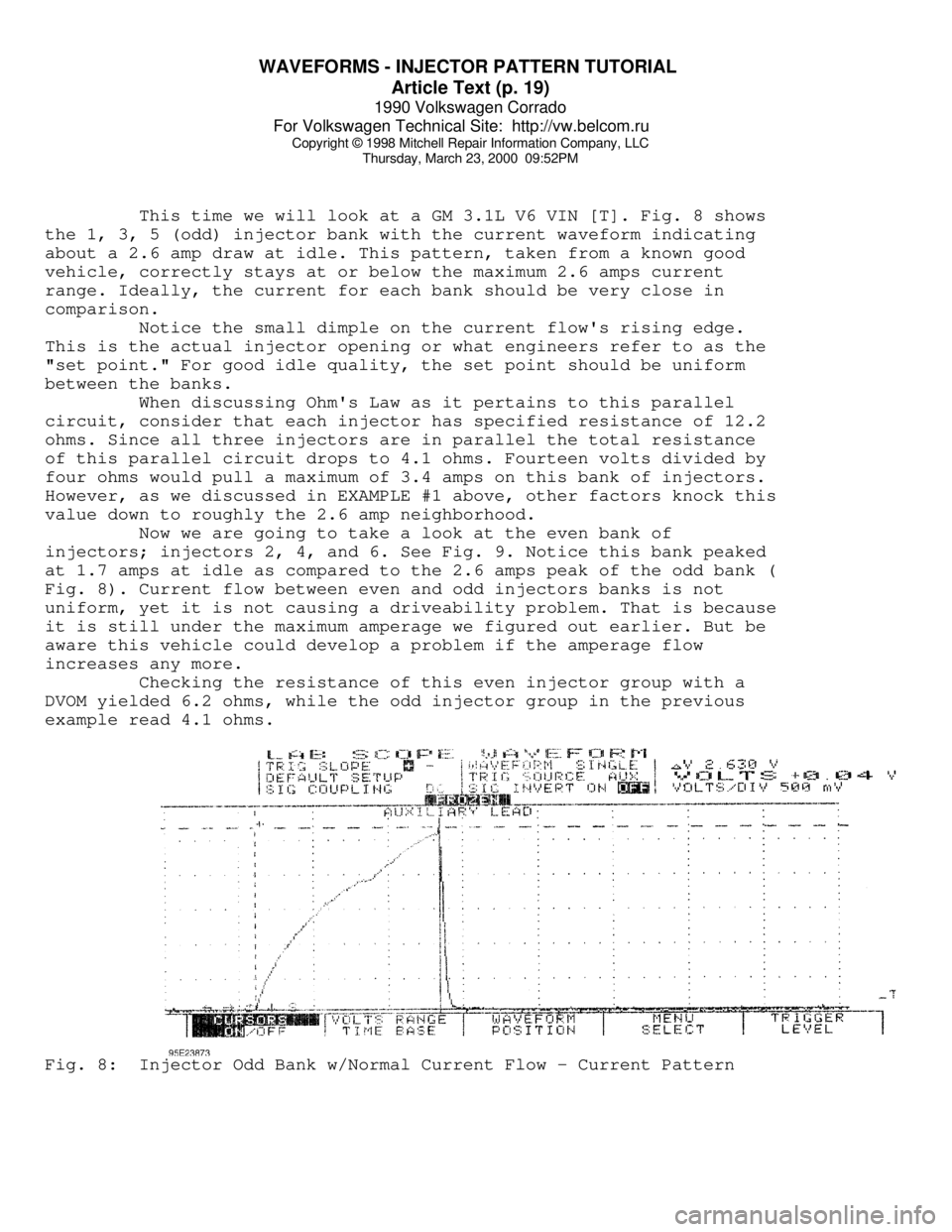
This time we will look at a GM 3.1L V6 VIN [T]. Fig. 8 shows
the 1, 3, 5 (odd) injector bank with the current waveform indicating
about a 2.6 amp draw at idle. This pattern, taken from a known good
vehicle, correctly stays at or below the maximum 2.6 amps current
range. Ideally, the current for each bank should be very close in
comparison.
Notice the small dimple on the current flow's rising edge.
This is the actual injector opening or what engineers refer to as the
"set point." For good idle quality, the set point should be uniform
between the banks.
When discussing Ohm's Law as it pertains to this parallel
circuit, consider that each injector has specified resistance of 12.2
ohms. Since all three injectors are in parallel the total resistance
of this parallel circuit drops to 4.1 ohms. Fourteen volts divided by
four ohms would pull a maximum of 3.4 amps on this bank of injectors.
However, as we discussed in EXAMPLE #1 above, other factors knock this
value down to roughly the 2.6 amp neighborhood.
Now we are going to take a look at the even bank of
injectors; injectors 2, 4, and 6. See Fig. 9. Notice this bank peaked
at 1.7 amps at idle as compared to the 2.6 amps peak of the odd bank (
Fig. 8). Current flow between even and odd injectors banks is not
uniform, yet it is not causing a driveability problem. That is because
it is still under the maximum amperage we figured out earlier. But be
aware this vehicle could develop a problem if the amperage flow
increases any more.
Checking the resistance of this even injector group with a
DVOM yielded 6.2 ohms, while the odd injector group in the previous
example read 4.1 ohms.Fig. 8: Injector Odd Bank w/Normal Current Flow - Current Pattern