1989 MITSUBISHI GALANT ECO
[x] Cancel search: ECOPage 3 of 1273

00-l
GENERAL
CONTENTS
GENERAL DATA AND SPECIFICATIONS.....23
HOWTOUSETHISMANUAL......................
3
Definition of Terms ......................................3
ExplanationofCircuitDiagrams..................7
Explanation of
ManualContents .................4
Explanation of the Troubleshooting
Guide .............................................................
6
Model
Indications .........................................3
Scope of Maintenance, Repair and
Servicing Explanations
..................................
3
Troubleshooting .............................................3
LUBRICATIONANDMAINTENANCE............
34
MAINTENANCE SERVICE............................... 39
AirCleanerElement
.....................................39
Automatic
Transaxle
.....................................43
Ball Joint and Steering Linkage Seals ........45
Brake Hoses................................................. 45
Disc Brake Pads ........................................... 44
Drive Belt (For Water Pump and
Generator) .......................................................
41
Drive
Shaft Boots .........................................45
Engine Coolant
............................................. 44
Engine Oil .....................................................
41
Engine Oil Filter ...........................................41
Exhaust System
............................................ 45
FuelHoses
...................................................39
Fuel System
.................................................39
Manual Transaxle ..........................................42
RearAxle......................................................45
Rear Drum Brake Linings and
RearWheel Cylinders
..................................44
Spark
Plugs...................................................40
Timing Belt...................................................40
MASTER
TROUBLESHOOTING.....................28
PRECAUTIONS
BEFORESERVICE................15
RECOMMENDED LUBRICANTS AND
LUBRICANT CAPACITIESTABLE..................35
SCHEDULED
MAINTENANCETABLE ...........38
SPECIAL HANDLING INSTRUCTIONS
FOR AWD MODELS
.......................................20
TABLE OF MAIN SEALANTS
AND
ADHESIVES ............................................46
TIGHTENING TORQUE
................................... 27
TOWING
ANDHOISTING ..............................17
VEHICLE
IDENTIFICATION .............................8
Chassis Number ...........................................
11
EngineModel
Stamping
...............................12
Theft Protection ............................................12
Vehicle Identification Code Chart Plate.......
8
Vehicle Identification Number List
..............8
Vehicle Identification Number Location .......
8
Vehicle Information
CodePlate...................1 1
Vehicle SafetyCertificationLabel................12
Page 19 of 1273
GENERAL - Towina and Hoisting
00-l 7
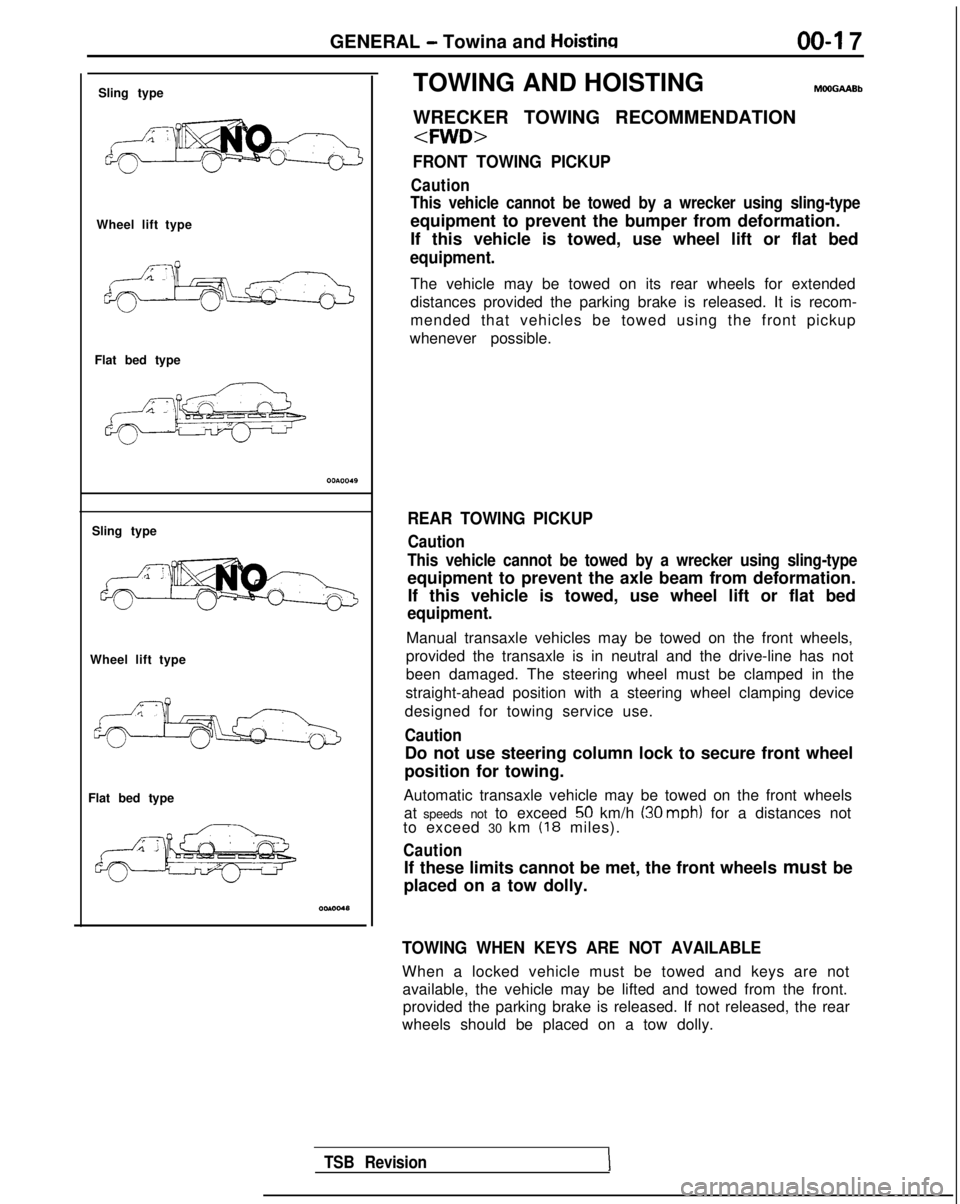
Sling type
Wheel lift type
Flat bed type
Sling type
Wheel lift type
Flat bed type TOWING AND HOISTING
WRECKER TOWING RECOMMENDATION
FRONT TOWING PICKUP
Caution
This vehicle cannot be towed by a wrecker using sling-type
equipment to prevent the bumper from deformation.
If this vehicle is towed, use wheel lift or flat bed
equipment.
The vehicle may be towed on its rear wheels for extended
distances provided the parking brake is released. It is recom-
mended that vehicles be towed using the front pickup
whenever possible.
REAR TOWING PICKUP
Caution
This vehicle cannot be towed by a wrecker using sling-type
equipment to prevent the axle beam from deformation. If this vehicle is towed, use wheel lift or flat bed
equipment.
Manual transaxle vehicles may be towed on the front wheels,
provided the transaxle is in neutral and the drive-line has not
been damaged. The steering wheel must be clamped in the
straight-ahead position with a steering wheel clamping device
designed for towing service use.
Caution
Do not use steering column lock to secure front wheel
position for towing.
Automatic transaxle vehicle may be towed on the front wheels at speeds not to exceed
50 km/h (30 mob) for a distances not
to exceed 30 km (18 miles).
Caution
If these limits cannot be met, the front wheels must be
placed on a tow dolly.
TOWING WHEN KEYS ARE NOT AVAILABLE
When a locked vehicle must be towed and keys are not available, the vehicle may be lifted and towed from the front.provided the parking brake is released. If not released, the rear
wheels should be placed on a tow dolly.
TSB Revision
Page 28 of 1273
00-263ms
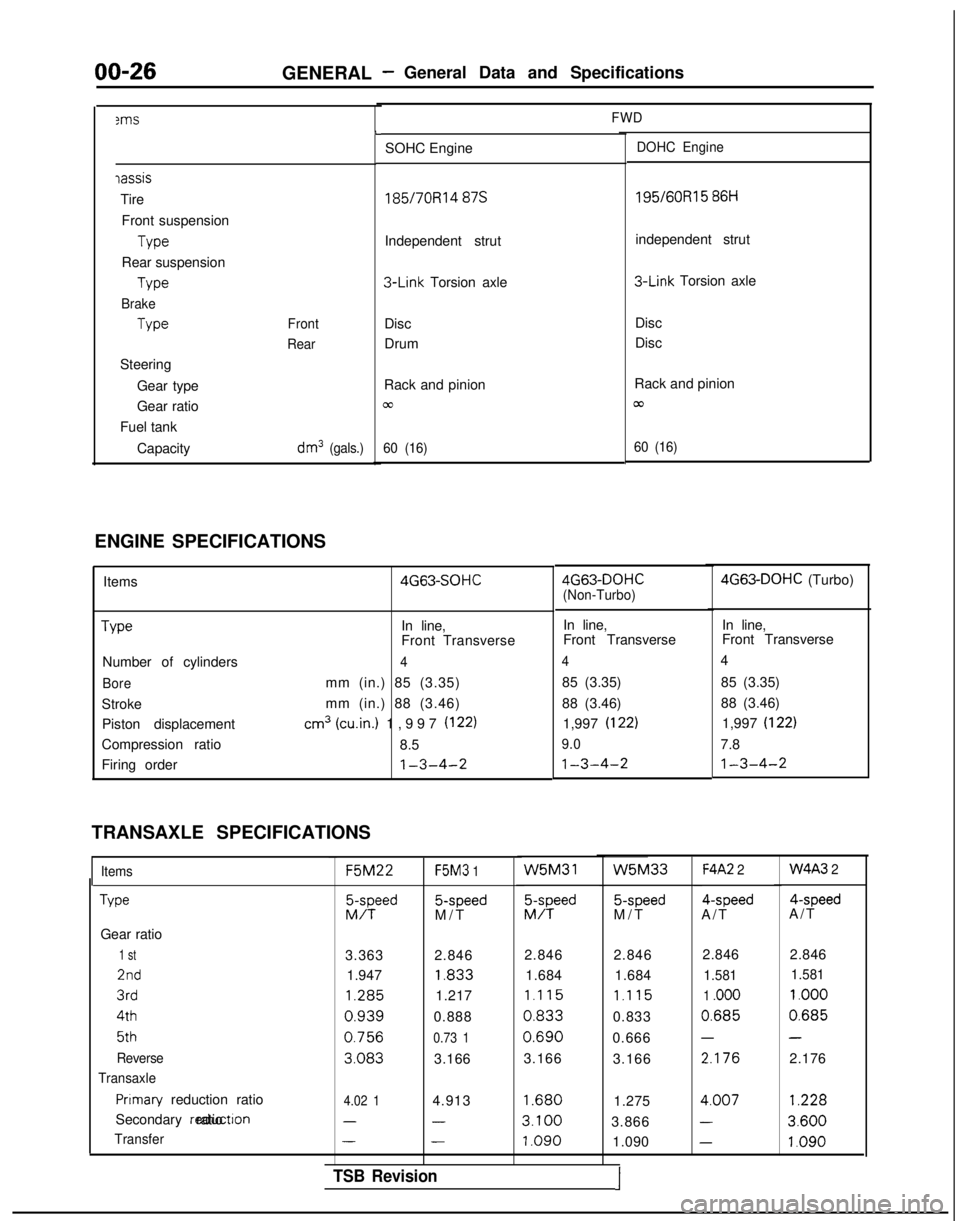
GENERAL -General Data and Specifications
FWD
iassis
Tire
Front suspension Type
Rear suspension Type
Brake
Type
Steering Gear type
Gear ratio
Fuel tank
Capacity
Front
Rear
dm3 (gals.)
L
SOHC EngineDOHC Engine
185/7ORl4 87s 195/60R15
86H
Independent strut independent strut 3-Link
Torsion axle 3-Link
Torsion axle
Disc
Drum Disc
Disc
Rack and pinion
cc
60 (16)
Rack and pinion
/cu
60 (16)
ENGINE SPECIFICATIONS Items Type
Number of cylinders
Bore
StrokePiston displacement
Compression ratio
Firing order 4G63-SOHC
In line,
Front Transverse
4
mm (in.) 85 (3.35)
mm (in.) 88 (3.46)
cm3 (win.) 1,997 (122)
8.5
1-3-4-2
TRANSAXLE SPECIFICATIONS
Items
Type
Gear ratio
1 st
2nd
3rd 4th
5th
Reverse
Transaxle
Pnmary reduction ratio
Secondary reductron ratio
Transfer F5M22
F5M3
1 5-speed
M/T W5M31
EFd
5-speed
M/T
F4A2 2 4-speed
A/T 4-speed
A/T
3.363 2.846 2.846 2.846
1.947 1.833
1.684 1.684 1.285
1.217
1.115 1.115
0.9390.8880.8330.833
0.7560.73 10.6900.666
3.0833.166
3.166
3.166 2.846 2.846
1.581
1.581
1 .ooo 1.000
0.6850.685
--
2.1762.176
4.02 14.9131.6801.2754.007
1.228
---3.1003.8663.600
---1.0901.090
1.0904G63-DOHC
(Non-Turbo) 4G63-DOHC
(Turbo)
In line, In line,
Front Transverse Front Transverse
44
85 (3.35) 85 (3.35)
88 (3.46) 88 (3.46)
1,997 (I
22)1,997 (I 22)
9.0
7.8
1-3-4-21-3-4-2
W5M33W4A3 2
TSB Revision1
Page 30 of 1273
00-28GENERAL - Tightening Torque/Master Troubleshooting
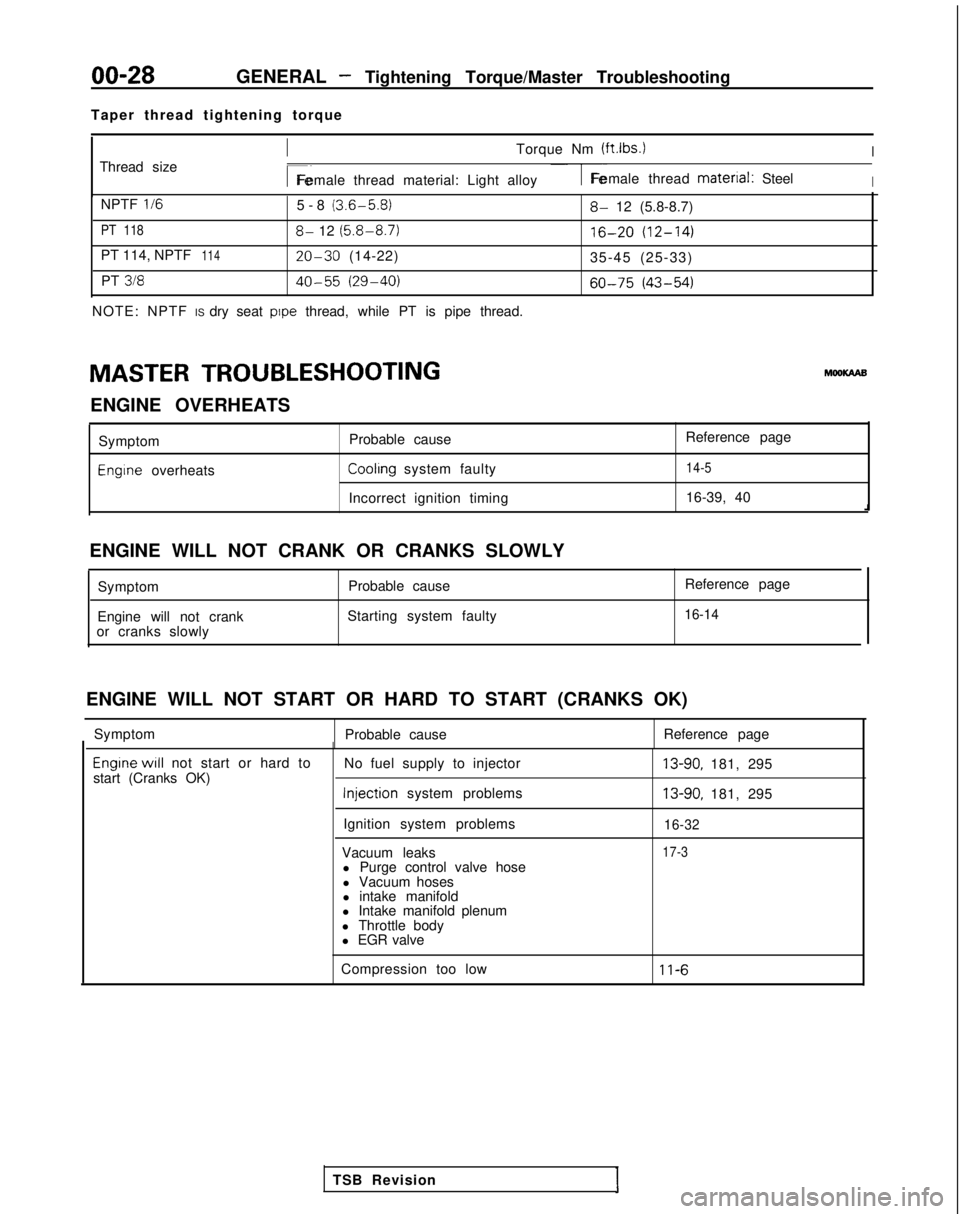
Taper thread tightening torque
Thread size
ITorque Nm (ftlbs.)I
r~Female thread material: Light alloy1-Female thread material: SteelI
NPTF II65-8 (3.6-5.8)
PT 1188- 12 (5.8-8.7)
PT 114, NPTF11420-30 (14-22)
PT
31840-55 (29-40)
NOTE: NPTF IS dry seat pope thread, while PT is pipe thread.
8- 12 (5.8-8.7)
16-20 (12-14)
35-45 (25-33)
60-75 (43-54)
MASTER TROUBLESHOOTING hlooKAAB
ENGINE OVERHEATS Symptom
Engine overheats Probable cause
Reference pageCoolrng system faulty14-5
Incorrect ignition timing
16-39, 40
ENGINE WILL NOT CRANK OR CRANKS SLOWLY Symptom Probable cause
Engine will not crank Starting system faulty
or cranks slowly Reference page
16-14
ENGINE WILL NOT START OR HARD TO START (CRANKS OK)
Symptom Probable cause Reference page
Engrne WIII not start or hard to
start (Cranks OK) No fuel supply to injector Injection
system problems
Ignition system problems
Vacuum leaks l Purge control valve hose
l Vacuum hoses
l intake manifold
l Intake manifold plenum
l Throttle body
l EGR valve13-90, 181, 295
13-90, 181, 295
16-32
17-3
Compression too low11-6
TSB Revision
Page 36 of 1273
00-34GENERAL- Lubrication and Maintenance
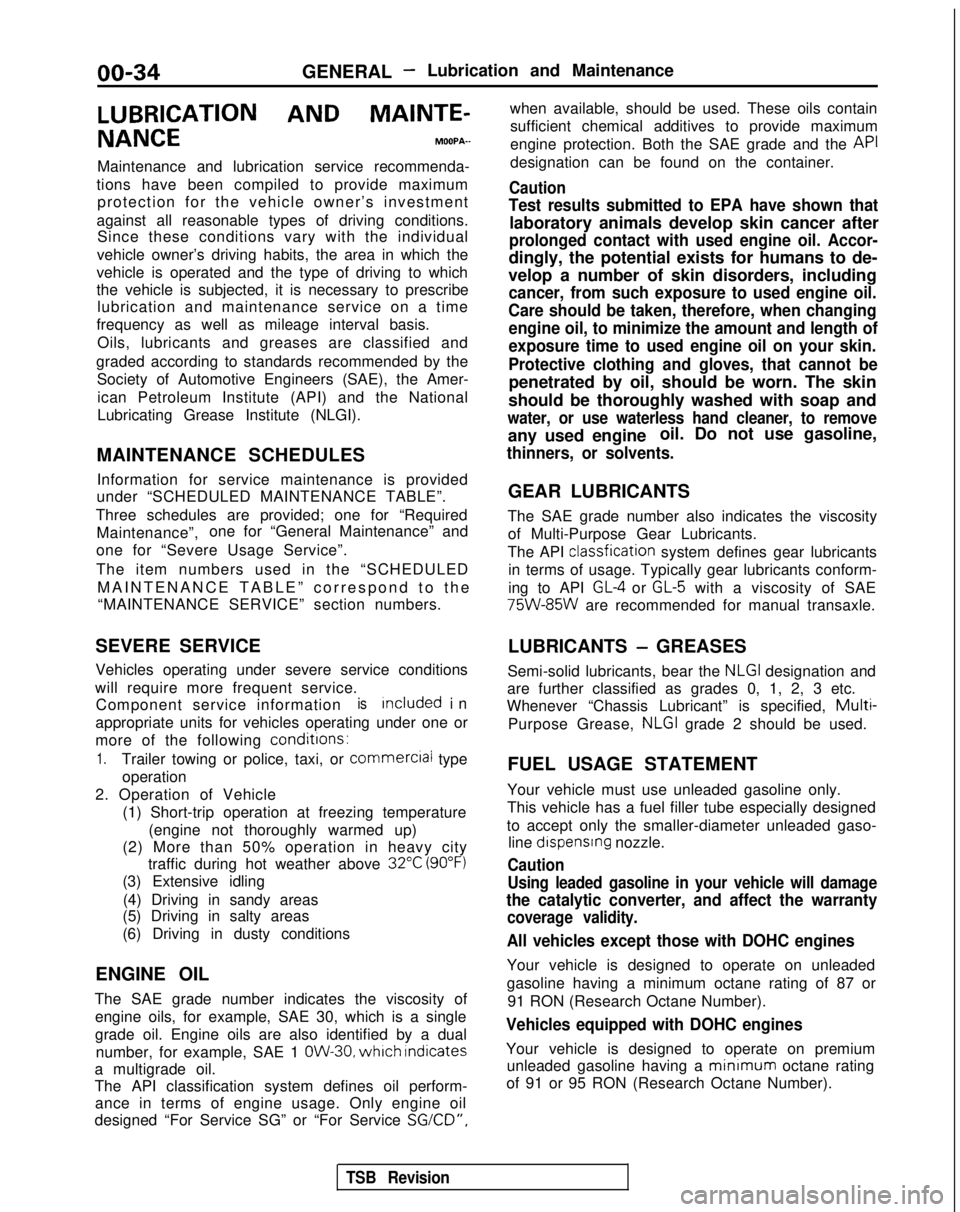
LUBRICATION AND
MAINTE-
NANCEMOOPA-
Maintenance and lubrication service recommenda-
tions have been compiled to provide maximum protection for the vehicle owner’s investment
against all reasonable types of driving conditions. Since these conditions vary with the individual
vehicle owner’s driving habits, the area in which the
vehicle is operated and the type of driving to which
the vehicle is subjected, it is necessary to prescribe lubrication and maintenance service on a time
frequency as well as mileage interval basis.
Oils, lubricants and greases are classified and
graded according to standards recommended by the Society of Automotive Engineers (SAE), the Amer-
ican Petroleum Institute (API) and the National
Lubricating Grease Institute (NLGI).
MAINTENANCE SCHEDULES Information for service maintenance is provided
under “SCHEDULED MAINTENANCE TABLE”.
Three schedules are provided; one for “Required Maintenance”, one for “General Maintenance” and
one for “Severe Usage Service”.
The item numbers used in the “SCHEDULED MAINTENANCE TABLE” correspond to th
e
“MAINTENANCE SERVICE” section numbers.
SEVERE SERVICE
Vehicles operating under severe service conditions
will require more frequent service. Component service information
isIncluded i
n
appropriate units for vehicles operating under one or
more of the following conditrons:
1.Trailer towing or police, taxi, or
commerciai
type
operation
2. Operation of Vehicle (1) Short-trip operation at freezing temperature(engine not thoroughly warmed up)
(2) More than 50% operation in heavy city traffic during hot weather above
32°C (90°F)
(3) Extensive idling
(4) Driving in sandy areas
(5) Driving in salty areas
(6) Driving in dusty conditions
ENGINE OIL
The SAE grade number indicates the viscosity of engine oils, for example, SAE 30, which is a single
grade oil. Engine oils are also identified by a dual number, for example, SAE 1
OW-30, which Indicates
a multigrade oil.
The API classification system defines oil perform- ance in terms of engine usage. Only engine oil
designed “For Service SG” or “For Service
SGKD”,
when available, should be used. These oils contain
sufficient chemical additives to provide maximum
engine protection. Both the SAE grade and the API
designation can be found on the container.
Caution
Test results submitted to EPA have shown that
laboratory animals develop skin cancer after
prolonged contact with used engine oil. Accor-
dingly, the potential exists for humans to de-
velop a number of skin disorders, including
cancer, from such exposure to used engine oil.
Care should be taken, therefore, when changing engine oil, to minimize the amount and length of
exposure time to used engine oil on your skin.
Protective clothing and gloves, that cannot be
penetrated by oil, should be worn. The skin
should be thoroughly washed with soap and
water, or use waterless hand cleaner, to remove
any used engine oil. Do not use gasoline,
thinners, or solvents.
GEAR LUBRICANTS
The SAE grade number also indicates the viscosity of Multi-Purpose Gear Lubricants.
The API classfication
system defines gear lubricants
in terms of usage. Typically gear lubricants conform-
ing to API
GL-4 or GL-5 with a viscosity of SAE 75W-85W
are recommended for manual transaxle.
LUBRICANTS
- GREASES
Semi-solid lubricants, bear the
NLGI designation and
are further classified as grades 0, 1, 2, 3 etc.
Whenever “Chassis Lubricant” is specified,
Multi-
Purpose Grease, NLGI grade 2 should be used.
FUEL USAGE STATEMENT
Your vehicle must use unleaded gasoline only.
This vehicle has a fuel filler tube especially designed
to accept only the smaller-diameter unleaded gaso- line
dispensrng nozzle.
Caution
Using leaded gasoline in your vehicle will damage
the catalytic converter, and affect the warranty
coverage validity.
All vehicles except those with DOHC engines
Your vehicle is designed to operate on unleaded
gasoline having a minimum octane rating of 87 or
91 RON (Research Octane Number).
Vehicles equipped with DOHC engines
Your vehicle is designed to operate on premiumunleaded gasoline having a minimum
octane rating
of 91 or 95 RON (Research Octane Number).
TSB Revision
Page 37 of 1273
GENERAL -Lubrication and Maintenance/Recommended Lubricants and Lubricant Capacities Table00-35
If premium unleaded gasoltne IS not available,
MATERIALS ADDED TO FUEL
unleaded gasoline having a octane rating of 87 or
91 RON (Research Octane Number) may be used. Indiscriminate use of fuel system cleaning agents
In this case, the performance and fuel consumption should be avoided. Many of these materials
in-
WIII suffer a little degradatron.tended for gum and varnish removal may contain
highly active
solvents or similar ingredients that can
be harmful to gasket and diaphragm materials used
in fuel system component parts.
Gasolines containing alcohol
Some gasolrnes sold at service stations contain
alcohol, although they may not be SC identified. Use
of fuels containing alcohol is not recommended
unless the nature of the blend can be
determrned
as being satisfactory.
Gasohol
- A mixture of 10% ethanol (grain alcohol)
and 90% unleaded gasoline may be used
In your
car. If
driveability problems are experienced as a
result of using gasohol, it IS recommended that the
car be operated on gasoline. Methanol
- Do not use gasolines containing
methanol (wood alcohol). Use of this type of
alcohol can result in vehicle performance deteriora-
tion and damage critical parts in the fuel system
components. Fuel system damage and performance
problems, resulting from the use of gasolines
containing methanol, may not be covered by the
new car warranty.
Gasolines containing MTBE (Methyl Tertiary Butyl
Ether)
Unleaded gasolrne containrng
15% or less MTBE
may be used in your car. (Fuel containing MTBE
over 15% vol. may cause reduced engine per-
formance and produce vapor lock or hard starting.) RECOMMENDED
LUBRICANTS AND
LUBRICANT CAPACITIES TAB,&-
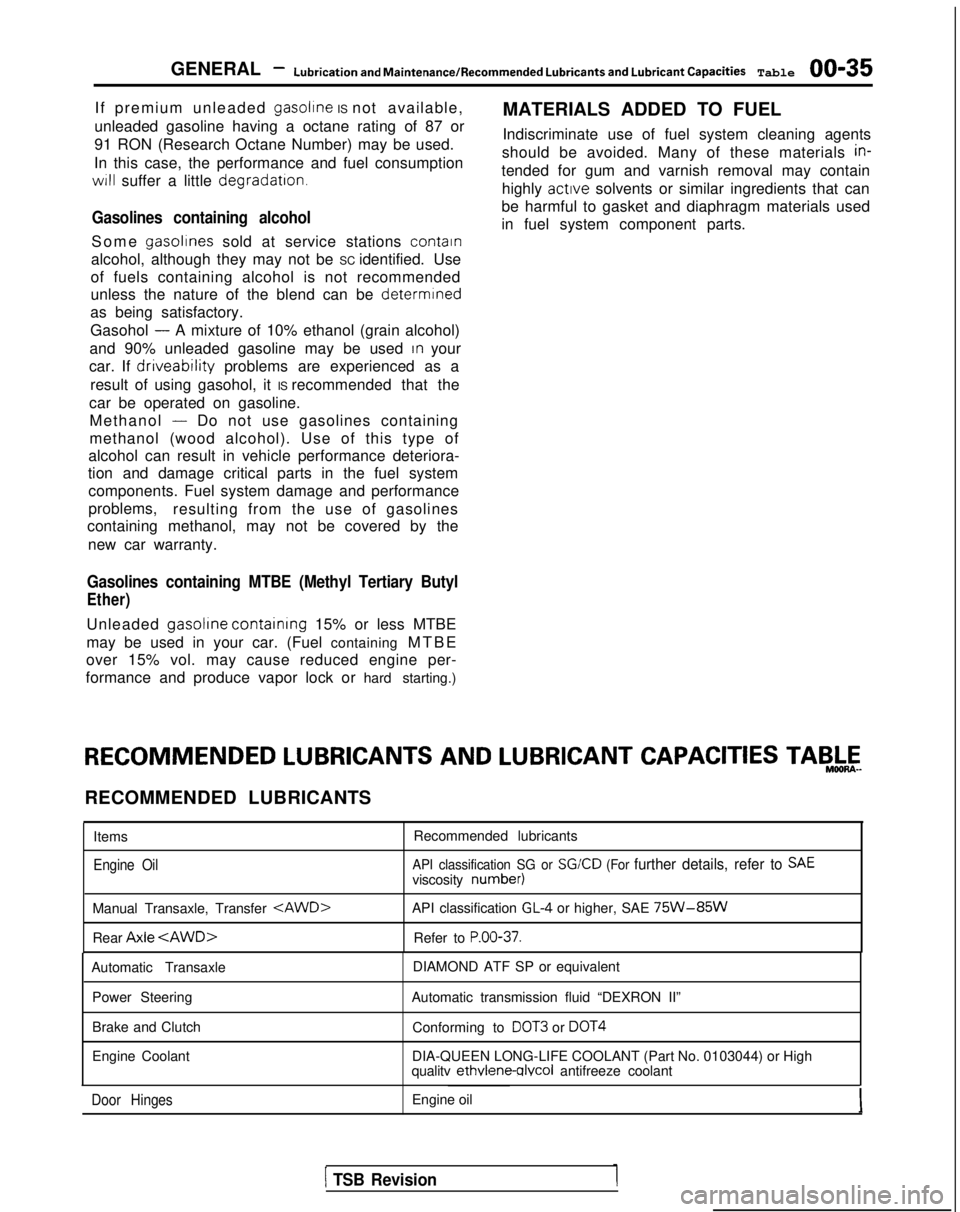
RECOMMENDED LUBRICANTS
Items
Engine Oil
Recommended lubricants
API classification SG or SGKD (For further details, refer to SAEviscosity number)
Manual Transaxle, Transfer
Rear Axle
API classification GL-4 or higher, SAE 75W-85W
Refer to P.OO-37.
Automatic Transaxle
Power Steering
Brake and Clutch
Engine Coolant DIAMOND ATF SP or equivalent
Automatic transmission fluid “DEXRON II” Conforming to
DOT3 or DOT4
DIA-QUEEN LONG-LIFE COOLANT (Part No. 0103044) or High
qualitv ethvlene-qlvcol
antifreeze coolant
Door HingesEngine oil
1 TSB Revision
Page 38 of 1273
00-36
GENERAL -Recommended Lubricants and Lubricant Capacities Table
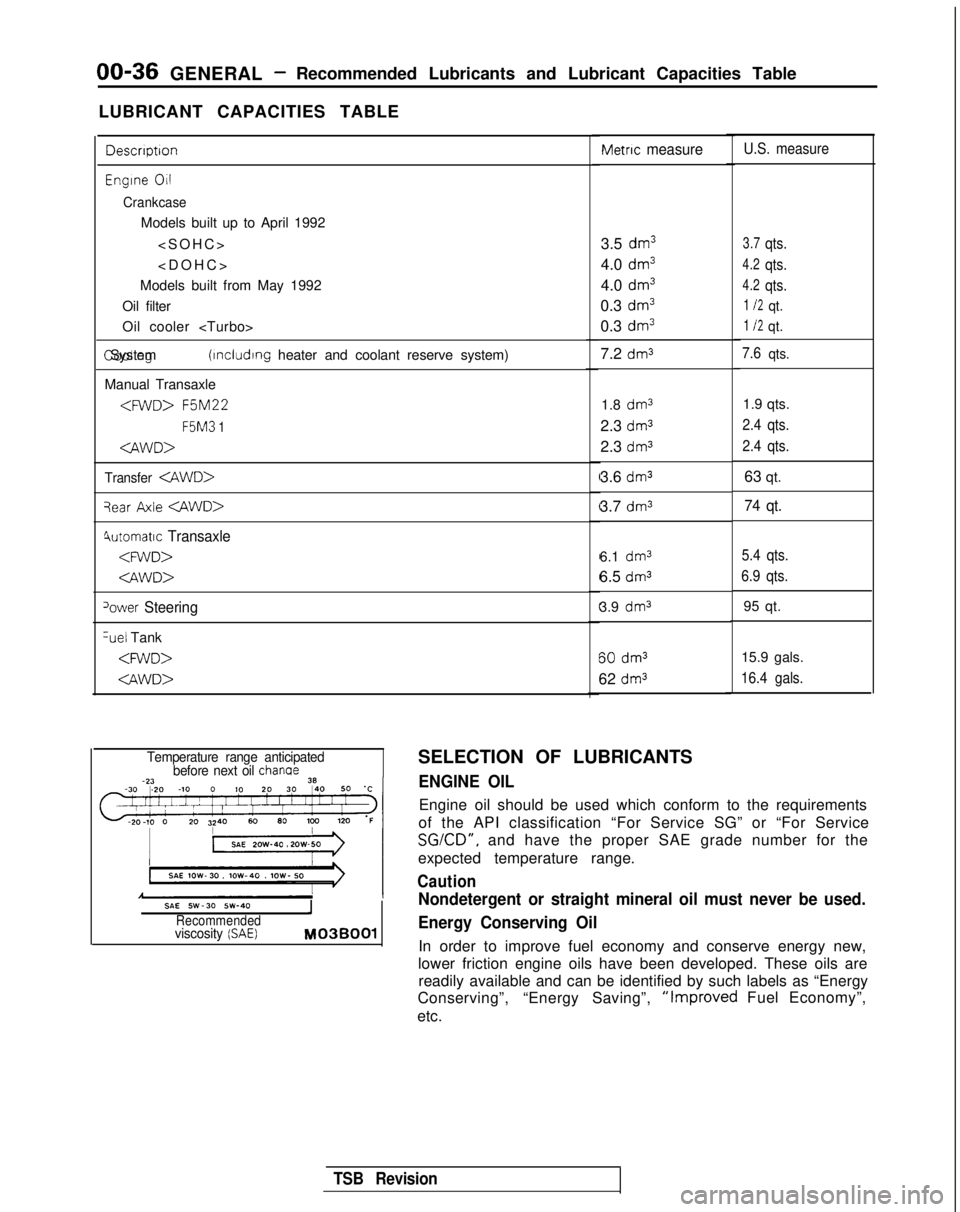
LUBRICANT CAPACITIES TABLE
Descrrptron
Engrne 011
Crankcase
Models built up to April 1992
Models built from May 1992
Oil filter
Oil cooler
(rncludrng heater and coolant reserve system)
Manual Transaxle
F5M3
1
Transfer
qear Axle
4utomatrc Transaxle
‘ower Steering %el
Tank
Metric measure
3.5 dm3
4.0 dm3
4.0 dm3
0.3 dm3
0.3 dm3
7.2 dm3
1.8 dm31.9 qts.
2.3
dm32.4 qts.
2.3 dm32.4 qts.
3.6 dm363 qt.
3.7
dm374 qt.
6.1 dm3
6.5 dms
3.9 dm3 60
dm3
62 dm3
U.S. measure
3.7qts.
4.2qts.
4.2qts.
1 I2qt.
1 I2qt.
7.6qts.
5.4 qts.
6.9 qts.
95 qt.
15.9 gals.
16.4 gals.
Temperature range anticipated before next oil chanae
SAE SW-30 SW-40IRecommendedviscosity (SAE) M03BOOl
SELECTION OF LUBRICANTS
ENGINE OIL
Engine oil should be used which conform to the requirements
of the API classification “For Service SG” or “For Service
SGKD”, and have the proper SAE grade number for the
expected temperature range.
Caution
Nondetergent or straight mineral oil must never be used.
Energy Conserving Oil
In order to improve fuel economy and conserve energy new,
lower friction engine oils have been developed. These oils are readily available and can be identified by such labels as “Energy
Conserving”, “Energy Saving”,
“Improved Fuel Economy”,
etc.
TSB Revision
Page 39 of 1273
GENERAL - Recommended LubricaMs and Lubricant Capacities Table 00-37
721004
4
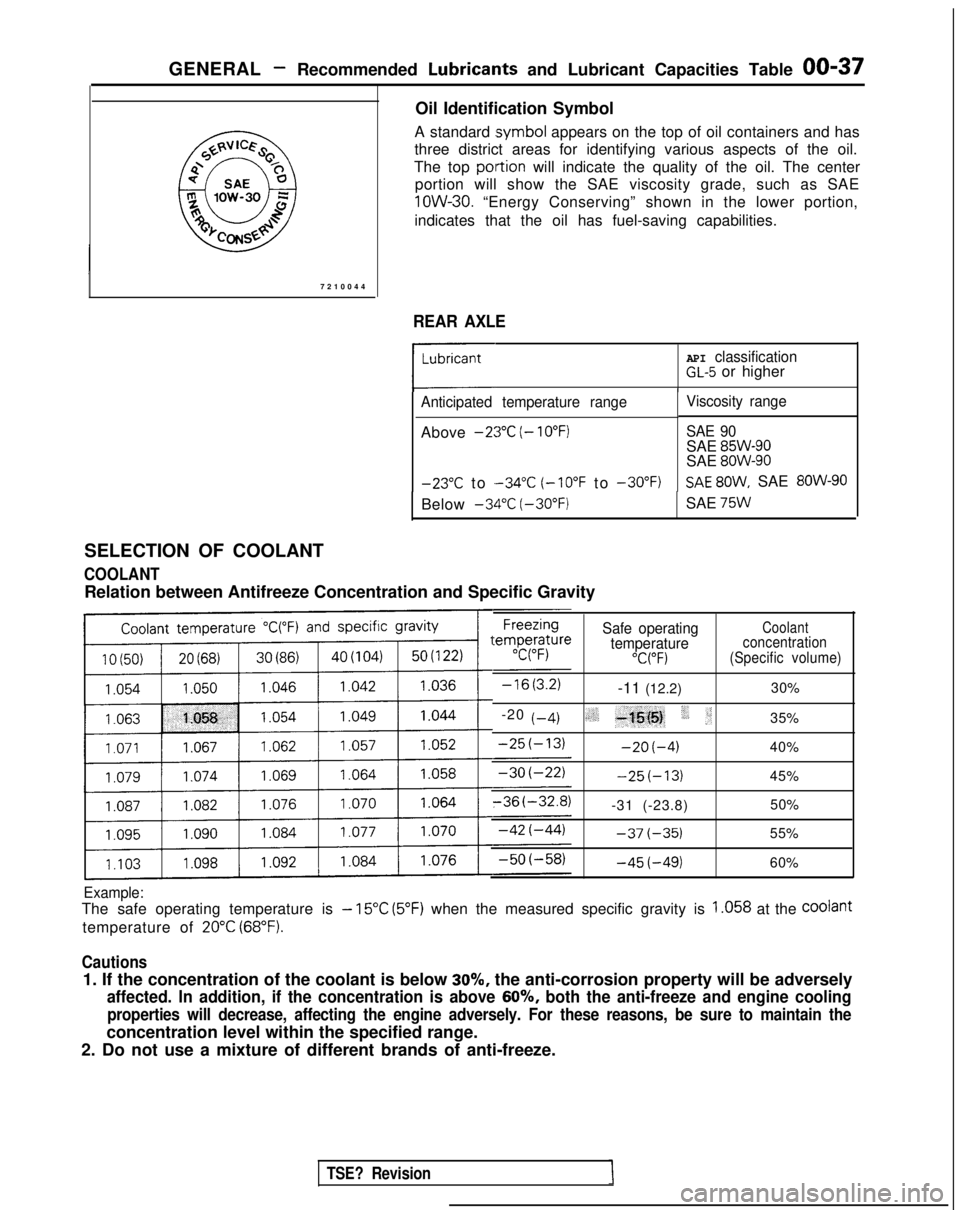
Oil Identification Symbol
A standard
.symbol appears on the top of oil containers and has
three district areas for identifying various aspects of the oil.
The top
polqion will indicate the quality of the oil. The center
portion will show the SAE viscosity grade, such as SAE lOW-30.
“Energy Conserving” shown in the lower portion,
indicates that the oil has fuel-saving capabilities.
REAR AXLE
API classificationGL-5 or higher
Anticipated temperature range
Above -23°C
(- 10°F)
-23°C to --34°C (-10°F
to -30°F)
Viscosity range
SAE 90
SAE 85W-90SAE 8OW-90
SAE 8OW. SAE 8OW-90
Below
-34°C
(-30°F)SAE 75W
SELECTION OF COOLANT
COOLANT
Relation between Antifreeze Concentration and Specific Gravity
Safe operatingCoolant
temperatureconcentration
“C(“F)(Specific volume)
-11 (12.2) 30%
-20
t-4)(,.‘_ -+j{@, ‘, :;35%
-2O(-4)40%
-25(-13)45%
-31 (-23.8) 50%
-37(-35)55%
-45(-49)60%
Example:
The safe operating temperature is - 15°C (5°F) when the measured specific gravity is 1.058 at the Coolant
temperature of 20°C (68°F).
Cautions
1. If the concentration of the coolant is below 30%, the anti-corrosion property will be adversely
affected. In addition, if the concentration is above 60%, both the anti-freeze and engine cooling
properties will decrease, affecting the engine adversely. For these reas\
ons, be sure to maintain the
concentration level within the specified range.
2. Do not use a mixture of different brands of anti-freeze.
TSE? Revision