Page 1357 of 1865
ENGINE SPEED SENSING POWER STEERING 1 0
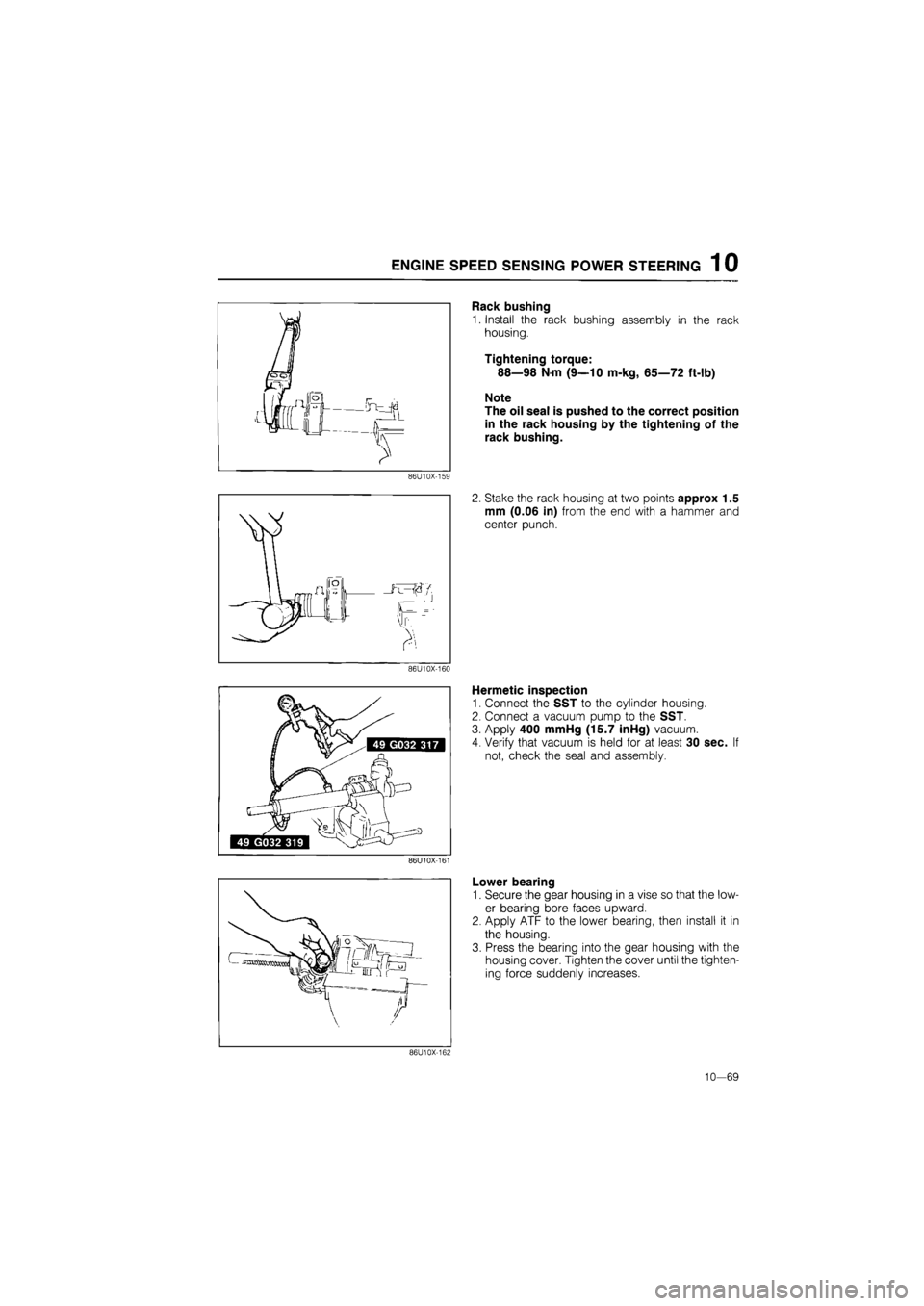
Rack bushing
1. Install the rack bushing assembly in the rack
housing.
Tightening torque:
88—98 N m (9—10 m-kg, 65—72 ft-lb)
Note
The oil seal is pushed to the correct position
in the rack housing by the tightening of the
rack bushing.
86U10X-159
2. Stake the rack housing at two points approx 1.5
mm (0.06 in) from the end with a hammer and
center punch.
86U10X-160
Hermetic inspection
1. Connect the SST to the cylinder housing.
2. Connect a vacuum pump to the SST.
3. Apply 400 mmHg (15.7 inHg) vacuum.
4. Verify that vacuum is held for at least 30 sec. If
not, check the seal and assembly.
86U10X-161
Lower bearing
1. Secure the gear housing in a vise so that the low-
er bearing bore faces upward.
2. Apply ATF to the lower bearing, then install it in
the housing.
3. Press the bearing into the gear housing with the
housing cover. Tighten the cover until the tighten-
ing force suddenly increases.
86U10X-162
10—69
Page 1371 of 1865
OIL PUMP 1 0
OIL PUMP
REMOVAL AND INSTALLATION
1. Jack up the front of the vehicle, and support it with safety stands.
2. Remove in the order shown in the figure, referring to the removal note for specially marked parts.
3. Install in the reverse order of removal.
4. Tighten all nuts and bolts to the specified torque, referring to the figure.
Note
a) The power steering fluid will leak out when the return hose or the pressure hose is dis-
connected. Prepare a suitable container for it to drain into.
b) After installation, inspect the deflection of the oil pump belt and bleed the air from the
system, then check for fluid leakage. 2WS (Gasoline engine)
76G10X-041
4. Bracket
5. Oil pump
6. Oil pump pulley
1. Belt
2. Nut
3. Pipes
10—83
Page 1375 of 1865
ELECTRICAL COMPONENTS OF ELECTRONICALLY-CONTROLLED POWER STEERING (ECPS) 1 0
ELECTRICAL
COMPONENTS
OF
ELECTRONICALLY-CONTROLLED POW-
ER STEERING (ECPS)
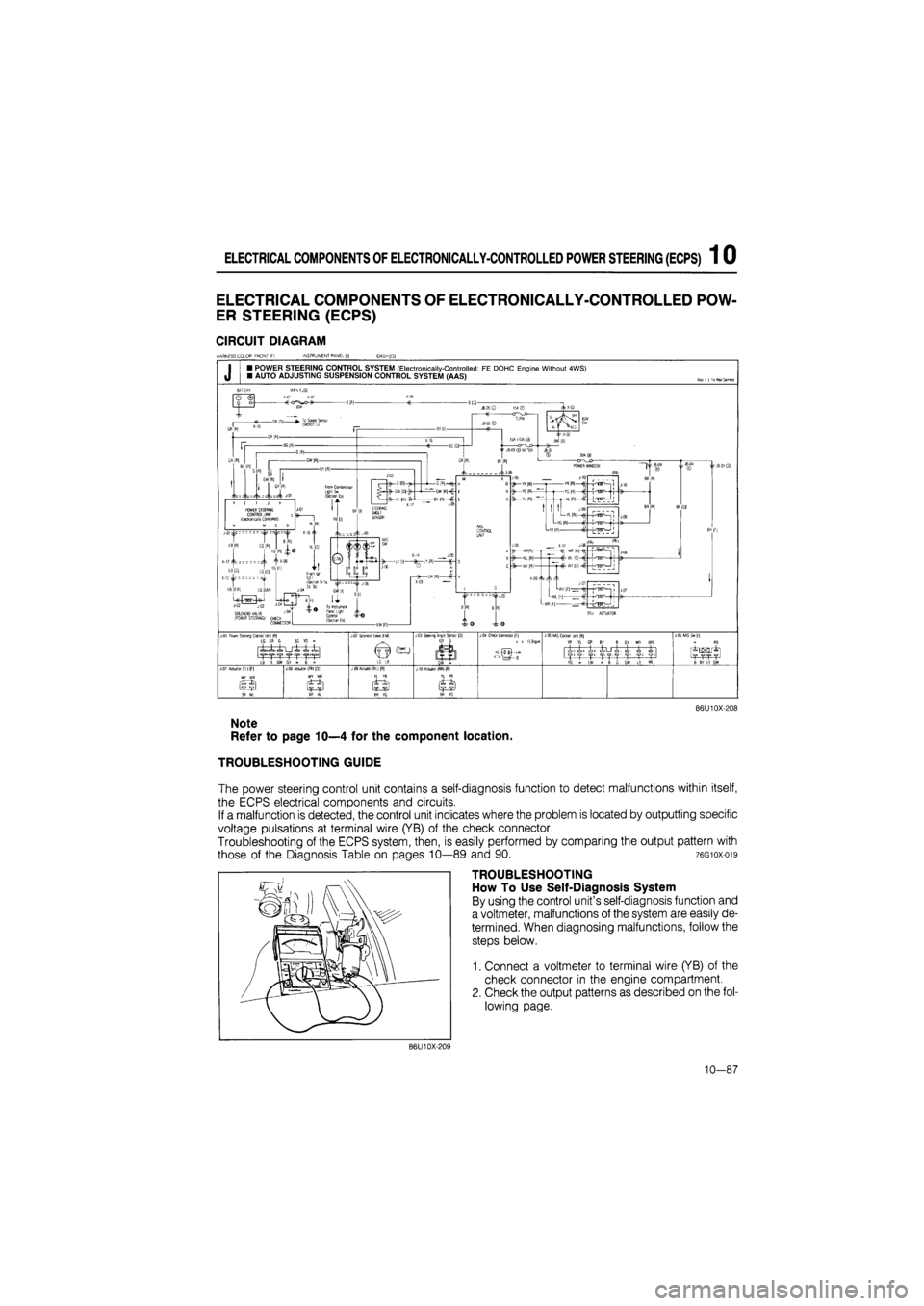
CIRCUIT DIAGRAM
J POWER STEERING CONTROL SYSTEM (Electronically-Controlled: FE DOHC Engine Without 4WS) AUTO ADJUSTING SUSPENSION CONTROL SYSTEM (AAS)
MAIN FUSE
IcLJ=.cLLJX..=L1.| T'TTTTT'P LB YL GW GY * B «
I-02
Solenoid Valve
[EM] J-04
Check Connector |F|
VG-j-Ijj-LW
J-05
AAS
Conlorl Unit |R| YR YL GR BY B GY WY WR \LL L LuL I 1 L I T. T TTT T T. T,i B G GW LY WL IT TT TI
J-07 Aclualor (FL) |F] WY WR J-08 Aclualor (FR) [D] WY WR J-09 Aclualor (RL) [R| YL YR J-10 Aclualor
(RR) |R|
Yl YR
86U10X-208
Note
Refer to page 10—4 for the component location.
TROUBLESHOOTING GUIDE
The power steering control unit contains a self-diagnosis function to detect malfunctions within itself,
the ECPS electrical components and circuits.
If a malfunction is detected, the control unit indicates where the problem is located by outputting specific
voltage pulsations at terminal wire (YB) of the check connector.
Troubleshooting of the ECPS system, then, is easily performed by comparing the output pattern with
those of the Diagnosis Table on pages 10—89 and 90. 76G10X-019
TROUBLESHOOTING
How To Use Self-Diagnosis System
By using the control unit's self-diagnosis function and
a voltmeter, malfunctions of the system are easily de-
termined. When diagnosing malfunctions, follow the
steps below.
1. Connect a voltmeter to terminal wire (YB) of the
check connector in the engine compartment.
2. Check the output patterns as described on the fol-
lowing page.
86U10X-209
10—87
Page 1376 of 1865
1 0 ELECTRICAL COMPONENTS OF ELECTRONICALLY-CONTROLLED POWER STEERING (ECPS)
76G10X-020
76G10X-021
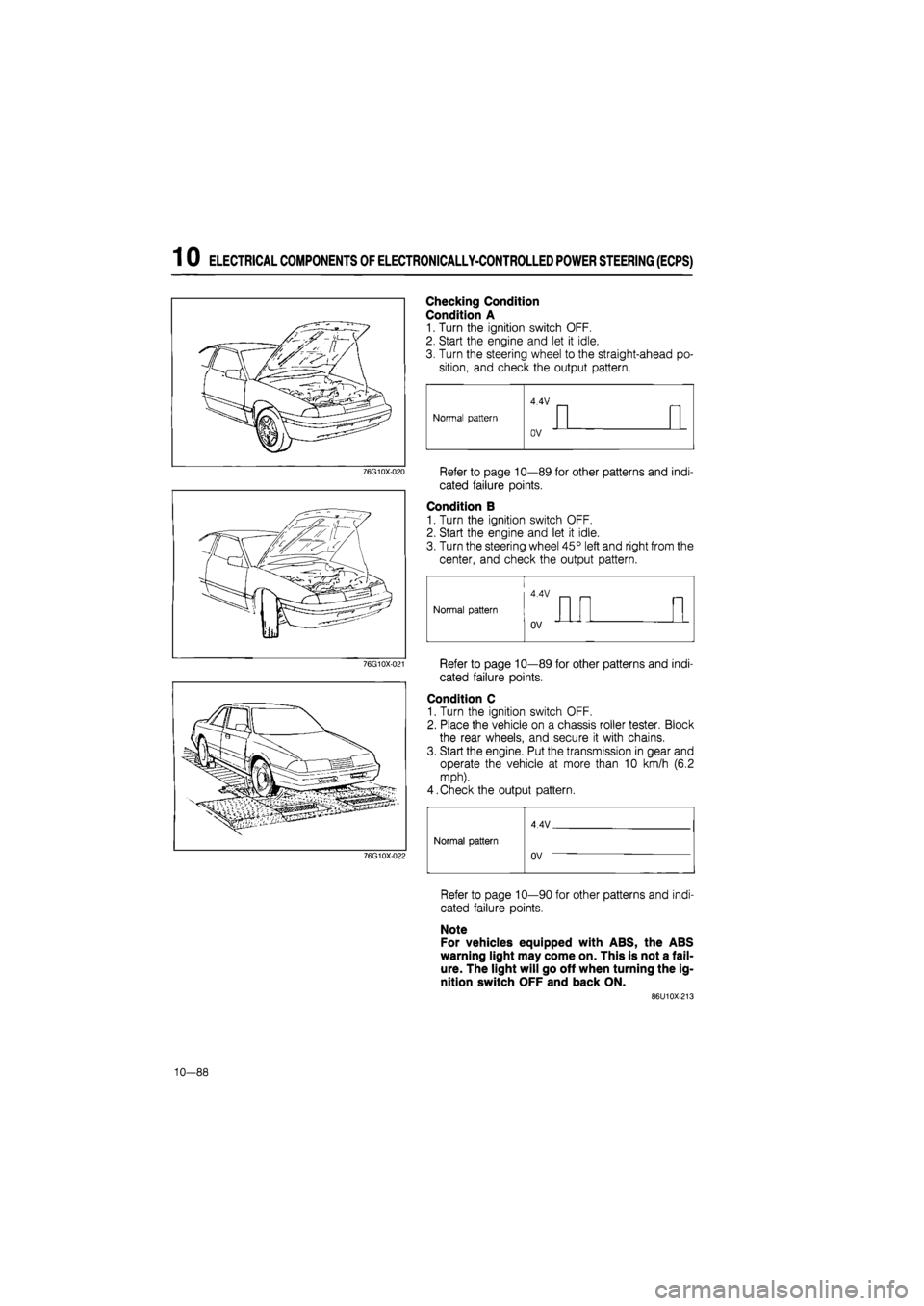
Checking Condition
Condition A
1. Turn the ignition switch OFF.
2. Start the engine and let it idle.
3. Turn the steering wheel to the straight-ahead po-
sition, and check the output pattern.
Refer to page 10—89 for other patterns and indi-
cated failure points.
Condition B
1. Turn the ignition switch OFF.
2. Start the engine and let it idle.
3. Turn the steering wheel 45° left and right from the
center, and check the output pattern.
Refer to page 10—89 for other patterns and indi-
cated failure points.
Condition C
1. Turn the ignition switch OFF.
2. Place the vehicle on a chassis roller tester. Block
the rear wheels, and secure it with chains.
3. Start the engine. Put the transmission in gear and
operate the vehicle at more than 10 km/h (6.2
mph).
4.Check the output pattern.
76G10X-022
Normal pattern
4 4V
Normal pattern Normal pattern
uV
Refer to page 10—90 for other patterns and indi-
cated failure points.
Note
For vehicles equipped with ABS, the ABS
warning light may come on. This is not a fail-
ure. The light will go off when turning the ig-
nition switch OFF and back ON.
86U10X-213
10—88
Page 1379 of 1865
ELECTRICAL COMPONENTS
OF
ELECTRONICALLY-CONTROLLED POWER STEERING (ECPS) 1 0
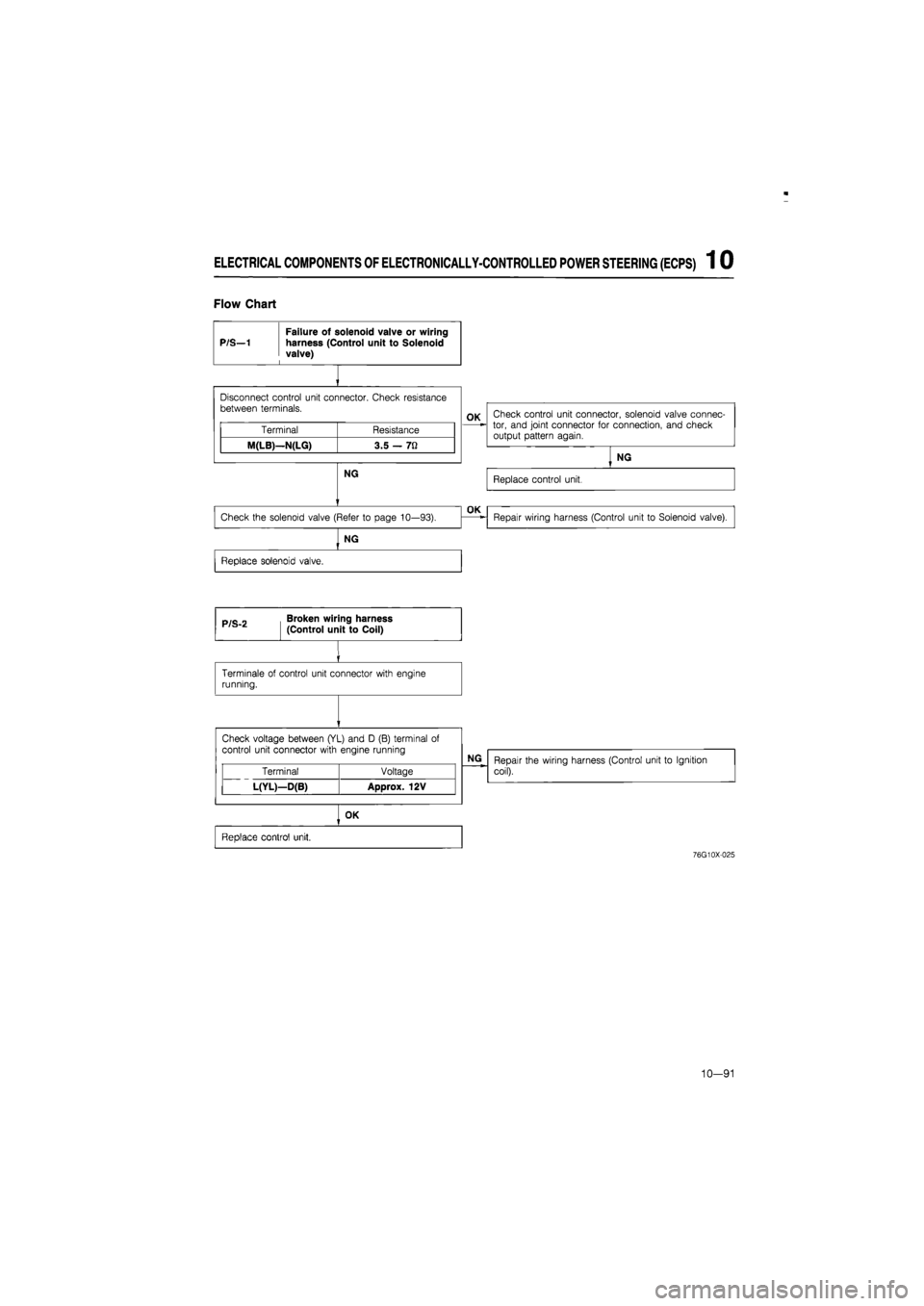
Flow Chart
P/S—1
Failure of solenoid valve or wiring harness (Control unit to Solenoid valve)
Disconnect control unit connector. Check resistance between terminals.
Check voltage between (YL) and D (B) terminal of
control unit connector with engine running
OK
Terminal Resistance
M(LB)—N(LG) 3.5 — 7Q
Check control unit connector, solenoid valve connec-tor, and joint connector for connection, and check output pattern again.
NG
Check the solenoid valve (Refer to page 10—93),
NG
Replace solenoid valve.
P/S-Z Broken wiring harness
(Control unit to Coil)
Terminate of control unit connector with engine running.
NG
Replace control unit.
OK Repair wiring harness (Control unit to Solenoid valve).
Terminal Voltage
L(YL)-D(B) Approx. 12V
NG Repair the wiring harness (Control unit to Ignition
coil).
OK
Replace control unit.
76G10X-025
10—91
Page 1383 of 1865
ELECTRICAL COMPONENTS OF 4-WHEEL STEERING 1 0
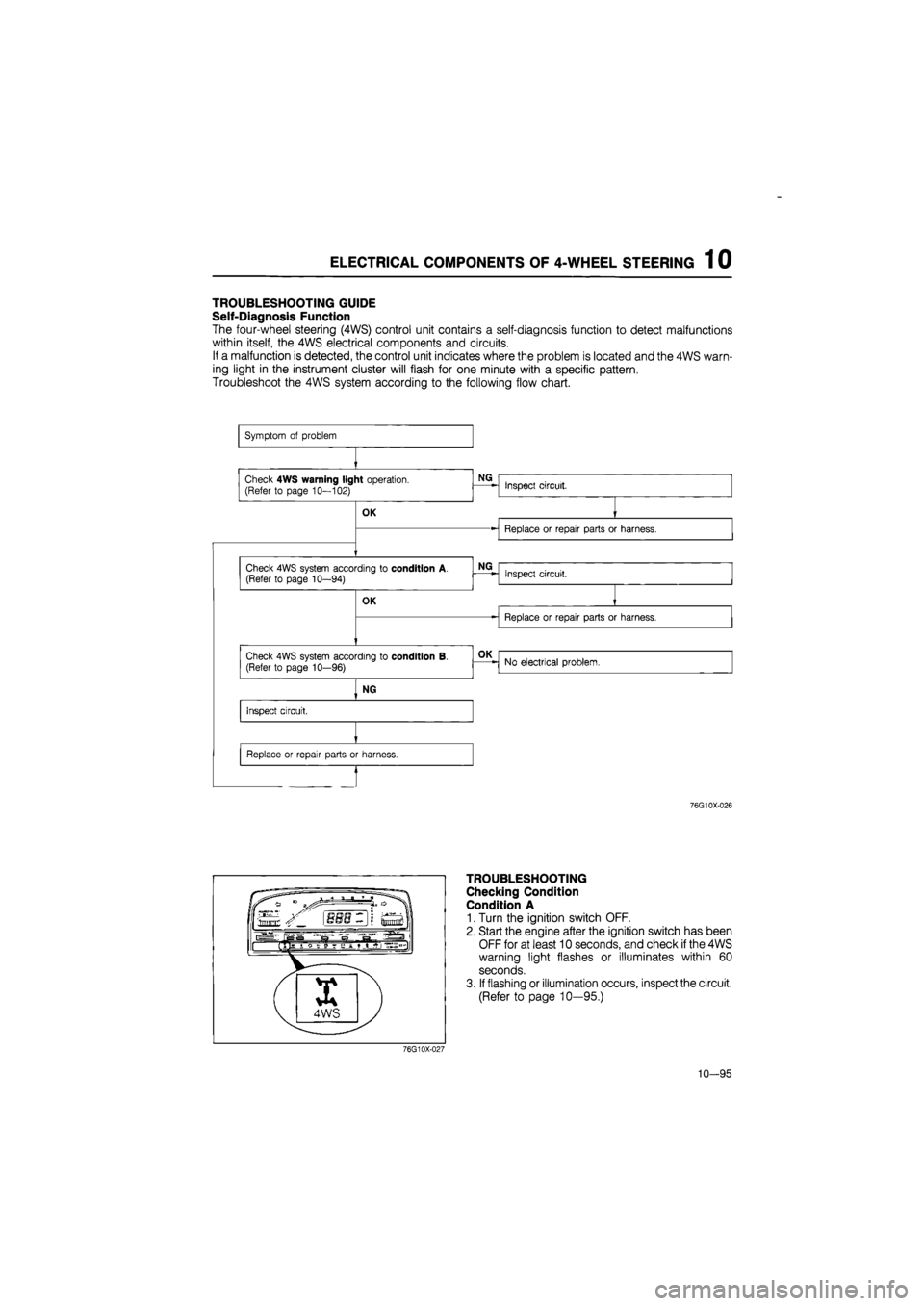
TROUBLESHOOTING GUIDE
Self-Diagnosis Function
The four-wheel steering (4WS) control unit contains a self-diagnosis function to detect malfunctions
within itself, the 4WS electrical components and circuits.
If a malfunction is detected, the control unit indicates where the problem is located and the 4WS warn-
ing light in the instrument cluster will flash for one minute with a specific pattern,
Troubleshoot the 4WS system according to the following flow chart.
Symptom of problem
76G10X-026
TROUBLESHOOTING
Checking Condition
Condition A
1. Turn the ignition switch OFF.
2. Start the engine after the ignition switch has been
OFF for at least 10 seconds, and check if the 4WS
warning light flashes or illuminates within 60
seconds.
3.
If
flashing or illumination occurs, inspect the circuit.
(Refer to page 10—95.)
76G10X-027
10—95
Page 1384 of 1865
1 0 ELECTRICAL COMPONENTS OF 4-WHEEL STEERING
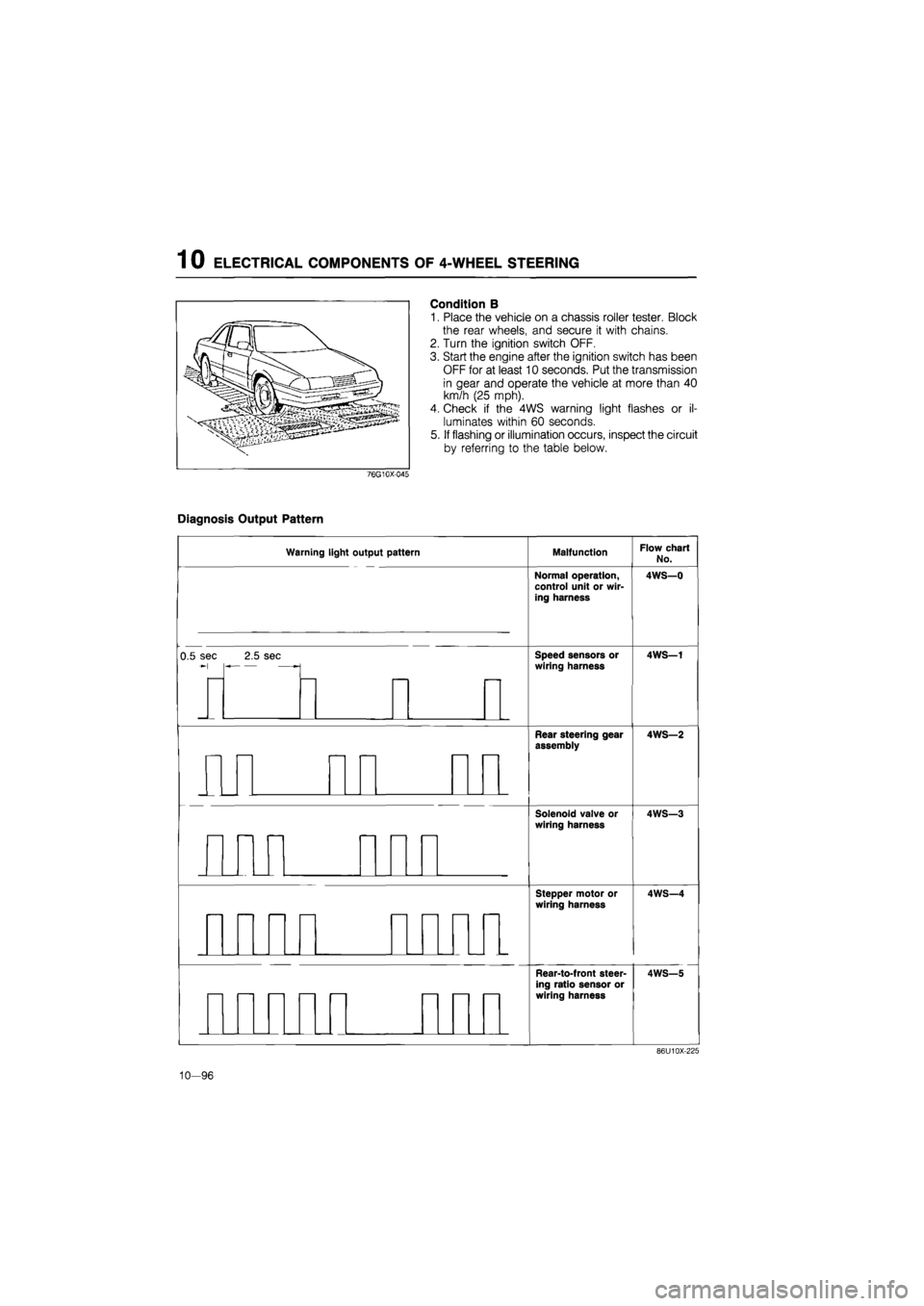
Condition B
1. Place the vehicle on a chassis roller tester. Block
the rear wheels, and secure it with chains.
2. Turn the ignition switch OFF.
3. Start the engine after the ignition switch has been
OFF for at least 10 seconds. Put the transmission
in gear and operate the vehicle at more than 40
km/h (25 mph).
4. Check if the 4WS warning light flashes or il-
luminates within 60 seconds.
5.
If
flashing or illumination occurs, inspect the circuit
by referring to the table below.
76G10X045
Diagnosis Output Pattern
Warning light output pattern
0.5 sec —i 2.5 sec
Malfunction
Normal operation, control unit or wir-ing harness
Speed sensors or
wiring harness
Flow chart
No.
4WS—0
4WS—1
Rear steering gear
assembly
Solenoid valve or wiring harness
Stepper motor or wiring harness
Rear-to-front steer-ing ratio sensor or wiring harness
4WS—2
4WS—3
4WS—4
4WS—5
86U10X-225
10-96
Page 1386 of 1865
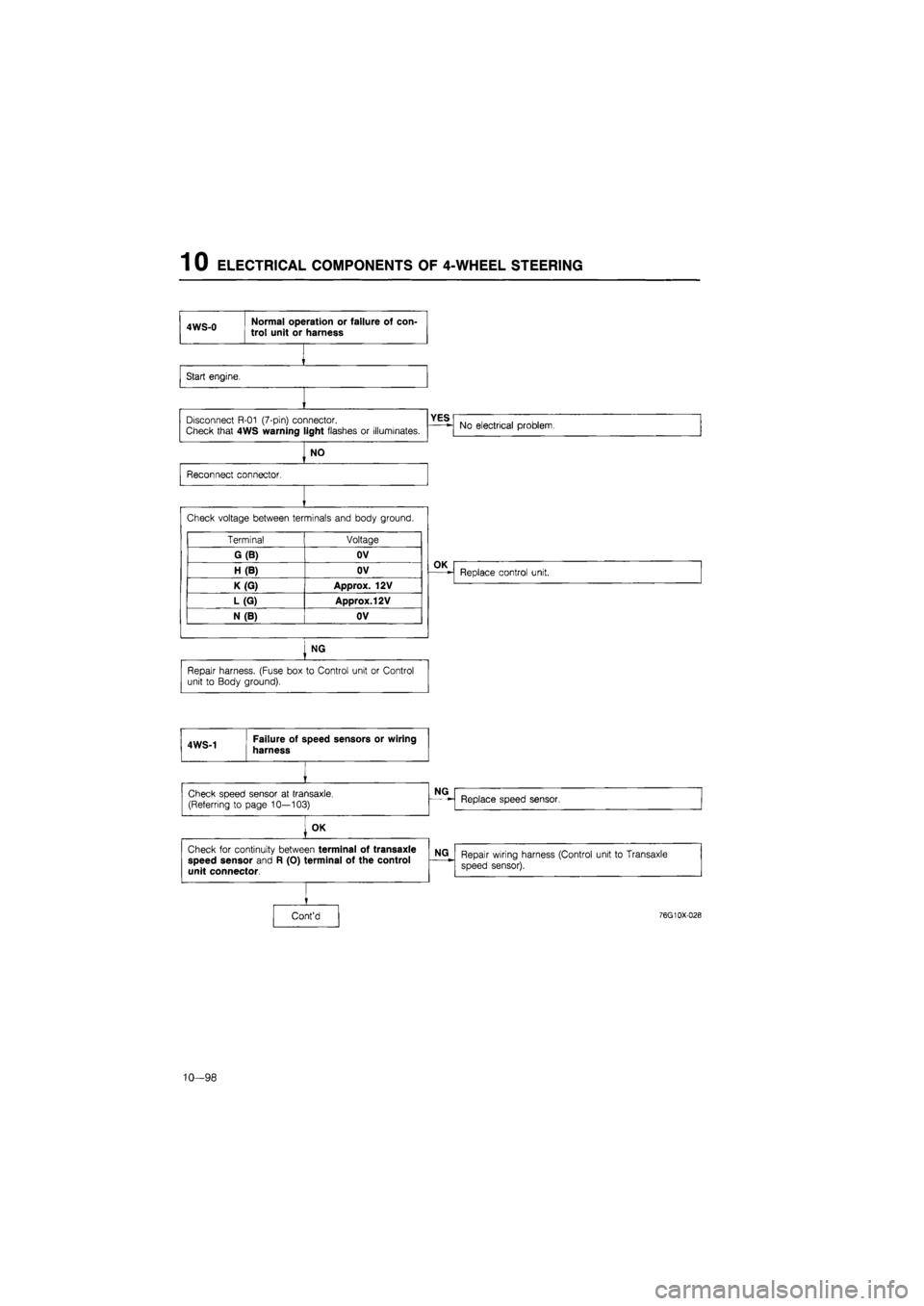
1 0 ELECTRICAL COMPONENTS OF 4-WHEEL STEERING
4WS-0 Normal operation or failure of con-trol unit or harness
Start engine.
Disconnect R-01 (7-pin) connector. Check that 4WS warning light flashes or illuminates.
NG
Repair harness. (Fuse box to Control unit or Control unit to Body ground).
YES No electrical problem.
NO
Reconnect connector.
Check voltage between terminals and body ground.
Terminal Voltage
G(B) OV
H(B) OV
K(G) Approx. 12V
L(G) Approx. 12V
N(B) OV
OK Replace control unit.
4WS-1 Failure of speed sensors or wiring
harness
Check speed sensor at transaxle. (Referring to page 10—103)
OK
NG Replace speed sensor.
Check for continuity between terminal of transaxle speed sensor and R (O) terminal of the control unit connector.
NG^ Repair wiring harness (Control unit to Transaxle
speed sensor).
Cont'd 76G10X-028
10—98