1987 MAZDA 626 engine oil
[x] Cancel search: engine oilPage 949 of 1865

REMOVAL 7B
REMOVAL
PRECAUTION
(1) Drain the ATF before removal.
(2) Jack up the vehicle and support it with safety stands after attaching the engine support.
Components
1. Battery
2. Battery carrier
3. Main fuse block
4. Distributor lead
5. Air flow meter connector
(G4A-EL)
6. Air cleaner assembly
(G4A-EL)
7. Air cleaner hose (G4A-EL)
8. Fresh air duct (G4A-HL)
9. Speedometer cable
10. Connectors
11. Grounds
12. Selector cable
13. Throttle cable
14. Front wheels
15. Splash shields
16. Oil cooler outlet and inlet
hoses
17. Tie-rod ends
18. Stabilizer bar control links
19. Lower arm ball joints
20. Driveshaft
21. Joint shaft bracket
76G07B-106
22. Joint shaft and driveshaft
23. Exhaust pipe bracket
24. Gusset plates
25. Under cover
26. Torque converter nuts
27. Manifold bracket (G4A-EL)
28. Starter
29. Engine mount No.4
30. Engine mount No.2
31. Crossmember and left side
lower arm
32. Transaxle
7B—83
Page 1001 of 1865
INSPECTION AND REPAIR 7B
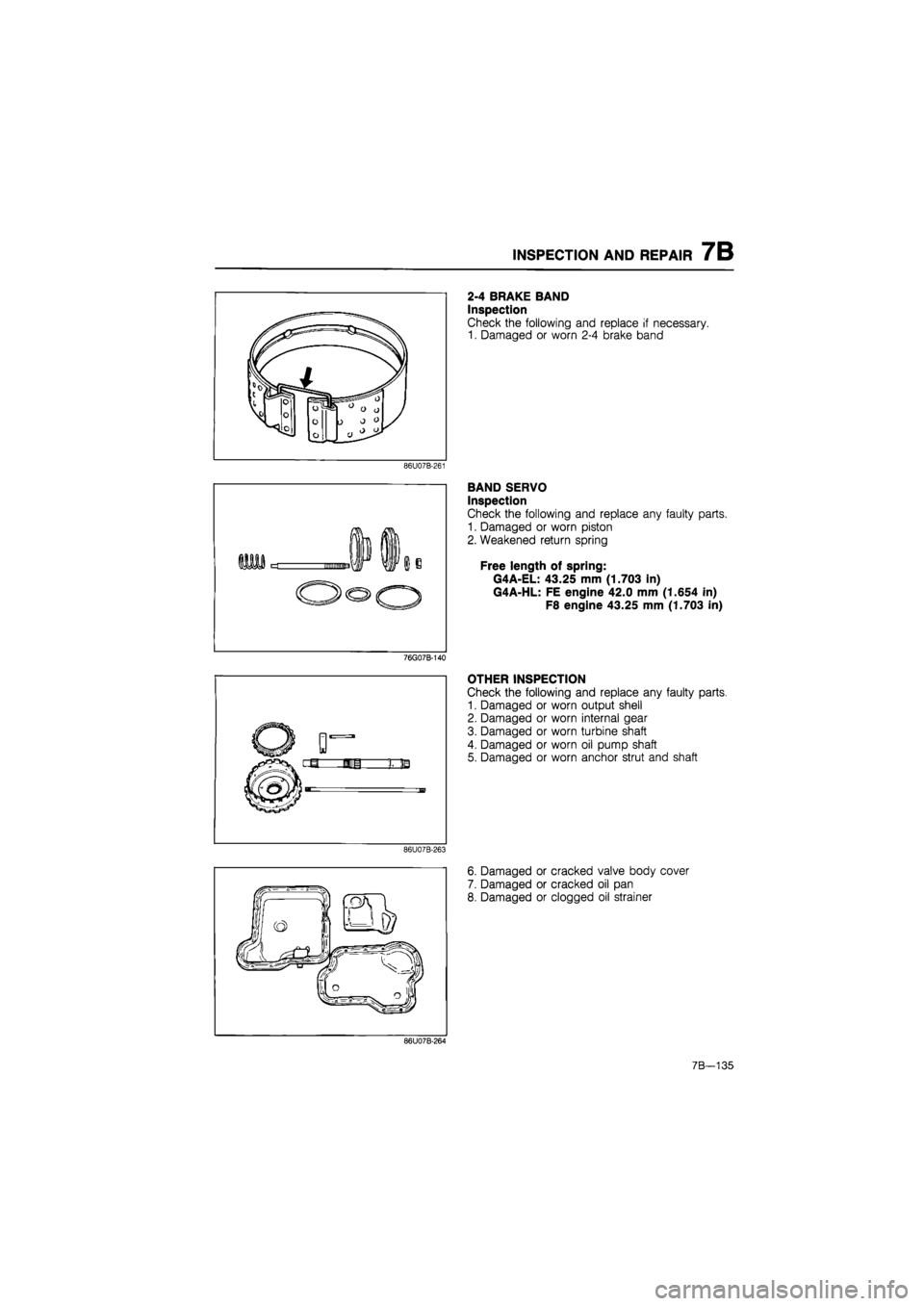
2-4 BRAKE BAND
Inspection
Check the following and replace if necessary.
1. Damaged or worn 2-4 brake band
86U07B-261
BAND SERVO
Inspection
Check the following and replace any faulty parts.
1. Damaged or worn piston
2. Weakened return spring
Free length of spring:
G4A-EL: 43.25 mm (1.703 in)
G4A-HL: FE engine 42.0 mm (1.654 in)
F8 engine 43.25 mm (1.703 in)
76G07B-140
OTHER INSPECTION
Check the following and replace any faulty parts.
1. Damaged or worn output shell
2. Damaged or worn internal gear
3. Damaged or worn turbine shaft
4. Damaged or worn oil pump shaft
5. Damaged or worn anchor strut and shaft
86U07B-263
6. Damaged or cracked valve body cover
7. Damaged or cracked oil pan
8. Damaged or clogged oil strainer
86U07B-264
7B—135
Page 1027 of 1865
INSPECTION AND REPAIR 7B
Inspection
Check the following and replace any faulty parts.
1. Damaged or worn valves
2. Damaged oil passage
3. Cracked or damaged valve body
4. Operation of each valve
5. Weakened spring
Spring
Spring name Outer dia.
mm
(in) Free length
mm (in)
Wire dia.
mm
(in) Spring color
1-2 accumulator small spring F8 engine 9.9 (0.400) 84.7 (3.335) 1.2 (0.047) Red
1-2 accumulator large spring
FE engine 13.0 (0.512) 73.2 (2.881) 1.8 (0.071) Pink 1-2 accumulator large spring F8 engine 16.0 (0.630) 84.7 (3.335) 2.0 (0.079) White
Bypass spring 5.0 (0.197) 25.1 (0.988) 0.7 (0.028) Yellow
Servo control spring 4.9 (0.193) 27.1 (1.067) 0.5 (0.020) Light blue
2-3 timing spring 8.3 (0.327) 26.5 (1.043) 0.8 (0.031)
—
N-R accumulator rear spring 11.1 (0.437) 68.2 (2.685) 1.0 (0.039) Blue
N-D accumulator front spring 9.8 (0.386) 60.9 (2.398) 1.1 (0.043) Yellow
Low reducing spring 8.7 (0.343) 38.3 (1.508) 0.9 (0.035) Black
OD release spring 6.0 (0.236) 32.6 (1.283) 0.6 (0.024) Orange
Coasting bypass spring 5.8 (0.228) 31.3 (1.232) 0.6 (0.024) Yellow
3-2 timing spring 8.2 (0.323) 28.55 (1.124) 0.8 (0.031) Maroon
3-2 capacity spring 5.55 (0.219) 30.5 (1.201) 0.55 (0.022) Light green
Throttle relief ball spring 6.6 (0.260) 20.3 (0.799) 0.8 (0.031) Light green
76G07B-165
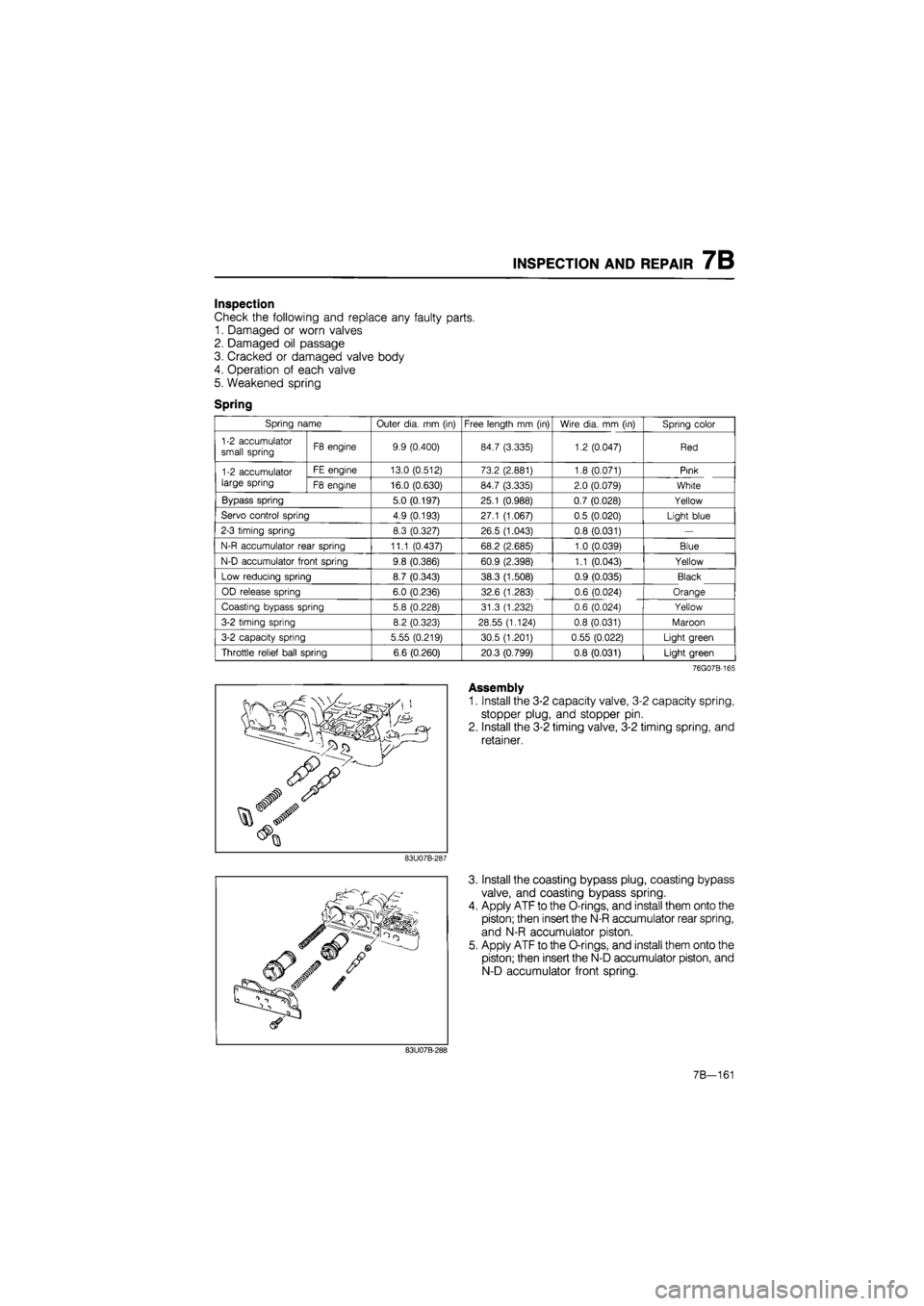
Assembly
1. Install the 3-2 capacity valve, 3-2 capacity spring,
stopper plug, and stopper pin.
2. Install the 3-2 timing valve, 3-2 timing spring, and
retainer.
83U07B-287
3. Install the coasting bypass plug, coasting bypass
valve, and coasting bypass spring.
4. Apply ATF to the O-rings, and install them onto the
piston; then insert the N-R accumulator rear spring,
and N-R accumulator piston.
5. Apply ATF to the O-rings, and install them onto the
piston; then insert the N-D accumulator piston, and
N-D accumulator front spring.
83U07B-288
7B—161
Page 1080 of 1865
7B ASSEMBLY
/ O-ring
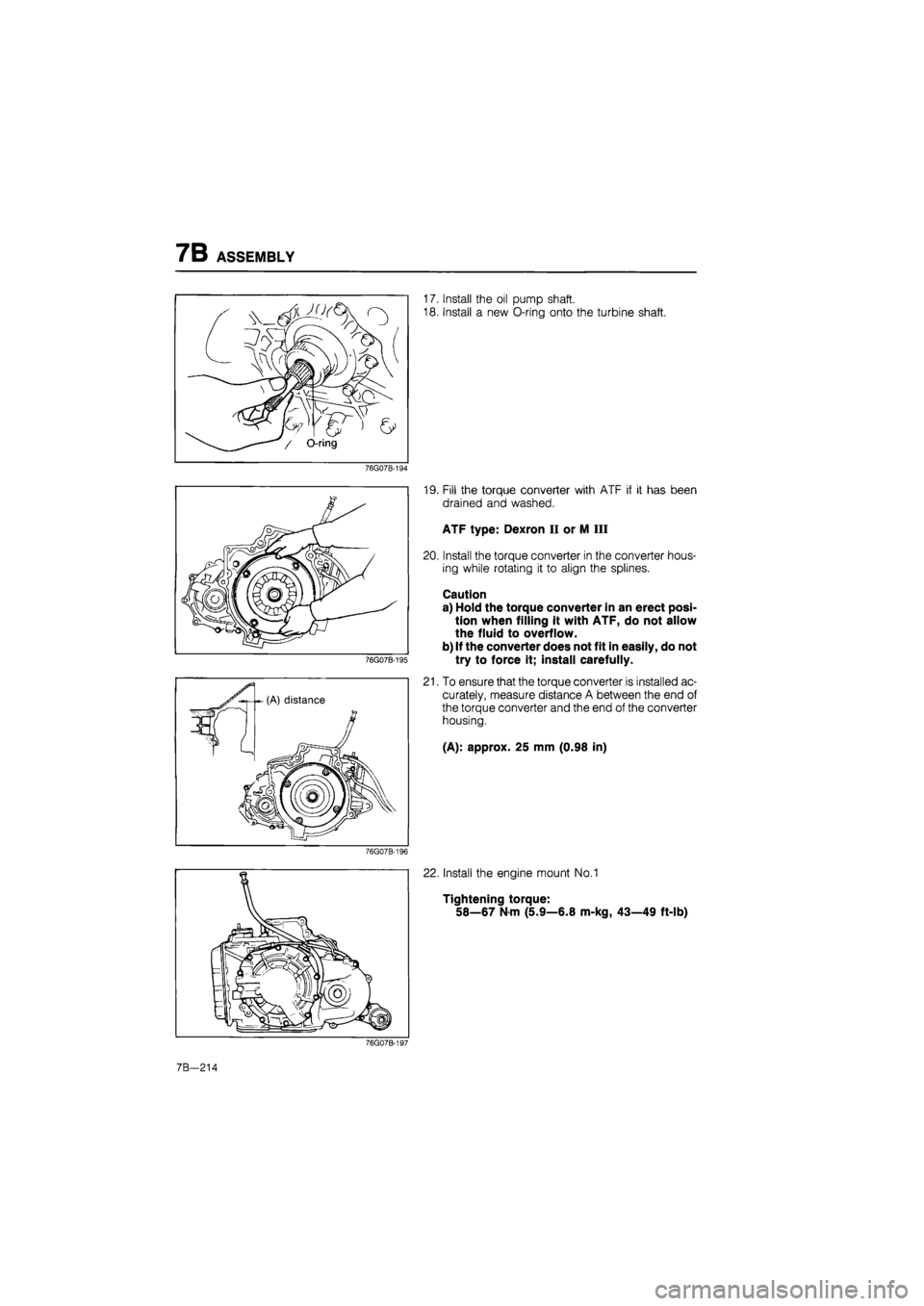
17. Install the oil pump shaft.
18. Install a new O-ring onto the turbine shaft.
76G07B-194
76G07B-195
19. Fill the torque converter with ATF if it has been
drained and washed.
ATF type: Dexron II or M III
20. Install the torque converter in the converter hous-
ing while rotating it to align the splines.
Caution
a) Hold the torque converter in an erect posi-
tion when filling it with ATF, do not allow
the fluid to overflow.
b) If the converter does not fit in easily, do not
try to force it; install carefully.
21. To ensure that the torque converter is installed ac-
curately, measure distance A between the end of
the torque converter and the end of the converter
housing.
(A): approx. 25 mm (0.98 in)
22. Install the engine mount No.1
Tightening torque:
58—67
N
m (5.9—6.8 m-kg, 43—49 ft-lb)
76G07B-197
7B-214
Page 1084 of 1865
7B INSTALLATION
86U07B-449
Standard bolt Reamer bolt
86U07B-450
86U07B-451
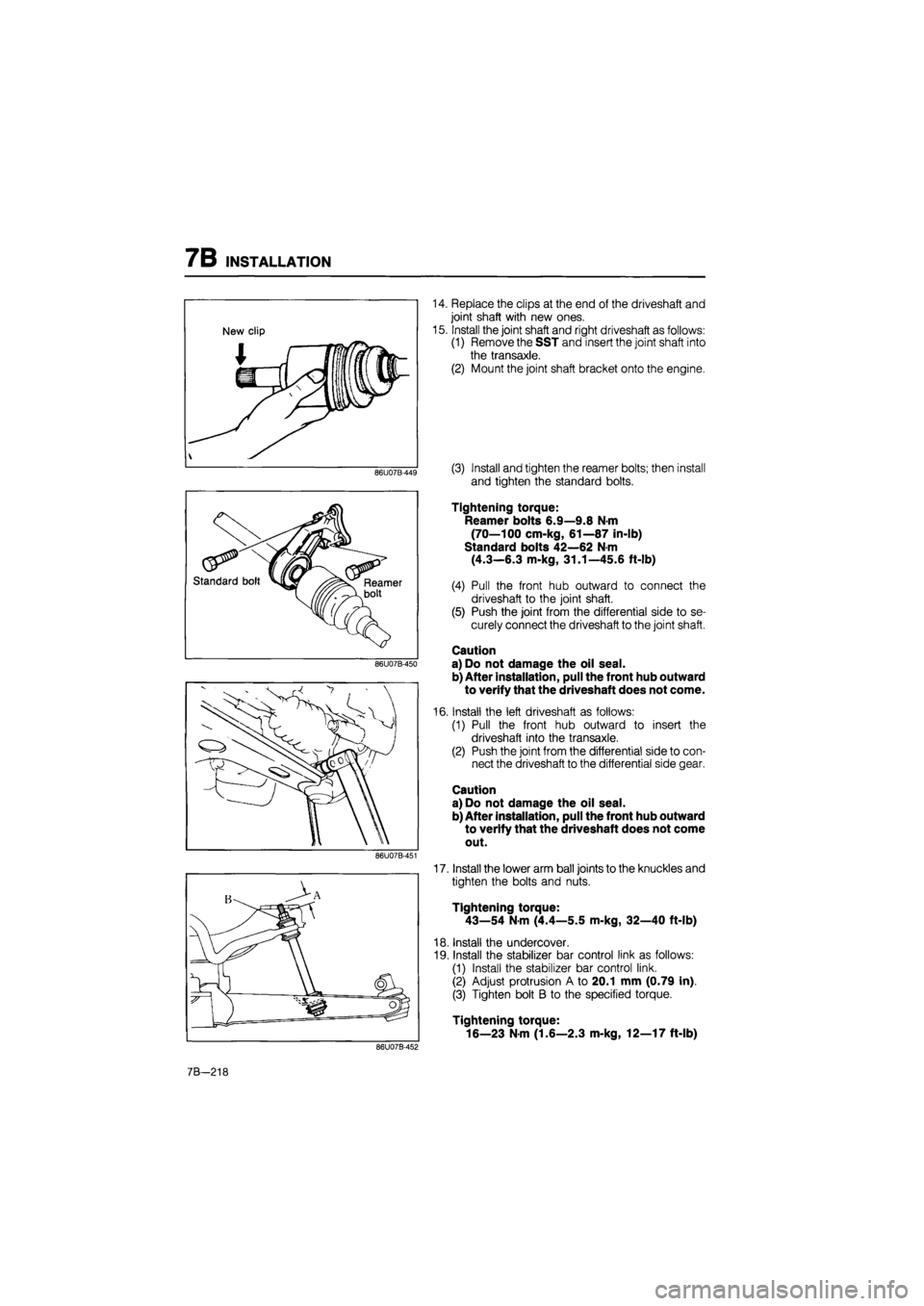
14. Replace the clips at the end of the driveshaft and
joint shaft with new ones.
15. Install the joint shaft and right driveshaft as follows:
(1) Remove the SST and insert the joint shaft into
the transaxle.
(2) Mount the joint shaft bracket onto the engine.
(3) Install and tighten the reamer bolts; then install
and tighten the standard bolts.
Tightening torque:
Reamer bolts 6.9—9.8 N-m
(70—100 cm-kg, 61—87 in-lb)
Standard bolts 42—62 N-m
(4.3—6.3 m-kg, 31.1—45.6 ft-lb)
(4) Pull the front hub outward to connect the
driveshaft to the joint shaft.
(5) Push the joint from the differential side to se-
curely connect the driveshaft to the joint shaft.
Caution
a) Do not damage the oil seal.
b) After installation, pull the front hub outward
to verify that the driveshaft does not come.
16. Install the left driveshaft as follows:
(1) Pull the front hub outward to insert the
driveshaft into the transaxle.
(2) Push the joint from the differential side to con-
nect the driveshaft to the differential side gear.
Caution
a) Do not damage the oil seal.
b) After installation, pull the front hub outward
to verify that the driveshaft does not come
out.
17. Install the lower arm ball joints to the knuckles and
tighten the bolts and nuts.
Tightening torque:
43—54 N-m (4.4—5.5 m-kg, 32—40 ft-lb)
18. Install the undercover.
19. Install the stabilizer bar control link as follows:
(1) Install the stabilizer bar control link.
(2) Adjust protrusion A to 20.1 mm (0.79 in).
(3) Tighten bolt B to the specified torque.
Tightening torque:
16—23 N-m (1.6—2.3 m-kg, 12—17 ft-lb)
86U07B-452
7B-218
Page 1122 of 1865
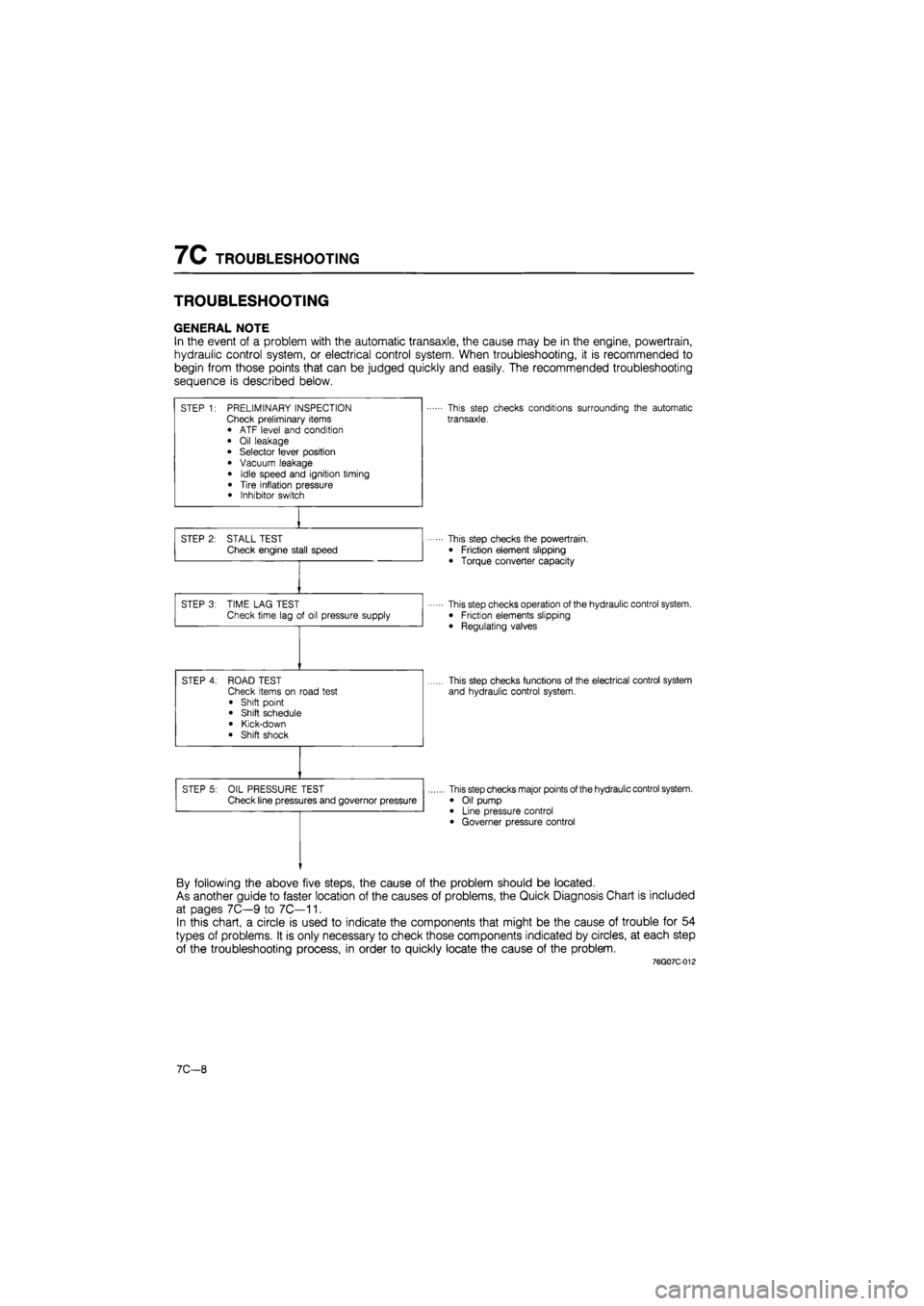
7C TROUBLESHOOTING
TROUBLESHOOTING
GENERAL NOTE
In the event of a problem with the automatic transaxle, the cause may be in the engine, powertrain,
hydraulic control system, or electrical control system. When troubleshooting, it is recommended to
begin from those points that can be judged quickly and easily. The recommended troubleshooting
sequence is described below.
STEP 1: PRELIMINARY INSPECTION Check preliminary items • ATF level and condition
• Oil leakage • Selector lever position
• Vacuum leakage
• Idle speed and ignition timing
• Tire inflation pressure • Inhibitor switch
This step checks conditions surrounding the automatic
transaxle.
STEP 2: STALL TEST Check engine stall speed This step checks the powertrain.
• Friction element slipping
• Torque converter capacity
STEP 3: TIME LAG TEST Check time lag of oil pressure supply This step checks operation of the hydraulic control system. • Friction elements slipping
• Regulating valves
STEP 4: ROAD TEST Check items on road test
• Shift point • Shift schedule
• Kick-down • Shift shock
This step checks functions of the electrical control system
and hydraulic control system.
STEP 5: OIL PRESSURE TEST Check line pressures and governor pressure This step checks major points of the hydraulic control system.
• Oil pump • Line pressure control • Governer pressure control
By following the above five steps, the cause of the problem should be located.
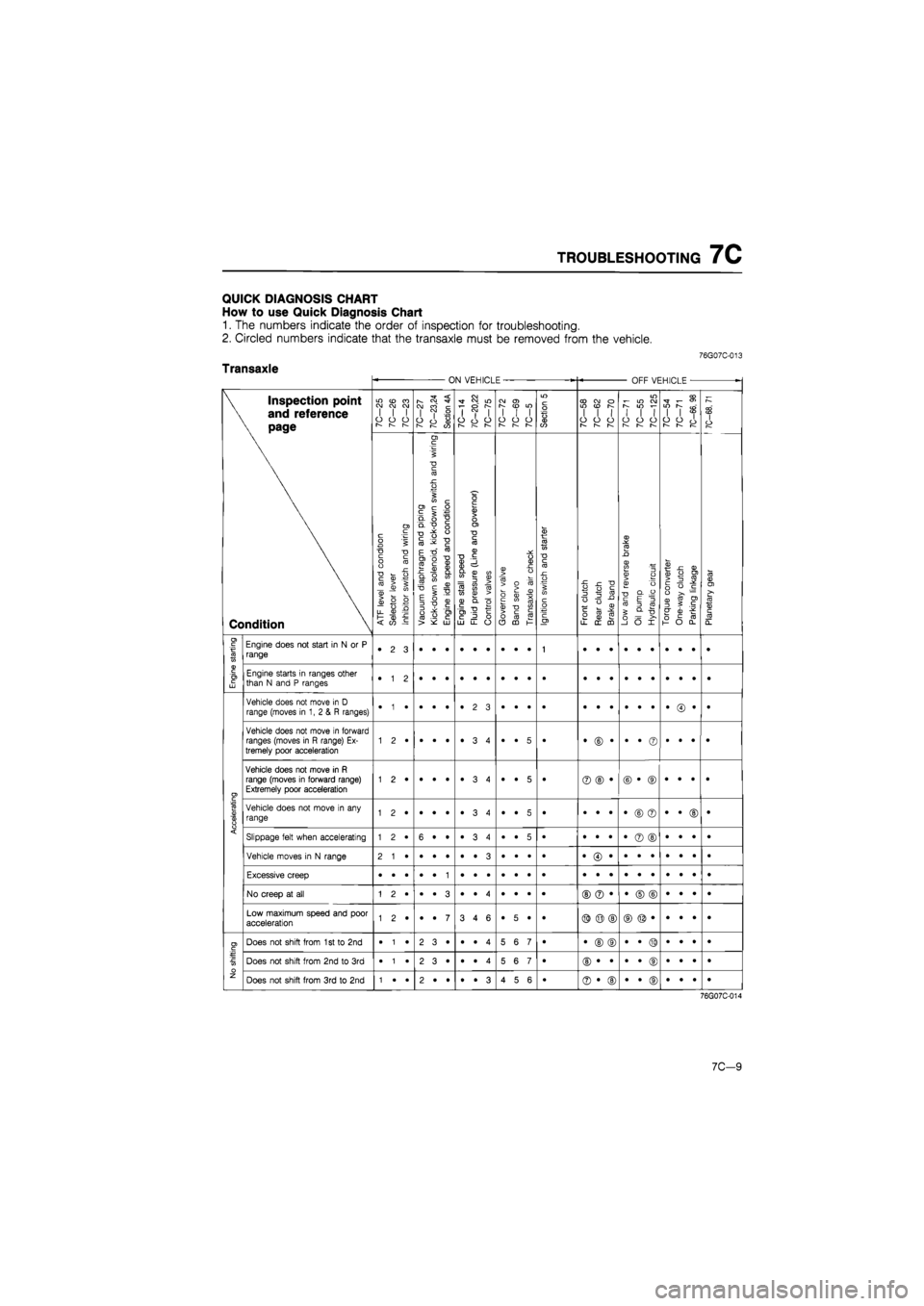
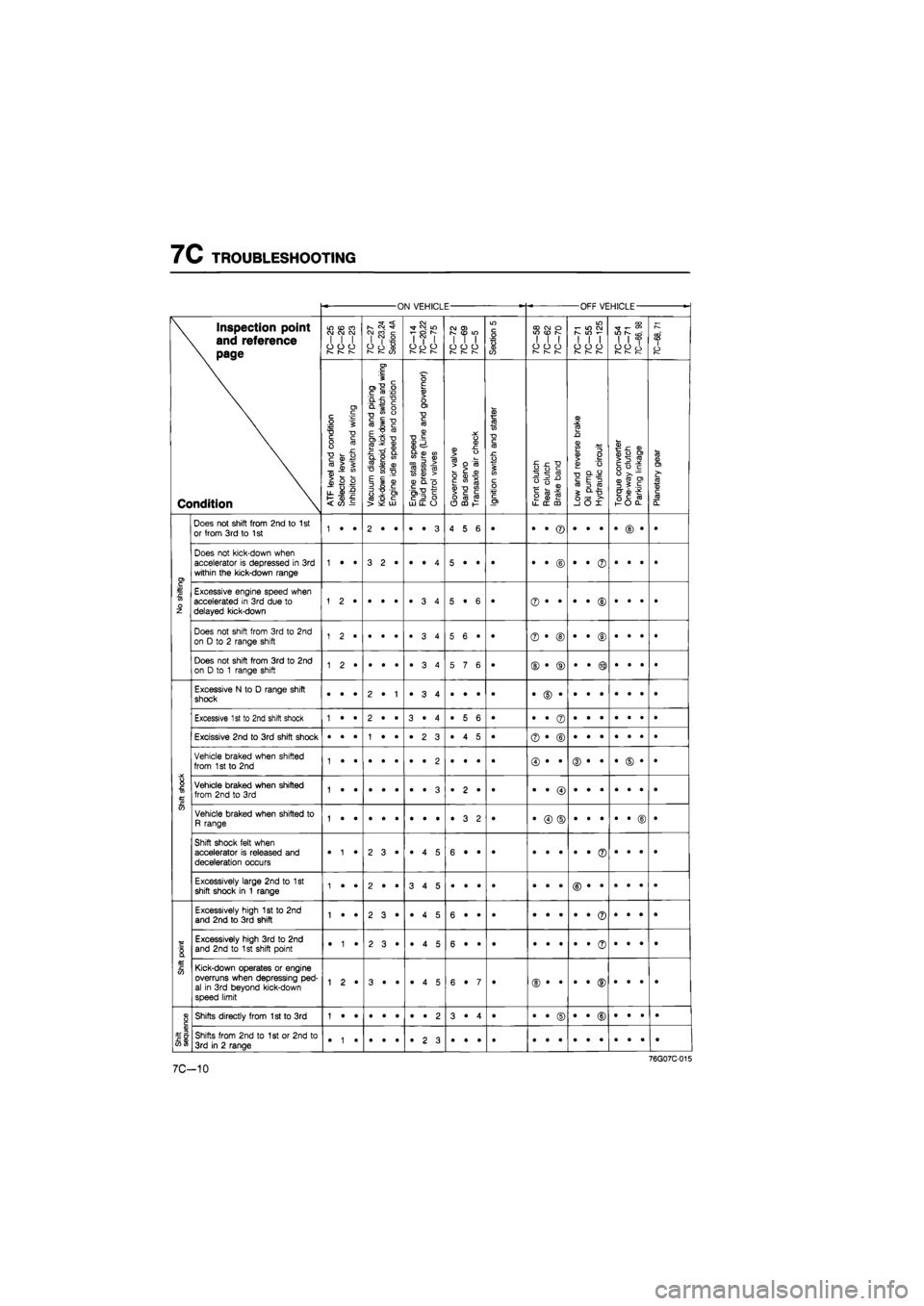
As another guide to faster location of the causes of problems, the Quick Diagnosis Chart is included
at pages 7C—9 to 7C—11.
In this chart, a circle is used to indicate the components that might be the cause of trouble for 54
types of problems. It is only necessary to check those components indicated by circles, at each step
of the troubleshooting process, in order to quickly locate the cause of the problem.
76G07C-012
7C—8
Page 1123 of 1865
TROUBLESHOOTING
7C
QUICK DIAGNOSIS CHART
How
to use
Quick Diagnosis Chart
1.
The
numbers indicate
the
order
of
inspection
for
troubleshooting.
2. Circled numbers indicate that
the
transaxle must
be
removed from
the
vehicle.
76G07C-013
Transaxle ON VEHICLE OFF VEHICLE
•
\ Inspection point
\
and
reference
\ page
Condition
7C-25
7C-26
7C-23
10—21
7C—23,24
Section
4A
7C-14
7C—20,22
10—lb
10-12 10—69
7C—5
Section
5
7C—58
7C-62
7C-70
7C-71
7C-55
7C-125
7C-54 7C-71
7C-66,
98
7C-68,
71
\ Inspection point
\
and
reference
\ page
Condition
ATF
level
and
condition
Selector
lever
Inhibitor
switch
and
wiring
^
Vacuum
diaphragm
and
piping
|
Kick-down
solenoid,
kick-down
switch
and
wiring
Engine
idle
speed
and
condition
Engine
stall
speed
Fluid
pressure
(Line
and
governor)
Control
valves
Governor
valve
Band
servo
Transaxle
air
check
Ignition
switch
and
starter
Front
clutch
Rear
clutch
Brake
band
Low
and
reverse
brake
Oil
pump Hydraulic
circuit
Torque
converter
One-way
clutch
Parking
linkage
Planetary
gear
I
Engine
starting
Engine does
not
start
in
N or P
range •
2 3
1
Engine
starting
Engine starts
in
ranges other than
N
and P
ranges •
1 2
Accelerating
Vehicle does
not
move
in
D
range (moves
in 1, 2 & R
ranges) •
• •
•
Accelerating
Vehicle does
not
move
in
forward ranges (moves
in R
range)
Ex-
tremely poor acceleration •
• 5
• •
© •
•
• ©
•
• •
•
Accelerating
Vehicle does
not
move
in R
range (moves
in
forward range) Extremely poor acceleration 1
2 •
•
• •
•
3 4
•
• 5
• ©
© •
©
• ©
•
• •
•
Accelerating
Vehicle does
not
move
in any
range 1
2 •
•
• •
•
3 4
•
• 5
• •
• •
•
© ©
•
• ©
•
Accelerating Slippage felt when accelerating 1
2 •
6
• •
•ST
CO
•
•
• 5
• •
• •
•
© ©
•
• •
• Accelerating
Vehicle moves
in
N
range
Accelerating
Excessive creep
Accelerating
No creep
at all
©
© •
•
© ©
•
• •
•
Accelerating
Low maximum speed
and
poor acceleration 1
2 •
•
• 7
3
4 6
•
5 •
• ©
© ©
No shifting
Does
not
shift from
1
st to 2nd
•
1 •
2
3 •
•
• 4
5
6 7
• •
© ©
•
• ©
•
• •
•
No shifting
Does
not
shift from
2nd to 3rd
•
1 •
2
3 •
•
• 4
5
6 7
•
No shifting
Does
not
shift from
3rd to 2nd
1
• •
2
• •
•
• 3
4
5 6
• ©
• ©
•
• ©
•
• •
•
76G07C-014
7C-9
Page 1124 of 1865
7C TROUBLESHOOTING
ON VEHICLE OFF VEHICLE
-
\ Inspection point
\ and reference
\ page
Condition
LO
(O
CO CJ OJ CM I
I I
O
O
CJ
r-~
r—
7C-27
7C—23,24
Section
4A
7C—14
7C—20,22
7C-75
CO
O)
I
I I
o
o o
r—
r—
Section
5
CO CO
o
WON I
I I
o
o o
1— 1—
m i-
in co
S
IO
i-
1
1 1
o
o o
—
I—
7C—54
7C-71
7C-66,
98
7C—68,
71
\ Inspection point
\ and reference
\ page
Condition
A.TF
level
and
condition
Selector
lever
Inhibitor
switch
and
wiring
Vacuum
diaphragm
and
piping
Kick-down
solenoid,
kick-down
switch
and
wiring
Engine
idle
speed
and
condition
Engine
stall
speed
Fluid
pressure
(Line
and
governor)
Control
valves
Governor
valve
Band
servo
Transaxle
air
check
Ignition
switch
and
starter
Front
clutch
Rear
clutch
Brake
band
Low
and
reverse
brake
Oil pump Hydraulic
circuit
Torque
converter
One-way
clutch
Parking
linkage
Planetary
gear
No
shifting
Does
not
shift from 2nd
to
1
st or from
3rd to
1
st 1
• •
2
• •
•
• 3
4
5 6
•
No
shifting
Does
not
kick-down when accelerator
is
depressed
in 3rd
within
the
kick-down range 1
• •
3
2*
•
• 4
5
• •
• •
• ©
•
• ©
•
• •
•
No
shifting
Excessive engine speed when accelerated
in 3rd
due
to
delayed kick-down 5
• 6
• ©
• •
•
• ©
•
• •
• No
shifting
Does
not
shift from
3rd to 2nd
on
D to
2
range shift 1
2 •
5
6 •
• ©
• ®
•
• ®
•
• •
•
No
shifting
Does
not
shift from
3rd to 2nd
on
D to 1
range shift 5
7 6
• ©
• ®
•
• ®
•
• •
•
Shift
shock
Excessive
N to
D
range shift shock •
• •
2
• 1
•
3 4
•
• •
• •
© •
•
• •
•
• •
•
Shift
shock
Excessive
1
st
to
2nd shift shock 1
• •
2
• •
3
• 4
•
5 6
• •
• ©
•
• •
•
• •
•
Shift
shock
Excissive 2nd
to 3rd
shift shock •
• •
1
• •
•
2 3
•
4 5
• ©
• ©
Shift
shock
Vehicle braked when shifted from
1
st
to 2nd
Shift
shock
Vehicle braked when shifted from 2nd
to 3rd
1
• •
•
• •
•
• 3
.
2 •
•
Shift
shock
Vehicle braked when shifted
to
R range 1
• •
•
• •
•
• •
•
3 2
• •
© ©
•
• •
•
• ©
•
Shift
shock
Shift shock felt when accelerator
is
released
and
deceleration occurs •
1 •
2
3*
•
4 5
6
• •
• •
• •
•
• ©
•
• *
•
Shift
shock
Excessively large 2nd
to 1st
shift shock
in 1
range 1
• •
2
• •
3
4 5
•
• •
•
Shift
point
Excessively high
1st to 2nd
and 2nd
to
3rd shift 1
• •
2
3 •
•
4 5
6
• •
•
Shift
point
Excessively high
3rd to 2nd
and
2nd to
1
st shift point •
1 •
2
3 •
•
4 5
6
• •
• •
• •
•
• ©
•
• •
•
Shift
point
Kick-down operates
or
engine overruns when depressing
ped-
al
in 3rd
beyond kick-down speed limit
1
2 •
3
• •
•
4 5
6
• 7
•
Shift
sequence
Shifts directly from 1st
to 3rd
1
• •
•
• •
•
• 2
3
• 4
• •
• ©
•
• ©
•
• •
•
Shift
sequence
Shifts from
2nd to 1st or
2nd
to
3rd
in
2
range •
1 •
•
• •
•
2 3
•
• •
•
7C-10