Page 907 of 1865

TROUBLESHOOTING (G4A-HL) 7B
TROUBLESHOOTING (G4A-HL)
GENERAL NOTE
In the event of a problem with the automatic transaxle, the cause may be in the engine, power train,
hydraulic control system, or electrical control system.
When troubleshooting, therefore, it is recommended to begin from those points that can be judged
quickly and easily. The recommended troubleshooting sequence is described below.
STEP 4: TIME LAG TEST
Check time lag of oil pressure supply
STEP 6: OIL PRESSURE TEST Check line, throttle, and governor pressures
This step checks conditions surrounding the automatic
transaxle.
This step checks the electrical control system.
• Function of the electrical control system
• Components
This step checks the power train. • Friction element slipping • Torque converter capacity
This step checks operation of the hydraulic control system. • Accumulators • Friction elements slipping • Regulating valves
This step checks functions of the electric control system and
hydraulic control system.
This step checks major points of the hydraulic control system.
• Oil pump • Line pressure control • Throttle pressure control
• Governer pressure control
STEP 5: ROAD TEST Check items on road test
• Shift point • Shift schedule
• Kick-down • Shift shock • Lock-up and overdrive inhibition
By following the above 6 steps, the cause of the problem should be located.
As another guide to faster location of the causes of problems, the Quick Diagnosis Chart is included
at pages 7B—42, 43.
In this chart, a circle is used to indicate the components that might be the cause of trouble for 20
types of problems. It is only necessary to check those components indicated by circles, at each step
of the troubleshooting process, in order to quickly locate the cause of the problem.
76G07B-040
7B—41
Page 915 of 1865
TROUBLESHOOTING (G4A-HL) 7B
STEP 3 (STALL TEST)
This step is performed to determine if there is slippage of the friction elements or malfunction of the
hydraulic components.
Preparation
Check the following items prior to testing:
1. Engine coolant, engine oil and ATF levels.
2. Warm the engine thoroughly to raise the ATF temperature to operating level (50—80°C, 122—176°F).
3. Engage the parking brake and use wheel chocks at the front and rear wheels.
Pull the parking brake Water temperature
ATF
83U07B-038
7B—49
Page 916 of 1865
7B TROUBLESHOOTING (G4A-HL)
Procedure
76G07B-054
1. Connect a tachometer to the engine.
2. Shift the selector lever to D range.
3. Depress the brake pedal firmly with the left foot and gradually depress the accelerator pedal with
the right foot.
4. Read and note the engine speed as soon as it becomes constant, then release the accelerator pedal.
Caution
Steps 3 to 4 must be performed within 5 seconds.
5. Shift the selector to N range and run the engine at idle speed for at least one minutes.
Note This one minute idle period is performed to cool the ATF and prevent oil degradation.
6. Perform stall tests for the following ranges in the same manner.
(1) 2 range
(2) 1 range
(3) R range
Standard stall speed:
FE engine F8 engine
D.S.L range 2430—2530 rpm D.S.L range 2180—2280 rpm
R range 2390—2490 rpm R range 2140—2240 rpm
Caution
Always provide adequate cooling time between individual range stall tests.
7B-50
Page 917 of 1865

TROUBLESHOOTING (G4A-HL) 7B
Evaluation
Condition Possible cause
Above specification
In all ranges Insufficient line pressure
Worn oil pump
Above specification
In all ranges Insufficient line pressure Oil leakage from oil pump, control valve, and/or transaxle case
Stuck pressure regulator valve
Above specification
In D 2, and 1 One-way clutch 1 slipping
Above specification
In D range only One-way clutch 2 slipping
Above specification In 2 range only 2-4 brake slipping Above specification
In R range only
Low and reverse brake slipping
Above specification
In R range only
Reverse clutch slipping
Above specification
In R range only Perform a road test, to determine if this is caused by the low and reverse brake or the reverse clutch, as follows:
a) Effective engine braking in 1 range Front clutch
b) No engine braking in 1 range Low and reverse brake
Within specification All shift control elements within transaxle are functioning
normally.
Below specification
Engine out of tune
Below specification One-way clutch slipping within torque converter
76G07B-055
7B—51
Page 924 of 1865
7B TROUBLESHOOTING (G4A-HL)
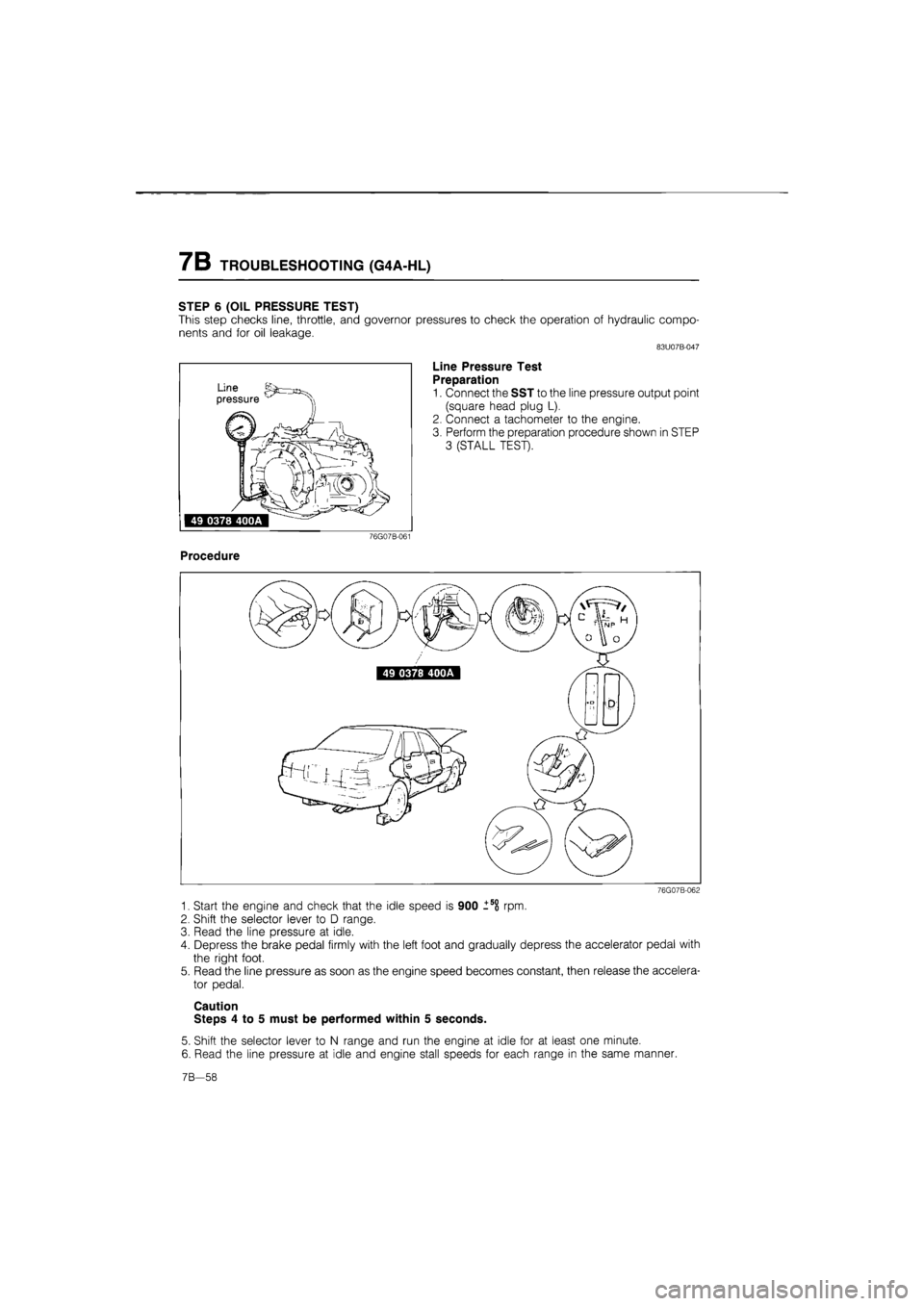
Line Pressure Test
Preparation
1. Connect the SST to the line pressure output point
(square head plug L).
2. Connect a tachometer to the engine.
3. Perform the preparation procedure shown in STEP
3 (STALL TEST).
STEP 6 (OIL PRESSURE TEST)
This step checks line, throttle, and governor pressures to check the operation of hydraulic compo-
nents and for oil leakage.
83U07B-047
Procedure
76G07B-062
1. Start the engine and check that the idle speed is 900 rpm.
2. Shift the selector lever to D range.
3. Read the line pressure at idle.
4. Depress the brake pedal firmly with the left foot and gradually depress the accelerator pedal with
the right foot.
5. Read the line pressure as soon as the engine speed becomes constant, then release the accelera-
tor pedal.
Caution
Steps 4 to 5 must be performed within 5 seconds.
5. Shift the selector lever to N range and run the engine at idle for at least one minute.
6. Read the line pressure at idle and engine stall speeds for each range in the same manner.
7B—58
Page 937 of 1865

ON-VEHICLE MAINTENANCE 7B
ON-VEHICLE MAINTENANCE
AUTOMATIC TRANSAXLE FLUID (ATF)
Inspection for Fluid Leaks
Check for fluid leaks; the following figure shows the locations where fluid leakage may possibly occur.
1. Oil pan
2. Control valve body cover
3. Oil pump
4. Inhibitor switch
5. Speedometer driven gear
6. Pulse generator (G4A-EL)
7. Oil filler tube
8. Throttle cable
9. Bearing cover
76G07B-085
10. Driveshaft
11. Square head plug
12. Transaxle case
13. Drain plug
14. Oil cooler return pipe
15. Oil cooler outlet pipe
16. Fluid temperature switch (G4A-EL)
17. Blind plugs
18. Governor cover (G4A-HL)
Inspection of Level
1. Apply the parking brake and position wheel chocks
to prevent the car from rolling forward.
Note
Place the car on a flat, level surface.
2. Run the engine so that the automatic transaxle fluid
reaches specified temperature.
3. While the engine is idling, shift the select lever from
P to L or P to 1 and back again.
4. Let the engine idle.
5. Shift the select lever to P.
76G07B-086
7B—71
Page 944 of 1865
7B ON-VEHICLE MAINTENANCE
Installation
Install in the reverse order of removal referring to in-
stallation note.
Installation note
Control valve body
Install the control valve body.
Tightening torque: 11—15 N-m
(110—150 cm-kg, 95—130 in-lb)
86U07B-083
Note
a) To place the manual plate in the correct po-
sition of the manual valve, shift into "R" be-
fore installation.
b) Verify that the manual plate and manual
valve are assembled correctly by using a
mirror, then tighten the mounting bolts.
86U07B-084
w v
ATF level
After installation, add ATF, and with the engine idling,
check the fluid level and for leaks.
(Refer to page 7B—71)
76G07B-100
Throttle cable
Adjust the throttle cable with the oil pressure test.
86U07B-086
7B-78
Page 946 of 1865
7B ON-VEHICLE MAINTENANCE
86U07B-091
76G07B-101
76G07B-102
3. Install the magnets on the oil pan as shown and
install the oil pan along with a new gasket.
Tightening torque:
8—11 Nm (80—110 cm-kg, 69—95 in-lb)
4. Add ATF, and with the engine idling, check the fluid
level and for leaks. (Refer to page 7B—71)
ADJUSTMENT OF 2-4 BRAKE BAND
1. Remove the oil pan. (Refer to page 7B—79)
2. Adjust the 2-4 brake band. (Refer to page 7B—211)
REPLACEMENT OF DRIVESHAFT OIL SEAL
Replace the oil seal in the same manner as for the
manual transaxle. (Refer to page 7A—9)
86U07B-094
7B-80


