1987 MAZDA 626 engine oil
[x] Cancel search: engine oilPage 781 of 1865
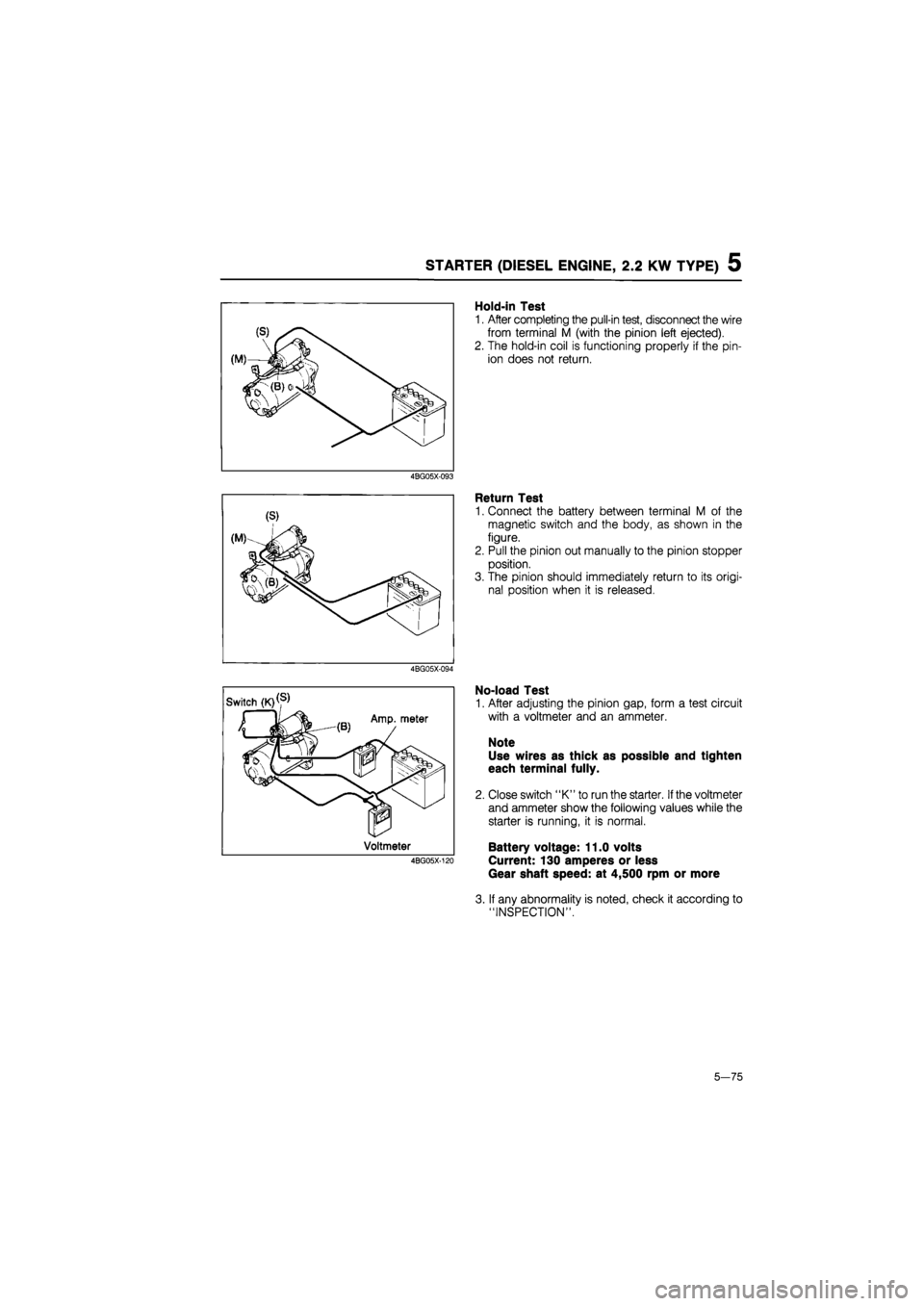
5 STARTER (DIESEL ENGINE, 2.0 KW TYPE)
Hold-in Test
1. After completing the pull-in test, disconnect the wire
from terminal M (with the pinion left ejected).
2. The hold-in coil is functioning properly if the pin-
ion does not return.
4BG05X-093
Return Test
1. Connect the battery between terminal M of the
magnetic switch and the body, as shown in the
figure.
2. Pull the pinion out manually to the pinion stopper
position.
3. The pinion should immediately return to its origi-
nal position when it is released.
4BG05X-094
No-load Test
1. After adjusting the pinion gap, form a test circuit
with a voltmeter and an ammeter.
Note
Use wires as thick as possible and tighten
each terminal fully.
2. Close switch "K" to run the starter.
If
the voltmeter
and ammeter show the following values while the
starter is running, it is normal.
Battery voltage: 11.0 volts
Current: 130 amperes or less
Gear shaft speed: at 4,500 rpm or more
3. If any abnormality is noted, check it according to
"INSPECTION".
5—75
Page 789 of 1865

TROUBLESHOOTING GUIDE 6
SPECIFICATIONS
Item Engine model F6 F8 FE FE DOHC RF-N RF-CX
Clutch control type Hydraulic
Clutch cover type Diaphragm spring
General 3,434
(350,770) 3,846
(392,862) 4,316 (440,968) 3,846
(392,862) —
Set load
N (kg, lb) ECE (Except UK) — 4,022
(410,902) 4,611 (470, 1,034) 4,022 (410, 902)
UK — 3,846
(392,862)
4,611 (470,1,034) 4,316
(440,968)
3,846 (392,862) 4,022 (410,902)
Clutch disc Outer diameter mm (in) 200 (7.874) 215 (8.465) 225 (8.858)
Inner diameter mm (in) 130 (5.118) 150 (5.906)
Pressure plate side
General 4.1 (0.16) —
Thickness Pressure plate side
ECE
(Except UK) — 3.8 (0.15)
mm(in)
Pressure plate side UK 4.1 (0.16)13.8 (0.15) 4.1 (0.16) 3.8 (0.15)
Flywheel side 3.5 (0.14)
Type Suspended
Pedal ratio LHD 6.00
Clutch pedal Pedal ratio RHD 5.96
Full stroke mm (in) 135 (5.31)
Height mm (in) 216.5-221.5 (8.524-8.720)
Master cylinder inner diameter mm (in) 15.87 (0.625)
Release cylinder inner diameter mm (in) 19.05 (0.750)
Clutch fluid type DOT-3 or DOT-4, FMVSS 116, or SAE J1703
76G06X-002
TROUBLESHOOTING GUIDE
Problem Possible Cause Remedy Page
Slipping Clutch disc facing worn excessively Replace 6—17 Clutch disc facing surface hardened or oil on Repair or replace 6-17
surface Pressure plate deformed Repair or replace 6-16 Diaphragm spring damaged or weakened Replace 6-16 Insufficient clutch pedal play Adjust 6—4 Clutch pedal does not function smoothly Repair or replace 6—4, 5 Flywheel deformed Repair or replace 6-18
Faulty Excessive runout or deformity of clutch disc Replace 6-17 disengagement Clutch disc splines rusted or worn Remove rust or 6—17 replace Oil on clutch cover facing surface Repair or replace 6-16 Diaphragm spring weakened Replace 6-16
Excessive clutch pedal play Adjust 6—4, 5
Insufficient clutch fluid Add fluid 6-4
Leakage of clutch fluid Reoair or reDlace —
Clutch vibrates Oil on clutch disc facing surface Repair or replace 6-17 when starting Torsion spring weakened Replace 6-17 Clutch disc facing surface hardened or deformed Repair or replace 6-17
Clutch disc facing rivets loose Replace 6-17 Pressure plate deformed Replace 6-16
Flywheel surface hardened or deformed Repair or replace 6-18
Loose or worn engine mount Tighten or replace —
Clutch pedal Pedal shaft not properly lubricated lubricate or replace 6-5 does not func-tion smoothlv
Abnormal noise Clutch release bearing damaged Replace 6—17 Poor lubrication of clutch release bearing sleeve Lubricate or replace 6-17
Torsion spring weakened Replace 6-17
Excessive crankshaft end play Repair Refer to Section 1 Pilot bearing worn or damaged by heat Replace 6-16
Worn pivot points of release fork • Reoair or replace 6-18
76G06X-003
6-3
Page 810 of 1865

7A OUTLINE
SPECIFICATIONS
•Engine model
Item ——
FE DOHC F6 FE 12-valve
FE 8-valve F8 RF-N RF-CX •Engine model
Item —— Leaded Unleaded F6 FE 12-valve Carb. Fl F8 RF-N RF-CX
Transaxle control Floor shift
Synchromesh system Forward synchromesh, Reverse selective sliding and synchromesh
Gear ratio
1st 3.307
Gear ratio
2nd 1.833
Gear ratio 3rd 1.310 1.233 1.161 Gear ratio
4th 1.030 0.970 0.914 0.861
Gear ratio
5th 0.837 0.795 0.755 0.680
Gear ratio
Reverse 3.166
Final gear ratio 4.105 3.850 4.105 3.850 4.105
Oil Type
ATF: DEXRON-II Above -18°C (0°F): API: GL-4 or GL-5 SAE 80W-90 or SAE 90 Oil
Capacity 3.35 liters (3.6 US qt, 3.9 Imp qt)
76G07A-004
7A—4
Page 811 of 1865

TROUBLESHOOTING GUIDE 7A
TROUBLESHOOTING GUIDE
Problem Possible cause Remedy Page
Change lever won't Seized change lever ball Replace 7A-58 shift smoothly, or is Seized change control rod joint Replace 7A-58
hard to shift Bent change control rod Replace 7A-58
Too much play in Worn change control rod bushing Replace 7A-58 change lever Weak spring of ball or change lever Replace 7A-58 Worn bushing of ball or change lever Replace 7A—58
Difficult to shift Bent change rod Replace 7A—58
No grease in transmission control Lubricate with grease 7A-58
Insufficient oil Add oil 7A-6
Deterioration of oil quality Replace with oil of 7A-6 specified quality
Wear or play of shift fork or shift rod Replace 7 A—18
Wear of synchronizer ring Replace 7A-27
Wear of synchronizer cone of gear Replace 7A-27
Bed contact of synchronizer ring and cone of Replace 7A-27 gear
Excessive longitudinal play of gears Replace 7A-22
Wear of bearing Adjust or replace 7A—22
Wear of synchronizer key spring Replace 7A-27
Excessive shaft gear bearing preload Adjust 7A-37
Improperly adjusted change guide plate Adjust 7A-20
Won't stay in gear Bent change control rod Replace 7A-58
Worn change control rod bushing Replace 7A-58
Weak change lever ball spring Replace 7A-58
Improperly installed extension bar Tighten 7A-58
Wear of shift fork Replace 7A—22
Wear of clutch hub Replace 7A-27
Worn clutch hub sleeve Replace 7A-27
Worn gear sliding part of both shaft gears Replace 7A-26
Worn gear sliding part of each gear Replace 7A-26
Worn steel sliding groove of control end Replace 7 A—18
Weak spring pressing against steel ball Replace 7A-18
Excessive thrust clearance Replace 7A—33,35
Worn bearing Replace 7A—22
Improperly installed engine mount Tighten 7A—49
Abnormal noise Insufficient oil Add oil 7A-6
Deterioration of oil quality Replace 7A-6
Worn bearing Adjust or replace 7A-22
Worn gear sliding surface of both shaft gears Replace 7A—26
Wear of sliding surfaces of gears Replace 7A-26
Excessive thrust clearance Replace 7A—33,35
Damaged gear teeth Replace with oil of 7A-26
specified quality Foreign material in gears Replace 7A-22
Damaged differential gear, or excessive backlash Adjust or replace 7A—30
76G07A-005
7A-5
Page 880 of 1865

7B TROUBLESHOOTING (G4A-EL)
ON VEHICLE-
-f-
—OFF VEHICLE
\ Inspection point
and
\ reference page
Condition
•
Electronic control system Prelim-
inary
Hydraulic
control
system
Power train \ Inspection point
and
\ reference page
Condition
•
7B-66
m CO I m r--
7B-63
i
cn to I m
Section
4B
|
Section
4B
|
ID to i m
CO CO 1 CD
7B-68
|
en CO 1 IX)
to 1 00 r-.
cn CD 1 CO
7B-69
|
1 CD r--
cn s-1 m
Section
4B
r*-cn
S-1 CD h-
"=1-
rJ CO
7 CD r-
(XI o
1 m
cn CM 1 CD
7B-107
|
CD
7 CD 7 m
I
7B-113
I
CO CM
7 CO r-.
m cn
7 CO r-.
cn
7 DO r-
CM CM
7 CO
|
7B-126
CO
1*-r*-
7 m r-
\ Inspection point
and
\ reference page
Condition
•
Brake
light
switch
|
Inhibitor
switch
|
Mode
switch
|
1
CO. •o o X
Idle
switch
Throttle
sensor
|
Water
temp,
switch
|
0 tn c 0) cn
s
ffi
Q tn 01 o Hi >
Pulse
generator
|
"a o c 0) a to CM
TJ O CL ID s CO C\l 3-4
solenoid
|
Lock-up
solenoid
I
ATF
level
and
condition
|
Selector
lever
m Xj CO CJ 03
1 sz
Idle
speed
and
Ignition
timing
Control
valves
Accumulators
Oil
pump
Hydraulic
circuit
Torque
converter
Forward
clutch
Coasting
clutch
Reverse
clutch
JT O
u TT ro 2-4
brake
band
and
servo
$ 2
B cn cii > £ "O C CO
o
XI y
o >. CO S cb a O
One-way
clutch
2
s CI Cn tz JC 5 0-
Planetary
gear
Differential
assembly
Accelerating
Vehicle does
not
move
in
D,
S,
L,
or R
range
O O O O O O O O O O 0
Accelerating
Vehicle moves
in N
range -0 0 -—
Accelerating
Excessive creep
-0 O O -—
Accelerating
No creep
at all
O o o o
o
G 0 O O
Shifting
|
No shift
O O o
o
0 O 0 0
o
o O
Shifting
|
Abnormal shift sequence
0 o O O 0
o
o 0 O o o 0 O
Shifting
|
Frequent shifting 0 o 0 0 o 0 O O 0
Shifting
|
Excessively high
or
low
shift point 0 o 0 O 0 0 o 0 O 0 0
Shifting
|
No lock-up
0 o 0 0 o 0 O O o O
Shifting
|
No kick-down o o o o
Slipping
Engine
run
away
or
slip when
starting vehicle 0 o 0 O o O
Slipping
Engine
run
away
or
slip when
up-
or
down-shifting o o o 0 o O 0 0 O
8 n cn 4S SI V)
Excessive
N to D or N to R
shift shock o O o o o O
8 n cn 4S SI V)
Excessive shift shock when
up-
shifting
or
downshifting o o o o 0 0 0 8 n cn 4S SI V) Excessive shift shock when
changing range 0 0 o 0 o
j
Noise
Transaxle noisy
in N or P
range o o 0 O
j
Noise
Transaxle noisy
in D, S, L,
or
R range o 0 0 O
I
Others
j
No engine braking o O o 0 o o
I
Others
j
No mode change o 0 o o o o o o o
O
o
0
I
Others
j
Transaxle overheats
o o
0 o 0 o 0
I
Others
j
Vehicle moves
in
"P",
or
park-ing gear
not
disengaged when
"P"
is
dis-
engaged
0 O
I
Others
j
Hold indicator flashes o
0
o
0
o
O
o — — —
I
Others
j
Engine will
not
start
o
o
O — — —
76G07B-014
7B—14
Page 893 of 1865

TROUBLESHOOTING (G4A-EL) 7B
STEP 4 (STALL TEST)
This step is performed to determine if there is slippage of the friction elements or malfunction of the
hydraulic components.
Preparation
Check the following items prior to testing:
1. Engine coolant, engine oil and ATF levels.
2. Warm the engine thoroughly to raise the ATF temperature to operating level (50—80°C, 122—176°F).
3. Engage the parking brake and use wheel chocks at the front and rear wheels.
Pull the parking brake Water temperature
ATF
79G07C-084
7B-27
Page 895 of 1865

TROUBLESHOOTING (G4A-EL) 7B
7. Perform the stall test for the following ranges in the same manner.
(1) D range (4) L range
(2) D range (Hold) (5) L range (Hold)
(3) S range (Hold)
Caution
Be sure to allow sufficient cooling time between each stall test.
Engine stall speed: D.S.L range 2170—2270 rpm
R range 2130—2230 rpm
Note
The stall test can be performed with the EC-AT Tester in place of a tachometer.
Drum stall speed indication: 0 rpm
76G0/B-029
Evaluation
Condition Possible cause
Above specification
In all ranges Insufficient line
pressure
Worn oil pump
Above specification
In all ranges Insufficient line
pressure Oil leakage from oil pump, control valve, and/or transmission case
Stuck pressure regulator valve
Above specification
In forward ranges Forward clutch slipping One-way clutch 1 slipping
Above specification
In D range One-way clutch 2 slipping
Above specification
In S (Hold) and L (Hold) ranges Coasting clutch slipping
Above specification In D (Hold) and S (Hold) ranges 2-4 brake band slipping Above specification
In R, L and L (Hold) ranges Low and reverse brake slipping
Above specification
In R range
Low and reverse brake slipping Reverse cluch slipping Perform road test to determine whether problem is low and reverse brake or reverse clutch
a) Engine brake applied in 1st ...Reverse clutch
b) Engine brake not applied in 1st ...Low and reverse brake
Within specification All shift control elements within transmission are func-
tioning normally.
Below specification
Engine out of tune
Below specification One-way clutch slipping within torque converter
86U07B-036
7B-29
Page 897 of 1865

TROUBLESHOOTING (G4A-EL) 7B
STEP 6 (OIL PRESSURE TEST)
This step checks line pressures for checking the hydraulic components and for oil leakage.
Line Pressure Test
Preparation
1. Perform the preparation procedure shown in STEP 4 (STALL TEST).
2. Connect a tachometer to the engine.
3. Connect the SST to the line pressure inspection hole (square head plug L)
Procedure
76G07B-031
1. Start the engine and check the idle speed in P range
Idle speed: 900 -so rpm
2. Shift the selector lever to D range and read the line pressure at idle.
3. Depress the brake pedal firmly with the left foot and gradually depress the accelerator pedal with
the right foot.
4. Read the line pressure as soon as the engine speed becomes constant, then release the accelera-
tor pedal.
Caution
Steps 3 to 4 must be performed within 5 seconds.
5. Shift the selector lever to N range and run the engine at idle for at least one minute.
6. Read the line pressure at idle and engine stall speeds for each range in the same manner.
7B—31