Page 1132 of 2389
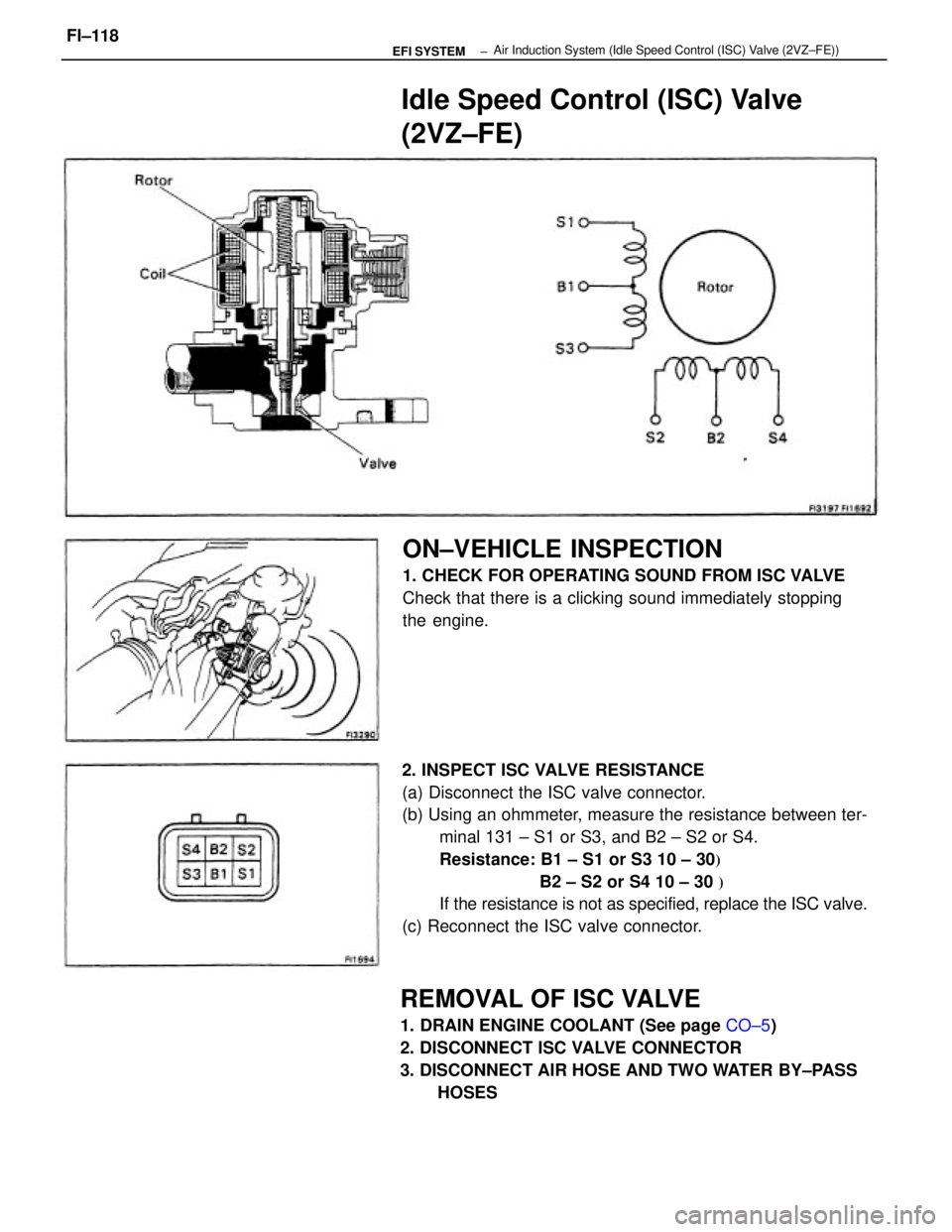
2. INSPECT ISC VALVE RESISTANCE
(a) Disconnect the ISC valve connector.
(b) Using an ohmmeter, measure the resistance between ter-
minal 131 ± S1 or S3, and B2 ± S2 or S4.
Resistance: B1 ± S1 or S3 10 ± 30
�
B2 ± S2 or S4 10 ± 30 �
If the resistance is not as specified, replace the ISC valve.
(c) Reconnect the ISC valve connector.
REMOVAL OF ISC VALVE
1. DRAIN ENGINE COOLANT (See page CO±5)
2. DISCONNECT ISC VALVE CONNECTOR
3. DISCONNECT AIR HOSE AND TWO WATER BY±PASS
HOSES
ON±VEHICLE INSPECTION
1. CHECK FOR OPERATING SOUND FROM ISC VALVE
Check that there is a clicking sound immediately stopping
the engine.
Idle Speed Control (ISC) Valve
(2VZ±FE)
± EFI SYSTEMAir Induction System (Idle Speed Control (ISC) Valve (2VZ±FE))FI±118
Page 1133 of 2389
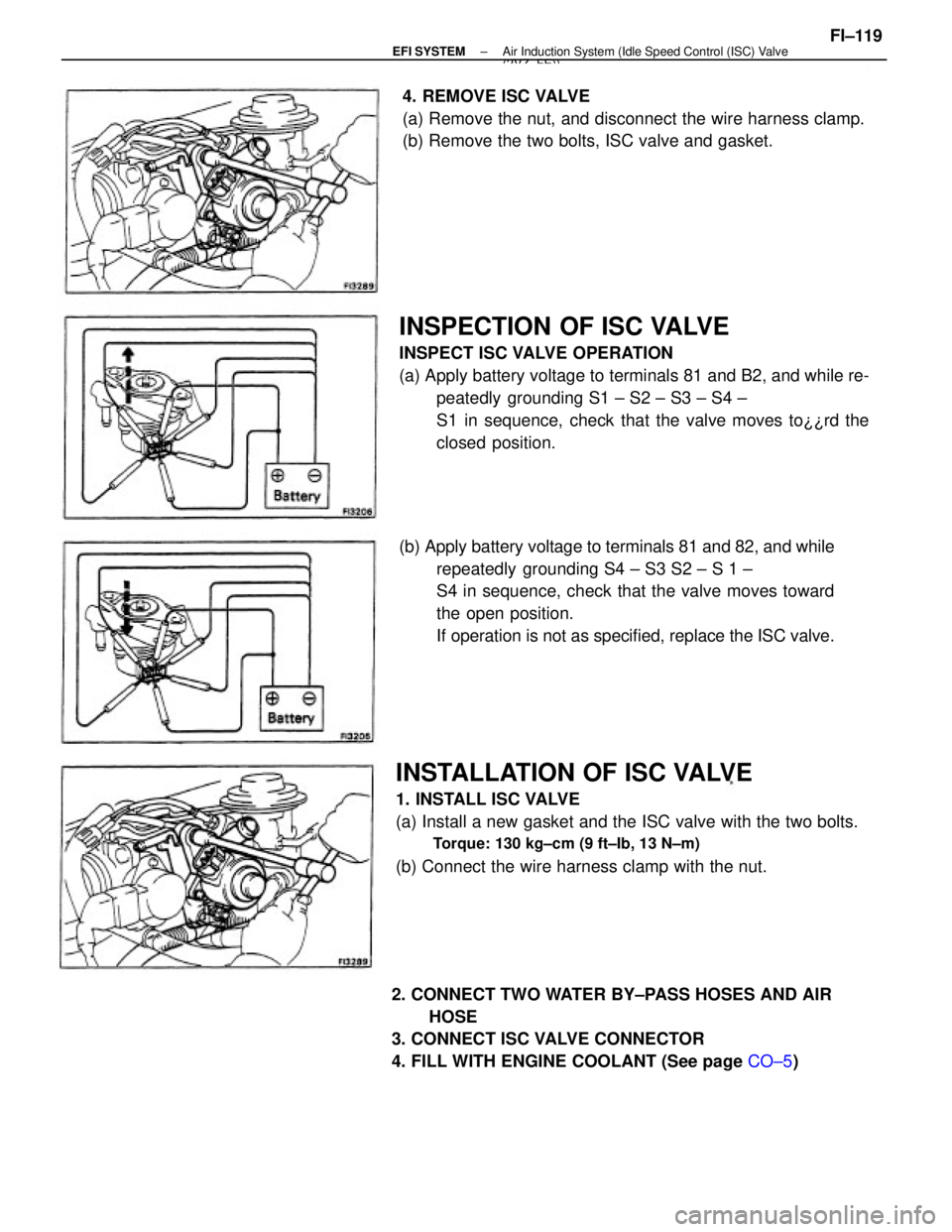
INSTALLATION OF ISC VALVE
1. INSTALL ISC VALVE
(a) Install a new gasket and the ISC valve with the two bolts.
Torque: 130 kg±cm (9 ft±Ib, 13 N±m)
(b) Connect the wire harness clamp with the nut.
INSPECTION OF ISC VALVE
INSPECT ISC VALVE OPERATION
(a) Apply battery voltage to terminals 81 and B2, and while re-
peatedly grounding S1 ± S2 ± S3 ± S4 ±
S1 in sequence, check that the valve moves to¿¿rd the
closed position.
2. CONNECT TWO WATER BY±PASS HOSES AND AIR
HOSE
3. CONNECT ISC VALVE CONNECTOR
4. FILL WITH ENGINE COOLANT (See page CO±5) (b) Apply battery voltage to terminals 81 and 82, and while
repeatedly grounding S4 ± S3 S2 ± S 1 ±
S4 in sequence, check that the valve moves toward
the open position.
If operation is not as specified, replace the ISC valve. 4. REMOVE ISC VALVE
(a) Remove the nut, and disconnect the wire harness clamp.
(b) Remove the two bolts, ISC valve and gasket.
± EFI SYSTEMAir Induction System (Idle Speed Control (ISC) Valve(2VZ FE))
FI±119
Page 1148 of 2389
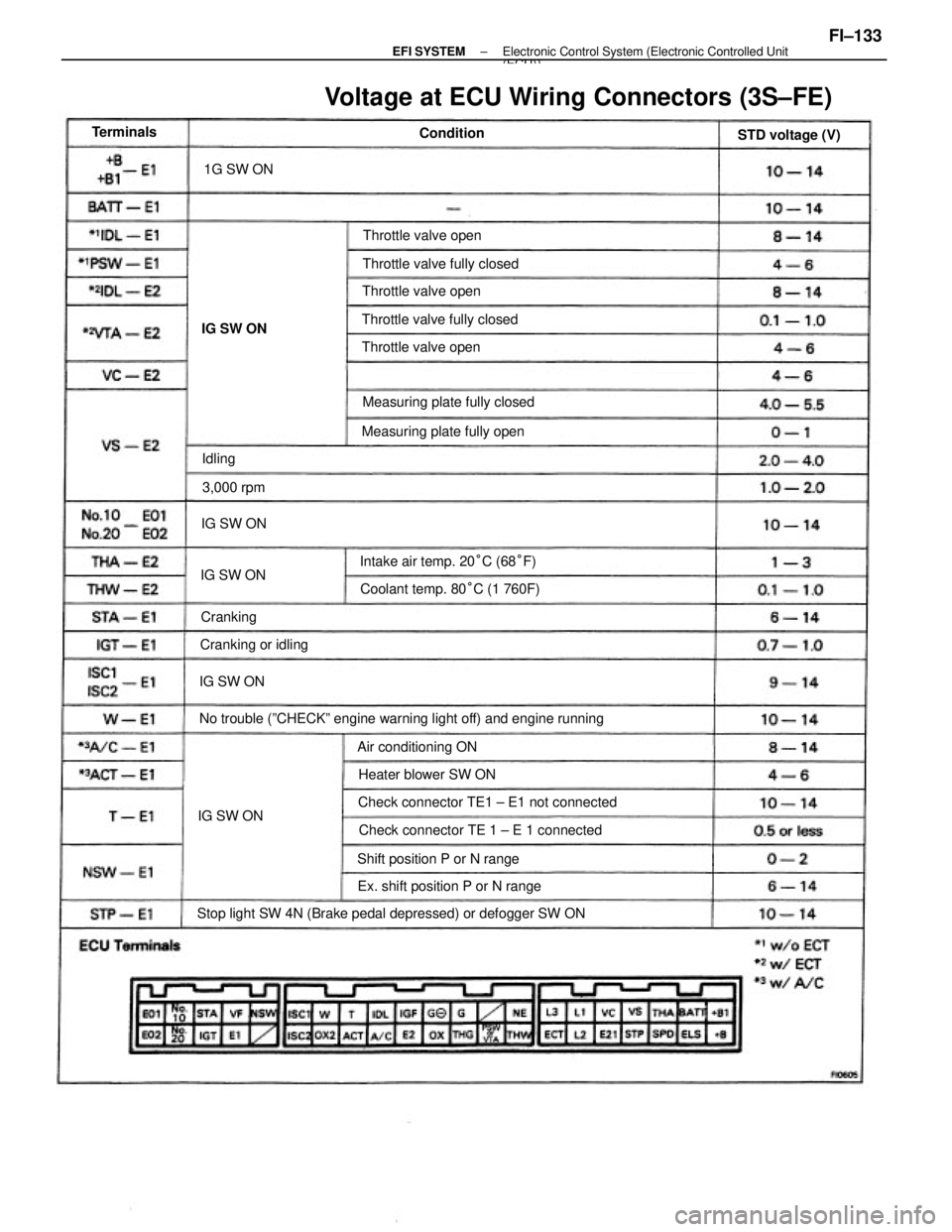
Voltage at ECU Wiring Connectors (3S±FE)
No trouble (ºCHECKº engine warning light off) and engine running
Stop light SW 4N (Brake pedal depressed) or defogger SW ONCheck connector TE1 ± E1 not connected
Check connector TE 1 ± E 1 connectedMeasuring plate fully closed
Ex. shift position P or N rangeIntake air temp. 20°C (68°F)
Coolant temp. 80°C (1 760F) Measuring plate fully open
Shift position P or N rangeThrottle valve fully closedThrottle valve fully closed
Heater blower SW ON Air conditioning ONThrottle valve open
Throttle valve open
Throttle valve open
Cranking or idlingIG SW ONSTD voltage (V) Condition
3,000 rpm
IG SW ONIG SW ON1G SW ON
IG SW ON Terminals
IG SW ON
CrankingIdling
± EFI SYSTEMElectronic Control System (Electronic Controlled Unit(ECU))
FI±133
Page 1149 of 2389
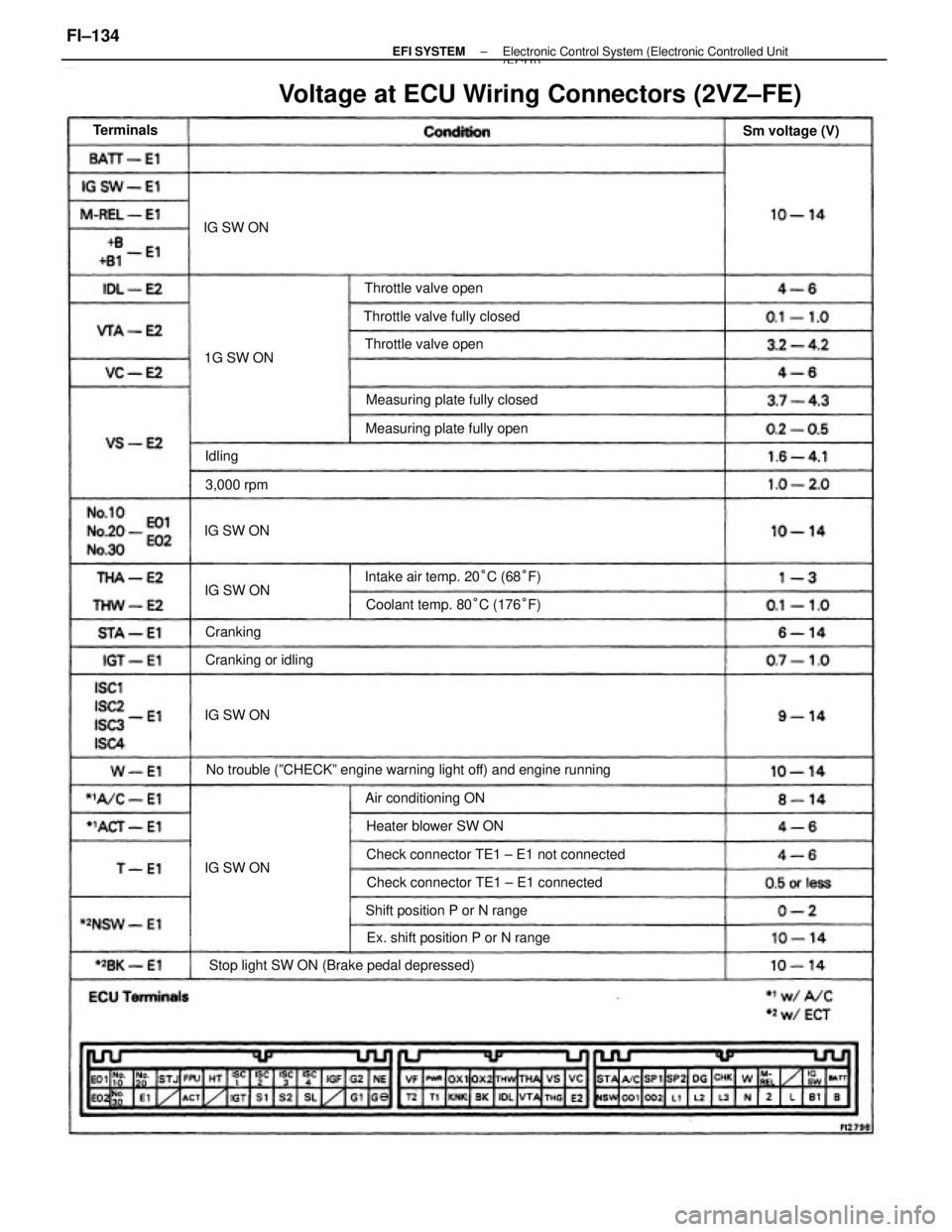
Voltage at ECU Wiring Connectors (2VZ±FE)
No trouble (ºCHECKº engine warning light off) and engine running
Stop light SW ON (Brake pedal depressed)Check connector TE1 ± E1 not connected
Check connector TE1 ± E1 connected
Ex. shift position P or N range Measuring plate fully closed
Intake air temp. 20°C (68°F)
Coolant temp. 80°C (176°F) Measuring plate fully open
Shift position P or N range Throttle valve fully closed
Heater blower SW ON Air conditioning ON Throttle valve open Throttle valve open
Cranking or idlingSm voltage (V)
3,000 rpm IG SW ON
IG SW ON
IG SW ON
IG SW ON
IG SW ON 1G SW ON Terminals
Cranking Idling
± EFI SYSTEMElectronic Control System (Electronic Controlled Unit(ECU))
FI±134
Page 1161 of 2389
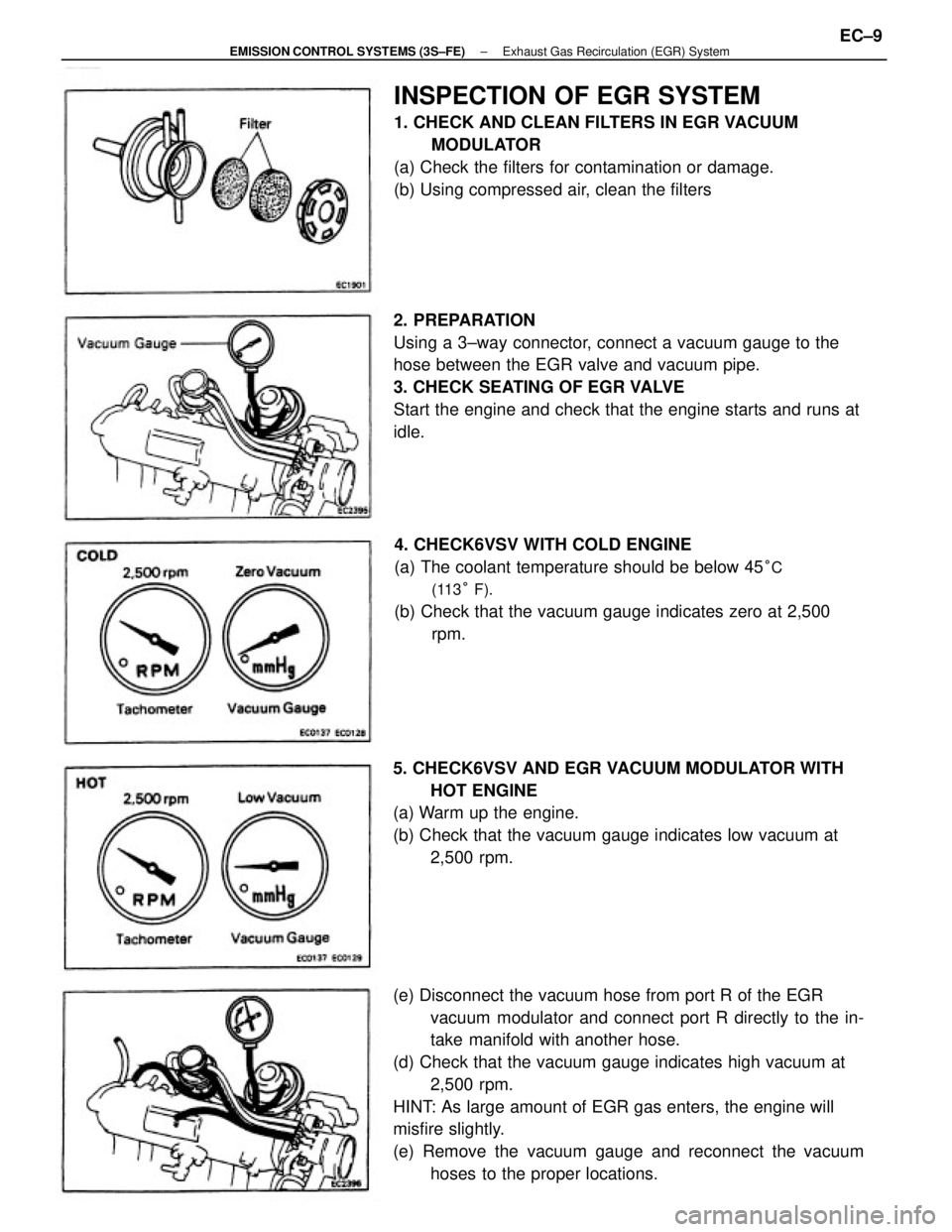
(e) Disconnect the vacuum hose from port R of the EGR
vacuum modulator and connect port R directly to the in-
take manifold with another hose.
(d) Check that the vacuum gauge indicates high vacuum at
2,500 rpm.
HINT: As large amount of EGR gas enters, the engine will
misfire slightly.
(e) Remove the vacuum gauge and reconnect the vacuum
hoses to the proper locations. 2. PREPARATION
Using a 3±way connector, connect a vacuum gauge to the
hose between the EGR valve and vacuum pipe.
3. CHECK SEATING OF EGR VALVE
Start the engine and check that the engine starts and runs at
idle.
5. CHECK6VSV AND EGR VACUUM MODULATOR WITH
HOT ENGINE
(a) Warm up the engine.
(b) Check that the vacuum gauge indicates low vacuum at
2,500 rpm.
INSPECTION OF EGR SYSTEM
1. CHECK AND CLEAN FILTERS IN EGR VACUUM
MODULATOR
(a) Check the filters for contamination or damage.
(b) Using compressed air, clean the filters
4. CHECK6VSV WITH COLD ENGINE
(a) The coolant temperature should be below 45
°C
(113° F).
(b) Check that the vacuum gauge indicates zero at 2,500
rpm.
± EMISSION CONTROL SYSTEMS (3S±FE)Exhaust Gas Recirculation (EGR) SystemEC±9
Page 1162 of 2389
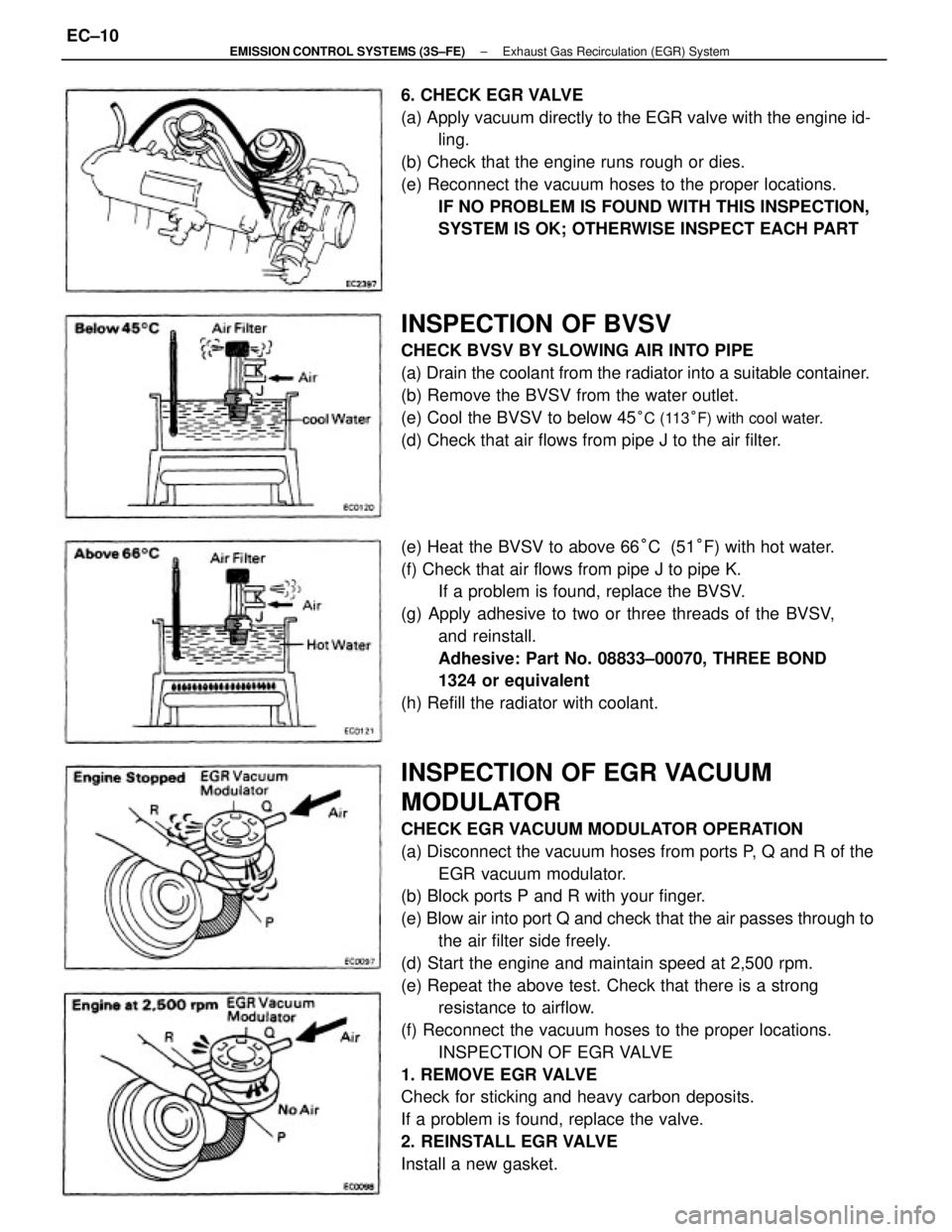
INSPECTION OF EGR VACUUM
MODULATOR
CHECK EGR VACUUM MODULATOR OPERATION
(a) Disconnect the vacuum hoses from ports P, Q and R of the
EGR vacuum modulator.
(b) Block ports P and R with your finger.
(e) Blow air into port Q and check that the air passes through to
the air filter side freely.
(d) Start the engine and maintain speed at 2,500 rpm.
(e) Repeat the above test. Check that there is a strong
resistance to airflow.
(f) Reconnect the vacuum hoses to the proper locations.
INSPECTION OF EGR VALVE
1. REMOVE EGR VALVE
Check for sticking and heavy carbon deposits.
If a problem is found, replace the valve.
2. REINSTALL EGR VALVE
Install a new gasket.
INSPECTION OF BVSV
CHECK BVSV BY SLOWING AIR INTO PIPE
(a) Drain the coolant from the radiator into a suitable container.
(b) Remove the BVSV from the water outlet.
(e) Cool the BVSV to below 45
°C (113°F) with cool water.
(d) Check that air flows from pipe J to the air filter.
(e) Heat the BVSV to above 66°C (51°F) with hot water.
(f) Check that air flows from pipe J to pipe K.
If a problem is found, replace the BVSV.
(g) Apply adhesive to two or three threads of the BVSV,
and reinstall.
Adhesive: Part No. 08833±00070, THREE BOND
1324 or equivalent
(h) Refill the radiator with coolant. 6. CHECK EGR VALVE
(a) Apply vacuum directly to the EGR valve with the engine id-
ling.
(b) Check that the engine runs rough or dies.
(e) Reconnect the vacuum hoses to the proper locations.
IF NO PROBLEM IS FOUND WITH THIS INSPECTION,
SYSTEM IS OK; OTHERWISE INSPECT EACH PART
± EMISSION CONTROL SYSTEMS (3S±FE)Exhaust Gas Recirculation (EGR) SystemEC±10
Page 1174 of 2389
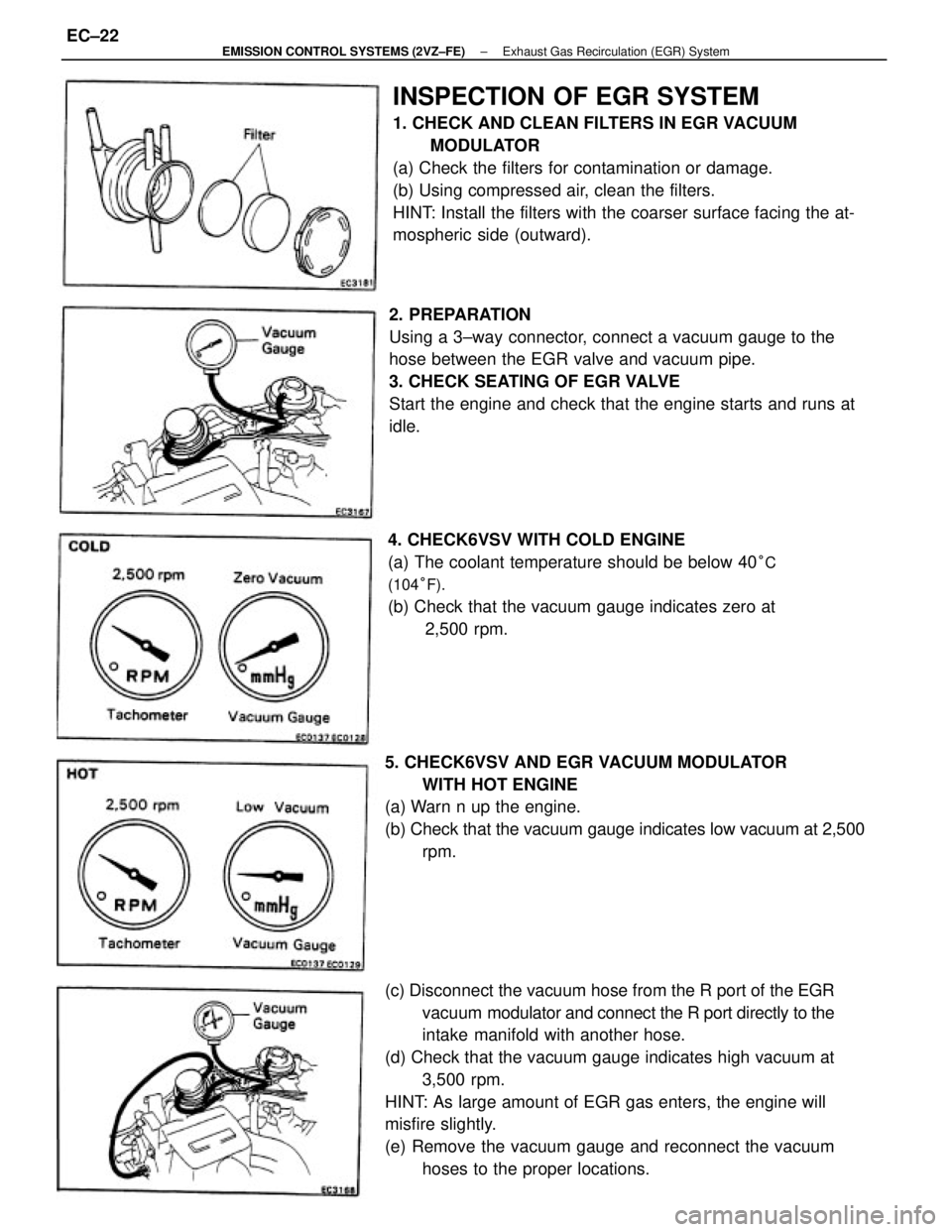
(c) Disconnect the vacuum hose from the R port of the EGR
vacuum modulator and connect the R port directly to the
intake manifold with another hose.
(d) Check that the vacuum gauge indicates high vacuum at
3,500 rpm.
HINT: As large amount of EGR gas enters, the engine will
misfire slightly.
(e) Remove the vacuum gauge and reconnect the vacuum
hoses to the proper locations.
INSPECTION OF EGR SYSTEM
1. CHECK AND CLEAN FILTERS IN EGR VACUUM
MODULATOR
(a) Check the filters for contamination or damage.
(b) Using compressed air, clean the filters.
HINT: Install the filters with the coarser surface facing the at-
mospheric side (outward).
2. PREPARATION
Using a 3±way connector, connect a vacuum gauge to the
hose between the EGR valve and vacuum pipe.
3. CHECK SEATING OF EGR VALVE
Start the engine and check that the engine starts and runs at
idle.
4. CHECK6VSV WITH COLD ENGINE
(a) The coolant temperature should be below 40
°C
(104°F).
(b) Check that the vacuum gauge indicates zero at
2,500 rpm.
5. CHECK6VSV AND EGR VACUUM MODULATOR
WITH HOT ENGINE
(a) Warn n up the engine.
(b) Check that the vacuum gauge indicates low vacuum at 2,500
rpm.
± EMISSION CONTROL SYSTEMS (2VZ±FE)Exhaust Gas Recirculation (EGR) SystemEC±22
Page 1175 of 2389
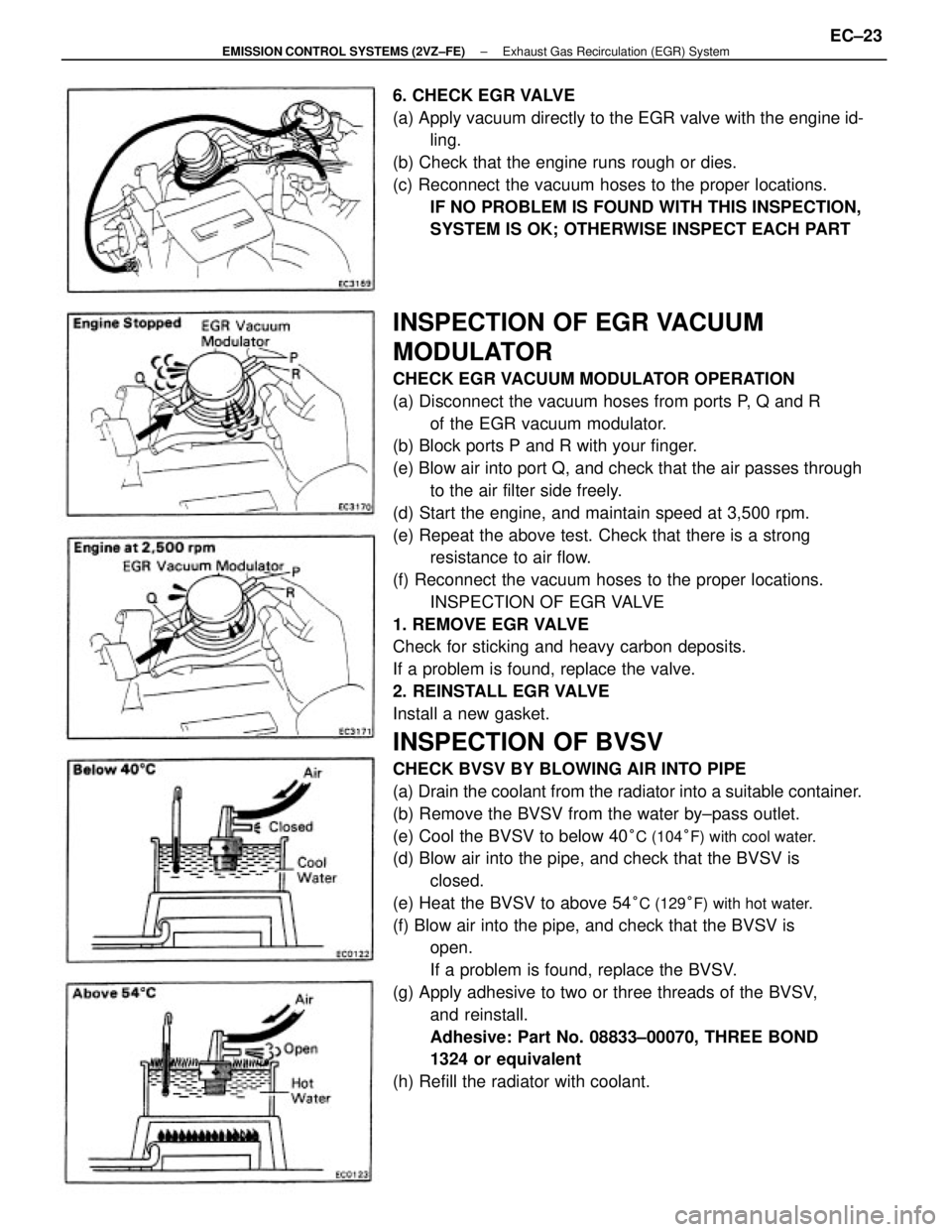
INSPECTION OF EGR VACUUM
MODULATOR
CHECK EGR VACUUM MODULATOR OPERATION
(a) Disconnect the vacuum hoses from ports P, Q and R
of the EGR vacuum modulator.
(b) Block ports P and R with your finger.
(e) Blow air into port Q, and check that the air passes through
to the air filter side freely.
(d) Start the engine, and maintain speed at 3,500 rpm.
(e) Repeat the above test. Check that there is a strong
resistance to air flow.
(f) Reconnect the vacuum hoses to the proper locations.
INSPECTION OF EGR VALVE
1. REMOVE EGR VALVE
Check for sticking and heavy carbon deposits.
If a problem is found, replace the valve.
2. REINSTALL EGR VALVE
Install a new gasket.
INSPECTION OF BVSV
CHECK BVSV BY BLOWING AIR INTO PIPE
(a) Drain the coolant from the radiator into a suitable container.
(b) Remove the BVSV from the water by±pass outlet.
(e) Cool the BVSV to below 40
°C (104°F) with cool water.
(d) Blow air into the pipe, and check that the BVSV is
closed.
(e) Heat the BVSV to above 54
°C (129°F) with hot water.
(f) Blow air into the pipe, and check that the BVSV is
open.
If a problem is found, replace the BVSV.
(g) Apply adhesive to two or three threads of the BVSV,
and reinstall.
Adhesive: Part No. 08833±00070, THREE BOND
1324 or equivalent
(h) Refill the radiator with coolant. 6. CHECK EGR VALVE
(a) Apply vacuum directly to the EGR valve with the engine id-
ling.
(b) Check that the engine runs rough or dies.
(c) Reconnect the vacuum hoses to the proper locations.
IF NO PROBLEM IS FOUND WITH THIS INSPECTION,
SYSTEM IS OK; OTHERWISE INSPECT EACH PART
± EMISSION CONTROL SYSTEMS (2VZ±FE)Exhaust Gas Recirculation (EGR) SystemEC±23