Page 968 of 2389

Rectifiers (Rectifier Holder)
1. INSPECT POSITIVE RECTIFIER
(a) Connect the ohmmeter positive (+) probe to each rectifier
terminal and the negative (±) probe to the positive (+) ter-
minal, and check that there is no continuity.
(b) Reverse the ohmmeter probes, and check that there is con-
tinuity.
If continuity is not as specified, replace the rectifier holder.
2. INSPECT NEGATIVE RECTIFIER
(a) Connect the ohmmeter positive (+) probe to each rectifier
terminal and the negative (±) probe to each negative (±)
terminal, check that there is continuity.
(b) Reverse the ohmmeter probes, and checK that there is no
continuity.
If continuity is not as specified, replace the rectifier holder. (c) Solder the brush wire to the brush holder at specified
exposed length.
Exposed length: 10.5 mm (a.413 in.)
(d) Check that the brush moves smoothly in the brush
holder.
(e) Cut off the excess wire.
(f) Apply insulation paint to the soldered point. 2. IF NECESSARY, REPLACE BRUSHES
(a) Unsolder and remove the brush and spring.
(b) Run the wire of a new brush through the hole in the
brush holder, and insert the spring and brush into the
brush holder.
Bearings
1. INSPECT FRONT BEARING
Check that the bearing is not rough or worn.
± CHARGING SYSTEMAlternatorCH±10
Page 969 of 2389
2. IF NECESSARY, REPLACE FRONT BEARING
(a) Remove the four screws, bearing retainer and bearing.
(c) Using SST and a press, press in a new bearing.
SST 09608±20012 (09608±00030)
3. INSPECT REAR BEARING
Check that the bearing is not rough or worn.(b) Using a socket wrench and press, press out the bear-
ing.
(d) Install the bearing retainer with the four screws.
± CHARGING SYSTEMAlternatorCH±11
Page 970 of 2389

ASSEMBLY OF ALTERNATOR
(See page CH±6)
1. INSTALL ROTOR TO DRIVE END FRAME
2. ASSEMBLE DRIVE END FRAME AND RECTIFIER END
FRAME
(a) Using a plastic±faced hammer, lightly tap in the end frame.
(b) Install the four nuts.
3. INSTALL PULLEY
(a) Install the pulley to the rotor shaft by tightening the
pulley nut by hand.
(b) Hold SST(A)with a torque wrench, and tighten SST (B) clock-
wise to the specified torque.
SST 09820±63010
Torque: 400 kg±cm (29 ft±Ib, 39 N±m)
(c) Check that SST (A) is secured to the pulley shaft.
(d) As shown in the illustration, mount SST (C) in a vise, and
install the alternator to SST (C).
(e) To torque the pulley nut turn SST (A) in the direction
shown in the illustration.
Torque: 1,125 kg±cm (81 ft±Ib, 110 N±m )
(f) Remove the alternator from SST (C).
(g) Turn SST (6) and remove SST (A and6). 4. IF NECESSARY, REPLACE REAR BEARING
(a) Using SST, remove the bearing cover and bearing.
SST 09820±00021
NOTICE: Be careful not to damage the fan.
(b) Using SST and a press, press in a new bearing and
bearing cover.
SST 09285±76010
± CHARGING SYSTEMAlternatorCH±12
Page 971 of 2389
5. INSTALL IC REGULATOR AND BRUSH HOLDER
(a) Install the brush holder cover to the brush holder.
(b) Install the IC regulator together with the brush holder
horizontally as shown.
(c) Install the five screws until there is a clearance of
approx. 1 mm (0.04 in.) between the brush holder and
connector. 4. INSTALL RECTIFIER HOLDER
(a) Install the four rubber insulators on the lead wires.
(b) Install the rectifier holder with the four screws.
(d) Fit the brush holder cover.
± CHARGING SYSTEMAlternatorCH±13
Page 972 of 2389
2. INSTALL DRIVE BELT
Adjust the drive belt tension. (See step 3 on page CH±3)
Drive belt tension:
w/ A/C New belt 175 + 5 lb
Used belt 130+ 10 lb
w/o A/C New belt 125 t 25 Ib
Used belt 95 + 20 Ib
3. CONNECT CONNECTOR AND WIRE TO ALTERNATOR
4. CONNECT CABLE TO NEGATIVE TERMINAL OF
BATTERY
5. PERFORM ON±VEHICLE INSPECTION
(See steps 5 to 7 on pages CH±4 and 5)
INSTALLATION OF ALTERNATOR
(3S±FE)
1. INSTALL ALTERNATOR
Mount the alternator on the alternator brackets with the
pivot bolt and adjusting lock bolt. Do not tighten the bolts
yet. 6. INSTALL REAR END COVER
(a) Install the end cover with the three nuts.
(b) Install the terminal insulator with the nut.
7. CHECK THAT ROTOR ROTATES SMOOTHLY
± CHARGING SYSTEMAlternatorCH±14
Page 973 of 2389
2. INSTALL DRIVE BELT
Adjust the drive belt tension. (See step 3 on page CH±3)
Drive belt tension:
New belt 175 ± 5 Ib
Used belt 115
+ 20 Ib
3. CONNECT CONNECTOR AND WIRE TO ALTERNATOR
4. CONNECT WIRE HARNESS TO CLIP
5. INSTALL NO.2 RH MOUNT STAY
Torque: Bolt 890 kg±cm (64 ft±Ib, 87 N±m)
Nut 530 kg±cm (38 ft±Ib, 52 N±m)
6. CONNECT CABLE TO NEGATIVE TERMINAL OF
BATTERY
7. PERFORM ON±VEHICLE INSPECTION
(See steps 5 to 7 on pages CH±4 and 5)
INSTALLATION OF ALTERNATOR
(2VA±FE)
1. INSTALL ALTERNATOR
Mount the alternator on the alternator bracket with the pivot
bolt and adjusting lock bolt. Do not tighten the bolts yet.
± CHARGING SYSTEMAlternatorCH±15
Page 1025 of 2389
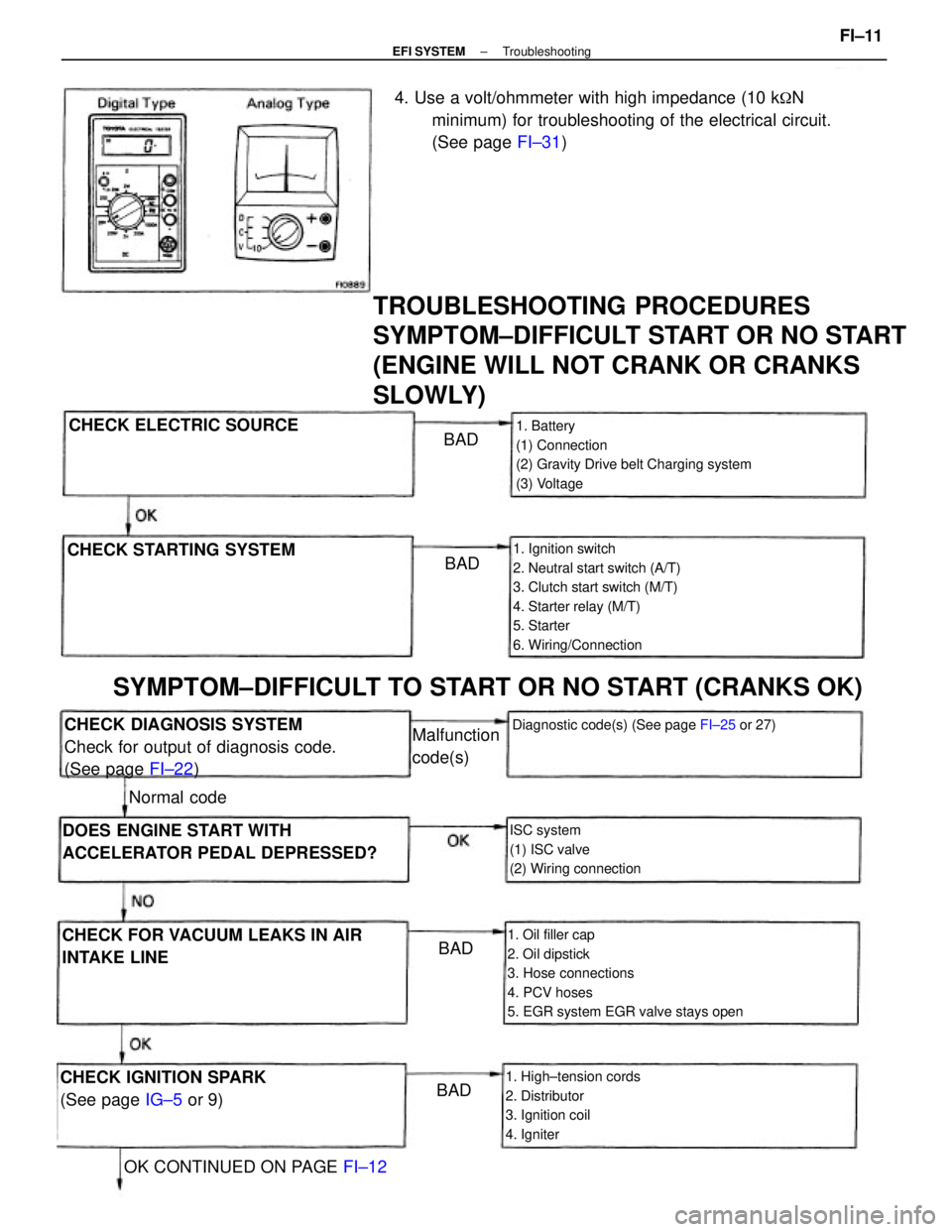
TROUBLESHOOTING PROCEDURES
SYMPTOM±DIFFICULT START OR NO START
(ENGINE WILL NOT CRANK OR CRANKS
SLOWLY)
4. Use a volt/ohmmeter with high impedance (10 k�N
minimum) for troubleshooting of the electrical circuit.
(See page FI±31)
1. Oil filler cap
2. Oil dipstick
3. Hose connections
4. PCV hoses
5. EGR system EGR valve stays open1. Battery
(1) Connection
(2) Gravity Drive belt Charging system
(3) Voltage
1. Ignition switch
2. Neutral start switch (A/T)
3. Clutch start switch (M/T)
4. Starter relay (M/T)
5. Starter
6. Wiring/Connection
SYMPTOM±DIFFICULT TO START OR NO START (CRANKS OK)
CHECK DIAGNOSIS SYSTEM
Check for output of diagnosis code.
(See page FI±22)
1. High±tension cords
2. Distributor
3. Ignition coil
4. Igniter
DOES ENGINE START WITH
ACCELERATOR PEDAL DEPRESSED?
CHECK FOR VACUUM LEAKS IN AIR
INTAKE LINEISC system
(1) ISC valve
(2) Wiring connection
CHECK IGNITION SPARK
(See page IG±5 or 9)
Diagnostic code(s) (See page FI±25 or 27)
OK CONTINUED ON PAGE FI±12 CHECK STARTING SYSTEMCHECK ELECTRIC SOURCE
Malfunction
code(s)
Normal codeBAD BAD
BAD
BAD
± EFI SYSTEMTroubleshootingFI±11
Page 1180 of 2389
The 3S±FE engine is an in±line 4±cylinder engine with the cylinders numbered 1 ± 2 ± 3 ± 4 from the
front.
The crankshaft is supported by 5 bearing inside the crankcase. These bearing are made of aluminum
alloy.
The crankshaft is integrated with 8 weights for balance. Oil holes are placed in the center of the crank-
shaft to supply oil to the connecting rods, bearing, pistons and other components.
This engine's ignition order is 1 ± 3 ± 4 ± 2. The cylinder head is made of aluminum alloy, with a cross
flow type intake and exhaust layout and with pent±roof type combustion chambers. The spark plugs are
located in the center of the combustion chamber.
The intake manifold has 8 independent long ports and utilizes the inertial supercharging effect to im-
prove engine torque at low and medium speeds.
Exhaust and intake valves are equipped with irregular pitch springs made of special valve spring carbon
steel which are capable of functioning no matter what the engine speed.
The intake side camshaft is driven by a timing belt, and a gear on the intake side camshaft engages with
a gear on the exhaust side camshaft to drive it. The cam journal is supported at 5 places between the
valve lifters of each cylinder and on the front end of the cylinder head. Lubrication of the cam journal and
gear is accomplished by oil being supplied through the oiler port in the center of the camshaft.
Adjustment of the valve clearance is done by means of outer shim type system, in which valve adjusting
shims are located above the valve lifters. This permits replacement of the shims without removal of the
camshafts.
The resin timing belt cover is made of 2 pieces. A service hole is provided in the No. 1 belt cover for ad-
justing the timing belt tension.
Piston are made of high temperature±resistant aluminum alloy, and a depression is built into the piston
head to prevent interference with the valves.
Piston pins are the semi±floating type, with the pins fastened to the connecting rods by pressure fitting,
allowing the pistons and pins to float.
The No. 1 compression ring is made of steel and the No. 2 compression ring is made of cast iron. The oil
ring is made of a combination of steel and stainless steel. The outer diameter of each piston ring is
slightly larger than the diameter of the piston and the flexibility of the rings allows them to hug the cylin-
der walls when they are mounted on the piston rings No. 1 and No. 2 work to prevent gas leakage from
the cylinder and oil ring works to clear oil off the cylinder walls to prevent it from entering the combustion
chambers.
The cylinder block is made of cast iron. It has 4 cylinders which are approximately 2 times the length of
the piston stroke. The top of the cylinders is closed off by the cylinder head and the lower end of the cyl-
inders becomes the crankcase, in which the crankshaft is installed. In .addition, the cylinder block con-
tains a water jacket, through which coolant is pumped to cool the cylinders.
The oil pan is bolted onto the bottom of the cylinder block. The oil pan is an oil reservoir made of
pressed steel shoot. A dividing plate is included inside the oil pan to keep sufficient oil in the bottom of
the pan even when the vehicle is tilted. This dividing plate also prevents the oil from making waves when
the vehicle is topped suddenly and thus shifting the oil away from the oil pump suction pipe.
± ENGINE MECHANICALDescription (3S±FE)EM±3


