Page 970 of 2389

ASSEMBLY OF ALTERNATOR
(See page CH±6)
1. INSTALL ROTOR TO DRIVE END FRAME
2. ASSEMBLE DRIVE END FRAME AND RECTIFIER END
FRAME
(a) Using a plastic±faced hammer, lightly tap in the end frame.
(b) Install the four nuts.
3. INSTALL PULLEY
(a) Install the pulley to the rotor shaft by tightening the
pulley nut by hand.
(b) Hold SST(A)with a torque wrench, and tighten SST (B) clock-
wise to the specified torque.
SST 09820±63010
Torque: 400 kg±cm (29 ft±Ib, 39 N±m)
(c) Check that SST (A) is secured to the pulley shaft.
(d) As shown in the illustration, mount SST (C) in a vise, and
install the alternator to SST (C).
(e) To torque the pulley nut turn SST (A) in the direction
shown in the illustration.
Torque: 1,125 kg±cm (81 ft±Ib, 110 N±m )
(f) Remove the alternator from SST (C).
(g) Turn SST (6) and remove SST (A and6). 4. IF NECESSARY, REPLACE REAR BEARING
(a) Using SST, remove the bearing cover and bearing.
SST 09820±00021
NOTICE: Be careful not to damage the fan.
(b) Using SST and a press, press in a new bearing and
bearing cover.
SST 09285±76010
± CHARGING SYSTEMAlternatorCH±12
Page 973 of 2389
2. INSTALL DRIVE BELT
Adjust the drive belt tension. (See step 3 on page CH±3)
Drive belt tension:
New belt 175 ± 5 Ib
Used belt 115
+ 20 Ib
3. CONNECT CONNECTOR AND WIRE TO ALTERNATOR
4. CONNECT WIRE HARNESS TO CLIP
5. INSTALL NO.2 RH MOUNT STAY
Torque: Bolt 890 kg±cm (64 ft±Ib, 87 N±m)
Nut 530 kg±cm (38 ft±Ib, 52 N±m)
6. CONNECT CABLE TO NEGATIVE TERMINAL OF
BATTERY
7. PERFORM ON±VEHICLE INSPECTION
(See steps 5 to 7 on pages CH±4 and 5)
INSTALLATION OF ALTERNATOR
(2VA±FE)
1. INSTALL ALTERNATOR
Mount the alternator on the alternator bracket with the pivot
bolt and adjusting lock bolt. Do not tighten the bolts yet.
± CHARGING SYSTEMAlternatorCH±15
Page 980 of 2389
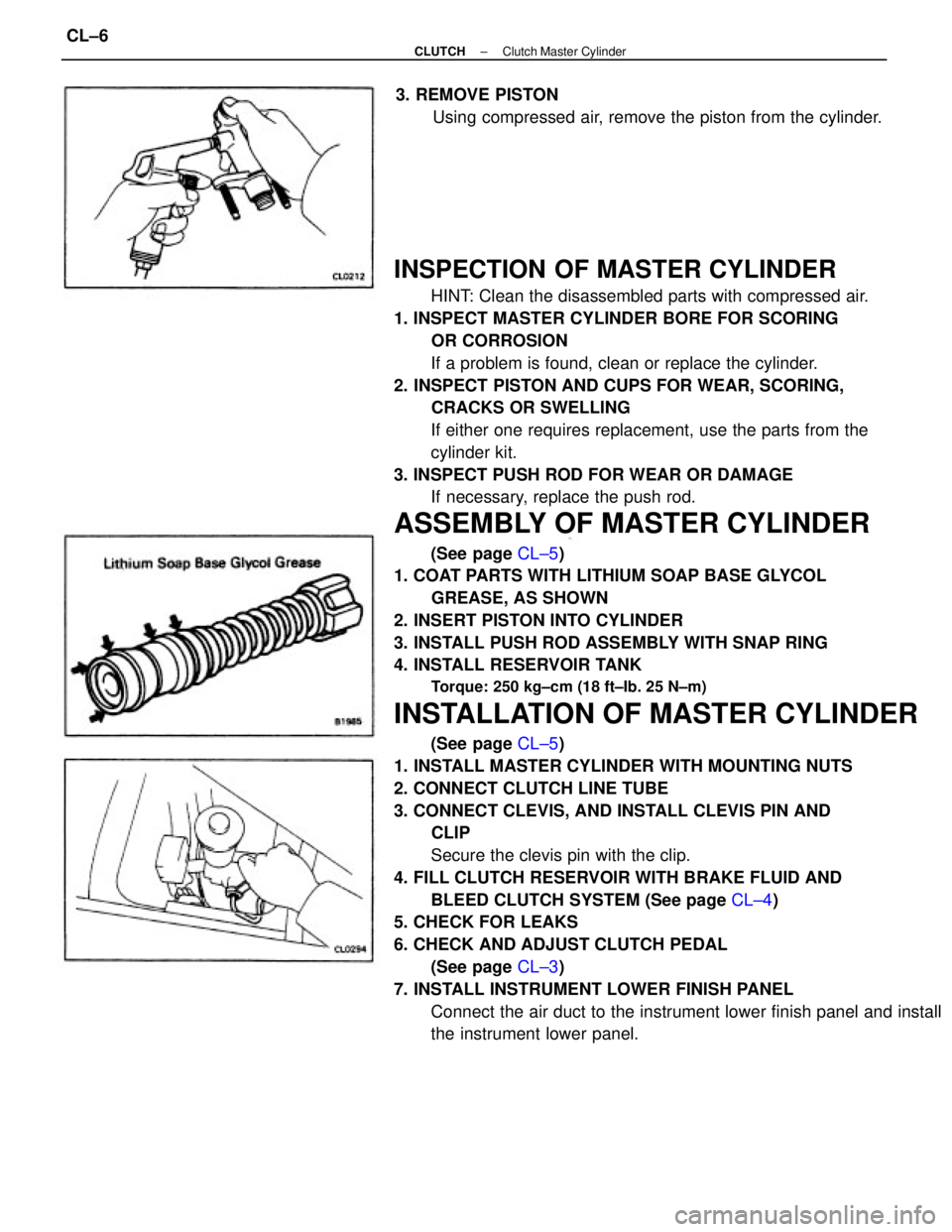
INSPECTION OF MASTER CYLINDER
HINT: Clean the disassembled parts with compressed air.
1. INSPECT MASTER CYLINDER BORE FOR SCORING
OR CORROSION
If a problem is found, clean or replace the cylinder.
2. INSPECT PISTON AND CUPS FOR WEAR, SCORING,
CRACKS OR SWELLING
If either one requires replacement, use the parts from the
cylinder kit.
3. INSPECT PUSH ROD FOR WEAR OR DAMAGE
If necessary, replace the push rod.
ASSEMBLY OF MASTER CYLINDER
(See page CL±5)
1. COAT PARTS WITH LITHIUM SOAP BASE GLYCOL
GREASE, AS SHOWN
2. INSERT PISTON INTO CYLINDER
3. INSTALL PUSH ROD ASSEMBLY WITH SNAP RING
4. INSTALL RESERVOIR TANK
Torque: 250 kg±cm (18 ft±Ib. 25 N±m)
INSTALLATION OF MASTER CYLINDER
(See page CL±5)
1. INSTALL MASTER CYLINDER WITH MOUNTING NUTS
2. CONNECT CLUTCH LINE TUBE
3. CONNECT CLEVIS, AND INSTALL CLEVIS PIN AND
CLIP
Secure the clevis pin with the clip.
4. FILL CLUTCH RESERVOIR WITH BRAKE FLUID AND
BLEED CLUTCH SYSTEM (See page CL±4)
5. CHECK FOR LEAKS
6. CHECK AND ADJUST CLUTCH PEDAL
(See page CL±3)
7. INSTALL INSTRUMENT LOWER FINISH PANEL
Connect the air duct to the instrument lower finish panel and install
the instrument lower panel. 3. REMOVE PISTON
Using compressed air, remove the piston from the cylinder.
± CLUTCHClutch Master CylinderCL±6
Page 982 of 2389
INSPECTION OF RELEASE CYLINDER
HINT: Clean the disassembled part with compressed air.
1. INSPECT RELEASE CYLINDER BORE FOR SCORING
OR CORROSION
If a problem is found, clean or replace the cylinder.
2. INSPECT PISTON AND CUPS FOR WEAR, SCORING.
CRACKS OR SWELLING
If either one requires replacement, use the parts from the
cylinder kit.
3. INSPECT PUSH ROD FOR WEAR OR DAMAGE
If necessary, replace the push rod.
INSTALLATION OF RELEASE CYLINDER
(see page CL±7)
1. INSTALL RELEASE CYLINDER WITH TWO BOLTS
2. CONNECT CLUTCH LINE TUBE
Using SST, connect the tube.
SST. 09751±36011
Torque: 155 kg±cm (11 ft±Ib, 15 N±m)
3. FILL CLUTCH RESERVOIR WITH BRAKE FLUID AND
BLEED CLUTCH SYSTEM
(See page CL±4)
4. CHECK FOR LEAKS
ASSEMBLY OF RELEASE CYLINDER
(see page CL±7)
1. COAT PISTON WITH LITHIUM SOAP BASE GLYCOL
GREASE, AS SHOWN
2. INSERT PISTON WITH SPRING
3. INSTALL BOOT AND INSERT PUSH ROD
± CLUTCHClutch Release CylinderCL±8
Page 985 of 2389

INSTALLATION OF CLUTCH UNIT
(See page CL±8)
1. INSTALL CLUTCH DISC AND COVER ON FLYWHEEL
(a) Insert SST in the clutch disc, and then set them and the cover
in position.
SST S51 Transaxle
09301±32010
E52, E56F5 Transaxle
09301±17010
(b) Align the matchmarks on the clutch cover and flywheel.
(e) Torque the bolts on the clutch cover in the order shown.
Torque: 195 kg±cm (14 ft±Ib, 19 N±m)
HINT: Temporarily tighten the No.1 and No.2 bolts. 5. INSPECT RELEASE BEARING
Turn the bearing by hand while applying force in the axial
direction.
HINT: The bearing is permanently lubricated and requires
no cleaning or lubrication.
If a problem is found, replace the bearing together with the
hub.
2. CHECK DIAPHRAGM SPRING TIP ALIGNMENT
Using a dial indicator with roller instrument, check the
diaphragm spring tip alignment.
Maximum non±alignment: 0.5 mm (0.020 in.)
If alignment is not as specified, using SST, adjust the
diaphragm spring tip alignment.
SST 09333±00013
3. APPLY MOLYBDENUM DISULPHIDE LITHIUM BASE
GREASE(NLGI N0.2) TO FOLLOWING PARTS:
(a) Release fork and hub contact points.
(b) Release fork and push rod contact point.
(e) Release fork pivot point.
± CLUTCHClutch UnitCL±11
Page 990 of 2389

3. (3S±FE)
REPLACE ENGINE COOLANT
(a) Remove the radiator cap.
CAUTION: To avoid the danger of being burned, do not re-
move it while the engine and radiator are still hot
as fluid and steam can be blown out under pressure.
(b) Drain the coolant from the .radiator and engine drain cocks.
(Engine drain cock at the right rear of engine block.)
(c) Close the drain cocks.
Torque (Engine drain cock):
130 kg±cm (9 ft±Ib, 13 N±m) HINT: If the engine tends to overheat, removal of the
thermostat will adversely effect cooling efficiency.
CHECK AND REPLACEMENT OF
ENGINE COOLANT
1. CHECK ENGINE COOLANT LEVEL AT RESERVE TANK
The coolant level should be between the ºLOWº and
ºFULLº lines.
If low, check for leaks and add coolant up to the ºFULLº
line.
Dirt, leaves or insects on radiator or condenser
Hoses, Water pump, thermostat housing, radiator,
heater, core, plugs or head gasket leakage
Thermostat faulty
Incorrect ignition timing
Electric cooling system faulty
Radiator hose plugged or rotted
Water pump faulty
Radiator plugged or cap faulty
Cylinder head or block cracked or water passage
clogged
2. CHECK ENGINE COOLANT QUALITY
There should not be any excessive deposits of rust or scales
around the radiator cap or radiator filler hole, and the cool-
ant should be free from oil.
If excessively dirty, replace the coolant.
Check thermostat
Reset tinning
Inspect electric cooling system
Replace hose
Replace water pump
Check radiator and cap
Repair as necessary
TROUBLESHOOTING
CO±12, 13
IG±17, 20
CO±20, 22 Clean radiator or condenser
Repair as necessary Engine overheats
Possible causeRemedy Problem
CO±6, 9 Page
± COOLING SYSTEM
TroubleshootingCO±4
Page 991 of 2389

3. (3S±FE)
REPLACE ENGINE COOLANT
(a) Remove the radiator cap.
CAUTION: To avoid the danger of being burned, do not re-
move it while the engine and radiator are still hot
as fluid and steam can be blown out under pressure.
(b) Drain the coolant from the .radiator and engine drain cocks.
(Engine drain cock at the right rear of engine block.)
(c) Close the drain cocks.
Torque (Engine drain cock):
130 kg±cm (9 ft±Ib, 13 N±m) HINT: If the engine tends to overheat, removal of the
thermostat will adversely effect cooling efficiency.
CHECK AND REPLACEMENT OF
ENGINE COOLANT
1. CHECK ENGINE COOLANT LEVEL AT RESERVE TANK
The coolant level should be between the ºLOWº and
ºFULLº lines.
If low, check for leaks and add coolant up to the ºFULLº
line.
Dirt, leaves or insects on radiator or condenser
Hoses, Water pump, thermostat housing, radiator,
heater, core, plugs or head gasket leakage
Thermostat faulty
Incorrect ignition timing
Electric cooling system faulty
Radiator hose plugged or rotted
Water pump faulty
Radiator plugged or cap faulty
Cylinder head or block cracked or water passage
clogged
2. CHECK ENGINE COOLANT QUALITY
There should not be any excessive deposits of rust or scales
around the radiator cap or radiator filler hole, and the cool-
ant should be free from oil.
If excessively dirty, replace the coolant.
Check thermostat
Reset tinning
Inspect electric cooling system
Replace hose
Replace water pump
Check radiator and cap
Repair as necessary
TROUBLESHOOTING
CO±12, 13
IG±17, 20
CO±20, 22 Clean radiator or condenser
Repair as necessary Engine overheats
Possible causeRemedy Problem
CO±6, 9 Page
± COOLING SYSTEMCheck and Replacement of Engine CoolantCO±4
Page 992 of 2389

(d) To release the air, loosen the union bolt of the water out-
let five revolutions.
(e) Slowly fill the system with coolant.
Use a good brand of ethylene±glycol base coolant,
mixed according to the manufacturer's directions.
Capacity (w/ Heater):
M/T 9.5 liters (10.0 US qts, 8.4 Imp. qts)
A/T 9.4 liters (9.9 US qts, 8.3 Imp. qts)
(f) Tighten the union bolt of the water outlet.
Torque: 180 kg±cm (13 ft±Ib, 18 N±m)
(g) Install the radiator cap.
(h) Start the engine and check for leaks.
(i) Recheck the coolant level and refill as necessary.
HINT: When the coolant has been depleted, refill with
coolant and repeat steps (d) to (i). 4. (2VZ±FE)
REPLACE ENGINE COOLANT
(a) Remove the radiator cap.
CAUTION: To avoid the danger of being burned, do not re-
move it while the engine and radiator are still hot as fluid
and steam can be blown out under pressure.
(b) Drain the coolant from the radiator and engine drain cocks.
(Engine drain cocks are at the front center and rear right
of the cylinder block.)
(c) Close the drain cocks.
Torque (Engine drain cock):
300 kg±cm (22 ft±Ib, 29 N±m)
NOTICE:
wDo not use alcohol type coolant.
wThe coolant should be mixed with demineralized
water or distilled water.
Capacity (w/ Heater).
M/T 6.4 liters (6.8 US qts, 5.6 Imp. qts)
A/T (2WD) 6.3 liters (6.7 US qts, 5.5 Imp. qts)
A/T (4WD) 6.8 liters (7.2 US qts, 6.0 Imp. qts)
(e) Install the radiator cap.
(f) Start the engine and check for leaks.
(g) Recheck the coolant level and refill as necessary. (d) Fill the system with coolant.
Use a good brand of ethylene±glycol base coolant, mixed
according to the manufacturer's directions.
Using coolant which includes more than 5O%
ethylene±glycol (but less than 70%) is recommended.
± COOLING SYSTEMCheck and Replacement of Engine CoolantCO±5

