1985 FORD GRANADA fuse box
[x] Cancel search: fuse boxPage 243 of 255
REF•8
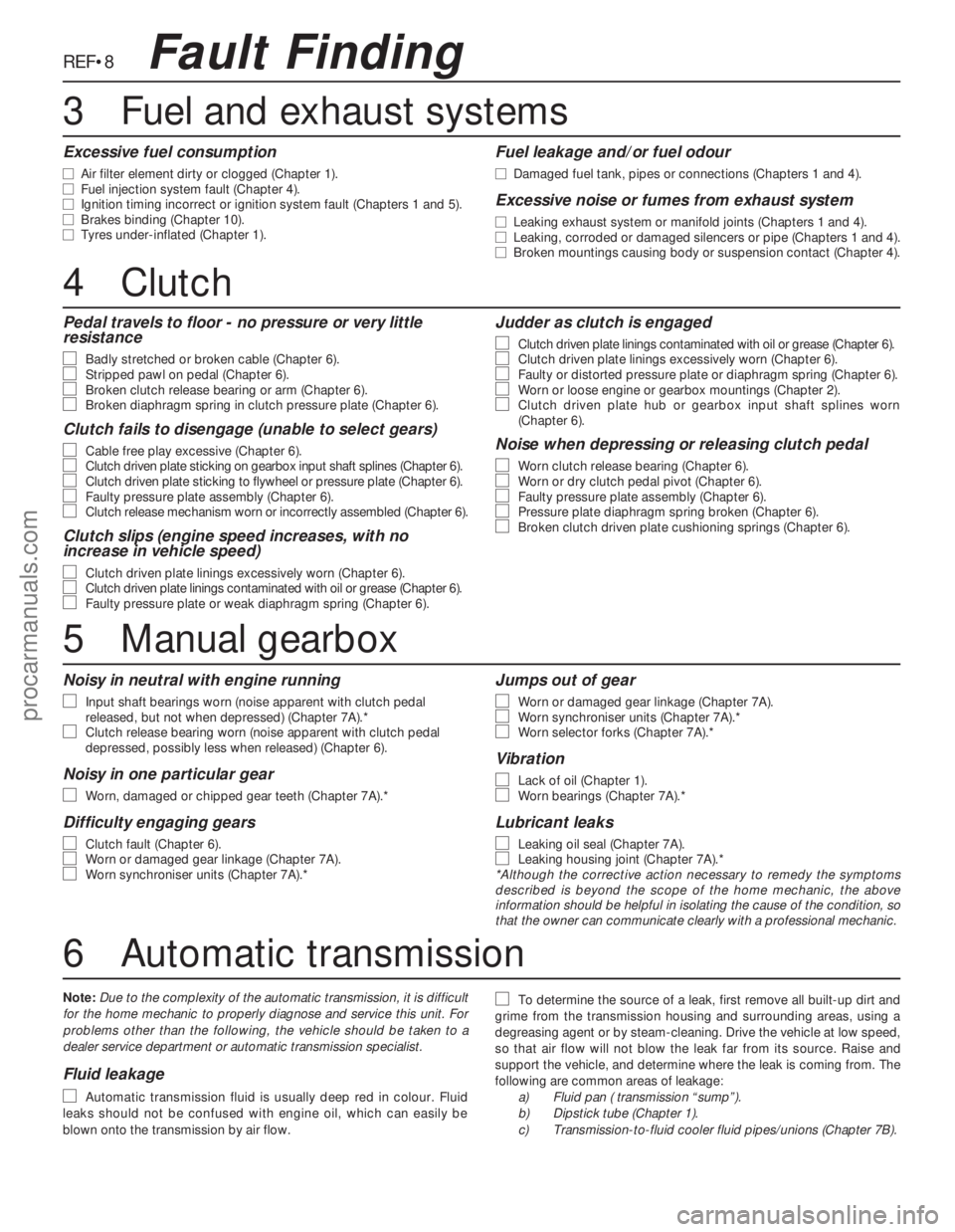
Pedal travels to floor - no pressure or very little
resistance
m m
Badly stretched or broken cable (Chapter 6).m
mStripped pawl on pedal (Chapter 6).m
mBroken clutch release bearing or arm (Chapter 6).m
mBroken diaphragm spring in clutch pressure plate (Chapter 6).
Clutch fails to disengage (unable to select gears)
m m
Cable free play excessive (Chapter 6).m
mClutch driven plate sticking on gearbox input shaft splines (Chapter 6).m
mClutch driven plate sticking to flywheel or pressure plate (Chapter 6).m
mFaulty pressure plate assembly (Chapter 6).m
mClutch release mechanism worn or incorrectly assembled (Chapter 6).
Clutch slips (engine speed increases, with no
increase in vehicle speed)
m m
Clutch driven plate linings excessively worn (Chapter 6).m
mClutch driven plate linings contaminated with oil or grease (Chapter 6).m
mFaulty pressure plate or weak diaphragm spring (Chapter 6).
Judder as clutch is engaged
m m
Clutch driven plate linings contaminated with oil or grease (Chapter 6).m
mClutch driven plate linings excessively worn (Chapter 6).m
mFaulty or distorted pressure plate or diaphragm spring (Chapter 6).m
mWorn or loose engine or gearbox mountings (Chapter 2).m
mClutch driven plate hub or gearbox input shaft splines worn
(Chapter 6).
Noise when depressing or releasing clutch pedal
m m
Worn clutch release bearing (Chapter 6).m
mWorn or dry clutch pedal pivot (Chapter 6).m
mFaulty pressure plate assembly (Chapter 6).m
mPressure plate diaphragm spring broken (Chapter 6).m
mBroken clutch driven plate cushioning springs (Chapter 6).
Excessive fuel consumption
m
mAir filter element dirty or clogged (Chapter 1).
m mFuel injection system fault (Chapter 4).
m mIgnition timing incorrect or ignition system fault (Chapters 1 and 5).
m mBrakes binding (Chapter 10).
m mTyres under-inflated (Chapter 1).
Fuel leakage and/or fuel odour
m
mDamaged fuel tank, pipes or connections (Chapters 1 and 4).
Excessive noise or fumes from exhaust system
m
mLeaking exhaust system or manifold joints (Chapters 1 and 4).
m mLeaking, corroded or damaged silencers or pipe (Chapters 1 and 4).
m mBroken mountings causing body or suspension contact (Chapter 4).
Fault Finding
4Clutch
5Manual gearbox
Noisy in neutral with engine running
m m
Input shaft bearings worn (noise apparent with clutch pedal
released, but not when depressed) (Chapter 7A).*
m mClutch release bearing worn (noise apparent with clutch pedal
depressed, possibly less when released) (Chapter 6).
Noisy in one particular gear
m m
Worn, damaged or chipped gear teeth (Chapter 7A).*
Difficulty engaging gears
m m
Clutch fault (Chapter 6).m
mWorn or damaged gear linkage (Chapter 7A).m
mWorn synchroniser units (Chapter 7A).*
Jumps out of gear
m m
Worn or damaged gear linkage (Chapter 7A).m
mWorn synchroniser units (Chapter 7A).*m
mWorn selector forks (Chapter 7A).*
Vibration
m m
Lack of oil (Chapter 1).m
mWorn bearings (Chapter 7A).*
Lubricant leaks
m m
Leaking oil seal (Chapter 7A).m
mLeaking housing joint (Chapter 7A).*
*Although the corrective action necessary to remedy the symptoms
described is beyond the scope of the home mechanic, the above
information should be helpful in isolating the cause of the condition, so
that the owner can communicate clearly with a professional mechanic.
6Automatic transmission
Note:Due to the complexity of the automatic transmission, it is difficult
for the home mechanic to properly diagnose and service this unit. For
problems other than the following, the vehicle should be taken to a
dealer service department or automatic transmission specialist.
Fluid leakage
m m
Automatic transmission fluid is usually deep red in colour. Fluid
leaks should not be confused with engine oil, which can easily be
blown onto the transmission by air flow.
m mTo determine the source of a leak, first remove all built-up dirt and
grime from the transmission housing and surrounding areas, using a
degreasing agent or by steam-cleaning. Drive the vehicle at low speed,
so that air flow will not blow the leak far from its source. Raise and
support the vehicle, and determine where the leak is coming from. The
following are common areas of leakage:
a)Fluid pan ( transmission “sump”).
b)Dipstick tube (Chapter 1).
c)Transmission-to-fluid cooler fluid pipes/unions (Chapter 7B).
3Fuel and exhaust systems
procarmanuals.com
Page 253 of 255
IND•2
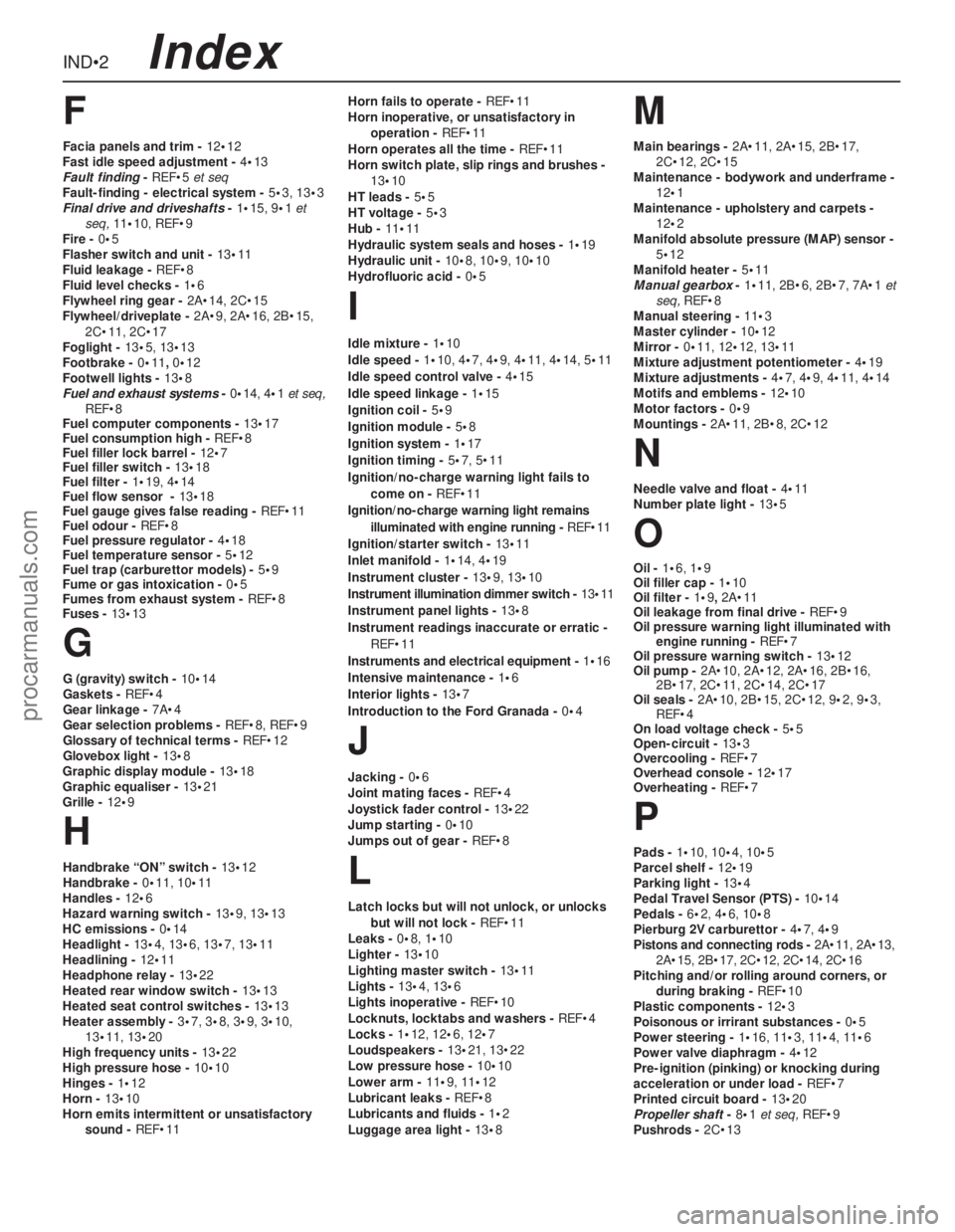
F
Facia panels and trim - 12•12
Fast idle speed adjustment - 4•13
Fault finding- REF•5et seq
Fault-finding - electrical system - 5•3, 13•3
Final drive and driveshafts- 1•15, 9•1et
seq, 11•10, REF•9
Fire - 0•5
Flasher switch and unit - 13•11
Fluid leakage - REF•8
Fluid level checks - 1•6
Flywheel ring gear - 2A•14, 2C•15
Flywheel/driveplate - 2A•9, 2A•16, 2B•15,
2C•11, 2C•17
Foglight - 13•5,13•13
Footbrake - 0•11, 0•12
Footwell lights - 13•8
Fuel and exhaust systems- 0•14, 4•1et seq,
REF•8
Fuel computer components - 13•17
Fuel consumption high - REF•8
Fuel filler lock barrel - 12•7
Fuel filler switch - 13•18
Fuel filter - 1•19, 4•14
Fuel flow sensor - 13•18
Fuel gauge gives false reading - REF•11
Fuel odour - REF•8
Fuel pressure regulator - 4•18
Fuel temperature sensor - 5•12
Fuel trap (carburettor models) - 5•9
Fume or gas intoxication - 0•5
Fumes from exhaust system - REF•8
Fuses - 13•13
G
G (gravity) switch - 10•14
Gaskets - REF•4
Gear linkage - 7A•4
Gear selection problems - REF•8, REF•9
Glossary of technical terms - REF•12
Glovebox light - 13•8
Graphic display module - 13•18
Graphic equaliser - 13•21
Grille - 12•9
H
Handbrake “ON” switch - 13•12
Handbrake - 0•11, 10•11
Handles - 12•6
Hazard warning switch - 13•9, 13•13
HC emissions - 0•14
Headlight - 13•4, 13•6, 13•7, 13•11
Headlining - 12•11
Headphone relay - 13•22
Heated rear window switch - 13•13
Heated seat control switches - 13•13
Heater assembly - 3•7, 3•8, 3•9, 3•10,
13•11, 13•20
High frequency units - 13•22
High pressure hose - 10•10
Hinges - 1•12
Horn - 13•10
Horn emits intermittent or unsatisfactory
sound - REF•11Horn fails to operate - REF•11
Horn inoperative, or unsatisfactory in
operation - REF•11
Horn operates all the time - REF•11
Horn switch plate, slip rings and brushes -
13•10
HT leads - 5•5
HT voltage - 5•3
Hub - 11•11
Hydraulic system seals and hoses - 1•19
Hydraulic unit - 10•8, 10•9, 10•10
Hydrofluoric acid - 0•5
I
Idle mixture - 1•10
Idle speed - 1•10, 4•7, 4•9, 4•11, 4•14, 5•11
Idle speed control valve - 4•15
Idle speed linkage - 1•15
Ignition coil - 5•9
Ignition module - 5•8
Ignition system - 1•17
Ignition timing - 5•7, 5•11
Ignition/no-charge warning light fails to
come on - REF•11
Ignition/no-charge warning light remains
illuminated with engine running - REF•11
Ignition/starter switch - 13•11
Inlet manifold - 1•14, 4•19
Instrument cluster - 13•9, 13•10
Instrument illumination dimmer switch - 13•11
Instrument panel lights - 13•8
Instrument readings inaccurate or erratic -
REF•11
Instruments and electrical equipment - 1•16
Intensive maintenance - 1•6
Interior lights - 13•7
Introduction to the Ford Granada - 0•4
J
Jacking - 0•6
Joint mating faces - REF•4
Joystick fader control - 13•22
Jump starting - 0•10
Jumps out of gear - REF•8
L
Latch locks but will not unlock, or unlocks
but will not lock - REF•11
Leaks - 0•8, 1•10
Lighter - 13•10
Lighting master switch - 13•11
Lights - 13•4, 13•6
Lights inoperative - REF•10
Locknuts, locktabs and washers - REF•4
Locks - 1•12, 12•6, 12•7
Loudspeakers - 13•21, 13•22
Low pressure hose - 10•10
Lower arm - 11•9, 11•12
Lubricant leaks - REF•8
Lubricants and fluids - 1•2
Luggage area light - 13•8
M
Main bearings - 2A•11, 2A•15, 2B•17,
2C•12, 2C•15
Maintenance - bodywork and underframe -
12•1
Maintenance - upholstery and carpets -
12•2
Manifold absolute pressure (MAP) sensor -
5•12
Manifold heater - 5•11
Manual gearbox- 1•11, 2B•6, 2B•7, 7A•1et
seq, REF•8
Manual steering - 11•3
Master cylinder - 10•12
Mirror - 0•11, 12•12, 13•11
Mixture adjustment potentiometer - 4•19
Mixture adjustments - 4•7, 4•9, 4•11, 4•14
Motifs and emblems - 12•10
Motor factors - 0•9
Mountings - 2A•11, 2B•8, 2C•12
N
Needle valve and float - 4•11
Number plate light - 13•5
O
Oil - 1•6, 1•9
Oil filler cap - 1•10
Oil filter - 1•9, 2A•11
Oil leakage from final drive - REF•9
Oil pressure warning light illuminated with
engine running - REF•7
Oil pressure warning switch - 13•12
Oil pump - 2A•10, 2A•12, 2A•16, 2B•16,
2B•17, 2C•11, 2C•14, 2C•17
Oil seals - 2A•10, 2B•15, 2C•12, 9•2, 9•3,
REF•4
On load voltage check - 5•5
Open-circuit - 13•3
Overcooling - REF•7
Overhead console - 12•17
Overheating - REF•7
P
Pads - 1•10, 10•4, 10•5
Parcel shelf - 12•19
Parking light - 13•4
Pedal Travel Sensor (PTS) - 10•14
Pedals - 6•2, 4•6, 10•8
Pierburg 2V carburettor - 4•7, 4•9
Pistons and connecting rods - 2A•11, 2A•13,
2A•15, 2B•17, 2C•12, 2C•14, 2C•16
Pitching and/or rolling around corners, or
during braking - REF•10
Plastic components - 12•3
Poisonous or irrirant substances - 0•5
Power steering - 1•16, 11•3, 11•4, 11•6
Power valve diaphragm - 4•12
Pre-ignition (pinking) or knocking during
acceleration or under load - REF•7
Printed circuit board - 13•20
Propeller shaft- 8•1et seq, REF•9
Pushrods - 2C•13
Index
procarmanuals.com