1982 CHEVROLET CAMARO head
[x] Cancel search: headPage 464 of 875
GM – CAMARO 1982-1992 – Repair Guide (Checked by WxMax) 464
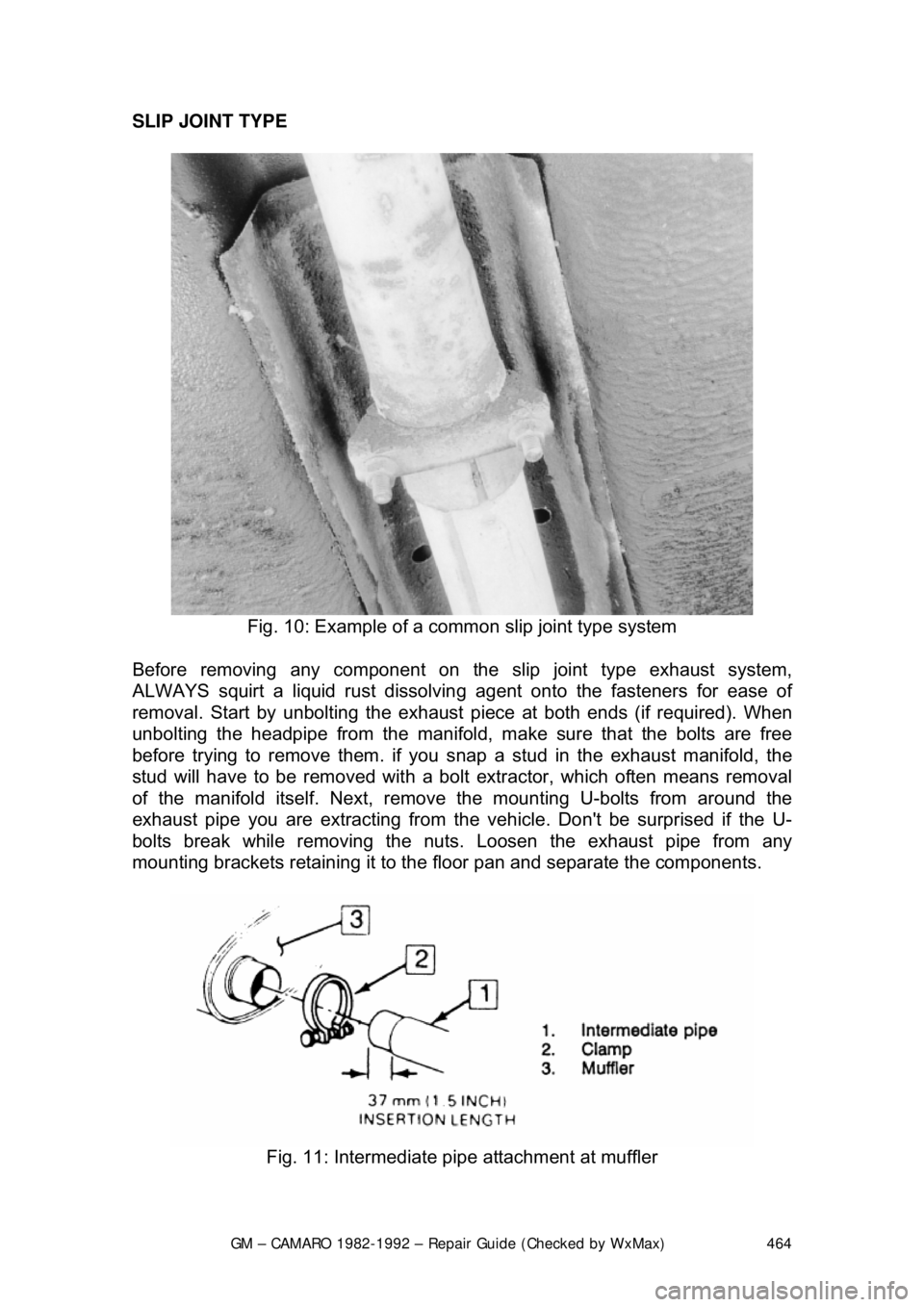
SLIP JOINT TYPE
Fig. 10: Example of a co mmon slip joint type system
Before removing any component on the slip joint type exhaust system,
ALWAYS squirt a liquid rust dissolvin g agent onto the fasteners for ease of
removal. Start by unbolting the exhaust piece at both ends (if required). When
unbolting the headpipe from the manifold, ma ke sure that the bolts are free
before trying to remove them. if you s nap a stud in the exhaust manifold, the
stud will have to be removed with a bolt extractor, which often means removal
of the manifold itself. Next, remove the mounting U-bolts from around the
exhaust pipe you are extracti ng from the vehicle. Don't be surprised if the U-
bolts break while removing the nuts. Loosen the exhaust pipe from any
mounting brackets retaining it to t he floor pan and separate the components.
Fig. 11: Intermediate pipe attachment at muffler
Page 465 of 875

GM – CAMARO 1982-1992 – Repair Guide (Checked by WxMax) 465
Fig. 12: Muffler hanger attachment
ENGINE RECONDITIONING DETE RMINING ENGINE CONDITION
Anything that generates heat and/or friction will eventually burn or wear out (i.e.
a light bulb generates heat, therefore its life span is limited). With this in mind, a
running engine generates trem endous amounts of both; friction is encountered
by the moving and rotating parts inside the engine and heat is created b\
y
friction and combustion of the fuel. Ho wever, the engine has systems designed
to help reduce the effects of heat and fr iction and provide added longevity. The
oiling system reduces the amount of fr iction encountered by the moving parts
inside the engine, while the cooling system reduces heat created by friction and
combustion. If either system is not main tained, a break-down will be inevitable.
Therefore, you can see how regular main tenance can affect the service life of
your vehicle. If you do not drain, flush and refill your cooling system at the
proper intervals, deposits will begin to accumulate in the radiator, thereby
reducing the amount of heat it can extrac t from the coolant. The same applies to
your oil and filter; if it is not changed often enoug h it becomes laden with
contaminates and is unable to properly lubricate the engine. This increases
friction and wear.
There are a number of methods for evaluat ing the condition of your engine. A
compression test can reveal the condition of your pistons, piston rings, cylinder
bores, head gasket(s), valves and valve seat s. An oil pressure test can warn
you of possible engine bearing, or oil pump failures. Excessive oil consumption,
evidence of oil in the engine air intake area and/or bluish smoke from the tail
pipe may indicate worn piston rings, worn valve guides and/or valve seals. As a
general rule, an engine that uses no more than one quart of oil every 1000
miles is in good condi tion. Engines that use one quart of oil or more in less than
1000 miles should first be checked for oil leaks. If any oil leaks are present,
have them fixed before dete rmining how much oil is consumed by the engine,
especially if blue smoke is not visible at the tail pipe.
COMPRESSION TEST
A noticeable lack of engine power, excessive oil consumption and/or poor fuel
mileage measured over an extended period are all indicators of internal engine
Page 466 of 875

GM – CAMARO 1982-1992 – Repair Guide (Checked by WxMax) 466
wear. Worn piston rings, scored or wo
rn cylinder bores, blown head gaskets,
sticking or burnt valves, and worn valve seats are all possible culprits. A check
of each cylinder's compression will help locate the problem.
A screw-in type compression gauge is more accurate than the type you simply
hold against the spark plug hole. Although it takes slightly longer to use, it's
worth the effort to obtain a more accurate reading.
1. Make sure that the proper amount and viscosity of engine oil is in the
crankcase, then ensure the battery is fully charged.
2. Warm-up the engine to normal operat ing temperature, then shut the
engine OFF.
3. Disable the ignition system.
4. Label and disconnect all of the spark plug wires from the plugs.
5. Thoroughly clean the cylinder h ead area around the spark plug ports,
then remove the spark plugs.
6. Set the throttle plate to the fully open (wide-open throttle) position. You
can block the accelerator linkage open for this, or you can have an
assistant fully depress the accelerator pedal.
Fig. 1: A screw-in type compression gauge is more accurate and easier to use
without an assistant
7. Install a screw-in type compression gauge into the No. 1 spark plug hole
until the fitting is snug.
WARNING - Be careful not to crossthread the spark plug hole.
Page 467 of 875

GM – CAMARO 1982-1992 – Repair Guide (Checked by WxMax) 467
8. According to the tool manufacture
r's instructions, connect a remote
starting switch to the starting circuit.
9. With the ignition switch in the OFF position, use the remote starting
switch to crank the engine through at least five compression strokes
(approximately 5 seconds of cranking) and record the highest reading on
the gauge.
10. Repeat the test on each cylinder, cranking the engine approximately the
same number of compression stroke s and/or time as the first.
11. Compare the highest readi ngs from each cylinder to that of the others.
The indicated compression pre ssures are considered within
specifications if the lo west reading cylinder is within 75 percent of the
pressure recorded for the highest readi ng cylinder. For example, if your
highest reading cylinder pressure was 150 psi (1034 kPa), then 75
percent of that would be 113 psi (779 kPa). So the lowest reading
cylinder should be no less than 113 psi (779 kPa).
12. If a cylinder exhibits an unusually low compression reading, pour a
tablespoon of clean engine oil into the cylinder through the spark plug
hole and repeat the compression tes t. If the compression rises after
adding oil, it means that the cylinder's piston rings and/or cylinder bore
are damaged or worn. If the pressure re mains low, the valves may not be
seating properly (a valve job is needed), or the head gasket may be
blown near that cylinder. If compressi on in any two adjacent cylinders is
low, and if the addition of oil doesn' t help raise compression, there is
leakage past the head gasket. Oil and coolant in the combustion
chamber, combined with blue or const ant white smoke from the tail pipe,
are symptoms of this pr oblem. However, don't be alarmed by the normal
white smoke emitted from the tail pipe during engine warm-up or from
cold weather driving. There may be evidence of water droplets on the
engine dipstick and/or oil droplets in the cooling system if a head gasket
is blown.
OIL PRESSURE TEST
Check for proper oil pressu re at the sending unit passage with an externally
mounted mechanical oil pressure gauge (a s opposed to relying on a factory
installed dash-mounted gauge). A tachom eter may also be needed, as some
specifications may require running the engine at a specific rpm.
1. With the engine cold, locate and remo ve the oil pressure sending unit.
2. Following the manufacturer's inst ructions, connect a mechanical oil
pressure gauge and, if necessary, a tachometer to the engine.
3. Start the engine and allow it to idle.
4. Check the oil pressure reading when cold and record the number. You
may need to run the engine at a specified rpm, so check the
specifications chart located earlier in this section.
5. Run the engine until normal operati ng temperature is reached (upper
radiator hose will feel warm).
6. Check the oil pressure reading agai n with the engine hot and record the
number. Turn the engine OFF.
Page 468 of 875

GM – CAMARO 1982-1992 – Repair Guide (Checked by WxMax) 468
7. Compare your hot oil pressure reading
to that given in the chart. If the
reading is low, check the cold pressu re reading against the chart. If the
cold pressure is well above the spec ification, and the hot reading was
lower than the specificat ion, you may have the wr ong viscosity oil in the
engine. Change the oil, making sure to use the proper grade and
quantity, then repeat the test.
Low oil pressure readings could be attributed to internal component wear, pump
related problems, a low oil leve l, or oil viscosity that is too low. High oil pressure
readings could be caused by an overfilled crankcase, too high of an oil viscosity
or a faulty pressure relief valve.
BUY OR REBUILD?
Now that you have determined that your engine is worn out, you must make
some decisions. The question of whether or not an engine is worth rebuilding is
largely a subjective matter and one of per sonal worth. Is the engine a popular
one, or is it an obsolete model? Are parts available? Will it get acceptable gas
mileage once it is rebuilt? Is the car it's being put into worth keeping? Would it
be less expensive to buy a new engine, have your engine rebuilt by a pro,
rebuild it yourself or buy a used engine from a salvage yard? Or would it be
simpler and less expensive to buy another car? If you have considered all these
matters and more, and have still decided to r ebuild the engine, then it is time to
decide how you will rebuild it.
The editors of this information feel that most engine machining should be
performed by a professional machine shop. Don't think of it as wasting money,
rather, as an assurance that the job has been done right the first time. There
are many expensive and spec ialized tools required to perform such tasks as
boring and honing an engine block or having a valve job done on a cylinder
head. Even inspecting the parts requires expensive micrometers and gauges to
properly measure wear and clearances. Al so, a machine shop can deliver to
you clean, and ready to assemble parts, saving you time and aggravation. Your
maximum savings will come from perf orming the removal, disassembly,
assembly and installation of the engine and purchasing or renting only the tools
required to perform the above tasks. Depending on the particular
circumstances, you may save 40 to 60 perc ent of the cost doing these yourself.
A complete rebuild or overhaul of an engine involves replacing all of the moving
parts (pistons, rods, crankshaft, camsha ft, etc.) with new ones and machining
the non-moving wearing surfaces of t he block and heads. Unfortunately, this
may not be cost effective. For instanc e, your crankshaft may have been
damaged or worn, but it can be machined undersize for a minimal fee.
So, as you can see, you can replace ev erything inside the engine, but, it is
wiser to replace only those parts whic h are really needed, and, if possible,
repair the more expensive ones. Later in this section, we will break the engine
down into its two main components: t he cylinder head and the engine block. We
will discuss each component, and the re commended parts to replace during a
rebuild on each.
Page 470 of 875

GM – CAMARO 1982-1992 – Repair Guide (Checked by WxMax) 470
•
Never hot tank aluminum parts (the c austic hot tank solution will eat the
aluminum.
• Remove all aluminum parts (identif ication tag, etc.) from engine parts
prior to the tanking.
• Always coat threads lightly with engine oil or anti-seize compounds
before installation, to prevent seizure.
• Never overtighten bolts or spark plugs especially in aluminum threads.
When assembling the engine, any parts that will be exposed to frictional contact
must be prelubed to provide lubricatio n at initial start-up. Any product
specifically formulated for this purpos e can be used, but engine oil is not
recommended as a prelube in most cases.
When semi-permanent (locked, but removabl e) installation of bolts or nuts is
desired, threads should be cleaned and coat ed with Loctite® or another similar,
commercial non-hardening sealant.
CLEANING
Before the engine and its components ar e inspected, they must be thoroughly
cleaned. You will need to remove any eng ine varnish, oil sludge and/or carbon
deposits from all of the com ponents to insure an accurate inspection. A crack in
the engine block or cylinder head can eas ily become overlooked if hidden by a
layer of sludge or carbon.
Fig. 1: Use a gasket scraper to remove t he old gasket material from the mating
surfaces
Page 472 of 875
GM – CAMARO 1982-1992 – Repair Guide (Checked by WxMax) 472
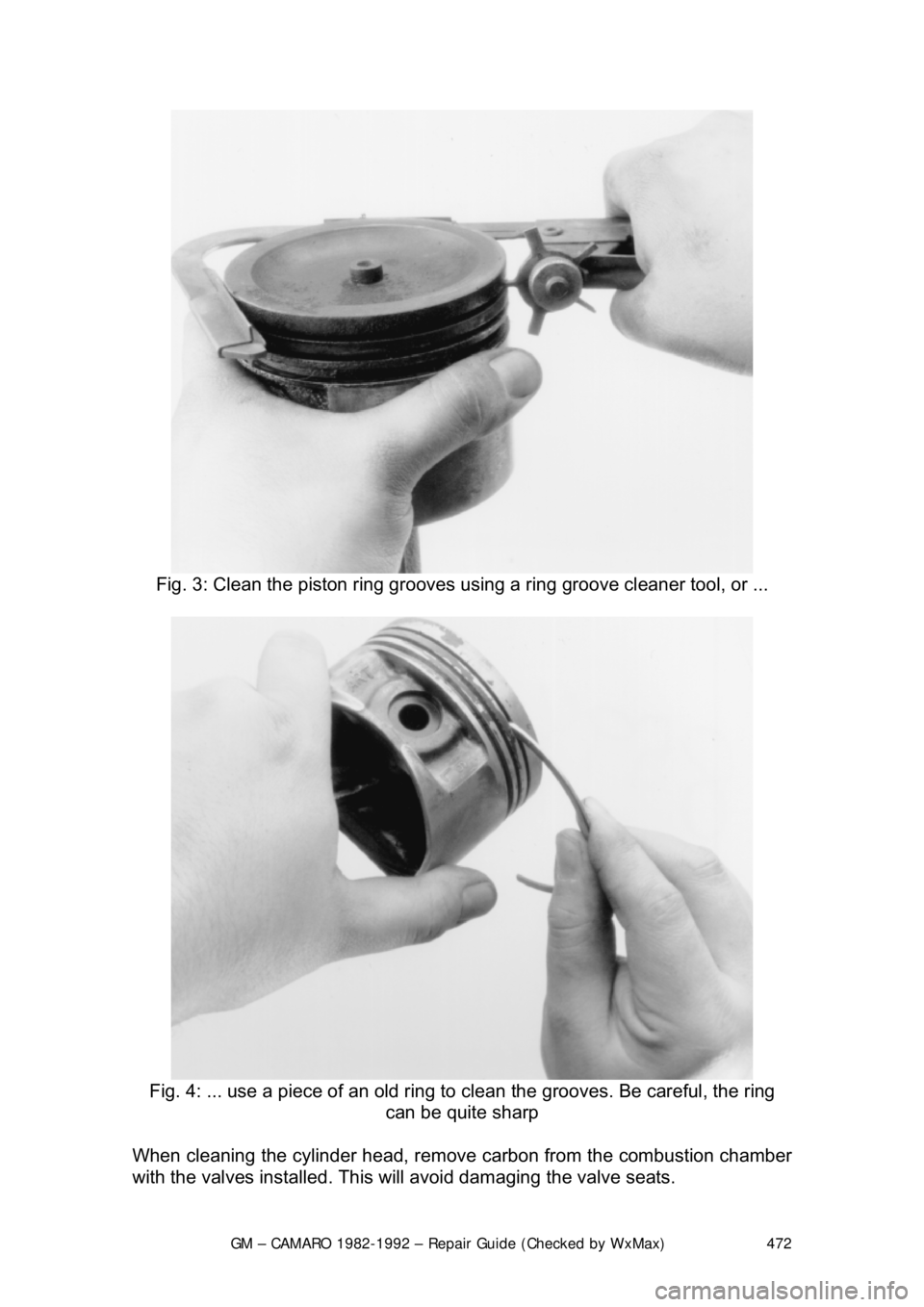
Fig. 3: Clean the piston ring grooves using a ring groove cleaner tool, or ...
Fig. 4: ... use a piece of an old ring to clean the grooves. Be careful,\
the ring
can be quite sharp
When cleaning the cylinder head, remove carbon from the combustion chamber
with the valves installed. This will avoid damaging the valve seats.
Page 476 of 875

GM – CAMARO 1982-1992 – Repair Guide (Checked by WxMax) 476
Before attempting to repair a threaded
hole, remove any snapped, broken or
damaged bolts or studs. Penetrating oil ca n be used to free frozen threads. The
offending item can usually be removed with locking pliers or using a screw/stud
extractor. After the hole is clear, the thread can be repaired, as shown in the
series of accompanying illustrations and in the kit manufacturer's instructions.
ENGINE PREPARATION
To properly rebuild an engine, you must fi rst remove it from the vehicle, then
disassemble and diagnose it. Ideally you should place your engine on an engine
stand. This affords you the best access to the engine components. Follow the
manufacturer's directions for using the stand with your particular engine.
Remove the flywheel or fl explate before installing the engine to the stand.
Now that you have the engine on a stand, and assuming that you have drained
the oil and coolant from the engine, it's ti me to strip it of all but the necessary
components. Before you start disassembli ng the engine, you may want to take
a moment to draw some pictures, or fabr icate some labels or containers to mark
the locations of various components and the bolts and/or studs which fasten
them. Modern day engines use a lot of littl e brackets and clips which hold wiring
harnesses and such, and these holders are often mounted on studs and/or bolts
that can be easily mixed up. The manufacturer spent a lot of time and money
designing your vehicle, and they wouldn't have wasted any of it by haphazardly
placing brackets, clips or fasteners on t he vehicle. If it's present when you
disassemble it, put it back when you asse mble, you will regret not remembering
that little bracket which holds a wire har ness out of the path of a rotating part.
You should begin by unbolting any accessories still attached to the engine, such
as the water pump, power steering pump, alternator, etc. Then, unfasten any
manifolds (intake or exhaust) which were not removed during the engine
removal procedure. Finally, remove any covers remaining on the engine such
as the rocker arm, front or timing cove r and oil pan. Some front covers may
require the vibration dam per and/or crank pulley to be removed beforehand.
The idea is to reduce the engine to the bar e necessities (cylinder head(s), valve
train, engine block, crankshaft, pistons and connecting rods), plus any other 'in
block' components such as oil pumps, balance shafts and auxiliary shafts.
Finally, remove the cylinder head(s) from the engine block and carefully place
on a bench. Disassembly instructions fo r each component follow later in this
section.
CYLINDER HEAD
There are two basic types of cylinder heads used on today’s automobiles:
the Overhead Valve (OHV) and the Over head Camshaft (OHC). The latter can
also be broken down into two subgr oups: the Single Overhead Camshaft
(SOHC) and the Dual Overhead Camshaft (DO HC). Generally, if there is only a
single camshaft on a head, it is just referred to as an OHC head. Also, an
engine with a OHV cylinder head is also known as a pushrod engine.