1982 CHEVROLET CAMARO head
[x] Cancel search: headPage 512 of 875

GM – CAMARO 1982-1992 – Repair Guide (Checked by WxMax) 512
5. Make sure the ring gaps are pr
operly spaced around the circumference
of the piston. Fit a piston ring co mpressor around the piston and slide the
piston and connecting rod assembly do wn into the cylinder bore, pushing
it in with the wooden hammer handle. Pu sh the piston down until it is only
slightly below the top of the cylinder bore. Guide the connecting rod onto
the crankshaft bearing journal carefully, to avoid damaging the
crankshaft.
6. Check the bearing clearance of all the rod bearings, fitting them to the
crankshaft bearing journals. Follow the procedure in the crankshaft
installation above.
7. After the bearings have been fitted, apply a light coating of assembly oil
to the journals and bearings.
8. Turn the crankshaft until the appropria te bearing journal is at the bottom
of its stroke, then push the piston a ssembly all the way down until the
connecting rod bearing seat s on the crankshaft journal. Be careful not to
allow the bearing cap screws to stri ke the crankshaft bearing journals
and damage them.
9. After the piston and connecting rod assemblies have been installed, check the connecting rod side clearance on each crankshaft journal.
10. Prime and install t he oil pump and the oil pump intake tube.
CAMSHAFT, LIFTERS AND TIMING ASSEMBLY 1. Install the camshaft.
2. Install the lifters/followers into their bores.
3. Install the timing gears/chain assembly.
CYLINDER HEAD(S) 1. Install the cylinder head(s) using new gaskets.
2. Assemble the rest of the valve tr ain (pushrods and rocker arms and/or
shafts).
ENGINE COVERS AND COMPONENTS
Install the timing cover(s) and oil pan. Re fer to your notes and drawings made
prior to disassembly and install all of the components that were removed. Install
the engine into the vehicle.
ENGINE START-UP AND BREAK-IN
STARTING THE ENGINE
Now that the engine is inst alled and every wire and hose is properly connected,
go back and double check that all cool ant and vacuum hoses are connected.
Check that you oil drain plug is instal led and properly tightened. If not already
done, install a new oil filt er onto the engine. Fill the crankcase with the proper
amount and grade of engine oil. Fill the cooling system with a 50/50 mixture of
coolant/water.
Page 565 of 875

GM – CAMARO 1982-1992 – Repair Guide (Checked by WxMax) 565
3. Reconnect the signal
hose and listen for air flow through the ventilation
tube into the anti-backfire valve. A speed drop should be noticed when
the hose is reconnected.
4. If these conditions are not found, check hoses for restrictions or leaks. If
hoses are OK, replace the anti-backfire valve.
AIR PUMP 1. Check the drive belt tension.
2. Increase the engine speed and observe an increase in air flow. If air flow
does not increase, replace the air pump.
CONTROL VALVE 1. Remove the hoses. Blow through t he valve (toward the cylinder head).
2. Then, suck through the valve (or blow through the other side). If air flows
in one direction, the valve is operative. If not, replace the control valve.
REMOVAL & INSTALLATION
AIR PUMP 1. Remove the AIR control valves and/or adapter at the pump.
2. Loosen the air pump adjustment bolt and remove the drive belt.
3. Unscrew the pump mounting bolts and then remove the pump pulley.
4. Unscrew the pump mounting bol ts and then remove the pump.
To install: 5. Position the pump into place and secure it with the mounting bolts.
6. Install the pump pulley.
7. Install the air pump drive belt and adjust pump belt with the pump
adjustment bolt.
8. Install the AIR contro l valves and/or adapter.
Page 629 of 875

GM – CAMARO 1982-1992 – Repair Guide (Checked by WxMax) 629
as much voltage to fire the plug at hi
gh speeds than at idle. The improved
air/fuel ratio control of modern fuel injection combin ed with the higher voltage
output of modern ignition systems will often allow an engine to run significantly
longer on a set of standard spark plugs, but keep in mind that efficiency will
drop as the gap widens (along wit h fuel economy and power).
When you're removing spark plugs, work on one at a time. Don't start by
removing the plug wires all at once, because, unless you number them, they
may become mixed up. Take a minute before you begin and number the wires
with tape.
1. Disconnect the negative battery cabl e, and if the vehicle has been run
recently, allow the engine to thoroughly cool.
2. Carefully twist the spark plug wire boot to loosen it, then pull upward and
remove the boot from the plug. Be su re to pull on the boot and not on the
wire, otherwise the connector locat ed inside the boot may become
separated.
3. Using compressed air, blow any water or debris from the spark plug well
to assure that no harmful contam inants are allowed to enter the
combustion chamber when the spark plug is removed. If compressed air
is not available, use a rag or a brush to clean the area.
Remove the spark plugs when the engine is cold, if possible, to prevent damage
to the threads. If removal of the plugs is difficult, apply a few drops of
penetrating oil or silicone spray to t he area around the base of the plug, and
allow it a few minutes to work.
4. Using a spark plug socket that is equipped with a rubber insert to
properly hold the plug, turn the spar k plug counterclockwise to loosen
and remove the spark pl ug from the bore.
WARNING - Be sure not to use a flexible extension on the socket. Use of a
flexible extension may allow a shear fo rce to be applied to the plug. A shear
force could break the plug off in the cylinder head, leading to costly a\
nd
frustrating repairs.
To install:
5. Inspect the spark plug boot for t ears or damage. If a damaged boot is
found, the spark plug wire must be replaced.
6. Using a wire feeler gauge, check and adjust the spark plug gap. When
using a gauge, the proper size shoul d pass between the electrodes with
a slight drag. The next larger size should not be able to pass while the\
next smaller size should pass freely.
7. Carefully thread the plug into the bor e by hand. If resistance is felt before
the plug is almost completely th readed, back the plug out and begin
threading again. In small, hard to r each areas, an old spark plug wire and
boot could be used as a th reading tool. The boot will hold the plug while
you twist the end of the wire and t he wire is supple enough to twist
before it would allow t he plug to crossthread.
Page 630 of 875

GM – CAMARO 1982-1992 – Repair Guide (Checked by WxMax) 630
WARNING
- Do not use the spark plug socke t to thread the plugs. Always
carefully thread the plug by hand or us ing an old plug wire to prevent the
possibility of crossthreading and damaging the cylinder head bore.
8. Carefully tighten the spark plug. If the plug you are installing is equipped
with a crush washer, seat the plug, then tighten about
1/4 turn to crush
the washer. If you are installing a t apered seat plug, tighten the plug to
specifications provided by the vehicle or plug manufacturer.
9. Apply a small amount of silicone di electric compound to the end of the
spark plug lead or inside the spark pl ug boot to prevent sticking, then
install the boot to the spark plug and pus h until it clicks into place. The
click may be felt or hear d, then gently pull back on the boot to assure
proper contact.
INSPECTION & GAPPING
Check the plugs for deposits and wear. If they are not going to be replaced,
clean the plugs thoroughly. Remember t hat any kind of deposit will decrease
the efficiency of the plug. Plugs can be cleaned on a spark plug cleaning
machine, which can sometimes be found in service stations, or you can do an
acceptable job of cleaning with a stiff br ush. If the plugs are cleaned, the
electrodes must be filed flat. Use an igni tion points file, not an emery board or
the like, which will leave deposits. The electrodes must be filed perfectly flat
with sharp edges; rounded edges reduce the s park plug voltage by as much as
50%.
Check spark plug gap before installati on. The ground electrode (the L-shaped
one connected to the body of the plug) mu st be parallel to the center electrode
and the specified size wire gauge (please refer to the Tune-Up Specifications
chart for details) must pass between t he electrodes with a slight drag.
NEVER adjust the gap on a used platinum type spark plug .
Always check the gap on new plugs as they are not always set correctly a\
t the
factory. Do not use a flat feeler g auge when measuring the gap on a used plug,
because the reading may be inaccurate. A round-wire type gapping tool is the
best way to check the gap. The co rrect gauge should pass through the
electrode gap with a slight drag. If you're in doubt, try one size smaller and one
larger. The smaller gauge should go through easily, while the larger one\
shouldn't go through at all. Wire gapping tools usually have a bending tool
attached. Use that to adjust the side electrode until the proper distance is
obtained. Absolutely never attempt to bend the center electrode. Also, be
careful not to bend the side electrode too fa r or too often as it may weaken and
break off within the engine, requiring remova l of the cylinder head to retrieve it.
Page 669 of 875

GM – CAMARO 1982-1992 – Repair Guide (Checked by WxMax) 669
1. Disconnect the pressure gauge. R
un the fuel line into a graduated
container.
2. Run the engine at idle until one pint of gasoline has been pumped. One
pint should be delivered in 30 seconds or less. There is normally enough
fuel in the carburetor float bowl to perform this test, but refill it if
necessary.
3. If the delivery rate is below the mini mum, check the lines for restrictions
or leaks, then r eplace the pump.
CARBURETORS
The V6 engine is equipped with the Ro chester E2SE carburetor, V8 engines
use the E4ME and E4MC. These carburet ors are of the downdraft design and
are used in conjunction with the CCC system for fuel cont rol. They have special
design features for optimum air/fuel mixt ure control during all ranges of engine
operation.
An electric solenoid in the carburetor controls the air/fu el ratio. The solenoid is
connected to an Electronic Control Module (ECM) which is an on-board
computer. The ECM provides a controllin g signal to the solenoid. The solenoid
controls the metering rod(s) and an id le air bleed valve, thereby closely
controlling the air/fuel ratio throughout the operating range of the engine.
MODEL IDENTIFICATION
General Motors Rochester carburetors ar e identified by their model code. The
first number indicates the number of ba rrels, while one of the last letters
indicates the type of choke used. These are V for the manifold mounted choke
coil, C for the choke coil mounted in the carburetor body, and E for electric
choke, also mounted on the carburetor. Model codes ending in A indicate an
altitude-compensatin g carburetor.
Because of their intricate nature and co mputer controls, the E2SE, E4ME and
E4MC carburetors should only be se rviced by a qualified technician.
PRELIMINARY CHECKS
The following should be observed befor e attempting any adjustments.
1. Thoroughly warm the engine. If the engine is cold, be sure that it reaches
operating temperature.
2. Check the torque of all carburet or mounting nuts and assembly screws.
Also check the intake manifold-to-cyli nder head bolts. If air is leaking at
any of these points, any attempts at adjustment will inevitably lead to
frustration.
3. Check the manifold heat control valve (if used) to be sure that it is free.
4. Check and adjust the choke as necessary.
5. Adjust the idle speed and mixture. If the mixture screws are capped,
don't adjust them unless all other c auses of rough idle have been
eliminated. If any adjustments are per formed that might possibly change
Page 692 of 875

GM – CAMARO 1982-1992 – Repair Guide (Checked by WxMax) 692
IDLE AIR VALVE
A cover is in place over t
he idle air bleed valve. Also , the access holes to the
idle mixture needles are s ealed with hardened plugs. This is done to seal the
factory settings, during original equipment production. These items are NOT to
be removed unless required for cleaning, part replacement, improper dwell
readings or if the System Performance Check indicates the carburetor is the
cause of the trouble.
ROCHESTER E4ME AND E4MC
1. With engine OFF, cover the internal bowl vents and inlet to bleed valve
and the carburetor air intakes with maski ng tape. This is done to prevent
metal chips from entering.
2. Carefully drill rivet head of idle air bleed cover, with 0.110 in. (2.8mm) drill bit.
3. Remove rivet head and all pieces of rivet.
4. Lift cover off air bleed valve and bl ow out any metal shavings, or use a
magnet to remove excess metal.
CAUTION - Always wear eye protection when using compressed air.
5. Remove masking tape.
6. Start engine and allow it to reac h normal operating temperature.
7. Disconnect the vacuum hose from t he canister purge valve and plug it.
8. While idling in D for automatic transmission or N for manual
transmission, slowly turn the valve c ounterclockwise or clockwise, until
the dwell reading varies within the 25-35 degree range, attempting to be
as close to 30 degrees as possible.
Perform this step carefully. The air bleed valve is very sensitive and should be
turned in
1/8 turn increments only.
9. If the dwell reading d oes not vary and is not within the 25-35 degree
range, it will be necessary to remove the plugs and to adjust the idle
mixture needles.
Page 699 of 875
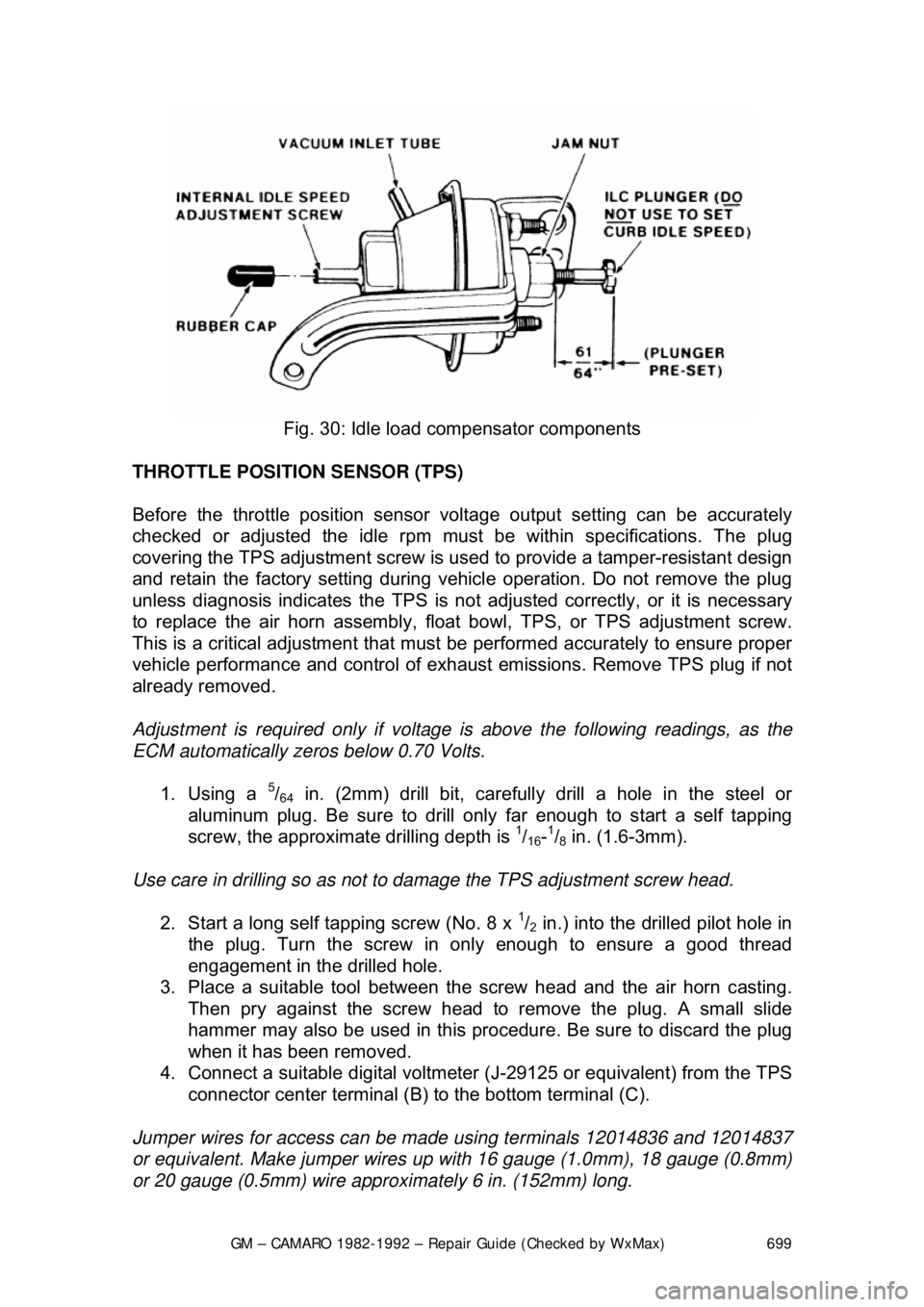
GM – CAMARO 1982-1992 – Repair Guide (Checked by WxMax) 699
Fig. 30: Idle load compensator components
THROTTLE POSITION SENSOR (TPS)
Before the throttle position sensor voltage output setting can be accurately
checked or adjusted the idle rpm mu st be within specifications. The plug
covering the TPS adjustment screw is used to provide a tamper-resistant design
and retain the factory setting during vehicl e operation. Do not remove the plug
unless diagnosis indicates t he TPS is not adjusted correct ly, or it is necessary
to replace the air horn assembly, float bowl, TPS, or TPS adjustment screw.
This is a critical adjustment that must be performed accurately to ensure proper
vehicle performance and contro l of exhaust emissions. Remove TPS plug if not
already removed.
Adjustment is required only if voltage is above the following readings, as the
ECM automatically zeros below 0.70 Volts.
1. Using a
5/64 in. (2mm) drill bit, carefully drill a hole in the steel or
aluminum plug. Be sure to drill only far enough to start a self tapping
screw, the approximat e drilling depth is
1/16-1/8 in. (1.6-3mm).
Use care in drilling so as not to damage the TPS adjustment screw head.
2. Start a long self tapping screw (No. 8 x
1/2 in.) into the drilled pilot hole in
the plug. Turn the screw in only enough to ensure a good thread
engagement in the drilled hole.
3. Place a suitable tool between the screw head and the air horn casting.
Then pry against the screw head to remove the plug. A small slide
hammer may also be used in this proc edure. Be sure to discard the plug
when it has been removed.
4. Connect a suitable digital voltmete r (J-29125 or equivalent) from the TPS
connector center terminal (B) to the bottom terminal (C).
Jumper wires for access can be made using terminals 12014836 and 12014837
or equivalent. Make jumper wires up with 16 gauge (1.0mm), 18 gauge (0.8mm)
or 20 gauge (0.5mm) wire approximately 6 in. (152mm) long.
Page 760 of 875

GM – CAMARO 1982-1992 – Repair Guide (Checked by WxMax) 760
GENERAL INFORMATION & MAINTENANCE
HOW TO USE THIS INFORMATION
The introductory part of this repair gui de is intended to help you learn more
about the inner workings of your Camaro while saving you money on its upkeep
and operation.
The beginning of the repair guide will likely be referred to the most, since that is
where you will find information for maintenance and tune-up. The other
information deals with the more complex systems of your vehicle. Systems
(from engine through brakes) are covered to the extent that the average do-it-
yourselfer can attempt. This repair guide will not explain such things as
rebuilding a differential because the ex pertise required and the special tools
necessary make this uneconomical. It will, however, give you detailed
instructions to help you change your own brake pads and shoes, replace spark
plugs, and perform many more jobs that can save you money and help avoid
expensive problems.
A secondary purpose of this repair guide is a reference for owners who want to
understand their vehicle and/or their mechanics better.
WHERE TO BEGIN
Before removing any bolts, read through t he entire procedure. This will give you
the overall view of what tools and supplies will be required. So read ahead and
plan ahead. Each operation should be approached logically and all procedures
thoroughly understood before attempting any work.
If repair of a component is not considered practical, we tell you how to remove
the part and then how to insta ll the new or rebuilt replacement. In this way, you
at least save labor costs.
AVOIDING TROUBLE
Many procedures in this repair guide r equire you to "label and disconnect ..." a
group of lines, hoses or wires. Don't be think you can remember where
everything goes - you won't. If you hook up va cuum or fuel lines incorrectly, the
vehicle may run poorly, if at all. If you hook up electrical wiring incorrectly, you
may instantly learn a very expensive lesson.
You don't need to know the proper name for each hose or line. A piece of
masking tape on the hose and a piece on its fitting will allow you to assign your
own label. As long as you remember your own code, the lines can be
reconnected by matching your tags. Re member that tape will dissolve in
gasoline or solvents; if a part is to be washed or cleaned, use another method
of identification. A permanent felt-tipped marker or a metal scribe can be very
handy for marking metal parts. Remove any tape or paper labels after
assembly.