1982 CHEVROLET CAMARO air condition
[x] Cancel search: air conditionPage 465 of 875

GM – CAMARO 1982-1992 – Repair Guide (Checked by WxMax) 465
Fig. 12: Muffler hanger attachment
ENGINE RECONDITIONING DETE RMINING ENGINE CONDITION
Anything that generates heat and/or friction will eventually burn or wear out (i.e.
a light bulb generates heat, therefore its life span is limited). With this in mind, a
running engine generates trem endous amounts of both; friction is encountered
by the moving and rotating parts inside the engine and heat is created b\
y
friction and combustion of the fuel. Ho wever, the engine has systems designed
to help reduce the effects of heat and fr iction and provide added longevity. The
oiling system reduces the amount of fr iction encountered by the moving parts
inside the engine, while the cooling system reduces heat created by friction and
combustion. If either system is not main tained, a break-down will be inevitable.
Therefore, you can see how regular main tenance can affect the service life of
your vehicle. If you do not drain, flush and refill your cooling system at the
proper intervals, deposits will begin to accumulate in the radiator, thereby
reducing the amount of heat it can extrac t from the coolant. The same applies to
your oil and filter; if it is not changed often enoug h it becomes laden with
contaminates and is unable to properly lubricate the engine. This increases
friction and wear.
There are a number of methods for evaluat ing the condition of your engine. A
compression test can reveal the condition of your pistons, piston rings, cylinder
bores, head gasket(s), valves and valve seat s. An oil pressure test can warn
you of possible engine bearing, or oil pump failures. Excessive oil consumption,
evidence of oil in the engine air intake area and/or bluish smoke from the tail
pipe may indicate worn piston rings, worn valve guides and/or valve seals. As a
general rule, an engine that uses no more than one quart of oil every 1000
miles is in good condi tion. Engines that use one quart of oil or more in less than
1000 miles should first be checked for oil leaks. If any oil leaks are present,
have them fixed before dete rmining how much oil is consumed by the engine,
especially if blue smoke is not visible at the tail pipe.
COMPRESSION TEST
A noticeable lack of engine power, excessive oil consumption and/or poor fuel
mileage measured over an extended period are all indicators of internal engine
Page 485 of 875

GM – CAMARO 1982-1992 – Repair Guide (Checked by WxMax) 485
CYLINDER HEAD
There are several things to check on
the cylinder head: valve guides, seats,
cylinder head surface flatness, cracks and physical damage.
VALVE GUIDES
Now that you know the valves are good, you can use them to check the guides,
although a new valve, if available, is preferred. Before you measure anything,
look at the guides carefully and inspect t hem for any cracks, chips or breakage.
Also if the guide is a removable style (a s in most aluminum heads), check them
for any looseness or evidence of movem ent. All of the guides should appear to
be at the same height from the spring s eat. If any seem lower (or higher) from
another, the guide has moved. Mount a dial indicator onto the spring side of the
cylinder head. Lightly oil the valve stem and insert it into the cylinder head.
Position the dial indicator against the valve stem near the tip and zero the
gauge. Grasp the valve stem and wiggle towards and away from the dial
indicator and observe the readings. Mount the dial indicator 90 degrees from
the initial point and zero the gauge and again take a reading. Compare the two
readings for a out of round condition. Check the readings against the
specifications given. An Inside Diamete r (I.D.) gauge designed for valve guides
will give you an accurate valve guide bore measurement. If the I.D. gauge is
used, compare the readings wit h the specifications given. Any guides that fail
these inspections should be replaced or machined.
Fig. 11: A dial gauge may be used to che ck valve stem-to-guide clearance; read
the gauge while moving the valve stem
Page 488 of 875

GM – CAMARO 1982-1992 – Repair Guide (Checked by WxMax) 488
Physical damage is usually very eviden
t. For example, a broken mounting ear
from dropping the head or a bent or broken stud and/or bol t. All of these defects
should be fixed or, if irrepairabl e, the head should be replaced.
REFINISHING & REPAIRING
Many of the procedures given for refini shing and repairing the cylinder head
components must be performed by a ma chine shop. Certain steps, if the
inspected part is not worn, can be perfo rmed yourself inexpensively. However,
you spent a lot of time and effort so far, why risk trying to save a couple bucks if
you might have to do it all over again?
VALVES
Any valves that were not replaced s hould be refaced and the tips ground flat.
Unless you have access to a valve grinding machine, this should be done by a
machine shop. If the valves are in extr emely good condition, as well as the
valve seats and guides, they may be lapped in without performing machine
work.
It is a recommended practice to lap the valves even after machine work has
been performed and/or new valves hav e been purchased. This insures a
positive seal between the valve and seat.
LAPPING THE VALVES
Before lapping the valves to the seat s, read the rest of the cylinder head
information to insure that any related parts are in acceptable enough condition
to continue.
Before any valve seat machining and/or lapping can be performed, the guides
must be within factory re commended specifications.
1. Invert the cylinder head.
2. Lightly lubricate the va lve stems and insert them into the cylinder head in
their numbered order.
3. Raise the valve from the seat and apply a sma ll amount of fine lapping
compound to the seat.
4. Moisten the suction h ead of a hand-lapping tool and attach it to the head
of the valve.
5. Rotate the tool bet ween the palms of both hands , changing the position
of the valve on the valve seat and lifting the tool often to prevent
grooving.
6. Lap the valve until a smooth, polished circle is evident on the valve and
seat.
7. Remove the tool and the valve. Wi pe away all traces of the grinding
compound and store the valve to maintain its lapped location.
SPRINGS, RETAINERS AND VALVE LOCKS
Page 490 of 875

GM – CAMARO 1982-1992 – Repair Guide (Checked by WxMax) 490
To replace cast-in type valve guides, t
hey must be drilled out, then reamed to
accept replacement guides. This must be done on a fixture which will allow
centering and leveling off of the original valve seat or guide, otherwise a serious
guide-to-seat misalignment may occur maki ng it impossible to properly machine
the seat.
Replaceable-type guides are pressed into the cylinder head. A hammer and a
stepped drift or punch may be used to inst all and remove the guides. Before
removing the guides, measure the protrusi on on the spring side of the head and
record it for installation. Use the stepped drift to hammer out the old guide from
the combustion chamber side of the head. When installing, determine whether
or not the guide also seal s a water jacket in the head, and if it does, use the
recommended sealing agent. If there is no water jacket, grease the valve guide
and its bore. Use the stepped drift, and hamme r the new guide into the cylinder
head from the spring side of the cylinder head. A stack of washers the same
thickness as the measured protrusion may help the installation process.
VALVE SEATS
Before any valve seat machining can be performed, the guides must be within
factory recommended specifications.
If any machining or replacements were made to the valve guides, the seats
must be machined.
If the seats are in good condition, the va lves can be lapped to the seats, and the
cylinder head assembled. See the valves in formation for instructions on lapping.
If the valve seats are worn, cracked or damaged, they must be serviced by a
machine shop. The valve seat must be per fectly centered to the valve guide,
which requires very accurate machining.
CYLINDER HEAD SURFACE
If the cylinder head is war ped, it must be machined flat. If the warpage is
extremely severe, the head may need to be replaced. In some instances, it may
be possible to straighten a warped head enough to allow machining. In either
case, contact a professional machine shop for service.
CRACKS AND PHYSICAL DAMAGE
Certain cracks can be repaired in both ca st iron and aluminum heads. For cast
iron, a tapered threaded insert is inst alled along the length of the crack.
Aluminum can also use the tapered inse rts, however welding is the preferred
method. Some physical damage can be repaired through brazing or welding.
Contact a machine shop to get expert advice for your particular dilemma.
ASSEMBLY
Page 496 of 875

GM – CAMARO 1982-1992 – Repair Guide (Checked by WxMax) 496
ENGINE BLOCK
ENGINE BLOCK BEARING ALIGNMENT
Remove the main bearing caps and, if sti
ll installed, the main bearing inserts.
Inspect all of the main bearing saddles and caps for damage, burrs or high
spots. If damage is found, and it is caused from a spun main bearing, the block
will need to be align-bored or, if severe enough, replacement. Any burrs or high
spots should be carefully removed with a metal file.
Place a straightedge on the bearing saddles, in the engine block, along the
centerline of the crankshaft. If any cl earance exists between the straightedge
and the saddles, the block must be align-bored.
Align-boring consists of machining th e main bearing saddles and caps by
means of a flycutter that runs through the bearing saddles.
DECK FLATNESS
The top of the engine blo ck where the cylinder head m ounts is called the deck.
Insure that the deck surface is clean of dirt, carbon deposits and old gasket
material. Place a straightedge across the surface of the deck along its
centerline and, using feeler gauges, check the clearance along several points.
Repeat the checking procedure with th e straightedge placed along both
diagonals of the deck surface. If the reading exceeds 0.003 in. (0.076mm)
within a 6.0 in. (15.2cm) span, or 0.006 in . (0.152mm) over the total length of
the deck, it must be machined.
CYLINDER BORES
The cylinder bores house the pistons and are slightly larger than the pistons
themselves. A common piston-to-bor e clearance is 0.0015-0.0025 in.
(0.0381mm-0.0635mm). Inspect and measur e the cylinder bores. The bore
should be checked for out-of-roundness, t aper and size. The results of this
inspection will determine w hether the cylinder can be us ed in its existing size
and condition, or a rebore to the next oversize is required (or in the case of
removable sleeves, have replacements installed).
Page 500 of 875

GM – CAMARO 1982-1992 – Repair Guide (Checked by WxMax) 500
within specifications, install new bear
ings in the rod and take another
measurement. If the clearance is still out of specifications, and the crankshaft is
not, the rod will need to be reconditioned by a machine shop.
You can also use Plastigage to check the bearing clearances. The assembling
section has complete instructions on its use.
CAMSHAFT
Inspect the camshaft and lifters/followers as described earlier in this section.
BEARINGS
All of the engine bearings should be visua lly inspected for wear and/or damage.
The bearing should look evenly worn a ll around with no deep scores or pits. If
the bearing is severely worn, scored, pi tted or heat blued, then the bearing, and
the components that use it, should be brought to a machine shop for inspection.
Full-circle bearings (used on most camshafts, auxiliary shafts, balance shafts,
etc.) require specialized tools for re moval and installation, and should be
brought to a machine shop for service.
OIL PUMP
The oil pump is responsible for provid ing constant lubrication to the whole
engine and so it is re commended that a new oil pump be installed when
rebuilding the engine.
Completely disassemble the oil pump and thoroughly clean all of the
components. Inspect the oil pump gears and housing for wear and/or damage.
Insure that the pressure relief valve oper ates properly and there is no binding or
sticking due to varnish or debris. If all of the parts are in proper working
condition, lubricate the gears and relie f valve, and assemble the pump.
REFINISHING
Almost all engine block refinishing must be performed by a machine shop. If the
cylinders are not to be rebored, then t he cylinder glaze can be removed with a
ball hone. When removing cylinder glaz e with a ball hone, use a light or
penetrating type oil to lubricate the hone. Do not allow the hone to run dry as
this may cause excessive scoring of t he cylinder bores and wear on the hone. If
new pistons are required, t hey will need to be installed to the connecting rods.
This should be performed by a machine shop as the pistons must be installed in
the correct relationship to the rod or engine damage can occur.
Page 549 of 875
GM – CAMARO 1982-1992 – Repair Guide (Checked by WxMax) 549
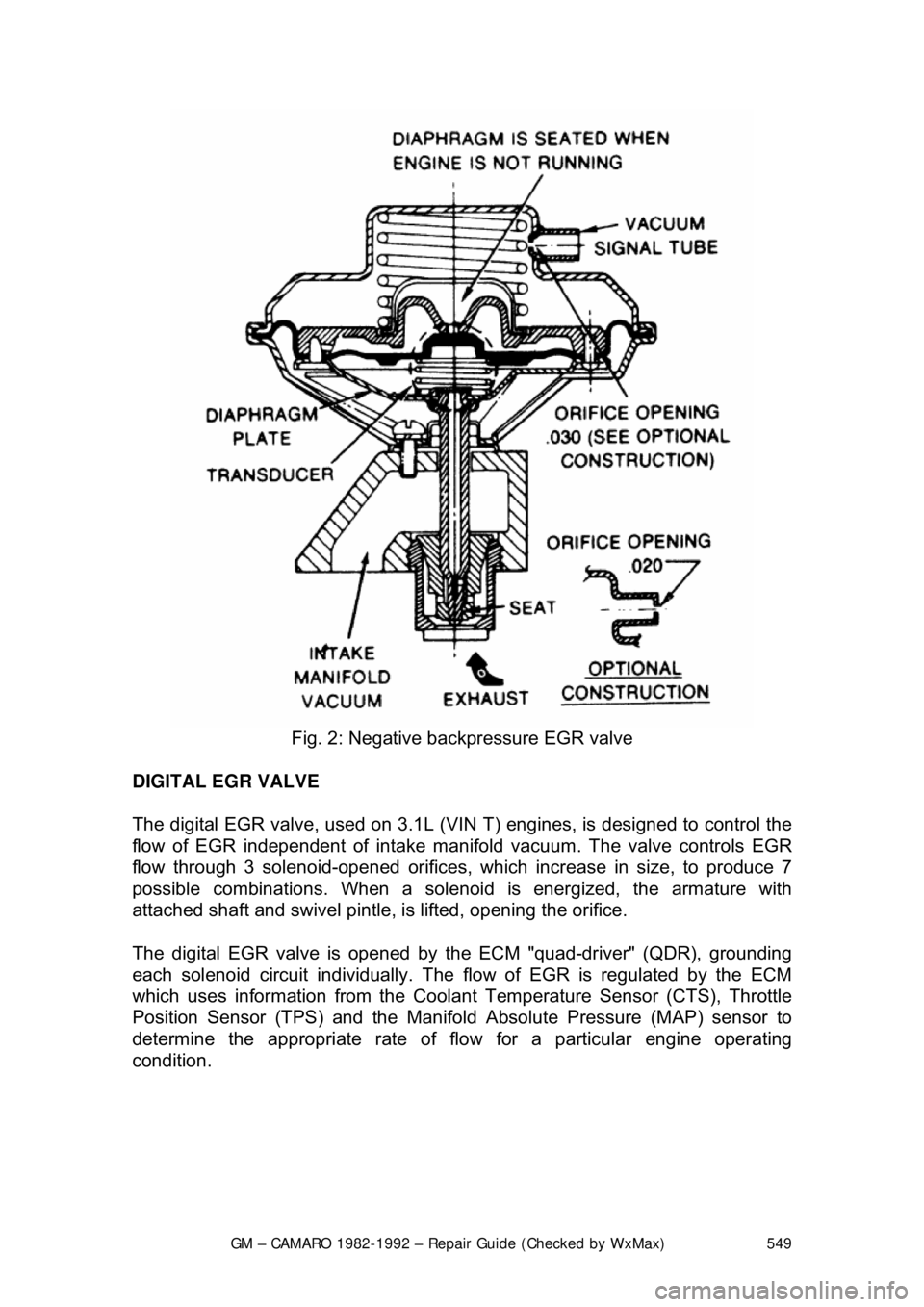
Fig. 2: Negative backpressure EGR valve
DIGITAL EGR VALVE
The digital EGR valve, used on 3.1L (VIN T) engines, is designed to control the
flow of EGR independent of intake mani fold vacuum. The valve controls EGR
flow through 3 solenoid- opened orifices, which increa se in size, to produce 7
possible combinations. When a solenoid is energized, the armature with
attached shaft and swivel pintle, is lifted, opening the orifice.
The digital EGR valve is opened by t he ECM "quad-driver" (QDR), grounding
each solenoid circuit individually. The fl ow of EGR is regulated by the ECM
which uses information from the Coolant Temperature Sensor (CTS), Throttle
Position Sensor (TPS) and the Manifold Absolute Pressure (MAP) sensor to
determine the appropriate rate of flow for a particular engine operating
condition.
Page 563 of 875
GM – CAMARO 1982-1992 – Repair Guide (Checked by WxMax) 563
On the 2.8L engine only, an anti-backfire (g
ulp) valve is used to allow air flow
into the intake manifold. This is us ed to help prevent backfire during high
vacuum deceleration conditions. The extra air enters the intake system to lean
the rich air/fuel mixture. The valve is o perated by the intake manifold vacuum to
allow air from the air filter to flow into the intake manifold.
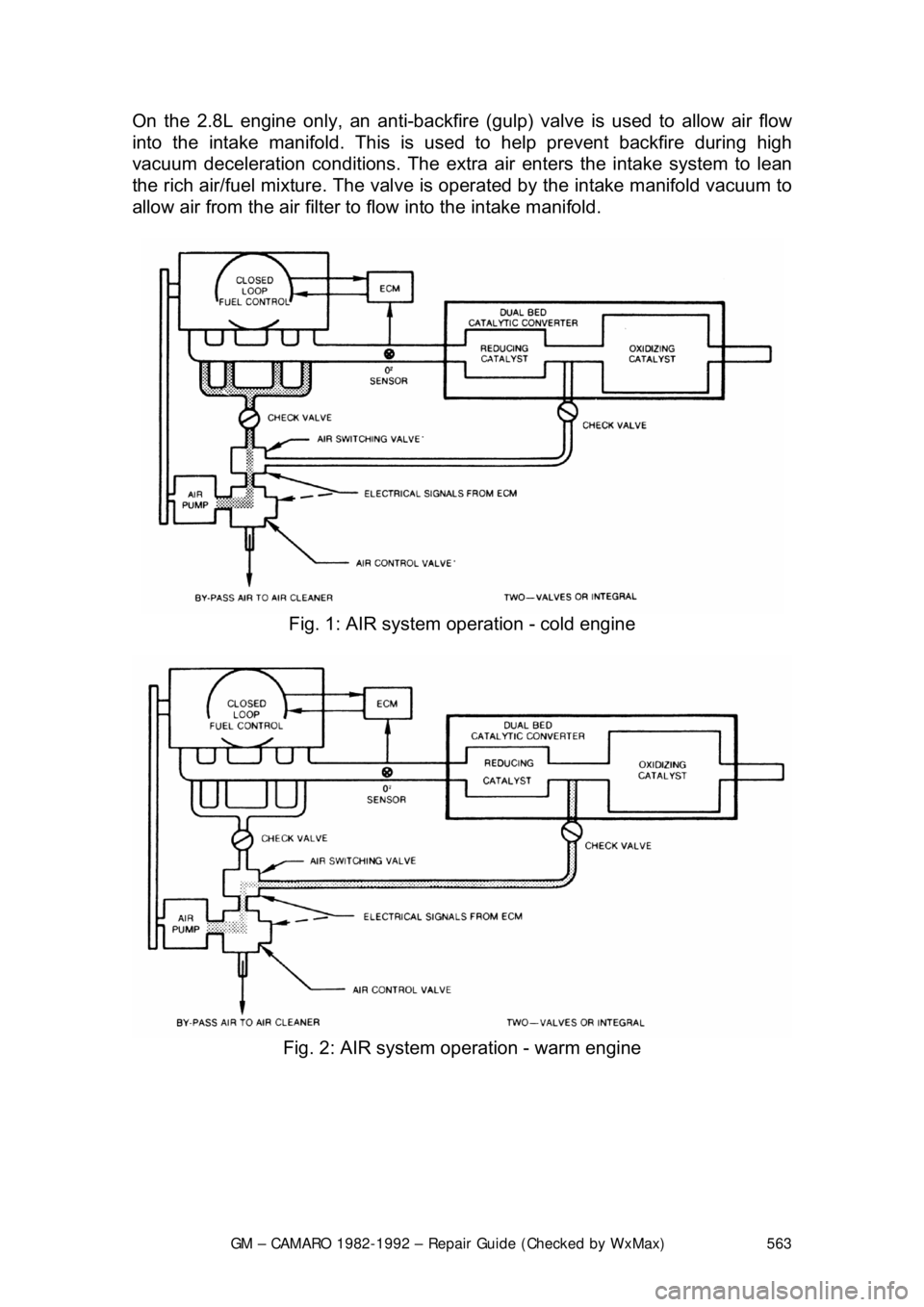
Fig. 1: AIR system operation - cold engine
Fig. 2: AIR system operation - warm engine