1982 CHEVROLET CAMARO ignition
[x] Cancel search: ignitionPage 386 of 875

GM – CAMARO 1982-1992 – Repair Guide (Checked by WxMax) 386
FUEL INJECTION
1. Remove the air cleaner.
2. Drain the radiator.
3. Disconnect: a. Battery cables at the battery.
b. Upper radiator and heater hoses at the manifold.
c. Crankcase ventilation hoses as required.
d. Fuel line at the carburetor.
e. Accelerator linkage.
f. Vacuum hose at the distributor, if equipped.
g. Power brake hose at the car buretor base or manifold, if
applicable.
h. Temperature sending switch wires.
4. Remove the distributor cap and scribe the rotor position relative to the
distributor body, and engine.
5. Remove the distributor.
6. If applicable, remove the alternator upper bracket. As required, remove
the air cleaner bracket, and accelerator bellcrank.
7. Remove the manifold-to-head attachi ng bolts, then remove the manifold
and carburetor as an assembly.
8. Mark and disconnect all emission re lated items (e.g.: wiring, vacuum
hoses, etc.) which are connected to manifold mounted items.
9. If the manifold is to be replaced , transfer the carburetor (and mounting
studs), water outlet and thermostat (use a new gasket) heater hose
adapter, EGR valve (use new gasket) and, if applicable, TVS switch(s)
and the choke coil.
To install: 10. Before installing the manifold, thoroughly clean the gasket and sealing
surfaces of the cylinder heads and manifold.
11. Install the manifold end seals, folding the tabs if applicable, and the
manifold/head gaskets, using a s ealing compound around the water
passages.
Make sure that the new manifold gaskets match the old ones EXACTLY.
12. When installing the manifold, care should be taken not to dislocate the
end seals. It is helpful to use a pilo t in the distributor opening. Tighten the
manifold bolts to 30 ft. lbs. (40 Nm) for 5.0L or 20-25 ft. lbs. (27-34 Nm)
for 2.8L in the sequence illustrated.
13. Install the distributor with the rotor in its original location as indicated by
the scribe line. If the engi ne has been disturbed, refer to the previous
Distributor Removal and Installation procedure.
14. If applicable, install the alter nator upper bracket and adjust the belt
tension.
15. Connect all disconnected components at their original locations.
16. Fill the cooling system, start the engine, check for leaks and adjust the
ignition timing and carburetor idle speed and mixture.
Page 409 of 875

GM – CAMARO 1982-1992 – Repair Guide (Checked by WxMax) 409
When servicing the engine, be absolutely sure to mark vacuum hoses and
wiring so that these items
may be properly reconnected during installation. Also,
when disconnecting fittings of metal lines (fuel, power brake vacuum), always
use two flare nut (or line) wrenches. Ho ld the wrench on the large fitting with
pressure on the wrench as if you were tightening the fitting (clockwise), THEN
loosen and disconnect the smaller fitting fr om the larger fitting. If this is not
done, damage to the line will result.
CAUTION - When draining the coolant, keep in mind that cats and dogs are
attracted by the ethylene gl ycol antifreeze, and are quite likely to drink any that
is left in an uncovered container or in puddles on the ground. This will prove
fatal in sufficient quantity. Always drai n the coolant into a sealable container.
Coolant should be reused unless it is contaminated or several years old.
2.5L ENGINE
Fig. 1: Cylinder head bolt torque sequence for 2.5L engine
1. Disconnect the negative battery cable.
2. Drain the engine block and radiator of coolant.
3. Raise and safely support the vehi cle. Remove the exhaust pipe and
lower the vehicle.
4. Remove the oil level indicator tube.
5. Remove the air cleaner.
6. Unplug the electrical and vac uum connections and disconnect the
linkage from the TBI unit.
7. Disconnect the fuel lines.
8. Remove the EGR valve.
9. Disconnect the heater hoses from the intake manifold.
10. Remove the ignition coil.
Page 417 of 875
GM – CAMARO 1982-1992 – Repair Guide (Checked by WxMax) 417
16. Fill the cooling syst
em with the proper type and amount of coolant.
Connect the negative battery cable.
17. Raise and support the vehicle safely . Install a new oil filter, lower the
vehicle. Fill the crankcase with the proper type and quantity of engine oil.
18. Start the engine, check for lea ks and check the ignition timing.
OIL PAN
REMOVAL & INSTALLATION
CAUTION - The EPA warns that prolonged contact with used engine oil may
cause a number of skin disorders, incl uding cancer! You should make every
effort to minimize your exposure to used engine oil. Pr otective gloves should be
worn when changing the oil. Wash y our hands and any other exposed skin
areas as soon as possible after exposure to used engine oil. Soap and water, or
waterless hand cleaner should be used.
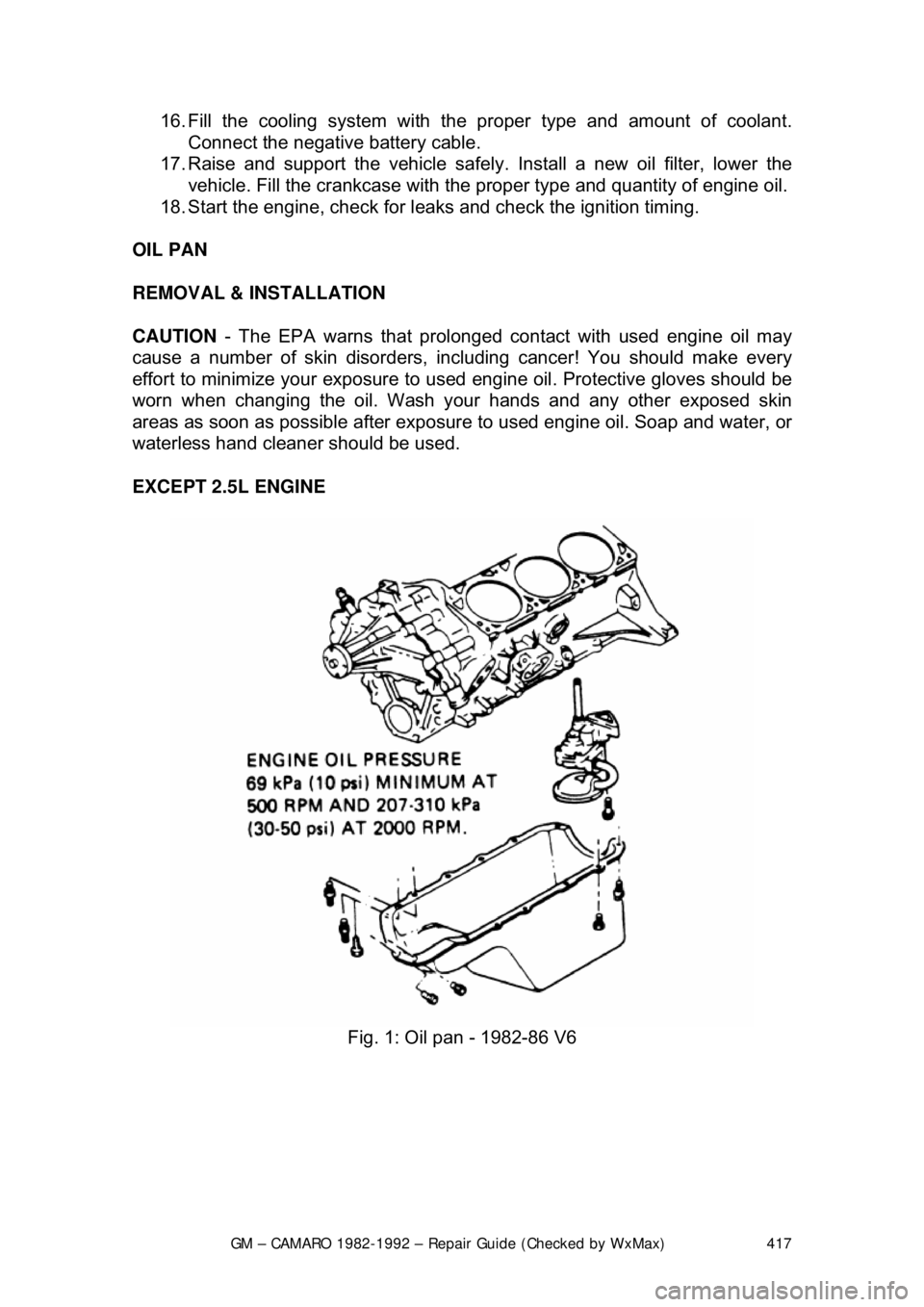
EXCEPT 2.5L ENGINE
Fig. 1: Oil pan - 1982-86 V6
Page 443 of 875

GM – CAMARO 1982-1992 – Repair Guide (Checked by WxMax) 443
Ensure that oil holes are properly al
igned. Replace camshaft rear plug, and
stake it into position to aid retention.
INSPECTION
CAMSHAFT LOBE LIFT
Check the lift of each lobe in consecutiv e order and make a note of the reading.
1. Remove the fresh air inlet tube a nd the air cleaner. Remove the heater
hose and crankcase ventilation hoses. Remove valve rocker arm
cover(s).
2. Remove the rocker arm stud nut or fulcrum bolts, fulcrum seat and rocker
arm.
3. Make sure the pushrod is in the valve tappet socket. Install a dial indicator so that the actuating poin t of the indicator is in the pushrod
socket (or the indicator ball socket adapter tool is on the end of the
pushrod) and in the same plane as the pushrod movement.
4. Disable the ignition and fuel systems.
5. Install a remote starter switch. Crank the engine with the ignition and fuel
system disabled. Turn the crankshaft ov er until the tappet is on the base
circle of the camshaft lobe. At this position, the pushrod will be in its
lowest position.
6. Zero the dial indicator. Continue to rotate the crankshaft slowly until the
pushrod is in the fully raised position.
7. Compare the total lift recorded on the dial indicator with the specification
shown on the Camshaft Specification chart.
To check the accuracy of the original in dicator reading, continue to rotate the
crankshaft until the indicator reads zero. If the lift on any lobe is below specified
wear limits listed, the ca mshaft and the valve tappet operating on the worn
lobe(s) must be replaced.
8. Install the rocker arm, fulcrum seat and stud nut or fulcrum bolts. Adjust
the valves, if required (r efer to the valves procedure in this section).
9. Install the valve rocker arm cover(s) and the air cleaner.
CAMSHAFT END PLAY
On all gasoline V8 engi nes, prying against the aluminum-nylon camshaft
sprocket, with the valve train load on t he camshaft, can break or damage the
sprocket. Therefore, the rocker arm adj usting nuts must be backed off, or the
rocker arm and shaft assembly must be loosened sufficiently to free the
camshaft. After checking the camshaft e nd play, check the valve clearance.
Adjust if required (refer to procedure in this section).
1. Push the camshaft toward the rear of the engine. Install a dial indicator or
equivalent so that the indicator point is on the camshaft sprocket
attaching screw.
Page 466 of 875

GM – CAMARO 1982-1992 – Repair Guide (Checked by WxMax) 466
wear. Worn piston rings, scored or wo
rn cylinder bores, blown head gaskets,
sticking or burnt valves, and worn valve seats are all possible culprits. A check
of each cylinder's compression will help locate the problem.
A screw-in type compression gauge is more accurate than the type you simply
hold against the spark plug hole. Although it takes slightly longer to use, it's
worth the effort to obtain a more accurate reading.
1. Make sure that the proper amount and viscosity of engine oil is in the
crankcase, then ensure the battery is fully charged.
2. Warm-up the engine to normal operat ing temperature, then shut the
engine OFF.
3. Disable the ignition system.
4. Label and disconnect all of the spark plug wires from the plugs.
5. Thoroughly clean the cylinder h ead area around the spark plug ports,
then remove the spark plugs.
6. Set the throttle plate to the fully open (wide-open throttle) position. You
can block the accelerator linkage open for this, or you can have an
assistant fully depress the accelerator pedal.
Fig. 1: A screw-in type compression gauge is more accurate and easier to use
without an assistant
7. Install a screw-in type compression gauge into the No. 1 spark plug hole
until the fitting is snug.
WARNING - Be careful not to crossthread the spark plug hole.
Page 467 of 875

GM – CAMARO 1982-1992 – Repair Guide (Checked by WxMax) 467
8. According to the tool manufacture
r's instructions, connect a remote
starting switch to the starting circuit.
9. With the ignition switch in the OFF position, use the remote starting
switch to crank the engine through at least five compression strokes
(approximately 5 seconds of cranking) and record the highest reading on
the gauge.
10. Repeat the test on each cylinder, cranking the engine approximately the
same number of compression stroke s and/or time as the first.
11. Compare the highest readi ngs from each cylinder to that of the others.
The indicated compression pre ssures are considered within
specifications if the lo west reading cylinder is within 75 percent of the
pressure recorded for the highest readi ng cylinder. For example, if your
highest reading cylinder pressure was 150 psi (1034 kPa), then 75
percent of that would be 113 psi (779 kPa). So the lowest reading
cylinder should be no less than 113 psi (779 kPa).
12. If a cylinder exhibits an unusually low compression reading, pour a
tablespoon of clean engine oil into the cylinder through the spark plug
hole and repeat the compression tes t. If the compression rises after
adding oil, it means that the cylinder's piston rings and/or cylinder bore
are damaged or worn. If the pressure re mains low, the valves may not be
seating properly (a valve job is needed), or the head gasket may be
blown near that cylinder. If compressi on in any two adjacent cylinders is
low, and if the addition of oil doesn' t help raise compression, there is
leakage past the head gasket. Oil and coolant in the combustion
chamber, combined with blue or const ant white smoke from the tail pipe,
are symptoms of this pr oblem. However, don't be alarmed by the normal
white smoke emitted from the tail pipe during engine warm-up or from
cold weather driving. There may be evidence of water droplets on the
engine dipstick and/or oil droplets in the cooling system if a head gasket
is blown.
OIL PRESSURE TEST
Check for proper oil pressu re at the sending unit passage with an externally
mounted mechanical oil pressure gauge (a s opposed to relying on a factory
installed dash-mounted gauge). A tachom eter may also be needed, as some
specifications may require running the engine at a specific rpm.
1. With the engine cold, locate and remo ve the oil pressure sending unit.
2. Following the manufacturer's inst ructions, connect a mechanical oil
pressure gauge and, if necessary, a tachometer to the engine.
3. Start the engine and allow it to idle.
4. Check the oil pressure reading when cold and record the number. You
may need to run the engine at a specified rpm, so check the
specifications chart located earlier in this section.
5. Run the engine until normal operati ng temperature is reached (upper
radiator hose will feel warm).
6. Check the oil pressure reading agai n with the engine hot and record the
number. Turn the engine OFF.
Page 513 of 875

GM – CAMARO 1982-1992 – Repair Guide (Checked by WxMax) 513
1. Connect the vehicle battery.
2. Start the engine. Keep y
our eye on your oil pressure indicator; if it does
not indicate oil pressure within 10 se conds of starting, turn the vehicle
off.
WARNING - Damage to the engine can result if it is allowed to run with no oil
pressure. Check the engine oil level to make sure that it is full. Check for any
leaks and if found, repair the leaks be fore continuing. If there is still no
indication of oil pressure, y ou may need to prime the system.
3. Confirm that there are no fluid leaks (oil or other).
4. Allow the engine to reach nor mal operating temperature (the upper
radiator hose will be hot to the touch).
5. If necessary, set the ignition timing.
6. Install any remaining components such as the air cleaner (if removed for
ignition timing) or body panels which were removed.
BREAKING IT IN
Make the first miles on the new engine , easy ones. Vary the speed but do not
accelerate hard. Most importantly, do not lug the engine, and avoid sustained
high speeds until at least 100 miles. Ch eck the engine oil and coolant levels
frequently. Expect the engine to use a littl e oil until the rings seat. Change the
oil and filter at 500 miles, 1500 mile s, then every 3000 miles past that.
KEEP IT MAINTAINED
Now that you have just gone through all of that hard work, keep yourself from
doing it all over again by thoroughly maintaining it. Not that you may not have
maintained it before, heck you c ould have had one to two hundred thousand
miles on it before doing this. However, you may have bought the vehicle used,
and the previous owner did not keep up on maintenance. Which is why you just
went through all of that hard work. See?
Page 570 of 875

GM – CAMARO 1982-1992 – Repair Guide (Checked by WxMax) 570
Switch (TVS). The electrical type, cons
ists of a ceramic grid located under the
base of the carburetor.
A check of the operation should be made at regular maintenance intervals.
TESTING
VACUUM SERVO TYPE 1. With the engine cold, observe the posit ion of the actuator arm. Start the
engine. The arm should move toward the diaphragm (closing the valve).
2. If the arm does not move, remove the hose and check for vacuum. If still
no vacuum, remove the top hose from the TVS switch and check for
vacuum.
3. If vacuum is present in the top hose, replace the TVS switch.
4. If vacuum is present at the actuator and it does not move, try to free the
valve. If the valve cannot be freed, it must be replaced.
ELECTRICAL TYPE 1. Turn the ignition ON with the engine co ld and probe both terminals of the
heater switch connector with a test light.
• If 1 wire has power, replace the heater switch.
• If neither wire has power, repai r the ignition circuit.
• If both wires have power, probe the pink wire at the heater
connector (if no power, repair the c onnector of the heater switch).
2. If power exists at the pink wire , disconnect the heater connector and
connect a tester across the harness terminal. If no power, repair the
ground wire; if power exists, check the resistance of the heater.
3. If heater is over 3 ohm s, replace the heater. If under 3 ohms, replace the
connector, start the engine (operate to normal temperature) and probe
the pink wire. If no power, the system is OK; if power exists, replace the
heater switch.
REMOVAL & INSTALLATION
VACUUM SERVO TYPE 1. Disconnect the vacuum hose at the EFE.
2. Remove exhaust pipe to manifold nuts.
3. Remove the crossover pipe. Complete removal is not always necessary.
4. Remove the EFE valve.
To install: 5. Position the EFE valve into place.
6. Install the crossover pipe.
7. Install the exhaust pi pe to manifold nuts.
8. Connect the vacuum hose at the EFE.