1982 CHEVROLET CAMARO ignition
[x] Cancel search: ignitionPage 655 of 875

GM – CAMARO 1982-1992 – Repair Guide (Checked by WxMax) 655
2. Clean off the marks and coat them wit
h white paint or chalk, if necessary,
so that they may be seen.
3. Run the engine until it reaches no rmal operating temperature, then shut
off the engine.
4. With the ignition OFF, connect a ta chometer to the distributor, and a
timing light with an inductive pickup lead to the No. 1 spark plug wire.
WARNING - Never pierce a secondary ignition wire in order to connect a timing
light. A pierced wire may lead to engine misfiring and driveability problems.
5. To properly set the ignition timing , the EST must be placed in the bypass
mode. a. On the 2.5L engine, refer to t he emission control label for the
procedure.
If the label is missing or unreadable, c ontact your Chevrolet dealer for a
replacement.
b. On 2.8L and 5.0L ca rbureted engines, disconnect the 4-wire EST
connector at the distributor. (Fault code 42 may be set in ECM memory,
and must be cleared once the procedur e is completed). Proceed to Step
7.
c. On 2.8L, 5.0L and 5.7L fuel inje cted engines, with the engine RUNNING
and all accessories off, use a jumper wire to connect diagnostic terminal
B and ground terminal A of the 12-terminal Assembly Line Diagnostic
Link (ALDL) usually located under t he left side of the instrument panel.
DO NOT disconnect the 4-wir e EST connector at the distributor. Aim the
timing light at the timing mark; the li ne on the balancer or pulley will line
up with the timing mark. Increase engine speed and check for timing
advance. If the timing still advances with engine speed, perform Step 6. If
timing does not advance with engi ne speed, proceed to Step 7.
If timing advances with engine speed, it will be necessary to disconnect the
single-wire Set Timing connector. (Faul t code 42 may be set in ECM memory,
and must be cleared once the procedure is completed).
6. Remove the jumper wire from t he ALDL, and shut off the ignition.
Disconnect the Set Timing connector, usually located under the plastic
cover above the heater unit, in the engi ne compartment. (The wire in this
connector is normally Tan/Black.)
7. With the engine running and all accessories off, aim the light at the timing
mark. The line on the balancer or pulle y will line up with the timing mark.
If a change in timing is necessary, loosen the hold-down clamp bolt at
the base of the distributor . While observing the timing mark, rotate the
distributor slightly unt il the line indicates the correct timing. Use the
timing specification on the emi ssion control label in the engine
compartment. If this label is missi ng or damaged, refer to the Tune-Up
Specifications chart in this Section.
Page 656 of 875

GM – CAMARO 1982-1992 – Repair Guide (Checked by WxMax) 656
8. Once the timing is set to specific
ation, tighten the distributor hold-down
clamp. Recheck the timing to make su re it did not change while the bolt
was being tightened.
9. Remove the jumper wire from the ALDL connector, if applicable, with the
engine still running. (Usually, if this is performed before the engine is
shut off, no trouble codes will be stored.)
10. Turn the engine OFF, then remove the timing light and tachometer.
Reconnect the number 1 spark plug wire, if disconnected.
11. Attach the 4-wire EST connector at the distributor, or reconnect the Set
Timing connector, if applicable.
12. Check for fault code 42, and clear, if necessary, by disconnecting the
negative battery cable for at least 30 seconds.
To prevent ECM damage, the key must be in the OFF position when
disconnecting or reconnecting battery cables.
1988-90 VEHICLES
When adjusting the timing, refer to the instructions on the emission control
sticker inside the engine compartment. If th e instructions on the label disagree
with the procedure listed below, follo w the instructions on the label.
1. Locate the timing marks on the cran kshaft pulley and the front of the
engine.
2. Clean off the marks and coat them with white paint or chalk, so that they
may be easily seen.
3. Run the engine until it reaches no rmal operating temperature, then shut
off the engine.
4. With the ignition OFF, connect a ta chometer to the distributor, and a
timing light with an inductive pickup lead to the No. 1 spark plug wire.
WARNING - Never pierce a secondary ignition wire in order to connect a timing
light. A pierced wire may lead to engine misfiring and driveability problems.
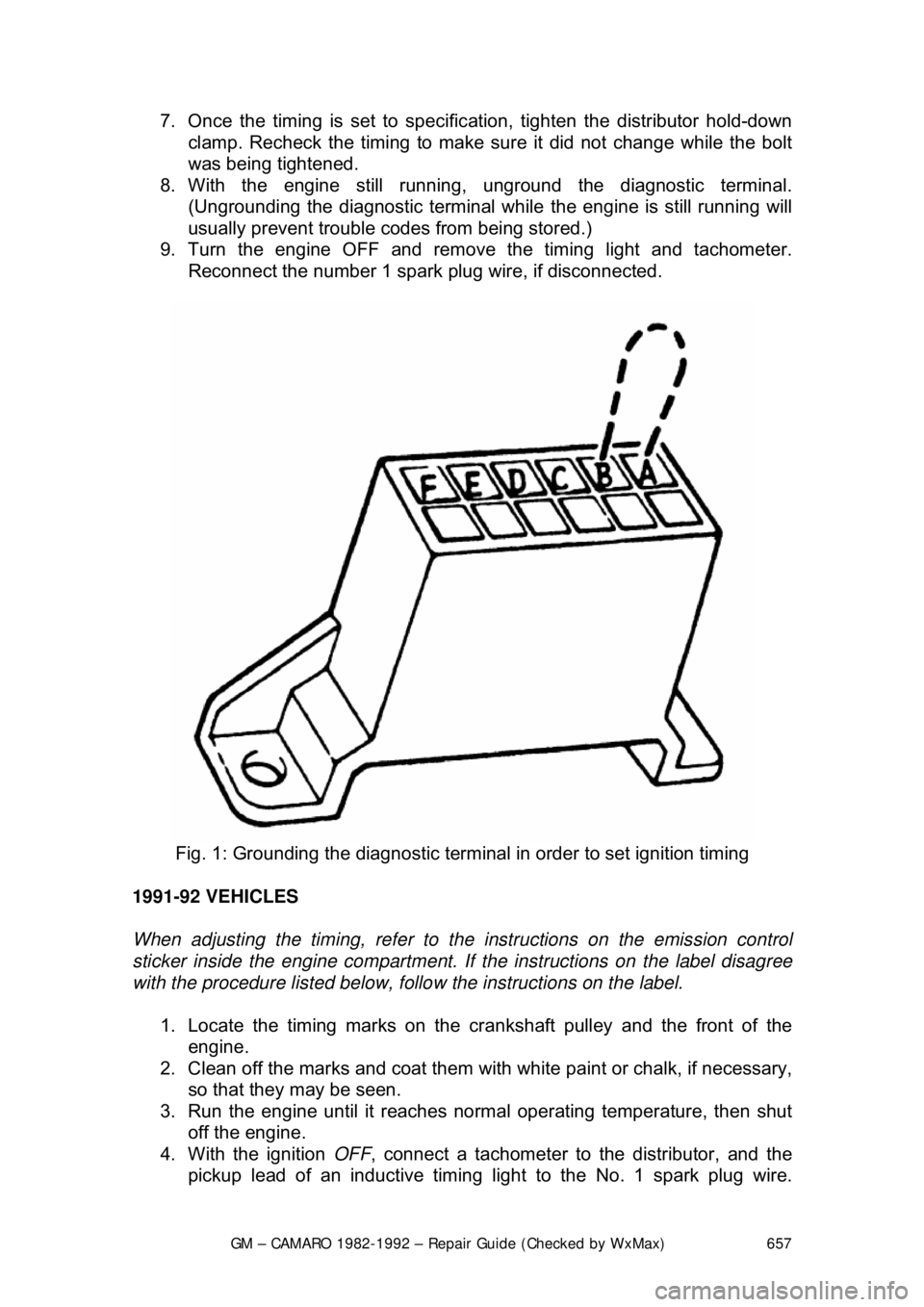
5. Start the engine. With the engine running and all accessories off, use a
jumper wire to connect diagnostic terminal B and ground terminal A of
the 12-terminal Assembly Line Diagnostic Link (ALDL), located under the
instrument panel.
If jumping the ALDL terminals does not prevent timing advance, the EST
bypass wire will have to be disconnected instead.
6. Aim the timing light at the timing mark. The line on the balancer or pulley
will line up with the timing mark. If a change in timing is necessary,
loosen the hold-down clamp bolt at t he base of the distributor. While
observing the timing mark, rotate the distributor slightly until the line
indicates the correct timing. Use t he timing specification on the emission
control label in the engine compartm ent. If this label is missing or
damaged, refer to the Tune- Up Specifications chart in this Section.
Page 657 of 875
GM – CAMARO 1982-1992 – Repair Guide (Checked by WxMax) 657
7. Once the timing is set to specific
ation, tighten the distributor hold-down
clamp. Recheck the timing to make su re it did not change while the bolt
was being tightened.
8. With the engine still running, unground the diagnostic terminal.
(Ungrounding the diagnostic terminal while the engine is still running will
usually prevent trouble c odes from being stored.)
9. Turn the engine OFF and remove the timing light and tachometer.
Reconnect the number 1 spark plug wire, if disconnected.
Fig. 1: Grounding the diagnostic termi nal in order to set ignition timing
1991-92 VEHICLES
When adjusting the timing, refer to the instructions on the emission control
sticker inside the engine compartment. If th e instructions on the label disagree
with the procedure listed below, follo w the instructions on the label.
1. Locate the timing marks on the cran kshaft pulley and the front of the
engine.
2. Clean off the marks and coat them wit h white paint or chalk, if necessary,
so that they may be seen.
3. Run the engine until it reaches no rmal operating temperature, then shut
off the engine.
4. With the ignition OFF, connect a tachometer to the distributor, and the
pickup lead of an inductive timing li ght to the No. 1 spark plug wire.
Page 658 of 875
GM – CAMARO 1982-1992 – Repair Guide (Checked by WxMax) 658
Connect the timing light power leads
according to the manufacturer's
instructions.
WARNING - Never pierce a secondary ignition wire in order to connect a timing
light. A pierced wire may lead to engine misfiring and driveability problems.
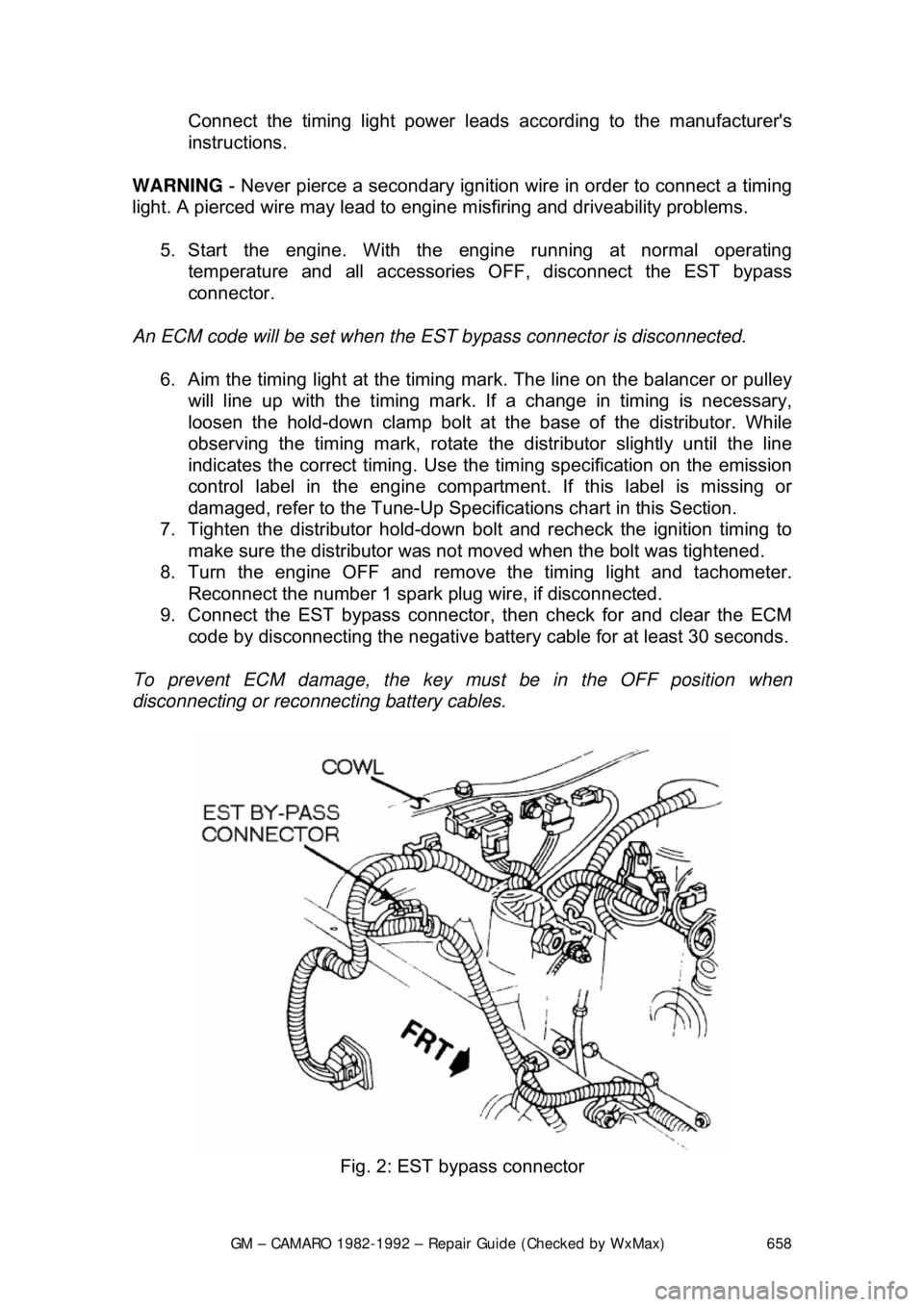
5. Start the engine. With the engine running at normal operating
temperature and all accessories OFF, disconnect the EST bypass
connector.
An ECM code will be set when the EST bypass connector is disconnected.
6. Aim the timing light at the timing mark. The line on the balancer or pulley
will line up with the timing mark. If a change in timing is necessary,
loosen the hold-down clamp bolt at t he base of the distributor. While
observing the timing mark, rotate the distributor slightly until the line
indicates the correct timing. Use t he timing specification on the emission
control label in the engine compartm ent. If this label is missing or
damaged, refer to the Tune- Up Specifications chart in this Section.
7. Tighten the distributor hold-down bolt and recheck the ignition timing to
make sure the distributor was not moved when the bolt was tightened.
8. Turn the engine OFF and remove the timing light and tachometer.
Reconnect the number 1 spark plug wire, if disconnected.
9. Connect the EST bypass connector , then check for and clear the ECM
code by disconnecting the negative battery cable for at least 30 seconds.
To prevent ECM damage, the key must be in the OFF position when
disconnecting or reconnecting battery cables.
Fig. 2: EST bypass connector
Page 666 of 875

GM – CAMARO 1982-1992 – Repair Guide (Checked by WxMax) 666
FUEL SYSTEM
BASIC FUEL SYSTEM DIAGNOSIS
When there is a problem star ting or driving a vehicle, two of the most important
checks involve the ignition and the fuel systems. The questions most mechanics
attempt to answer first, "is there spark?" an d "is there fuel?" will often lead to
solving most basic problems. For igni tion system diagnosis and testing, please
refer to the information on engine electr ical components and ignition systems
found earlier in this repair guide. If the ignition system checks out (there is
spark), then you must determine if the f uel system is operating properly (is there
fuel?).
CARBURETED FUEL SYSTEM
MECHANICAL FUEL PUMP
All fuel pumps used on carbureted V6 and V8 engines are of the diaphragm
type and are serviced by replacement onl y. No adjustments or repairs are
possible. The fuel pump is mounted on th e left front (V6) and right front (V8) of
the engine.
The fuel pumps are also equipped with vapor return lines for purposes of
emission control and to reduce vapor lock. All pumps are operated by an
eccentric on the camshaft. On V6 an d V8 engines, a pushrod between the
camshaft eccentric and the fuel pump operates the pump.
REMOVAL & INSTALLATION
When disconnecting the fuel pump outlet fitting, always use two wrenches to
avoid twisting the line.
1. Disconnect the fuel in take and outlet lines at the pump, then plug the
pump intake line.
2. Remove the two pump mounting bol ts and lockwashers; remove the
pump and its gasket.
3. If the pump pushrod is to be remo ved from the V8, remove the two
adapter bolts and lockwashers, then re move the adapter and its gasket.
4. Install the fuel pump with a new gasket reversing the removal procedure.
Coat the mating surfaces with sealer.
5. Connect the fuel lines and check for leaks.
Page 697 of 875
GM – CAMARO 1982-1992 – Repair Guide (Checked by WxMax) 697
9. Check, and if necessary, adjust fast
idle speed, as described on the
Vehicle Emission Control Information (VECI) label.
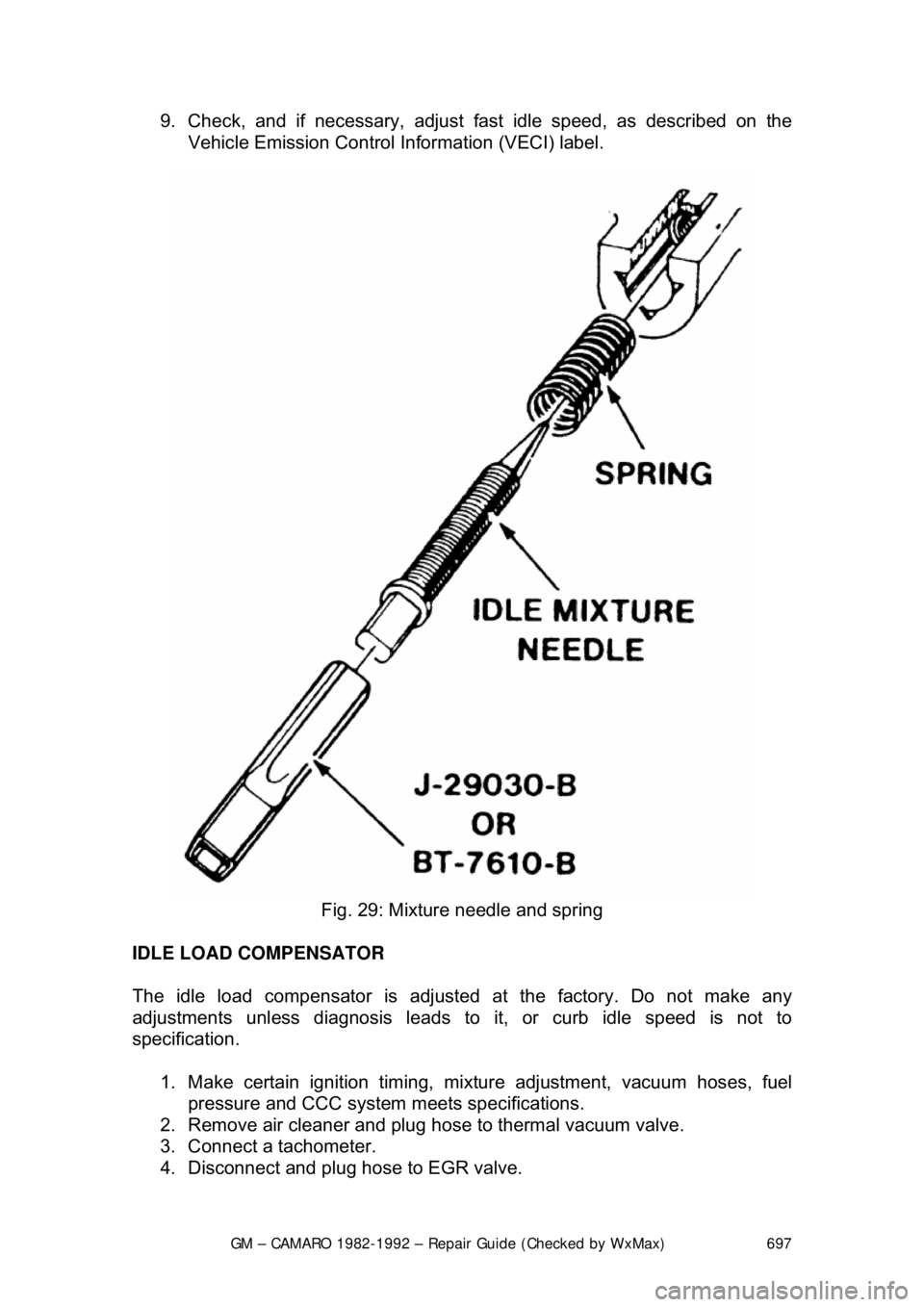
Fig. 29: Mixture needle and spring
IDLE LOAD COMPENSATOR
The idle load compensator is adjusted at the factory. Do not make any
adjustments unless diagnosis leads to i t, or curb idle speed is not to
specification.
1. Make certain ignition timing, mi xture adjustment, vacuum hoses, fuel
pressure and CCC system meets specifications.
2. Remove air cleaner and plug hose to thermal vacuum valve.
3. Connect a tachometer.
4. Disconnect and plug hose to EGR valve.
Page 700 of 875
GM – CAMARO 1982-1992 – Repair Guide (Checked by WxMax) 700
5. With the ignition
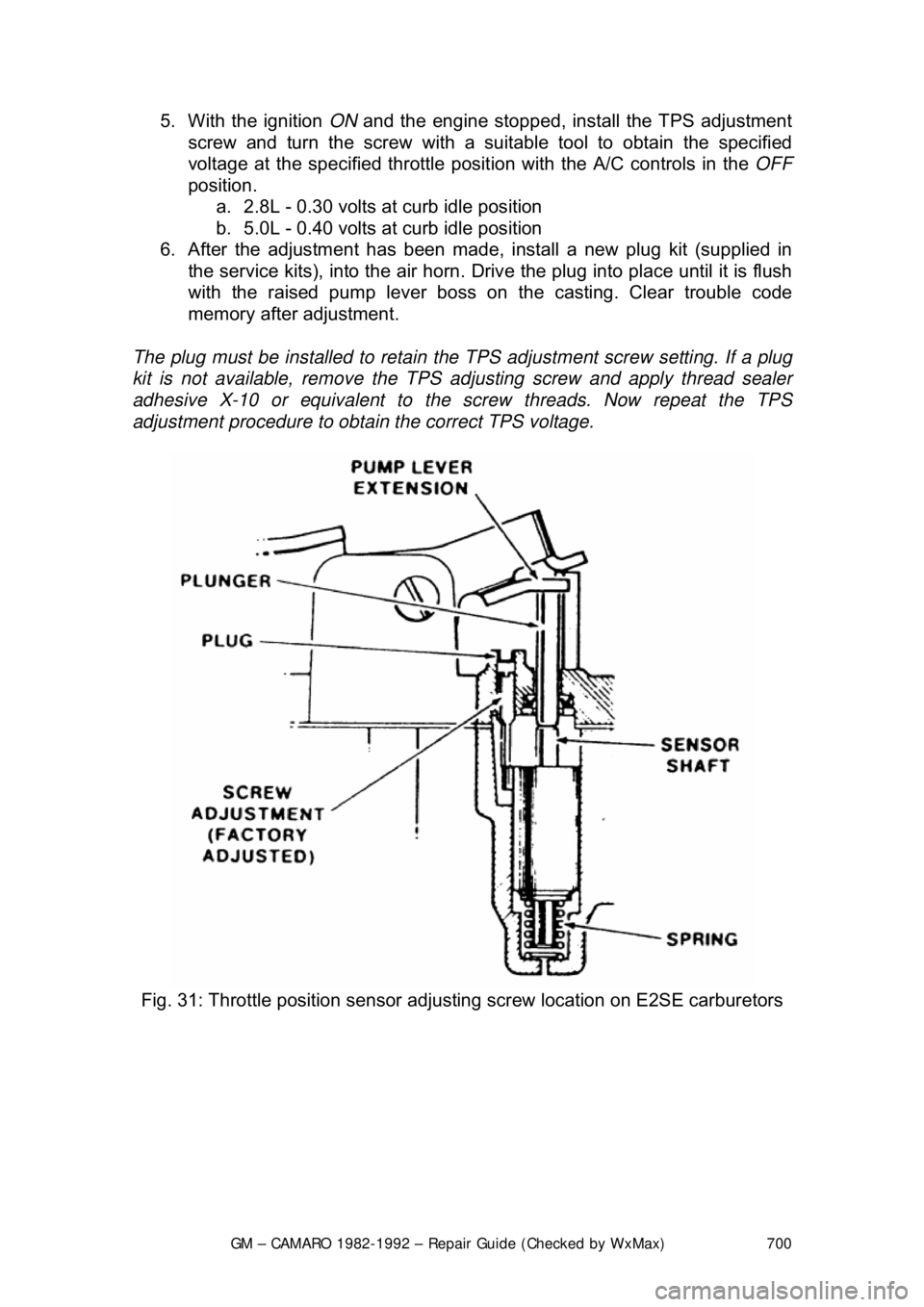
ON and the engine stopp ed, install the TPS adjustment
screw and turn the screw with a suitable tool to obtain the specified
voltage at the specified throttle posit ion with the A/C controls in the OFF
position. a. 2.8L - 0.30 volts at curb idle position
b. 5.0L - 0.40 volts at curb idle position
6. After the adjustment has been made, install a new plug kit (supplied in
the service kits), into the air horn. Driv e the plug into place until it is flush
with the raised pump lever boss on t he casting. Clear trouble code
memory after adjustment.
The plug must be installed to retain the TPS adjustment screw setting. If a plug
kit is not available, remove the T PS adjusting screw and apply thread sealer
adhesive X-10 or equivalent to the scr ew threads. Now repeat the TPS
adjustment procedure to obtain the correct TPS voltage.
Fig. 31: Throttle position sensor adjus ting screw location on E2SE carburetors
Page 720 of 875

GM – CAMARO 1982-1992 – Repair Guide (Checked by WxMax) 720
8. Using a number 20 Torx® bit, turn
the throttle stop screw until the engine
speed is 475-525 rpm in PARK (aut o transmission) or 450-500 rpm in
NEUTRAL (manual transmission).
9. Stop the engine and remove tool J-33047 from the throttle body.
10. Reconnect the TV cable to the throttle control bracket.
11. Reconnect the IAC valve connector.
12. Use silicone sealant to co ver the throttle stop screw.
13. Reinstall the air cleaner.
Fig. 6: Installing tool J-33047
5.0L ENGINES 1. Remove the idle stop screw plug or cap.
2. Ground the diagnostic connector (ALDL).
3. Turn the ignition ON and wait 45 seconds, DO NOT start the engine.
4. Disconnect the idle air control connector with the ignition ON.
5. Remove the ground from the di agnostic connector and disconnect the
distributor set-timing connector.
6. Connect a tachometer to the engine.
7. Place the transmission in PARK (auto transmission) or NEUTRAL
(manual transmission). Start and run the engine until it reaches normal
operating temperature.
It is important that the distributor set- timing connector be disconnected to fix the
spark advance at base timing. This elim inates the possibility of changes in
engine speed due to variations in timing.