1980 CHEVROLET CITATION light
[x] Cancel search: lightPage 54 of 95
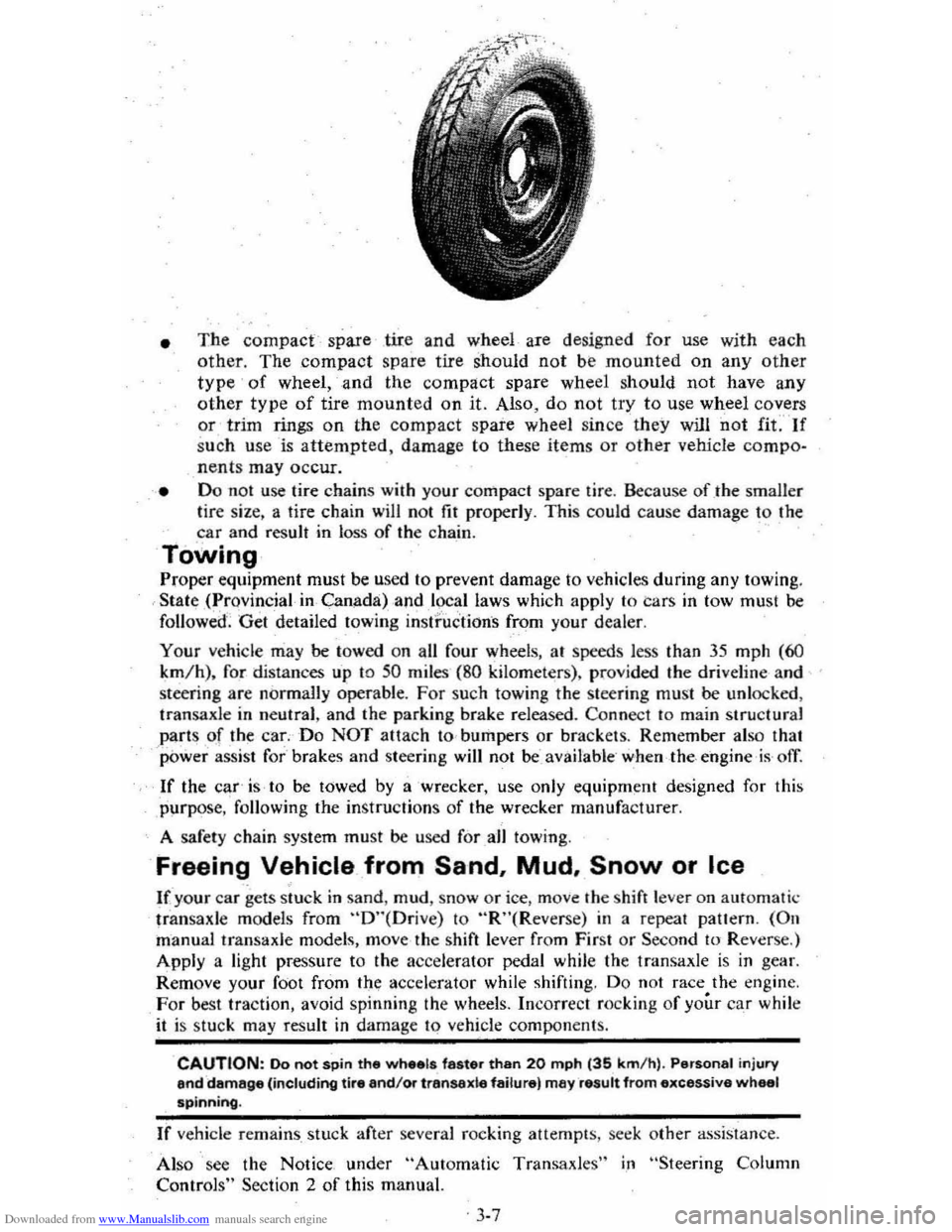
Downloaded from www.Manualslib.com manuals search engine • The compact spare .tire and wheel are design ed for use with each
other. The compact spare tire should not be mounted on any other
type of wheel, and the compact spare wheel should not have any
other type of tire mounted on it. Also, do not try to use wheel covers or trim rings on the compact spare wheel since they will not fif" If
s u ch u se is attempted, damage to these items or other vehicle compo~
nent s may occur.
• Do 1I0t use tire chains with your compact spar e tir e. Because of .the smaller lire size, a tire chain will no t fit properly . This could cause damage to the car and result in loss of the cha,in.
Towing
Prop er equipment must be used 10 prevent damage to ve hicle s during any towing .
State ,(.,rovincial in Canada) ,and l~~l laws which apply to Cars in tow must be
followed '. Get detailed towing instructions from your deale r.
Your
vehicle may be towed on all fo ur wheels, at speeds less than 35 mph (60
km /h) , for distances u'p 1O 50 miles ( 8 0 kilometer s). pro vided the driveline and
steering are normally operabl
e. For such towing the steering must be unlocked ,
tran saxle in neutral , and the parking brake released . Co
nnec t to main structural
part s of th~ car; Do NOT attach to , bumpers or brackets . Remember also that power assist for brakes and steering will not beavailable ' when the, engine is ofl
If the car' is to be towed by a 'wrecker, use only equipm~nt designed for this
purpos
e, following the instru ction s of the wrecker manufacturer.
A safety chain system must
be used forall towing .
Freeing Vehicle from Sand. Mud. Snow or Ice
If your car gets stuck in sa nd , mud , snow or ice , move the s hift lever on aut om atic
tr ans ax le models from "D"(Orive) to "R"(Reverse) in a repeat pattern. (On
manual transaxle models, move the shift lever from First or Second to Rever se.)
Apply a
light pressure to the acce lerator pedal while the transaxle is in gear.
Remove your
foot from the;: accelerator while shifting . Do not race the engine.
For best traction, avoid spinnin g the wheels. Incorrect rocking of your car while it is stuc k may result in damage to vehicle components.
CAUTION: 00 not spin the wh •• ls faster than 20 mph (35 km/ h) . Personal injury end damage (including tire and/Of transexle failure) rna)' result from excessive wheal spinning.
If vehide re mains stuck after several roc king attempt s, s eek other assistan ce.
Also 'see the Notice under
"Automatic Transaxles" i,n "Steering Column
Contro ls" Section 2 of this manu al.
. 3-7
Page 55 of 95
Downloaded from www.Manualslib.com manuals search engine SECTION 4
APPEARANCE CARE
CAUTION: Some cl .. n .... may be poi8Of10ua or flammable, and their improper UH may cau .. per.,nal Injury or damage the inside of the vehicle. Therefore, when cleaning the inside of the vehicle. 00 NOT USE volatile cleaning solvents such as:
acetone. lacquer thinnere. enamel reducers. nail polish removers; or such cl •• ning
materials •• 'aundry soaps. bleach .. or reducing agents except as noted In the fabric cteenlng advice on stein removal that ~Iowa. . NEVER UH carbon tetrachloride, paolin., benzene or naphtha for any cleaning purpose.
Overexposure to the .. vapors may .... ult!n II health problem. This is even more likely to occur In small. unventilated .~. It is recommended that all vehicle doors
be opened for ventilation when any cleaning agents or other chemicals are uNCI in the interior. Approved respiratory protection equipment may be nMded. Follow the manufacturer's advice whenever cleaning agents or other chemicals are used,
Inside or outside the vehicle.
NOTICE: To avoid pouible permanent discoloration of white or light colored nata. DO NOT let materlala with unstabl. dyes come In contact with seat trim materials until the trim meterlals are totally dry. (This would Include certain types of casual
clothing. such a8 colored denims. corduroys. leathers and suedes: also decorative paper, etc.)
CARE AND CLEANING OF INTERIOR TRIM
With the use of modern trim materials, it is VERY IMPORTANT that proper
cleaning techniques
and cleaners be used. Failure to do this on the first cleaning
may result
in water spots, spot rings, or setting of stains or soilage, all of which
make it more difficult to remove in a second cleaning.
The portions of the following cleaning instructions that are in BOLD TYPE are especia11y important and MUST be performed.
Dust and loose dirt that accumulate on interior fabrics should be removed often
with a vacuum cleaner or soft brush. Vinyl or leather trim should be wiped
regularly with a clea:1 damp cloth. Normal trim soilage, spots, or stains can be cleaned with these GM cleaners:
Description
G.M. Spot Lifter 8 oz. (.237L) Solvent Type
G.M. Multi-Purpose Powdered Cleaner
G.M. Part No.
1051398
6
lb. (2.72 Kg) Foam Type 1050429 The above products are excellent cleaners when used property.
They are available through your Authorized dealer.
Remember these basic staps before claaning :
1. Remove stains as quickly as possible before they become "set."
2. Use a clean cloth or sponge, and change to a clean area often. (A SOFT brush
may
be used if stains persist.)
3.
Use solvent type cleaners only in a well ventilated area; also, do not saturate
the stained area.
4-1
Page 56 of 95
Downloaded from www.Manualslib.com manuals search engine 4. If a ring forms after spot cleaning, dean the entire area IMMEDIATELY.
5. Follow specific instructions on cleaner labels.
CLEANING GENERAL SOILAGE OR WATER SPOTS FROM
FABRIC-TYPE TRIM WITH FOAM-TYPE CLEANER
GM Multi~Purpose Powdered Cleaner is excellent for this type of cleaning, and
for cleaning panel sections where
small cleaning rings may be left from spot
cleaning .
• Vacuum'~rea thoroughly to remove loose dirt.
• AL WAYS clean a fuJI trim assembly or complete trim section. Mask
surrounding trim along stitch
or well Hnes.
• Mi x Multi-Purpose Powdered Cleaner in -strict accordance with direction s
on label of container. Mix in proportion for smaller quantities.
• USE SUDS ONLY ON A CLEAN SPONGE OR SOFT BRISTLE BRUSH. DO NOT SATURATE FABRIC OR RUB HARSHLY WITH BRUSH.
•
IMMEDIATELY AFTER CLEANING, WIPE OFF EXCESS CLEANER WITH SLIGHTLY DAMP ABSORBENT TOWEL OR CLOTH.
IMPORTANT' -IMMEDIATELY AFTER WIPING, FORCE-DRY
FABRIC WITH AIR HOSE, HEAT DRYER OR HEAT LAMP. (Use
ca ution with-beat dryer
or lamp to, help prev~nt damage to fabri c.)
• When trim materials with a sheen or luster finish are dry, wipe fabric lightly with a soft. dry,c1ean cloth to restore its sheen or luster.
SPOT CLEANING FABRIC-TYPE TRIM WITH SOLVENT
TYPE CLEANER
Before trying to remove -a spot or stain from fabric , detennine as accurately as
y o u ca n wha t kind and how old the spot
or stain is. Some spots or stains can be removed with water or mild ~p solution (see "Removal of Specific Stains ").
Spots or stains should always be removed as soon as possi ble.
Some tyPes of stains or soilage, such as lipstick, . ink s and gre ase"are very difficult
(sometimes impossible) to completely reIilove~ When cleaning this type ·of stain or soilage ,' be,: sure not to en)arg e,:the soiled area. .
GM Fabric Cleaner (Solvent Type) is exceHent for spot c1ea,ning grease, oil, or
fat stains .
• Gently scrape -exceSs stain otT trim material with a clean . DULL knife or .
sc raper .
USE VERY LITTLE CLEANER, light pressure, and clean cloths
(preferably c heesecloth) . Cleaning , shquld be from outside of stain "FEATHERING" towards the center;-Keep changing to a clean section of
cloth .
• Wben stain is cleaned from ,fabric,immediately dry area with an air hose.
heat dryer, or heat lamp 'to help ,prevent a cleaning ring. (Use caution with
heat dryer or lamp to prevent damage to fabric) .
• If a ring forms . immediately repeat the deaning operation over a slightly
larger area with emphasi s on "FEA THERINO" toward s its center. If ring
still remains, mask ofT surrounding trim-sections and clean entire affected area
with
GM MUlti-Purpose Powdered Cleaner (as described under -"Cleaning
' General Soilage or Water Spots with -Foam Type Cleaner").
4-2
Page 57 of 95
Downloaded from www.Manualslib.com manuals search engine REMOVAL OF SPECIFIC STAINS
Grease or Oil Stains -Includes, grease, oil, butter, margarine, shoe polish,
coffee with cream, chewing gum, cosmetic creams, vegetable oils, wax crayon, tar
and asphalts.
• Carefully scrape of I excess stain; then use Fabric Cleaner (Solvent Type) as
previously described.
• Shoe polish, wax crayons,. tar and asphalts will stain if allowed to remain on
trim; they should be removed as soon as possible. Use caution as cleaner will
dissolve them and may cause them to "bleed."
Non-Greasy Stains -Includes catsup, coffee (black), egg, fruit, fruit juice, milk,
soft drinks, wine, vomit and blood;
•
Carefully scrape off excess stain; then sponge stain with cool water.
• If stain remains,"· use Multi-Purpose Powdered Cleaner (Foam Type) as
previously described.
• If odor persists after cleaning vomit or urine, treat area with a water-baking
soda solution: 5 milliliters (1 teaspoon) baking soda to 250 milliliters (1 cup)
of tepid water.
• Finally, if needed, clean lightly with Fabric Cleaner (Solvent Type).
Combination
Stains - Includes candy, ice cream, mayonnaise , chili sauce and
unknown stains.
• Carefully scrape off excess stain; then clean with cool water and allow to dry.
• If stain remains, clean with Fabric Cleaner (Solvent Type).
CLEANING VINYL OR LEATHER TRIM
Ordinary soilage can be removed from vinyl or leather with warm water and a
mild soap such as saddle soap or oil soap, or equivalent.
• Apply a small amount of soap solution and allow to soak for a few minutes
to loosen dirt; then, rub briskly with a clean, damp cloth to remove dirt and
traces of soap. (This may be repeated several times,
if necessary.)
• Soilage such as tars, asphalts, shoe polish,etc. will stain if allowed to remain
on trim. They should be wiped ofT as quickly as possible and the area cleaned
with a clean cloth dampened with GM Vinyl Cleaner (Solvent Type).
SEAT BELT CARE
• Clean seat belts only with mild soap and lukewarm water.
• Do not bleach or dye belts since this may severely weaken them.
CLEANING GLASS SURFACES
Glass surfaces should be cleaned on a regular basis. Use of GM Glass Cleaner or a commercial household glass cleaning agent will remove normal tobacco
smoke and dust films sometimes caused by ingredients used in vinyls and interior
plastics.
Never use abrasive cleaners on any vehicle glass, as they may cause scratches.
Also,
if such cleaners are used on the inside of the back window, any electric
defogger element may be damaged. A void placing decals on the inside rear window
which may later have to be scraped
ofT. If you use a temporary license, take care
not to attach it across the defogger grid.
Page 64 of 95
Downloaded from www.Manualslib.com manuals search engine On all C-4 cars, a "CHECK ENGINE" light on the instrument panel is
designed to come on during engine starting , to let you know the bulb is working. (The light will stay on a short time after the engine starts.) If the light comes on while driving, service to the emission control system
may be required. See your Chevrolet dealer' as soon as possible for an inspection of the system. Continued driving without having the C-4 System serviced _ could eventually
cause damage
to the emission control system . It could also affect fuel
e conomy and drivabili -ty.
ENGINE OIL AND FILTER RECOMMENDATIONS • Engine oils' are labeled on 'the containers with various API (American
Petroleum Institute) designations 6f quality. Use engine oils that are labeled
5E or SE/CC. Do not use oils labeled only SA, 5B, 5C, SD, CA, CB, CC or CD; _or oils with the combination label SE and CD (SE/CD). Higher
quality oils labeled SF will be introduced soon (late 1979, or 1980). These SF oils are preferred and should be used when available.
• The oil and filter change intervals for your engine are based on the use of SE-quality or SF-quality oils and ,high- quality filters such as AC oil filters. Using oils other than SE-quality or SF-quality oils, or oil change intervals
longer than recommended. could reduce -engine life and might affect your
warranty.
• Your engine was filled with a high·quality engine oil when it was built. You do ,not have to change this oil before the suggested change period.
•
If your normal driving does nQt include one or more of the four "severe service" conditions listed below. change the oil every 7,500 miles (12 000 ' kilometers) or 12 months, whichever comes first. Change the oillilter at the
first oil change. then every second oil change, if mileage (7,500 miles or 12
000. kilom~ters) determines .w ,hen you change the oil. If _time (12 months)
determines when you change the oil, change the filter with every oil change.
• Change the oil and oil filter every 3,000 miles (4 800 kilometers) , or three
months if you often drive under one or more of these 'severe service·,~.
conditions: • Driving in dusty areas
• Towing ,3 trailer
• Frequent idling or idling for long periods
• Driving 4 miles (6 kilometers) br'less in freezing weather,o~other short trips in cold weather, where the engine does not thoTough ,ly warm up.
• Change the oil and oil filter as soon as -possible after driving in a dust
storm.
Oil Viscosity
Engine oil viscosity (thickness) has an effect on fuel economy. Lowec viscosity
engine oils can provide increased , fuel " economy; however, higher temperature
weather conditions require higher viscosity engine oils for satisf~ctory lubrication.
To. get the best fuel economy with your-1980 Chevrolet, -iou should use -,, ' .
fuel. 'saviiJ.&:_engine oil ohhe_ proper viscosity. These oils call_ be found. in serviCe
stations and other retail stores. They are-identified by words such as: "Energy Saving," "Conserves Gasoline," "Gas Saving," "Gasoline Saving," '''Friction
Reducing," "Improved Gasoline Mileage" or "Fuel Saving."
The following chart lists the engine ' oil viscosities recommended for the
temperature range you expect before the next oil change. For lemperalures above ,_18°C (O"F),SAE lOW-30 is -the preferred viscosity grade. Ircold-weather starting
problems
are encountered at temperatures below -lSoC (
5-3
Page 66 of 95
Downloaded from www.Manualslib.com manuals search engine NOTICE: You cannot read the correct fluid level if you have just driven the car for a long time at high speed, in city traffic in hot weather, or if the car has been pulling a trailer. Wait. until the fluid has cooled down (about 30 minutes).
Remove the dipstick located on the driver's side forward of the cowl. Carefully
touch the wet end of the dipstick to find out if the fluid is cool, warm or hot. Wipe
it clean and push it back in until the cap seats. Pull
out the dipstick and read the
fluid level.
• If it felt cool or warm (about room temperature), the level should be
between the dimples above the "Full" mark.
• If it was too hot to hold. the level should be at or in the hatched area.
Add just enough DEXRON-®n fluid to fill the transaxle. It takes only 0.5 liter
(one pint)to raise the level from "Add" to "Full" with a hot transaxle.
Do not overfill the transaxle. Overfilling can cause foaming and loss of fluid, which
could result in transaxle damage.
Automatic Transaxle Drain Intervals
Change the transmission fluid and change the filter (or clean the screen) as
outlined in Section
A of the Maintenance Schedule folder.
ELECTRIC FAN
CAUTION: Keep hands, tools, and clothing away from the angine cooling fan to help prevent personal injury. This fan is electric and can come on whether or not the engine is running. The fan can start automatically in response to a heat sensor when the ignition is in the "Run" position.
ENGINE COOLING SYSTEM
The coolant recovery system is standard. The coolant in the radiator expands with
heat, and the overflow collects in the recovery tank. When the system cools down,
the coolant
is drawn back into the radiator.
The cooling system was filled at the factory with a quality coolant that meets
GM Specification 1899-M. The cooling system is designed to use coolant (a mixture
of water and ethylene glycol antifreeze) rather than plain water. The coolant
solution should be used year round. It has many advantages, such as:
• provides freezing protection down to _37°C, (-34°P)
•
provides boiling protection up to 128QC, (262°P)
•
protects against rust and corrosion in the cooling system,
• maintains the proper engine temperature for efficient operation and emission
control, and
• allows proper operation of the coolant temperature light (or gage).
See Section A of the Maintenance Schedule folder to find out when the coolant
must
be replaced.
COOLING SYSTEM CARE
Check the cooling system at regular intervals, such as during fuel stops. You
usually do not need to remove the radiator cap to check the coolant level. Lift
the engine hood and look at the "see through" coolant recovery tank. When the
engine
is cold, the coolant level -should be at or slightly above the "Full Cold"
mark on the tank. When the engine has fully warmed up, the level should be at ')r slightly below the "Full Hot" mark on the tank. If the coolant level is low,
5-5
Page 68 of 95
Downloaded from www.Manualslib.com manuals search engine 3. Stop the engine. Open the radiator drain valve to drain the coolant. (Drainage
may be speeded by removing the drain plugs in the block.)
4. Close the drain valve (install block drain plugs, if removed). Add water until
the system is filled and run the engine until the upper radiator hose is hot again.
5. Repeat steps 3 and 4 several times until the drained liquid is nearly colorless.
6. Drain the system and then close the radiator drain valve tightly. (Install block
drain plugs, if removed.)
7. Disconnect all hoses from the coolant recovery tank. Remove the tank and
pour out any fluid. Scrub and clean the inside of the tank with soap and water.
Flush it well with clean water,
then drain it. Reinstall the tank and hoses.
8. Add enough water and ethylene glycol antifreeze (meeting GM Specification
1899-M)to provide the required cooling, freezing, and corrosion protection. Use a solution that is at least 50 percent antifreeze, but no more than 70
percent antifreeze. Fill the radiator to the base of the filler neck and fill the
coolant recovery
tank to the "Full Hot" mark. Put the recovery tank cap back
on.
9. Run the engine, with the radiator cap removed, until the upper radiator hose
is hot.
10. With the engine idling, add coolant to the radiator until it reaches the bottom
of the filler neck. Install the radiator cap, making sure the arrows on the cap line up with the overflow. tube.
It is the owner's responsibility to:
• Maintain cooling system freeze protection at _37°C (_34°F) to ensure
protection against corrosion and loss of coolant from boiling. (A SO/50
mixture of water and ethylene glycol antifreeze will provide freeze protection
to ~ 37°C ore -34°P.) You should do this even if you don't expect freezing
temperatures.
• Add ethylene glycol base antifreeze that meets GM Specification 1899-M
when antifreeze
hasto be added because of coolant loss or for more protection
' against freezing at temperatures lower than _37°C (-·J4°P).
NOTICE: Do not use alcohol or methanol-base antifreeze. or plain water alone. in your vehicle at any time. They will boil at a lower pOint than that at which the hot light indicator (or temperature gage) works. and they do not provide proper protection against corrosion.
Radiator Pressure Cap
The radiator cap, a 105 kPa(15 psi) pressure type, must be installed tightly,
otherwise coolant may be lost and damage to engine may result from overheating.
Radiator pressure caps should be checked periodically for proper operation.
If
replacement is required, an AC cap is recommended.
Thermostat
The engine coolant temperature is controlled by a thermostat. It stops coolant flow
through the radiator until a preset temperature is reached. This thermostat is
installed in
the engine coolant outlet on the engine block. The same thermostat is used in both winter and summer. When a replacement is needed, AC~Delco parts
are recommended.
5-7
Page 70 of 95
Downloaded from www.Manualslib.com manuals search engine CAUTION: If the air cleaner is removed during repair or maintenance, be sure to . put It back on correctly. If the air cleaner is not correctly installed, there could be II fire In the engine compartment (if there should happen to be a backfire), or other engine malfunction.
Power Steering System
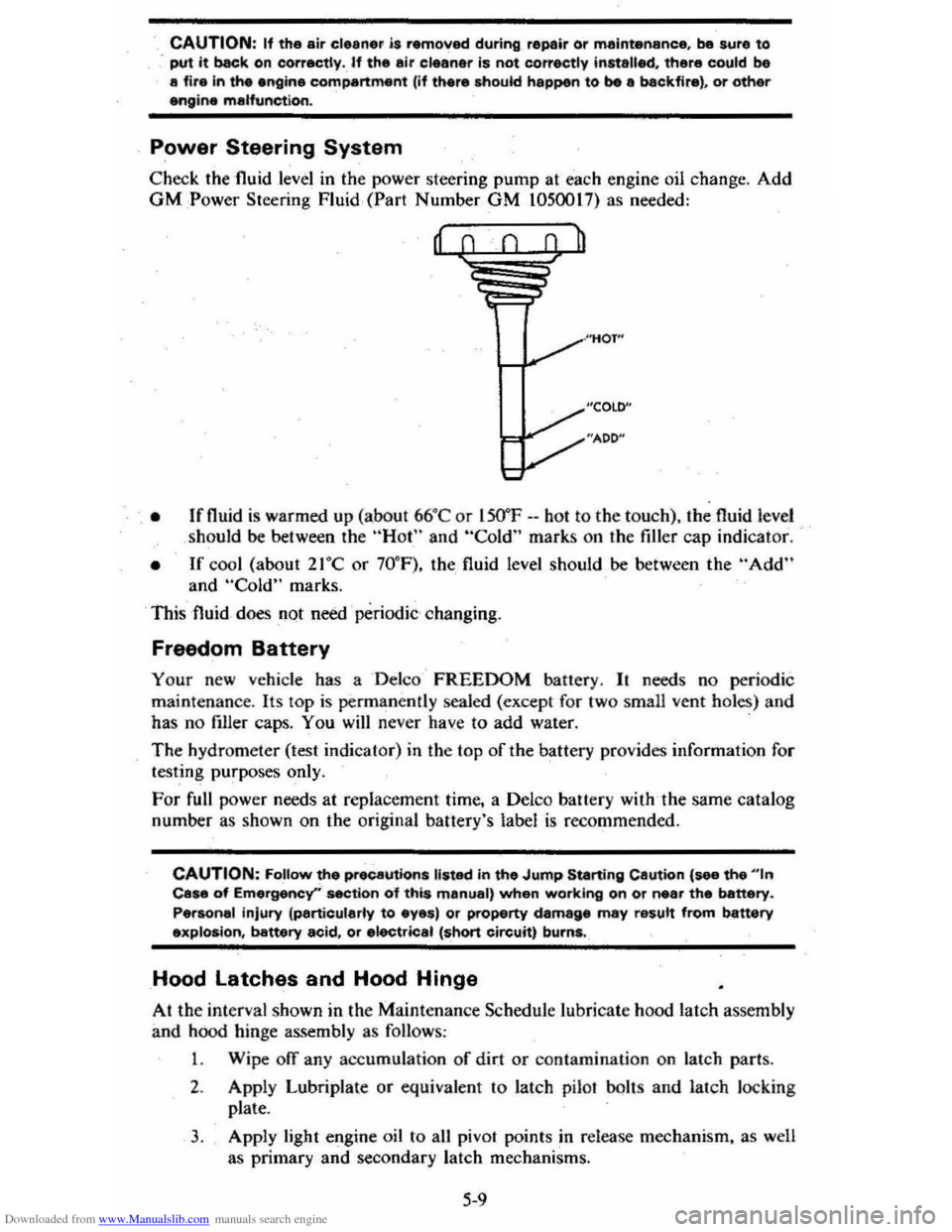
Check the 'fluid level in the power steering pump at each engine oil change. Add GM :Power Steering Fluid, (Part Number GM 1050017) as needed:
, • Ifnuid is warmed up (abo ut 66°C or lSO"F --hot to the to uch), the fluid level
should be between the "Hot" and "Cold" marks on the filler cap indicat or.
• If cool (about 21°C or 70° F), the fluid level should be between the "Add" and "Cold" marks.
This fluid
does not need ' periodic changing.
Freedom Battery
Your new vehicle has a Delco FREEDOM battery. It needs no periodic
maint enance . Its
lOp is permanently sealed (except for two small vent holes) and
has no filler caps. You will never have to add water. .
The hydrometer (test indicat or) in the top of the battery provides information for
testing purposes only.
For full power needs at repla cement time, a Delco battery with ,the same catalog
number as shown on the original banery's label
is recommended.
CAUTION: FoUow the precautions listed in the Jump Starting Cautton {see the "'n Case of Emergency''' section o"f this manual, when working on or near the battery.
Personal injury (particularly to eyes) or property damage may result from battery explosion, battery acid, or electric.1 (short circuit) burns.
Hood latches and Hood Hinge
At the interval shown in the Maintenance Schedule lubricate hood latch assembly
and hood hinge assembly as follows :
1 . Wipe off any accumulation
of dir.t or contamination on latch parts.
2. Apply Lubriplate or equivalent to latch pilaf bolts and latch loc king
plate .
3. Apply light engine oil to all pivot points in release mechanism, as well
as primary
and secondary latch mechanisms.
5-9