1969 FORD MUSTANG light
[x] Cancel search: lightPage 176 of 413

03-12-05
Wheels
And
Tires
03-12-05
and sharp edges from valve hole
in
rim.
8. Mount first tire bead exercising
care
not to
pinch
air
container.
9. Start valve through hole
in rim.
Do
not
pull valve housing into place
at this time.
10.
Mount
the
second bead starting
just past
the
valve
so the
last portion
of
the
bead goes over
the rim at the
valve.
11.
Rotate
the
tire back
and
forth
to center
the
valve housing.
12.
Pull
the
valve housing into
place. Make certain that
the
rubber
valve ridge
is
visible around
thi
valve
housing
(Fig.
12).
13.
Tighten
the
core housing lightly
using pliers.
14.
Thread
the
Inflate-Chek adapt-
er onto
the
core housing.
15.
Inflate
the
inner chamber
to
seat
the
tire beads exercising care
not
to exceed
45 psi
pressure. Adjust this
inner chamber
air
pressure
to 15 psi
higher than
the
recommended tire
pressure.
F 1387
- A
FIG. 12—Valve Installation
16.
Remove
the
Inflate-Chek
adapter
and
adjust tire (outer cham-
ber) pressure
to the
recommended
pressure.
17.
Recheck inner chamber pres-
sure.
18.
Install valve
cap.
WHEEL
AND
TIRE
INSTALLATION
1.
Clean
all
dirt from
the hub and
drum.
2.
Position
the
wheel
and
tire
on
the
hub and
drum. Install
the
wheel
hub nuts
and
tighten them alternately
to draw
the
wheel evenly against
the
hub
and
drum.
3.
Lower
the
vehicle
to the
floor,
and torque
the hub
nuts
to
specifica-
tion.
MAJOR REPAIR OPERATIONS
HOISTING INSTRUCTIONS
Damage
to
steering linkage compo-
nents
and
front suspension struts
may
occur
if
care
is
not
exercised when
po-
sitioning
the
hoist adapters
of 2
post
hoists prior
to
lifting
the
vehicle.
If
a 2
post hoist
is
used
to
lift
the
vehicle, place
the
adapters under
the
lower arms
or the
No.
1
crossmember.
Do
not
allow
the
adapters
to
contact
the steering linkage.
If the
adapters
are placed under
the
crossmember,
a
piece
of
wood (2x4x16 inches) should
be placed
on the
hoist channel
be-
tween
the
adapters. This will prevent
the adapters from damaging
the
front
suspension struts.
FRONT WHEEL GREASE
SEAL
AND
BEARING
REPLACEMENT AND/OR
REPACKING
If bearing adjustment will
not
elimi-
nate looseness
or
rough
and
noisy
op-
eration,
the hub and
bearings should
be cleaned, inspected,
and
repacked
with specified wheel grease.
If the
bearing cups
or the
cone
and
roller
assemblies
are
worn
or
damaged, they
should
be
replaced.
DRUM BRAKES
1.
Raise
the
vehicle until
the
wheel
and tire clear
the
floor.
2.
Remove
the
wheel cover
or hub
cap.
Remove
the
grease
cap
from
the
hub.
Remove
the
cotter
pin,
nut
lock,
adjusting
nut, and
flat washer from
the spindjej, Remove
the
outer bearing
cone
and
roller assembly
(Fig.
1).
3.
Pull
the
wheel,
hub, and
drum
assembly
off the
wheel spindle.
4.
Remove
and
discard
the
grease
retainer. Remove
the
inner bearing
Too/-T69L-J102-A
F1476-A
FIG. 13—Removing Front Wheel
Bearing Cup—Except Lincoln
Continental
cone
and
roller assembly from
the hub
with Tool 1175AE.
5.
Clean
the
lubricant
off the
inner
and outer bearing cups with solvent
and inspect
the
cups
for
scratches,
pits,
excessive wear,
and
other
dam-
age.
If
the
cups
are
worn
or
damaged,
remove them with Tool T69L-1102-A
(Fig.
13).
6. Thoroughly clean
the
inner
and
outer bearing cone
and
roller assem-
blies with solvent
and dry
them thor-
oughly.
Do not
spin
the
bearings with
compressed
air.
Inspect
the
cone
and
roller assem-
blies
for
wear
or
damage,
and
replace
them
if
necessary.
The
cone
and
roller
assemblies
and the
bearing cups
should
be
replaced
as a
unit
if
damage
to either
is
encountered.
7. Thoroughly clean
the
spindle
and
the inside
of the hub
with solvent
to
remove
all old
lubricant.
Cover
the
spindle with
a
clean
cloth,
and
brush
all
loose dust
and
dirt from
the
brake assembly.
To
pre-
vent getting dirt
on the
spindle, care-
fully remove
the
cloth from
the
spindle.
8.
If the
inner and/or outer bearing
cup(s) were removed, install
the re-
placement cup(s)
in the hub
with
the
tool shown
in Fig.
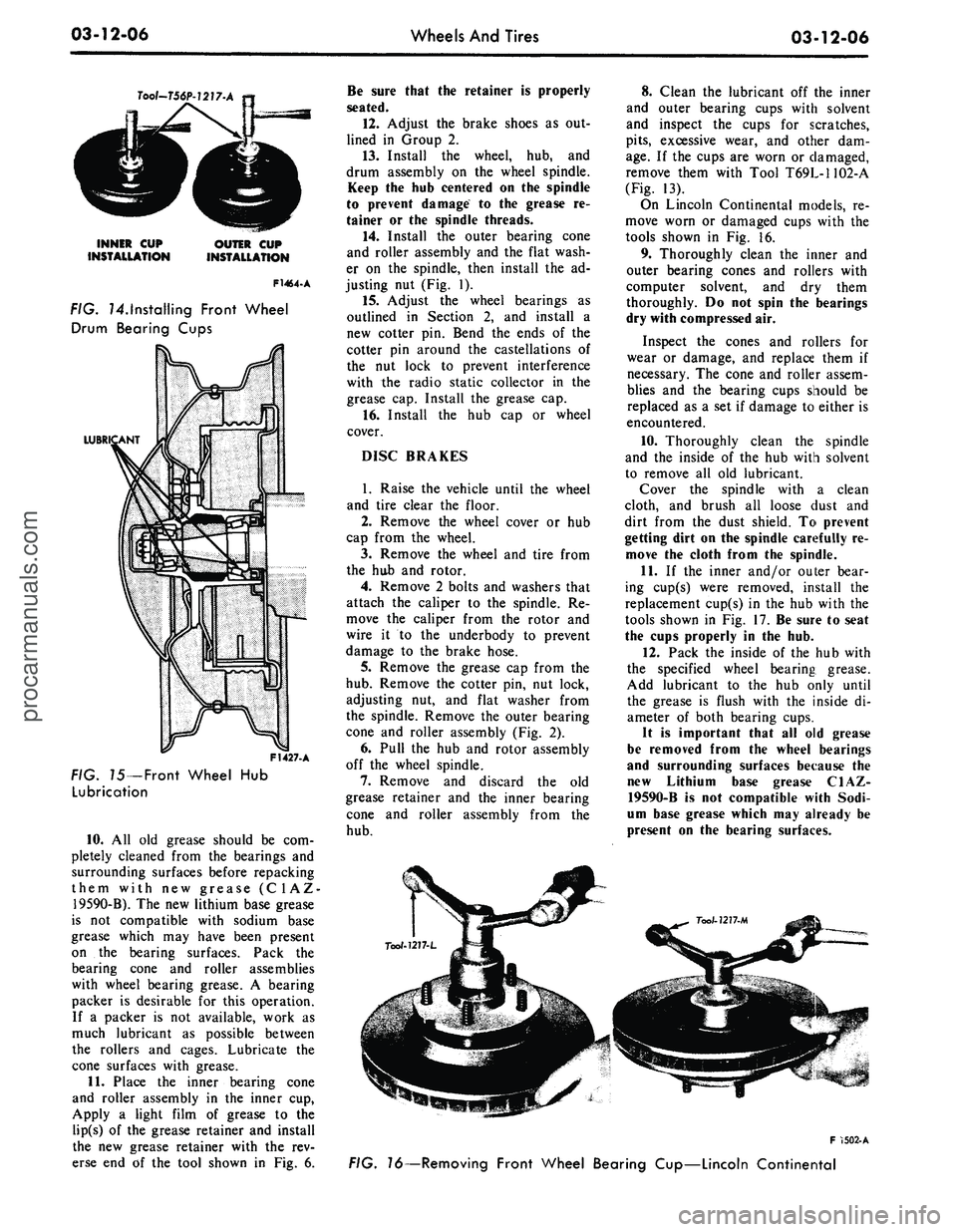
14.
Be
sure
to
seat
the cups properly
in the hub.
9. Pack
the
inside
of the hub
with
specified wheel bearing grease.
Add
lubricant
to the hub
only until
the
grease
is
flush with
the
inside diame-
ter
of
both bearing cups
(Fig.
15).procarmanuals.com
Page 177 of 413
03-12-06
Wheels And Tires
03-12-06
Tool-T56P-1217-A
INNER CUP
INSTALLATION
OUTER CUP
INSTALLATION
F1464-A
FIG. ^.Installing Front Wheel
Drum Bearing Cups
LUBR
F1427. A
FIG. 75—Front Wheel Hub
Lubrication
10.
All old grease should be com-
pletely cleaned from the bearings and
surrounding surfaces before repacking
them with new grease (C1AZ-
19590-B). The new lithium base grease
is not compatible with sodium base
grease which may have been present
on the bearing surfaces. Pack the
bearing cone and roller assemblies
with wheel bearing grease. A bearing
packer is desirable for this operation.
If a packer is not available, work as
much lubricant as possible between
the rollers and cages. Lubricate the
cone surfaces with grease.
11.
Place the inner bearing cone
and roller assembly in the inner cup,
Apply a light film of grease to the
lip(s) of the grease retainer and install
the new grease retainer with the rev-
erse end of the tool shown in Fig. 6.
Be sure that the retainer is properly
seated.
12.
Adjust the brake shoes as out-
lined in Group 2.
13.
Install the wheel, hub, and
drum assembly on the wheel spindle.
Keep the hub centered on the spindle
to prevent damage to the grease re-
tainer or the spindle threads.
14.
Install the outer bearing cone
and roller assembly and the flat wash-
er on the spindle, then install the ad-
justing nut (Fig. 1).
15.
Adjust the wheel bearings as
outlined in Section 2, and install a
new cotter pin. Bend the ends of the
cotter pin around the castellations of
the nut lock to prevent interference
with the radio static collector in the
grease cap. Install the grease cap.
16.
Install the hub cap or wheel
cover.
DISC BRAKES
1.
Raise the vehicle until the wheel
and tire clear the floor.
2.
Remove the wheel cover or hub
cap from the wheel.
3.
Remove the wheel and tire from
the hub and rotor.
4.
Remove 2 bolts and washers that
attach the caliper to the spindle. Re-
move the caliper from the rotor and
wire it to the underbody to prevent
damage to the brake hose.
5.
Remove the grease cap from the
hub.
Remove the cotter pin, nut lock,
adjusting nut, and flat washer from
the spindle. Remove the outer bearing
cone and roller assembly (Fig. 2).
6. Pull the hub and rotor assembly
off the wheel spindle.
7.
Remove and discard the old
grease retainer and the inner bearing
cone and roller assembly from the
hub.
8. Clean the lubricant off the inner
and outer bearing cups with solvent
and inspect the cups for scratches,
pits,
excessive wear, and other dam-
age.
If the cups are worn or damaged,
remove them with Tool T69L-1102-A
(Fig. 13).
On Lincoln Continental models, re-
move worn or damaged cups with the
tools shown in Fig. 16.
9. Thoroughly clean the inner and
outer bearing cones and rollers with
computer solvent, and dry them
thoroughly. Do not spin the bearings
dry with compressed air.
Inspect the cones and rollers for
wear or damage, and replace them if
necessary. The cone and roller assem-
blies and the bearing cups should be
replaced as a set if damage to either is
encountered.
10.
Thoroughly clean the spindle
and the inside of the hub with solvent
to remove all old lubricant.
Cover the spindle with a clean
cloth, and brush all loose dust and
dirt from the dust shield. To prevent
getting dirt on the spindle carefully re-
move the cloth from the spindle.
11.
If the inner and/or outer bear-
ing cup(s) were removed, install the
replacement cup(s) in the hub with the
tools shown in Fig. 17. Be sure to seat
the cups properly in the hub.
12.
Pack the inside of the hub with
the specified wheel bearing grease.
Add lubricant to the hub only until
the grease is flush with the inside di-
ameter of both bearing cups.
It is important that all old grease
be removed from the wheel bearings
and surrounding surfaces because the
new Lithium base grease C1AZ-
19590-B is not compatible with Sodi-
um base grease which may already be
present on the bearing surfaces.
F 1502-A
FIG. 16—Removing Front Wheel Bearing Cup—Lincoln Continentalprocarmanuals.com
Page 178 of 413

03-12-07
Wheels And Tires
03-12-07
Tool - 7277- K
F 1263-A
FIG. 17—Installing Front Wheel Bearing Cup
13.
Pack the bearing cone and roll-
er assemblies with wheel bearing
grease. A bearing packer is desirable
for this operation. If a packer is not
available, work as much lubricant as
possible between the rollers and cages.
Lubricate the cone surfaces with
grease.
14.
Place the inner bearing cone
and roller assembly in the inner cup.
Apply a light film of grease to the lips
of the grease retainer and install the
new grease retainer with the tool
shown in Fig. 18. Be sure the retainer
is properly seated.
15.
Install the hub and rotor as-
sembly on the wheel spindle. Keep the
hub centered on the spindle to prevent
damage to the grease retainer or the
spindle threads.
16.
Install the outer bearing cone
and roller assembly and the flat wash-
er on the spindle, then install the ad-
justing nut.
17.
Adjust the wheel bearings as
outlined in Section 2, and install a
new cotter pin. Bend the ends of the
cotter pin around the castellations of
the nut lock to prevent interference
with the radio static collector in the
grease cap. Install the grease cap.
18.
Install the caliper to the spindle
and torque the attaching bolts to spe-
cifications as detailed in Group 2.
19.
Install the wheel and tire on the
hub.
20.
Install the hub cap or wheel
cover.
21.
Before driving the vehicle,
pump the brake pedal several times to
obtain normal brake lining to rotor
clearance and restore normal brake
pedal travel.
FRONT HUB AND DRUM
ASSEMBLY REPLACEMENT
When the hub and drum assembly
is replaced, new bearings and a grease
retainer must be installed in the new
assembly. The new grease retainer
should be soaked in light engine oil at
least 30 minutes before installation.
1.
Raise the vehicle until the wheel
and tire clears the floor. Pry off the
hub cap or wheel cover, and remove
the wheel and tire from the hub and
drum assembly.
2.
Remove the grease cap from the
hub.
Remove the cotter pin, nut lock
adjusting nut, and flat washer from
the spindle. Remove the outer bearing
cone and roller assembly (Fig. 1).
3.
Pull the hub and drum assembly
off the wheel spindle.
4.
Remuve the grease retainer and
the inner bearing cone and roller as-
sembly from the hub with Tool
1175AE.
5.
Remove the protective coating
from the new hub and drum with car-
buretor degreaser.
6. Pack the inside of the hub with
specified wheel bearing grease. Add
lubricant to the hub only until the
grease is flush with the inside diame-
ter of both bearing cups (Fig. 15).
7.
All old grease should be com-
pletely cleaned from the bearings be-
fore repacking them with new grease.
Pack the bearing cone and roller
assemblies with wheel bearing grease.
A bearing packer is desirable for this
operation. If a packer is not available,
work as much lubricant as possible
between the rollers and cages. Lubri-
cate the cone surfaces with grease.
8. Place the inner bearing cone and
roller assembly in the inner cup, and
install the new grease retainer with the
reverse end of the tool shown in Fig.
6. Be sure that the retainer is properly
seated.
9. Adjust the brake shoes as out-
lined in Group 2.
10.
Install the new hub and drum
assembly on the wheel spindle. Keep
the hub centered on the spindle to pre-
vent damage to the grease retainer.
11.
Install the outer bearing cone
and roller assembly and the flat wash-
er on the spindle; then, install the ad-
justing nut (Fig. 1).
12.
Position the wheel and tire on
the new hub and drum assembly. In-
stall the wheel hub nuts and tighten
them alternately in order to draw the
wheel evenly against the hub and
drum.
13.
Adjust the wheel bearings as
outlined in Section 2, and install a
new cotter pin. Bend the ends of the
cotter pin around the castellations of
the nut lock to prevent interference
with the radio static collector in the
grease cap. Install the grease cap.
14.
Install the hub cap or wheel
cover.
FRONT HUB AND ROTOR
ASSEMBLY REPLACEMENT
When the hub and rotor assembly is
replaced, new bearings and a grease
retainer must be installed in the new
assembly.
1.
Raise the vehicle until the wheel
and tire clear the floor. Pry off the
hub cap or wheel cover, and remove
the wheel and tire from the hub and
rotor assembly.
2.
Remove 2 bolts and washers that
attach the caliper to the spindle. Re-
move the caliper from the rotor and
wire it to the underbody to prevent
damage to the brake hose.
3.
Remove the grease cap from the
hub.
Remove the cotter pin, nut lock,
adjusting nut, and flat washer from
the spindle; then, remove the outer
bearing cone and roller assembly,
(Fig. 2).
4.
Pull the hub and rotor off the
spindle.
5.
Remove the protective coating
from the new hub and rotor with car-
buretor degreaser.
6. Grease and install the inner
bearing cone and roller assembly in
the inner bearing cup. Apply a light
film of grease on the grease retainerprocarmanuals.com
Page 188 of 413
04-01-01
General Axle Service
04-01-01
GROUP
4
PART
4-1
PAGE
General Axle Service 04-01-01
PART 4-2
Rear Axle
—
Removable Carrier Type ... 04-02-01
PART
4-3
Rear Axle
—
Integral CarrierType
(Except Ford Light Duty WER) 04-03-01
PART 4-4
Rear Axle
—
Ford
Light-Duty (WER)
PART
4-5
Soecifications
PAGE
04-04-01
04-05-01
PART
4-1
General Axle Service
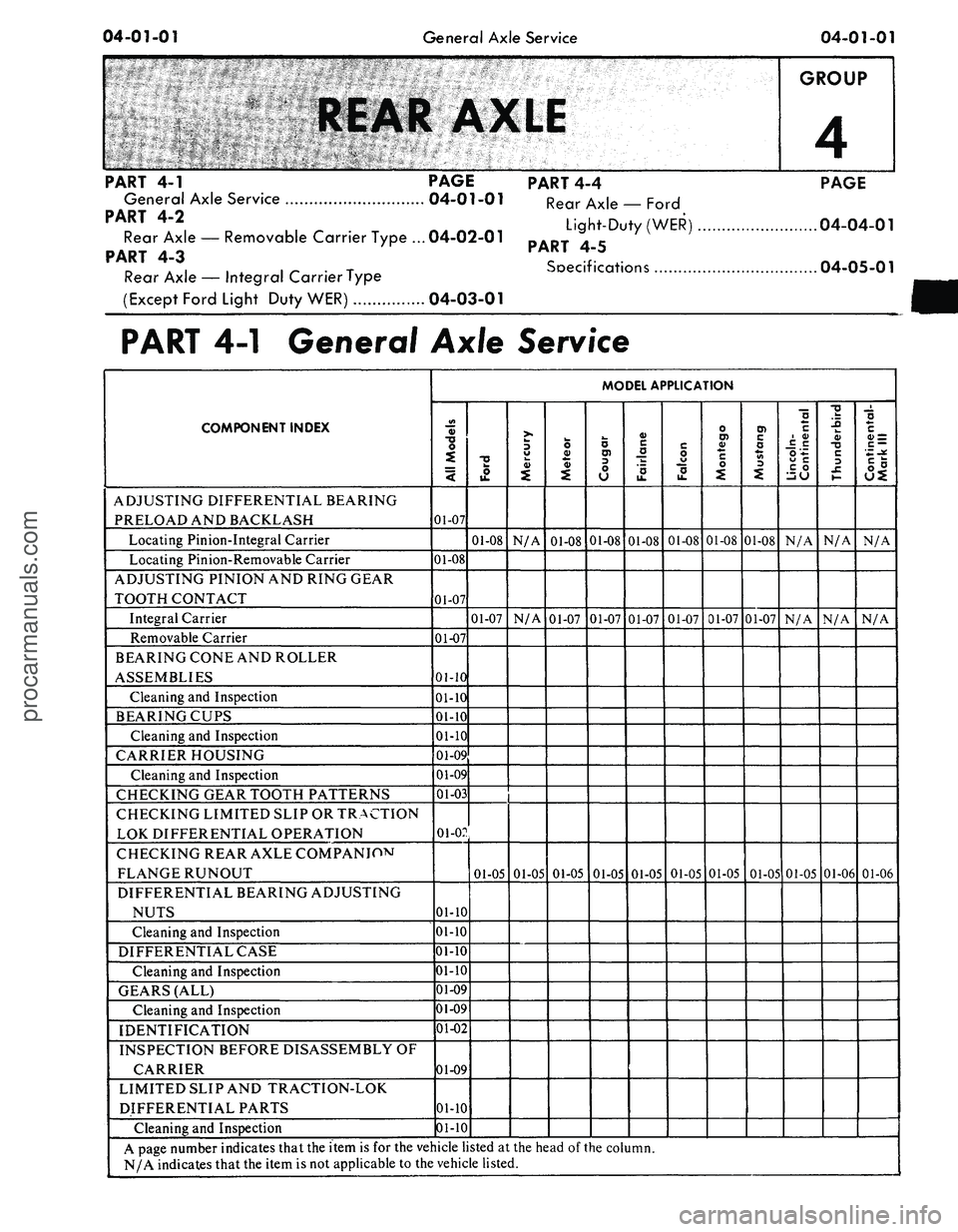
COMPONENT INDEX
ADJUSTING DIFFERENTIAL BEARING
PRELOAD AND BACKLASH
Locating Pinion-Integral Carrier
Locating Pinion-Removable Carrier
ADJUSTING PINION AND RING GEAR
TOOTH CONTACT
Integral Carrier
Removable Carrier
BEARING CONE AND ROLLER
ASSEMBLIES
Cleaning
and
Inspection
BEARING CUPS
Cleaning
and
Inspection
CARRIER HOUSING
Cleaning
and
Inspection
CHECKING GEAR TOOTH PATTERNS
CHECKING LIMITED SLIP
OR
TRACTION
LOK DIFFERENTIAL OPERATION
CHECKING REAR AXLE COMPANIOM
FLANGE RUNOUT
DIFFERENTIAL BEARING ADJUSTING
NUTS
Cleaning
and
Inspection
DIFFERENTIAL CASE
Cleaning
and
Inspection
GEARS (ALL)
Cleaning
and
Inspection
IDENTIFICATION
INSPECTION BEFORE DISASSEMBLY
OF
CARRIER
LIMITED SLIP AND TRACTION-LOK
DIFFERENTIAL PARTS
Cleaning
and
Inspection
MODEL APPLICATION
All
Models
01-07
01-08
01-07
01-07
01-10
01-10
01-10
01-10
01-09
01-09
01-03
01-02
01-10
01-10
01-10
01-10
01-09
01-09
01-02
01-09
01-10
01-10
Ford
01-08
01-07
01-05
Mercury
N/A
N/A
01-05
Meteor
01-08
01-07
01-05
Cougar
01-08
01-07
01-05
Fairlane
01-08
01-07
01-05
Falcon
01-08
01-07
01-05
Montego
01-08
01-07
01-05
Mustang
01-08
01-07
01-05
Lincoln-
Continental
N/A
N/A
01-05
Thunderbird
N/A
N/A
01-06
Continental-
Mark
III
N/A
N/A
01-06
A page number indicates that the item
is for
the vehicle listed
at the
head
of
the column.
N/A indicates that the item
is not
applicable
to
the vehicle listed.
procarmanuals.com
Page 192 of 413

04-01-05
General Axle Service
04-01-05
Integral Carrier Type Axle
1.
Thinner shim with
the
backlash
set
to
specifications moves
the
pinion
farther from
the
ring gear.
2.
Thicker shim with
the
backlash
set
to
specifications moves
the
pinion
closer
to the
ring gear.
If
the
patterns
are not
correct,
make
the
changes
as
indicated.
The
differential case
and
drive pinion will
have
to be
removed from
the
carrier
casting
to
change
a
shim. When
re-
installing
the
pinion
and
ring gear
of a
non-hunting
or
partial non-hunting
gear
set, be
sure that
the
marked
tooth
on the
pinion indexes between
the marked teeth
on the
ring gear
(Fig.
51,
Part
4-2).
Refer
to
Pinion
and Ring Gear Tooth Contact Adjust-
ment, Section
2.
REAR AXLE COMPANION
FLANGE RUNOUT CHECK
ALL AXLES EXCEPT
THUNDERBIRD
AND
CONTINENTAL MARK
III
1.
Raise
the
vehicle
on a
hoist that
supports
the
rear axle (twin-post
hoist).
2.
Remove
the
driveshaft assembly
(Group
5).
3.
Check
the
companion flange
damage
to the
universal joint bearing
locating lugs.
If the
universal joint
bearing locating lugs
on the
compan-
ion flange
are
shaved (worn)
or dam-
aged, replace
the
companion flange
(Fig.
5).
PROPERLY SEATED
CUP SHAVES LUG
E 1621-A
FIG. 5—Checking Companion
Flange
4.
The
rear axle companion flange
runout
is
checked with
a
modified uni-
versal joint (checking tool)
a
dial indi-
cator with
1.000
inch minimum travel,
and
a
cup-shaped dial indicator adapt-
er tool
(Fig. 6). To
fabricate
the
checking tool, modify
a
universal joint
assembly
by
removing
two
bearing
cups that are opposite each other, and
cuttting
or
grinding
off
one
of
the uni-
versal joint bearing flanges (Fig. 6).
5.
Install
the
cup-shaped adapter
on
the dial indicator stem. Install
the
dial
indicator
on the
pinion retainer
or pi-
nion nose bumper bracket. Position
the indicator
to
allow
an
indication
at
the ends
of the
universal joint bearing
cups
and the
remaining exposed jour-
nal
of the
cross-shaft.
6. Turn
the
companion flange
so
that
the
dial indicator cup-type adapt-
er rests
on the
machined surface
of
the bearing
cup (Fig. 6).
Rotate
the
companion flange side-to-side slightly
to obtain
a
reading indicating that
the
bearing
cup
surface
is
perpendicular
to
the indicator cup-type adapter. This
will
be the
point
at
which
the
dial
in-
dicator
cup is
closest
to the
center
of
companion flange rotation.
It is
also
the point
at
which
the
dial indicator
hand will reverse direction
as
the com-
panion flange
is
turning.
Set the
dial
indicator
to
zero.
oo/-6565,
Used
'With Bracket From
Too!-4201-C
MOUNT HERE
Tool-4201-C
E
1622-
A
FIG. 6—Flange Bearing
Cup
Run-out Check—Typical
7.
Carefully retract
the
dial indica-
tor stem
and
rotate
the
companion
flange 180 degrees
to
position
the ma-
chined surface
of the
opposite univer-
sal bearing under
the
dial indicator
adapter tool. Again, slightly rotate
the
flange side-to-side
to
position
the
bearing perpendicular
to the
dial indi-
cator adapter. Again, this
is the
point
at which
the
indicator hand will
rev-
erse direction
as the
flange
is
rotated.
Record
the
flange bearing
cup
runout
reading obtained from
the
indicator
(Fig.
7).
Rotate
the
companion flange
90
degrees
and
position
the
dial indicator
adapter
on the
machined
end of the
exposed journal
(Fig. 8). Be
sure
the
end surface
of the
exposed journal
is
perpendicular
to the
indicator
cup-
type adapter. This requires that
the
cross-shaft
be
moved fore
and aft on
the flange bearing cups. Note
the
point
at
which
the
indicator hand rev-
erses direction. Rotate
the
flange
as-
sembly side-to-side until
the
cross-
shaft
is
perpendicular
to the
pinion
shaft axis,
and the
indicator hand
re-
verses direction. Zero the dial indicator
and check the zero point again by
Tool-6565, Used
With Bracket
Fro
Tool-4201 -C
MOUNT HERE —
Too/-4207-C
E 1624-A
FIG. 8—Cross Shaft Runout
Check—Typical
INDICATOR
READING
1
2
3
Average
FLANGE
BEARING CUP
RUNOUT—INCH
0.C04
0.002
0.003
0.003
DRIVESHAFT UNIVERSAL
CROSS-SHAFT
RUNOUT—INCH
0.005
0.004
0.003
0.004
FIG. 7—Flange Bearing
Cup and
Cross Shaft Runout Averaging
Chart—Typical Readingsprocarmanuals.com
Page 193 of 413

04-01-06
General Axle Service
04-01-06
FLANGE BEARING
CUP RUNOUT
0.000
0.001
0.002
0.003
0.004
0.005
0.006
0.007
0.008
DRIVE SHAFT UNIVERSAL CROSS-SHAFT RUNOUT-INCH
0.000
0.000
0.001
0.002
0.003
0.004
0.005
0.006
0.007
0.008
0.001
0.001
0.0013
0.0022
0.0032
0.0042
0.0051
0.0061
0.0071
0.0081
0.002
0.002
0.0022
0.0027
0.0036
0.0045
0.0053
0.0062
0.0073
0.0082
0.003
0.003
0.0032
0.0037
0.0042
0.005
0.0058
0.0068
0.0075
0.0087
0.004
0.004
0.0042
0.0045
0.005
0.0057
0.0063
0.0072
0.0081
0.009
0.005
0.005
0.0051
0.0053
0.0058
0.0064
0.0071
0.0078
0.0087
0.0094
0.006
0.006
0.0061
0.0062
0.0067
0.0072
0.0078
0.0085
0.0093
0.010
0.007
0.007
0.0071
0.0072
0.0077
0.0081
0.0087
0.0092
0.0099
0.0104
0.008
0.008
0.0081
0.0082
0.0085
0.009
0.0094
0.010
0.0103
0.011
The total (combined) companion flange runout
is
located
in the
square where
the
columns containing
the
flange bearing cup runout
and universal cross shaft runout readings intersect.
FIG. 9—Companion Flange Combined Runout Chart
slightly moving the cross-shaft fore
and aft, then rotate the companion
flange from side-to-side.
8. With the indicator at zero, care-
fully retract the dial stem and rotate
the flange 180 degrees. Rotate the
cross-shaft 180 degrees on the flange
bearing cups to position the exposed
journal under the dial indicator adapt-
er. Rock the cross-shaft fore and aft
and the companion flange side-to-side
to establish the point at which the in-
dicator hand reverses direction. This
will determine the driveshaft universal
cross-shaft run-out. Record this read-
ing (Fig. 8).
9. Repeat steps 5 through 8 at least
three times and average the indicator
readings obtained (Fig. 7).
10.
To determine the total (com-
bined) companion flange runout, it
will be necessary to use the combined
runout chart (Fig. 9). Position a
straight edge at the amount of flange
bearing cup runout indicated on the
left hand column of the chart. Posi-
tion another straight edge vertically at
the amount of driveshaft universal
cross-shaft runout indicated on the top
of the chart. The point at which the
straight edges cross the chart indicates
the combined rear axle flange runout.
For example:
With an indicated 0.003 inch flange
bearing cup runout and an indicated
0.004 inch universal cross-shaft runout
(Fig. 9), the combined companion
flange runout will be 0.005 inch as in-
dicated in the square on the chart
(Fig. 9).
11.
If the reading obtained in Step
10 exceeds specifications, reposition
the companion flange 180 degrees on
the pinion shaft and repeat steps 1
through 10.
12.
If the repeat readings still ex-
ceed specifications, re-position the
flange an additional 90 degrees on the
pinion shaft and check the runout
(Steps 4 through 10).
13.
If the runout is still excessive,
replace the companion flange and
check the runout. If necessary, rotate
the new flange on the pinion shaft
until an acceptable runout is obtained.
If excessive runout is still evident
after replacement of the companion
flange, it will be necessary to replace
the ring and pinion gear, and repeat
the above checks until runout is within
specifications.
14.
Install the driveshaft assembly
(Group 5). Make sure the universal
joint bearing cups are properly posi-
tioned between the companion flange
lugs.
15.
Lower the vehicle. Road test
the vehicle. If drive shaft vibrations
are evident during the road test, re-
move the driveshaft from the compan-
ion flange and rotate it 180 degrees.
Road test the vehicle again.
THUNDERBIRD AND
CONTINENTAL MARK III
1.
Raise the vehicle on a hoist that
supports the rear axle (twin-post
hoist).
2.
Remove the driveshaft assembly
(Group 5).
3.
Check the companion flange for
damage.
4.
To check radial runout, set up
dial indicator as shown in Fig. 10.
5.
Rotate the companion flange
with the dial indicator in place. If the
runout exceeds specifications, remove
the flange and reinstall it 180 degrees
from original position. Follow the
procedure in Part 4-2 for companion
flange installation.
6. If the runout is still excessive, re-
move and reinstall the flange an addi-
tional 90 degrees and recheck runout.
7.
To check lateral (face) runout,
set up the dial indicator as shown in
Fig. 11. Repeat steps 5 and 6.
FLANGE
MOUNT HERE
Too/-4207-C
Too/-6565 USED WITH BRACKET FROM Tool-4201
FIG. 10—Checking Companion Flange Radial Runout—
Thunderbird and Continental Mark III
E1697-Aprocarmanuals.com
Page 194 of 413

04-01-07
General Axle Service
04-01-07
Tool-4201-
C
Tool-6565 USED WITH BRACKET
FROM Too/^*207-C
FLANGE
E1743-A
procedure under Backlash and Differ-
ential Bearing Preload Adjustments.
If the tooth pattern indicates a change
in shim thickness, follow the proce-
dure under Pinion Location.
REMOVABLE CARRIER
TYPE AXLE
The shim location for the removable
carrier type axle is between the pinion
retainer and the carrier (Fig. 13).
When adjusting this type carrier re-
ducing shim thickness will move the
pinion toward the ring gear; increas-
ing shim thickness will move the pi-
nion away from the ring gear (Fig.
13).
FIG. 11—Checking Companion Flange Lateral Runout—
Thunderbird and Continental Mark III
INTEGRAL CARRIER
TYPE AXLE
8. If the runout is still excessive, re-
place the companion flange and check
the runout. If necessary, rotate the
new flange on the pinion shaft until an
acceptable runout is obtained.
If excessive runout is still evident
after replacement of the companion
flange, it will be necessary to replace
the ring and pinion gear, and repeat
the above checks until runout is within
specifications.
9. Install the driveshaft assembly
(Group 5).
PINION LOCATION
ADJUSTMENT
BACKLASH
ADJUSTMENT,
LEFT
ADJUSTING
NUT
E1476-A
FIG. 12—Pinion and Ring Gear
Tooth Contact Adjustment
—
Integral Carrier Type Axles
PINION AND RING GEAR
TOOTH CONTACT
ADJUSTMENT
Two separate adjustments affect pin-
ion and ring gear tooth contact.
They are pinion location and backlash
(Figs.
12 and 13).
Individual differences in matching
the differential housing and the gear
set require the use of shims to locate
the pinion for correct contact with the
ring gear.
When adjusting either type axle,
shim thickness should be increased or
reduced only as indicated by the tooth
pattern check described in the fore-
going Section 1.
If the tooth pattern check indicates
a change in backlash only, follow the
PINION
LOCATION
ADJUSTMENT
SHIMS
LEFT
ADJUSTING
NUT
RIGHT
ADJUSTING
BACKLASH NUT
ADJUSTMENT El 409-A
FIG. 13—Pinion and Ring Gear
Tooth Contact Adjustment—
Removable Carrier Axles
The shim location for the integral
carrier type axle, is between the pi-
nion gear and the pinion rear bearing
cone (Fig. 12). When adjusting this
type axle, increasing shim thickness
moves the pinion toward the ring
gear; reducing shim thickness moves
the pinion away from the ring gear
(Fig. 12).
BACKLASH AND DIFFERENTIAL
BEARING PRELOAD
ADJUSTMENTS (ALL AXLES)
On a Light-Duty (WER) Axle, it is
necessary to remove the rear axle
shafts prior to performing the adjust-
ment procedures. Refer to Rear Axle
Shaft Wheel Bearing and Oil Seal Re-
placement—Light-Duty (WER), Axle,
Part 4-4, Section 2.
To secure a more uniform control
of differential side bearing preload in
service repairs, a dial indicator set-up
such as shown in Fig. 12 is used.
In both types of axle (Fig. 11 and
12),
the ring gear is moved away from
or toward the pinion as described in
the following procedure.
1.
Remove the adjusting nut locks,
loosen the differential bearing cap
bolts,
then torque the bolts to 15 ft-lbs
on integral carrier type axle; 20 ft-lbs
on removable carrier type axles before
making adjustments.
2.
The left adjusting nut is on the
ring gear side of the carrier. The right
nut is on the pinion side. Loosen the
right nut until it is away from the cup.
Tighten the left nut until the ring gear
is just forced into the pinion with
0.000 backlash then rotate the pinion
several revolutions to be sure no bind-
ing is evident. (Recheck the right nutprocarmanuals.com
Page 197 of 413

04-01-10
General Axle Service
04-01-10
The pattern taken during disassem-
bly should be helpful in judging if
gears can be re-used. Worn gears can-
not be rebuilt to correct a noisy condi-
tion. Gear scoring is the result of ex-
cessive shock loading or the use of an
incorrect lubricant. Scored gears can-
not be re-used.
Examine the teeth and thrust surfa-
ces of the differential gears. Wear on
the hub of the differential gear can
cause a chucking noise known as
chuckle when the vehicle is driven at
low speeds. Wear of splines, thrust
surfaces, or thrust washers, can con-
tribute to excessive drive line back-
lash.
BEARING CUPS AND
CONE AND ROLLER
ASSEMBLIES
Check bearing cups for rings,
scores, galling, or excessively worn
wear patterns. Pinion cups must be
solidly seated. Check by attempting to
insert a 0.0015-inch feeler between
these cups and the bottoms of their
bores.
When operated in the cups, cone
and roller assemblies must turn with-
out roughness. Examine the roller
ends for wear. Step-wear on the roller
ends indicates the bearings were not
preloaded properly, or the rollers were
slightly misaligned.
If inspection reveals either a defec-
tive cup or a defective cone and roller
assembly, both parts should be re-
placed to avoid early failure.
DIFFERENTIAL BEARING
ADJUSTING NUTS
Temporarily install the bearing caps
and test the fit of the adjusting nuts in
their threads. The nuts should turn
easily when the caps are tightened to
25 ft-lbs. The faces of the nuts that
contact the bearing cups must be
smooth and square. Replace the nuts
or examine the threads in the carrier
if their fit is not proper. Be sure that
the bearing caps and adjusting nuts
are on the side they were machined to
fit. Observe the punch marks and
scribe marks made during disassem-
bly.
U-JOINT FLANGE
Be sure that the eai» of the flange
have not been damaged in removing
the drive shaft or in removing the
flange from the axle. The end of the
flange that contacts the front pinion
bearing inner race as well as the flat
surface of the pinion nut counterbore
must be smooth. Polish these surfaces
if necessary. Roughness aggravates
backlash noises and causes wear of
the flange and pinion nut with a resul-
tant loss in pinion bearing preload.
PINION RETAINER
Be sure that the pinion bearing cups
are seated. Remove any chips or burrs
from the mounting flange. Clean the
groove for the O-ring seal and all lu-
bricant passages. If the cups were re-
moved, examine the bores carefully.
Any nicks or burrs in these bores
must be removed to permit proper
seating of the cups.
CARRIER HOUSING
Make sure that the differential
bearing bores are smooth and the
threads are not damaged. Remove any
nicks or burrs from the mounting sur-
faces of the carrier housing.
DIFFERENTIAL CASE
Make sure that the hubs where the
bearings mount are smooth. Carefully
examine the differential case bearing
shoulders, which may have been dam-
aged when the bearings were removed.
The bearing assemblies will fail if they
do not seat firmly against the shoul-
ders.
Check the fit (free rotation) of
the differential side gears in their
counterbores. Be sure that the mating
surfaces of the two parts of the case
are smooth and free from nicks or
burrs.
LIMITED SLIP AND
TRACTION-LOK
DIFFERENTIAL PARTS
Inspect the clutch plates for uneven
or extreme wear. The dog-eared clutch
plates must be free from burrs, nicks
or scratches which could cause excess-
ive or erratic wear to the bonding ma-
terial of the internally splined clutch
plates.
The internally splined clutch
plates should be inspected for condi-
tion of the bond, bonding material,
and wear. Replace the bonded plates
if their thickness is less than 0.085
inch or if the bonded material is
scored or badly worn. Inspect the
bonded plate internal teeth for wear.
Replace them, if excessive wear is evi-
dent. Bonded plates should be re-
placed as a set only
Examine all thrust surfaces and
hubs for wear. Abnormal wear on
these surfaces can contribute to a
noisy axle.
Inspect the Belleville spring (limited
slip) for proper free height of 1/4
inch.
LUBRICANT LEVEL
The lubricant level should be
checked every 6000 miles with the ve-
hicle in normal curb attitude. The lu-
bricant level should be at the lower
edge of the filler plug hole located in
either the carrier casting or housing
cover. It is unnecessary to periodically
drain the axle lubricant. The factory
fill should remain in the housing for
the life of the vehicle, except when re-
pairs are made. The specified lubri-
cant should be installed when the axle
is overhauled.procarmanuals.com