1969 DATSUN B110 lock
[x] Cancel search: lockPage 55 of 136
ruel
S
stem
Note
When
somewhat
over
choked
set
bl
metal
cover
after
turning
it
clockwise
slightly
Adjustment
oflnterlock
Opelntng
of
Pnmary
and
Secondary
Throttle
Values
Open
the
pnmary
Side
throttle
valve
48
from
the
fully
closed
positIOn
and
measure
clearance
GIn
between
the
throttle
valve
and
throttle
chamber
mSlde
wall
as
shown
m
Figure
99
GIn
0
228
m
WIthout
dlsturbmg
the
above
settmg
bend
connectmg
rod
as
necessary
so
that
secoridary
throttle
valve
IS
about
to
open
Upon
com
pletIOn
of
the
adjustment
make
sure
that
the
hnk
system
operates
smoothly
Dash
Pot
Adjustment
AutomatIC
Trans
mlsszon
car
only
It
IS
necessary
that
the
Idhng
speed
of
engme
and
mIxture
have
been
well
turned
up
and
engme
IS
suffiC1
n
y
warm
1
Turn
throttle
valve
by
hand
and
read
engme
speed
when
the
da
h
pot
Just
touches
the
stop
per
lever
Adjust
the
pOSitIOn
of
the
dash
pot
by
turnmg
the
nut
until
the
engine
speed
IS
In
the
range
from
1
900
to
2
000
rpm
Make
sure
that
the
engine
speed
IS
smoothly
leduced
from
3
000
to
1
000
rpm
within
a
few
econds
Removal
Remove
the
aIr
cleaner
DIsconnect
the
fuel
line
vacuum
line
automatic
choke
harness
and
antl
dlesehng
solenOId
harness
from
carburetor
Remove
the
throttle
lever
Remove
four
nuts
and
washers
retaining
the
carburetor
to
the
mamfold
If
necessary
LIft
the
carburetor
and
remove
from
the
mamfold
Remove
and
dlscard
the
gasketcused
between
the
carburetor
and
mamfold
8
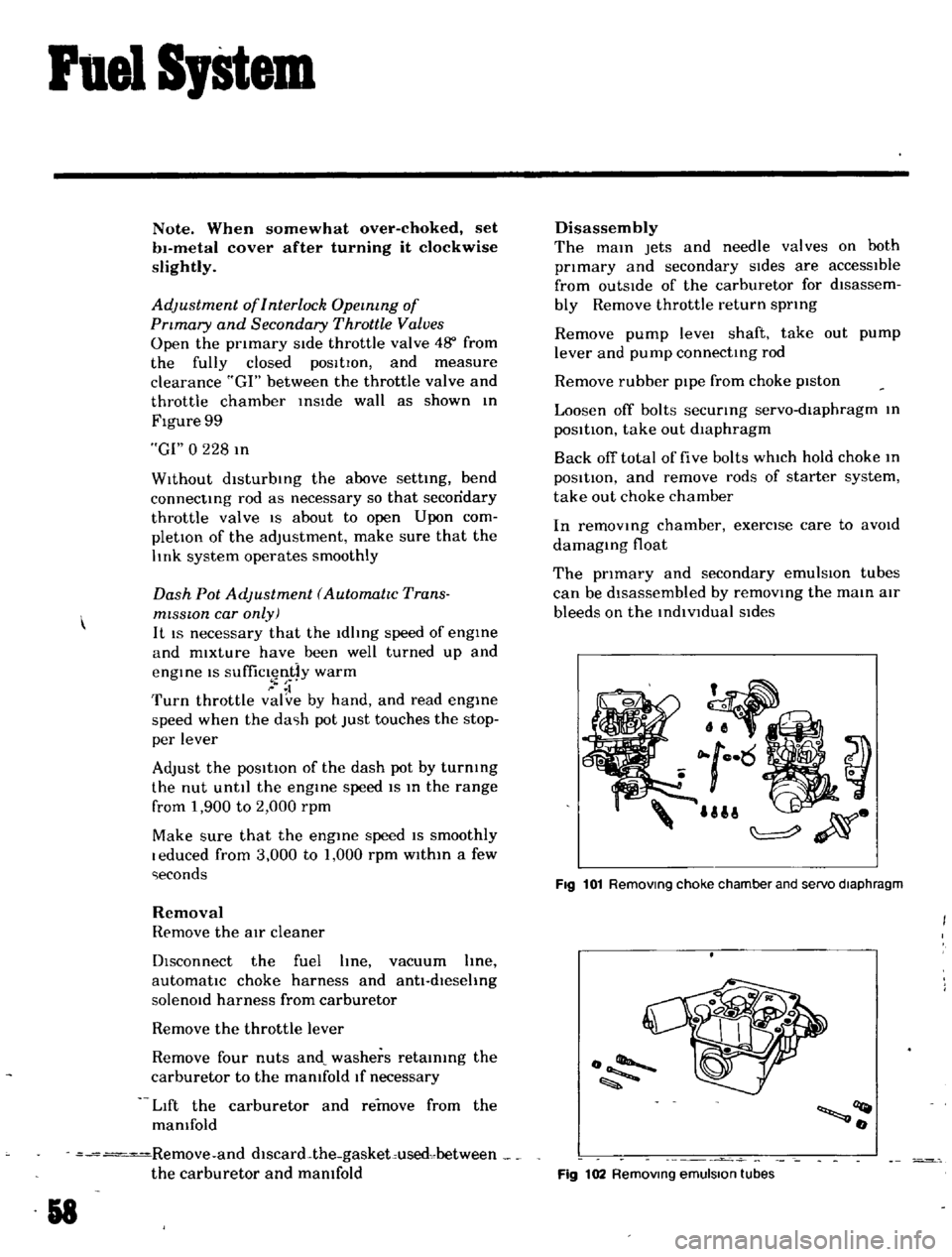
Disassembly
The
main
Jets
and
needle
valves
on
both
primary
and
secondary
Sides
are
accessible
from
outSIde
of
the
carburetor
for
disassem
bly
Remove
throttle
return
sprmg
Remove
pump
level
shaft
take
out
pump
lever
and
pump
connectmg
rod
Remove
rubber
pipe
from
choke
piston
Loosen
off
bolts
secutlng
servo
diaphragm
In
positIOn
take
out
dIaphragm
Back
off
total
of
five
bolts
which
hold
choke
In
posItion
and
remove
rods
of
starter
system
take
out
choke
chamber
In
removmg
chamber
exercise
care
to
aVOId
damaging
float
The
pnmary
and
secondary
emulsIOn
tubes
can
be
disassembled
by
removmg
the
main
air
bleeds
on
the
indiVidual
SIdes
UII
ij
Fig
101
Removmg
choke
chamber
and
servo
diaphragm
o
llQt
o
Fig
102
Removmg
emulsion
tubes
Page 56 of 136
Fuel
Sptem
In
removIng
Injector
weight
piston
return
sptlng
and
ball
care
should
be
exercIsed
to
prevent
them
from
beIng
scattered
and
lost
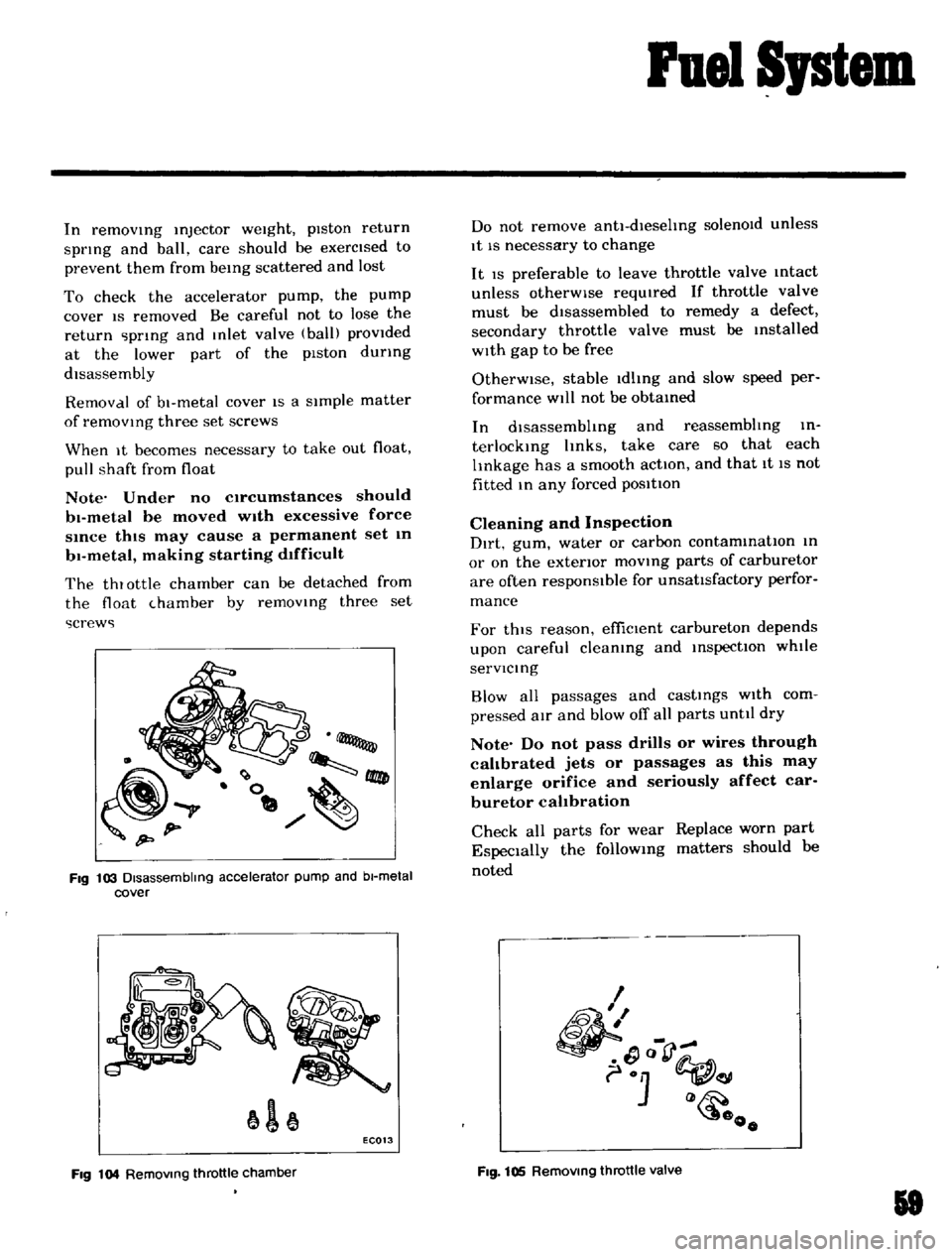
To
check
the
accelerator
pump
the
pump
cover
IS
removed
Be
careful
not
to
lose
the
return
spring
and
mlet
valve
bal
prOVided
at
the
lower
part
of
the
piston
dUring
dIsassembly
Removal
of
bl
metal
cover
IS
a
sImple
matter
of
removmg
three
set
screws
When
It
becomes
necessary
to
take
out
float
pull
shaft
from
float
Note
Under
no
C1rcumstances
should
bl
metaI
be
moved
with
excessive
force
Since
this
may
cause
a
permanent
set
In
b1
metal
making
starting
d1fficuIt
The
thlottle
chamber
can
be
detached
from
the
float
hamber
by
removmg
three
set
screws
Fig
103
Disassembling
accelerator
pump
and
bl
metal
cover
1
EC013
Fig
104
RemOVing
throttle
chamber
Do
not
remove
antl
dlesehng
solenOId
unless
It
IS
necessary
to
change
It
IS
preferable
to
leave
throttle
valve
mtact
unless
otherWise
reqUIred
If
throttle
valve
must
be
dIsassembled
to
remedy
a
defect
secondary
throttle
valve
must
be
Installed
wIth
gap
to
be
free
OtherWise
stable
Idlmg
and
slow
speed
per
formance
Will
not
be
obtamed
In
dlsassembhng
and
reassembhng
in
terlockIng
hnks
take
care
so
that
each
lInkage
has
a
smooth
action
and
that
It
IS
not
fitted
m
any
forced
posltton
Cleaning
and
Inspection
Dirt
gum
water
or
carbon
contammatIon
m
or
on
the
exterior
movmg
parts
of
carburetor
are
often
responsible
for
unsattsfactory
perfor
mance
For
thiS
reason
effiCient
carbureton
depends
upon
careful
cleamng
and
InspectIOn
whtle
servlcmg
Blow
all
passages
and
castmgs
wIth
com
pressed
aIr
and
blow
off
all
parts
unttl
dry
Note
Do
not
pass
drills
or
wires
through
calibrated
jets
or
passages
as
this
may
enlarge
orifice
and
seriously
affect
car
buretor
calibration
Check
all
parts
for
wear
Replace
worn
part
EspeCially
the
followmg
matters
should
he
noted
I
1
Q
o
Fig
105
RemOVing
throttle
valve
18
Page 57 of 136
Fuel
SJstem
Check
float
needle
and
seat
for
wear
Replace
the
assembly
If
worn
Check
the
throttle
and
choke
bores
In
throttle
body
and
cover
castIng
for
wear
or
out
of
round
Inspect
Idle
adjustIng
needles
for
burrs
or
ndges
Replace
as
reqUIred
Inspect
gaskets
to
ensure
that
they
do
not
ap
pear
hard
or
bnttle
and
that
the
edges
are
not
turned
or
dIstorted
If
any
such
condItIOn
IS
detected
they
must
be
replaced
Check
filter
secreen
screen
for
cloggIng
Clean
and
If
It
IS
dIstorted
or
remaInS
plugged
replace
Check
cluster
for
loose
or
worn
parts
If
damage
or
Ioosene
s
eXists
replace
cluster
assembly
Check
the
hnkage
for
operatIng
condItion
Inspect
the
operatIOn
of
acceleratIng
pump
Pour
gasohne
Into
the
float
chamber
and
operate
the
throttle
hver
Check
conditIOn
of
gasohne
InjectIOn
from
the
acceleratIng
nozzle
Assembly
and
Installation
Assemble
and
Install
the
carburetor
In
I
everse
sequence
of
dIsassembly
and
removal
Replace
the
gaskets
If
necessary
When
dlsassembhng
and
reassembhng
the
In
terlock
hnk
and
related
components
be
careful
not
to
bend
or
deform
the
components
Reassembly
carefully
and
correctly
so
that
all
Interlock
hnks
operate
smoothly
Jets
The
carburetor
performance
depends
on
Jets
and
aIr
bleed
and
the
vehicle
emISSIOns
largely
depends
on
the
carburetor
performan
ce
That
IS
why
these
components
are
manufactured
WIth
utmost
care
To
clean
them
use
gasohne
and
blow
aIr
on
them
ChangIng
Jet
or
air
bleed
sIze
may
cause
III
vehICle
emIssIon
So
they
should
not
be
changed
theIr
numbers
Trouble
Shootmg
In
the
follOWIng
table
the
symptom
and
causes
of
carburetor
troubles
and
remedIes
for
them
are
hsted
to
faclhtate
qUIck
repaIrs
There
are
vanous
causes
of
engIne
trouble
It
sometImes
happens
that
the
completely
effec
tlve
carburetor
seems
apparently
to
have
some
troubles
when
electnc
systern
IS
defec
tIve
Therefore
whenever
the
engIne
has
troubles
electnc
system
must
be
checked
first
before
adjusting
the
carburetor
TROUBLE
SHOOTING
Troubles
POSSible
causes
Remedlc
Overflow
Dirt
accumulated
on
needle
valve
Clean
needle
valve
Fuel
pump
pressure
100
hIgh
RCpJlf
pump
Needle
valve
seat
Improper
Lap
or
replai
e
ExceSSIve
fuel
Fuel
overflows
See
above
I
l
onsumptlon
Each
mam
aIr
bleed
clogged
Clean
80
Page 60 of 136
Cooling
Sptem
Fig
106
Coolmg
system
C0026
FIg
107
Water
pump
and
front
cover
FIg
1I1S
Water
pump
removal
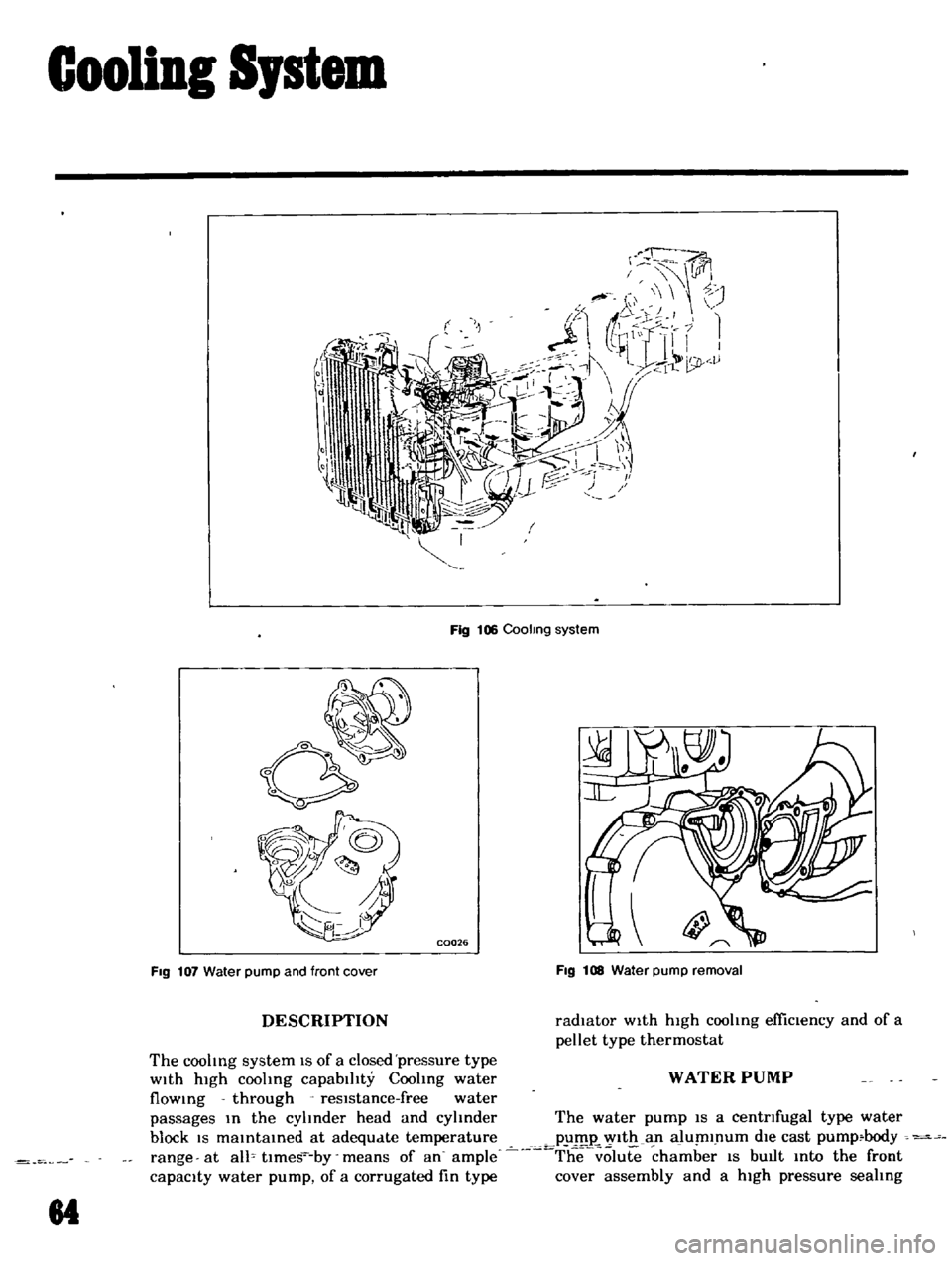
DESCRIPTION
radiator
w1th
hIgh
coohng
efficiency
and
of
a
pellet
type
thermostat
The
coohng
system
IS
of
a
closed
pressure
type
With
hIgh
coolmg
capablhty
Coohng
water
WATER
PUMP
flowmg
through
resIstance
free
water
passages
m
the
cyhnder
head
and
cyhnder
The
water
pump
IS
a
centrifugal
type
water
block
IS
mamtamed
at
adequate
temperature
pum
WIth
an
alumlpum
d1e
cast
pump
body
range
at
allo
tlmes
by
means
of
an
ample
T
he
olute
chamber
IS
bUIlt
mto
the
front
capacIty
water
pump
of
a
corrugated
fin
type
cover
assembly
and
a
high
pressure
seahng
84
Page 71 of 136
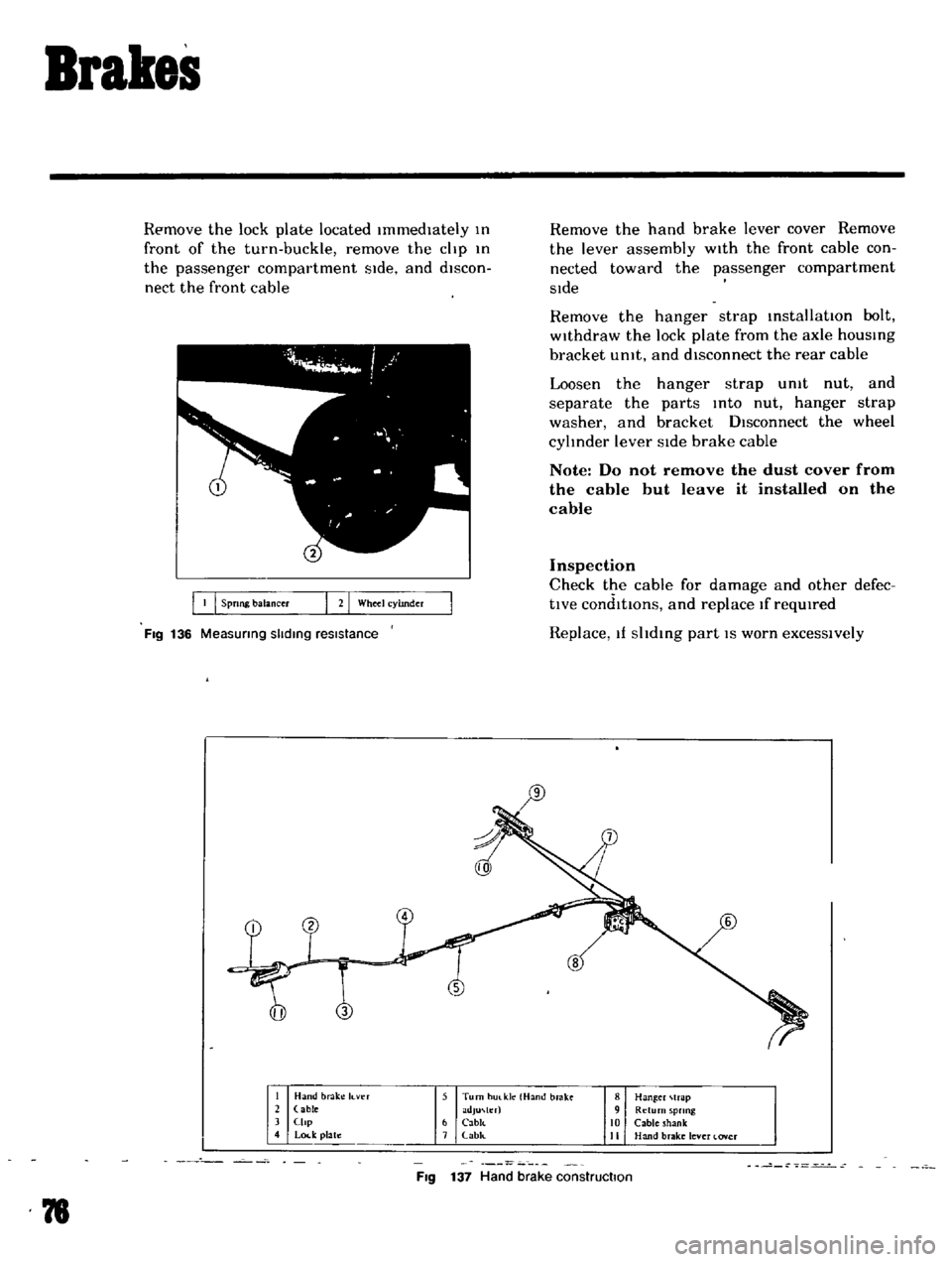
Brakes
Remove
the
lock
plate
located
Immediately
III
front
of
the
turn
buckle
remove
the
clip
III
the
passenger
compartment
SIde
and
discon
nect
the
front
cable
I
Spong
balancer
G
Wheel
cyhnder
FIg
136
Measunng
slidIng
resistance
Remove
the
hand
brake
lever
cover
Remove
the
lever
assembly
wIth
the
front
cable
con
nected
toward
the
passenger
compartment
SIde
Remove
the
hanger
strap
installatIOn
bolt
withdraw
the
lock
plate
from
the
axle
hOUSIng
bracket
umt
and
disconnect
the
rear
cable
Loosen
the
hanger
strap
umt
nut
and
separate
the
parts
Into
nut
hanger
strap
washer
and
bracket
DIsconnect
the
wheel
cylinder
lever
SIde
brake
cable
Note
Do
not
remove
the
dust
cover
from
the
cable
but
leave
it
installed
on
the
cable
Inspection
Check
the
cable
for
damage
and
other
defec
tlve
condlttons
and
replace
If
reqUIred
Replace
If
shdIng
part
IS
worn
excessively
1
Hand
brake
It
ver
2
able
J
Clip
4
Lock
plate
5
Turn
hUlkle
Hand
brake
adJU
h
r
6
CabJc
7
abk
8
Han
er
trap
9
Return
sprmg
10
Cable
shank
II
Hand
brake
lever
lover
FIg
137
Hand
brake
construction
78
Page 72 of 136
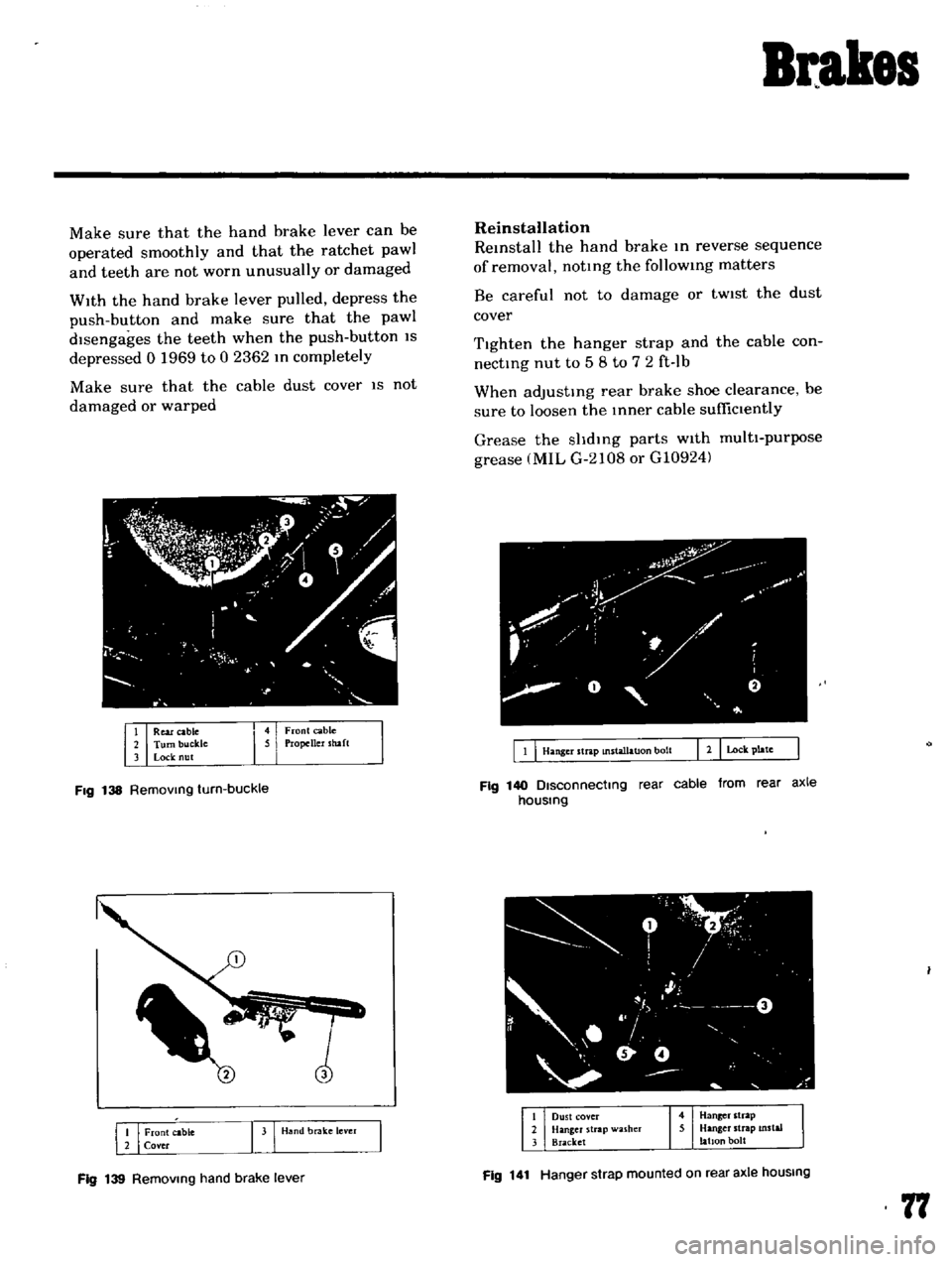
Brakes
Make
sure
that
the
hand
brake
lever
can
be
operated
smoothly
and
that
the
ratchet
pawl
and
teeth
are
not
worn
unusually
or
damaged
With
the
hand
brake
lever
pulled
depress
the
push
button
and
make
sure
that
the
pawl
disengages
the
teeth
when
the
push
button
IS
depressed
0
1969
to
0
2362
In
completely
Make
sure
that
the
cable
dust
cover
1S
not
damaged
or
warped
FIg
138
Removing
turn
buckle
I
Front
cabl
2
Cover
CI
H
nd
brok
1
Ye
Fig
139
Removing
hand
brake
lever
Reinstallation
Remstall
the
hand
brake
m
reverse
sequence
of
removal
notmg
the
folloWIng
matters
Be
careful
not
to
damage
or
tW1St
the
dust
cover
TIghten
the
hanger
strap
and
the
cable
con
nectmg
nut
to
5
8
to
7
2
ft
lb
When
adJustmg
rear
brake
shoe
clearance
be
sure
to
loosen
the
mner
cable
sufficIently
Grease
the
shdmg
parts
w1th
multI
purpose
grease
MIL
G
2108
or
G10924l
o
Lock
plate
Fig
140
Disconnecting
rear
cable
from
rear
axle
housing
i
O
j
0
I
J
i
Ii
0
j
0
0
V
I
Dust
cover
Hanger
strap
washer
Bracket
I
Fig
141
Hanger
strap
mounted
on
rear
axle
hOUSing
77
Page 73 of 136
Brakes
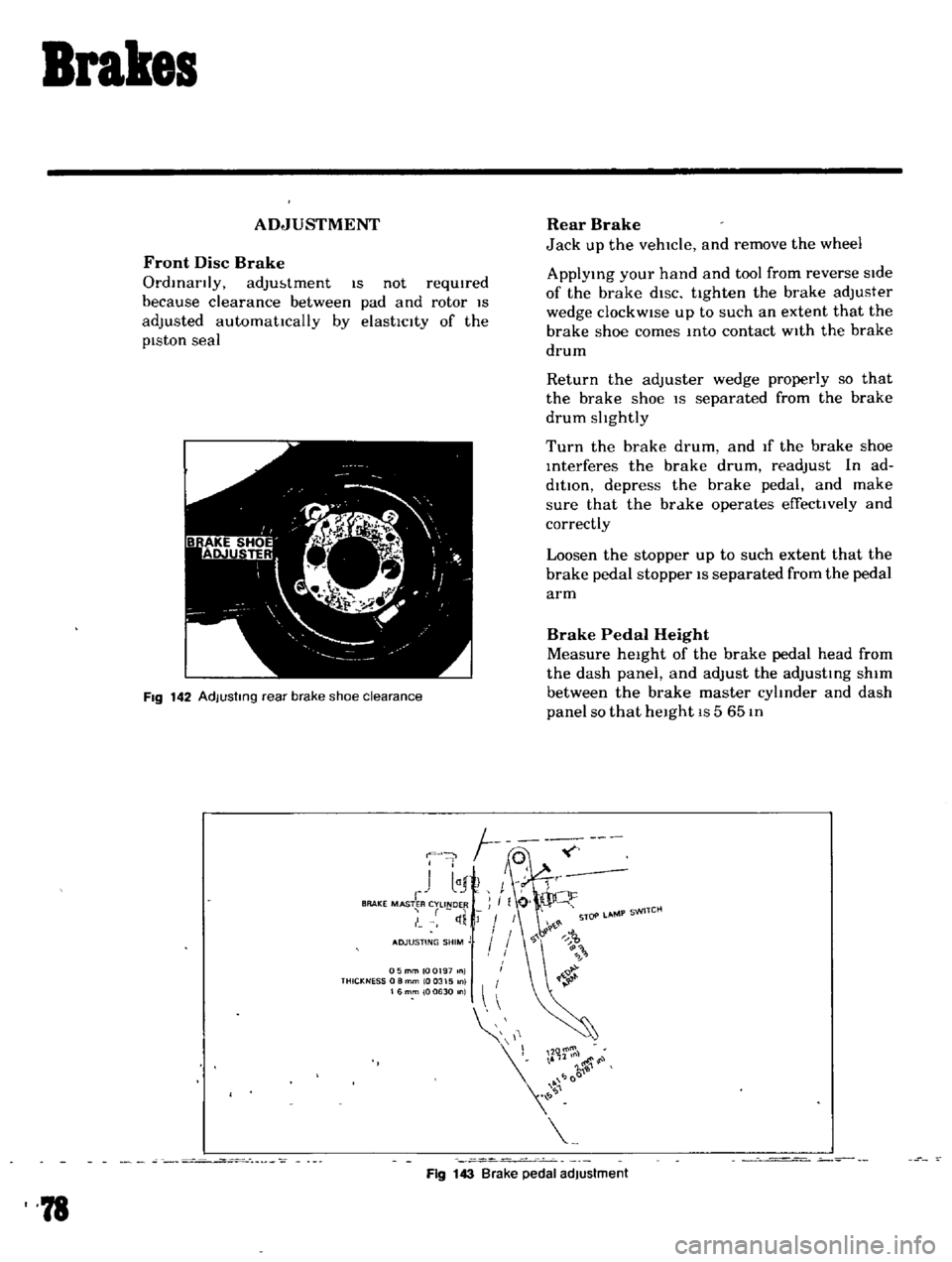
ADJUSTMENT
Front
Disc
Brake
Ordinarily
adJu
tment
IS
not
requIred
because
clearance
between
pad
and
rotor
IS
adjusted
automattcally
by
elasttclty
of
the
pIston
seal
I
iJ
1
el
i
C
1
FIg
142
AdJustmg
rear
brake
shoe
clearance
F
J
I
1
I
r
BRAKE
MASTER
CYLINDER
I
tI
Rear
Brake
Jack
up
the
vehicle
and
remove
the
wheel
ApplYing
your
hand
and
tool
from
reverse
side
of
the
brake
diSC
ttghten
the
brake
adjuster
wedge
clockWise
up
to
such
an
extent
that
the
brake
shoe
comes
Into
contact
With
the
brake
drum
Return
the
adjuster
wedge
properly
so
that
the
brake
shoe
IS
separated
from
the
brake
drum
slIghtly
Turn
the
brake
drum
and
If
the
brake
shoe
Interferes
the
brake
drum
readjust
In
ad
dition
depress
the
brake
pedal
and
make
sure
that
the
brake
operates
effecttvely
and
correctly
Loosen
the
stopper
up
to
such
extent
that
the
brake
pedal
stopper
IS
separated
from
the
pedal
arm
Brake
Pedal
Height
Measure
height
of
the
brake
pedal
head
from
the
dash
panel
and
adjust
the
adjusting
shim
between
the
brake
master
cylInder
and
dash
panel
so
that
height
IS
5
65
In
05mmlOQ197
nl
THICKNESS
0
8
mm
10
0315
0
16mm
100630
n
11
r
l00
Fig
143
Brake
pedal
adjustment
78
Page 74 of 136
Brakes
Adjusting
shIm
thickness
for
selectIOn
o
0197
In
00315
In
o
0630
In
Note
When
adjusting
be
sure
to
use
ad
Jusbng
sh1ms
having
same
th1ckness
for
upper
and
lower
brake
master
cylinder
IOstallahon
bolts
Upon
completIOn
of
adjusting
shIm
adjust
ment
tighten
the
stopper
down
to
such
an
ex
tent
that
heIght
of
the
pedal
head
IS
5
57
pO
0787
In
and
tighten
the
lock
nut
becurely
Free
travel
of
the
brake
pedal
IS
0
197
to
0591
tn
and
the
stroke
IS
4
72
In
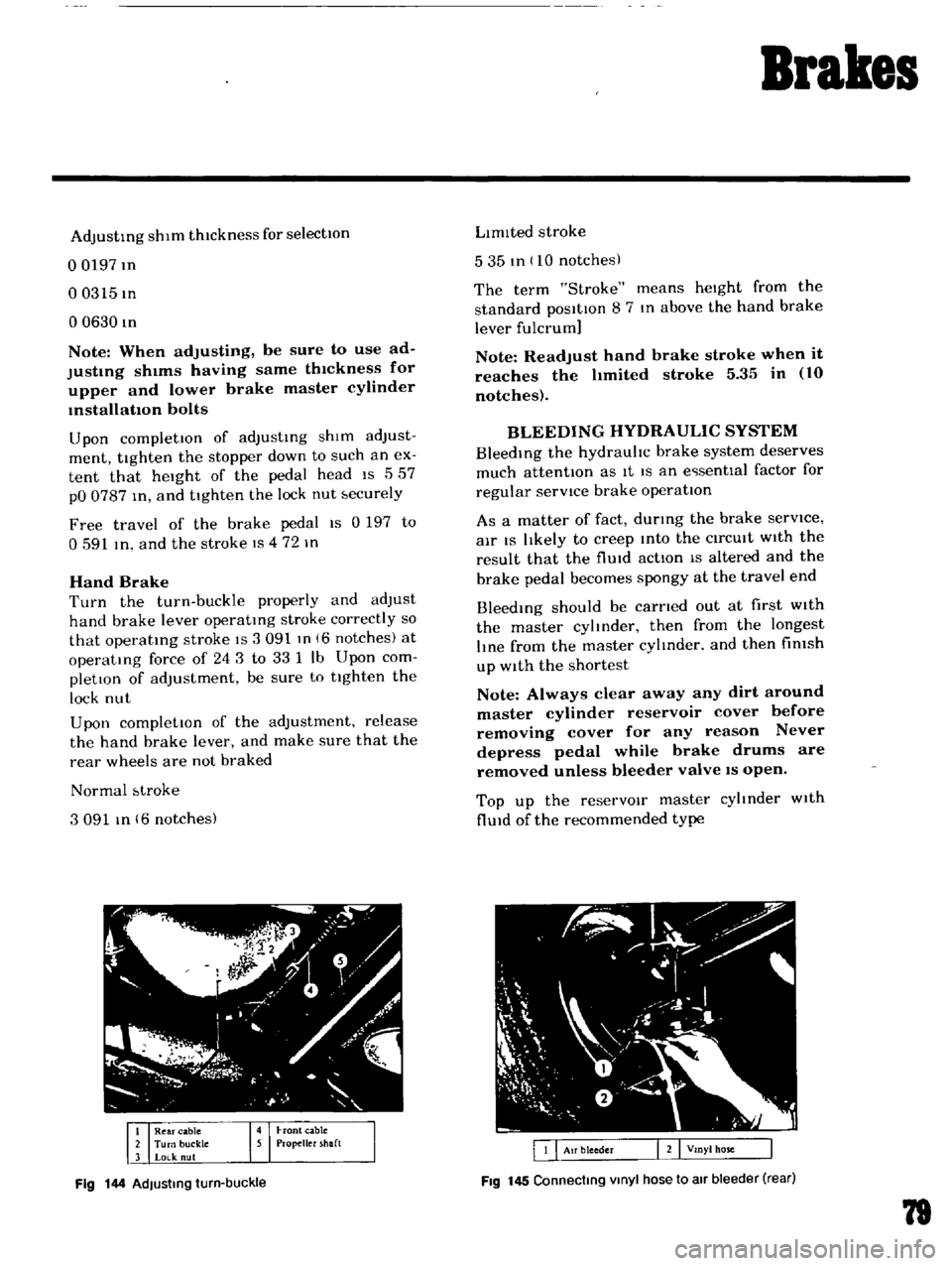
Hand
Brake
Turn
the
turn
buckle
properly
and
adjust
hand
brake
lever
operatmg
stroke
correctly
so
that
operatmg
stroke
IS
3
091
m
16
notches
at
operatIng
force
of
243
to
331
Ib
Upon
com
pletIOn
of
adjustment
be
sure
to
tIghten
the
lock
nut
Upon
completIOn
of
the
adjustment
release
the
hand
brake
lever
and
make
sure
that
the
rear
wheels
are
not
braked
Normal
btroke
3091
In
6
notches
Fig
144
AdJusting
turn
buckle
LImIted
stroke
535
tn
10
notches
The
term
Stroke
means
heIght
from
the
standard
posItIon
8
7
In
above
the
hand
brake
lever
fulcrum
Note
Readjust
hand
brake
stroke
when
it
reaches
the
hmited
stroke
5
35
in
10
notches
BLEEDING
HYDRAULIC
SYSTEM
BleedIng
the
hydrauhc
brake
system
deserves
much
attentIOn
as
It
IS
an
e
senttal
factor
for
regular
servICe
brake
operatIon
As
a
matter
of
fact
durmg
the
brake
serVice
air
IS
lIkely
to
creep
Into
the
CirCUIt
WIth
the
result
that
the
flUId
actIon
IS
altered
and
the
brake
pedal
becomes
spongy
at
the
travel
end
Bleedmg
should
be
carned
out
at
first
WIth
the
master
cylmder
then
from
the
longest
lIne
from
the
master
cylmder
and
then
fimsh
up
With
the
shortest
Note
Always
clear
away
any
dirt
around
master
cylinder
reservoir
cover
before
removing
cover
for
any
reason
Never
depress
pedal
while
brake
drums
are
removed
unless
bleeder
valve
IS
open
Top
up
the
reservOIr
master
cyltnder
With
flUId
of
the
recommended
type
Fig
145
Connecting
Vinyl
hose
to
air
bleeder
rear
79