2023 HYUNDAI IONIQ 6 seats
[x] Cancel search: seatsPage 132 of 582

Seats & Safety System
3-38
ability to control the SRS deployment
based on whether or not the seat belts are
fastened, and how severe the impact is.
The advanced SRS offers the ability to
control the airbag inflation within two
levels. A first stage level is provided for
moderate-severity impacts. A second
stage level is provided for more severe
impacts.
According to the impact severity, and
seat belt usage, the SRS Control Module
(SRSCM) controls the airbag inflation.
Failure to properly wear seat belts can
increase the risk or severity of injury in an
accident.
WARNING To reduce the risk of serious injury or
death from inflating front airbags, take
the following precautions:
• Seat belts must be worn at all times to help keep occupants positioned
properly.
• Move your seat as far back as possible from front airbags, while still
maintaining control of the vehicle.
• Never lean against the door or center console.
• Do not allow the front passenger to place their feet or legs on the
dashboard.
• Never place any objects (such as dashboard cover, mobile phone holder,
cup holder, perfume or stickers) over or
near the airbag modules on the steering
wheel, instrument panel, windshield
glass, and the front passenger’s panel
above the glove box. Such objects may
cause harm if the vehicle is in a collision
severe enough to cause the airbags to
deploy.
• Do not attach any objects on the front windshield and inside mirror.
Side airbags
Side airbag
B3003202
B3003203
Your vehicle is equipped with a side
airbag in each front seat. The purpose of
the airbag is to provide the vehicle’s
driver and the front passenger with
additional protection than that offered by
the seat belt alone.
The side airbags are designed to deploy
during certain side impact collisions,
depending on the crash severity, angle,
speed and point of impact.
The side airbags on both sides of the
vehicle are designed to deploy when a
rollover is detected by a rollover sensor.
(if equipped with rollover sensor)
The side airbags are not designed to
deploy in all side impact or rollover
situations.
The side airbags are designed to deploy
during certain side impact collisions,
depending on the crash severity.
For vehicles equipped with a rollover
sensor the side and/or curtain airbags and
Hyundai_CE_en_US.book Page 38
Page 133 of 582
3
3-39
pretensioners on both sides of the vehicle
may deploy if a rollover or possible
rollover is detected.
The side airbags are not designed to
deploy in all side impact or rollover
situations.
WARNING To reduce the risk of serious injury or
death from an inflating side airbag, take
the following precautions:
• Seat belts must be worn at all times to help keep occupants positioned
properly.
• Do not allow passengers to lean their heads or bodies onto doors, put their
arms on the doors, stretch their arms
out of the window, or place objects
between the doors and seats.
• Hold the steering wheel at the 9 o’clock and 3 o’clock positions, to minimize the
risk of injuries to your hands and arms.
• Do not use any accessory seat covers. This could reduce or prevent the
effectiveness of the system.
• Do not hang other objects except clothes. In an accident it may cause
vehicle damage or personal injury
especially when airbag is inflated.
• Do not place any objects over the airbag or between the airbag and
yourself. Also, do not attach any objects
around the area the airbag inflates such
as the door, side door glass, front and
rear pillar.
• Do not place any objects between the door and the seat. They may become
dangerous projectiles if the side airbag
inflates.
• Do not install any accessories on the side or near the side airbags.
• Do not impact the doors when the Start/Stop button is in the ON or START
position as this may cause the side
airbags to inflate. • If the seat or seat cover is damaged,
have the system serviced by an
authorized HYUNDAI dealer.
Curtain airbags
B3003301
B3003302
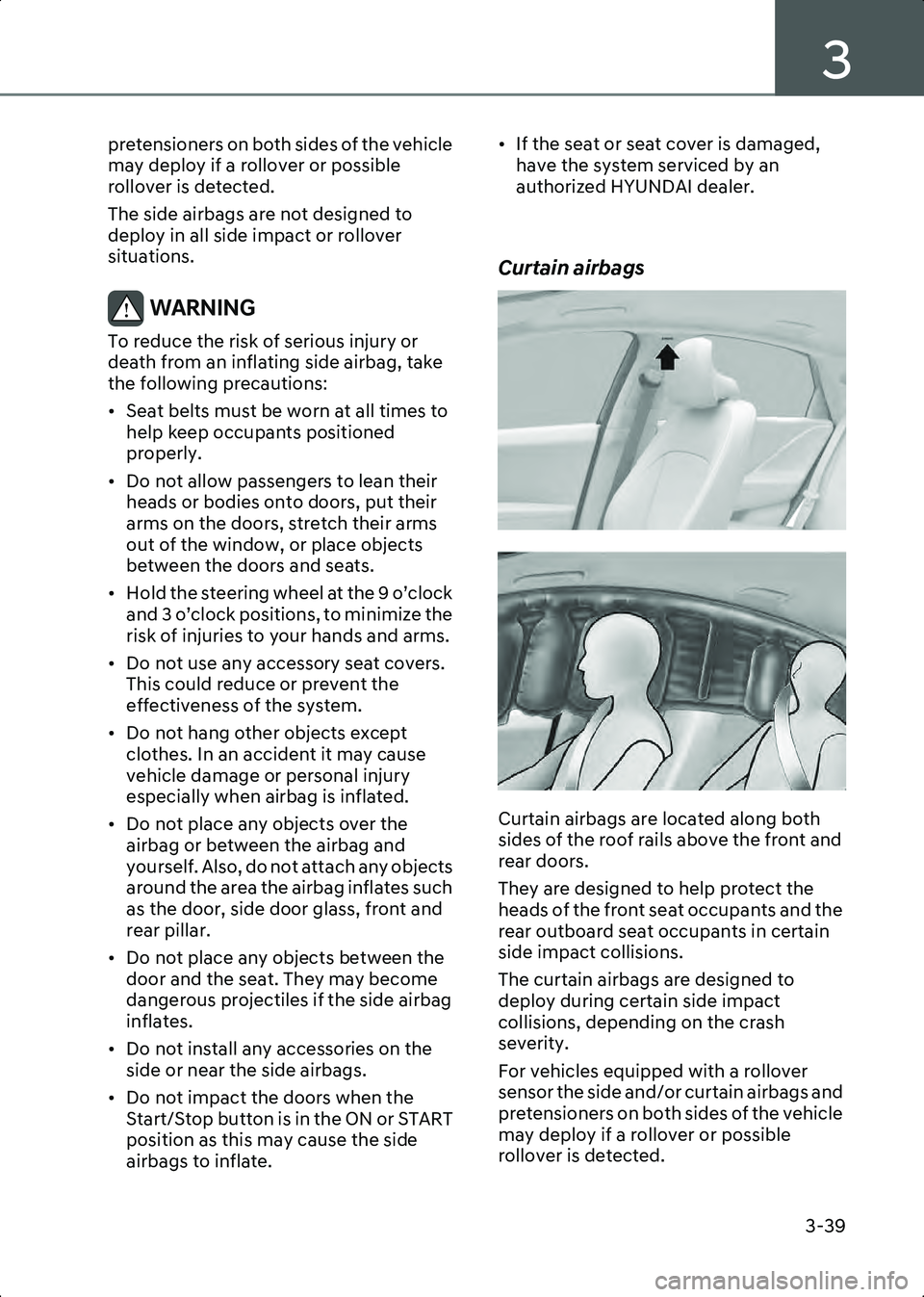
Curtain airbags are located along both
sides of the roof rails above the front and
rear doors.
They are designed to help protect the
heads of the front seat occupants and the
rear outboard seat occupants in certain
side impact collisions.
The curtain airbags are designed to
deploy during certain side impact
collisions, depending on the crash
severity.
For vehicles equipped with a rollover
sensor the side and/or curtain airbags and
pretensioners on both sides of the vehicle
may deploy if a rollover or possible
rollover is detected.
Hyundai_CE_en_US.book Page 39
Page 134 of 582
Seats & Safety System
3-40
The curtain airbags are not designed to
deploy in all side impact or rollover
situations.
WARNING To reduce the risk of serious injury or
death from an inflating curtain airbag,
take the following precautions:
• All occupants must wear seat belts at all times to help keep occupants
positioned properly.
• Properly secure Child Restraint System as far away from the door as possible.
• Do not place any objects over the airbag. Also, do not attach any objects
around the area the airbag inflates such
as the door, side door glass, front and
rear pillar, roof side rail.
• Do not hang other objects except clothes, especially hard or breakable
objects.
In an accident, it may cause vehicle
damage or personal injury.
• Do not allow passengers to lean their heads or bodies onto doors, put their
arms on the doors, stretch their arms
out of the window, or place objects
between the doors and seats.
• Do not attempt to open or repair the side curtain airbags yourself. If
necessary, have the airbag inspected
by an authorized HYUNDAI dealer.
How does the Airbags System
Operate?
A3002401
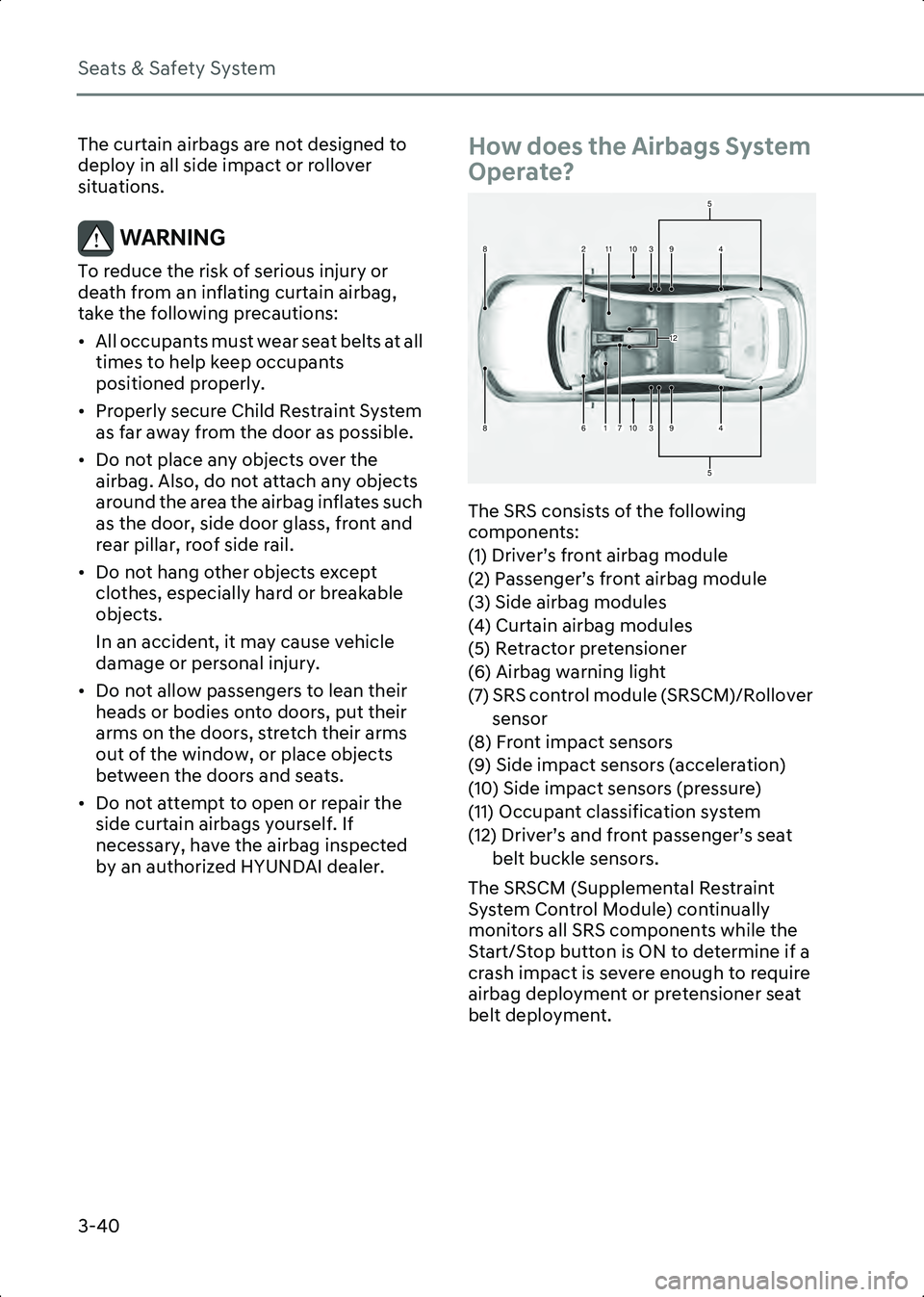
The SRS consists of the following
components:
(1) Driver’s front airbag module
(2) Passenger’s front airbag module
(3) Side airbag modules
(4) Curtain airbag modules
(5) Retractor pretensioner
(6) Airbag warning light
(7) SRS control module (SRSCM)/Rollover sensor
(8) Front impact sensors
(9) Side impact sensors (acceleration)
(10) Side impact sensors (pressure)
(11) Occupant classification system
(12) Driver’s and front passenger’s seat belt buckle sensors.
The SRSCM (Supplemental Restraint
System Control Module) continually
monitors all SRS components while the
Start/Stop button is ON to determine if a
crash impact is severe enough to require
airbag deployment or pretensioner seat
belt deployment.
4
5
5
11
1
23
37
8
86
9
49
10
10
12
Hyundai_CE_en_US.book Page 40
Page 136 of 582
Seats & Safety System
3-42
• To help provide protection, the airbags must inflate rapidly. The speed of
airbag inflation is a consequence of
extremely short time in which to inflate
the airbag between the occupant and
the vehicle structures before the
occupant impacts those structures.
This speed of inflation reduces the risk
of serious or life-threatening injuries
and is thus a necessary part of airbag
design.
However, the rapid airbag inflation can
also cause injuries which can include
facial abrasions, bruises and broken
bones because the inflation speed also
causes the airbags to expand with a
great deal of force.
• There are even circumstances under which contact with the airbag can
cause fatal injuries, especially if the
occupant is positioned excessively
close to the airbag.
You can take steps to reduce the risk of
being injured by an inflating airbag. The
greatest risk is sitting too close to the
airbag. An airbag needs about 10 in. (25
cm) of space to inflate. NHTSA
recommends that drivers allow at least 10
in. (25 cm) between the center of the
steering wheel and the chest.
WARNING To reduce the risk of serious injury or
death from an inflating airbag, take the
following precautions:
• NEVER place a child restraint in the front passenger seat.
Always properly restrain children under
age 13 in the rear seats of the vehicle.
• Adjust the front passenger’s and driver's seats as far to the rear as
possible while allowing you to maintain
full control of the vehicle.
• Hold the steering wheel with hands at the 9 o'clock and 3 o'clock positions. • Never place anything or anyone
between the airbag and the seat
occupant.
• Do not allow the front passenger to place their feet or legs on the
dashboard.
Driver’s front airbag (1)
OLMB033054
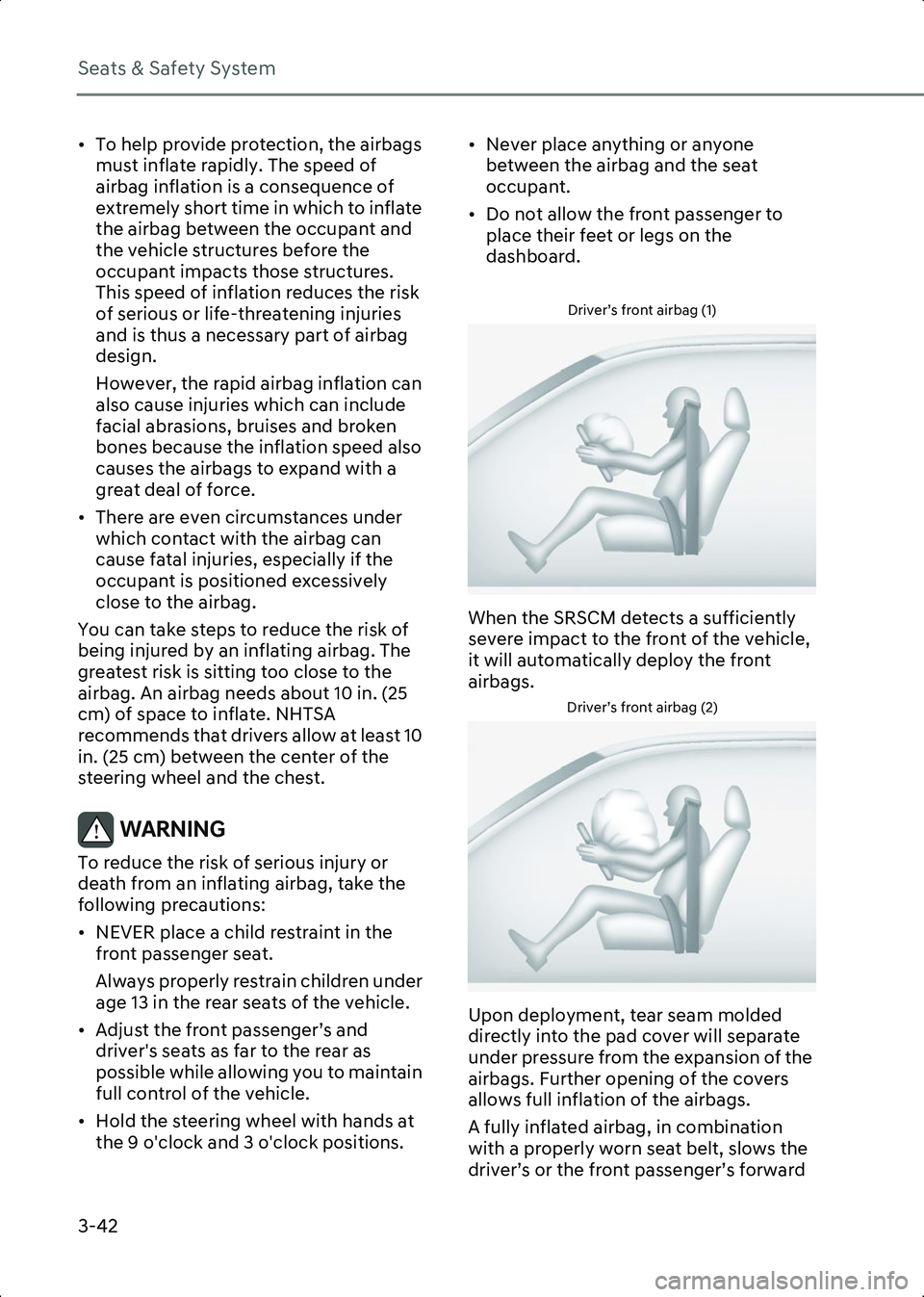
When the SRSCM detects a sufficiently
severe impact to the front of the vehicle,
it will automatically deploy the front
airbags.
Driver’s front airbag (2)
OLMB033055
Upon deployment, tear seam molded
directly into the pad cover will separate
under pressure from the expansion of the
airbags. Further opening of the covers
allows full inflation of the airbags.
A fully inflated airbag, in combination
with a properly worn seat belt, slows the
driver’s or the front passenger’s forward
Hyundai_CE_en_US.book Page 42
Page 138 of 582
Seats & Safety System
3-44
Noise and smoke from inflating
airbag
When the airbags inflate, they make a
loud noise and may produce smoke and
powder in the air inside of the vehicle.
This is normal and is a result of the
ignition of the airbag inflator. After the
airbag inflates, you may feel substantial
discomfort in breathing because of the
contact of your chest with both the seat
belt and the airbag, as well as from
breathing the smoke and powder. The
powder may aggravate asthma for some
people. If you experience breathing
problems after an airbag deployment,
seek medical attention immediately.
Though the smoke and powder are
nontoxic, they may cause irritation to the
skin, eyes, nose, throat, etc. If this is the
case, wash and rinse with cold water
immediately and seek medical attention if
the symptoms persist.
Occupant Classification
System (OCS)
B3003102
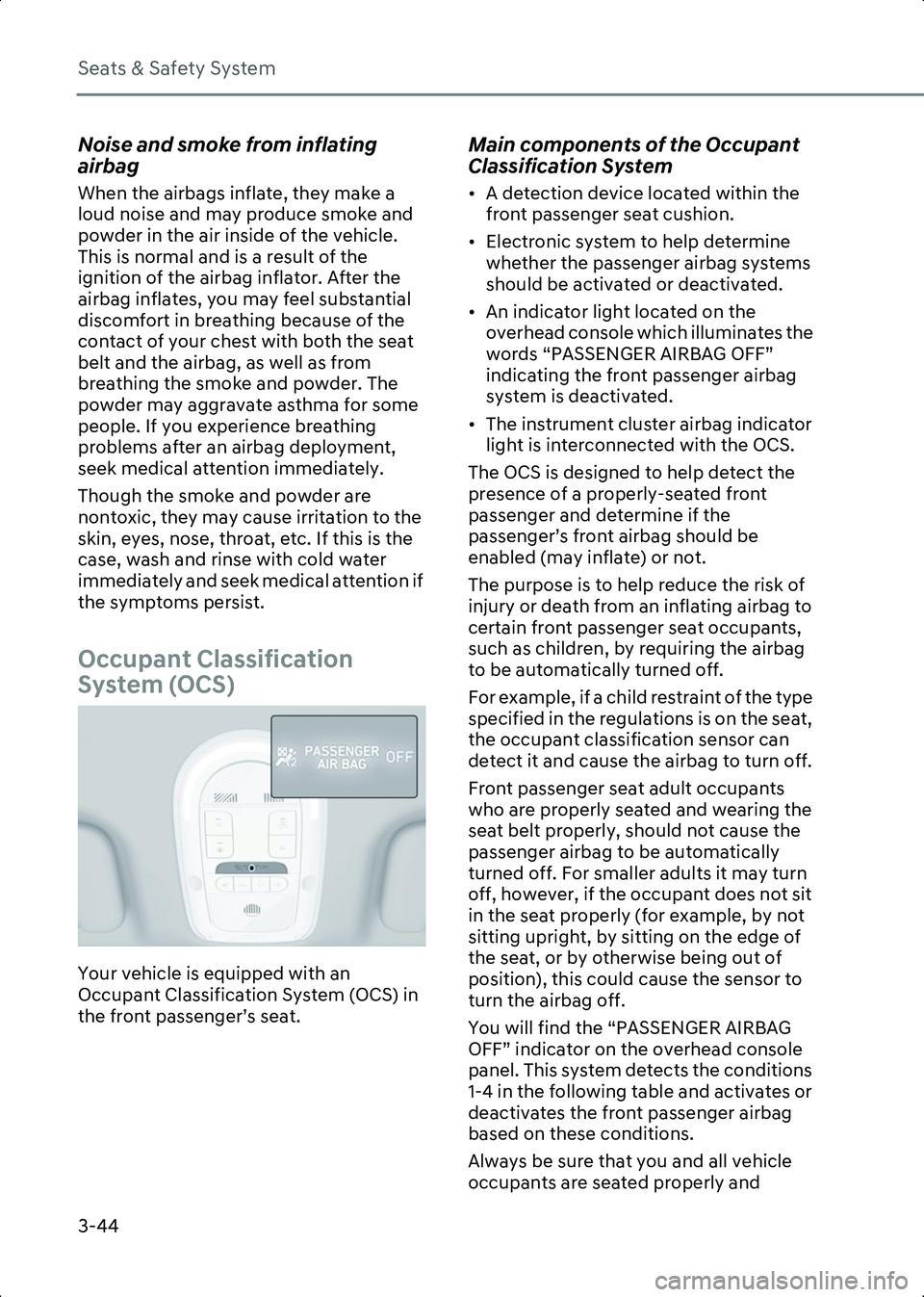
Your vehicle is equipped with an
Occupant Classification System (OCS) in
the front passenger’s seat.
Main components of the Occupant
Classification System
• A detection device located within the front passenger seat cushion.
• Electronic system to help determine whether the passenger airbag systems
should be activated or deactivated.
• An indicator light located on the overhead console which illuminates the
words “PASSENGER AIRBAG OFF”
indicating the front passenger airbag
system is deactivated.
• The instrument cluster airbag indicator light is interconnected with the OCS.
The OCS is designed to help detect the
presence of a properly-seated front
passenger and determine if the
passenger’s front airbag should be
enabled (may inflate) or not.
The purpose is to help reduce the risk of
injury or death from an inflating airbag to
certain front passenger seat occupants,
such as children, by requiring the airbag
to be automatically turned off.
For example, if a child restraint of the type
specified in the regulations is on the seat,
the occupant classification sensor can
detect it and cause the airbag to turn off.
Front passenger seat adult occupants
who are properly seated and wearing the
seat belt properly, should not cause the
passenger airbag to be automatically
turned off. For smaller adults it may turn
off, however, if the occupant does not sit
in the seat properly (for example, by not
sitting upright, by sitting on the edge of
the seat, or by otherwise being out of
position), this could cause the sensor to
turn the airbag off.
You will find the “PASSENGER AIRBAG
OFF” indicator on the overhead console
panel. This system detects the conditions
1-4 in the following table and activates or
deactivates the front passenger airbag
based on these conditions.
Always be sure that you and all vehicle
occupants are seated properly and
Hyundai_CE_en_US.book Page 44
Page 140 of 582
Seats & Safety System
3-46
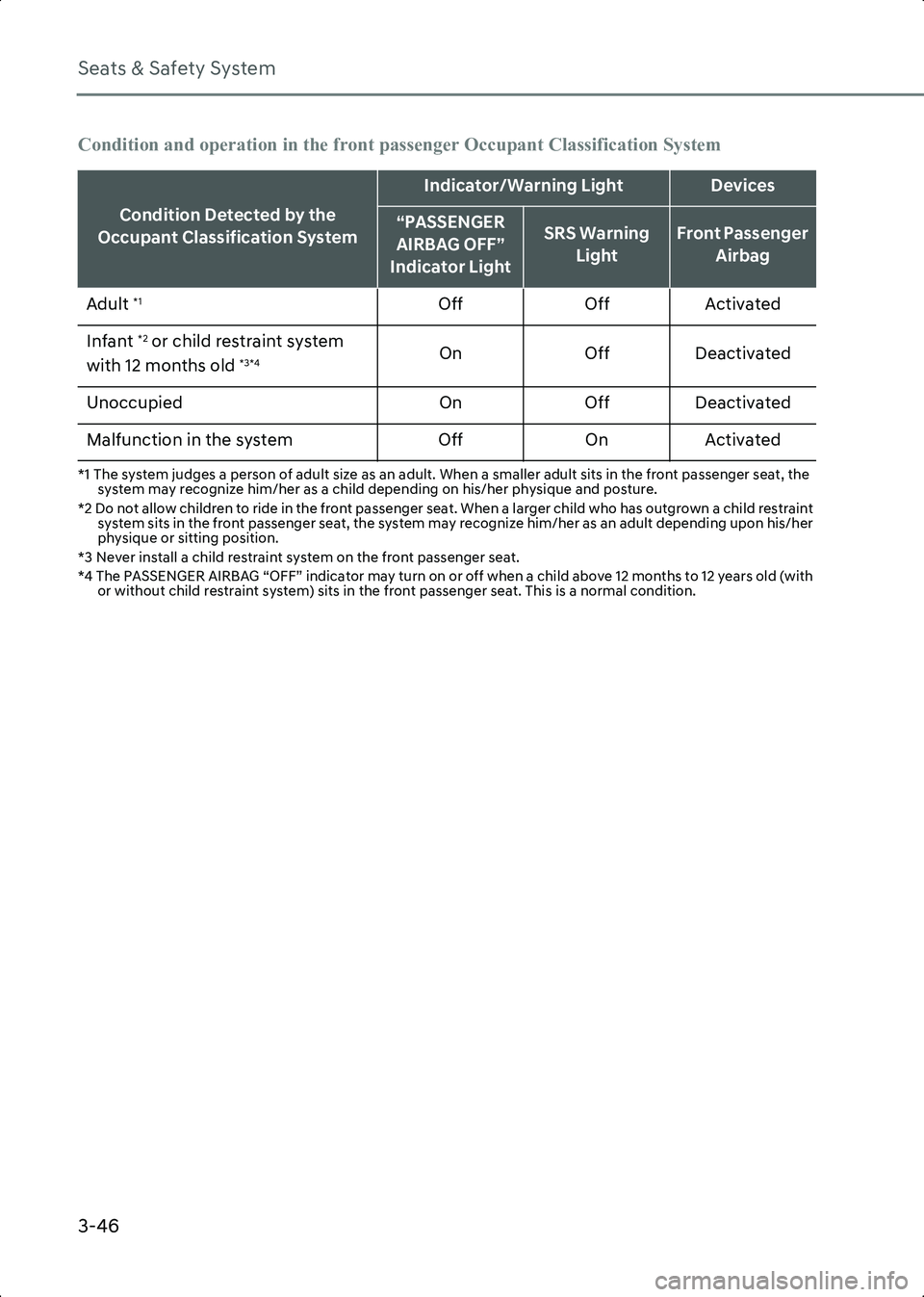
Condition and operation in the front passenger Occupant Classification System
*1 The system judges a person of adult size as an adult. When a smaller adult sits in the front passenger seat, the system may recognize him/her as a child depending on his/her physique and posture.
*2 Do not allow children to ride in the front passenger seat. When a larger child who has outgrown a child restraint system sits in the front passenger seat, the system may recognize him/her as an adult depending upon his/her
physique or sitting position.
*3 Never install a child restraint system on the front passenger seat.
*4 The PASSENGER AIRBAG “OFF” indicator may turn on or off when a child above 12 months to 12 years old (with or without child restraint system) sits in the front passenger seat. This is a normal condition.
Condition Detected by the
Occupant Classification System
Indicator/Warning LightDevices
“PASSENGER AIRBAG OFF”
Indicator LightSRS Warning LightFront Passenger Airbag
Adult
*1Off OffActivated
Infant
*2 or child restraint system
with 12 months old *3*4On Off Deactivated
Unoccupied OnOff Deactivated
Malfunction in the system OffOnActivated
Hyundai_CE_en_US.book Page 46
Page 142 of 582
Seats & Safety System
3-48
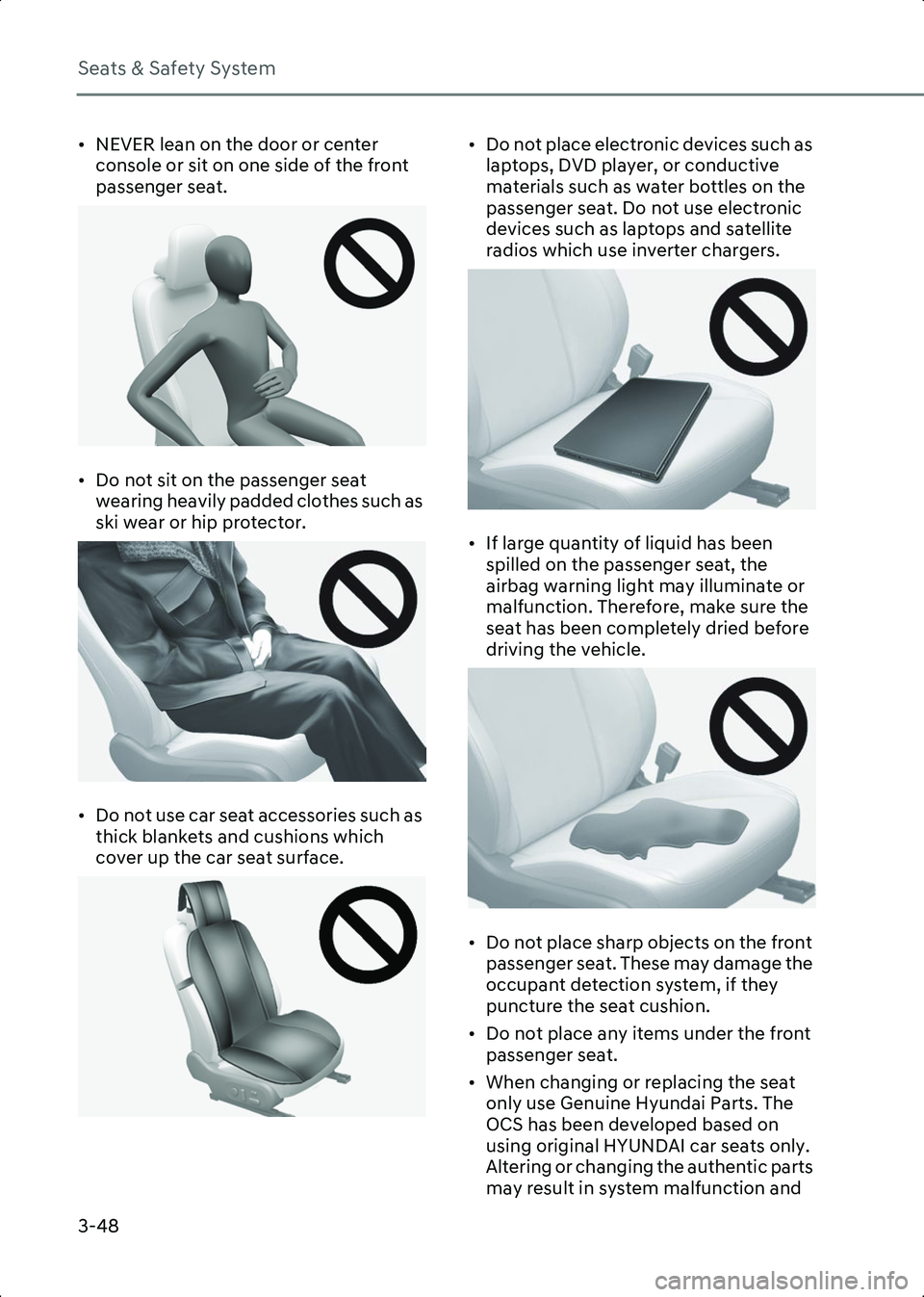
• NEVER lean on the door or center console or sit on one side of the front
passenger seat.
B3003109
• Do not sit on the passenger seat wearing heavily padded clothes such as
ski wear or hip protector.
B3003110
• Do not use car seat accessories such as thick blankets and cushions which
cover up the car seat surface.
B3003112
• Do not place electronic devices such as laptops, DVD player, or conductive
materials such as water bottles on the
passenger seat. Do not use electronic devices such as laptops and satellite
radios which use inverter chargers.
B3003111
• If large quantity of liquid has been spilled on the passenger seat, the
airbag warning light may illuminate or
malfunction. Therefore, make sure the
seat has been completely dried before
driving the vehicle.
B3003113
• Do not place sharp objects on the front passenger seat. These may damage the
occupant detection system, if they
puncture the seat cushion.
• Do not place any items under the front passenger seat.
• When changing or replacing the seat only use Genuine Hyundai Parts. The
OCS has been developed based on
using original HYUNDAI car seats only.
Altering or changing the authentic parts
may result in system malfunction and
Hyundai_CE_en_US.book Page 48
Page 144 of 582
Seats & Safety System
3-50
Why didn’t My Airbag Go Off in
a Collision?
There are certain types of accidents in
which the airbag would not be expected
to provide additional protection. These
include rear impacts, second or third
collisions in multiple impact accidents, as
well as low speed impacts. Damage to the
vehicle indicates collision energy
absorption, and is not an indicator of
whether or not an airbag should have
inflated.
Airbag collision sensors
WARNING To reduce the risk of an airbag deploying
unexpectedly and causing serious injury
or death:
• Do not hit or allow any objects to impact the locations where airbags or
sensors are installed.
• Do not perform maintenance on or around the airbag sensors. If the
location or angle of the sensors is
altered, the airbags may deploy when
they should not or may not deploy
when they should.
• Installing bumper guards with non-genuine Hyundai parts may
adversely affect the collision and airbag
deployment performance.
To ensure correct function of the airbag
system, have the bumper replaced with
genuine Hyundai part specified for your
vehicle.
• Press the Start/Stop button to the OFF or ACC position and wait for 3 minutes
when the vehicle is being towed to
prevent inadvertent airbag
deployment.
• Have all airbag repairs conducted by an authorized HYUNDAI dealer.
Hyundai_CE_en_US.book Page 50