2022 TOYOTA YARIS CROSS plate
[x] Cancel search: platePage 227 of 618

225
4
CV Owner's Manual_Europe_M52N20_en
4-5. Using the driving support systems
Driving
hole cover, steel plate, etc.), steps, or
a protrusion in front of your vehicle • When passing under an object (road sign, billboard, etc.)
• When approaching an electric toll gate barrier, parking area barrier, or other
barrier that opens and closes • When using an automatic car wash• When driving through or under objects
t ha t ma y c on t a ct yo u r ve hi cl e , s u ch as thick grass, tree branches, or a ban-ner
• When driving through steam or smoke • When driving near an object that
reflects radio waves, such as a large truck or guardrail• When driving near a TV tower, broad-
casting station, electric power plant, radar equipped vehicles, etc., or other location where strong radio waves or
electrical noise may be present • When there are many things which can reflect the radio waves of the
radar in the vicinity (tunnels, truss bridges, gravel roads, snow covered road that have tracks, etc.)
• For region A: While making a right/left turn, when an oncoming vehicle or a crossing pedestrian has already
exited the path of your vehicle • For region A: While making a right/left turn, closely in front of an oncoming
vehicle or a crossing pedestrian
• For region A: While making a right/left
turn, when an oncoming vehicle or a crossing pedestrian stops before entering the path of your vehicle
• For region A: While making a right/left turn, when an oncoming vehicle turns right/left in front of your vehicle
• For region A: While steering into the direction of oncoming traffic
■Situations in which the system may
not operate properly
●In some situations such as the follow-
ing, an object may not be detected by the radar sensor and front camera, preventing the system from operating
properly: • When a detectable object is approaching your vehicle
• When your vehicle or a detectable object is wobbling• If a detectable object makes an abrupt
maneuver (such as sudden swerving, acceleration or deceleration)• When your vehicle approaches a
detectable object rapidly • When a detectable object is not directly in front of your vehicle
• When a detectable object is near a wall, fence, guardrail, manhole cover,
vehicle, steel plate on the road, etc. • When a detectable object is under a structure
Page 281 of 618

279
4
CV Owner's Manual_Europe_M52N20_en
4-5. Using the driving support systems
Driving
■The system can be operated when
●The engine switch is in ON.
●Toyota parking assist-sensor function
is on.
●The vehicle speed is less than about
10 km/h (6 mph).
●The shift lever is in other than P.
■If “Clean Parking Assist Sensor” is
displayed on the multi-information display
A sensor may be covered with water
drops, ice, snow, dirt, etc. Remove the water drops, ice, snow, dirt, etc., from
the sensor to return the system to nor- mal.
Also, due to ice forming on a sensor at
low temperatures, a warning message may be displayed or the sensor may not be able to detect an object. Once the ice
melts, the system will return to normal.
If a warning message is displayed even if the sensor is clean, there may be a
sensor malfunction. Have the vehicle inspected by any authorized Toyota retailer or Toyota authorized repairer, or
any reliable repairer.
■Sensor detection information
●The sensor’s detection areas are lim-
ited to the areas around the vehicle’ front and rear bumpers.
WARNING
■To ensure the system can oper-ate properly
Observe the following precautions. Failing to do so may result in the vehi-cle being unable to be driven safely
and possibly cause an accident.
●Do not damage the sensors, and
always keep them clean.
●Do not a sticker or an electronic
component, such as a backlit license plate (especially fluorescent type), fog lights, fender pole or wire-
less antenna is installed near a radar sensor.
●Do not subject the radar sensor or its surrounding area to a strong impact. If the radar sensor, front
grille, or front bumper has been subjected to a strong impact, have the vehicle inspected by any autho-
rized Toyota retailer or Toyota authorized repairer, or any reliable repairer. If a sensor or the rear
bumper needs to be removed/installed or replaced, con-tact any authorized Toyota retailer
or Toyota authorized repairer, or any reliable repairer.
●Do not modify, disassemble or paint the sensors.
●Do not attach a license plate cover.
●Keep your tires properly inflated.
■When to disable the function
In the following situations, disable the
function as it may operate even though there is no possibility of a colli-sion.
●Failing to observe the warnings above.
●A non-genuine Toyota suspension (lowered suspension, etc.) is
installed.
■Notes when washing the vehicle
Do not apply intensive bursts of water or steam to the sensor area.
Doing so may result in the sensor malfunctioning.
●When using a high pressure washer to wash the vehicle, do not spray the sensors directly, as doing
so may cause a sensor to malfunc- tion.
●When using steam to clean the vehicle, do not direct steam too close to the sensors as doing so
may cause a sensor to malfunction.
Page 344 of 618
342
CV Owner's Manual_Europe_M52N20_en
6-1. Maintenance and care
6-1.Mainte nance a nd care
Working from top to bottom, lib-
erally apply water to the vehicle
body, wheel wells and underside
of the vehicle to remove any dirt
and dust.
Wash the vehicle body using a
sponge or soft cloth, such as a
chamois.
For hard-to-remove marks, use
car wash soap and rinse thor-
oughly with water.
Wipe away any water.
Wax the vehicle when the water-
proof coating deteriorates.
If water does not bead on a clean sur-
face, apply wax when the vehicle body
is cool.
■Automatic car washes
●Before washing the vehicle: • Fold the mirrors.
Start washing from the front of the vehi-
cle. Extend the mirrors before driving.
●Turn off the power back door (if equipped).
●Brushes used in automatic car washes may scratch the vehicle sur-
face, parts (wheel, etc.) and harm your vehicle’s paint.
●In certain automatic car washes, the
rear spoiler may interfere with
machine operation. This may prevent the vehicle from being cleaned prop-erly or result in damage to the rear
spoiler.
■High pressure car washes
As water may enter the cabin, do not bring the nozzle tip near the gaps
around the doors or perimeter of the windows, or spray these areas continu-ously.
■When using a car wash (vehicles
with a smart entry & start system)
If the door handle becomes wet while the electronic key is within the effective
range, the door may lock and unlock repeatedly. In that case, follow the fol-lowing correction procedures to wash
the vehicle:
●Place the key in a position 2 m (6 ft.)
or more separate from the vehicle while the vehicle is being washed. (Take care to ensure that the key is
not stolen.)
●Set the electronic key to battery-sav-
ing mode to disable the smart entry & start system. ( P.137)
■Wheels and wheel ornaments (if equipped)
●Remove any dirt immediately by using a neutral detergent.
●Wash detergent off with water immedi-ately after use.
●To protect the paint from damage, make sure to observe the following
precautions. • Do not use acidic, alkaline or abrasive detergent
• Do not use hard brushes • Do not use detergent on the wheels when they are hot, such as after driv-
ing or parking in hot weather
■Bumpers
Do not scrub with abrasive cleaners.
■Plated portions (if equipped)
If dirt cannot be removed, clean the
parts as follows:
Cleaning and protecting
the vehicle exterior
Perform cleaning in a manner
appropriate to each compo-
nent and its material.
Cleaning instructions
Page 388 of 618
386
CV Owner's Manual_Europe_M52N20_en
6-3. Do-it-yourself maintenance
Check the wattage of the light bulb
to be replaced. ( P.455)
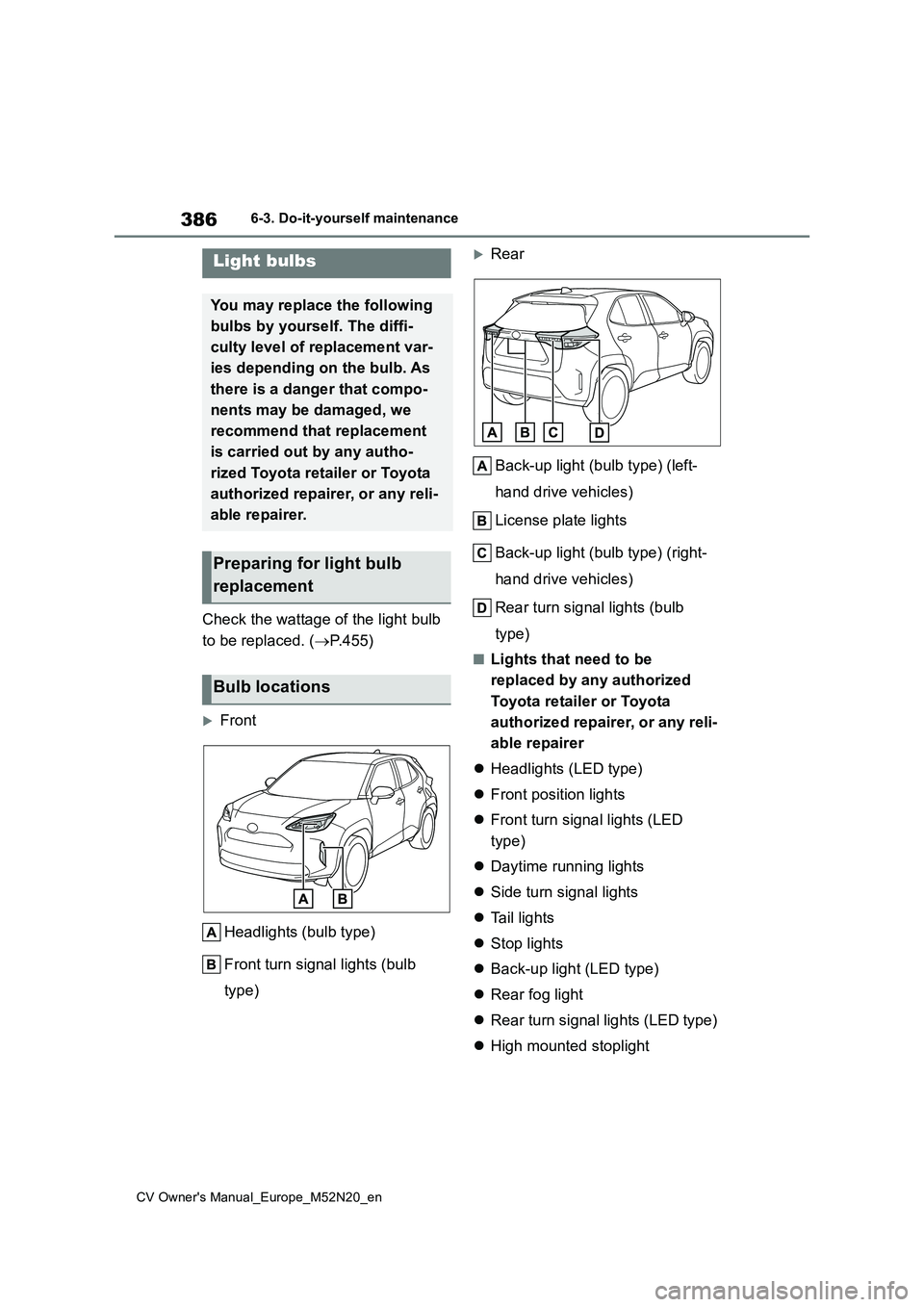
Front
Headlights (bulb type)
Front turn signal lights (bulb
type)
Rear
Back-up light (bulb type) (left-
hand drive vehicles)
License plate lights
Back-up light (bulb type) (right-
hand drive vehicles)
Rear turn signal lights (bulb
type)
■Lights that need to be
replaced by any authorized
Toyota retailer or Toyota
authorized repairer, or any reli-
able repairer
Headlights (LED type)
Front position lights
Front turn signal lights (LED
type)
Daytime running lights
Side turn signal lights
Ta i l l i g h t s
Stop lights
Back-up light (LED type)
Rear fog light
Rear turn signal lights (LED type)
High mounted stoplight
Light bulbs
You may replace the following
bulbs by yourself. The diffi-
culty level of replacement var-
ies depending on the bulb. As
there is a danger that compo-
nents may be damaged, we
recommend that replacement
is carried out by any autho-
rized Toyota retailer or Toyota
authorized repairer, or any reli-
able repairer.
Preparing for light bulb
replacement
Bulb locations
Page 389 of 618
387
6
CV Owner's Manual_Europe_M52N20_en
6-3. Do-it-yourself maintenance
Maintenance and care
■LED light bulbs
The lights other than the following lights
each consist of a number of LEDs. If any of the LEDs burn out, take your vehicle to any authorized Toyota retailer or
Toyota authorized repairer, or any reli- able repairer to have the light replaced.
●Headlights (bulb type)
●Front turn signal lights (bulb type)
●Rear turn signal lights (bulb type)
●License plate lights
●Back-up light (bulb type)
■Condensation build-up on the
inside of the lens
Temporary condensation build-up on the inside of the headlight lens does not
indicate a malfunction. Contact any authorized Toyota retailer or Toyota authorized repairer, or any reliable
repairer for more information in the fol- lowing situations:
●Large drops of water have built up on the inside of the lens.
●Water has built up inside the head-light.
■When replacing light bulbs
P. 3 8 4
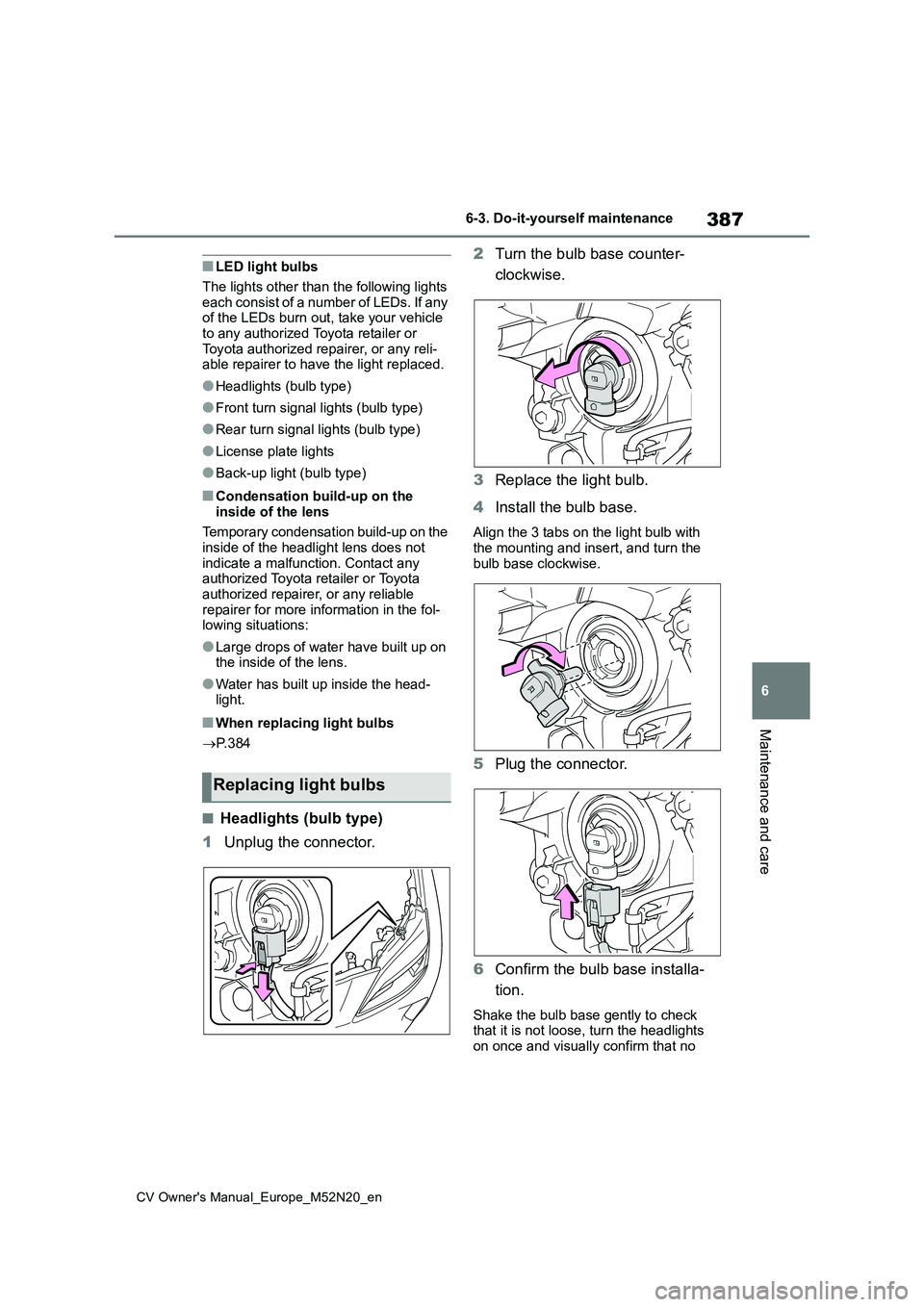
■Headlights (bulb type)
1 Unplug the connector.
2 Turn the bulb base counter-
clockwise.
3 Replace the light bulb.
4 Install the bulb base.
Align the 3 tabs on the light bulb with the mounting and insert, and turn the
bulb base clockwise.
5 Plug the connector.
6 Confirm the bulb base installa-
tion.
Shake the bulb base gently to check that it is not loose, turn the headlights
on once and visually confirm that no
Replacing light bulbs
Page 391 of 618

389
6
CV Owner's Manual_Europe_M52N20_en
6-3. Do-it-yourself maintenance
Maintenance and care
installing it.
7Install the 2 bolts.
■License plate light
1 Remove the lens.
1 Insert a small flathead screw-
driver, etc., into either the right
or left hole of the lens.
2 Tilt the screwdriver in the direc-
tion of the arrow shown in the
illustration so as to release the
fitting portion, and then remove
the lens.
To prevent damage to the vehicle, wrap
the tip of the screwdriver with tape.
Lens
Fitting portion
Page 438 of 618

436
CV Owner's Manual_Europe_M52N20_en
7-2. Steps to take in an emergency
When the engine does not start, the
following steps can be used as an
interim measure to start the engine
if the engine switch is functioning
normally.
Do not use this starting procedure
except in case of emergency.
1 Pull the parking brake switch to
check that the parking brake is
set. ( P.186)
Parking brake indicator will come on.
2Check that the shift lever is in P
(Multidrive) or N (manual trans-
mission).
3 Turn the engine switch to ACC.
4 Press and hold the engine
switch for about 15 seconds
while depressing the brake
pedal (Multidrive) or clutch
pedal (manual transmission)
firmly.
Even if the engine can be started using
the above steps, the system may be
malfunctioning. Have the vehicle
inspected by any authorized Toyota
retailer or Toyota authorized repairer, or
any reliable repairer.
Emergency start function
(vehicles with a smart entry
& start system)
If you lose your keys
New genuine keys can be
made by any authorized Toyota
retailer or Toyota authorized
repairer, or any reliable
repairer using the other key
(vehicles without a smart entry
& start system) or mechanical
key (vehicles with a smart
entry & start system) and the
key number stamped on your
key number plate.
Keep the plate in a safe place
such as your wallet, not in the
vehicle.
NOTICE
■When an electronic key is lost
(vehicles with a smart entry & start system)
If the electronic key remains lost, the
risk of vehicle theft increases signifi- cantly. Visit any authorized Toyota retailer or Toyota authorized repairer,
or any reliable repairer immediately with all remaining electronic keys that were provided with your vehicle.
Page 457 of 618

455
8
CV Owner's Manual_Europe_M52N20_en
8-1. Specifications
Vehicle specifications
18-inch tires
Compact spare tire (if equipped)
*: If equipped
A: HIR2 halogen bulbs
B: Wedge base bulbs (amber)
C: Wedge base bulbs (clear)
Tire size215/50R18 92V
Tire inflation pressure
(Recommended cold tire
inflation pressure)
Front tire
220 kPa (2.2 kgf/cm2 or bar, 32 psi)
Rear tire
200 kPa (2.0 kgf/cm2 or bar, 29 psi)
Wheel size18 7J
Wheel nut torque103 N•m (10.5 kgf•m, 76 ft•lbf)
Tire sizeT145/90D16 106M
Tire inflation pressure
(Recommended cold tire
inflation pressure)
420 kPa (4.2 kgf/cm2 or bar, 60 psi)
Wheel size16 4T
Wheel nut torque103 N•m (10.5 kgf•m, 76 ft•lbf)
Light bulbs
Light bulbsWTyp e
Exterior
Halogen headlights (bulb type)55A
Front turn signal lights (bulb type)21B
Rear turn signal lights (bulb type)21B
Back up light (bulb type)16C
License plate light5C
Interior
Vanity lights*8C
Interior lights/personal lights5C
Luggage compartment light5C