2019 MERCEDES-BENZ SPRINTER ignition
[x] Cancel search: ignitionPage 149 of 354

Problems with
the electronic le vel control Problem
Possible causes/consequences and 0050 0050Solutions
Yo u cannot raise or lo wer
th eve hicle le vel when
st ationar y. The compressor is in danger of
overheating. Af terre peatedly raising and
lo we ring theve hicle, electronic le vel control (play pr otection) is deactiva‐
te d. #
Tryto set theve hicle le vel manually again af ter appro ximately
one minute.
Electri c level control has been deactivated due tounde rvoltage. The bat‐
te ry may not be charging.
Handling and ride comfort may suf fer. #
Start the engine. #
Consult a qualified specialist workshop as soon as possible. Re
fueling Re
fueling theve hicle &
WARNING Risk offire or explosion from
fuel
Fu els are highly flammable. #
Fire, open flames, smoking and creation
of spar ksmust be avoided. #
Swit choff the ignition and, if available,
th est ationary heater, before and while
re fueling theve hicle. &
WARNING Risk of inju ryfrom fuels
Fu els are poisonous and hazardous to your
health. #
Do not swallow fuel or let it come into
con tact wi thskin, eyes or clo thing. #
Do not inhale fuel vapor. #
Keep children away from fuel. #
Keep doors and windo wsclosed du ring
th ere fueling process.
If yo u or other people come into contact with
fuel, obser vethefo llowing: #
Immediately rinse fuel off your skin with
soap and water. #
If fuel comes into contact with your
ey es, immediately rinse them thor‐
oughly with clean water.Seek medical
attention immediately. #
Ifyo u swallow fuel, seek medical atten‐
tion immediatel y.Do not induce vomit‐
ing. #
Change immediately out of clo thing that
has come into con tact wi thfuel. &
WARNING Risk offire or explosion from
electros tatic charge
Electros tatic charge can crea tespar ksand
th ereby ignite fuel vapors. #
Before opening the fuel filler cap or tak‐
ing hold of the pump nozzle, touch the
me tallic body of theve hicle.
This dischar ges any electros tatic charge
th at may ha vebuilt up. #
Do not get into theve hicle again during
th ere fueling process.
Otherwise, electros tatic charge could
build up again. &
WARNING Risk offire from fuel mixture
Ve hicles with a diesel engine:
If yo u mix diesel fuel with gasoline, theflash
point of the fuel mixture is lo werth an that of
pure diesel fuel.
While the engine is running, component pa rts
in theex haust sy stem may overheat without
wa rning. #
Neverre fuel using gasoline. #
Never mix gasoline with diesel fuel. Driving and parking
12 5
Page 150 of 354

*
NO
TEDo not use diesel torefuel vehicles
with a gasoline engine. If
yo u acciden tally refuel with the wrong fuel:
R Do not switch the ignition on. Otherwise
fuel can enter the engine.
Even small amounts of the wrong fuel
could result in damage tothe fuel sy stem
and the engine. The repair costs are high. #
Consult a qualified specialist workshop. #
Have the fuel tank and fuel lines drained
comple tely. *
NO
TEDo not use gasoline torefuel vehi‐
cles with a diesel engine. If
yo u acciden tally refuel with the wrong fuel:
R Do not switch the ignition on. Otherwise,
fuel can enter the fuel sy stem.
Even small amounts of the wrong fuel
could result in damage tothe fuel sy stem
and the engine. The repair costs are high. #
Consult a qualified specialist workshop. #
Have the fuel tank and fuel lines drained
comple tely. *
NO
TEDama getothe fuel sy stem caused
by ove rfilled fuel tanks. #
Only fill th e fuel tank until the pump
nozzle switches off. *
NO
TEFuel may spr ayout when you
re mo vethe fuel pump nozzle. #
Only fill th e fuel tank until the pump
nozzle switches off. *
NO
TEDama getopainted sur faces due to
fuel #
Do not spill any fuel on painted sur fa‐
ces. +
ENVI
RONMENTAL NOTEEnvironmental
damage due toimproper handling of fuel If fuels are handled improperly,
they pose a
danger topersons and the environment. #
Do not allow fuels torun into the sew‐
age sy stem, the sur face wate rs,the
ground water or into the ground. Re
quirements:
R The vehicle is unloc ked.
R The auxiliary heating is deactivated.
R The ignition is switched off
R The front left-hand door is open.
% Do not
get ba ckinto theve hicle during the
re fueling process. Otherwise, electros tatic
ch arge could build up again.
Obser vethe no tes on operating fluids
(/ page 263). 1
Fuelfiller flap
2 Fuelfiller cap
% The fuel
filler flap is beside the front left-hand
door when vie wed in the direction of tr avel.
The position of the fuel filler cap 00D4is also
shown in the Instrument Displa y.The ar row
on thefilling pump specifies the side of the
ve hicle. #
Open fuel filler flap 1. #
Turn fuel filler cap 2coun ter-clockwise and
re mo veit. #
Close all vehicle doors topreve nt fuel vapors
from entering theve hicle interior. #
Comple tely slide thefiller neck of the pump
nozzle into theta nk, hook in place and refuel. #
Fillthe fuel tank only until the pump nozzle
switches off. #
Replace fuel filler cap 2and turn it clock‐
wise.
Yo u will hear a click when the fuel filler cap is
closed full y. #
Open the front left-hand door. #
Close fuel filler flap 1. 12 6
Driving and pa rking
Page 151 of 354

%
Ve
hicles with a diesel engine and incor‐
re ct fueling pr otector against refueling
with gasoline: thefiller neck is designed for
re fueling at diesel filling pumps for passenger
ve hicles. %
Ve
hicles with a diesel engine without
incor rect fueling pr otector: you can also
re fuel at a diesel filling pump for truc ks.
% If
th e fuel tank has been run comple tely dr y,
add at least 1.3 ga l (5 l) of fuel. Problems with
the fuel and fuel tank Problem
Possible causes/consequences and 0050 0050Solutions
Fu el is leaking from the
ve hicle. The fuel line or
the fuel tank is de fective. #
Apply the parking brake. #
Switch off the engine. #
Remo vetheke y from the ignition loc k.
Or, on vehicles with KEYLESS‑GO: #
Open the driver's door.
The on-board electronics are in position 005A. This corresponds tothe
"k ey remo ved". #
Do not restart the engine under any circums tances. #
Consult a qualified specialist workshop.
The engine does not
st art. The fuel
tank has been run comple tely dr y. #
Refuel theve hicle with at least 1.3 ga l (5 l) of fuel. #
Swit chthe ignition on for appro ximately ten seconds. #
Start the engine continuously for a maximum of ten seconds until it
ru ns smo othly.
If th e engine does not star t: #
Switch the ignition on for appro ximately ten seconds. #
Start the engine continuously for a maximum of ten seconds until it
ru ns smo othly.
If th e engine does not start af terth re e attem pts: #
Consult a qualified specialist workshop. DEF
Note
s on DEF
* NO
TEWhen you open the DEF tank,
small amounts of ammonia vapor may
escape. #
Only fill th e DEF tank in well-ventilated
areas. #
Do not let DEF come into con tact wi th
skin, eyes or clo thes. #
Keep DEF away from children. *
NO
TEDo not ingest DEF. If DEF is swallo
wed: #
Immediately rinse out your mouth thor‐
oughly. #
Drink plenty of water. #
Seek medical attention immediately. *
NO
TEDama gecaused byadditives in
DEF or bydiluting DEF The DEF
exhaust gas af tertre atment sy stem
could be destr oyed bythefo llowing:
R Additives in DEF Driving and parking
127
Page 153 of 354

Ad
ding DEF
* NO
TEEngine damage due toDEF being
in the fuel #
DEF must not be used tofill th e fuel
ta nk. #
Only use DEF tofill th e DEF tank. #
Do not overfill the DEF tank. *
NO
TEContamination of theve hicle inte‐
ri or due toDEF leakage #
After adding, careful lyclose the DEF
re fill con tainer. #
Avoid car rying DEF refill con tainers per‐
manently in theve hicle. Re
quirements:
R The ignition is switched off
The following messages that appear in succes‐
sion in the multifunction display indicate that you
need torefill th e DEF tank:
R Refill Additive See Operator's Manual
The DEF tank has fallen below thefirs twa rn‐
ing thre shold.
R Refill Additive Starts until Emerg. Op.: XXX
See Operator's Manual
The DEF supply has fallen below there ser ve
mar k.
Af terth e message appears forth efirs t time,
th ere maining DEF supp lywill last for appro x‐
ima tely 1,200 miles (1,900 km). The engine
can then only be star ted ano ther 16 times.
The number of remaining engine starts XX(16
to 1) is shown in the message everytime the
engine is star ted.
R Refill Additive Emergency Op.: XXX mph See
Operator's Manual
You can only drive theve hicle at a maximum
speed of 5 mph (8 km/h).
Yo u can also ha vethe DEF fill le vel and the DEF
ra nge displ ayed (/ page128). Opening
the DEF filler cap on filler caps that
are not loc kable #
Open the hood. #
Turn DEF filler cap 1coun ter-clockwise and
re mo veit.
Opening the DEF filler cap on loc kable filler
caps #
Open the hood. #
Take tool 4 for unlocking DEF filler cap 1
from theve hicle tool kit. Driving and parking
12 9
Page 154 of 354

#
Pull co ver3 on DEF filler cap 1up, turn
90° and release. #
Insert tool 4 in holes 2of DEF filler cap
1. #
Turn DEF filler cap 1coun ter-clockwise and
re mo veit.
Preparing the DEF refill canis ter Va
riant 1 Va
riant 2 #
Unscr ewthe cap on DEF refill canis ter2. #
Screw disposable hose 1onto the opening
of DEF refill canis ter2 until hand-tight. Ad
ding DEF Va
riant 1 Va
riant 2 #
Screw disposable hose 2onto thefiller neck
of theve hicle until hand-tight. #
Lift up and tip DEF refill canis ter1.
The filling process stops when the DEF tank is
comple tely full.
DEF refill canis ter1 can be remo ved when it
has been only partially em ptied. #
Unscr ewdisposable hose 2and close DEF
re fill canis ter1 inreve rse order. #
Switch on the ignition for at least 60 seconds. #
Start theve hicle.
% Av
oid storing DEF containers permanent lyin
th eve hicle.
DEF refill bottle
Only scr ewthe DEF refill bottle hand-tight onto
th efiller opening in the engine compartment. It
may otherwise be damaged. 13 0
Driving and pa rking
Page 159 of 354

The electric parking brake is also automatically
applied if Active Dis tance Assi stDISTRONIC has
brought theve hicle toast andstill.
In addition, at least one of thefo llowing condi‐
tions must be fulfilled:
R the engine is switched off
R the driver is not sitting in the driver's seat
R the belt buckle is undone
R there is a sy stem malfunction
R the po wer supply is insuf ficient
R theve hicle is stationary for a long time
The red0049 and0024 (USA) or 0024(Canada)
indicator lamp in the instrument display lights up.
The electric parking brake is only actually applied
when there d0049 and0024 (USA) or 0024
(Canada) indicator lamps light up continuousl y.
Re leasing the electric pa rking brake automat‐
ically
Ve hicles with automatic transmission:
The electric parking brake of your vehicle is
re leased when all of thefo llowing conditions are
fulfilled:
R The driver is sitting in the driver's seat.
R The driver is belted.
R The engine is running.
R The transmission is in position 005Bor005E and
yo u depress the accelera tor
or
Yo u swit chfrom transmission position 005Dto
position 005Bor005E. You must also depress the
accelerator if tra veling on steep uphill gradi‐
ents.
R Ifth e transmission is in position 005E,there ar-
end doors must be closed.
App lying/releasing the electric pa rking brake
manually &
WARNING Risk of accident and inju ry
due tochildren and animals left unat ten‐
ded in theve hicle
If yo u lea vechildren and animals unat tended
in theve hicle, they may be able toset the
ve hicle in motion, forex ample by:
R Releasing the parking brake.
R Shifting the automatic transmission out of
park position 005D. R
Starting the engine.
In addition, they may operate vehicle equip‐
ment and become trapped. #
Never lea vechildren and animals unat‐
te nded in theve hicle. #
When leaving theve hicle, alw aysta ke
th e SmartK eywith you and lock the
ve hicle. #
Toappl y:press switch 1.
When the electric parking brake is applied,
th ere d0049 and0024 (USA) or 0024(Can‐
ada) indicator lamps light up in the instru‐
ment displa y.The electric parking brake is
only actually applied when there d0049
and 0024 (USA) or 0024(Canada) indicator
lamps light up continuousl y.
It is also possible toapply the electric parking
brake when the ignition is switched off. #
Torelease: pull switch 1.
The red0049 and0024 (USA) or 0024(Can‐
ada) indicator lamps in the instrument display
go out.
Yo u may on lyrelease the electric parking
brake if the ignition is switched on with the
st art/ stop button. Driving and parking
13 5
Page 165 of 354

Canceling a brake application of
Active Brake
Assi st
Yo u can cancel a brake application of Active
Brake Assi stat any time by:
R Fully depressing the accelerator pedal or with
kickdown.
R Fully releasing the brake pedal (only during
situation-dependent braking assis tance).
Ac tive Brake Assi stmay cancel the brake applica‐
tion when one of thefo llowing conditions is fulfil‐
led:
R You maneuver toavo idthe obs tacle.
R Thereis no longer a risk of collision.
R An obs tacle is no longer de tected in front of
yo ur vehicle.
Sy stem limitations
The sy stem may be impaired or may not function
in thefo llowing situations:
R The sensors are af fected bysno w,rain, fog or
heavy spr ay.
R The sensors are dirty, fogged up, damaged or
co vered.
R The sensors are af fected byinter fere nce from
ot her radar sources, e.g. strongradar reflec‐
tions in parking garage s.
R If a loss of tire pressure or a defective tire has
been de tected and displa yed.
R Full sy stem per form ance is not available for a
fe w seconds af ter switching on the ignition or
af te r driving off.
The sy stem may not react cor rectly in thefo llow‐
ing situations:
R In complex traf fic situations, objects may not
al wa ys be clear lyde tected.
R Pedestrians or vehicles mo vequickly into the
de tection range of the sensors.
R Pedestrians are obscured by other objects.
R In bends with a nar rowradius. Setting
Active Brake Assi st Requ
irements:
R The ignition is switched on Multimedia sy
stem:
4 © 5
Settings 5
Assistance
5 Active Brake Assist
The following settings are available:
R Early
R Medium
R Late #
Select a setting.
The Medium setting is selec ted automatically
eve rytime the engine is star ted.
Deactivating Active Brake Assi st
% It is
recommended that Active Brake Assi stis
alw ays left activated. #
Select Off.
The dis tance warning function and autono‐
mous braking function are deactivated.
% When
Active Brake Assi stis deactivated, the
00D4 symbol appears inthest atus area of
th e multifunction displa y. Cruise control
Fu
nction of cruise control
Cruise cont rol accelerates and brakes theve hicle
automatically in order tomaintain a pr eviously
st ored speed.
If yo u accelerate toove rtake, forex ample, the
st ored speed is not dele ted. If youre mo veyour
fo ot from the accelerator pedal af terove rtaking,
cruise control will resume speed regulation back
to thestored speed.
Cruise contro l is operated using the cor respond‐
ing steering wheel buttons. You can store any
ro ad speed abo ve15 mp h (20 km/h).
If yo ufa ilto adapt your driving style, cruise con‐
trol can neither reduce therisk of an accident nor
ove rride the la wsof ph ysics. It cannot take into
account road, weather or traf fic conditions.
Cruise control is only an aid. You are responsible
fo rth e dis tance totheve hicle in front, forve hicle
speed, braking in good time and forst ay ing in
yo ur lane.
Displa ysinthe multifunction display
The status of cruise control and thestored speed
are shown in the multifunction displa y. Driving and pa
rking 141
Page 171 of 354
Re
ar view camera Fu
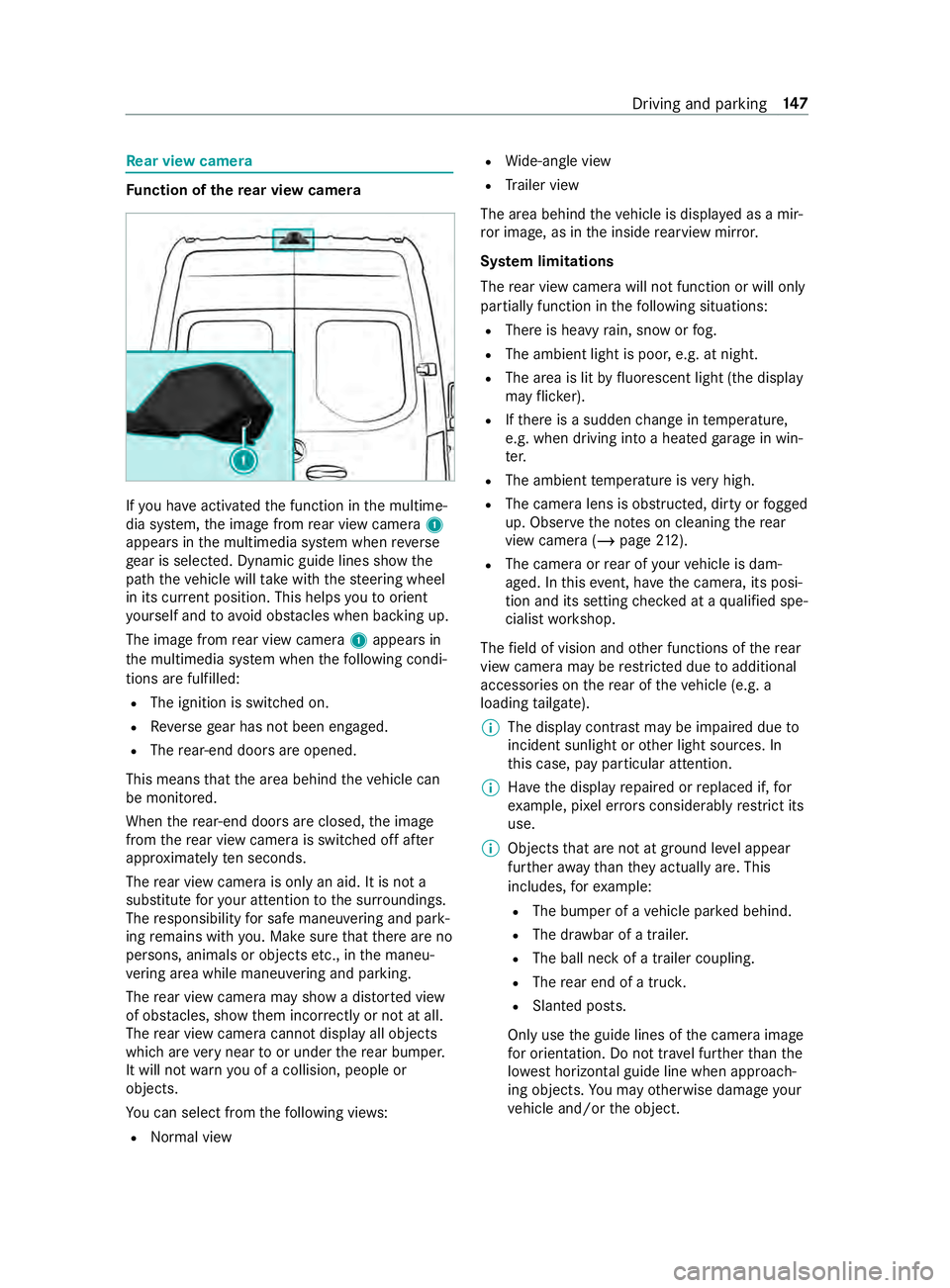
nction of there ar view camera If
yo u ha veactivated the function in the multime‐
dia sy stem, the image from rear view camera 1
appears in the multimedia sy stem when reve rse
ge ar is selec ted. Dynamic guide lines show the
path theve hicle will take with thesteering wheel
in its cur rent position. This helps youto orient
yo urself and toavo id obs tacles when ba cking up.
The image from rear view camera 1appears in
th e multimedia sy stem when thefo llowing condi‐
tions are fulfilled:
R The ignition is switched on.
R Reversege ar has not been engaged.
R The rear-end doors are opened.
This means that the area behind theve hicle can
be monitored.
When there ar-end doors are closed, the image
from there ar view camera is swit ched off af ter
appr oximately ten seconds.
The rear view camera is only an aid. It is not a
substitute foryo ur attention tothe sur roundings.
The responsibility for safe maneu vering and pa rk‐
ing remains with you. Make sure that there are no
persons, animals or objects etc., in the maneu‐
ve ring area while maneuvering and pa rking.
The rear view camera may show a dis torted view
of obs tacles, show them incor rectly or not at all.
The rear view camera cannot display all objects
which are very near toor under there ar bumper.
It will not warnyou of a collision, people or
objects.
Yo u can select from thefo llowing vie ws:
R Norma l view R
Wide-angle view
R Trailer view
The area behind theve hicle is displa yed as a mir‐
ro r image, as in the inside rearview mir ror.
Sy stem limitations
The rear view camera will not function or will only
partially function in thefo llowing situations:
R There is heavy rain, snow or fog.
R The ambient light is poor, e.g. at night.
R The area is lit byfluorescent light (the displ ay
may flic ke r).
R Ifth ere is a sudden change in temp erature,
e.g. when driving into a heated garage in win‐
te r.
R The ambient temp erature is very high.
R The camera lens is obstructed, dirty or fogged
up. Obser vethe no tes on cleaning there ar
view camera (/ page212).
R The camera or rear of your vehicle is dam‐
aged. In this event, ha vethe camera, its posi‐
tion and its setting checked at a qualified spe‐
cialist workshop.
The field of vision and other functions of there ar
view camera may be restricted due toadditional
accesso ries on there ar of theve hicle (e.g. a
loading tailgate).
% The display contrast may be impaired due
to
incident sunlight or other light sources. In
th is case, pay particular attention.
% Ha
ve the display repaired or replaced if, for
ex ample, pixel er rors considerably restrict its
use.
% Objects that are not at ground le vel appear
fur ther aw ay than they actually are. This
includes, forex ample:
R The bumper of a vehicle par ked behind.
R The dr awbar of a trailer.
R The ball neck of a trailer coupling.
R The rear end of a truc k.
R Slanted posts.
Only use the guide lines of the camera image
fo r orientation. Do not tr avel fur ther than the
lo west horizontal guide line when approach‐
ing objects. You may otherwise damage your
ve hicle and/or the object. Driving and parking
147