2019 MERCEDES-BENZ S CLASS ESP
[x] Cancel search: ESPPage 419 of 578

#Pushthe plug of hose5intoflange6oftire sealant bottle1untilthe plug engages.
#Place tire sealant bottle1head downwardsintorecess2ofthe tire inflation compres‐sor.
#Removethe cap fromvalve7onthefaultytire.
#Screwfilling hose8ontovalve7.
#Insert connector4into a12V socket inyourvehicle.
#Switch onthe ignition.
#Press on and off switch3onthe tire infla‐tion compressor.The tire inflation compressor is switched on.The tire is inflated. First, tire sealant is pum‐ped intothe tire. The pressure may brieflyrisetoapproximately 500 kPa (5 bar/73 psi).
Do not switch offthe tire inflation compres‐sor duringthis phase.
#Letthe tire inflation compressorrunfor amaximum of eight minutes.The tire shouldthen haveattained a tirepressure of at least180 kPa (1.8 bar/26 psi).
If tire sealant leaksout, make sureyou cleantheaffected area asquickly as possible. It is prefera‐bletouse clearwater.
Ifyouget tire sealant onyour clothing, haveitcleaned as soon as possible with perchloroethy‐lene.
If a tirepressure of180 kPa (1.8 bar/26 psi)has not been attained after eight minutes:
#Switch offthe tire inflation compressor.
#Unscrewthefilling hose fromthevalve ofthefaulty tire.
Please notethat tire sealant may leak out whenunscrewingthefilling hose.
#Driveforwards orreverseveryslowlyforapproximately 33ft(10 m).
#Pump upthe tire again.After a maximum of eight minutesthe tirepressure must be at least180 kPa (1.8 bar/26 psi).
&WARNINGRisk of accident duetothespecified tire pressure not beingreached
Ifthe specified tire pressure is notreachedafterthe specified time,the tire istoo badlydamaged. The tire sealant cannotrepairthetire inthis instance.
Damaged tires and a tire pressurethat istoolow can significantly impair braking and han‐dlingcharacteristics.
#Do not continue driving.
#Consult aqualified specialistworkshop.
Breakdown assistance417
Page 420 of 578

If a tire pressureof180 kPa (1.8 bar/26 psi)has been attained after eight minutes:
&WARNINGRisk of accident from drivingwithsealed tires
A tiretemporarily sealed with tire sealantimpairs drivingcharacteristics and is notsuitablefor higher speeds.
#Adaptyour drivingstyle accordinglyanddrive carefully.
#Do notexceedthe maximum speedlimit with a tirethat has beenrepairedusing tire sealant.
Observethe maximum permissible speedfor atire sealed with tire sealant 50mph (80 km/h).#Affixthe upper section ofthe TIREFITstickertothe instrument cluster in a location whereit will be easilyseenbythe driver.
*NOTEStaining causedbyleaking tiresealant
After use,excess tire sealant may leak outfromthefilling hose.
#Therefore, placethefilling hose intheplastic bagthat containedthe TIREFITkit.
+ENVIRONMENTALNOTEEnvironmentalpollution causedbyenvironmentally irre‐sponsible disposal
Tiresealant contains pollutants.
#Havethe tire sealant bottle disposed ofprofessionally,e.g. at an authorizedMercedes-Benz Center.
#Switch offthe tire inflation compressor.
#Unscrewthefilling hose fromthevalve ofthefaulty tire.
#Stow the tire sealant bottle,the tire inflationcompressor andthewarning triangle.
#Pullawayimmediately.
#Stop driving after approximatelyten minutesandcheckthe tire pressure usingthe tireinflation compressor.The tire pressure must now be at least130 kPa (1.3 bar/19 psi).
&WARNINGRisk of accident duetothespecified tire pressure not beingreached
Ifthe specified tire pressure is notreachedafter a brief drive,the tire istoo badly dam‐aged. The tire sealant cannotrepairthe tireinthis instance.
Damaged tires and tire pressurethat istoolow can significantly impairthe braking prop‐erties andthe handlingcharacteristics.
#Do not continue driving.
#Consult aqualified specialistworkshop.
In cases such asthe one mentioned above, con‐tact an authorized Mercedes-Benz Center. Orcall 1-800-FOR-MERCedes (inthe USA) or1-800-387-0100(in Canada).
#Correctthe tire pressure if it isstill at least130 kPa (1.3 bar/19 psi).You willfindthevalues intheTireand Loading Informationplacard onthe B-pillar onthe driver's side orinthe tire pressuretable inthe fuelfillerflap.
#Toincreasethe tire pressure:switchonthe tire inflation compressor.
41 8Breakdown assistance
Page 421 of 578
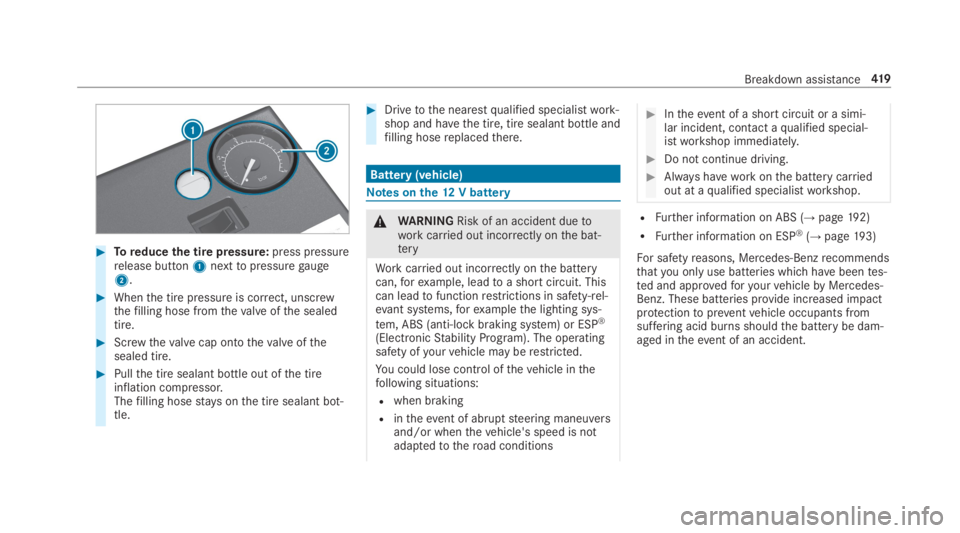
#Toreduce the tire pressure:press pressurerelease button1nexttopressuregauge2.
#Whenthe tire pressure is correct, unscrewthefilling hose fromthevalve ofthe sealedtire.
#Screwthevalve cap ontothevalve ofthesealed tire.
#Pullthe tire sealant bottle out ofthe tireinflation compressor.Thefilling hosestays onthe tire sealant bot‐tle.
#Drivetothe nearestqualified specialistwork‐shop and havethe tire, tire sealant bottle andfilling hosereplacedthere.
Battery(vehicle)
Notes onthe12V battery
&WARNINGRisk of an accident duetoworkcarried out incorrectly onthe bat‐tery
Workcarried out incorrectly onthe batterycan,forexample, leadtoa short circuit. Thiscan leadtofunctionrestrictions in safety-rel‐evant systems,forexamplethe lighting sys‐
tem, ABS (anti-lockbraking system) or ESP®
(ElectronicStability Program). The operatingsafety ofyourvehicle may berestricted.
You could lose control ofthevehicle inthefollowing situations:
Rwhen braking
Rintheevent of abruptsteering maneuversand/or whenthevehicle's speed is notadaptedtotheroad conditions
#Intheevent of a shortcircuit or a simi‐lar incident, contact aqualified special‐istworkshop immediately.
#Do not continue driving.
#Always haveworkonthe battery carriedout at aqualified specialistworkshop.
RFurther information on ABS (→page192)
RFurther information on ESP®(→page193)
For safetyreasons, Mercedes-Benzrecommendsthatyou onlyuse batteries which havebeentes‐ted and approvedforyourvehiclebyMercedes-Benz. These batteries provide increased impactprotectiontopreventvehicle occupants fromsuffering acid burns shouldthe battery be dam‐aged intheevent of an accident.
Breakdown assistance419
Page 422 of 578
Allvehiclesexceptvehicles with a lithium-ion battery
&WARNINGRisk ofexplosion duetoelec‐trostaticcharge
Electrostaticchargecan cause sparks whichmay ignitethe highlyflammablegas mixtureinthe battery.
#Todischargeany electrostaticchargethat may havebuilt up,touchthe metalvehicle body before handlingthe bat‐tery.
The highlyflammablegas mixture is createdwhilethe battery ischarging and duringstartingassistance.
&WARNINGDanger ofchemical burnsfromthe battery acid
Battery acid is caustic.
#Avoid contact withthe skin,eyes orclothing.
#Do not leanoverthe battery.
#Do not inhale batterygases.
#Keepchildrenawayfromthe battery.
#Immediatelyrinse battery acid offthor‐oughly with plenty of cleanwater andseek medical attention immediately.
Allvehicles
+ENVIRONMENTALNOTEEnvironmentaldamagecausedbyimproper disposal ofbatteries
Batteries contain pollutants. It isillegaltodispose ofthem withthe householdrubbish.
#
Dispose of batteries in anenvironmentallyresponsible manner.Takedischarged batteriestoaqualified
specialistworkshop ortoa collectionpointfor used batteries.
Ifyou havetodisconnectthe12V battery,con‐tact aqualified specialistworkshop.
Comply with safety notes andtakeprotectivemeasures when handling batteries.
Risk ofexplosion.
Fire, openflames and smoking areprohibited when handlingthe battery.Avoid creating sparks.
Electrolyteor battery acid is corro‐sive.Avoid contact withthe skin,eyesor clothing.Wear suitable protectiveclothing, in particulargloves, anapron and aface mask.Immediatelyrinse electrolyteor acid splashes offwith cleanwater.Consult a doctor ifnecessary.
420Breakdown assistance
Page 424 of 578
#When givingstarting assistance, alwaysmake surethatyou onlyconnect bat‐teryterminals with identical polarity.
#Duringstarting assistance,you mustobservethe described orderfor con‐necting and disconnectingthe jumpercables.
#Do not connect or disconnectthe bat‐teryclamps whilethe engine isrunning.
&WARNINGRisk ofexplosion duringcharging process andstarting assistance
Duringthecharging process andstartingassistance,the battery mayrelease anexplo‐sivegas mixture.
#Avoidfire, openflames, creating sparksand smoking.
#Make surethatthere is sufficientventi‐lation duringthecharging process andduringstarting assistance.
#Do not leanover a battery.
&WARNINGRisk ofexplosion from a fro‐zen battery
A discharged battery may freeze attempera‐tures slightly aboveor below freezing point.
Duringstarting assistance or batterycharg‐ing, batterygas may bereleased.
#Alwaysthawa frozen batteryoutfirstbeforecharging it or performingstart‐ing assistance.
Ifthe indicator/warning lamps inthe instrumentcluster do not light up at lowtemperatures, it isverylikelythatthe discharged battery has fro‐zen. Inthis caseyou may neither jump-startthevehicle norchargethe battery.
The service life of a batterythat has beenthawed may be dramatically shortened. Thestartingcharacteristics may be impaired, espe‐cially at lowtemperatures.
It isrecommendedthatyou haveathawed bat‐terychecked at aqualified specialistworkshop.
Allvehicles
*NOTEDamagecausedbynumerous orextended attemptstostartthe engine
Numerous orextended attemptstostarttheengine may damagethe catalytic converterduetonon-combusted fuel.
#Avoid numerous andextended attemptstostartthe engine.
Observethefollowing points duringstartingassistance and whenchargingthe battery:
ROnly use undamaged jumper cables/charg‐ing cables with a sufficient cross-section andinsulatedterminal clamps.
RNon-insulated parts oftheterminal clampsmust not come into contact withother metalparts whilethe jumper cable/charging cableis connectedtothe battery/jump-startcon‐nection point.
RThe jumper cable/charging cable must notcome into contact withany parts which maymovewhenthe engine isrunning.
422Breakdown assistance
Page 426 of 578
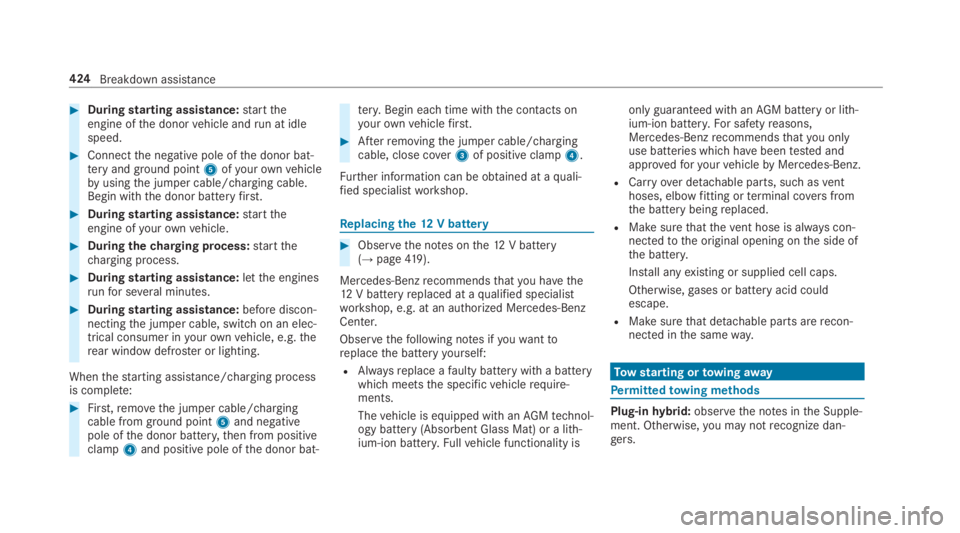
#Duringstarting assistance:starttheengine ofthe donorvehicle andrun at idlespeed.
#Connectthe negative pole ofthe donor bat‐teryandground point5ofyourownvehiclebyusingthe jumper cable/charging cable.Begin withthe donor batteryfirst.
#Duringstarting assistance:starttheengine ofyourownvehicle.
#Duringthecharging process:startthecharging process.
#Duringstarting assistance:letthe enginesrunfor several minutes.
#Duringstarting assistance:before discon‐nectingthe jumper cable, switch on an elec‐trical consumer inyourownvehicle, e.g.therear windowdefroster or lighting.
Whenthestarting assistance/charging processis complete:
#First,removethe jumper cable/chargingcable from ground point5and negativepole ofthe donor battery,then from positiveclamp4and positive pole ofthe donor bat‐
tery. Begin eachtime with the contacts onyourownvehiclefirst.
#Afterremovingthe jumper cable/chargingcable, close cover3of positive clamp4.
Further information can be obtained at aquali‐fied specialistworkshop.
Replacing the12V battery
#Observethe notes onthe12V battery(→page419).
Mercedes-Benzrecommendsthatyou havethe12V batteryreplaced at aqualified specialistworkshop, e.g. at an authorized Mercedes-BenzCenter.
Observethefollowing notes ifyouwanttoreplacethe batteryyourself:
RAlwaysreplace afaulty batterywith a batterywhich meetsthe specificvehiclerequire‐ments.
Thevehicle is equipped with anAGMtechnol‐ogy battery (Absorbent Glass Mat) or a lith‐ium-ion battery.Fullvehicle functionality is
only guaranteed with anAGM battery or lith‐ium-ion battery.For safetyreasons,Mercedes-Benzrecommendsthatyou onlyuse batteries which havebeentested andapprovedforyourvehiclebyMercedes-Benz.
RCarryover detachable parts, such asventhoses, elbowfitting orterminal coversfromthe battery beingreplaced.
RMake surethatthevent hose is alwayscon‐nectedtothe original opening onthe side ofthe battery.
Install anyexisting or supplied cell caps.
Otherwise,gases or battery acid couldescape.
RMake surethat detachable parts arerecon‐nected inthe sameway.
Towstarting ortowingaway
Permittedtowing methods
Plug-inhybrid:observethe notes inthe Supple‐ment. Otherwise,you may notrecognize dan‐gers.
424Breakdown assistance
Page 441 of 578

Furtherrelated subjects:
RNotes on tire pressure (→page 435)
RTirepressuretable (→page 437)
RTireand Loading Information placard(→page442)
Tirepressure monitoring system
Function ofthe tire pressure monitoring sys‐tem
&DANGERRisk of accident duetoincor‐rect tire pressure
Every tire, includingthe spare (if provided),should bechecked when cold at least once amonth and inflatedtothe pressurerecom‐mendedbythevehicle manufacturer (seeTireand Loading Information placard ontheB-pillar onthe driver’sside orthe tire pres‐sure label onthe inside ofthe fuelfillerflapofyourvehicle). Ifyourvehicle has tires of adifferent sizethanthe size indicated ontheTireand Loading Information placard orthe
tire pressuretable,you needtodeterminethe proper tire pressureforthose tires.
As an added safetyfeature,yourvehicle hasbeen equipped with a tire pressure monitor‐ing system (TPMS)that illuminates a low tirepressure indicator lamp when one or more ofyour tires are significantly underinflated.Accordingly, ifthe low tire pressure indicatorlamp lights up,you shouldstop andcheckyour tires as soon as possible, and inflatethemtothe proper pressure. Driving on asignificantly underinflated tire causesthe tiretooverheat and can leadtotirefailure.Underinflation also increases fuel consump‐tion andreduces tire tread life, and mayaffectthevehicle's handling and braking abil‐ity. Please notethatthe TPMS is not a substi‐tutefor proper tire maintenance, and it isthedriver'sresponsibilitytomaintain correct tirepressure,even if underinflation has notreachedthe leveltotrigger illumination ofthe TPMS low tire pressure indicator lamp.
Yourvehicle has also been equipped with aTPMS malfunction indicatortoindicate when
the system is not operating properly. TheTPMS malfunction indicator is combined withthe low tire pressure indicator lamp. Whenthe system detects a malfunction,the indica‐tor lamp willflashfor approximatelya minuteandthenremain continuously illuminated.This sequence will continue upon subsequentvehiclestart-ups as long asthe malfunctionexists.
Whenthe malfunction indicator is illumina‐ted,the system may not be abletodetect orsignal low tire pressure as intended. TPMSmalfunctions may occurfor avariety ofrea‐sons, includingthe installation of incompati‐blereplacement or alternate tires or wheelsonthevehiclethat preventthe TPMS fromfunctioning properly.
Alwayscheckthe TPMS malfunctionwarninglamp afterreplacing one or more tires orwheels onyourvehicletoensurethatthereplacement or alternate tires and wheelsallowthe TPMStocontinuetofunction prop‐erly.
Wheels and tires439
Page 442 of 578
The systemchecksthe tire pressure andthe tiretemperature ofthe tires installed onthevehiclebymeans of a tire pressuresensor.
New tire pressure sensors, e.g. in winter tires,are automaticallytaught-in duringthefirst jour‐neytheyare used.
The tire pressure appears inthe multifunctiondisplay (→page 255).
Ifthere is a substantial pressure loss or ifthetiretemperature isexcessive,you will bewarnedinthefollowingways:
Rvia display messages (→page511)
Rviathewwarning lamp inthe instrumentcluster (→page 533)
The tire pressuremonitoring system is only anaid. It isthe driver'sresponsibilitytosetthe tirepressuretotherecommended cold tire pressuresuitableforthe operating situation. Setthe tirepressurefor cold tires using a tire pressuregauge. Notethatthe correct tire pressureforthecurrent operating situation mustfirst betaught-intothe tire pressure monitoring system.
In most cases,the tire pressure monitoring sys‐tem will automatically updatethe newreferencevalues afteryou havechangedthe tire pressure.You can, however,also updatethereferenceval‐uesbyrestartingthe tire pressure monitoringsystem manually (→page441).
System limitations
The system may be impaired or may not functioninthefollowing situations:
RIfthe tire pressure is set incorrectly
RIfthere is a sudden pressure loss caused,forexample,byaforeign object penetratingthetire
RIfthere is a malfunction causedbyanotherradio signal source
Make suretoobservethefollowing furtherrela‐ted subject:
RNotes on tire pressure (→page 435)
Checkingthe tire pressure withthe tire pres‐sure monitoring system
Requirements:RThe ignition is switched on.
On-board computer:
,Service.Tires
One ofthefollowing displaysappears:
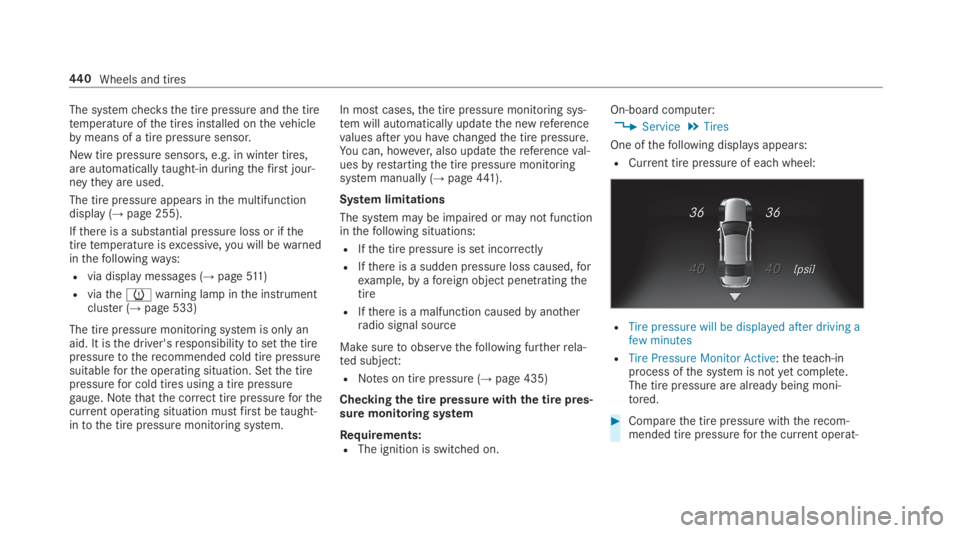
RCurrent tire pressure of eachwheel:
RTire pressure will be displayed after driving afew minutes
RTire Pressure Monitor Active:theteach-inprocess ofthe system is notyet complete.The tire pressure are already being moni‐tored.
#Comparethe tire pressure withtherecom‐mended tire pressureforthe current operat‐
440Wheels and tires