2019 MERCEDES-BENZ S CLASS ESP
[x] Cancel search: ESPPage 443 of 578

ing condition (→page 437). Observethenotes on tiretemperature (→page 435).
%Thevalues displayed inthe multifunction dis‐play may deviate fromthose ofthe tire pres‐suregauge astheyrefertosea level.Athighaltitudes,the tire pressurevalue indicatedbya pressuregauge are higherthanthoseshownbythe on-board computer. Inthiscase, do notreducethe tire pressure.
Make suretoobservethefollowing furtherrela‐ted subject:
RNotes on tire pressure (→page 435)
Restartingthe tire pressure monitoring sys‐tem
Requirements:RTherecommended tire pressure is correctlysetfortherespective operating condition oneach ofthefour wheels (→page 435).
Restartthe tire pressure monitoring system inthefollowing situations:
RThe tire pressure haschanged.
RThe wheels or tires havebeenchanged ornewly installed.
On-board computer:
,Service.Tires
#Swipe downwards onTouch Control ontheleft-hand side ofthesteering wheel.TheUse Current Pressures as New Refer-ence Values?message is shown inthe multi‐function display.
#Pressvtoconfirmtherestart.TheRun Flat Indicator Restartedmessage isshown inthe multifunction display.
Currentwarning messages are deleted andthewyellowwarning lamp goes out.
Afteryou havedrivenfor afew minutes,thesystemcheckswhetherthe current tire pres‐sures are withinthe specifiedrange. The cur‐rent tire pressures arethen accepted asref‐erencevalues and monitored.
Make suretoobservethefollowing furtherrela‐ted subject:
RNotes on tire pressure (→page 435)
Radio equipment approval ofthe tire pres‐sure monitoring system
Radio equipment approval numbers
CountryRadio type approval number
Canada IC: 2546A-GG4T
IC: 2546A-DG6W2D4
IC: 2546A-MC34MA4
Le présent appareil est conformeaux CNR d'Industrie Canadaapplicables aux appareilsradioexempts de licence. L'exploita‐tion est autorisée aux deux con‐ditions suivantes:
(1) l'appareil ne doit pas produirede brouillage,et
(2) l'utilisateur de l'appareil doitacceptertout brouillageradioé‐lectrique subi, même si le
brouillage est susceptible d'encompromettrelefonctionnement.
Wheels and tires441
Page 445 of 578

%The data shown inthe illustration isexampledata.
TheTireand Loading Information placard shows:
RMaximum number of seats2accordingtothe maximum number of people permittedtotravel inthevehicle.
RMaximum permissible load3comprisesthegrossweight of allvehicle occupants, loadand luggage.
RRecommended tire pressures1for coldtires. Therecommended tire pressures arevalidforthe maximum permissible load anduptothe maximum permissiblevehiclespeed.
Please also note:
RInformation on permissibleweights and loadsonthevehicle identification plate(→page 466).
RInformation on tire pressure inthe tire pres‐suretable (→page 437).
Furtherrelated subjects:
RDeterminingthe maximum permissible load(→page443)
RNotes on tire pressure (→page 435).
Determiningthe maximum permissible load
Thefollowingsteps havebeen developed asrequired of all manufacturers underTitle 49,Code ofU.S.FederalRegulations,Part575, pur‐suanttothe "NationalTraffic and MotorVehicleSafetyAct of1966".
#Step 1:locatethestatement "The combinedweight of occupants and load should neverexceed XXXkgor XXX lbs." ("The combinedweight of occupants and load should neverexceed XXXkgor XXX lbs.") onyourvehicle'sTireand Loading Information placard.
#Step 2:determinethe combinedweight ofthe driver and passengersthat will be travel‐ing inyourvehicle.
#Step 3:subtractthe combinedweight ofthedriver and passengers from XXXkgorXXX lbs.
#Step 4:theresultingfigure equalsthe per‐missible cargo and luggage load capacity.Forexample: If "XXX" equals1400 lbs andtherearefiveoccupants inyourvehicle with aweight of150 lbs each,the maximum cargoand luggage load capacity is 650 lbs (1400 -750 (5 x150) = 650 lbs).
#Step 5:determinethe combinedweight ofluggage and loadthatthevehicle will be car‐rying.For safetyreasons,thisweight may notsafelyexceedtheavailable cargo and lug‐gageload capacity calculated instep 4.
Wheels and tires443
Page 449 of 578
and one-half times aswell onthe governmenttesttrack as a tire graded100.
Therelative performance of tires depends uponthe actual conditions oftheir use, however,andmay depart significantly fromthe norm duetovariations in driving habits, service practices anddifferences inroadcharacteristics and climateconditions.
Tractiongrade
&DANGERRisk of accident duetoinade‐quate traction
The tractiongrade assignedtothis tire isbased onstraight-ahead braking tractiontests, and does not include either accelera‐tion, cornering,hydroplaning or peak tractioncharacteristics.
#Always adaptyour drivingstyle anddrive at a speedtosuitthe prevailingtraffic andweather conditions.
*NOTEDamagetothe drivetrain fromwheelspin
#Avoid wheelspin.
The traction grades – from highesttolowest –are AA,A,B and C. Those gradesrepresentthetire's abilitytostop onwet pavement as meas‐ured under controlled conditions on specifiedgovernmenttestsurfaces made of asphalt andconcrete.
Temperaturegrade
&WARNINGRisk of accident from tireoverheating and tirefailure
Thetemperature gradeforthis tire is estab‐lishedfor a tirethat is properly inflated andnotoverloaded. Excessive speed, underinfla‐tion, orexcessive loading, either separatelyor in combination, can causeexcessive heatbuild-up and possible tirefailure.
#Observetherecommended tire pres‐sures andregularlycheckthe tire pres‐
sure of all tires includingthe sparewheel.
#Adjustthe tire pressure as necessary.
Thetemperature grades are A (the highest), Band C. Theyrepresentthe tire'sresistancetothegeneration of heat and its abilitytodissipateheat whentested under controlled conditions ona specified indoor laboratorytestwheel. Sus‐tained hightemperature can causethe materialofthe tiretodegenerate andreduce tire life, andexcessivetemperature can leadtosudden tirefailure. Grade C correspondstoa level of per‐formance which all passenger car tires mustmeet undertherequirements ofthe US Depart‐ment ofTransportation.
DOT,TireIdentificationNumber (TIN)
US tireregulationsstipulatethateverytire man‐ufacturer orretreader mustimprint a TIN in oronthe sidewall of each tire produced.
Wheels and tires447
Page 452 of 578

Preceding letter11:RWithout: passengervehicle tires accordingtoEuropean manufacturingstandards.
R"P": passengervehicle tires accordingtoUSmanufacturingstandards.
R"LT": light truck tires accordingtoUS manu‐facturingstandards.
R"T": compact emergency sparewheels withhigh tire pressurethat are only designedfortemporary use in an emergency.
Aspectratio33:Ratio between tire height and tire width in per‐cent (tireheight dividedbytire width).
Tire code44(tiretype):R"R"radial tire
R"D": bias ply tire
R"B": bias belted tires
R"ZR":radial tire with a maximum speed above149mph (240 km/h) (optional)
Rim diameter55:The diameter ofthe bead seat (notthe diameteroftherimflange). Therim diameter is specifiedin inches (in).
Load-bearing index66:Numerical codethat specifiesthe maximumload-bearing capacity of a tire (e.g. "91" corre‐spondsto1356 lbs (615kg)).
The load-bearing capacity ofthe tire must be atleast halfthe permissible axle load ofyourvehi‐cle. Do notoverloadthe tiresbyexceedingthespecified load limit.
See also:
RMaximum permissible load ontheTireandLoading Information placard (→page442)
RMaximum tire load (→page448)
RLoad index
Speedrating77:Specifiesthe approved maximum speed ofthetire.
%An electronic speed limiter preventsyourvehicle fromexceeding a speed of130mph(210km/h).
Makesurethatyour tires havetherequiredspeedrating.You can obtain information ontherequired speedrating from an authorizedMercedes-Benz Center.
Summer tires
IndexSpeedrating
Qupto100mph (160 km/h)
Rupto106mph (170 km/h)
Supto112mph (180 km/h)
Tupto118mph (190 km/h)
Hupto130mph (210km/h)
Vupto149mph (240 km/h)
Wupto168mph (270 km/h)
Yupto186mph (300 km/h)
450Wheels and tires
Page 454 of 578

UniformTireQuality GradingStandards:auniformstandardtogradethequality of tireswithregardtotreadquality,tire traction andtemperaturecharacteristics. Thequality gradingassessment is madebythe manufacturerfollow‐ing specifications fromtheU.S. government. Thequalitygrade of a tire is imprinted onthe sidewall ofthe tire.
Recommended tire pressure:therecommen‐ded tire pressure isthe tire pressure specifiedforthe tires mountedtothevehicle atthefac‐tory.
The tire and informationtable containstherec‐ommended tire pressuresfor cold tires,the max‐imum permissible load andthe maximum per‐missiblevehicle speed.
The tire pressuretable containstherecommen‐ded tire pressuresfor cold tires undervariousoperating conditions, i.e. loading and/or speedofthevehicle.
Increasedvehicleweight duetooptionalequipment:the combinedweight of allstandardand optional equipmentavailableforthevehicle,
regardless of whether it is actually installed onthevehicle or not.
Rim:the part ofthe wheel on whichthe tire isinstalled.
GAWR (Gross AxleWeightRating):the GAWRisthe maximum permissible axle load. Theactual load on an axle must neverexceedthegrossaxleweightrating. The gross axleweightrating can befound onthevehicle identificationplate onthe B‑pillar onthe driver's side.
Speedrating:the speedrating is partofthe tireidentification. It specifiesthe speedrangeforwhich a tire is approved.
GVW (GrossVehicleWeight):the grossvehicleweight comprisestheweight ofthevehicleincluding fuel,tools,the spare wheel, accesso‐ries installed, occupants, luggage andthe trailerdrawbar noseweight, if applicable. Thegrossvehicleweight must notexceedthe grossvehicleweightratingGVWR as specified onthevehicleidentification plate onthe B‑pillar onthe driver'sside.
GVWR (GrossVehicleWeightRating):theGVWR isthe maximum permitted grossweight
ofthe fully ladenvehicle (weight ofthevehicleincluding all accessories, occupants, fuel, lug‐gageandthe trailer drawbar noseweight if appli‐cable). Thegrossvehicleweightrating is speci‐fied onthevehicle identification plate ontheB‑pillar onthe driver's side.
Maximumweight ofthe ladenvehicle:themaximumweight isthe sum ofthe curbweightofthevehicle,theweight ofthe accessories,themaximum load andtheweight of optional equip‐ment installed atthefactory.
Kilopascal (kPa):metric unitfor tire pressure.6.9 kPa correspondsto1 psi. Another unitfortire pressureis bar.100 kilopascal (kPa) equals1 bar.
Load index:in additiontothe load-bearingindex,the load index may also be imprinted onthe sidewall ofthe tire. This specifiesthe load-bearing capacity ofthe tire more precisely.
Curbweight:theweight of avehicle withstand‐ard equipment includingthe maximum capacityof fuel, oil and coolant. It also includesthe airconditioning system and optional equipment if
452Wheels and tires
Page 456 of 578

Changing a wheel
Notes on selecting, installing andreplacingtires
Mercedes-AMGvehicles:observethe notes inthe Supplement. Otherwise,you may notrecog‐nize dangers.
You can askfor informationregarding permittedwheel/tire combinations at an authorizedMercedes-Benz Center.
&WARNINGRisk of accident duetoincor‐rect dimensions of wheels and tires
If wheels and tires ofthe wrong size areinstalled,the wheel brakes or wheel suspen‐sion components may be damaged.
#Alwaysreplace wheels and tires withthosethat fulfillthe specifications ofthe original part.
Whenreplacing wheels, make suretofitthecorrect:
RDesignation
RModel
Whenreplacing tires, make suretoinstallthecorrect:
RDesignation
RManufacturer
RModel
&WARNINGRisk of injurythroughexceed‐ingthe specified tire loadrating orthepermissible speedrating
Exceedingthe specified tire loadrating orthe permissible speedrating may leadtotiredamageandtothe tires bursting.
#Therefore, only use tire types and sizesapprovedforyourvehicle model.
#Observethe tire loadrating and speedratingrequiredforyourvehicle.
*NOTEVehicle and tire damagethroughtire types and sizesthat havenot beenapproved
For safetyreasons, onlyuse tires, wheelsand accessories which havebeen speciallyapprovedbyMercedes-Benzforyourvehicle.
These tires are specially adaptedtothe con‐
trol systems, such as ABS, ESP®and4MATIC, and marked asfollows:
RMO = Mercedes-Benz Original
RMOE = Mercedes-Benz Original Extended(run-flat tire onlyfor certain wheels)
RMO1 = Mercedes-Benz Original (only cer‐tain AMG tires)
Certaincharacteristics, such as handling,vehicle noise emissions, fuel consumption,etc. mayotherwise be adversely affected.Furthermore,other tire sizes couldresult inthe tiresrubbing againstthe body and axlecomponents when loaded. This couldresultin damagetothe tire orthevehicle.
454Wheels and tires
Page 457 of 578
Only use tires, wheels and accessoriesthathavebeenchecked andrecommendedbyMercedes-Benz.
*NOTERisktodriving safety fromretrea‐ded tires
Retreaded tires are neithertested norrecom‐mendedbyMercedes-Benz, since previousdamage cannot always be detected onretreaded tires.
Forthisreason driving safety cannot be guar‐anteed.
#Do not use used tires ifyou havenoinformation abouttheir previous usage.
*NOTEPossible damagetowheels or tireswhen drivingover obstacles
Large wheels havea lower tire section width.The lowerthe tire section width,the greateristherisk of damagetowheels or tires whendrivingover obstacles.
#Avoid obstacles or drive particularlycarefully.
*NOTEDamagetoelectronic componentparts fromthe use of tire-mountingtools
Vehicles with a tire pressure monitoringsystem:Electronic component parts arelocated inthe wheel.Tire-mountingtoolsshould not be used inthe area ofthevalve.
This couldotherwise damagethe electroniccomponent parts.
#Havethe tireschanged at aqualifiedspecialistworkshop only.
*NOTEDamagetosummer tires at lowambienttemperatures
Atlow ambienttemperatures,tears couldformwhen driving with summer tires, caus‐ing permanent damagetothe tires.
#Attemperatures below 45 °F (7 °C),use M+S tires .
Accessory partsthat are not approvedforyourvehiclebyMercedes-Benz or are not being usedcorrectly can impairthe operating safety.
Before purchasing and using non-approvedaccessories, visit aqualified specialistworkshopand inquire about:
RSuitability
RLegalstipulations
RFactoryrecommendations
&WARNINGRisk of accident withhighperformance tires
The special tire tread in combination withtheoptimized tire compound meansthattheriskof skidding orhydroplaning onwetroads isincreased.
In addition,the tire grip is greatlyreduced ata low outsidetemperature and tirerunningtemperature.
#Switch onthe ESP®and adaptyourdrivingstyle accordingly.
#Use M+S tire at outsidetemperaturesof lessthan10°C (50 °F).
Wheels and tires455
Page 461 of 578
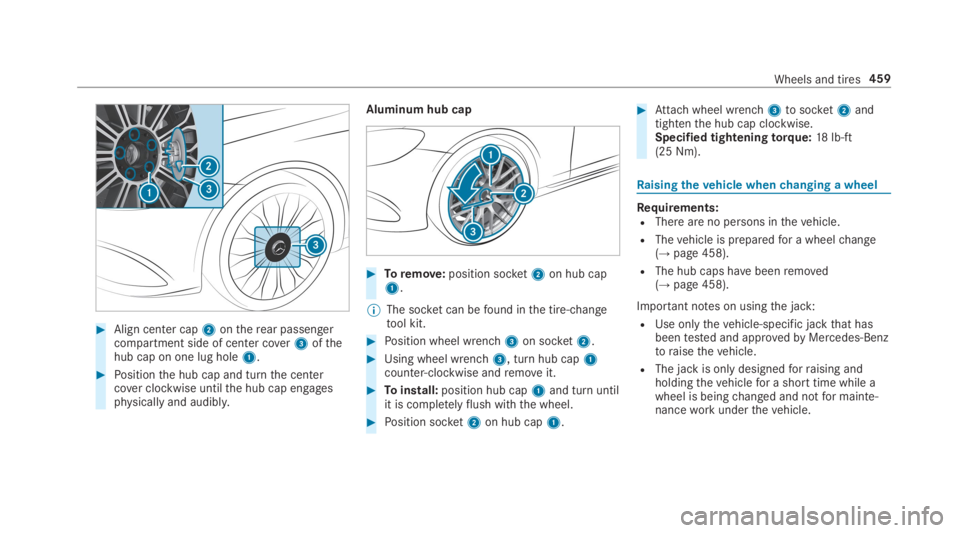
#Align center cap2ontherear passengercompartment side of center cover3ofthehub cap on one lug hole1.
#Positionthe hub cap and turnthe centercover clockwise untilthe hub cap engagesphysically and audibly.
Aluminum hub cap
#Toremove:position socket2on hub cap1.
%The socket can befound inthe tire-changetool kit.
#Position wheel wrench3on socket2.
#Using wheel wrench3, turn hub cap1counter-clockwise andremoveit.
#Toinstall:position hub cap1and turn untilit is completelyflush withthe wheel.
#Position socket2on hub cap1.
#Attachwheel wrench3tosocket2andtightenthe hub cap clockwise.Specified tighteningtorque:18lb-ft(25 Nm).
Raisingthevehicle whenchanging a wheel
Requirements:RThere are no persons inthevehicle.
RThevehicle is preparedfor a wheelchange(→page 458).
RThe hub caps havebeenremoved(→page 458).
Important notes on usingthe jack:
RUse onlythevehicle-specific jackthat hasbeentested and approvedbyMercedes-Benztoraisethevehicle.
RThe jack is only designedforraising andholdingthevehiclefor a short time while awheel is beingchanged and notfor mainte‐nanceworkunderthevehicle.
Wheels and tires459