2018 MERCEDES-BENZ G-CLASS ESP
[x] Cancel search: ESPPage 34 of 294

Instrument cluster
FunctionPage
:Speedometer wit hsegments16 0
Warning and indicator lamps:
÷ ESP®19 6
å ESP®OF F196
! ABS194
J Brakes(yellow)19 3
L Low-beam headlamps86
TParking lamp s87
KHigh-beam headlamps88
Brakes(red)19 3
$ (USAonly)
J Canad aonly
Parking brak e
F(USAonly)
· Distanc ewarning20 1
;#! Turn signals88
=Multifunction display162
FunctionPag e
?Tachometer160
Warning and indicator lamps:
R Rear fog lamp87
;CheckEngin e199
h Tirepressur emonitor20 2
6 Restrain tsystem38
ü Seat belt s192
ACoolan ttemperature gauge16 1
Warning and indicator lamps:
? Coolan t199
BFue llevel indicator
Warning and indicator lamps:
8 Reserve fuel wit hfuel
filler flap location indicator
(right-hand side )
199
CInstrumen tcluste rlighting16 0
32Instrument cluster
At a glance
Page 36 of 294

Center console
Center console, upper section
FunctionPage
:Multimedia system; see the
Digital Operator's Manual
;cSeat heating78
=sSeat ventilation79
?cPARKTRONIC143
AèECO start/stop func-
tion107
FunctionPage
B£ Hazard warning lamps88
C45PASSENGER AIR-
BAG OFF indicator lamp39
DåESP®59
34Center console
At a glance
Page 48 of 294
You should only use seat covers that have
been approved for the respective seat by
Mercedes-Benz.
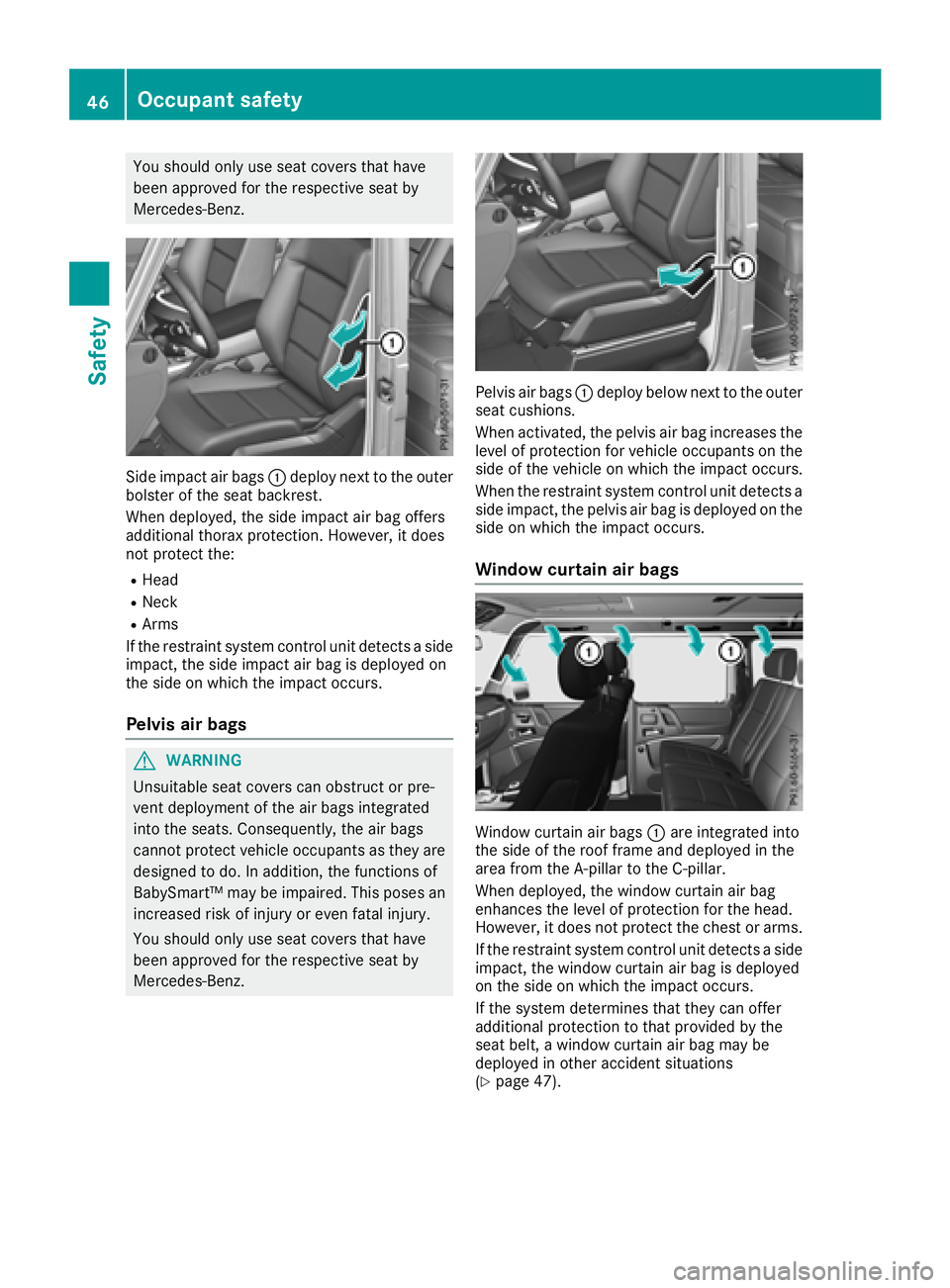
Side impact air bags:deploy next to the outer
bolster of the seat backrest.
When deployed, the side impact air bag offers
additional thorax protection. However, it does
not protect the:
RHead
RNeck
RArms
If the restraint system control unit detects a side
impact, the side impact air bag is deployed on
the side on which the impact occurs.
Pelvis air bags
GWARNING
Unsuitable seat covers can obstruct or pre-
vent deployment of the air bags integrated
into the seats. Consequently, the air bags
cannot protect vehicle occupants as they are designed to do. In addition, the functions of
BabySmart™ may be impaired. This poses an
increased risk of injury or even fatal injury.
You should only use seat covers that have
been approved for the respective seat by
Mercedes-Benz.
Pelvis air bags :deploy below next to the outer
seat cushions.
When activated, the pelvis air bag increases the
level of protection for vehicle occupants on the side of the vehicle on which the impact occurs.
When the restraint system control unit detects a
side impact, the pelvis air bag is deployed on the side on which the impact occurs.
Window curtain air bags
Window curtain air bags :are integrated into
the side of the roof frame and deployed in the
area from the A-pillar to the C-pillar.
When deployed, the window curtain air bag
enhances the level of protection for the head.
However, it does not protect the chest or arms.
If the restraint system control unit detects a side
impact, the window curtain air bag is deployed
on the side on which the impact occurs.
If the system determines that they can offer
additional protection to that provided by the
seat belt, a window curtain air bag may be
deployed in other accident situations
(
Ypage 47).
46Occupant safety
Safety
Page 49 of 294

Deployment of Emergency Tensioning
Devicesan dair bags
Important safet ynotes
GWARNING
The air bag parts are hot after an air bag has
bee ndeployed .There is aris kof injury.
Do no ttouch th eair bag parts .Hav e a
deployed air bag replaced at aqualified spe -
cialis tworkshop as soo nas possible.
GWARNING
A deployed air bag no longer offers any pro -
tection and canno tprovid eth eintended pro -
tection in an accident. There is an increase d
ris kof injury.
Hav eth evehicle towed to aqualified special-
ist workshop in order to hav e adeployed air
bag replaced.
It is important fo ryour safet yand that of your
passenger to hav edeployed air bags replaced
and to hav eany malfunctionin gair bags
repaired. Thi swill hel pto mak esur eth eair bags
continue to perform their protective function fo r
th evehicle occupant sin th eevent of acrash .
GWARNING
Emergency Tensioning Devices that hav e
deployed pyrotechnically are no longer opera-
tional and are unable to perform their inten-
ded protective function .Thi sposes an
increase dris kof injury or eve nfatal injury.
Hav epyrotechnically triggere dEmergency
Tensioning Devices replaced immediately at a
qualified specialis tworkshop .
If Emergency Tensioning Devices are triggere d
or air bags are deployed ,you will hear abang,
and som epowder may also be released. The
6 restrain tsyste mwarnin glamp lights up.
Only in rar ecases will th eban gaffec tyour hear -
ing. The powder that is release dgenerally doe s
no tconstitute ahealth hazard ,but it may cause
short-term breathin gdifficulties in people wit h
asthm aor other respirator yproblems. Provided
it is saf eto do so, you should leav eth evehicle
immediately or ope nth ewindow in order to pre -
ven tbreathin gdifficulties . Ai
rbags and pyrotechni cEmergency Tensioning
Devices (ETDs) contain perchlorat ematerial,
whic hmay require special handlin gand regard
fo rth eenvironment. National guidelines mus t
be observed durin gdisposal. In California, see
www.dtsc.ca.gov/Hazard ousWas
te/
Perchlorate/index.cfm .
Method of operation
Duringth efirst stage of acollision ,th erestrain t
syste mcontro luni tevaluates important physi-
cal dat arelatin gto vehicle deceleration or accel-
eration ,suc has:
Rduration
Rdirection
Rintensit y
Based on th eevaluation of this data, th e
restrain tsyste mcontro luni ttriggers th eEmer-
gency Tensioning Devices durin g afronta lor
rea rcollision .
An Emergency Tensioning Devic ecan only be
triggered, if:
Rth eignition is switched on
Rth ecomponent sof th erestrain tsyste mare
operational. You can fin dfurther information
under "Restrain tsyste mwarnin glamp "
(
Ypage 38 )
Rtheseat belt buckl etongue has engage din
th ebelt buckl eof th erespective fron tseat
The Emergency Tensioning Devices in th erea r
compartmen tare triggere dindependentl yof th e
loc kstatus of th eseat belts.
If th erestrain tsystem contro luni tdetects a
more severe accident, further component sof
th erestrain tsystem are activated independ -
entl yof eac hother in certain fronta lcollision
situations:
RDriver' sair bag
RFront-passenger fron tair bag
The front- passe
nger fron tair bag is activated or
deactivated dependin gon th eperson on th e
front-passenger seat .The front-passenger fron t
air bag can only deploy in an acciden tif th e
PASSENGE RAI RBA GOF Findicator lamp is off.
Observ eth einformation on th ePASSENGE RAI R
BA GOF Findicator lamp (
Ypage 39).
Your vehicle has atwo-stage driver's air bag. In
th efirst deploymen tstage, th efron tair bag is
filled wit hpropellant gas .The fron tair bag is full y
deployed wit hth emaximum amount of propel-
Occupant safety47
Safety
Z
Page 50 of 294
lant gas if a second deployment threshold is
reached within a few milliseconds.
The activation threshold of the Emergency Ten-
sioning Devices and the air bags is determined
by evaluating the rate of vehicle deceleration or
acceleration which occurs at various points in
the vehicle. This process is pre-emptive in
nature. Deployment should take place in good
time at the start of the collision.
The rate of vehicle deceleration or acceleration
and the direction of the force are essentially
determined by:
Rthe distribution of forces during the collision
Rthe collision angle
Rthe deformation characteristics of the vehicle
Rthe characteristics of the object with which
the vehicle has collided
Factors which can only be seen and measured
after a collision has occurred do not play a deci-
sive role in the deployment of an air bag. Nor do
they provide an indication of air bag deploy-
ment.
The vehicle can be deformed considerably, with-
out an air bag being deployed. This is the case if
only parts which are relatively easily deformed
are affected and the rate of deceleration is not
high. Conversely, air bags may be deployed even
though the vehicle suffers only minor deforma-
tion. This is the case if, for example, very rigid
vehicle parts such as longitudinal body mem-
bers are hit, and sufficient deceleration occurs
as a result.
If the restraint system control unit detects a side
impact or if the vehicle rolls over, the applicable
components of the restraint system are
deployed independently of each other depend-
ing on the apparent type of accident.
RSide impact air bag and pelvis air bag on the
side on which an impact occurs, independen t
from t
he Emergency Tensioning Device and
seat belt usage
The side impact air bag on the front-
passenger side deploys under the following
conditions:
-BabySmart™ detects that the front-
passenger seat is occupied or
-the seat belt buckle tongue is engaged in
the belt buckle of the front-passenger seat
RWindow curtain air bag on the side of impact, independently of the use of the seat belt and
independently of whether the front-
passenger seat is occupied
REmergency Tensioning Devices, if the system
determines that deployment can offer addi-
tional protection in this situation
RWindow curtain air bags on the driver's and
front-passenger side in certain situations
when the vehicle rolls over, if the system
determines that deployment can offer addi-
tional protection to that provided by the seat
belt
iNot all air bags are deployed in an accident.
The different air bag systems work independ- ently of each other.
How the air bag system works is determined
by the severity of the accident detected,
especially the vehicle deceleration or accel-
eration and the apparent type of accident:
RFrontal collision
RSide impact
RRollover
NECK-PRO head restraints/NECK-
PRO luxury head restraints
Important safety notes
GWARNING
The function of the head restraint may be
impaired if you:
Rattach objects such as coat hangers to the
head restraints, for example
Ruse head restraint covers
If you do so, the head restraints cannot fulfill
their intended protective function in the event of an accident. In addition, objects attached
to the head restraints could endanger other
vehicle occupants. There is an increased risk
of injury.
Do not attach any objects to the head
restraints and do not use head restraint cov-
ers.
Method of operation
NECK-PRO head restraints/NECK-PRO luxury
head restraints offer additional protection
against head and neck injuries. In the event of a
rear collision of a certain severity, the NECK-
PRO head restraints/NECK-PRO luxury head
48Occupant safety
Safety
Page 54 of 294
ing systems on the child restraint system
checked at a qualified specialist workshop,
before you install a child restraint system
again.
The securing systems of child restraint systems
are:
Rthe seat belt system
Rthe LATCH-type (ISOFIX) securing rings
Rthe Top Tether anchorages
iIf it is absolutely necessary to install a child
restraint system on the front-passenger seat,
always observe the information on "Child
restraint systems on the front-passenger
seat" (
Ypage 55). There you will also find
information on deactivating the front-
passenger front air bag.
All child restraint systems must meet the fol-
lowing standards:
RU.S. Federal Motor Vehicle Safety Standards
213 and 225
RCanadian Motor Vehicle Safety Standards
213 and 210.2
Confirmation that the child restraint system cor-
responds to the standards can be found on an
instruction label on the child restraint system.
This confirmation can also be found in the instal-
lation instructions that are included with the
child restraint system.
Observe the warning labels in the vehicle inte-
rior and on the child restraint system.
LATCH-type (ISOFIX) child seat secur-
ing system
GWARNING
LATCH-type (ISOFIX) child restraint systems
do not offer sufficient protection for children
whose weight combined with the child
restraint system is greater than 65 lbs (29 kg) and who are secured using the safety belt
integrated in the child restraint system. In the
event of an accident, a child might not be
restrained correctly. This poses an increased
risk of injury or even fatal injury.
If the child and the child restraint system
together weigh more than 65 lbs (29 kg), only
use LATCH-type (ISOFIX) child restraint sys-
tems with which the child is also secured with
the vehicle seat belt. Also secure the child
restraint system with the Top Tether belt, if
available.
Always comply with the manufacturer's instal-
lation and operating instructions for the child
restraint system used.
Before every trip, make sure that the LATCH-
type (ISOFIX) child restraint system is engaged
correctly in both LATCH-type (ISOFIX) securing
rings
!When installing the child restraint system,
make sure that the seat belt for the middle
seat does not get trapped. The seat belt could
otherwise be damaged.
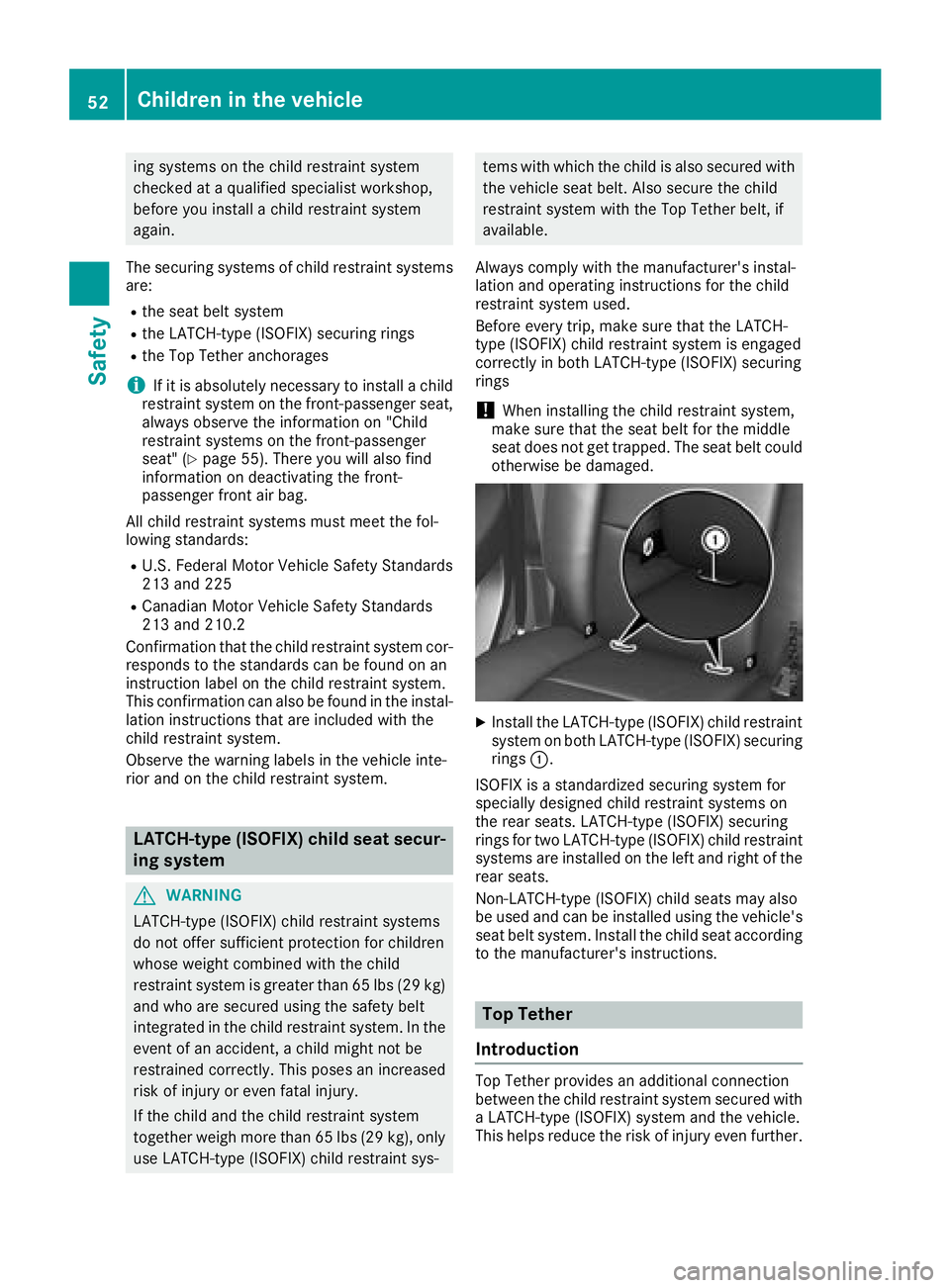
XInstall the LATCH-type (ISOFIX) child restraint system on both LATCH-type (ISOFIX) securing
rings :.
ISOFIX is a standardized securing system for
specially designed child restraint systems on
the rear seats. LATCH-type (ISOFIX) securing
rings for two LATCH-type (ISOFIX) child restraint
systems are installed on the left and right of the
rear seats.
Non-LATCH-type (ISOFIX) child seats may also
be used and can be installed using the vehicle's
seat belt system. Install the child seat according
to the manufacturer's instructions.
Top Tether
Introduction
Top Tether provides an additional connection
between the child restraint system secured with
a LATCH-type (ISOFIX) system and the vehicle.
This helps reduce the risk of injury even further.
52Children in the vehicle
Safety
Page 56 of 294

accident. This poses an increased risk of
injury or even fatal injury.
Do not place any of the devices mentioned
above or similar devices on the front-
passenger seat. Be aware of the status of the
front-passenger front air bag both before and
during the journey.
The BabySmart™ air bag deactivation system's
sensor system in the front-passenger seat
detects whether a special Mercedes-Benz child
restraint system with a transponder for the
BabySmart™ air bag deactivation system has
been installed. In this case, the PASSENGER AIR
BAG OFF indicator lamp lights up and remains
lit. The front-passenger front air bag is deacti-
vated.
When the SmartKey is removed from the ignition
lock or is in position g, the PASSENGER AIR
BAG OFF indicator lamp is not lit.
iIf the front-passenger front air bag is deac-
tivated by the BabySmart™ air bag deactiva-
tion system, the following remain enabled on
the front-passenger side:
Rthe side impact air bag
Rthe pelvis air bag
Rthe window curtain air bag
Rthe Emergency Tensioning Device
GWARNING
If you secure a child in a child restraint system on the front-passenger seat and the
PASSENGER AIR BAG OFF indicator lamp is
off, the front-passenger front air bag can
deploy in the event of an accident. The child
could be struck by the air bag. This poses an
increased risk of injury or even fatal injury.
Make sure that the front-passenger front air
bag has been deactivated. The PASSENGER
AIR BAG OFF indicator lamp must be lit.
NEVER use a rearward-facing child restraint
on a seat protected by an ACTIVE FRONT AIR
BAG in front of it; DEATH or SERIOUS INJURY
to the child can occur.
GWARNING
If the PASSENGER AIR BAG OFF indicator
lamp is lit, the front-passenger front air bag is
deactivated. It will not be deployed in the
event of an accident and cannot perform its
intended protective function. A person in the
front-passenger seat could then, for example, come into contact with the vehicle's interior,
especially if the person is sitting too close to
the dashboard. This poses an increased risk of
injury or even fatal injury.
In this case the front-passenger seat may not
be used. You may only transport a child on the
front-passenger seat if they are seated in a
suitable rearward or forward-facing child
restraint system. Always observe the child
restraint system manufacturer's installation
instructions.
GWARNING
If you secure a child in a forward-facing child
restraint system on the front-passenger seat
and you position the front-passenger seat too close to the dashboard, in the event of an
accident, the child could:
Rcome into contact with the vehicle's inte-
rior if the PASSENGER AIR BAG OFF indi-
cator lamp is lit, for example
Rbe struck by the air bag if the PASSENGER
AIR BAG OFF indicator lamp is off
This poses an increased risk of injury or even fatal injury.
Move the front-passenger seat as far back as
possible. Always make sure that the shoulder belt strap is correctly routed from the vehicle
belt sash guide to the shoulder belt guide on
the child restraint system. The shoulder belt
strap must be routed forwards and down-
wards from the belt sash guide. If necessary,
adjust the belt sash guide and the front-
passenger seat accordingly. Always observe
the information about suitable positioning of
the child restraint system in this Operator's
Manual as well as the child restraint system
manufacturer's installation instructions.
54Children in the vehicle
Safety
Page 60 of 294

As a result, they could:
Ractivate vehicle equipment and become
trapped, for example
Ractivate or deactivate systems, thereby
endangering other road users
Unsecured animals could also be flung around
the vehicle in the event of an accident or sud-
den steering or braking, thereby injuring vehi- cle occupants. There is a risk of an accident
and injury.
Never leave animals unattended in the vehi-
cle. Always secure animals properly during
the journey, e.g. use a suitable animal trans-
port box.
Driving safety systems
Overview of driving safety systems
In this section, you will find information about
the following driving safety systems:
RABS ( Anti-lock Braking System)
(Ypage 58)
RBAS ( Brake Assist System) (Ypage 59)
RESP®(E lectronic StabilityProgram)
(Ypage 59)
REBD ( Electronic Brake force Distribution)
(Ypage 61)
RADAPTIVE BRAKE (Ypage 61)
Important safety notes
If you fail to adapt your driving style or if you are
inattentive, the driving safety systems can nei-
ther reduce the risk of an accident nor override
the laws of physics. Driving safety systems are
merely aids designed to assist driving. You are
responsible for maintaining the distance to the
vehicle in front, for vehicle speed, for braking in good time, and for staying in lane. Always adapt
your driving style to suit the prevailing road and weather conditions and maintain a safe distance
from the vehicle in front. Drive carefully.
The driving safety systems described only work as effectively as possible when there is ade-
quate contact between the tires and the road
surface. Pay particular attention to the informa-
tion regarding tires, recommended minimum tire tread depths etc. in the "Wheels and tires"
section (
Ypage 257).
In wintry driving conditions, always use winter
tires (M+S tires) and if necessary, snow chains.
Only in this way will the driving safety systems
described in this section work as effectively as
possible.
ABS (Anti-lock Braking System)
General information
ABS regulates brake pressure in such a way that the wheels do not lock when you brake. This
allows you to continue steering the vehicle when
braking.
The yellow !ABS warning lamp in the instru-
ment cluster lights up when the ignition is
switched on. It goes out when the engine is run- ning.
ABS works from a speed of about 5 mph
(8 km/h), regardless of road-surface conditions.
ABS works on slippery surfaces, even when you
only brake gently.
Important safety notes
iObserve the "Important safety notes" sec-
tion (Ypage 58).
GWARNING
If ABS is faulty, the wheels could lock when
braking. The steerability and braking charac-
teristics may be severely impaired. Addition-
ally, further driving safety systems are deac-
tivated. There is an increased danger of skid-
ding and accidents.
Drive on carefully. Have ABS checked imme-
diately at a qualified specialist workshop.
When ABS is malfunctioning, other systems,
including driving safety systems, will also
become inoperative. Observe the information
on the ABS warning lamp (
Ypage 194) and dis-
play messages which may be shown in the
instrument cluster (
Ypage 175).
58Driving safety systems
Safety