2017 AUDI TT ROADSTER warning light
[x] Cancel search: warning lightPage 211 of 314

co
co
.... N
" N .... 0
" "' c:o
met, be sure to check the light regularly to make
certain that the
P A SSENGER AIR BAG OFF '-1;
light stays on continuously whenever the ignition
is on. If the
PAS SENGER AIR BAG OFF '-1; light
does not appear on and does not stay on all the
time, stop as soon as it is safe to do so and
- reactivate the system by turning the ign ition
off for more than 4 seconds and then turning it
on again;
- remove and reinstall the child restraint. Make sure that the child restraint is properly installed and that the safety belt for the front pas
senger seat has been correctly routed through
the child restraint as descr ibed in the child re
straint manufacturer's i nstructions;
- make sure that the convertible locki ng retrac
tor on the safety be lt for the front passenger
seat has bee n activated and that the safety belt
has been pulled tight.
- make sure that no electrical device (such as a
laptop, CD player, electronic games device,
power inverter or seat hea ter for child seats) is
placed or used on the front passenger seat if
the device is connected to the 12•volt socket or
the cigarette lighter socket;
- make sure that no seat heater has been retro
fitted or otherwise added to the front passen
ger seat;
- make sure that nothing can interfere with the
safety belt buckles and that they are not ob
structed;
- make sure that there are no wet objects (such
as a wet towel) and no water or other liquids on
the front passenger seat cush ion.
If the PASSENGER AIR BAG OFF~; light st ill
doe s not come on ...
If the PAS SENGER AIR BA G OFF '-1; light sti ll
does not come on and does not stay on continu
ously (when the ignition is sw itched on),
- take the child restraint off t he front passenger
seat and have the airbag system inspected by
your Audi dealer immed iate ly.
Th e PASSENGER AIR BAG OFF~; light
should NOT come on ...
The PA SSENGER AIR BAG OFF ~ ; light should
NOT come on when the ign ition is on and an
Airb ag sys tem
adult is sitting in a proper seating pos ition on the
front passenger seat. If the
PASSENGER AIR
BAG OFF~;
light comes on and stays on whi le
driv ing, under these c ircumstances, make sure
that:
- the adult on the front passenger seat is proper
ly seated on the center of the seat cushion w ith
his or her back up against the backrest and the backrest is not reclined,
- the adult is not taking we ight off the seat by
holding on to the passenger assist handle
above the front passenger door or support ing
their weight on the armrest,
- the safety belt is being properly worn and that
there is not a lot of slack in the safety belt web
b ing ,
- there are no aftermarket seat covers or cush
ions or other things (such as blankets) on the
front passenger seat that might cause the ca pacitive passenge r detection system to miscal
culate e lectr ica l capaci ta nce.
' Important safety instructions on
monitoring the Advanced Airbag System
A WARNING
--- If the stat us of the Advanced Airbag System
has changed while the vehicle is moving, the
PASSENGER AIR BAG OFF '-1; ON @ light
blin ks for about 5 seconds to cat ch the driv
er 's attent ion . If this happens, a lways stop
as soon as it is sa fe to do so and check the
steps described above .
- If the
PASSENGER AIR BAG OFF~; light
does not go off when an adult who is not
very small is sitting on the front passenger
seat after tak ing the steps described above,
have the airbag system inspected by your
author ized Audi dealer before t ransporting
anyone on the front passenger seat .
A WARNING ....._
An airbag system that is not functioning prop
e rly cannot prov ide supplemental protect io n
i n a fronta l crash.
- If the ai rbag ind icator light
<=:> page 14
comes when the veh icle is being used, have
209
Page 212 of 314
Airbag syste m
the system inspected immediately by your
authorized Audi dealer. It is possible that
the airbag will inflate when it is not sup
posed to, or will not inflate when it should.
A WARNING
If the front airbag inflates, a child without a
child restra int, or in a rearward-facing child
safety seat, or in a forward-facing child re
straint that has not been properly installed
w ill be seriously injured and can be killed.
- If you must install a rearward-fac ing child
seat on the front passenger seat because of
exceptional c ircumstances and the
PA SSEN
G ER AIR BAG OFF,;;
light does not appear
and stay on, have the airbag system inspect
ed by your Audi dealer.
- If, in exceptional circumstances, you must
install a forward-facing chi ld restraint on
the front passenger seat, always move the
seat into its rearmost pos ition in the seat's
fore and aft adjustment range, as far away
from the airbag as possible. The backrest
must be adjusted to an upright posit ion.
Make s ure that the PASSENGER AI R BAG
OFF ,;;
light comes on and stays on a ll the
t ime whenever the ignition is switched on.
A WARNING
If the PAS SENGER AIR BAG OFF~; light does
not go out when an adult is s itting on the
front passenger seat afte r taking the steps
described above, have the airbag system in
spected by your Audi dealer before transport
ing anyone on the front passenger seat.
(D Tips
If the capacitive passenger detection system
determines that the front passenger seat is
empty, the frontal airbag on the passenger
side w ill be turned off, and the
PA SSENGER
AIR BA G OFF ~;
light will stay on.
Repair, care and disposal of the airbags
Parts of the a irbag system are installed at many
d ifferent places on your Aud i. Instal ling, remov-
210
ing, servicing or repairing a part in an area of the
vehicle can damage a part of an airbag system
and prevent that system from work ing properly
i n a coll is ion.
There are some important things you have to know to make sure that the effectiveness of the
system will not be impaired and that discarded
components do not cause injury or pollute the
environment.
A WARNING
Improper care, servicing and repair proce
dures can increase the risk of personal injury
and death by preventing an airbag from de
p loying when needed or deploy ing an a irbag
unexpectedly:
-
- Never cover, obstruct, or change the steer
ing wheel ho rn pad or airbag cover or the in
strumen t panel or modify them in any way.
- Never attach any objects such as cup ho lde rs
or telephone mountings to the surfaces cov
ering the a irbag un its.
- For cleaning the horn pad or instr ument
panel, use only a soft, dry doth or one mois
tened w ith plain water. Solvents or cleaners
could damage the airbag cover or change
the st iffness or strength of the material so
that the airbag cannot deploy and protect proper ly.
- Never repair, ad just, or change any parts of
the airbag system.
- All work on the steering wheel, inst rument
panel, front seats or e lectr ica l system (in
cluding the installation of audio equ ipment,
cellular te lephones and CB radios, etc.)
m ust be perfo rmed by a qualified techn ician
who has the training and spec ial equipment
necessary.
- For any work on the airbag system, we
strong ly recommend tha t you see you r au
thori zed A udi dealer or qualified wo rkshop.
- Never modify the front bumper or pa rts of
the vehicle body.
- Always make sure that the side a irbag can
inflate w ithout interfe rence:
Page 214 of 314
Airbag system
Knee airbags
Description of knee airbags
The knee airbag system can provide supplemen
tal protection to properly restrained front seat
occupants.
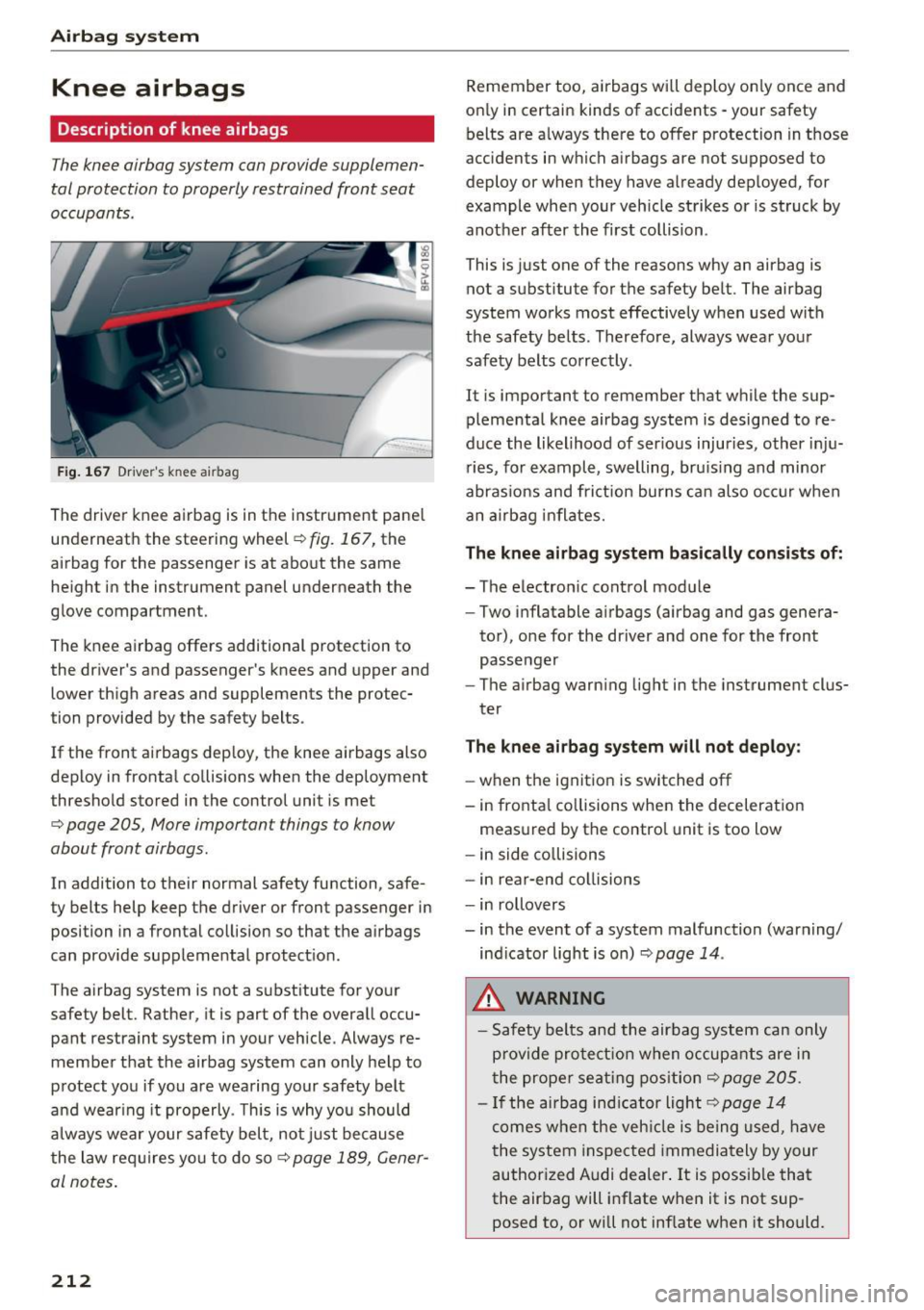
Fig. 167 Driver's knee airbag
The driver knee airbag is in the instrument panel
underneath the steering wheel¢
fig. 167, the
airbag for the passenger is at about the same
height in the instrument panel underneath the
glove compartment.
The knee airbag offers additional protection to
the driver's and passenger's knees and upper and
lower thigh areas and supplements the protec
tion provided by the safety belts.
If the front airbags deploy, the knee airbags also
deploy in frontal collisions when the deployment
threshold stored in the control unit is met
¢ page 205, More important things to know
about front airbags.
In addition to their normal safety function, safe
ty belts help keep the driver or front passenger in
position in a frontal collision so that the airbags
can prov ide supplemental protection.
The airbag system is not a substitute for your
safety belt. Rather, it is part of the overall occu
pant restraint system in your vehicle. Always re
member that the airbag system can only help to
protect you if you are wearing your safety belt
and wearing it properly . This is why you should
always wear your safety belt, not just because
the law requires you to do so ¢
page 189, Gener
al notes.
212
Remember too, airbags will deploy on ly once and
on ly in certain kinds of accidents -your safety
belts are always there to offer protection in those
accidents in which airbags are not supposed to
deploy or when they have already deployed, for
example when your vehicle strikes or is struck by
another after the first collision .
This is just one of the reasons why an airbag is
not a substitute for the safety belt . The airbag
system works most effectively when used with
the safety belts. Therefore, always wear your
safety belts correctly.
It is important to remember that while the sup
plemental knee airbag system is designed to re
duce the likelihood of serious injuries, other inju
ries, for example, swelling, bruising and minor
abras ions and friction burns can also occur when
an airbag inflates.
The knee airbag system basically consists of:
-The electronic control module
- Two inflatable airbags (airbag and gas genera-
tor), one for the driver and one for the front
passenger
- The airbag warning light in the instrument clus-
ter
The knee airbag system will not deploy:
-when the ignition is switched off
- in frontal collisions when the decelerat ion
measured by the control unit is too low
- in side collisions
- in rear-end co llisions
- in rollovers
- in the event of a system malfunction (warning/
ind icator light is on) ¢
page 14 .
&_ WARNING
-Safety belts and the airbag system can only
provide protection when occupants are in
the proper seating position ¢
page 205.
-If the airbag ind icator light¢ page 14
comes when the vehicle is being used, have
the system inspected immediately by your
authorized Audi dealer.
It is possible that
the airbag will inflate when it is not sup
posed to, or wi ll not inflate when it should.
Page 216 of 314
Airbag system
prevent proper deployment of the airbag.
Small objects can be thrown through the
vehicle if the airbag deploys and injure you
or your passenger .
- Make sure there are no cracks, deep scratch
es or other damage in the area of the instru
ment panel where the knee airbags are lo
cated.
- If children a re incorrect ly seated, their risk
of injury increases in a collision
c::> page 218, Child safety.
Side airbags
Description of side airbags
The airbag system can provide supplemental
protection to properly restrained occupants.
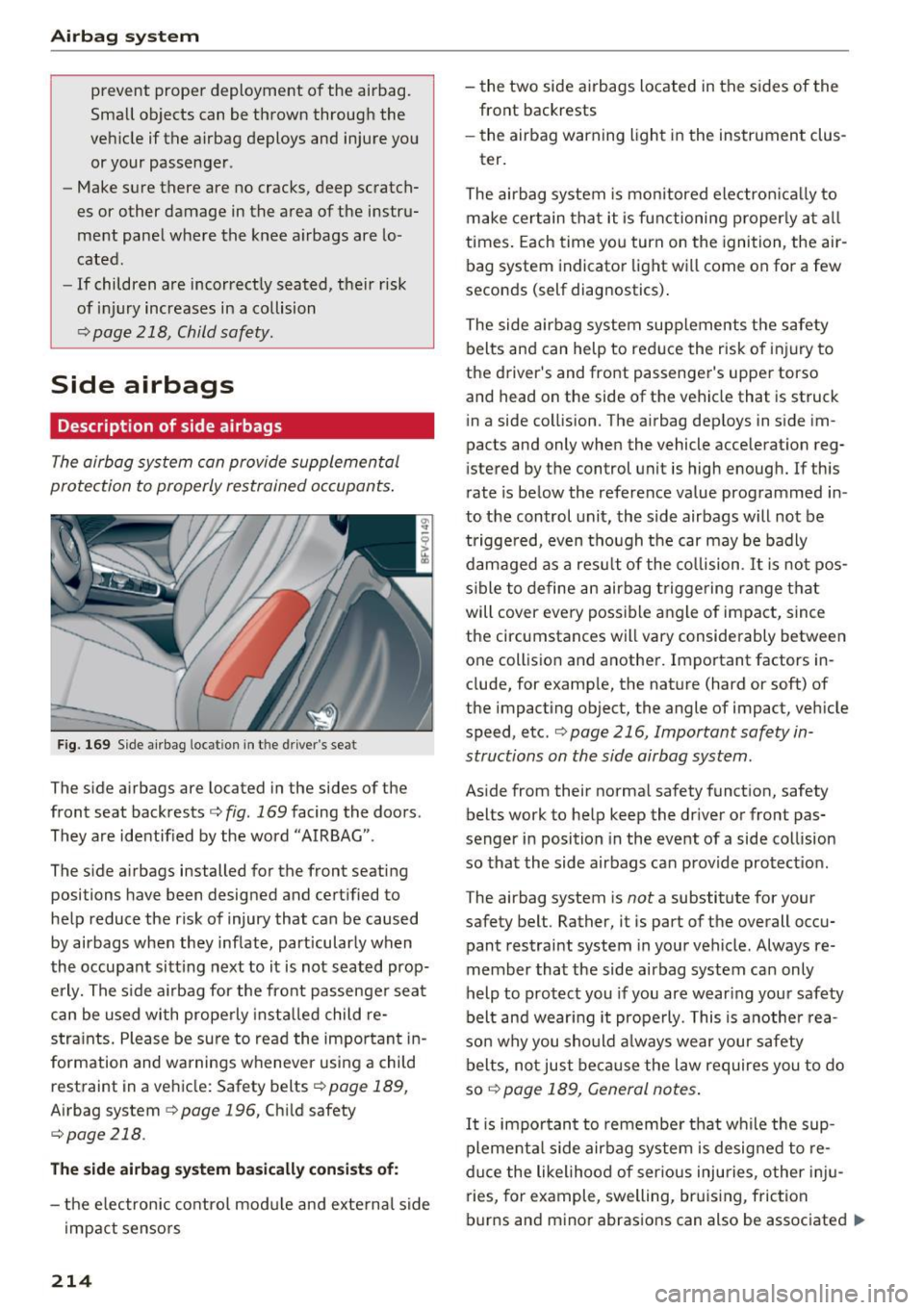
F ig. 169 Side airbag locat ion in t he drive r's seat
The side airbags are located in the sides of the
front seat backrests
c::> fig. 169 facing the doors .
They are identified by the word "AIRBAG".
The side airbags installed for the front seating
positions have been designed and certified to
help reduce the risk of injury that can be caused
by airbags when they inflate, particularly when
the occupant sitting next to it is not seated prop
erly. The side airbag for the front passenger seat
can be used with properly installed child re
straints. Please be sure to read the important in
formation and warnings whenever using a child
restraint in a vehicle: Safety belts
c::> page 189,
Airbag system c::>page 196, Child safety
c::> page 218 .
The side airbag system basically consists of:
- the electronic control modu le and external side
impact sensors
214
- the two side airbags located in the sides of the
front backrests
- the airbag warning light in the instrument clus-
ter.
The airbag system is mon itored electron ical ly to
make certain that it is functioni ng p roperly at all
times. Each time you turn on the ignition, the air
bag system indicator light will come on for a few
seconds (self diagnostics) .
The side airbag system supplements the safety
belts and can help to reduce the risk of injury to
the driver's and front passenger's upper torso
and head on the side of the vehicle that is struck
in a side collision. The airbag deploys in side im
pacts and only when the vehicle acceleration reg
istered by the control unit is high enough. If this
rate is below the reference value programmed in
to the control unit, the side airbags will not be
trigge red, even though the car may be badly
damaged as a result of the collision .
It is not pos
sible to define an airbag triggering range that
will cover every possible angle of impact, since
the circumstances will vary conside rably between
one collision and another. Important factors in
clude, for example, the nature (hard or soft) of
the impacting object, the angle of impact, vehicle
speed, etc.
c::> page 216, Important safety in
structions on the side airbag system .
Aside from their normal safety function, safety
belts work to help keep the driver or front pas
senger in position in the event of a side collision
so that the side airbags can provide protect ion.
The airbag system is
not a substitute for your
safety belt. Rather, it is part of the overall occu
pant restraint system in your vehicle . Always re
member that the side airbag system can only
help to protect you if you are wear ing your safety
belt and wear ing it properly. This is another rea
son why you sho uld always wear your safety
belts, not just because the law requires you to do
so
c::> page 189, General notes.
It is impo rtant to remember that while the sup
plemental side airbag system is desig ned to re
duce the likelihood of ser ious injuries, other inju
ries, for example, swelling, bruising , friction
burns and minor abrasions can also be associated ..,.
Page 217 of 314
CD
CD
.... N
" N ...... 0 r--. V, co
with deployed side airbags. Remember too, side
airbags will deploy on ly once and on ly in certain
kinds of acc idents -your safety be lts are always
there to offer protection .
Vehicle damage, repair costs or even the lack of
vehicle damage are not necessarily an indication
of over-sensitive or failed airbag activation. In
some collisions, both front and side airbags may
inflate. Remember too, that airbags will deploy
only once and only in certain kinds of coll isions -
your safety belts are always there to offer protec
tion in those acc idents in which airbags are not
supposed to deploy or when they have a lready
deployed.
The side airbag system will not deploy:
-when the ign ition is switched off
- in side collisions when the acceleration meas-
ured by the sensor is too low
- in front-end collisions
- in rear-end collisions
- in rollovers.
I n some types of accidents the front airbags and
side airbags may be triggered together.
_& WARNING
-Safety belts and the airbag system will only
provide protection when occupants are in
the proper seating position ¢
page 216.
-If the airbag indicator light q page 14
comes when the vehicle is being used, have
the system inspected immediate ly by your
authorized Audi dealer. It is possible that
the airbag will inflate when it is not sup
posed to, or will not inflate when it shou ld.
Airbag system
How supplemental side airbags work
Side airbags deploy instantly and can help re
duce the risk of upper torso injuries for occu
pants who are properly restrained.
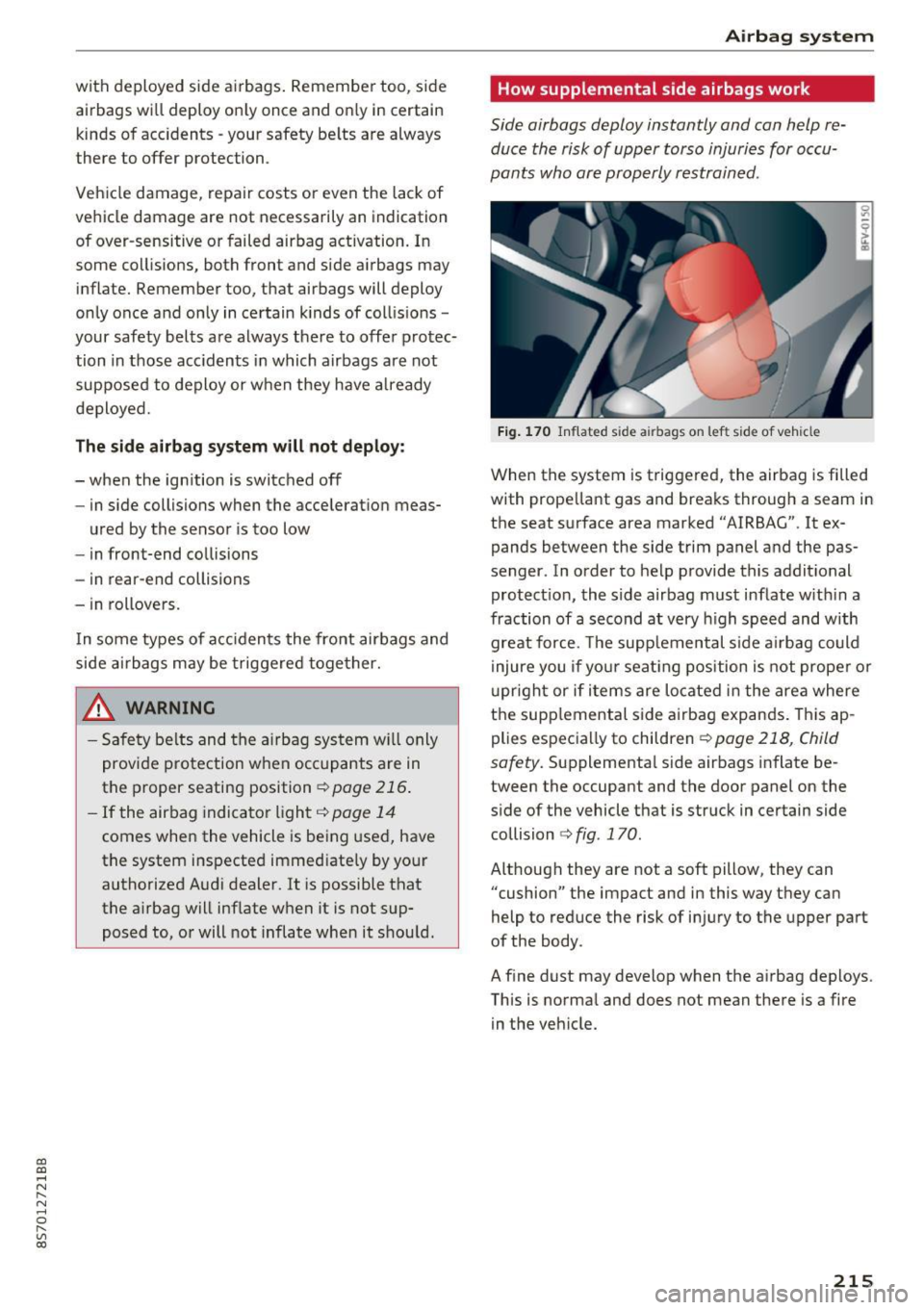
Fig. 170 Inflated side a irbags on lef t side of vehicle
When the system is triggered, the airbag is filled
with propellant gas and breaks through a seam in
the seat surface area marked "AIRBAG". It ex
pands between the side trim panel and the pas
senger . In order to help provide this addit ional
protect ion, the side airbag must inflate w ith in a
fraction of a second at very high speed and with
great force . Th e supp lemental s ide airbag could
injure you if you r seating position is not proper or
u pr ight or if items are located in the area where
the supp lemental side airbag expands. This ap
plies especially to children
c> page 218, Child
safety.
Supplemental side airbags inflate be
tween the occupant and the door panel on the
side of the vehicle that is struck in certain side collision
c> fig . 170.
Although they are not a soft pillow, they can
"cushion" the impact and in this way they can
help to reduce the risk of injury to the upper part
of the body .
A fine dust may develop when t he airbag deploys .
This is normal and does not mean there is a fire
in the veh icle.
215
Page 221 of 314
co
co
.... N
" N .... 0
" "' c:o
-Never install a rearward facing child safety
seat on the front passenger seat if the
PAS
SEN GER AIR BA G OFF ,;;
light does not
turn on and stay on. Have the system in
spected immediately by an authorized Audi
dealer or author ized Audi Service Facility .
A WARNING
-Forward-fac ing ch ild seats installed on the
front passenge r seat may inte rfere with the
deployment of the a irbag and cause serious
persona l injury to the child .
- If except ional circumstances require the use
of a forward-facing child restraint on the
front passenger's seat , the child's safety
and well-being require the following special
precautions to be taken:
- Always make sure that the forward -facing
seat has been designed and cert ified by its
manufacture r fo r use on a front passenger
seat with a front and s ide a irbag.
- Always carefully follow the manufacturer's
instructions provided with the child seat
or i nfant car rier.
- Never p ut the fo rward-facing child re
stra int up against o r very near the instru
men t panel.
- Always move the front passenger seat to
the highest posit ion in the up and down
ad justment range and move it back to the
rearmost position in the seat's fore and
aft adjustment range, as far away from
the airbag as possible, before installing
the forward-facing ch ild restraint.
- Always make sure that the safety be lt up
per anchorage is behind the child restra int
and not next to or in front of the child re
stra int so that the safety belt will be prop
erly positioned .
- Always make sure that nothing prevents
the front passenger's seat from be ing
moved to the rearmost posit ion in its fore
and aft adjustment range .
- Never place objects on the seat (such as a
laptop, CD p laye r, electronic games de
vice, powe r inverter or seat heater for
child seats). These may influence the elec-
Ch ild safety
trical capacitance measu red by the capaci
tive passenger detection system and can
also fly around in an accident and cause
serious personal injury.
- Never place or use any electrical device
(such as a laptop, CD player, electronic
games device, powe r inverter or seat heat
er for child seats) on the front passe nger
seat if the device is connected to the 12-
vo lt socket or the cigarette lighter soc ket.
- If a seat heate r has been retrofitted or
othe rw ise added to t he front passenger
seat, neve r insta ll any child res traint sys
tem on this seat.
- Make su re that there a re no wet objects
(s uch as a we t towe l) and no w ater or ot h
er liquids on the front passenger seat
cushion .
- Always m ake sure tha t the
PASSENGER
AIR BAG OFF,;;
light comes on and stays
on all the time whenever the ignition is
switched on .
- Never install a forward -facing chi ld safety
seat on the front passenger seat if the
PASSENGER AIR BAG OFF ~ ; light does
not turn on and stay on. Have the system
inspected immediately by an author ized
Audi dealer or authorized A udi Service Fa
c ility .
- Always buckle the child seat firmly in
place even if a child is not s itting in it . A
loose child seat can fly aro und during a
sudden stop or in a collision.
- Always read a nd heed all WARNINGS
whenever using a child rest raint in a vehi
cl e
9 page 189, Safety bel ts, 9 page 196,
Airbag system
and ~ page 218, Impor
tant information.
(j) Tips
A lways replace child restraints that were in
stalled in a vehicle du ring a c rash. Damage to
a child restrain t th at is not v is ible could cause
i t to fai l in another co llision situat ion .
219
Page 222 of 314
Child safety
Advanced front airbag system and children
Your vehicle is equipped with a front "Advanced
Airbag System" in compliance with United States Federal Motor Vehicle Safety Standard (FMVSS)
208 as applicable at the time your vehicle was
manufactured.
The Advanced Airbag system in your vehicle has
been certified to meet the "low-risk" require
ments for 3- and 6-year old children on the pas
senger side and small adults on the driver side.
The low risk deployment criteria are intended to
reduce the risk of injury through interaction with
the airbag that can occur, for example, by being
too close to the steering wheel and instrument panel when the airbag inflates. In addition, the
system has been certified to comply with the
"suppression" requirements of the Safety Stand
ard, to turn off the front airbag for infants up to
12 months who are restrained on the front pas
senger seat in child restraints that are listed in
the Standard .
Even though your vehicle is equipped with an Ad
vanced Airbag system, a child should always ride
in the seat properly restrained for its age and
size . The airbag on the passenger side makes the
front seat a potentially dangerous place for a
child to ride. The front seat is not the safest place
for a child in a forward-facing child safety seat. It
can be a very dangerous place for an infant or a larger child in a rearward-facing seat .
The vehicle's Advanced Airbag System has a ca pacitive passenger detection system in the front
passenger seat cushion that can detect the pres
ence of a baby or a child in a child restraint sys
tem on this seat.
The capacitive passenger detection system regis
ters the changes that result in an electrical field
when a ch ild, a child restraint, and a baby blanket
are on the front passenger seat. The change in
the measured capacitance due to the presence of
a child, a child restraint, and a baby blanket on
the front passenger seat is related to the child
restraint system resting on the seat. The meas
ured capacitance of a child restraint system var ies depending on the type of system and specific
make and model.
220
The electrical capacitance of the various types, makes, and models of child restraints specified
by the U.5 .National Highway Traffic Safety Ad
ministration (NHTSA) in the relevant safety
standard are stored in the Advanced Airbag Sys
tem control unit together with the capacitances
typical of infants and a 1-year old child . When a
child restraint is used on the front passenger
seat with a typical 1 year-old infant, the Ad
vanced Airbag System compares the capacitance
measured by the capacitive passenger detection
system with the data stored in the electronic con
trol unit.
Child restraints and Advanced front airbag
system
Regardless of the child restraint that you use,
make sure that it has been certified to meet Unit
ed States Federal Motor Vehicle Safety Standards
and has been certified by its manufacturer for
use with an airbag. If in exceptional circumstan
ces you must use it on the front passenger seat,
carefully read all of the information on child safe
ty and Advanced Airbags and heed all of the ap
plicable WARNINGS. Make certain that the child
and child restraint are correctly recognized by the
capacitive passenger detection system in the
front passenger seat, that the front passenger
airbag is turned off, and that the airbag status is
always correctly signaled by the
PASSENGER AIR
BAG OFF~;
light.
Many types and models of child restraints have
been available over the years, new models are in
troduced regularly incorporating new and im
proved designs and older models are taken out of
production. Child restraints are not standardized.
Child restraints of the same type typically have
different weights and sizes and different "foot
prints", the size and shape of the bottom of the
child restraint that sits on the seat, when they
are installed on a vehicle seat. These differences
make it virtually impossible to certify compliance
with the requirements for advanced airbags with each and every child restraint that has ever been
sold in the past or will be sold over the course of
the useful life of your vehicle. ..,.
Page 223 of 314
co
co
.... N
" N .... 0
" "' c:o
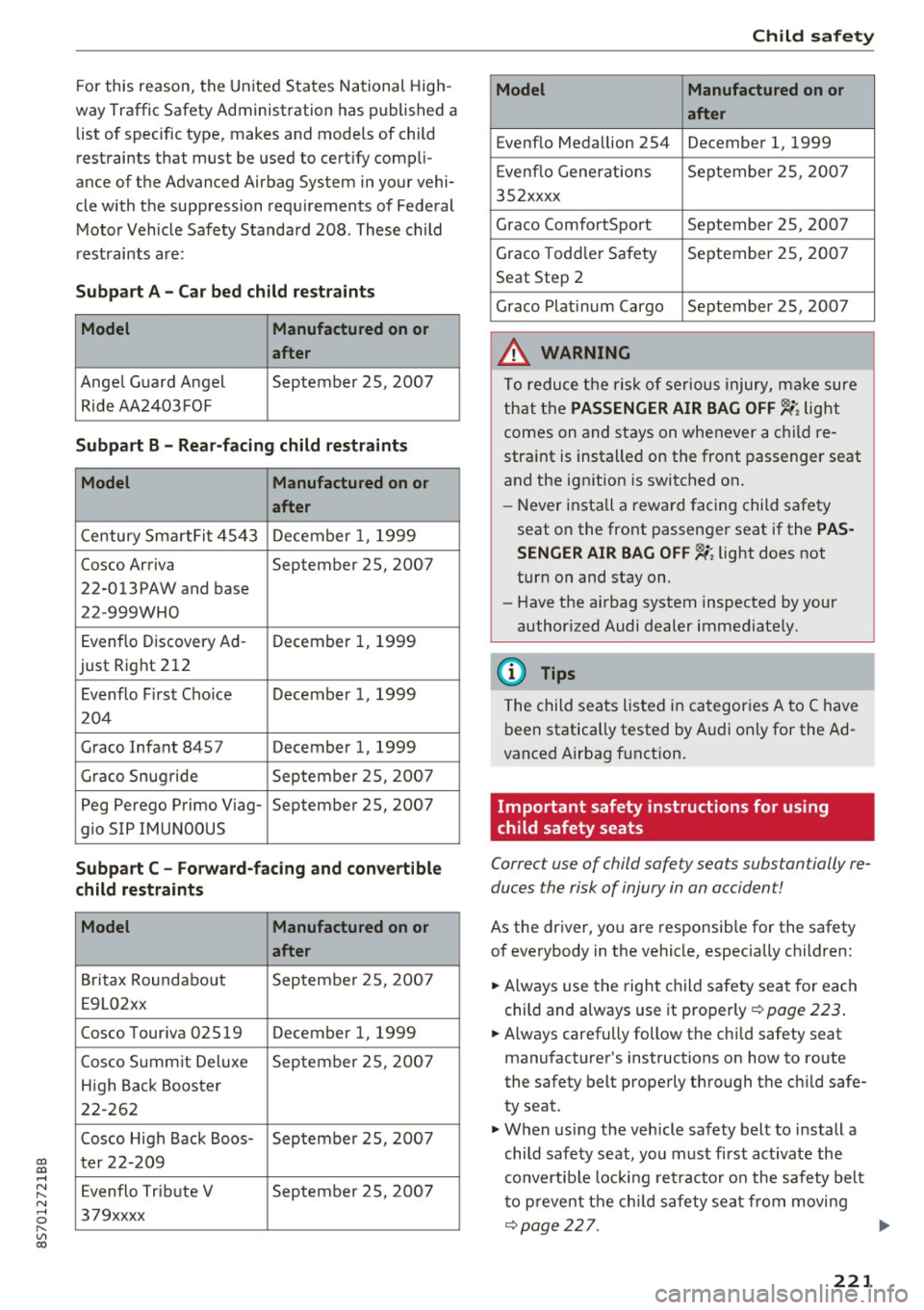
For this reason, the United States National High
way Traffic Safety Administration has published a
list of specific type, makes and models of child
restraints that must be used to certify compli
ance of the Advanced Airbag System in your vehi
cle with the suppression requirements of Federal Motor Vehicle Safety Standard 208. These child
restraints are:
Subpart A - Car bed child restraints
Model Manufactured on or
after
Angel Guard Angel September 25, 2007
Ride AA2403 FOF
Subpart B -Rear-facing child restraints
Model Manufactured on or
after
Century SmartFit 4543 December 1, 1999
Cosco Arriva September 25, 2007
22-013PAW and base
22-999WHO
Evenflo Discovery Ad- December 1, 1999
just Right 212
Evenflo Fir st Cho ice December 1, 1999
204
Graco Infant 8457 December 1, 1999
Graco Snug ride September 25, 2007
Peg Perego Primo Viag- September 25, 2007
gio SIP IMUNOOUS
Subpart C - Forward-facing and convertible
child restraints
Model Manufactured on or
after
Britax Roundabout September 25, 2007
E9L02xx
Cosco Touriva 02519 December 1, 1999
Cosco Summit Deluxe September 25, 2007
High Back Booster
22-262
Cosco High Back Boos- September 2S, 2007
ter 22-209
Evenflo Tribute V September 25, 2007
379xxxx
Child safety
Model Manufactured on or
after
Evenflo Medallion 2S4 December 1, 1999
E venflo Generations September 2S, 2007
352xxxx
Graco ComfortSport September 25, 2007
Graco Todd ler Safety September 25, 2007
Seat Step 2
Graco Plat inum Cargo September 25, 2007
_&. WARNING
To reduce the risk of serious injury, make sure
that the
PASSENGER AIR BAG OFF '1,;; light
comes on and stays on whenever a child re
straint is installed on the front passenger seat
and the ignition is switched on.
- Never install a reward facing child safety
seat on the front passenger seat if the
PAS
SENGER AIR BAG OFF
'1,;; light does not
turn on and stay on.
- Have the airbag system inspected by your
authorized Audi dealer immed iately.
(D Tips
The child seats listed in categories A to C have
been statically tested by Audi only for the Ad
vanced Airbag function.
Important safety instructions for using
child safety seats
Correct use of child safety seats substantially re
duces the risk of injury in an accident!
As the driver, you are responsible for the safety
of everybody in the vehicle, especially children:
.. Always use the right child safety seat for each
child and always use it properly ¢
page 223.
.. Always carefully follow the chi ld safety seat
manufacturer's instructions on how to route
the safety belt properly through the child safe
ty seat.
.. When using the veh icle safety belt to install a
child safety seat, you must first activate the
convertib le loc king retractor on the safety belt
to prevent the chi ld safety seat from moving
¢page 227. ..,.
221